Integrated, Sustainable and Low Emissions Transport in the Maldives
Part I: Project Information Name of Parent Program
Global Programme to Support Countries with the Shift to Electric Mobility.
GEF ID 10301 Project Type MSP
Type of Trust Fund GET
CBIT/NGI CBIT NGI Project Title
Integrated, Sustainable and Low Emissions Transport in the Maldives Countries
Maldives Agency(ies) UNEP
Other Executing Partner(s):
Department of Environment, Ministry of Environment Executing Partner Type
Government GEF Focal Area Climate Change
Taxonomy
Focal Areas, Climate Change, Climate Change Mitigation, Sustainable Urban Systems and Transport,
Influencing models, Demonstrate innovative approache, Strengthen institutional capacity and decision-making, Transform policy and regulatory environments, Convene multi-stakeholder alliances, Deploy innovative financial instruments, Stakeholders, Civil Society, Non-Governmental Organization, Academia, Community Based Organization, Communications, Awareness Raising, Behavior change, Public Campaigns, Education, Type of Engagement, Participation, Consultation, Information Dissemination, Private Sector, Capital providers, Individuals/Entrepreneurs, Financial intermediaries and market facilitators, Large corporations, SMEs, Gender Equality, Gender results areas, Access to benefits and services, Gender Mainstreaming, Beneficiaries, Women groups, Capacity, Knowledge and Research, Capacity Development, Innovation, Knowledge Generation
Rio Markers
Climate Change Mitigation Climate Change Mitigation 2 Climate Change Adaptation Climate Change Adaptation 0
Submission Date 4/27/2020
Expected Implementation Start 6/1/2021
Expected Completion Date 5/31/2024
Duration 48In Months Agency Fee($) 164,371.00
A. FOCAL/NON-FOCAL AREA ELEMENTS
Objectives/Programs Focal Area Outcomes Trust
Fund GEF
Amount($) Co-Fin Amount($)
CCM-1-2 Promote innovation and
technology transfer for sustainable energy breakthroughs for electric drive technology and electric mobility
GET 1,826,339.00 4,408,484.00
Total Project Cost($) 1,826,339.00 4,408,484.00
B. Project description summary
Project Objective
To mitigate greenhouse gas (GHG) emissions, promote energy security, and improve air quality through integrated, sustainable low-emissions transport systems in the Maldives
Project
Component Financin
g Type Expected
Outcomes Expected
Outputs Trus
t Fun d
GEF Project Financing(
$)
Confirmed Co- Financing(
$)
Project Component
Financin g Type
Expected Outcomes
Expected Outputs
Trus t Fun d
GEF Project Financing(
$)
Confirmed Co- Financing(
$)
Component 1:
Institutionalizati on of integrated sustainable low- carbon transport and development of regulatory framework and policies
Technical
Assistance Outcome 1:
Government establishes an
institutional framework and policies to promote and support integrated sustainable low- emission transport, including electric mobility
Output 1.1:
Integrated policy framework, including battery reuse and recycling and elderly, women, children and differently able (EWCD) features for sustainable and low emission transport developed and submitted to Ministries (Environment, Transport, Urban Development, and Planning
&
Infrastructure) for adoption Output 1.2:
Technical support provided to mandated Government authorities, Energy Department and NGOs for developing policy options including fiscal and non-fiscal policies, consideration of EWCD features, for sustainable urban low- emission transport planning Output 1.3:
Low emission Transport and e-Mobility Plan for Mal?
Region (Mal?
and Hulhumal?) inclusive of EWCD features developed and submitted for adoption by Ministry of Environment and Male City Council
GET 367,648.00 530,700.00
Project Component
Financin g Type
Expected Outcomes
Expected Outputs
Trus t Fun d
GEF Project Financing(
$)
Confirmed Co- Financing(
$)
Component 2:
Short-term barrier removal and scaling-up investments through low- emission sustainable transport demonstrations
Investmen
t Outcome 2:
Government and private sector use evidence from demonstratio n projects to plan new investments for scale-up of
sustainable low- emissions transport, including electric mobility
Output 2.1:
Technical support provided to Ministry of Environment and Private Sector (in consultation with other Ministries/
Energy Department) for
development of strategy to deploy electric vehicles (buses, bicycles, and 2-wheelers), including use of renewable based charging infrastructure, and financial mechanisms to support implementatio n (TA) Output 2.2:
Technical support provided to identified Government authorities and Energy Department for enabling investments in solar powered e-Boats (TA) Output 2.3:
Technical and financial support provided to Ministry of Transport, Maldives Transport &
Contracting Company and Male City Council for facilitating investments in integrated Electric Vehicles (EV) Transport system combining intra city e- Buses, shared (pedal assisted) e- Bikes, and associated charging infrastructure (INV)
GET 1,004,087.0 0
3,009,484.0 0
Project Component
Financin g Type
Expected Outcomes
Expected Outputs
Trus t Fun d
GEF Project Financing(
$)
Confirmed Co- Financing(
$)
Component 3:
Preparing for scale-up, monitoring, awareness creation and replication of integrated sustainable low- emission transport
Technical
Assistance Outcome 3:
Planners and users use new knowledge to develop and adopt integrated sustainable low emission transport solutions and options
Output 3.1:
Technical support provided to Ministry of Environment, Ministry of Transport and Maldives National University for preparing Measurement, Reporting, and
Verification (MRV) framework for sustainable low emissions transport designed and operational, including establishment of GHG emissions, air quality and emissions inventories Output 3.2:
Public awareness enhanced through awareness and advocacy campaigns on sustainable low-emissions transport supported by identified Government authorities and Civil Society Organizations (CSOs) Output 3.3:
Training provided to Government officials/
institutions, NGOs, Technicians, Health experts, etc.
on wider adoption of sustainable and low- emissions transport and consideration of gender mainstreamin g and EWCD considerations in the e- Mobility sector
GET 291,604.00 476,500.00
Project Component
Financin g Type
Expected Outcomes
Expected Outputs
Trus t Fun d
GEF Project Financing(
$)
Confirmed Co- Financing(
$)
Monitoring and
Evaluation GET 35,000.00
Sub Total ($) 1,698,339.0
0 4,016,684.0 0
Project Management Cost (PMC)
GET 128,000.00 391,800.00
Sub Total($) 128,000.00 391,800.00
Total Project Cost($) 1,826,339.00 4,408,484.00
C. Sources of Co-financing for the Project by name and by type Sources of
Co- financing
Name of Co-financier Type of Co- financing
Investment
Mobilized Amount($)
Recipient Country Government
Maldives Transport and
Contracting Company (MTCC) / Ministry of Transport and Civil Aviation (MoTCA)
Public
Investment Investment mobilized
2,350,284.00
Recipient Country Government
Energy Department, Ministry of
Environment In-kind Recurrent
expenditures 170,000.00
Recipient Country Government
Ministry of Environment In-kind Recurrent
expenditures
391,800.00
Recipient Country Government
Ministry of Environment In-kind Recurrent
expenditures
1,188,000.00
Recipient Country Government
Male? City Council In-kind Recurrent
expenditures 78,800.00
Private
Sector Housing Development
Corporation (HDC) In-kind Recurrent
expenditures 71,600.00 Civil
Society Organization
Bike Maldives In-kind Recurrent
expenditures 39,400.00
Others Maldives National University In-kind Recurrent
expenditures
82,600.00
Recipient Country Government
MTCC / MoTCA In-kind Recurrent
expenditures 36,000.00
Total Co-Financing($) 4,408,484.00 Describe how any "Investment Mobilized" was identified
The Ministry of Transport and Civil Aviation, via Maldives Transport and Contracting Company (MTCC), has confirmed a leveraged finance component. They were planning to kick-start a project for
implementation of public buses; however, the model was yet to be proven. This proposed project will
support use of e-buses in place of diesel buses and provide the necessary support to build up a business model that can further be scaled and replicated by MTCC, going forward.
D. Trust Fund Resources Requested by Agency(ies), Country(ies), Focal Area and the Programming of Funds Agenc
y Trust
Fund Country Focal
Area Programmin
g of Funds Amount($) Fee($)
UNEP GET Maldives Climat
e Change
CC STAR Allocation
1,826,339 164,371
Total Grant Resources($) 1,826,339.00 164,371.00
E. Non Grant Instrument
NON-GRANT INSTRUMENT at CEO Endorsement
Includes Non grant instruments? No Includes reflow to GEF? No
F. Project Preparation Grant (PPG) PPG Required
PPG Amount ($) 32,000
PPG Agency Fee ($) 2,880
Agenc
y Trust
Fund Country Focal
Area Programmin
g of Funds Amount($) Fee($)
UNEP GET Maldives Climat
e Change
CC STAR Allocation
32,000 2,880
Total Project Costs($) 32,000.00 2,880.00
Core Indicators
Indicator 6 Greenhouse Gas Emissions Mitigated Total Target Benefit
(At PIF)
(At CEO Endorsement)
(Achieved at MTR)
(Achieved at TE) Expected metric tons of
CO?e (direct) 0 970 0 0
Expected metric tons of CO?e (indirect)
0 891848 0 0
Indicator 6.1 Carbon Sequestered or Emissions Avoided in the AFOLU (Agriculture, Forestry and Other Land Use) sector
Total Target Benefit (At
PIF) (At CEO
Endorsement) (Achieved
at MTR) (Achieved at TE) Expected metric tons of
CO?e (direct)
Expected metric tons of CO?e (indirect)
Anticipated start year of accounting
Duration of accounting
Indicator 6.2 Emissions Avoided Outside AFOLU (Agriculture, Forestry and Other Land Use) Sector Total Target Benefit (At
PIF) (At CEO
Endorsement) (Achieved
at MTR) (Achieved at TE) Expected metric tons of
CO?e (direct) 970
Expected metric tons of
CO?e (indirect) 891,848
Anticipated start year of accounting
2023 Duration of accounting 12
Indicator 6.3 Energy Saved (Use this sub-indicator in addition to the sub-indicator 6.2 if applicable)
Total Target Benefit
Energy (MJ) (At
PIF) Energy (MJ) (At CEO Endorsement)
Energy (MJ) (Achieved at MTR)
Energy (MJ) (Achieved at TE) Target
Energy Saved (MJ)
41085100000.000000000 0
Indicator 6.4 Increase in Installed Renewable Energy Capacity per Technology (Use this sub-indicator in addition to the sub-indicator 6.2 if applicable)
Technolog y
Capacity (MW)
(Expected at PIF)
Capacity (MW) (Expected at CEO Endorsement)
Capacity (MW)
(Achieved at MTR)
Capacity (MW) (Achieved at TE)
Indicator 11 Number of direct beneficiaries disaggregated by gender as co-benefit of GEF investment Number
(Expected at
PIF) Number (Expected at CEO Endorsement)
Number (Achieved at MTR)
Number (Achieved at TE)
Female 833
Male 3,217
Total 0 4050 0 0
Part II. Project Justification
1a. Project Description
1a. Changes in project design
The Objective and Component of the project remain the same as outlined in the Child Project concept submitted with the Programme Framework Document (PFD). The component titles are now more aligned with the component titles for the PFD but there is no substantive change to the deliverables of the components. There is one small re-alignment with the MRV framework establishment. This is included in Component 3, which was earlier included as part of Component 2. An additional change was to include e-boats as part of the project coverage, which was not envisaged in the Child Project concept. The inclusion of e-boats was based on the suggestions by the stakeholders due to the key role boats play in transportation in Maldives. The modification/ changes in the wording below are attributed based on the inputs and suggestions from the various stakeholder consultations in Maldives. The language on the outcomes has also been modified to more accurately reflect the state that is being attempted as a result of project intervention.
Child Project elements affected Changes Component 1: Policy framework for integrated,
sustainable and low-emissions transport in Maldives
The Component has been reworded as:
Institutionalization of integrated sustainable low- carbon transport and development of regulatory framework and policies
Component 2: Demonstrating low emissions technologies for transport and establishing the measurement, reporting, verification (MRV) framework for transport
The component title has been reworded as:
Short-term barrier removal and scaling-up investments through low-emission sustainable transport demonstrations
Component 3: Knowledge management and public awareness campaign, and outreach for sustainable and low emissions transport
The component title has been reworded as:
Preparing for scale-up, monitoring, awareness creation and replication of integrated sustainable low-emission transport
Outcome 1: Adequate regulatory and institutional framework and policies adopted for integrated transport and urban planning and low-emissions transport modes
Outcome 1 is reworded as: Government establishes an institutional framework and policies to promote and support integrated sustainable low-emission transport, including electric mobility
Outcome 2: The benefits and feasibility of low- emissions transport system for Maldives, including electric vehicles demonstrated and policies adopted nationwide
Outcome 2 reworded as: Government and private sector use evidence from demonstration projects plan new investments for scale-up of sustainable low-emissions transport, including electric mobility
Outcome 3: Increased public awareness on the benefits and affordability of low emissions transport options
Outcome 3 reworded as: 3. Planners and users use new knowledge to develop and adopt integrated sustainable low emission transport solutions and options
1b. Project Description
1) Global environmental and/or adaptation problems, root causes and barriers that need to be addressed
The Maldives, officially the Republic of the Maldives, is an island nation in the Indian Ocean-Arabian Sea region. The country is made up of 26 atolls between the Chagos Archipelago and Minicoy Island, 250 miles southwest of India. The Maldives consists of over 1,192 islands, spanning approximately 900 kilometers along the Indian Ocean. Only 187 of these islands are inhabited.
The Maldives is the smallest Asian country, both by land area and population. Its estimated population in 2019 is 530,953 and the total land area of just 298 square kilometers. The Maldives Islands have a high population density of 1,781 people per square kilometer, making it the 11th most densely populated country on earth. The largest city in the Maldives is Male, also its capital city, with an estimated population of 63,000. This is followed by Addu City (32,000) and Fuvahmulah (12,000).
These are the only cities with a population surpassing 10,000 and only 19 other islands have populations exceeding 2,000 people.
The Gross Domestic Product (GDP) of Maldives is 4.7 billion US Dollars (USD) (2018), which is 11,890 USD per capita and growing at 6.1%. The GDP share in Maldives from major contributing sectors is as follows: Tourism (24.5%), Construction (6.7%), Transportation (5.4%) and Fisheries (4.31%). Its economy is expected to grow by 4.9% in 2018, driven primarily by the construction and tourism sectors. Maldives GDP per capita is USD 11.89 thousand, which ranks 155th in the world.
Maldives being an island nation with limited availability of natural resources, it depends on imports of fossil fuel to meet its energy demands. Due to the dispersed nature of the islands, Maldives does not have one single national grid. Each Island has its own electricity generation and distribution facility resulting in costly electricity. The cost of production of one unit of electricity is 20-22 cents as per current fuel prices in Male. In terms of energy mix, 97% of the energy demand was met by generation from fossil fuel and remaining 3% from renewable energy (mainly solar). Total installed capacity is 368 MW, of which the solar generation capacity stands at 11 MW. According to the statistics from Maldives customs, the nation imported 521 Metric Tonne of diesel in 2018, spending 5.38 billion Maldivian Rufiyaa (MVR), almost 7.4 % of its GDP. Shifting the dependency from fossil fuel, the current administration?s mandate is to produce a minimum of 70% of daytime peak load (around 80 megawatts (MW)) of electricity in all inhabited islands from renewable energy sources by 2030. This target has been revised from its initial value of 30% of daytime peak.
The low elevation of the Maldivian islands makes the nation highly vulnerable to rising sea levels. Its Nationally Determined Contribution (NDC) under the Paris Agreement acknowledges the challenges it faces given its high population density, dispersed geography, and limited resources. Given the country?s vulnerability, its NDC focuses on crucial actions to strengthen the country?s resilience to climate impacts and prioritizes mitigation in energy, transport, and waste.
Global environmental problem:
A global transition to low- and zero- emission mobility is essential to meet international climate commitments, including the Paris Climate Agreement. The transport sector is currently responsible for approximately one quarter of energy-related carbon dioxide emissions, this is expected to grow to one- third by 2050. In addition, the transport sector is a leading contributor to short-lived climate pollution, especially black carbon.
The global vehicle fleet is set to double by 2050, and almost all this growth will take place in low- and middle-income countries. By 2050 two out of three cars will be found in developing countries. This means that achieving global climate targets will require a shift to zero emissions mobility in all countries, including low- and middle-income ones.
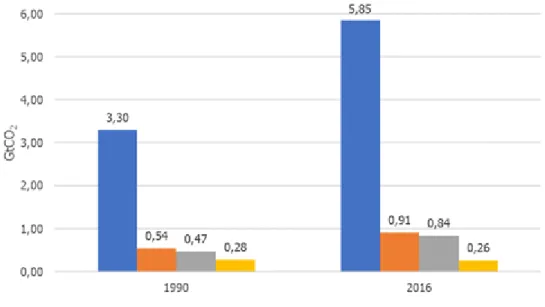
The Transport sector globally is one of the biggest growing contributors to the energy demand growth, in addition to power sector, industries (steel, cement, aluminium, etc.), forestry and others. Over the past decade, the global transport sector?s GHG emissions have increased at a faster rate than any other energy using sector. The sector produced ~8.0 GtCO2e of total emissions in 2016 (71% higher than 1990) and was responsible for approximately 25% of total energy-related CO2 emissions.
Figure 1. Global CO2 emissions by Transport sub-sector
Road transport accounts for about two-third of the transport emissions. The share of road transport emissions increased by two percentage points to 74%, while other modes of transport remained unchanged. Reducing these emissions is an important part of the climate change mitigation programs.
Without implementing sustainable mitigation policies, transport emissions could increase at a faster rate than emissions from the other energy end-use sectors and reach around 12 GtCO2e by 2050.
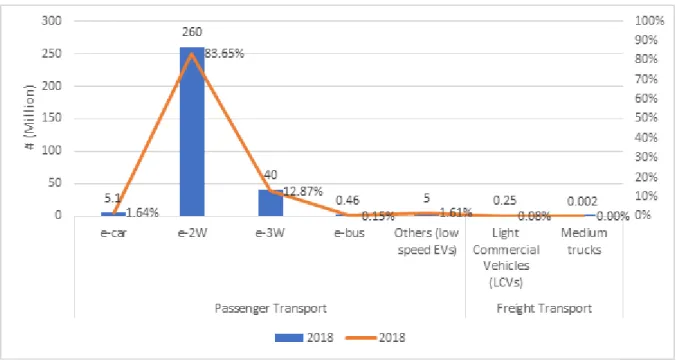
Figure 2. Global EV sales across vehicle segments
Electric Vehicles (pure electric, plug-in-hybrid) have emerged as good alternative to ICEs and there is rising deployment in last years. In 2018, there were nearly 310 million EVs (including 2Ws, 3Ws, cars, buses and trucks), of which electric - two wheelers (e-2W) formed ~84%, electric - three wheelers (e-3W) 13% and e-cars 1.6%. Various regions and countries like United States, European Union (EU), China, India, Canada, Japan, and others have built targeted EV Mission/Programs and driving increased EV adoption through policy, supply fiscal incentives, demand subsidies, standardisation, Govt. procurement, encouraging private investments and many other interventions.
IEA?s ?New Policies Scenario? estimates global EV sales to reach 23 million by 2030 (excluding 2W and 3W), emitting roughly 230 MtCO2e, but would be almost double, i.e. 450 MtCO2e if the equivalent vehicle fleet were powered by Measurement, Reporting, and Verification (ICE) powertrains. In comparison, the ?EV30@30 Scenario?, launched at the Eighth Clean Energy Ministerial (CEM) in 2017, estimates EV sales to reach to 43 million by 2030 (excluding 2W and 3W) emitting around 230 MtCO2e, while an equivalent ICE vehicle fleet would emit about 770 MtCO2e.
Transport demand per capita in developing and emerging economies is far lower than in Organization for Economic Co-operation and Development (OECD) countries but is expected to increase at a much faster rate in the next decades due to rising incomes and development of infrastructure.
National Scenario
Maldives does not have a significant manufacturing industry, and most things are imported, including 100% of automobiles. Its total import outside fossil fuel stand at 0.039 billion dollars, which is around 1% of its GDP. Following the growth in population and urbanization, there has been a rapid increase in the number of vehicles imported into Maldives, both for land and marine transport. The total registered vehicles have increased more than 295% from 22,303 in 2007 to 65,932 in 2014. The majority (83%) of vehicles registered in the Maldives are motorcycles, followed by cars (6%).
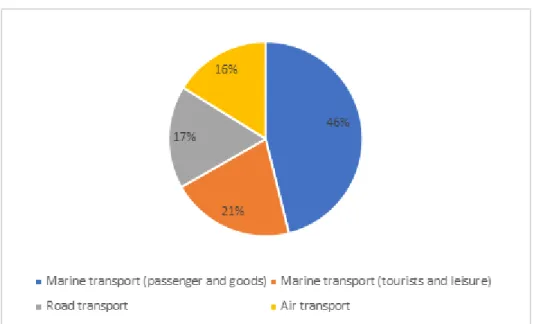
Furthermore, the total number of vessels registered has increased from 7,016 in 2005 to 11,913 in 2014 by approximately 70%. Energy consumption for sea transport in the atolls for passengers and goods has risen from 9 kilotons of oil equivalent in 2002 to nearly 50 kilotons of oil equivalent in 2009 and is one of the fastest growing emissions sectors in Maldives. Marine transport is estimated to contribute 67% of total transport related greenhouse gas emissions in Maldives and is the largest source of GHG emissions among the subcategories of the transport sector. Road transport emissions occur in congested urban areas, and are dispersed over a smaller area, but they contribute to around
~17% of total GHG emission from transport sector (See Figure 5 below).
In the Maldives, the analysis has shown that the major sources of greenhouse gases are also major sources of air pollutants. Electricity generation is the major source of CO2 emissions as well as a major source of SO2 and NOx. Waste is the major source of methane emissions and is also a major source of many other air pollutants. Like air pollution, emissions of GHGs are also projected to grow substantially in the future due to increase in population, and demand for energy. Finally, substantial growth in marine and road transport emissions is expected, if mitigation measures are not applied.
Though the country has recognized the transport sector as a focus for addressing congestion, air pollution, and GHG emissions, due to root causes and barriers described below, private vehicles continue to grow in absence of well-developed public transport system and investments in alternative transport services.
Policy and Regulations: The policies and regulations[1]1 for transport sector are primarily targeted to generate revenue from the import of vehicles, which are mainly personnel vehicles. One or two islands have a regulation on type of private vehicles that can be used otherwise there is no management of quality and technology of vehicles being imported. In recognition of air pollution issue, emission standards were developed recently in 2019 (as part of National Action Plan on Air Pollutants) but have not been effectively implemented. To give a few examples, there is no policy or regulation on efficiency of vehicles, age of vehicle, limiting number of vehicles being imported, etc. The import duty on electric vehicles has been eliminated, however, which does not seem enough to influence the type and age of vehicle or incentives to choose more environmentally friendly options. For example, the transport strategies aim to increase the share of biofuel vehicles but there is no policy framework to facilitate a shift to use of biofuels. Further there is no policy on the specification of biofuels, quality criteria, etc. This is further compounded by lack of Master Transport plan[2]2 for the country let alone an integrated urban development and transport plan. There are no guidelines and policy framework to develop integrated transport plan that would enable considering environmental aspects into developing the transport systems.
Institutional coordination: Transport planning needs to take into account a number of interrelated issues such as urban development plan approach, environmental issues to be addressed in designing the transport systems, energy availability, forex reserves which in case of Maldives is very important as it imports all its fuel, budgetary resources available to provide incentives or investments, etc. This requires a good coordination among institutions with responsibility for these issues and a coordination mechanism. Such a coordination or coordination mechanisms is practically absent and most of policies and regulations are prepared independently among the mandated government institutions. Normally an urban integrated transport planning process allows some level of coordination but absence of such a planning mechanism in Maldives aggravates the matter. To compound it the Male region was managed by Central Government Ministries, it is only recently that Decentralization Act of Maldives established a local governance structure. These systems are still in development stage and hence this adds to the coordination challenge.
Institutional Capacity: Weak institutional coordination is compounded by weak capacities in the Institutions. The policy makers don?t have adequate capacities for developing integrated transport plans, knowledge of policies and regulations to address the sustainable challenges that government would like to address, tools and approaches for financing transport projects, etc.
Information and awareness: The lack of information at the level of policy makers and end users is another challenge in shift towards sustainable low-emission transport system. The Policy makers lack access to information on latest tools and approaches for planning and designing policies and regulations, comparative analysis of various fuels/technologies, etc. There is also lack of information
on and tools to analyse the impacts of transport development on air pollution, fuel demand and its implication for forex, GHG emissions, etc. Similarly, citizens and end-users lack information on impacts of their transport choices, transport options and benefits of different transport options, etc.
There are very limited demonstration projects for sustainable transport. Lessons are often not well communicated and there is lack of a consensus on best practices. Due to the highly dispersed nature of the islands, outreach can be a barrier especially at the local island community level.
Industrial sector perspective/supply chain/local manufacturing: The Maldives is disadvantaged by the small size of the domestic market as well being as an archipelago, as such it is dependent on imports and landed value of material is very high. Local manufacturing and local supply chain creation is not viable thus benefit of this in reducing the cost of low emission transport options is non- existent. Further it limits competition and thus market forces have a limited influence on available options. This limits the import of high efficiency vehicles or alternative fuel vehicles or electric vehicles. Further, there is no e-charging infrastructure in the country. The lack of policies and incentives for low emission transport option to limits the investments in these options.
Financing / investment: The government is challenged in allocating budgetary resources towards creating public transport infrastructure or e-charging infrastructure. The lack of policies and incentives also inhibit the investments by private sector. Further, in absence of clear policy on non-motorized transport (NMTs) there is no incentive for investments in creating shared bike systems. The government lacks experience and awareness of business models for developing public-private partnership (PPP) projects to leverage budgetary resources for channelling private sector investments.
There is lack of access to financing options for individual consumers to enable purchase of e-bikes or for private investors to invest in e-vehicle infrastructure. Fiscal policies and public financing mechanisms have no provision for prioritizing low emission options or in reflecting lifecycle costs.
This is further exacerbated by inadequate financial incentives such as grants, tax incentives and concessional financing schemes.
In order to achieve the Nationally Determined Contributions (NDCs) the nation requires regulatory and policy level interventions with the following in place:
1) Comprehensive policies covering urban development and transport planning, 2) Transport master plan for the entire Greater Male? region,
3) Policy to ensure that vehicles imported to the country are cleaner or having zero emissions (fully electric),
4) Policies to limit the age of vehicles entering Male?,
5) Policies to limit the maximum number of vehicles in and around Male? region,
6) Fiscal policies and public financing mechanisms with provision for prioritizing low emission options or in reflecting lifecycle costs,
7) Financial incentives such as grants, tax incentives and concessional financing schemes.
These suggested policy measures can play a vital role in Maldives? achievement of its Climate change policy goals, the NDCs and the commitment to reduce GHG emissions by 24% by 2030.
2) Baseline scenario and any associated baseline projects
Maldives BAU Transport and Energy Landscape
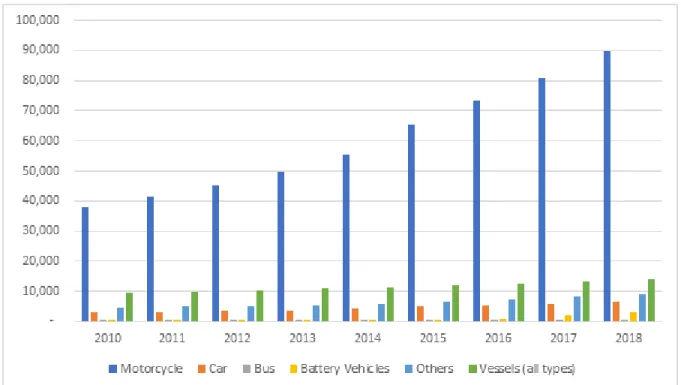
With the growing trend of urbanization and population growth, there is a significant increase in the number of vehicles observed within the country. The total registered vehicles on road in the Maldives have increased more than 235% from 46,028 in 2010 to 1,08,532 at the end of 2018. Majority of the vehicles registered are motorcycle (83%), followed by car (6%) and pick-up (3%). Battery scooter and tricycle form 2% of total vehicles (1% each), while battery car (golf cart/buggies) and bicycle represent 0.25% and 0.14% respectively. There are hardly any bus public transport services in the island, with only few areas like Greater Male Region and Addu Atoll having limited Bus services. There are some limited private taxi services available, and it?s a growing sector.
The total registered vessels (marine/sea) had increased ~200% from 7,016 in 2007 to 14,003 in 2018.
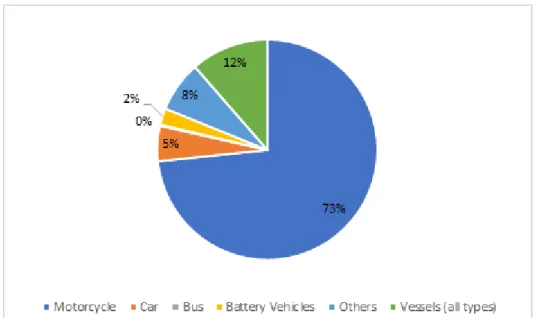
Majority of the vessels registered are Dhoani (52%), Launch (26%), Bokkuraa (12%), Boat (4%) and others . Combining both (i.e. vehicles and vessels), the transport mix is shown below.
Figure 3. Transport mix (including vessels), 2018
Motorcycle, car and bus have grown at a Compounded Annual Growth Rate (CAGR) of 11%, 10%
and 14% respectively from 2010 to 2018. Battery vehicles have grown at CAGR of 35% during the same period, and it also saw a significant increase in last 2 years.
Electricity access is almost 100% provided by a semi-public organization, State Electric Company Limited (STELCO), FENAKA (consolidating six utilities across the country), and via Island Development Committees on the smaller inhabited islands, with resort islands operating their own utility systems. Fenaka operates 148 powerhouses in inhabited islands and STELCO operates remaining 35 powerhouses. Total installed power generation capacity is 368 MW, with 214 MW in inhabited islands, 143 MW is resort islands and 11 MW of renewable.
According to the Maldives GHG inventory, the total emission from Maldives in 2011 was 1.2 MtCO2e, which is about 0.003% of global emissions. Electricity generation (63.5%) and transport (21.5%) are the two predominant fossil fuel emitting sectors, followed by fisheries, Liquefied petroleum gas (LPG) use, others. Energy consumption for marine/sea transport in the atolls has immensely risen and is one of the fastest growing emissions sectors in Maldives.
Figure 4. Year-wise Vehicle Growth
Figure 5. GHG emissions by transport sub-categories
Within transport, marine is the largest source of GHG emissions at ~67% (combination of passengers and goods & tourists and leisure), followed by road (17%) and air transport (16%). In BAU scenario, it is estimated that GHG emission will rise to 3.3 MtCO2e by the year 2030.
Greater Male Region Transport and Energy Landscape
Mal?, the main island, has an area of roughly 6.8 square kilometers with a population of 215,879 (2018). It is one of the islands with the highest population density in the world. It is completely built up with commercial and residential buildings that are on average 8-10 stories. There are no public bus transport services within the island, but there are private taxi/cab services available. The main mode of transport is by gasoline 2-whelers, which accounts for about 80% of all trips in the island. The main roads are narrow with two lanes bi-directional traffic while narrower feeder roads are usually one way.
Cars, 2-wheelers and other vehicles are parked on the curb contributing to more congestion. There are bicycles and electric bicycles as well in the vehicle mix.
The reclaimed land, Hulhumal?, has been developed adjacent to the Airport (Hulhul? island). Its first phase of development is completed and now has an estimated population of 30,000. Phase 2 development is under construction and is expected to open by late 2020. Phase 1 and Phase 2 development is estimated to accommodate 260,000 people according the plans of the Housing Development Corporation (HDC), who is responsible for the development of both phases. There are currently buses that serve Hulhul? island and connects to Hulhumal? that serves passengers going to various resorts and hotels from the airport. The new 2.1 kms Sinamal? bridge inaugurated in 2018 connects Mal?, Hulhul? and Huhumal? and has led to road commute by vehicle types between the three islands. There is new intercity bus system using the bridge operated by Maldives Ports Limited (MPL) between Male and Hulhumale. This travels within the Hulhumale city, but not within Male, because of the road congestion within Male. The bridge interconnectivity has further increased floating population in Male adding to road congestion. There are plans to connect another 3 islands Villimale, Thilafushi
and Gaulhiflhu with Male through roads in next 4 years. There is no plan for an integrated transport system or road public transport system under discussion. It is expected that the interconnectivity among these islands will lead to shift in mode from ferry to personal transport resulting in increase in traffic flow along with increased fossil fuel consumption, GHG emissions and air pollution.
STELCO is the power generating and distributing utility for Greater Male region. Currently there are different grids in three islands, and there is project implementation happening to connect Male and Hulhumale grids by mid of 2020. Male city has generation capacity of some 80MW with peak load of 66MW during March to May time period. The load growth in capital city has been 8-10%. Hulhumale had 1.74MW generation and recently had 50MW commissioned, with another planned 50MW augmentation in next 2-3 years. Vilimale has generator capacity of 4MW with peak of 2MW. The typical Distribution Transformers ratings are 630/ 1000/ 1500 kVA, and all distribution cabling is underground.
Male city has some 700+kW of solar roof tops installed under Japan International Cooperation Agency (JICA) project, feeding into the grid. STELCO had to earlier pay for this purchase of solar, and now it?s free. There is 1.5MW solar installed under Accelerating Sustainable Private Investment in Renewable Energy (ASPIRE) project by World bank at Hulhumale and its operational. Bid for construction of another 5MW is in progress. The Asian Development Bank (ADB) project for Waste- to-Energy is expected to add 8MW into the grid additionally by 2020. By 2024, it is envisaged that Greater Male region will have one grid.
The Government has set a target of 70% peak power through Renewable energy by 2030. A number of projects and funds are supporting the increase in renewable energy (RE) as source of electricity. Thus, it is expected that RE based electricity will increase in share in the medium to long term.
Energy Department within the Ministry of Environment and Energy is responsible for making sector related policies, planning and seek resources to develop the sector. The Maldives Energy Authority is a regulatory authority within the Ministry of Environment and Energy and has the mandate to regulate the energy sector through the implementation of relevant regulations.
Maldives Transport Authority an independent regulatory organization affiliated to the Ministry of Transport and civil Aviation operating under the guidance of a governing board. The MTA is mandated for Connecting the country via land, sea and air and establish a safe, reliable and sustainable transport network domestically and internationally. To ensure the safety of land, sea and air transportation of the Maldives and that the transport connectivity is affordable, sustainable and supports the socioeconomic development of the country in order to enhance the living standard of the people of the Maldives.
There is no established department per say that is dedicated to exclusively Air pollution but the Environment Department (Environment Protection Agency), The Climate Change Department under the Ministry of Environment in tandem with the Ministry of Health combinedly regulate the Air Quality management and Air pollution related policies and standards.
INSTITUTIONAL ARRANGEMENTS AND COORDINATION MECHANISMS RELATED TO ENERGY, TRANSPORT AND AIR POLLUTION,
Maldives Transport and Energy related Policy and Action Plans
In 2009, Maldives had set a broader policy of becoming Carbon Neutral (CN) by 2020, joining a few other nations like Norway, Costa Rica, etc. Various policy documents, strategies, action plans, investment plans like The Strategic Action Plan (SAP) 2009-2013; Maldives National Strategy for Sustainable Development (NSSD); Maldives National Energy Policy and Strategy; and Maldives Scaling Up Renewable Energy Programme (SREP) Investment Plan, 2013-17?, etc. made reference of Carbon Neutrality, however these policies provides very little or no strategy covering the entire economy and all GHG emissions sources and sinks. Quantitative targets for emissions caps by sources or sectors were also not incorporated in these policies except for the energy and the transport sectors.
While strong policy framework for environmental protection exists, legal framework needs to be strengthened with respect to air pollution.
The earlier government (from 2013-2018) diluted the approach to CN (also reflected in the Dec 2015 Intended Nationally Determined Contributions (INDC) Report), which led to the country not meeting the set goals. The new government is progressive and climate conscious and is taking steps to strengthen overall policy ecosystem and integrating climate, energy, transport and urban development.
Some important climate and sustainable development policies and strategy reports are listed below:
Timeline
Regulation/
Policy/
Strategy Key points related to low carbon emissions in Transportation and EVs
2009
Maldives National Strategy for Sustainable Development (NSSD)
Published by the Maldives government in conjunction with UNEP, the NSSD identifies several goals relating to climate change due to transport sector as below:
? Establish a carbon neutral transport system
o Reduce CO2 emissions from light vehicles ? the average car fleet should achieve CO2 emissions of 140g/km by 2015
o By 2015 not less than 10% of transport fuel should consist of biofuels, as an indicative target, considering raising their proportion to 20% by 2020
2011 Climate Change Legislation
? The government eliminated import duty on electric cars and motorcycles, while retaining a 200% tariff on petrol and diesel-powered vehicles
? The government also reduced the import duty from 25% to nil on solar and wind-powered ships and equipment, including sails
2014
Low Carbon Strategy for the Transport Sector
This GHG mitigation strategies emphasizes on:
? Introduction of Smaller and Smarter Vehicles Technologies (such as light-duty hybrids)
? Promotion of Hybrid Vehicles
? Promoting Electro-mobility (BEVs and FCVs) specifically in Male
? Development of Hybrid Vessels
? Promote the Use of Low Carbon Alternative Fuels
? Investment in Low Carbon Fuel Research
2014
Maldives Low Carbon Development Strategy
As part of its GHG mitigation options, the strategy advocated following activities by 2020:
? Promotion of hybrid vehicles
? Promotion of electric vehicles including electrical bicycles, and RE based charging stations
2015
The Maldives Climate Change Policy Framework
This strategic paper focuses on listing strategic goals and creating a framework for adaptation and mitigation policies to be implemented between 2015 and 2025. The following policy goals / strategies has been identified:
? Strengthen a low emission development future for Maldives o Ensure that transport systems meet society?s economic, social and environmental needs while minimizing their impacts on the economy, society and environment
o Achieve a balance shift towards environment friendly transport modes in order to bring about a sustainable transport and mobility system
2015
Renewable Energy Roadmap
This roadmap recommends
? the use of renewable energy for electric vehicle charging for short driving distances
? import of biofuels for land and sea transport
2016 Maldives Energy Policy
& Strategy
It consists of revised policies derived from Maldives Energy Policy and Strategy 2010, which are:
? strengthen the institutional and regulatory framework of the energy sector
? promote energy conservation and efficiency
? increase the share of renewable energy in the national energy mix
? improve the reliability and sustainability of electricity service and maintain universal access to electricity
? increase national energy security
2019
National Action Plan on Air Pollutants
The Maldives Ministry of Environment has developed, compiled and quantified for the first time, the reductions in air pollutants for measures originally developed with the aim of reducing greenhouse gases in the country with focused sectors ? power generation, transport and waste.
The National Action Plan on Air Pollutants (2019) outlines key interventions to curb emissions and air pollutants from transport and energy sector, whose implementation could reduce transport sector emissions by 21.53% and power sector emissions by 33% by 2030[3]3.
Strategies Description Implementation
Target period Requirement of financial resources (US
$)
Maldives' Nationally Determined Contribution (NDC)
Maldives' long term climate goals, also known as the Nationally Determined Contributions (NDC) intends to unconditionally reduce 10% of its greenhouse gases for the year 2030 compared to a business as usual scenario; and that this 10%
reduction could be increased up to 24% in a conditional manner, in the context of sustainable development, supported and enabled by availability of financial resources, technology transfer and capacity building.
Total 22 mitigation measures / options are identified across renewable energy, waste-to- energy, energy efficiency and transport.
2021 ? 2030 715,000,000
Revise and set vehicle emissions standards for land transport
Responsible Agencies[4]4: MEE, MTA, EPA
? Collect primary & secondary data
? Build national vehicle emissions inventory, test emissions using PEMs
? Revise vehicle emission standards
? Propose enforcing mechanism and provide training to enforcers
2020 ? 2030 95,000
Set fuel quality standards for Energy &
Transport
Responsible Agencies:
MEE, MEA
? Stakeholder meetings
? Detailed survey and/or analysis of imported fuel quality
? Develop fuel quality standards
? Develop roadmap
2020 ? 2030 1,00,000
Better maintenance of motorbikes / motorcycles (Transport / Conditional NDC measure)
Responsible Agencies:
MTA
? Explore best maintenance practices for motorbikes
? Conduct an awareness campaign to promote benefits of improved maintenance of motorbikes
? Establish maintenance service providers that are easily available in all parts of the country
2017 ? 2027 Information Not Available
Bioethanol blend (15%) in all gasoline
Responsible Agencies:
MEE, STO
? Explore financial scheme to finance bioethanol blend
? Promote bioethanol fuel to use in transport instead of gasoline
? Introduce mechanism for import and distribute bioethanol fuel
2020 ? 2025 Information not available
Biodiesel blend (20%) in diesel
Responsible Agencies:
MEE, STO
? Explore financial scheme to finance biodiesel blend
? Promote biodiesel fuel to use in transport instead of diesel
? Introduce mechanism for import and distribute biodiesel fuel
2020 ? 2025 Information not available
PVs with net metering
Responsible Agencies:
MEE, Utilities
? Conduct an awareness campaign target to households on the financial and
environmental benefits of installing solar photovoltaics (PV) in homes
? Explore and introduce financing mechanisms in households for installation of solar PV
2020 ? 2025 13,800,000
PVs on resorts
Responsible Agencies:
MEE, MoTCA, resorts
? Review related government policies
? Promote use solar PV through government policies and financial schemes
? Explore and introduce financing mechanisms for installation of solar PV
? Design and implement solar PV systems
2020 ? 2030 167,000,000
Large solar water heaters
Responsible Agencies:
MoTCA
? Conduct a detailed study on current water heaters used in hotels and resorts
? Create awareness on benefits of using solar water heaters
? Promote use of solar water heaters through government policies and financial schemes
? Develop and implement a plan to phase out or reduce conventional heaters with discussion among hotel and resort owners
2017 ? 2025 670,000
20MW wind power and 25MW LNG
? Explore financial scheme to finance (Liquefied natural gas) LNG and wind system
? Design and implement LNG and wind power system
2020 ? 2025 97,000,000
Upgrades of system efficiencies in diesel power houses
? Conduct a detailed study of power houses on the efficiency of the power houses
? Conduct an awareness campaign targeted to utilities on efficient operation of power houses
? Explore and introduce financing mechanisms for utilities for projects to improve efficiency in the power system
2017 ? 2021 61,000,000
Renewable energy roadmap for the Republic of Maldives
? The government indicated a target to install renewable electricity generation that meets up to 30% of daytime peak load in all inhabited islands within the next four years (by 2019)
2015 ? 2019 Information not available
The government has realized the challenge of air pollution and GHG emissions from transport sector as demonstrated by above mentioned actions plans and strategies. The government though has been slow
in implementing these strategies due to a combination of factors as mentioned in root causes and barriers. On the renewable energy front there has been some progress largely due to bilateral and multilateral supported projects, though the pace has been very slow. On the transport sector the focus is still on improving efficiency of Internal Combustion Technology (ICT) vehicles and biofuels. Public transport is not mentioned as part of the strategy and there is little focus on Non-motorized transport (NMT) options. The e-vehicle does find mention but is not yet the focus of the government.
Though a number of policies and strategies have been developed or being developed, most of the outcomes have mostly been in terms of report and its implementation has been very limited. The only main outcome of these is introduction of duty exemption for electric vehicles, reduction in import duties for RE equipment. Presently there is not system in place to collect, investigate and monitor quantitative data on the interlinkage between urban emissions, climate change, health and economic costs to the society. As a results stakeholder lack the necessary tools and knowledge to make low investment initiatives.
This is further compounded by absence of a coordination mechanism among various ministries on issues related to sustainable transport. Energy department is responsible for setting the energy related strategies and policies that govern the imports of fuels for use in economy and on electricity generation. The Maldives Transport Authority is responsible is responsible for transportation policies within the islands and connecting the islands. Ministry of
Environment has the responsibility to address the air pollution issues, which include air pollution from transport sector. Though the energy, transport and air pollution policies and action impact each other there is no formal mechanism of a co-development of policies to ensure synergy and consistency among them. Currently each of the ministry and departments does share its policies and strategies for feedback to other ministries and departments for comments, which is the process of all key issues in the government. Further the issues that are approved by Cabinet get considered by multiple ministries and departments. Thus an absence of more coordinated and co-development of sustainable transport among the 3 key actors hinders a more coherent energy, air pollution and transport policies and strategies. This limitation impedes the ability to steer
investments in sustainable and environment friendly urban development activities, which perpetuates the current status of urban areas being a significant contributor of emissions in Maldives.
Maldives associated Baseline Projects
The following table summarizes the various initiatives that constitute baseline activities for this project:
Project Name Description Implementation
Period
Available or Approved Budget, US$
Project Name Description Implementation Period
Available or Approved Budget, US$
Climate and Clean Air Coalition to Reduce Short- Lived Climate Pollutants (CCAC)
Implementing Partner-MEE
Supporting National Planning for Action on Short-Lived Climate Pollutants in the Maldives Baseline Activities:
? Awareness and outreach on the impacts and mitigation strategies
? Regional and local actions by identifying barriers, enhancing capacity and technical assistance
? Promote and finance best practices and measures in agriculture, industries, solid waste management, household cooking and domestic heating, transport, etc.
? Part of the Urban Health Initiative of the CCAC
2015 - ongoing 87,400
Low Emission Climate Resilient Development
Implementing Partner: MEE
Funding Agency:
Government of Denmark
The programme assists the Laamu Atoll and its islands to address low carbon and climate resilient development. It seeks to mainstream low carbon issues into local level development planning and service delivery for greater community level ownership and sustainability of programme benefits. The programme works in tandem with the local councils, civil society, private sector and stakeholders to establish improved coordination and enhanced participation in local planning; strengthen data and knowledge systems and improve learning by doing.
Baseline Activities:
? Formulate and promote partnership, coordination and participation platform for local low emission climate resilience planning and action
? Establish data and knowledge system to support evidence-based planning and policy development at the local levels
? Improved local level planning and management
2013 - ongoing 9,200,000
Project Name Description Implementation Period
Available or Approved Budget, US$
Urban Ambient Air Quality Monitoring
Implementing Partner ? Maldives National
University
MEE has the existing mandate of developing policies and strategies related to pollution control including air pollution and GHG reductions. It has an ongoing programme on improving the air quality to safeguard human health and establish fully equipped Ambient Air Quality Monitoring Station in densely populated islands. It is planning to monitor emissions from point and mobile sources and establish standards for such pollution sources.
Baseline Activities:
? Improved understanding of the climate and health affecting urban population
? Install 2 monitoring stations in Mal?
and Thilafushi
? Data collection and continuous monitoring of physical and chemical properties of aerosols and meteorological parameters
? Provision of research outputs for air pollution management in the Maldives
? Conducting training programmes to Improve technical capacity
? Dissemination of research outputs to academia, policy makers and the
community
2014 - ongoing 50,000
Project Name Description Implementation Period
Available or Approved Budget, US$
Landuse Zoning in the Greater Mal?
Region
Implementing Partner - HDC
The project comprises of land-use planning and zoning. Mal? is an unplanned city therefore enforcing zoning is a challenge. However, Hulhumal? as an up and coming satellite urban centre of Mal? there is strict zoning of industrial work and residential areas that contribute to better air quality in residential areas. Villingili is the older suburb of Mal? where use of motor vehicles is controlled and limited to only a few.
Majority of public transport is on electric buggies, personal bicycles or other electric vehicles.
Baseline Activities:
? Formulation of Masterplan for Hulumale
? Formulation of Zoning plan Green parks and buffer zones development plan
2016 - ongoing Information not available
Project Name Description Implementation Period
Available or Approved Budget, US$
Preparing Outer Islands for Sustainable Energy Development (POISED)[5]5
Implementing Partner ? FENEKA, MEE, MEA
Funding Agencies:
ADB, Climate Investment Funds, European
Investment Bank
POISED will consist of the following projects:
? Project 1: Small Power Station RE o 10 mall power stations will be converted to full RE
(approximately 2MW) using an optimum mix of wind and solar PV
? Project 2: Power System Rehabilitation
o About 15 power systems that are least efficient will be replaced and made ready for RE
installations
? Project 3: Implementation Support and Institutional Development
o Support will be provided to FENAKA to design and
implement these projects, to train FENAKA staff in operating and maintaining these systems, to monitor performance and to support planning for greater RE scale up on these islands
On-going 40,150,000
Project Name Description Implementation Period
Available or Approved Budget, US$
Accelerating Sustainable Private Investments in Renewable Energy (ASPIRE)
Implementing Partner ? MEE, FENAKA, MEA
Funding Agency:
Climate
Investment Funds (CIF)
The ASPIRE Programme consists of the following projects:
? Project 1: Renewable Energy Investments under a Feed-in Tariff
o Greater Male? Region Solar PV investments ? 15MW of solar PV to be fed in the grid systems (11MW for Male and 4MW for Hulhumale)
o Outer island solar & wind investments ? combined RE investments in solar PV and wind installation of about 3MW on medium to large electricity consuming island (>1GWh/year)
? Project 2: Utilization of Waste-to- Energy (WTE) Technologies in Outer Islands
o WTE investments in islands (S.Hithadhoo, HDh.
Kulhudhufushi and R. Vandhoo) to displace diesel used for electricity and water production
? Project 3: Implementation Support and Institutional Development
o Technical requirements for successful deployment as well as developing standards for interconnection and performance monitoring
On-going 72,010,000
Project Name Description Implementation Period
Available or Approved Budget, US$
Thilafushi Waste- to-Energy (WTE)
Funding Agencies: ADB and other financial institutions
The project comprises of implementation of the WTE facility to be part of a solid waste management system for the greater Male?
region and the neighbouring resort islands. The overall system to include waste collection and transportation to Thilafushi, waste processing and disposal on Thilafushi (segregation, recycling, composting, gasification and inert waste disposal in the landfill); and an up to 4 MW WTE power generation facility to replace the existing diesel-based power generators on the island
On-going 20,000,000
Grid
Interconnection between Male and Hulhumale
Funding Agency:
Government of Maldives
The project is another step forward in implementing environment friendly energy production, as it would increase the efficiency of diesel power generation.
2016-ongoing 369,000
Thilafushi- Gulhefallu- Villingili-Male bridge project
The project aims to meet the growing electricity demand on Male and other islands and to open up the possibility of supplying a number of islands from concentrated sources of renewable generation (i.e. solar, wind) that could be located on suitable uninhabited islands
Proposed Stage Information not
available
As is demonstrated from above projects, the major focus of the projects is on shift to renewable energy in the country. The efforts to increase renewable energy has been somewhat successful as witnessed from the increased renewable energy capacity from 2MW to 11MW over a period of last 6 years. This also lays the ground and justification for shift to e-mobility, rather than biofuels, given it address both air pollution and GHG emissions. The baseline projects on transport are part of larger strategy development and there are no specific projects or actions being taken (as seen on the ground also) to support a shift towards sustainable low emission transport in the country. Hence, there is no concrete evidence of any gains on sustainable transport. Most of the policies identified for implementation are not yet in place and in case of a few implemented, enforcement is lacking. As can be noticed, none of the strategies have yet started to focus on the biggest emitter, water based public transport system.
In the baseline it is expected that the country will increase its renewable energy plants by increasing the share of power supply through big solar based power plants. There is also a likelihood of wind power
being introduced. The government has set a target of 30% of peak power to be met by RE by 2030 and it is likely it may achieve this target.
In the transport sector the progress is expected to be slow and focused more on addressing air pollution through better emission standards and maintenance of vehicles. There are some efforts on introducing land based public transport but there are no concerted efforts, specially to have a more comprehensive public transport plan for the four islands which will be connected by Bridges. There are some efforts to introduce biofuels but given the issue of energy security and with no shift to import vehicles that can use biofuels, the likely shift to biofuels may not be significant. With practically no focus on e-mobility and NMT, in the baseline increasing share of transport demand will be met through private ICT vehicles and public taxi services. There is also a danger, especially in absence of any policy and regulations to prevent bad quality ICTs, with increasing e-vehicles being introduced in other countries, second hand used cars might end up in Maldives due to heavy price discount.
Gender Assessment[6]6:
The 2012 gender gap index puts Maldives in 95th place out of the 135 countries ranked, ahead of India at 105 but behind Sri Lanka at 39. The Maldives has particularly strong performance on female educational attainment, one of the four factors on which the index is based, but lags in the other three areas of economic participation and opportunities, health, and political empowerment[7]7.
Following Islamic tradition, men are considered the heads of households and principal decision makers.
Cultural norms link men with activities outside the home that would enable them to earn and support their families, such as fishing, construction, engineering, and mechanical jobs, as well as dealing with tourists and outsiders, among others. On the other hand, reproductive tasks such as childcare and household chores are seen as women?s responsibilities. Time-consuming reproductive responsibilities can inhibit women?s involvement in productive (paid) work, unless such activities are extensions of their reproductive roles, such as small-scale preparation and cooking of ?short eats?, which they sell to their immediate communities.
The notion of ?appropriate gender roles? and the gender division of labor gives rise to gender issues in the following areas:
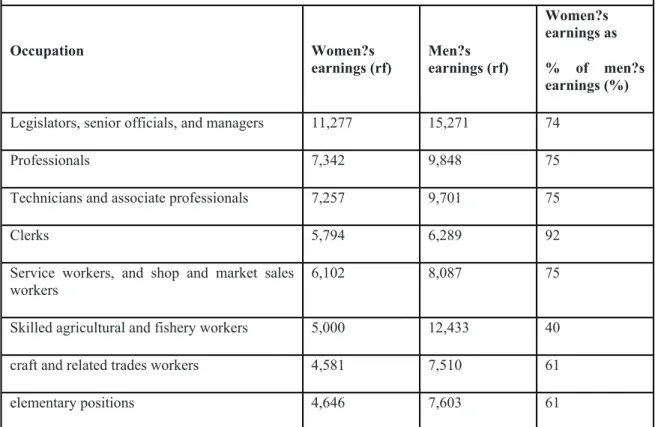
1) Employment: While women's participation rate in the Maldivian human resource work force across sectors has gone up in the past few years, it is still considerably lower than that of men. In case of labor force, ratio of employability is 59% women compared with 79% men. There are only 4 women out of 87 members of Parliament elected in 2018, and only 3 (17.6%) women ministers out of 17
ministers (See table 1) . There were only 14 women compared with 84 men among legislators, senior officials, and managers[8]8. The reasons for this could be attributed to the below factors:
? Gender disparity in labor force participation rate and unemployment rate
? Gender differences, including gender income gaps, in employment by industry (See table 2)
? Gender gaps in government employment
? Gender gap in participation in public office
Table 1: mean monthly earnings of Women and men, by Occupation, Mal?, 2010
Occupation Women?s
earnings (rf) Men?s earnings (rf)
Women?s earnings as
% of men?s earnings (%) Legislators, senior officials, and managers 11,277 15,271 74
Professionals 7,342 9,848 75
Technicians and associate professionals 7,257 9,701 75
Clerks 5,794 6,289 92
Service workers, and shop and market sales
workers 6,102 8,087 75
Skilled agricultural and fishery workers 5,000 12,433 40
craft and related trades workers 4,581 7,510 61
elementary positions 4,646 7,603 61
Source: Department of National Planning (Statistics Division). 2012. Household Income and Expenditure Survey 2009?2010. Mal?. p. 53.
Table 2: share of employment and mean monthly income of Women and men, by industry, 2010