Reducing barriers to promote electric mobility in the Republic of Belarus through the introduction of ultra-fast charging stations
Part I: Project Information GEF ID
10421 Project Type MSP
Type of Trust Fund GET
CBIT/NGI CBIT No NGI No Project Title
Reducing barriers to promote electric mobility in the Republic of Belarus through the introduction of ultra-fast charging stations
Countries Belarus Agency(ies) UNDP
Other Executing Partner(s)
Ministry of Natural Resources and Environmental Protection Executing Partner Type
Government GEF Focal Area Climate Change Taxonomy
Focal Areas, Climate Change, Climate Change Mitigation, Technology Transfer, Sustainable Urban Systems and Transport, Influencing models, Demonstrate innovative approache, Stakeholders, Type of Engagement, Partnership, Participation, Information Dissemination, Consultation, Communications, Awareness Raising, Public Campaigns, Beneficiaries, Gender Equality, Gender Mainstreaming, Sex-disaggregated indicators, Gender-sensitive indicators, Women groups, Gender results areas, Access to benefits and services, Capacity Development, Knowledge Generation and Exchange, Capacity, Knowledge and Research, Learning, Knowledge Generation, Knowledge Exchange, Innovation
Rio Markers
Climate Change Mitigation Climate Change Mitigation 2 Climate Change Adaptation Climate Change Adaptation 0
Submission Date 8/17/2021
Expected Implementation Start 1/1/2022
Expected Completion Date 12/31/2026
Duration 48In Months Agency Fee($) 123,305.00
A. FOCAL/NON-FOCAL AREA ELEMENTS Objectives/Programs Focal Area
Outcomes Trust
Fund GEF
Amount($) Co-Fin Amount($)
CCM-1-2 Promote electric drive
technologies and electric mobility
GET 1,297,945.00 13,296,000.00
Total Project Cost($) 1,297,945.00 13,296,000.00
B. Project description summary
Project Objective
To remove barriers in e-vehicle market in Belarus to help make e-vehicles more accessible to the population by changes to legislation, regulations, and policy, leading to 152,090 tonnes CO2e of direct greenhouse gas emission reductions, and 3.766 million tonnes CO2e (top-down) and 0.304 million tonnes CO2e (bottom-up) consequential greenhouse gas emission reductions.
Project Component
Financin g Type
Expected Outcomes
Expected Outputs
Trust Fund
GEF Project Financing($)
Confirmed Co- Financing($)
Project Component
Financin g Type
Expected Outcomes
Expected Outputs
Trust Fund
GEF Project Financing($)
Confirmed Co- Financing($)
1. Policies and
regulations to promote increased purchase and improved management of electric vehicles
Technical Assistance
Improved policies and regulations to promote increased purchase and
management of electric vehicles
1.1:
Developed and adopted national policy on sustainable transport which include measures for the
promotion of the mobility and future management of operation and
maintenance of the mobility technology
1.2: Gap analysis of all current relevant legislation to identify gaps that could be introduced to promote electric mobility 1.3:
Regulations brought into force on minimum purchase quotas for e- vehicles for state fleets
1.4:
Municipal regulations for
incentivizing e-vehicle use including the use of bus lanes and free parking
1.5:
Feasibility study on rebate scheme for promoting purchase of electric vehicles
GET 204,900.00 56,000.00
Project Component
Financin g Type
Expected Outcomes
Expected Outputs
Trust Fund
GEF Project Financing($)
Confirmed Co- Financing($)
2. Investment into super fast charging stations
Technical Assistance
Investment into super- fast charging stations is realized
2.1:
Feasibility studies for at least 3 Super-Fast Charging Stations (This output will be executed in close collaboration with
Belorusneft)
2.3:
Consensus amongst senior government officials on moving forward with a super fast charging station program (This output will be executed in close collaboration with
Belorusneft)
GET 46,700.00 135,000.00
Project Component
Financin g Type
Expected Outcomes
Expected Outputs
Trust Fund
GEF Project Financing($)
Confirmed Co- Financing($)
2. Investment into super fast charging stations
Investment Investment into super- fast charging stations is realized
2.2:
Installation of at least 3 - two or more berth Super- Fast Charging Station(s) (300+kW) to compliment the charging infrastructur e network of Belarus (Additional 25 charging stations to be installed by Belorusneft as a cofinancing) (This output will be executed in close collaboration with
Belorusneft)
GET 740,000.00 11,380,000.00
Project Component
Financin g Type
Expected Outcomes
Expected Outputs
Trust Fund
GEF Project Financing($)
Confirmed Co- Financing($)
3. Promotion of e-vehicles
Technical Assistance
Promotion of eVehicles to help consumers make educated decisions on e-vehicle purchases
3.1:
Nationwide PR
Campaign on eVehicles deployed involving car dealers
3.2: Project website that includes an interactive app created with charging infrastructur e locations and calculations of charging cost (one time, monthly and annually)
3.3:
Monitoring, reporting and verification of GHG emission reductions from the project activities
3.4: National Workshop on Electric Vehicles
3.5: Video highlighting results from the demo projects
3.6: Lessons learned study
GET 146,930.00 630,000.00
Project Component
Financin g Type
Expected Outcomes
Expected Outputs
Trust Fund
GEF Project Financing($)
Confirmed Co- Financing($)
Monitoring and Evaluation
Technical Assistance
Monitoring and Evaluation
Monitoring and Evaluation
GET 56,480.00 45,000.00
Sub Total ($) 1,195,010.00 12,246,000.00
Project Management Cost (PMC)
GET 102,935.00 1,050,000.00
Sub Total($) 102,935.00 1,050,000.00
Total Project Cost($) 1,297,945.00 13,296,000.00
C. Sources of Co-financing for the Project by name and by type Sources of
Co-financing Name of Co-financier Type of Co- financing
Investment
Mobilized Amount($)
GEF Agency UNDP In-kind Recurrent
expenditures
56,000.00
Recipient Country Government
Ministry of Natural Resources and
Environmental Protection
In-kind Recurrent
expenditures 200,000.00
Other UNDP EU4Climate Grant Investment
mobilized 620,000.00
Recipient Country Government
Belorusneft In-kind Recurrent
expenditures 120,000.00
Recipient Country Government
Belorusneft Grant Investment
mobilized
12,300,000.00
Total Co-Financing($) 13,296,000.00 Describe how any "Investment Mobilized" was identified
* Co-financing from RUE Production Association Belorusneft (Belorusneft in short), who are the national operator in charge of building and operating a chain of electric vehicle charging stations in the country, will be in the form of grant. The Belorusneft is the national organization that is responsible from building new charging stations in Belarus taking into account EV projections in the country. The Belorusneft will be investing in 25 superfast charging stations based on the knowledge and experience gathered with the 3 pilot demonstrations made by the Project. * Co-financing from UNDP?s EU4 Climate Project will be paralel financing as two projects will be implemented at the same time. EU4Climate Project supports the development and implementation of climate-related policies by the EU Eastern Partnership countries, including Belarus, to strengthen the capacity for domestic implementation of the Paris Agreement. The EU4Climate assistance will be in the collection of app information that would contain GHG emission reduction information from EVs on road transport that would fall within NDC implementation plans, roadmaps and timeframes for MoNREP; and to collect data on the total number of kilowatt hours being used for driving EVs, which will be useful in determining the GHG impact of an increased number of EVs in Belarus.
D. Trust Fund Resources Requested by Agency(ies), Country(ies), Focal Area and the Programming of Funds Agenc
y Trust
Fund Country Focal
Area Programmin
g of Funds Amount($) Fee($)
UNDP GET Belarus Climat
e Change
CC STAR Allocation
1,297,945 123,305
Total Grant Resources($) 1,297,945.00 123,305.00
E. Non Grant Instrument
NON-GRANT INSTRUMENT at CEO Endorsement
Includes Non grant instruments? No Includes reflow to GEF? No
F. Project Preparation Grant (PPG) PPG Required true
PPG Amount ($) 50,000
PPG Agency Fee ($) 4,750
Agenc
y Trust
Fund Country Focal
Area Programmin
g of Funds Amount($) Fee($)
UNDP GET Belarus Climat
e Change
CC STAR
Allocation 50,000 4,750
Total Project Costs($) 50,000.00 4,750.00
Core Indicators
Indicator 6 Greenhouse Gas Emissions Mitigated Total Target Benefit
(At PIF)
(At CEO Endorsement)
(Achieved at MTR)
(Achieved at TE) Expected metric tons of
CO?e (direct) 28000 152090 0 0
Expected metric tons of CO?e (indirect)
11500 0
304000 0 0
Indicator 6.1 Carbon Sequestered or Emissions Avoided in the AFOLU (Agriculture, Forestry and Other Land Use) sector
Total Target Benefit (At
PIF) (At CEO
Endorsement) (Achieved
at MTR) (Achieved at TE) Expected metric tons of
CO?e (direct)
Expected metric tons of CO?e (indirect)
Anticipated start year of accounting
Duration of accounting
Indicator 6.2 Emissions Avoided Outside AFOLU (Agriculture, Forestry and Other Land Use) Sector Total Target Benefit (At
PIF) (At CEO
Endorsement) (Achieved
at MTR) (Achieved at TE) Expected metric tons of
CO?e (direct) 28,000 152,090
Expected metric tons of
CO?e (indirect) 115,000 304,000 Anticipated start year of
accounting
2022 2023
Duration of accounting 10 4
Indicator 6.3 Energy Saved (Use this sub-indicator in addition to the sub-indicator 6.2 if applicable)
Total Target Benefit
Energy (MJ) (At PIF)
Energy (MJ) (At CEO
Endorsement)
Energy (MJ) (Achieved at MTR)
Energy (MJ) (Achieved at TE)
Target Energy Saved (MJ)
Indicator 6.4 Increase in Installed Renewable Energy Capacity per Technology (Use this sub-indicator in addition to the sub-indicator 6.2 if applicable)
Technolog y
Capacity (MW)
(Expected at PIF)
Capacity (MW) (Expected at CEO Endorsement)
Capacity (MW)
(Achieved at MTR)
Capacity (MW) (Achieved at TE)
Indicator 11 Number of direct beneficiaries disaggregated by gender as co-benefit of GEF investment Number
(Expected at
PIF) Number (Expected at CEO Endorsement)
Number (Achieved at MTR)
Number (Achieved at TE)
Female 14,000 3,000
Male 21,000 3,000
Total 35000 6000 0 0
Part II. Project Justification
1a. Project Description
describe any changes in alignment with the project design with the original pif
Since April 2019 when the original PIF for eVehicles Project was approved, there have not been many developments to strengthen the Government of Belarus?s drivenness on eVehicles due to the COVID- 19 pandemic. The only change of significance has been the duration of the Project which has been extended from 4 years to 5 years. However, more details of the components have been formulated based on discussions with MoNREP, Belorusneft and the GoB as listed in Table 1. Changes include only output levels with only old Outputs 3.2 and 3.3 being combined into a new Output 3.2.
Table 1: Changes brought to the project design due to changes in baseline activities.
PIF Outcomes and Outputs Changes made Reasons for change Output 1.1: Developed and
adopted national policy on sustainable transport which include measures for the promotion of the mobility and future management of operation and maintenance of the mobility technology.
Output 1.1: Gap analysis of all current relevant legislation to identify gaps that could be introduced to promote electric mobilit.
Output 1.2: Gap analysis of all current relevant legislation to identify gaps that could be introduced to promote electric mobility
Output 1.2: Developed and adopted national policy on sustainable transport which include measures for the promotion of the mobility and future management of operation and maintenance of the mobility technology
These were flipped to better reflect the priority that MoNREP saw in these two outputs.
PIF Outcomes and Outputs Changes made Reasons for change Output 2.3: Walk through
visits for senior governmental officials to the Super-Fast Charging Stations
Output 2.3: Consensus amongst senior government officials on moving forward with a super fast charging station program
The walk-through needed to lead to an outcome where these senior
government officers would support the propsed network of super-fast charnging stations by Belorusneft and other private investors. This output wold be supported by a Project consultant (who is involved on all performance-based eVehicle work) in a manner that informs the reader of the benefits of super-fast charging station performance in terms of its revenue, rate of return, the increase in the number of electric vehicles, and an estimated economic impact. This would facilitate quicker decision- making of these senrio government officials.
Output 3.2: Interactive website/app created with charging infrastructure locations and calculations of charging cost (one time, monthly and annually) Output 3.3: Project website
Output 3.2: Project website that includes an interactive app created with charging infrastructure locations and calculations of charging cost (one time, monthly and annually)
The project website is a logical place to get ifnraion to download the interactive app. Work has already begun on the app which needs improvements once the super-fast charging stations are set up.
Output 3.4: Monitoring, reporting and verification of GHG emission reductions from the project activities
Output 3.3: Monitoring, reporting and verification of GHG emission reductions from the project activities
Renumbering of outputs necessary since Outputs 3.2 and 3.3 were combined.
Output 3.5: National Workshop on Electric Vehicles held
Output 3.4: National Workshop on Electric Vehicles
Renumbering of outputs necessary since Outputs 3.2 and 3.3 were combined
Output 3.6: Video
highlighting results from the demo projects
Output 3.5: Video
highlighting results from the demo projects
Renumbering of outputs necessary since Outputs 3.2 and 3.3 were combined
Output 3.7: Lessons learned
study completed Output 3.6: Lessons learned
study Renumbering of outputs necessary
since Outputs 3.2 and 3.3 were combined
1a. Project Description.
1) The global environmental and/or adaptation problems, root causes and barriers that need to be addressed:
Greenhouse gas emissions (GHG) for Belarus in 2017 was 94 million tonnes CO2e excluding land use, land-use change and forestry (LULUCF)[1]1, which is about 0.176% of the global GHG emissions.
Despite the economy of Belarus growing by almost 300% during the 1995-2017 period, the level of greenhouse gas (GHG) emissions only increased 12%, remaining relatively stable. This is largely due to implementation of energy efficiency policies and measures and reduction in the share of oil in the total primary energy supply from 1990 to 2017. Approximately 61% of the GHGs was emitted from energy use, followed by agriculture (25%) and waste (7%). The country is also a large net sink of carbon, estimated to be 13.3 million tCO2e in 2017.
In 2015, Belarus submitted its intended nationally determined contribution (NDC) to the UNFCCC with an absolute GHG emission reduction target by at least 28% of the 1990 level (excluding emissions and removals in the land use, land-use change and forestry sector) by 2030. Belarus has managed to prevent its GHG intensity per unit of GDP from increasing over the past decade. With most cost- effective options to reduce GHG emissions having been realized in the past decade, the potential for sustained low-carbon economic growth beyond 2020 appears limited. Continued economic growth, however, will likely lead to an increase in GHG emissions during the decade of 2020-2030.
Considering the forecast of future growing GHG emissions beyond 2020 and the increasing contribution of GHGs in a ?business-as-usual? (BAU) scenario for the road transport sector, an obvious solution to future GHG emission reductions for Belarus is in technology improvements, such as electric vehicles (EVs) which can displace internal combustion engine (ICE) vehicles. To catalyse their EV market, public declarations have been made by Government of Belarus regarding the growth of the use of electric cars in Belarus.
With around 1,016 electric cars (including more than 80 electric buses) in Belarus, there are currently 415 charging stations installed in Belarus (100 stations are Level 3 and 315 stations are Level 4). The reasons for the slow deployment of electric vehicles in Belarus can be defined as:
? Lack of municipal regulation incentives to promote electric vehicles (e.g. permission to electric trucks to use toll roads for free, use of bus lanes
? High price of e-vehicles where reductions to customs duties and VAT regulations can reduce the end user cost;
? Lack of charging stations that do not take more time to charge than re-fuelling a diesel or petrol vehicle;
? Lack of maintenance and spare parts depots that need addressing from the private sector with government support;
? Low level of consumer knowledge of electric vehicles.
With Government of Belarus (GoB) attempts to catalyse this market through the scrapping of VAT (20%) on electric vehicle imports until 31 December 2025, an increasing number of EVs is expected to appear in Belarusian cities. Without the VAT, the Belorusneft e-vehicle market report would assume a very slow growth from the existing 1,016 to 7,000 vehicles by 2025. With the VAT removal and based on data of Bloomberg NEF and the International Energy Agency, Belorusneft and other experts expect the number of electric vehicles to be close to 5,000 at the end of 2021, 25,800 in 2022, all the way to 112,200 in 2025.
2) The baseline scenario and any associated baseline projects:
RUE Production Association Belorusneft (Belorusneft), who are the national operator in charge of building and operating a chain of electric vehicle charging stations in the country, are currently engaged on a programme to build new charging stations in Belarus taking into account these projections. In 2020 alone, the number of charging stations doubled from 200 to 400. Based on foreign experience and pilot projects for installation of charging stations, Mode 4 type charging stations have been located in places where the charging time of the EV is critical along long-distance routes within the city limits. Mode 3 charging stations have been located at places where the owner of the electric car can leave their vehicle for charging for 4 - 8 hours such as parking lots of large business centers, hotels, and public places.
According to Belorusneft, the amount of electricity used by electric cars in Belarus has increased by four times within one year. According to the estimates of the Belarusian vehicle charging stations chain, Malanka, the number of electric cars in the country has already exceeded 1,016 while the amount of electricity they consume has quadrupled to reach 6.4 million kWh. Taking into account the growth trends in Para0, the number of EVs in Belarus will exceed 565,000 by 2030, and will consume 2.3 billion kWh of electricity.
Support for the super-fast charging stations would complement the Government of Belarus policies regarding the promotion of electric vehicles. Some of the more important policies include:
*Decree of the President of the Republic of Belarus dated July 10, 2018 No. 273 on promoting the use of electric cars. The Decree stated that the state fee for the issuance of the permit to allow EVs on the roads and the VAT for importing charging stations for eVehicles was set to zero until the end of 2020;
*Decision of the Council of Ministers of the Republic of Belarus dated October 10, 2018 No. 731 on approval of the Program for the creation of the state charging network for charging electric vehicles.
According to this Decision, RUE ?Production Association ?Belorusneft? was defined as state operator for the development of the charging network for eVehicles in Belarus. This program was to provide for the installation of 1,304 charging stations by 2030 (including 1,224 charging stations of Mode 3 in buildings and 80 charging stations of Mode 4 on all main highways with the distance between the two nearest stations of 50-70 kilometers), and the installation of 25 superfast electric charging complexes in the cities and on the main highways (with the distance of 120-150 kilometres between the two nearest stations). Most of the Mode 4 charging stations in Belarus have capacities between 50 to 100 kW with the highest one with the capacity of 180 kW. (The super-fast charging stations that the project aims to pilot are the ones with capacities over 300 kW.);
*The Decree of the President of the Republic of Belarus dated on March 12, 2020 No. 92 where it is established that by 31 December 2025 that:
? no state duty is charged for the issuance of the permit for e-vehicles to be in road traffic with passenger cars of category M1 or M1G;
? have the right to apply an investment deduction as prescribed by the Tax Code of the Republic of Belarus;
? charging stations imported by legal entities or individual entrepreneurs into the territory of the Republic of Belarus are exempt from VAT levied by customs authorities;
? the rate of VAT is applied at the rate of 0% when importing electric vehicles for personal use;
? the costs incurred by the entity installing charging stations are transferred free of charge to legal landowner;
? land users have the right to simultaneously use land plots for their intended purpose and for the installation of charging stations;
? individuals who have purchased EVs in Belarus before 31 December 2025 have the right to receive a VAT refund;
? regional executive committees and Minsk City executive committee EVs are exempted from paying fees for communally owned parking lots.
*Decision of the Council of Ministers of the Republic of Belarus dated April 9, 2021 No.213 on approval of the Integrated Program for development of the electric transport for 2021-2025. This Decision envisages the organization of production of EVs from:
o the infrastructure required to manufacture basic components;
o the formation of institutional conditions to support the manufacture of EVs based on standardization, regulations and enforcement;
o creation of the EV infrastructure including charging network;
o coordination of governmental actions on the development of EVs and its infrastructure on the national and regional levels;
o implementation of measures to stimulate the development of EVs from production, acquisition and operation to disposal and reuse;
o minimization of economic, environmental, social and other risks
*Explanation of the Ministry of Economy of a presidential decree on 12 March 2020 on the launch of domestic production of electric cars to encourage their use through a number of incentives for buyers of electric cars[2]2, for corporations that buy and install charging stations, and preferences designed to stimulate the expansion of the chain of electric vehicle charging stations all over the country. In this explanation, buyers of eVehicles will have access to free public parking lots and will not have to pay taxes on the use of public roads. In addition, individuals who buy an electric car abroad will pay zero VAT for importing the eVehicles into Belarus, and those who buy an electric car domestically will receive a VAT discount;
*Decision of the Council of the Eurasian Economic Commission (EEC) dated on March 16, 2020, No.
29 that establishes the rate of import customs duty of the Unified Customs Tariff of the Eurasian
Economic Union to 0% of the customs value until December 31, 2021. However, on May 2021, the EEC has prepared the draft amendment for the re-introduction of a 15% duty rate for EVs from 2022 (equivalent to the general rate for other passenger cars). This issue is under currently discussion between the members of EEC;
Support for the super-fast stations would complement the Government of Belarus policies regarding the promotion of electric vehicles. Some of the more important policies include the Decree of the President of the Republic of Belarus dated on March 12, 2020 No. 92 where it is established that by 31 December 2025 that:
? no state duty is charged for the issuance of the permit for e-vehicles to be in road traffic with passenger cars of category M1 or M1G;
? buyers of EVs have the right to apply an investment deduction as prescribed by the Tax Code of the Republic of Belarus;
? charging stations imported by legal entities or individual entrepreneurs into the territory of the Republic of Belarus are exempt from VAT levied by customs authorities;
? the rate of VAT is applied at the rate of 0% when importing electric vehicles for personal use;
? the costs incurred by the entity installing charging stations are transferred free of charge to legal landowner;
? land users have the right to simultaneously use land plots for their intended purpose and for the installation of charging stations;
? individuals who have purchased EVs in Belarus before 31 December 2025 have the right to receive a VAT refund;
? regional executive committees and Minsk City executive committee EVs are exempted from paying fees for communally owned parking lots.
3) The proposed alternative scenario with a brief description of expected outcomes and components of the project:
The eVehicles Project aims to remove barriers to the e-vehicle market in Belarus helping to make e- vehicles more accessible to the population. It will do so by developing changes to legislation, regulations, and policy (concepts, strategies, programs), and by pilot investments to stimulating the necessary infrastructure investments in the charging network, leading to direct greenhouse gas emission reductions of 137,541 tonnes of CO2e cumulative over the Project implementation period and consequential greenhouse gas emission reductions of 3.766 million tonnes CO2e (top-down) and 1.726million tonnes CO2e (bottom-up).
For Belarus to achieve its intended nationally determined contribution (NDC) to the UNFCCC with an absolute GHG emission reduction target by at least 28% of the 1990 level, the concept of strengthening ongoing promotion of EVs appears especially appealing in the context of reducing fossil consumption.
The opportunity for GEF resources to be utilized for this purpose would create an alternative scenario for Belarus where there is an increased focus on deployment of EVs by:
? involving central and municipal governments to promote the use of e-vehicles through municipal regulations and amending policies as appropriate;
? setting up a demonstration for super-fast charging stations; and
? build capacity of all public and private stakeholders to popularize and mainstream e- vehicles.
The primary focus of creating this alternative scenario for Belarus would be on assisting with initial investments in super-fast charging stations (that is innovative charging technology for Belarus) with supporting activities from central and municipal government to promote e-vehicles. While Belorusneft is already installing Mode 3 and Mode 4 charging stations, the installation of super-fast charging stations is also necessary to make e-vehicle use more attractive and convenient for local users and transit users. Super-fast charging stations should also be located where drivers would not normally stop for long such as locations on regional and international highways. As such, it is believed that a pilot super-fast charging station would introduce users to the convenience of being able to charge their vehicles in 10 minutes, thus incentivising e-vehicle use, and providing a significant boost to decreasing the carbon footprint of the Belarusian road transport sector. To support this expected growth of electric vehicles in concert with the installation of new super fast charging stations, this Project would also support innovative ideas to promote the uptake of EVs through a variety of tools such as municipal regulations for EVs, public awareness raising activities, rebate financing schemes and policies to support EVs for public transport.
The alternative scenario proposed by the eVehicles Project is a 3-step strategy to achieve the objective of ?removal of barriers to the e-vehicle market in Belarus by removing barriers to help make e-vehicles more accessible to the population by changes to legislation, regulations, and policy, by pilot
investments to stimulate the necessary infrastructure investments in the charging network?. To achieve this objective, 3 components are proposed to achieve 3 outcomes:
Component 1 is expected to lead to an outcome of ?improved policies and regulations to promote increased purchase and management of electric vehicles?;
Component 2 is expected to lead to an outcome of ?investment in super-fast charging stations is realized?; and
Component 3 is expected to lead to the outcome of ?promotion of eVehicles to help consumers make educated decisions on e-vehicle purchases?.
Details of project outcomes, outputs and activities are provided below:
Outcome 1: Policies and regulations to promote increased purchase and improved management of electric vehicles. This outcome will be achieved through the collaborative involvement of the Central, State and municipal governments and UNEP led Global E-Mobility Programme to formulate a new national policy on transport promoting electric vehicles or eMobility. The new policy will contain a number of measures including e-vehicle quotas for municipal companies, free parking and bus lane use by EVs, and rebate schemes with car dealerships. A gap analysis of all of existing legislation on sustainable transport will be undertaken to identify the tweaking of existing legislation or introducing of new regulations and policies as appropriate.
Output 1.1: Gap analysis of all current relevant legislation to identify gaps that could be introduced to promote electric mobility. Activities to deliver this output will commence in Q4 of Year 1 (2022) including:
Activity 1.1.1: Review of all existing legislation on sustainable transport in Belarus including:
a review of current GoB policies related to EVs and charging infrastructure including incentives for the uptake of EVs including private cars, commercial fleets and public transport;
review of any expected policy changes in the short term;
Activity 1.1.2: Undertaking comparisons with best international practices including:
comparing local policies to international best practices and assessing the gaps versus best international practice. This will include attendance at a number of the regional trainings organized as part of the Global E-Mobility?s regional platform;
a strategy to prepare for the collection, re-use or environmentally sound disposal of downgraded EV batteries. By examining best practices at this stage of Belarus?s EV programme, this strategy can be further developed in about 10 to 15 years, at a time when higher volumes of downgraded batteries can be expected;
present suggestions for development of regulations and policies based on gaps identified by the aforementioned assessment analysis;
present findings to the Project Board for further action.
Output 1.2: Developed and adopted national policy on sustainable transport which include measures for the promotion of the mobility and future management of operation and maintenance of the mobility technology. Activities to deliver this output will commence in Q4 of Year 2 (2023) to provide assistance to the Project Board (chaired by the Ministry of Natural Resources and Environmental Protection who will also act as the National Implementing Agency of the Project) for the initiation of the preparation of the programme documents (concepts, strategies, programs) for broader adoption and the operation and maintenance of e-vehicles:
Activity 1.2.1: Updating market surveys on EVs, including:
update gender disaggregated market surveys of e-vehicle usage and consumer opinions of e-vehicles;
and
update gender disaggregated survey on e-vehicle infrastructure including charging stations and e- vehicles in use;
Activity 1.2.2: Technical and legal assistance for the preparation of a national policy on sustainable transport promoting e- mobility and its proper operation and maintenance including:
preparation of the drafts of the programme documents for national policy on sustainable transport promoting e- mobility and its proper operation and maintenance;
inclusion of actions by relevant ministries to improve the integration of renewable energy development and low carbon electric mobility;
development of guidelines, regulations and schemes defined for development under Output 1.1 for the collection, re-use or environmentally sound disposal of downgraded EV batteries; and
preparation of proposals for amendments to regulatory and legal acts resulting from the development and adoption of program documents;
development, based on international best practices, of the concept of organizations using renewable energy sources for own needs and vehicle to grid systems.
Output 1.3: Proposals developed for stimulating the purchase of e-Vehicles from the budget, and agreed with the national and municipal authorities. This output would commence upon the catalysed interest in EV investments by municipalities throughout Belarus, commencing in Q1 of Year 3 (2024) with the following activities:
Activity 1.3.1: Workshops and meetings to inform municipal governments and financial institutions about possible incentive options for the purchase of e-vehicles;
Activity 1.3.2: Preparation of proposals on the implementation of measures to stimulate the procurement of e-vehicles at the municipal level and with financial institutions. Preparations will include how city provides permits to EV fleets (i.e. municipal companies, taxis, delivery companies) based on pipeline EV investment plans and infrastructural readiness of the municipality to
accommodate an influx of EVs. This preparation should include international best practices of municipalities to accelerate EV adoption and informal consultations with municipalities and financial institutions for their inputs into preliminary strategies;
Activity 1.3.3: Conduct 2 round tables for municipalities and financial institutions to present draft proposals to stimulate the procurement of e-vehicles at the expense of budget funds. During the events, local authorities will be involved in the development of measures to stimulate the procurement of e- vehicles;
Activity 1.3.4: Technical assistance to municipal administrations and financial institutions to draft plans for increasing vehicle purchases for the municipality. Technical assistance will be offered as required or requested by municipalities and financial institutions for the drafting of specific issues within a municipality?s bankable plan for increased EV adoption.
Output 1.4: Municipal regulations for incentivizing e-vehicle use including the use of bus lanes and free parking. Project assistance will be provided to the Project Board to accelerate the development of regulations which would give advantages to operational e-vehicles. Activities will commence by Q2 in Year 3 (2024) including:
Activity 1.4.1: Conduct a round table to discuss incentivization measures and concepts. This could include an introduction to the participating municipalities of parking regulations which clear road space, dedicated bus lanes for synchronize lighting, and park-and-ride facilities;
Activity 1.4.2: Provide assistance to municipalities to implement stimulation measures for the use of electric vehicles. This activity would be done through the use of international experience.
Output 1.5: Feasibility study on stimulation measures for promoting purchase of electric vehicles.
Project assistance will be provided to the stakeholders to unlock the potential for increasing the deployment of electric vehicles in Belarus. The study should focus on financial institutions (particularly EBRD), the sources of funds from the state budget and the types of vehicle markets that could be transitioned into electric vehicles, especially those vehicle owners who are of lower income. Activities will commence by Q2 in Year 3 (2024) including:
Activity 1.5.1: Government officers and consultants to attend Global E-Mobility Programme?s regional workshops, events on community of practice and an e-mobility market place led by EBRD as part of Regional Support and Investment Platforms;
Activity 1.5.2: Consultants to prepare the feasibility study on rebate schemes for accelerating EV purchases;
Activity 1.5.3: Conduct workshop to brief financial stakeholders of the feasibility study findings.
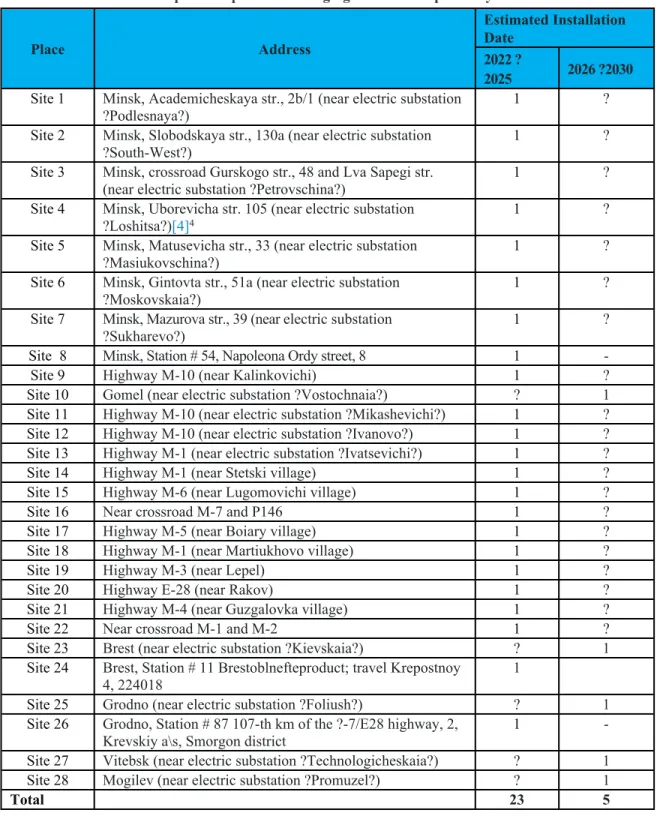
Outcome 2: Investment into super fast charging stations is realized. This outcome will be achieved through implementing pilot demonstration projects on super-fast charging stations under the programme proposed under Belorusneft. Implementing of these pilot projects will be preceded by feasibility studies for at least 3 super fast charging stations with at least one station in Minsk. By strategically locating stations according to the latest international standards for their installation, their use by EVs will become popularized, especially for EVs travelling long distances. These 3 pilot projects would then be used to guide the 25 super fast charging stations to be co-financed by Belorusneft as identified in Table 1 (23 stations completed before 2025 and 5 stations starting in 2026).
Output 2.1: Feasibility studies for at least 3 Super-Fast Charging Stations. This feasibility study will be conducted to ensure the pilot implementation of 3 super fast charging stations has the desired effect of popularizing these stations and catalyzing the electric vehicle market in Belarus. This study should consider previous studies that were done on super-fast charging stations and their impact on the country?s power grid infrastructure but also consider the latest scenarios regarding the changing of the EV market in Belarus, and the Belarus electricity sector including the potential for renewable energy sources and energy stored systems. The feasibility study should also define the existing international experience on deploying charging stations, bottlenecks faced elsewhere and overcoming strategies. The study should help the Project team by defining which types of superchargers will be needed in charging station hubs, what can be the ideal numbers of different charging models in hubs with respect to the current and future EV models in Belarus. Similarly, the study present best cases on software-hardware compatibility experiences between charging equipment and EVs for best results on charging efficiency.
The feasibility study will not consider market privatization options for the network expansion of super- fast charging stations given that the government agencies responsible for issuing permits for super-fast charging stations would provide approvals with certain state guarantees. An Environmental and Social Impact Assessment (ESIA) will be carried out simultaneously with the feasibility studies development for each station in order to identify and assess the potential social and environmental impacts of each station in its area of influence, evaluates alternatives, and designs appropriate avoidance, mitigation, management, and monitoring measures. Further details on project?s safeguards procedures can be find in ESMF (Annex O). If the scoped ESMPs would result from the scoped ESIAs of any of 3 super fast charging stations these ESMPS will be developed also in frames of this output as a part of the first stage of 3 super fast charging stations design. The most important aspect of this study will be a strategic location of the 3 pilot super-fast charging stations that will popularize all long-distance electric vehicle travel. The study will analyse the possible effects of Covid-19 pandemic to the procurement, deployment and management of charging stations and define measures to tbe considered to avoid any delays in piloting and future impacts to the users. Finally, the study will elaborate on climate change related risks for Belarus and define measures for the selection of charging equipment, deployment of charging stations, and measures to be taken in order to mitigate any possible climate change related risks. Activities to deliver this output in Q3 of Year 2 (2023) will include:
Activity 2.1.1: Undertake a review of existing information on fast charging and super fast charging stations in Belarus. There are possibly several proceedings studies on fast charging and super fast charging stations already done in Belarus. The information may be useful in determining how to locate 3 pilot super fast charging stations. This may include an existing study on the most optimal locations for super-fast charging stations based on a study of available networks. Information from the Global E- Mobility Programme?s Regional Support and Investment Platforms on super-fast charging stations may also be of benefit;
Activity 2.1.2: Assess cities in Belarus where super fast charging stations can have a maximum demonstrative effect. With Minsk being one of the obvious locations, placement of the other pilot stations may be advantageous in other locations such as the terminus is of the East-West corridor of Grodno-Minsk-Orsha. This assessment should be supported by surveys and data analysis. These findings may affect the rate of return on some of these locations. The review should be wide-ranging looking at other secondary cities within Belarus to ensure that the same care policies and development plans apply;
Activity 2.1.3: Assess the specific locations of the pilot super-fast charging stations in each of the selected cities. These locations need to meet specific conditions that will provide a competitive
advantage over existing fast charging stations. The super-fast charging stations should be located near a 110 kV electrical substation, and be located where there is both incoming and outgoing city traffic as well as transit traffic. Land ownership issues should also be examined under this activity with the relationship between the landowner and Belorusneft to be very clear in terms of payments and land rights. An estimate in terms of the rate of return on investment in a particular super fast charging station site should be made on the basis of the land rights, tariff policies and expected revenue from EV traffic using the station;
Activity 2.1.4: Prepare a short list of super-fast charging station suppliers for the pilot demonstration.
There is a growing supplier market for super fast charging stations globally. Some companies have excellent products but may be difficult to get timely delivery of their products. For this reason, the outcome of the feasibility study may recommend anywhere from 1 to 3 suppliers selected for 3 pilot super fast charging stations. The analysis will take into consideration of limitations on procurement and transportation of assets to Belarus due Covid-19 pandemic. Then, the Project team will define a procurement modality in line with UNDP and GEF procurement principles and rules. The procurement model will be submitted to Project Board for final approval before implemented (refer to the principles set under Activity 2.2.1)
Output 2.2: Installation of at least 3 Super-Fast Charging Station(s) (300+kW) to compliment the charging infrastructure network of Belarus. By Q1 of Year 3 (2024), selection of the suppliers for a minimum of 3 pilot super-fast charging stations (the number of super-fast charging stations may increase) will have been selected for installation. MoNREP will manage the Project budget for procurement of the super-fast charging stations and the tendering process for the selection of the 3 chargers with the assistance of Belorusneft, and provide staff to oversee its installation. Later, the Project will support Belorusneft to procure and install the 25 super-charging stations with the know- how gathered from the Project. Activities to deliver this output will include:
Activity 2.2.1: Assistance in preparation of the ToR and other documents for tendering process for selecting a supplier (or suppliers) for the supply and installation and construction of civil works for three 2 or more super-fast charging stations. During Project implementation, all Project activities providing direct financial support to investments (GEF INV) under this Output will begin with an initial step where with PMU, in consultation with key stakeholders, will prepare individual ?Project Investment Plan?. This plan will finalize, via detailed financial, technical, legal, procurement and operational assessments, the Project?s approach to providing GEF INV support to procurement activity.
The plan will address the key principles detailed below. This plan will be submitted for clearance to UNDP (CO and BPPS NCE), and then shared with Project Board, for approval. The key principles to be considered are:
o Ensure that the IP (GEF executing entity) selected modality to make the GEF INV is in line with UNDP?s policies and financial rules and regulations. If there is a departure between the IP?s policies and UNDP?s polices, UNDP?s policies must prevail;
o Ensure that the level of GEF INV support for private sector beneficiaries is determined on the principle of minimal concessionality or, in other words, that the GEF INV is used as efficiently as possible. In practice, during implementation, this will nearly always involve a step in the GEF INV financial mechanism where a financial analysis of the investment opportunity will be performed;
o Ensure that the design of the mechanism to provide GEF INV support in the particular sector safeguards financial resources against potential wrongdoing. For example, this may involve checks- and-balances, committees, and multiple individuals, on key decisions. Quoted cost of investments should be checked against market prices.
o Ensure that any GEF INV to the private sector recipients is done on a competitive process to identify the recipients;
? Activity 2.2.2: Consulting support in site preparations, civil works, installation of equipment, and commissioning of at least 3 super fast charging stations based on the findings of feasibility studies and Environmental and Social Impact Assessment (and the resulting ESMPs) under Output 2.1. Such support will include feedback to the Project Board on the compliance to best practices for the
construction and installation of the super-fast charging stations. Considering the suppliers that are being considered, the likelihood of compliance to best practices should be something that the supplier provides to the Project for learning purposes. Moreover, the project team will ensure putting in place necessary measures to mainstream COVID-19 considerations for charging station use by customers.
The know-how and lessons-learnt from this piloting experience will be shared with Belorusneft for the realization of 25 super-fast charging stations as part of their co-financing contribution. The e-Mobility Project will not have control over these 25 stations and therefore will not be accountable for them.
Output 2.3: Consensus amongst senior government officials on moving forward with a super fast charging station program. By Q2 of Year 3 (2024), the 3 super fast charging stations will be fully operational, allowing senior government officials to review the results and impact of the stations on EV deployment in Belarus. Based on stations performance in terms of revenue generation and increase in number of EVs being used, decisions should be easier to make on moving forward with a program to increase the number of super-fast charging stations throughout Belarus. Activities to deliver this output by 2025-26 (Year 4) include:
Activity 2.3.1: Collect super fast charging station performance data. This should be done by a Project consultant (who is involved on all performance-based eVehicle work) in a manner that informs the reader of the benefits of super-fast charging station performance in terms of its revenue, rate of return, the increase in the number of electric vehicles, and an estimated economic impact;
Activity 2.3.2: Conduct a tour to all 3 pilot super-fast charging stations for senior government officers and technocrats. This tour should assist the decision-making process of these officials in replicating strategically located super fast charging stations throughout Belarus. The super fast charging station performance data from Activity 2.3.1 will serve as a useful tool in passing information to these technocrats;
Activity 2.3.3: Assist in any plans or papers required by these officials for the expansion of the super fast charging station network in Belarus. At this time, arrangements will be made to transfer the ownership of the super-fast charging stations to Belorusneft.
Outcome 3: Promotion of e-vehicles to help consumers make educated decisions on e-vehicle purchases. This outcome will be achieved upon the completion of the super-fast charging station pilots, and with policies and national initiatives on electric mobility being promoted by the Government of Belarus. A primary initiative of this outcome will be to disseminate as much positive information on EV usage for Belarus through a number of measures that target certain stakeholders such as car dealers, banks and the general public.
Output 3.1: Nationwide PR Campaign on eVehicles deployed involving car dealers. The purpose of this output is to build capacity and raise awareness about the mobility by disseminating results of Outcomes 1 and 2 the targets car dealers that are willing to sell e-vehicles. The expected move towards EVs will be sufficiently strong, starting in Q1 of Year 2 (2023) to Year 4 to convince 1st and 2nd hand car dealers to assist in the public relations and awareness raising campaigns for EVs. The communication materials and campaign language will take into consideration of gender perspectives. Activities to deliver this output will include:
Activity 3.1.1: Send out notices to all car dealers notifying them of an opportunity to enter the electric vehicle market. Those dealers that respond can be engaged and awareness raising sessions by the Project to notify them of the developments in Outcomes 1 and 2, and the strong momentum towards electric mobility throughout Belarus;
Activity 3.1.2: Conduct awareness raising sessions of lessons learned from Outcomes 1 and 2. During these sessions, car dealers will eventually be trained in terms on how to deliver positive public messaging on electric vehicle usage. The resulting sales from this effort may convince will many of these 1st and 2nd hand car dealers to do their own promotion of EVs;
Output 3.2: Project website that includes an interactive app created with charging infrastructure locations and calculations of charging cost (one time, monthly and annually). This Belorusneft website (in partnership with MoNREP) will prove to be user-friendly and particularly useful to those wanting to evaluate an e-vehicle purchase and for those who have purchased an e-vehicle. The website (https://malankabn.by/en/) can be developed from existing websites[3]3 that will include information about the vehicle performance versus fossil fuel vehicles. It will also have applications for its users to view charging stations and calculate savings on costs of other owners EVs that are in operation.
Activities that can be carried out starting in Q1 of Year 2 (2023) to Year 4 include:
Activity 3.2.1: Set up application for mobile users to interactively enter their e-vehicle usage data for the purposes of monitoring energy consumption. There are a number of other existing such applications globally from which the Belarusian program will benefit. The app developer, representing Belorusneft as the owner of the website, should also have the means to be able to collect all the data being generated on the app for the purposes of collating the energy and GHG information to a central site. In this way, there would be another data point in terms of estimating the energy and GHG impact of the EE vehicle program in Belarus;
Activity 3.2.2: Set up the Belorusneft website with the application to provide a platform for reporting the latest news on E-mobility in Belarus. While the development of this app will mostly be done by the Project, its maintenance will partially be covered by the Project with the end goal the website
maintenance being covered entirely by Belorusneft.
Output 3.3: Monitoring, reporting and verification of GHG emission reductions from the project activities: This output is important for MoNREP for reporting the impact of this Project as well as the overall efforts of the Government of Belarus to meet its NDC commitments. With the assistance of the EU4Climate Fund to build the Belarusian capacity for GHG emission reduction programme management, activities to deliver this output starting in Q3 of Year 3 (2024) to Year 5 will include:
Activity 3.3.1: Collect information from app set up in Activity 3.2.2 that should contain information on GHG emission reductions from e-vehicles. The information being collected will fall within NDC implementation plans, roadmaps and timeframes, for MoNREP, including plans for updates and development of the NDC framework that was setup under the EU4Climate Fund but focused on road transport;
Activity 3.3.2: Collect information from all charging stations (Mode 3, Mode 4 and super fast charging stations). Using MRV systems activities being funded and setup by the sister UNDP-GEF project ?Capacity Building for Emission Trading and Strengthened MRV in the Republic of Belarus?, the Paris Agreement establishes a new transparency regime, under which countries will have to report progress on reducing GHG emissions and building climate resilience. This transparency regime is currently being established within the UNFCCC framework and its final details are still to be defined.
For the eVehicles Project, this will involve MoNREP and its consultants collecting data on the total number of kilowatt hours being used for driving EVs, which will be useful in determining the GHG impact of an increased number of EVs in Belarus;
Activity 3.3.3: Assistance to MoNREP on preparing NDC reports on GHG emission reductions from the road sector and electric vehicle program.
Output 3.4: National Workshop on Electric Vehicles. Another significant measure to raise awareness and build capacity, will be conducting a National Workshop that promotes eVehicle use and develops and disseminates the ?lessons learned? document (from Output 3.6) that can be used for by other countries and regions wishing to develop their eVehicle markets. With government agencies, the private sector and financial institutions participating in the National Workshop, activities to deliver this output starting in Q3 of Year 4 (2025) to Year 5 will include:
Activity 3.4.1: Organization of and preparation of materials for workshops including:
analysis of the current state of the e-vehicle market in the Republic of Belarus;
analysis of the current state of the charging infrastructure for e-Vehicles in the Republic of Belarus, including charging stations Mode 3, Mode 4 and superfast charging stations;
analysis of measures to stimulate the development of the e-vehicle market;
Activity 3.4.2: Conduct the national workshop. The workshop will be conducted under 2 months before the conclusion of the Project. Topics to be covered will include:
current status of the overall market of EVs in Belarus;
impact of government interventions and initiatives from donor partners on the level of EV usage Belarus;
a review of the government incentives and policies and bank programs that have catalyzed the EV market;
the current market and future program for charging stations for EVs in Belarus that includes Mode 3, Mode 4 and super-fast charging stations;
measures to ensure sustainability of EVs in Belarus including prudent operations and maintenance for the purposes of energy efficiency of EVs;
Activity 3.4.3: Drafting of the national workshop closing statements. These will be forward-looking statements by senior government officials at the workshop and printed on an official communiqu?.
Output 3.5: Video highlighting results from the demo projects. Video of Project activities as well as those of other government interventions would be a very important media tool for disseminating information on the Government of Belarus?s EV program. These activities should start early, and be sustained throughout the duration of the eVehicle Belarus Project. Activities to deliver this output starting in Q1 of Year 2 (2023) to Year 5 include:
Activity 3.5.1: Development of the video script reflecting the last 5 years of the development of e- vehicles in the Republic of Belarus. The Project team, jointly with the video team, will develop a script for creating a video, which will include:
evolution of cars from internal combustion engines to e-vehicles;
evolution of charging stations from slow to super fast;
information on the prospects for the development of the e-vehicle market in the Republic of Belarus;
Activity 3.5.2: Execute video plan for the development of electric vehicles in Belarus. The video should capture the following:
old footage of ICE vehicles;
early models of EVs and Mode 3 charging stations:
increased numbers of EVs including public transit and additional charging stations including Mode 4;
development of the super-fast charging stations from pilot stations from this Project to the ones subsequently developed by Belorusneft and other private sector entities;
graphics showing the source of energy for electric vehicles (renewable energy sources or energy storage) and the energy and fiscal savings of electric vehicles;
overview of operation and maintenance of electric vehicles and their advantages over ICE vehicles;
testimonials from users;
a statement on the future of electric ability in Belarus;
Activity 3.5.3: Post videos on the Project website of Output 3.2. The inaugural posting of the video could be done at the national workshop to bring it the proper profile that needs.
Output 3.6: Lessons learned study. The lessons learned document should be a record of electric vehicle development in Belarus that can be shared with other countries. As such, the document format should follow certain formats can be recommended for UNDP or the UNEP Global E-mobility Programme.
Activities to deliver this output Q3 of Year 4 (2025) to Year 5 includes:
Activity 3.6.1: Conduct lessons learned study. Prior to commencing the lessons learned study, the consultant should consult with UNDP or the UNEP Global E-mobility Programme to ensure the formatting of the lessons learned study is consistent with their formats, and would be favourably distributed amongst other countries. A rough sketch of the lessons learned study outline should be as follows:
introduction to the Belarus vehicle market and its potential 10 years ago for electric vehicles;
a compilation of early and later incentives by the government of Belarus to incentivize e-vehicles;
early to current successes of the Government of Belarus in e-mobility;
an overview of the impact of the electric vehicle program Belarus including environmental, economic and financial aspects. This will include strategies for the collection, re-use or environmentally sound disposal of downgraded EV batteries that may be employed in 10 to 15 years;
impact of super fast charging stations on the mobility acceptance by the public;
The involvement of the Global E-Mobility Programme (the Support and Investment Platform) will augment the technical assistance being offered by the Project through workshops;
Activity 3.6.2: Present lessons learned study at National Workshop.
Belorusneft is the primary stakeholder in charge of the installation of super-fast charging stations who have expressed an interest in receiving expert assistance on best international practices in the
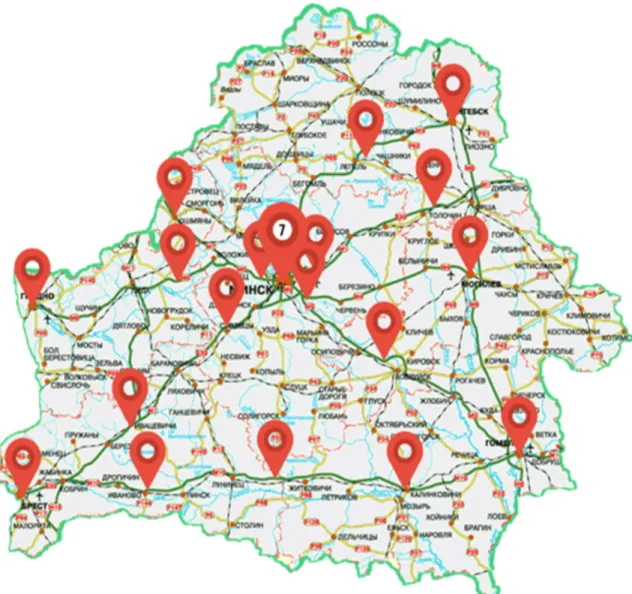
installation, operation and maintenance of these charging stations. Their key strategy for constructing super-fast charging stations for EVs in Belarus is the installation of a charging station near a 110 kV electrical substation. Such a location would provide competitive advantages over existing charging stations connected to regional distribution networks but with low-voltage. Considering the electric transport traffic potential between the main cities within Belarus, a charging network on all main highways of the country at a frequency of 50-70 kilometers would be required between super fast charging stations. Belorusneft are planning a network of 28 superfast charging stations with these conditions in mind. The superfast charging stations are in strategic locations that provide fast charging services for long distance electric vehicles. Table 2 lists all 28 superfast charging stations being proposed by Belorusneft alone. A map of the proposed super fast charging station network is provided on Figure 1 in Annex E.
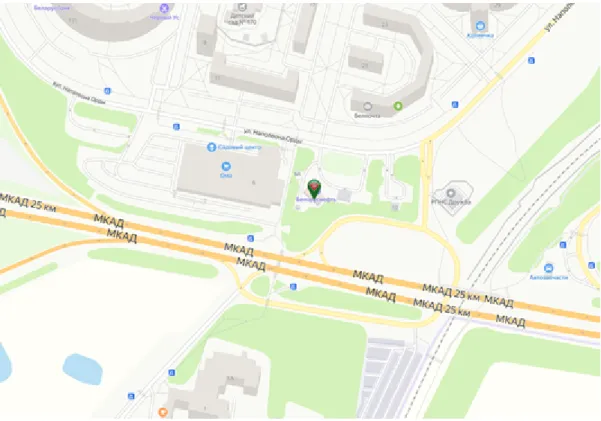
Three of these 28 super fast charging stations are proposed as the pilot projects of this project. The total GEF investment sought for these pilots is US$740,000. With the growth of electric cars primarily taking place in Minsk, one of these stations will located in Minsk at Gas Station No. 13 located on Uborevicha str., 105. This pilot project has been strategically located to provide quick charging services for both incoming and outgoing transit e-vehicle traffic (this would include vehicles travelling along the East-West corridor of Warsaw, Berlin, Moscow and north-south court orders of Kiev, Gomel, Vitebsk, Vilnius and Klipeda). Two large advantages of this site are the availability of free land plots
sufficient in size to construct a large fast charging station complex and the proximity of the site to the Loshitsa electrical substation, located 0.5 km from the site. Details of the other 2 pilot super-fast charging stations are provided in Annex E.
Table 2: List of Proposed Super-Fast Charging Station Complexes by Belorusneft
Estimated Installation
Place Address Date
2022 ?
2025 2026 ?2030 Site 1 Minsk, Academicheskaya str., 2b/1 (near electric substation
?Podlesnaya?)
1 ?
Site 2 Minsk, Slobodskaya str., 130a (near electric substation
?South-West?) 1 ?
Site 3 Minsk, crossroad Gurskogo str., 48 and Lva Sapegi str.
(near electric substation ?Petrovschina?) 1 ?
Site 4 Minsk, Uborevicha str. 105 (near electric substation
?Loshitsa?)[4]4 1 ?
Site 5 Minsk, Matusevicha str., 33 (near electric substation
?Masiukovschina?)
1 ?
Site 6 Minsk, Gintovta str., 51a (near electric substation
?Moskovskaia?) 1 ?
Site 7 Minsk, Mazurova str., 39 (near electric substation
?Sukharevo?) 1 ?
Site 8 Minsk, Station # 54, Napoleona Ordy street, 8 1 -
Site 9 Highway M-10 (near Kalinkovichi) 1 ?
Site 10 Gomel (near electric substation ?Vostochnaia?) ? 1
Site 11 Highway M-10 (near electric substation ?Mikashevichi?) 1 ? Site 12 Highway M-10 (near electric substation ?Ivanovo?) 1 ? Site 13 Highway M-1 (near electric substation ?Ivatsevichi?) 1 ?
Site 14 Highway M-1 (near Stetski village) 1 ?
Site 15 Highway M-6 (near Lugomovichi village) 1 ?
Site 16 Near crossroad M-7 and P146 1 ?
Site 17 Highway M-5 (near Boiary village) 1 ?
Site 18 Highway M-1 (near Martiukhovo village) 1 ?
Site 19 Highway M-3 (near Lepel) 1 ?
Site 20 Highway E-28 (near Rakov) 1 ?
Site 21 Highway M-4 (near Guzgalovka village) 1 ?
Site 22 Near crossroad M-1 and M-2 1 ?
Site 23 Brest (near electric substation ?Kievskaia?) ? 1
Site 24 Brest, Station # 11 Brestoblnefteproduct; travel Krepostnoy
4, 224018 1
Site 25 Grodno (near electric substation ?Foliush?) ? 1
Site 26 Grodno, Station # 87 107-th km of the ?-7/E28 highway, 2,
Krevskiy a\s, Smorgon district 1 -
Site 27 Vitebsk (near electric substation ?Technologicheskaia?) ? 1
Site 28 Mogilev (near electric substation ?Promuzel?) ? 1
Total 23 5