National Planning for an Inclusive and Effective Conservation Approach to Reaching Global Biodiversity Framework Target 3
Part I: Project Information GEF ID
10916 Project Type MSP
Type of Trust Fund GET
CBIT/NGI CBIT No NGI No Project Title
National Planning for an Inclusive and Effective Conservation Approach to Reaching Global Biodiversity Framework Target 3
Countries Global Agency(ies) WWF-US
Other Executing Partner(s) WWF-US
Executing Partner Type GEF Agency
GEF Focal Area Biodiversity Taxonomy
Focal Areas, Influencing models, Stakeholders, Gender Equality, Capacity, Knowledge and Research
Sector Rio Markers
Climate Change Mitigation Climate Change Mitigation 0 Climate Change Adaptation Climate Change Adaptation 0
Submission Date 3/1/2022
Expected Implementation Start 3/31/2022
Expected Completion Date 9/30/2023
Duration 15In Months Agency Fee($) 180,000.00
A. FOCAL/NON-FOCAL AREA ELEMENTS
Objectives/Programs Focal Area Outcomes Trust Fund
GEF Amount($)
Co-Fin Amount($) BD-2-7 *Address direct drivers to protect
habitats and species and *Improve financial sustainability, effective management, and ecosystem coverage of the global protected area estate.
GET 2,000,000.00 343,246.77
Total Project Cost($) 2,000,000.00 343,246.77
B. Project description summary
Project Objective
Support country planning to inclusively and effectively meet or exceed GBF Target 3.
Project Component
Financin g Type
Expected Outcomes
Expected Outputs
Trust Fund
GEF Project Financing($)
Confirmed Co- Financing($) Component
1: Develop inclusive and effective national level plans to achieve Target 3
Technical Assistance
1.1 Strengthene d country planning/
capacity to meet/exceed GBF Target 3
1.1.1 A concise, user- friendly ?how- to? guide for countries to develop an inclusive and effective plan to meet or exceed GBF Target 3
1.1.2 National plans for five countries (developed through inclusive processes)
GET 1,755,795.00 301,335.54
Project Component
Financin g Type
Expected Outcomes
Expected Outputs
Trust Fund
GEF Project Financing($)
Confirmed Co- Financing($) Component
2:
Knowledge products and M&E
Technical Assistance
2.1 Knowledge products are developed and shared with relevant rights holders and stakeholders to contribute to
knowledge management
2.2 M&E plan
implemented for adaptive management
2.1.1 Capacity support and presentation materials for use by country representatives at the GEF Assembly in June 2022
2.1.2 Accessible project lessons and KM products and their
dissemination, including dissemination of the guide 2.2.1 A monitoring and evaluation system, mainstreaming gender equality, to gauge the project?s implementatio n progress and impact
GET 63,654.00 10,924.41
Sub Total ($) 1,819,449.00 312,259.95 Project Management Cost (PMC)
GET 180,551.00 30,986.82
Project Management Cost (PMC)
Sub Total($) 180,551.00 30,986.82
Total Project Cost($) 2,000,000.00 343,246.77
Please provide justification
C. Sources of Co-financing for the Project by name and by type Sources of Co-
financing
Name of Co- financier
Type of Co- financing
Investment Mobilized
Amount($)
GEF Agency WWF-US In-kind Recurrent
expenditures
323,246.77
Other Conservation
Strategy Fund
In-kind Recurrent
expenditures
20,000.00
Total Co-Financing($) 343,246.77 Describe how any "Investment Mobilized" was identified
Not Applicable
D. Trust Fund Resources Requested by Agency(ies), Country(ies), Focal Area and the Programming of Funds Agenc
y
Trus t Fun d
Countr y
Focal Area
Programmin g of Funds
Amount($) Fee($) Total($)
WWF- US
GET Global Biodiversit y
BD
Global/Regiona l Set-Aside
2,000,000 180,000 2,180,000.0 0
Total Grant Resources($) 2,000,000.0 0
180,000.0 0
2,180,000.0 0
E. Non Grant Instrument
NON-GRANT INSTRUMENT at CEO Endorsement
Includes Non grant instruments? No Includes reflow to GEF? No
F. Project Preparation Grant (PPG) PPG Required true
PPG Amount ($) 50,000
PPG Agency Fee ($) 4,500
Agenc y
Trust Fund
Country Focal Area
Programming of Funds
Amount($) Fee($) Total($)
WWF- US
GET Global Biodiversity BD
Global/Regional Set-Aside
50,000 4,500 54,500.00
Total Project Costs($) 50,000.00 4,500.00 54,500.00
Core Indicators
Indicator 11 Number of direct beneficiaries disaggregated by gender as co-benefit of GEF investment Number
(Expected at PIF)
Number (Expected at CEO Endorsement)
Number (Achieved at MTR)
Number (Achieved at TE)
Female 2,500
Male 2,500
Total 0 5000 0 0
Provide additional explanation on targets, other methodologies used, and other focal area specifics (i.e., Aichi targets in BD) including justification where core indicator targets are not provided
Part II. Project Justification
1a. Project Description
Project Description ? Overview
Well-governed and effectively managed protected areas (PAs) and other effective area-based conservation measures (OECMs) are proven area-based approaches for safeguarding habitats, species, and ecosystem services. Significant progress has been made in increasing the area-based coverage of protected areas since the turn of the millennium. Currently, ~16% of the land and 7.4% of the ocean is reported as PAs or OECMs, although only 2.5% of the ocean is in highly/fully protected areas (UNEP- WCMC, 2021). Yet, despite this, around 4,900 or 33% of Key Biodiversity Areas (KBAs) remained without protected area coverage in 2019. Moreover, the majority of protected areas are state-governed and the protected area networks have tended to be underfunded, leading to levels of management being insufficient to halt degradation (?paper parks?). In some cases, this is also leading to protected area downgrading, downsizing and degazettement (Mascia and Pailler, 2010). The lesser focus placed to date on ecological connectivity and climate resilience also weakens these networks. There are also reported instances of human rights abuses occurring in the context of protected areas (Tauli-Corpuz, 2016), negatively impacting Indigenous Peoples and local communities (IPLCs). The emphasis on protected areas has also had the unintended effect of reducing the appropriate recognition of the value of areas outside these networks and led to the undervaluation of their associated governance and management systems at national and international levels - including by IPLCs, private landowners, and sectoral actors - such as farmers, fishers and foresters whose stewardship conserves biodiversity. This is despite the fact that IPLCs, in particular, are important custodians of the world?s remaining natural places and support ecosystem services used by people outside their territories and communities (Garnett, 2018; WWF et al., 2021).
In response to the above factors, among others, the area-based conservation paradigm is changing.
From 2001?2009, international biodiversity law and policy embraced human rights and equity through the Durban Action Plan that was adopted at the Vth IUCN World Parks Congress (IUCN, 2003) and the CBD Programme of Work on Protected Areas (CBD, 2004). Furthermore, the ?new paradigm for protected areas? (Phillips, 2003) emerged as the concept of ?governance? was expanded to include IPLCs as legitimate governance authorities, in addition to state and private actors, under all management types (Dudley, 2008). From 2010?2017, a raft of new guidance was developed to help implement the new paradigm, focusing on territories and areas conserved by IPLCs (Borrini- Feyerabend et al. 2013) and privately protected areas (Stolton et al., 2014).
The area-based conservation paradigm took a further step forward when Parties to the CBD included reference to ?other effective area-based conservation measures? (OECMs) in Target 11 of the Strategic Plan for Biodiversity (CBD, 2010; Jonas et al., 2014, 2018). While protected areas are dedicated to the conservation of biodiversity, OECMs are areas that achieve the long-term in situ conservation of biodiversity regardless of their management objectives (CBD, 2018; IUCN 2019) - especially those conserved by IPLCs, private landowners and sectoral actors. Target 11 placed an emphasis on ecological representativeness and connectivity as well as integrating protected areas and OECMs into larger landscapes and seascapes. There is also an ever-greater focus on the linkages between area-based conservation and climate change, both in terms of supporting areas and people to adapt to a changing climate and in terms of how those areas can support climate mitigation. These changes are having major ramifications for the kinds of areas and governance authorities that are included in national conservation frameworks with implications for inclusivity, conservation effectiveness and climate resilience. In particular, and in addition to the heightened focus on IPLCs, private landowners and sectoral actors such as those involved in farming, fishing and forestry are increasingly engaged in conservation efforts.
Draft Target 3 of the post-2020 Global Biodiversity Framework is currently framed in the following way: Ensure that at least 30 per cent globally of land areas and of sea areas, especially areas of particular importance for biodiversity and its contributions to people, are conserved through effectively and equitably managed, ecologically representative and well-connected systems of protected areas and other effective area-based conservation measures, and integrated into the wider landscapes and seascapes. Target 3 will incentivize countries to work towards increasing their area coverage of PAs and OECMs towards or exceeding the final agreed percentage target. This will require a range of governance and management approaches at the site-to-network level and the application of policy interventions, systems, tools, and partnerships that catalyze change and facilitate impact at scale. While some of the increase in area coverage will be delivered by the designation of new PAs - particularly in marine areas - a significant percentage of this increase is likely to come from newly identified OECMs, including those governed by IPLCs who own or govern ~32% of the Earth?s terrestrial surface (ICCA Consortium, 2021, WWF et al., 2021), as well as by sectoral actors. This will place significant emphasis on at least two core issues, namely: inclusivity and conservation effectiveness:
Inclusivity and rights: Central to Target 3 is the principle that countries? national-level planning processes are inclusive and are rights-based, including the full and effective participation of all relevant rights-holders and stakeholders and respect for their right to give or withhold their free, prior and informed consent. It is also imperative that existing or new protected areas and newly identified OECMs are governed and managed in ways that meet principles of equity, including recognition, procedure and distribution (CBD Decision 14/8, Annex II, 2018).
Effective conservation: While the main focus to date has been on management effectiveness within PAs, CBD Decision 14/8 (2018) on ?protected areas and OECMs? has shifted the emphasis towards long-term conservation outcomes? (Jonas et al., 2021). This has put a greater focus on measuring and reporting conservation effectiveness, including through the use of Indigenous knowledge systems, as appropriate.
In this context, this project?s objective is to: support country planning to inclusively and effectively meet or exceed GBF Target 3. Project partners will develop an easily accessible guide to developing inclusive and effective national level plans to achieve Target 3. In five countries, the project will support a series of in-country consultations and workshops with a wide range of stakeholders relating to GBF Target 3 to discuss local-to-national level priorities, review data, gaps analysis and develop national plans. As part of this, project partners will support in-country assessment and documentation of baseline data and gaps assessment relating to enabling conditions for Target 3, setting out what exists and what additional data are required to support work towards Target 3. This will support an inclusive analysis of those findings to address selected, prioritized (non-exhaustive) data or knowledge gaps. These activities and output will feed into broader multi-stakeholder consultations about local-to- national priorities for Target 3, designed to be inclusive, with a focus on right-based approaches to conservation, and to plan for effective, connected and climate resilient systems of PAs and OECMs.
This will result in 5 national plans for achieving or exceeding GBF Target 3.
Project partners will support country representatives to present progress at the GEF Assembly in June 2022 (date TBD). Project partners will also ensure that all project outputs, including lessons, are disseminated widely. A monitoring and evaluation system will be in place throughout, incorporating mainstreaming gender equity and gender responsiveness, to gauge the project?s implementation progress and impact.
a. Global environmental problems, threats and root causes i. Environmental Problems
The rate of change in biodiversity since 1970 is unprecedented in human history. Biodiversity has been significantly altered by multiple direct (threats) and indirect (root causes) anthropogenic drivers since the beginning of the industrial revolution and has been accelerating rapidly since 1970. Today a vast majority of local and global biodiversity indicators show a precipitous decline. The global rate of species extinction is now tens to hundreds of times higher than the background rate over the past 10
million years. Anthropogenic activity threatens many more species with global extinction than at any other time in history. An average of 25% of species in studied animal and plant groups are threatened.
Extrapolating from those results, scientists have concluded that 1 million species may face extinction within decades unless action is taken to reduce the intensity of the direct threats to biodiversity.
Without such action, further acceleration in extinction rates will likely result in future rates that are 10,000 times higher (Maheshwari, 2021) with concomitant and sometimes unpredictable declines in associated ecosystem services.
Since 1970, agricultural production, fish harvest, bioenergy production and harvest of raw materials have increased significantly resulting in 75% of the land surface has been significantly altered, 66% of the ocean has experienced increasing cumulative impacts, and 85% of wetlands has been lost (IPBES, 2019). While these increases in material production have contributed to increases in human wellbeing, they are supported by regulating ecosystem services which have declined, indicating that these gains in material production are not sustainable in the long term. For example, while the value of global agricultural crop production increased threefold since 1970 and raw timber harvest increased by 45%, the regulating services of soil organic carbon and pollination that support that production have declined. These gains will be difficult to sustain in the future as land degradation has reduced productivity in 23% of the global terrestrial area and pollinator loss has put at risk up to $577 billion in annual global crop output (IPBES, 2019). Similarly, the global wild marine fish harvest increased fourfold between 1950 and the late 1990s, declining due to overfishing (Galbraith et al., 2017) and habitat destruction (Laurance, 2010). And while growth in aquaculture can fill much of the gap in demand, it does so with negative environmental consequences (e.g., habitat degradation, invasive species, pollution). Moreover, habitat destruction along the coasts has also reduced coastal protection, increasing risk from floods and hurricanes for the 300 million people living within coastal 100-year flood zones (IPBES, 2019).
And while most focus in the loss of diversity centers on wild species, the diversity in local varieties and breeds of domesticated plants and animals is also declining, posing risk to global food security by undermining the resilience of agricultural and aquaculture systems to threats such as pests, pathogens and climate change (IPBES, 2019). As of 2016, greater than 9% of domesticated breeds of mammals used for food and agriculture had become extinct and many crop wild relatives important for long-term food security lack protection. Reductions in the diversity of cultivated crops, crop wild relatives and domesticated breeds mean that food production is less resilient against future climate change, pests and pathogens (IPBES, 2019).
ii. Threats
The direct drivers of these changes in biodiversity (or threats to biodiversity) with the largest global impact are changes in land and sea use, direct exploitation of species, climate change, pollution, and invasive species. In addition, these five direct drivers result from synergistically interacting indirect drivers of change (or root causes) which result from societal values and behaviors including governance, human population dynamics and trends, production and consumption patterns, trade, and technological innovation. The rate of change in the direct and indirect drivers and their relative impacts differs across regions and countries.
Among the five direct drivers, land-use change has had the largest relative negative impact on biodiversity in terrestrial and freshwater systems, followed by overexploitation of animals, plants and other organisms, mainly via harvesting, logging, hunting and fishing (IPBES, 2019). Changes in land use for agriculture, urban and infrastructure expansion top the list. Currently, over one third of the global terrestrial area has been converted for crop or domestic animal production. In addition, clearing of land for food production (row crops and pasture) is responsible for 70% of tropical forest conversion annually, leading to significant losses in biodiversity. Agriculture is also responsible for 70% of the freshwater withdrawals leading to a decrease in freshwater fisheries and biodiversity. Direct exploitation of fish, shellfish and other organisms through fishing is the largest relative negative impact
on biodiversity in marine systems, followed by land- and sea- use change such as coastal development for infrastructure and aquaculture (IPBES, 2019).
Although the impact of climate change on biodiversity and ecosystem services will likely become increasingly acute in the coming decades, climate change currently has its greatest impact on the loss of biodiversity and ecosystems services through exacerbating the impact of other drivers. The frequency and intensity of extreme weather events that result in increases in the frequency, severity, magnitude and distribution of warming, fires, floods, droughts and pests and pathogens have increased in the past 50 years. Through these pathways, climate change is demonstrably affecting species distribution, abundance, phenology, population dynamics, community structure and ecosystem function in terrestrial, marine and aquatic ecosystems with a complex array of ramifications that we do not yet fully comprehend.
iii. Root Causes
Indirect drivers of change (or root causes) result from societal values and behaviors which drive governance, human population dynamics and trends, production and consumption patterns, trade, and technological innovation. The ways in which biodiversity is conceptualized and valued has implications for choices that influence its degradation. Values differ across cultures and evolve over time. Values toward nature may be grounded in ethical principles, relationships, utilitarian values, or future focused. Cultural values with strong ties to biodiversity, or nature, found in many cultures, are associated with self-imposed restrictions based on norms (IPBES, 2019). Narrow utilitarian views of nature as economic inputs promote resource extraction, industrialization, urbanization, and global trade which have resulted in the decline of biodiversity worldwide. For example, in the last 50 years human population doubled while global extraction of biomass, fossil fuels, minerals, and metals increased sixfold (IPBES, 2019). Humans now extract 60 billion tons of renewable and nonrenewable resources while 75% of the terrestrial environment, 40% of the marine environment, and 50% of freshwater environment are experiencing severe impacts of degradation as a result (IPBES, 2019). In addition, expanding trade has meant that, in aggregate, the value of resource consumption has been disconnected from its impact on biodiversity and ecosystem service degradation. Technological innovation can result in increased pressure on ecosystem services through increased natural resource demand or extraction efficiency but it can also be a part of the solution to biodiversity loss through innovations that contribute to decoupling economic growth and the consumption of natural resources (IPBES, 2019).
iv. Barriers that need to be addressed to achieve Target 3 at the national level (systems description)
Target 3 of the post-2020 Global Biodiversity Framework, once agreed, will incentivize countries to increase their area-based conservation coverage towards the agreed percentage (currently 30%). But it will also pose a series of challenges that will need to be overcome if Target 3 is to be achieved or surpassed in ways that are inclusive and effective.
Barrier 1. Lack of global guides and comprehensive national plans, including sufficient data: At the planning stage for national-level efforts towards Target 3, countries often lack comprehensive and nationally-tailored plans of action (taking account of needs, gaps, barriers, inter alia) to guide country efforts to achieve Target 3 objectives and guidance with respect to development of such plans. To support national level plans, countries require comprehensive data. Yet in many countries, environmental and social data are either unavailable or not disaggregated. To make informed decisions, countries will need to address this barrier by conducting gaps analyses of the available data and, based on those findings and through inclusive processes, produce or secure additional analyses and data to address any gaps (including related to projections of future conditions).
Barrier 2. Less than fully inclusive planning and implementation: To develop national plans, related processes must address institutional and procedural barriers to the full and effective
participation of IPLCs, women, youth, private landowners, sectoral actors and other stakeholders such as NGOs and universities. IPLC voices, in particular, are often missing or deprioritized from key decision-making spaces at all levels of governance. This is despite the fact that IPLCs and sectoral players (including as cross-cutting categories: farmers, fishers, herders, hunters, ranchers and forest users) play a significant role in the governance, conservation, and sustainable use of biodiversity and depend on local ecosystem services. Especially as national agencies consider processes leading to any additions to their PA networks and the identification of OECMs, it is critical that rights-holders and stakeholders are engaged formally in planning processes from the earliest stage.
Barrier 3. Area-based conservation approaches that are not adequately planned and connected within landscapes, seascapes and river basins (including transboundary systems) and are not climate resilient: While some protected areas are equitable, effectively managed, well connected within larger ecological systems (including within transboundary systems), planned to be climate resilient, and deliver conservation outcomes for important biodiversity, many lack some or all of these characteristics. At the same time, to date, only 9 countries have reported OECMs to the World Database on OECMs (UNEP-WCMC, 2021). A lack or low levels of political will, capacity or finance can hinder countries? abilities to work towards:
Improving equity rights-based and governance arrangements and management effectiveness (including monitoring and rights-based enforcement) in inequitable or underperforming protected areas and starting to engage with OECMs.
Recognizing IPLC rights, lands and territories, and where needed, helping to strengthen rights, tenure and governance; and expanding coverage in areas with other tenure arrangements by enlarging, connecting, or establishing new PAs and OECMs, including in the context of IPLCs, private landowners and sectoral actors.
Repurposing areas by adapting management objectives to changing conditions to optimize benefits for people - including ecosystem services - and nature in areas that no longer serve their original intended purpose.
Planning across transboundary areas, in terrestrial, freshwater, coastal or marine systems, including by engaging with regional seas programmes, large marine ecosystem commissions, and river basin commissions.
The most effective scale for area-based conservation is the landscape/seascape/river basin. Yet there remain countries that continue to plan for single PAs or networks of only PAs, i.e., in some cases neither working at the landscape/seascape/river basin level nor including OECMs or other conserved areas in inclusive plans and actions. This needs to be addressed so that countries can plan at the landscape, seascape and river basin levels, as well as anticipate changing conditions, including due to climate change to enable:
Redesigning networks of protected and conserved areas in landscapes for more effective conservation, including enhanced connectivity and, where needed, temporary and dynamic protections as well as permanent ones.
Renovating modified or degraded ecosystems in the face of changing conditions to conserve nature and meet the shifting needs of people.
Barrier 4. Insufficient financial investment and related capacity: There exists persistent public underfunding for the equitable governance and effective management of protected and conserved area systems, which negatively impacts the capacity of governance and management authorities and limits the activities they can undertake. To secure nature and nature?s services to people for the long-term, both existing and future PAs and OECMs require sufficient, permanent financing for effective management. Addressing these shortfalls and securing related financing at the scale required ? from diverse sources including public, private, and market-based mechanisms, as appropriate and according to the right to FPIC ? is critical to achieving new global biodiversity targets and working to address biodiversity loss. That includes enhancing incentives for IPLCs to continue to manage their lands and waters to conserve nature and nature's services to people; incentives include adequate livelihoods and wellbeing conditions (e.g., health); as well as access to credit to the development of native-owned
business. Sufficient enabling conditions must be in place for large-scale permanent financing efforts to succeed.
Barrier 5. Policy incoherence hinders progressive approaches to Target 3: As above, there is a need to apply dynamic conservation approaches that account for threats like climate change at large scales and overcome resistance to moving away from outdated or inflexible approaches to conservation. To do this, there is a range of new, innovative approaches that are required to plan for and implement inclusive and effective conservation towards achieving or surpassing Target 3. Yet in- country legal and policy frameworks and related institutional arrangements are not necessarily sufficient or adequate to facilitate what is required, and this can result in ?policy incoherence?; i.e., when the government?s diverse stated aims are not fully aligned, including where policies support both subsidies to biodiversity damaging and plans to achieve biodiversity targets. Business as usual approaches to static planning for landscapes, seascapes, and their protected and conserved areas remain influential. Currently, pro-conservation short- and long-term policies are not regarded as a priority by many decision-makers that often favor harmful institutional arrangements and measures such as environmentally perverse subsidies. These constitute a barrier by being at cross-purposes with area- based conservation goals, including by encouraging overuse or wasteful use of natural resources and by contributing to the finance gap. Reforming existing frameworks - including relating to area based- conservation, wildlife crime and perverse subsidies, as well as developing new frameworks, and including for OECMs - will be crucial to address these barriers. In this context, harmful subsidies or policies, such as in the agriculture sector, constitute a barrier to achieving Target 3.
Barrier 6. Low levels of monitoring, evaluation and learning: Monitoring, evaluation and learning (MEL) are integral to reflexive and adaptive forms of planning and implementation. Countries that do not fully integrate MEL systems into their approach to Target 3 will underperform.
Taken together, the above 6 broad categories of issues will be barriers to achieving or exceeding GBF Target 3 inclusively and effectively unless they are addressed. The implications of not addressing each barrier effectively include:
Barrier 1: The lack of global guides and comprehensive national plans, including sufficient data will continue to hinder informed decision making and national-level planning.
Barrier 2: Less than fully inclusive planning and implementation - that result from institutional and procedural barriers to the full and effective participation of IPLCs, women, youth, private landowners, sectoral actors and other stakeholders such as NGOs and universities - denies these rights holders and stakeholders views from being integrated into the plans and can generate less engagement with non- inclusive plans and/or may result in conflict.
Barrier 3: Area-based conservation approaches that do not adequately plan for climate change and/or are not connected within landscapes, seascapes and river basins (including transboundary systems) may generate short-term benefits but will not lead to the long-term conservation and social outcomes. They may even exacerbate biodiversity loss over the medium- to long-term.
Barrier 4: Insufficient financial investment and related capacity, if unaddressed, undermines the ability of governance and management authorities to take decisive actions, at scale and over the long- term to address biodiversity loss.
Barrier 5: Laws, policies and institutional arrangements can become a limiting factor if they have become outdated and are not aligned with (and therefore enable) progresive progressive approaches to Target 3. For example, very few countries have begun to engage with how OECMs are either supported or hindered by their (sub-)national legal, policy and institutional frameworks. Policy incoherence results in nature loss and undermines conservation financing and actions. Where they are not/less supportive, some levels of reforms will be required to ensure these enabling conditions are in place.
Barrier 6: Where low levels of monitoring, evaluation and learning are not addressed, the conservation system will not be responsive enough to mitigate adverse trends or well placed to draw upon and replicate successes.
b. Baseline Scenario
Area-based conservation
Protected areas and OECMs can be effective strategies for addressing the environmental problems described above. In addition to safeguarding biodiversity, they can promote carbon sequestration, resiliency and adaptation to climate change, and a range of other ecosystem services that benefit people. The GBF Target 3 sets out a goal that at least 30% of the Earth?s land (including freshwater systems) and sea surface area be conserved through protected areas and other effective area-based conservation measures (OECMs) (Convention on Biological Diversity, 2021). To help illuminate the needed investments to achieve Target 3, the progress on area-based conservation to date is reviewed below.
The latest data from the Protected Planet indicate that just over 21 million km2, 15.7% of the planet?s land surface, is within protected areas, as are 28.1 million km2, or 7.9%, of the ocean?s surface (https://www.protectedplanet.net). The proportions of all river kilometers (Abell et al., 2017) and areas of wetland (Bastin et al., 2019) within protected areas are quite similar to the percentage of land protected, largely because these features maintain a scaling relationship with land area. Large rivers?which support the highest species richness of freshwater species and the greatest production of ecosystem services for people?have a somewhat lower level of protection (Opperman et al., 2021).
Further, because wetlands and river ecosystems are strongly shaped by flow patterns and connectivity within hydrological networks and flow patterns, traditional protected areas have limited ability to safeguard many of their processes and values and so scientists are developing other metrics to track their protection, such as the Connectivity Status Index (CSI) (Grill et al., 2019).
In addition to protected areas (in which conservation is the primary management objective), the CBD also tracks the contribution toward Target 3 of OECMs. An OECM is defined as ?A geographically defined area other than a protected area, which is governed and managed in ways that achieve positive and sustained long-term outcomes for the in situ conservation of biodiversity, with associated ecosystem functions and services and where applicable, cultural, spiritual, socio?economic, and other locally relevant values? (CBD, 2018). OECMs include some Indigenous, locally and privately conserved areas, corridors, water reserves, and security lands, among others (Jonas et al., 2018).
According to the data on the Protected Planet, the quantification of OECMs adds just over 1% of land surface (bringing the PA + OECM total to 16.8%) and 0.1% to the ocean surface (bringing the total to 8.0%).
Although the Aichi Target 11 for land (17% within PAs and OECMs) was essentially met by 2020, progress fell short of the target for the goal for oceans (10%), and inland waters are not well represented by being lumped in with land (Opperman et al. 2021). Further, while the global coverage goal for overall coverage in PAs and OECMs was met, the associated goal that protected areas coverage be ecologically representative has not been met. The target of 17% in PAs and OECMs was met for less than half of the world?s 821 ecoregions and one-third of Key Biodiversity Areas have no formal protection at all (UNEP-WCMC and IUCN, 2021).
Understanding progress toward conservation goals requires more than just spatial mapping and accounting. The effectiveness of management of PAs and OECMs is also key. The Aichi Targets also included goals for countries to survey their PAs and OECMs for management effectiveness with, for example, a goal that countries assess management effectiveness across 60% of their PAs and OECMs.
15% of countries have met this target. Globally, just over one-tenth of PAs, representing 18% of total spatial extent under protection, have documented assessments of their management effectiveness (UNEP-WCMC and IUCN, 2021). This metric only tracks whether an assessment has occurred, not on the results of those assessments and these results haven?t been organized and reported yet. The IUCN World Heritage Outlook provides some insight as it includes information on management effectiveness for a subset of the world?s protected areas (IUCN, 2020). The Outlook found that, since 2017, more Heritage Sites have deteriorated than have improved.
Aichi Target 11, and the draft GBF, also include goals that protected areas and OECMs be ?equitably managed? (which includes equitable governance), encompassing ?respect for stakeholders and their rights?transparency, accountability?and the fair distribution of costs and benefits.? The Protected Planet Report (2020) documents progress on these topics, and concludes, ?Despite these advances, achieving equitable governance remains one of the greatest challenges faced by the world?s conservation network.? Much of the need for improvements in equitable governance (and related arrangements such as shared governance) centers around the relationships between protected areas and indigenous peoples (and other local communities). The land managed by indigenous people represents a potentially major contribution to total global conservation of biodiversity and ecosystem services, through two ways:
Overlap with protected and conserved areas. Just over one-quarter (26%)* of protected or conserved lands (state or private) overlaps with the territory of indigenous people (ICCA Consortium, 2021).
Thus, management of these areas must account for the objectives and values of Indigenous peoples.
Non-overlapping lands with potential for conservation. The area of land managed by Indigenous peoples encompasses approximately 28 million km2, more than 20% of the world?s land surface. Of this total, approximately 5 million km2 is the overlap with protected or conserved areas, described above, while 23 million km2 does not overlap. Thus, the land owned by Indigenous peoples that does not have other formal recognition as a protected area represents 17% of the world?s land surface. Thus, Indigenous peoples manage an area of the planet?s land surface that is just slightly larger than the extent of land within protected areas and OECMs ? and a substantial portion of that protected and conserved land is also owned and/or governed by Indigenous peoples. It is clear that Indigenous peoples, and the lands and waters they own and manage, can make a critical contribution to the global conservation of nature. However, this contribution is contingent on the respect for the rights of IPLCs, including the right to free, prior and informed consent and their full and effective participation in decisions, transparent communication from governments, and, ultimately, management of resources that reflect the values and priorities of the people who own and/or govern the land, underscoring the need for progress on both equitable governance and effective management of protected and conserved areas.
* Garret et al. 2018 have similar, but somewhat larger numbers. However, the ICCA Consortium report is three years more recent and discusses the Garret report having taken into account those methods but having developed different numbers.
GBF Target 3
Parties were planning on meeting in 2020 at the 15th meeting of the Conference of the Parties to the CBD to agree a global biodiversity Framework. This did not occur due to COVID and the process is still ongoing. Nevertheless, the Parties have advanced a ?first detailed draft? of the Global Biodiversity Framework, that includes a draft Target 3 on area-based conservation: Ensure that at least 30 per cent globally of land areas and of sea areas, especially areas of particular importance for biodiversity and its contributions to people, are conserved through effectively and equitably managed, ecologically representative and well-connected systems of protected areas and other effective area based conservation measures, and integrated into the wider landscapes and seascapes.
While this has yet to be agreed, a number of countries have already started progressing towards the Target 3 goal of 30% coverage by 2030, including the 70 members of the High Ambition Coalition - i.e., developing existing plans and strategies to engage with the increased extend called for in draft Target 3 as well as potentially new approaches, such as OECMs. Donors and conservation NGOs are supporting both the global movement for ?30x30? (as GBF Target 3 is sometimes referred to) and individual countries? progress.
At the global level, WWF-US has been developing a new and dynamic approach to support countries to achieve the CBD?s anticipated post-2020 area-based conservation biodiversity target (WWF-US. 2019.
Area-based conservation: the way forward for WWF-US. Unpublished report). WWF-US assessed the global area-based conservation situation (summarized in the Annex); reviewed where WWF-US was supporting area-based conservation in the field; and analyzed how the organization will need to adjust its approach considering future change.
A 2019 rapid assessment revealed that WWF-US was supporting area-based conservation in nearly 2.7 million km2 around the world, with 85% of this terrestrial and 14% marine, along with 4,460 km of rivers. At least 60% of the total area was in PAs. Outside PAs, IPLC conserved areas covered the largest area, followed by corridors. Twenty-eight percent of all management units (protected areas and conserved areas) contained some Indigenous areas. Within this coverage, the regions where WWF intends to focus its future area-based conservation work are places where it has a long history of work in the field: Amazon, Arctic, the Great Plains of the United States, Eastern Himalayas, Greater Mekong, Congo Basin, and the Kavango-Zambezi Transfrontier Conservation Area. WWF is currently refining priority landscapes, seascapes, and river basins within these regions and identifying seascapes in additional oceanic regions. WWF US has subsequently undertaken landscape/seascape level area- based conservation assessments in the Bering Strait and Southwest Amazon.
Project Finance for Permanence (PFP), Earth for Life, and Enduring Earth
A series of PFPs are under development and implementation, which are building financial and management capacity for area-based conservation in target geographies around the world. PFPs empower local partners, align resources and efforts toward a specific conservation goal, improve management effectiveness and institutional capacities, and directly address the challenges and threats to protected and conserved areas to generate long term conservation results. Key enabling conditions for this approach include: having a unified goal, a political champion, in-country institutional capacity, good performance achieving international commitments, donor interest and pathways for long term financial sustainability in-country. A guide to the PFP approach ? Securing Sustainable Financing for Conservation Areas ? has been developed by the World Bank GEF-6 Amazon Sustainable Landscapes Program, WWF and country partners (in Colombia, Peru and Brazil).
PFPs in implementation during the proposed Target 3 GEF Project period, that this project will coordinate with and learn from, include:
Amazon Region Protected Areas for Life Project (ARPA). This GEF-funded project utilizes a PFP approach to support the expansion and consolidation of strict protected areas in the Amazonian region to advance government goals to bring at least 10% of the Amazon biome under strict protection.
Forever Costa Rica. Launched in 2010 in partnership with the Government of Costa Rica, the Linden Trust for Conservation, the Gordon and Betty Moore Foundation, the Walton Family Foundation, the GEF, The Nature Conservancy, and others, Forever Costa Rica aims to double the extent of Costa Rica?s marine protected areas, improve the management of marine and terrestrial protected areas, and secure permanent financing for protected areas. Over the past ten years it has benefitted 146 PAs, enhancing management effectiveness in 75 PAs.
Bhutan For Life ? the first PFP in Asia, BFL covers around 2 million hectares and will mobilize $43 million from the GEF, GCF, and others (in addition to a government commitment of $35m million) to strengthen enforcement and management of protected areas; protect and monitoring wildlife and habitats; and support communities through job creation initiatives in Bhutan. It includes interconnected protected areas and biological corridors, and has a target of bringing 51% of Bhutan under improved management, as well as carbon sequestration and climate change resilience goals.
Peru?s Natural Legacy (or ?PdP,? its Spanish acronym) ? is supported by the GEF and other donors.
PdP covers 17 million hectares of protected areas and aims to cover an identified $140 million gap for conservation of 38 protected areas and establishment of at least 2 new PAs. $70 million has been committed by donors towards closing the financial gap.
Heritage Colombia (or ?HeCo?, its Spanish acronym) - is also supported by the GEF along with other donors. HeCo is expected to close in 2022 and will include a donor fund of nearly $100 million to support 23 protected areas across over 25 million hectares of landscape.
Parallel processes in Ecuador and Bolivia, funded by the Bezos Earth Fund, to strengthen systemic enabling conditions over three years, which will lay the groundwork for achieving 30x30 goals and for possible PFPs there.
All of the above PFPs are supported by the GEF. Additional key partners to some of the PFPs include the Gordon and Betty Moore Foundation, WWF, World Bank, UNDP and GCF. New PFPs will be implemented through the new Enduring Earth partnership, comprised of The Pew Charitable Trusts, The Nature Conservancy, World Wildlife Fund, and Ben and Lucy Ana Walton through ZOMALAB.
The Enduring Earth partnership is proposing a global scaling up of the Project Finance for Permanence (PFP) approach to enable long-term financing and management of conservation areas. The Enduring Earth partners are actively discussing resource mobilization targets in the hundreds of millions for potentially closing 20 PFPs by 2030, with strong signals of interest from various philanthropic sources to advance a conservation vision aligned with the SDGs and other development ambitions. We will consider the countries in which this work is occurring as one of the criteria when selecting the 5 countries for the project. PFPs in development through the Enduring Earth partnership in 2022 and 2023 include: Colombia, Namibia, Belize, Gabon, Canada?s Northwest Territories, and the Great Bear Sea along the coast of British Columbia.
Bezos Earth Fund and 30x30
The Bezos Earth Fund (BEF) is Jeff Bezos's $10 billion commitment to fund scientists, activists, NGOs, and other actors that will drive climate and nature-based solutions. Funds will be fully allocated by 2030 - the date by which the United Nations' Sustainable Development Goals must be achieved. At the UN General Assembly, BEF announced a $1 billion pledge to support 30x30, with a focus on regions that are important for biodiversity, hold large carbon stocks and where governments have demonstrated commitment. Grants under this commitment will support creation, expansion, management and monitoring of protected and conserved areas, as well as advance the land tenure rights of indigenous peoples and the role of local communities and organizations in conservation.
On December 6th, BEF announced some specific grants under this $1 billion fund for 30x30, with a focus on the Congo Basin and Tropical Andes. This included 8 grants totaling $105.05 million towards the Congo Basin to create more than 11 million hectares of new protected areas, including the rights to 5 million hectares of land for local communities. The organizations will also work to strengthen the management of more than 60 million hectares of protected and conserved areas in the DRC, Gabon, and the Republic of Congo. Also announced were grants for the Tropical Andes: 11 grants were made totaling $151.05 million for the creation of more than 48 million hectares of newly protected areas.
This will secure the rights to 19 million hectares of land for local communities and strengthen the management of more than 108 million hectares of protected areas in Colombia, Ecuador, Peru, and Bolivia. A $5 million grant will also support the planning of the world's largest transnational marine protected area in the Galapagos and Eastern Pacific. Additionally, a $25 million grant will support the creation of an innovative global mechanism proposed by the global alliance of territorial communities to provide direct support for IPLC groups working with the Rights and Resources Group in the Campaign for Nature, to advance land tenure rights for indigenous peoples.
In addition to the BEF-funded Enduring Earth project, described above, the project is supporting the UN Environment Programme World Conservation Monitoring Centre (UNEP-WCMC) to support countries from the Congo Basin (Congo, Democratic Republic of the Congo, Gabon) and the Andes region (Bolivia, Colombia, Ecuador, Peru) to become global leaders in the identification, designation, management, monitoring and reporting of protected and conserved areas. UNEP-WCMC will convene national and international partners, including representatives of IPLCs to achieve three key outcomes regionally and in each country: a) identify, recognise, and map existing protected and conserved areas; b) determine priorities and targets for the designation of new protected and conserved areas; and c) comprehensively monitor and report progress against national targets and contributions to global ambitions for protected and conserved areas.
Additional GEF and non-GEF Programs Supporting Area-based Conservation and Inclusive Conservation
Additional relevant projects that the proposed Target 3 GEF Project will coordinate with, both in- country if there is an overlap with the final five project countries, and at the global and thematic level, include:
The Blue Nature Alliance to Expand and Improve the Conservation of 1.25 Billion Hectares of Ocean Ecosystems, which targets marine and coastal ecosystems, supported by the GEF, CI, Pew, Minderoo and Ben and Lucy Ana Walton;
Legacy Landscapes Fund, supported by BMZ, KfW, AfD, and a number of NGOs, which aims to: a) build a global, diversified portfolio of 30+ legacy landscapes by 2030, b) protect more than 60.000km2 of the world?s most important biodiversity, and c) set-up a 1bn USD sinking plus endowment funds with public and private donors that will allow to support operational costs of up to 30 landscapes in perpetuity. The Fund focuses on iconic parks only (IUCN categories 1-2) and parks must be at least 200,000 hectares;
Pristine Seas, led by National Geographic Society, an exploration, research, and conservation project that aims to find, survey, and help protect the last healthy, undisturbed places in the ocean.
The Inclusive Conservation Initiative (ICI), supported by the GEF and a partnership between Conservation International and IUCN, aims to support IPLCs to secure and enhance their stewardship over an estimated area of at least 3.6 million hectares of landscapes, seascapes and/or territories with high biodiversity and irreplaceable ecosystems.
The country selection will, to some extent, determine the tools and opportunities available to bring in private investments in support of GBF target 3.
Existing Regional & National Plans and Frameworks
Once the five countries have been finalized in early implementation, the project team will identify existing national and regional plans and frameworks relevant to the selected countries, so that existing plans and frameworks help inform national level planning with a view of securing, for example, critical links between marine fish stocks, their migratory patterns, key national or transboundary habitats, and to reflect experiences from including regional priority strategies and actions into the guide developed under output 1.1.1.
Baseline for Knowledge Management
The proposed GBF Target 3 GEF Project will coordinate and build off some existing best-practice and wide-reaching knowledge sharing platforms to disseminate results. This includes exploring the potential to develop synergies with other GEF-supported, World Bank managed programs ? Global Wildlife Program, Food Systems, Land Use and Restoration (FOLUR) Impact Program, and Amazon Sustainable Landscapes Program ? which host frequent, well attended webinars. The IW:LEARN Conference (which takes place every two years) and IW:LEARN website provide another GEF-funded platform for dissemination of project information. In 2022, two major events with government attendance include the GEF Assembly in June 2022 (date TBD), and the Biodiversity COP15, to be held in Kunming (China) date yet to be determined.
c. Proposed Alternative Scenario
The proposed alternative scenario is focused at the national level and involves a substantially more inclusive and effective approach to area-based conservation as the basis for achieving or exceeding Target 3 of the GBF. With reference to the section above on ?barriers?, the alternative scenario per category is set out below.
1. Comprehensive national plans, including sufficient data: There are comprehensive, nationally- tailored plans of action, taking account of data and analysis needs, gaps, barriers, budget, inter alia, to guide country efforts to achieve Target 3 objectives and guidance with respect to development of such plans. These plans include the identification of key terrestrial and marine areas that could contribute to achieve the 30x30 target at the national level and the findings of a rapid-review financial analysis which will estimate not only the baseline funding currently available for the selected countries, but the financial gaps and national roadmaps to address them. These plans will also contain the economic analysis and data about the short and long-term economic benefit from PAs and OECMs, providing information such as the socio-environmental benefits and co-benefits of investing in the improvement or expansion of these systems in each country. This information will be important for governmental agencies and other rights holders and stakeholders to demonstrate the social and environmental return of investment of PAs and OECMs, and they will be in better capacity to evidence the exponential opportunities of conservation and to attract funds and capacity to finance these areas.
2. Inclusive planning and implementation: National plans and implementation produced and undertaken through processes that ensure the full and effective participation of IPLCs, sectoral actors (private sector) and other stakeholders such as NGOs and academic institutions. This will include the plans being developed through inclusive processes as well as being reviewed widely to ensure inputs from diverse rights-holders and stakeholders, from across each country.
3. Area-based conservation approaches that are planned and connected within landscapes, seascapes and river basins and are climate resilient: National plans promote work towards protected areas and OECMs that: a) focus on governance equity and management effectiveness (including monitoring and rights-based enforcement) in inequitable or underperforming protected areas and start to engage with OECMs; b) recognize IPLC rights, lands and territories, and where needed, help to strengthen rights, tenure, governance and equitable access to benefits; and expand coverage in areas with other tenure arrangements by enlarging, connecting, or establishing new PAs and OECMs; c) redesign networks of areas in landscapes for more effective conservation, including enhanced connectivity and, where needed, temporary and dynamic protections as well as permanent ones; d) renovate modified or degraded ecosystems in the face of changing conditions to conserve nature and meet the shifting needs of people; and repurpose areas by adapting management objectives to changing conditions to optimize benefits for people - including ecosystem services - and nature in areas that no longer serve their original intended purpose.
4. Sufficient financial investment and related capacity: Governmental agencies and other rights holders and stakeholders use their plans to secure sufficient funds to support the appropriate levels of capacity and to fund all related area-based conservation activities. This includes sourcing funding from the GEF as well as from other nationally-based sources, funders and foundations. Funds can be used to support a wide range of relevant activities, including increasing capacity across all kinds of activities, from local implementation to the development of laws and policies (below).
5. Laws, policy coherence and institutional arrangements support progressive approaches to GBF Target 3: Countries' Target 3 plans catalyse dynamic conservation approaches through reformed and or new legal and policy frameworks and related institutional arrangements. This may include revising protected area-related legislation to enable or support governance by IPLCs and private entities, or to better recognise OECMs across landscapes, seascapes and river-basins - including in transborder areas. This also catalyses the identification of political opportunity windows to redirect harmful subsidies towards instruments and mechanisms that provide incentives for reducing the pressures and competition between land use systems. Key to repurposing harmful subsidies is also the coordination among different sectors in the economy and potentially a paradigm change in some traditional sectors (e.g., agriculture and mining).
6. Adequate monitoring, evaluation and learning: Country GBF Target 3 plans include reference to and generate investments in monitoring, evaluation and learning to ensure reflexive and adaptive forms
of management, planning and implementation. This in turn, leads to improved processes and better decisions, which contribute positively to GBF Target 3-related activities being undertaken.
i. Theory of Change
1 National plans, including sufficient data: If national GBF Target 3 planning processes are undertaken towards achieving or exceeding GBF Target 3, that draw on comprehensive data, then they will result in national-level plans.
2. Inclusive planning and implementation: If those GBF Target 3 planning processes are inclusive of all relevant rights holders and stakeholders then they will engage with a wide variety of considerations and the resulting plans will be inclusive.
3. Innovative, climate sensitive area-based conservation approaches: If those GBF Target 3 planning processes also engage with issues such as ecological connectivity, climate resilience and disaster risk management then the resulting plans will also include these considerations.
4. Sufficient financial investment and related capacity: If the GBF Target 3 national level plans are comprehensive, then governmental agencies and other rights holders and stakeholders will be better placed to use their plans to secure sufficient funds to support the appropriate levels of capacity and to fund all related area-based conservation activities.
5. Laws, policy coherence and institutional arrangements support progressive approaches to GBF Target 3: If countries' Target 3 plans make clear calls for reformed and/or new legal and policy frameworks and related institutional arrangements then those changes are more likely to be implemented. Coordination among different sectors is also crucial to increase the probability that the necessary institutional reforms to achieve or exceed Target 3 are implemented.
6. Adequate monitoring, evaluation and learning: If Target 3 plans include reference to monitoring, evaluation and learning, those activities are more likely to be funded and undertaken.
Overall, if GBF Target 3 plans are developed with a keen focus on inclusive conservation and conservation effectiveness, and based on comprehensive data, then countries will be in an optimum position to work towards either achieving or exceeding GBF Target 3 in ways that are rights-based, equitable and achieve the in-situ conservation of important biodiversity, ecological connectivity and climate resilience in systems of PAs and OECMs across landscapes, seascapes and river-basins. Taken together, the GBF Target 3 plans will establish an inclusive and scientifically sound basis for working towards Target 3, in ways that will deliver equitable and effective conservation outcomes.
ii. Project Objective
The project objective is the following: Support country planning to inclusively and effectively meet or exceed GBF Target 3.
iii. Project Components, Outcomes and Outputs
The project will be implemented through two components: 1) a global level component that includes development of a guide for countries related to GBF Target 3 planning, and the development of 5 national plans to inclusively and effectively meet or exceed Target 3, 2) a component relating to knowledge products and M&E, with a focus on: a) knowledge products being shared with relevant rights holders and stakeholders to contribute to knowledge management, and b) M&E plans being implemented for adaptive management. Note that project activities financed by the GEF project budget will include stakeholder consultation, meetings, information collection and analysis, and will not include any site-based activities in the five countries.
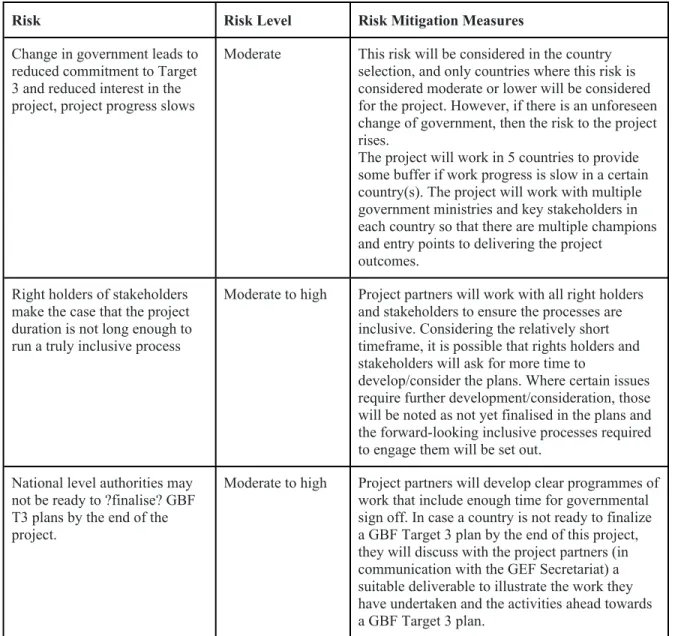
Given the relatively short timeframe for project development (under two months), scoping of countries for inclusion in the project is underway in project development but could not be completed with full government sign off. As such, the five participating countries will be finalized early in implementation.
A selection process and criteria for selection of the 5 countries has been developed and agreed upon, as follows.
Process:
? Develop a long list of countries that meet the goals of geographic representation of the GEF client countries and some level of commitment towards Target 3,
? Hold virtual consultations with in-country representatives from WWF and CSF to assess against the full list of criteria,
? Create a short list with a balance of: geographic representation, LDC, SIDS, MIC, and megadiverse countries, as well as marine and terrestrial area-based conservation opportunities,
? Hold virtual consultations with relevant government ministries, GEF OFPs and CBD Focal Points to discuss the project and gauge willingness and interest to engage, and
? Finalize the list of 5 countries.
Selection Criteria:
? Government willingness to generate plans for Target 3 within the project timeframe,
? Likelihood of engagement of civil society and IPLCs in the project and good relationship and attitude of government and project partners to civil society and IPLCs,
? Commitment to IPLC approaches, such as ICCAs and OECMs, and leadership in IPLC conservation,
? WWF office capacity (and CSF reach) to facilitate the project implementation in-country, especially the stakeholder engagement,
? Availability of technical expertise in-country to do the required analyses,
? Strong commitment to Target 3 (high ambition coalition member),
? Low risk of political turnover or instability in the project period,
? Capacity to influence other countries,
? Availability of relevant data, and
? Overall group of countries with inclusion/balance of LDCs, SIDS, megadiverse, and geographic/ecological balance.
The countries selected will represent diverse geographies, biomes, and potential for IPLC and/or OECM integration into Target 3 plans. With representation from four continents, there will be regional examples relevant for other GEF-eligible countries. Selected countries will ideally represent a spectrum of places from those that are already international leaders to places that have further to go for planning to reach Target 3. Finalization of countries will take into account government willingness to champion this work and present the work at global events or forums (such as GEF Assembly, tbd), local capacity that can dedicate time to this project, and no changes at the head-of-state level that would be expected to impact the project. Membership in the High Ambition Coalition, existing relationships between civil society and government to get this work done, and places that have the capacity to influence others and/or lead on IPLC issues will also be factors in consideration. Discussion on all of these criteria with country governments, including GEF Operational Focal Points, is underway and could not be completed during the condensed project development period. Country selection will be finalized during early project implementation.
Component 1: Develop inclusive and effective national level plans to achieve Target 3 Outcome 1.1 Strengthened country planning/ capacity to meet/exceed GBF Target 3
This component and outcome will develop a guide to support the development of inclusive and effective plans towards meeting or exceeding Target 3 in the 5 countries involved in this project as well as all other GEF-eligible countries and other governmental agencies, rights holders and stakeholders who might also use the guide. It also includes the development of plans for achieving or exceeding GBF Target 3 in ways that are inclusive and effective.