Creating an Enabling Environment to Support LDN Target Implementation Through Strengthening Capacities and Establishing an LDN Monitoring and Reporting System in Bosnia and Herzegovina
Part I: Project Information GEF ID
10830 Project Type MSP
Type of Trust Fund GET
CBIT/NGI CBIT No NGI No Project Title
Creating an Enabling Environment to Support LDN Target Implementation Through Strengthening Capacities and Establishing an LDN Monitoring and Reporting System in Bosnia and Herzegovina
Countries
Bosnia-Herzegovina Agency(ies)
UNEP
Other Executing Partner(s) FAO
Executing Partner Type GEF Agency
GEF Focal Area Land Degradation
Taxonomy
Focal Areas, Land Degradation, Sustainable Land Management, Sustainable Forest, Improved Soil and Water Management Techniques, Sustainable Agriculture, Land Degradation Neutrality, Food Security, Climate Change, Climate Change Mitigation, Agriculture, Forestry, and Other Land Use, Stakeholders, Type of Engagement, Information Dissemination, Participation, Consultation, Local Communities, Civil Society, Non- Governmental Organization, Communications, Public Campaigns, Awareness Raising, Education, Gender Equality, Gender results areas, Capacity Development, Participation and leadership, Gender Mainstreaming, Gender-sensitive indicators, Women groups, Beneficiaries, Capacity, Knowledge and Research, Knowledge Generation, Private Sector, Individuals/Entrepreneurs, Knowledge Exchange
Sector Rio Markers
Climate Change Mitigation Climate Change Mitigation 1 Climate Change Adaptation Climate Change Adaptation 0
Submission Date 6/21/2022
Expected Implementation Start 7/1/2022
Expected Completion Date 6/30/2024
Duration 24In Months Agency Fee($) 82,008.00
A. FOCAL/NON-FOCAL AREA ELEMENTS
Objectives/Programs Focal Area Outcomes Trust
Fund GEF
Amount($) Co-Fin Amount($)
LD-2-5 Create enabling
environments to support scaling up and
mainstreaming of SLM and LDN
GET 863,242.00 6,563,000.00
Total Project Cost($) 863,242.00 6,563,000.00
B. Project description summary
Project Objective
To foster a coherent policy environment and track progress towards achieving the national LDN targets.
Project Componen t
Financin
g Type Expected
Outcomes Expected
Outputs Trus
t Fun d
GEF Project Financing($
)
Confirmed Co- Financing($
)
Project Componen t
Financin g Type
Expected Outcomes
Expected Outputs
Trus t Fun d
GEF Project Financing($
)
Confirmed Co- Financing($
)
1: Creating an enabling environment for LDN
Technical
Assistance 1.1: Improved institutional, legal and policy framework for LDN
implementatio n
Indicator:
Number of planning documents that incorporate LDN monitoring and reporting for enhanced LDN
implementatio n
1.2: Enhanced LDN target implementatio n capacity of relevant stakeholders
Indicator:
200 individuals (100 women and 100 men) receiving support through the capacity development program
1.1.1 :
Analysis of the current institutional and legal set up in the country to assist in the identification of the key/hosting LDN institution responsible for monitoring and reporting (with clearly determined responsibilities ) on LDN progress
1.2.1: Capacity development program in place on LDN target setting and
implementatio n for BiH FBiH/RS Government staff, smallholder farmers and other relevant authorities (including the key/hosting institution)
GET 492,496.00 788,000.00
Project Componen t
Financin g Type
Expected Outcomes
Expected Outputs
Trus t Fun d
GEF Project Financing($
)
Confirmed Co- Financing($
)
Component 2:
Establishing LDN monitoring and reporting system and development of LDN roadmap
Technical
Assistance 2.1 LDN monitoring and reporting capacity improved at national and sub-national levels to support LDN in production landscapes in line with the Global Support Programme III
Indicator:
Decision support system that aligns local and national data operational to support planning, monitoring and reporting
10,000 hectares under best practices are selected and supported with gender perspective
2.1.1 Land Monitoring and Information sharing system (LMIS) developed, with two hosts
2.1.2 Capacity to monitor and report on LDN improved at national and sub-national levels
2.1.3: SLM and SFM best practices in forests, rangelands and croplands demonstrated on 4 pilot areas in both entities and results monitored via LMIS
GET 246,054.00 4,266,000.0 0
Project Componen t
Financin g Type
Expected Outcomes
Expected Outputs
Trus t Fun d
GEF Project Financing($
)
Confirmed Co- Financing($
)
Monitoring and evaluation
Technical
Assistance 3.1 Monitoring and
dissemination of lessons learned to support scaling up of FLR to the national level
3.1.1 Projects results and lessons learned disseminated among stakeholders on national and sub national level
3.1.2 Project results monitored and evaluated
GET 46,250.00 852,000.00
Sub Total ($) 784,800.00 5,906,000.0 0
Project Management Cost (PMC)
GET 78,442.00 657,000.00
Sub Total($) 78,442.00 657,000.00
Total Project Cost($) 863,242.00 6,563,000.00
Please provide justification N/A.
C. Sources of Co-financing for the Project by name and by type Sources of
Co- financing
Name of Co-financier Type of Co- financing
Investment
Mobilized Amount($)
Recipient Country Government
Ministry of Agriculture, Forestry and Water Management of Republika Srpska
In-kind Recurrent expenditures
6,300,000.00
GEF Agency FAO Grant Investment
mobilized 263,000.00
Total Co-Financing($) 6,563,000.00 Describe how any "Investment Mobilized" was identified
i. FAO cofinancing corresponds to Technical Cooperation Programs in BiH supporting
D. Trust Fund Resources Requested by Agency(ies), Country(ies), Focal Area and the Programming of Funds Agenc
y Tru
st Fun d
Country Focal
Area Programmi
ng of Funds
Amount(
$) Fee($) Total($)
UNEP GET Bosnia-
Herzegovi na
Land Degradati on
LD STAR
Allocation 863,242 82,008 945,250.
00
Total Grant Resources($) 863,242.
00 82,008.
00 945,250.
00
E. Non Grant Instrument
NON-GRANT INSTRUMENT at CEO Endorsement
Includes Non grant instruments? No Includes reflow to GEF? No
F. Project Preparation Grant (PPG) PPG Required true
PPG Amount ($) 50,000
PPG Agency Fee ($) 4,750
Agenc
y Trus
t Fun d
Country Focal
Area Programmin
g of Funds Amount($
) Fee($) Total($)
UNEP GET Bosnia-
Herzegovin a
Land Degradatio n
LD STAR Allocation
50,000 4,750 54,750.0 0
Total Project Costs($) 50,000.00 4,750.0
0 54,750.0 0
Core Indicators
Indicator 4 Area of landscapes under improved practices (hectares; excluding protected areas)
Ha (Expected at PIF)
Ha (Expected at CEO
Endorsement) Ha (Achieved at
MTR) Ha (Achieved at
TE)
10000.00 10000.00 0.00 0.00
Indicator 4.1 Area of landscapes under improved management to benefit biodiversity (hectares, qualitative assessment, non-certified)
Ha (Expected at PIF)
Ha (Expected at CEO
Endorsement) Ha (Achieved at
MTR) Ha (Achieved at
TE)
Indicator 4.2 Area of landscapes that meets national or international third party certification that incorporates biodiversity considerations (hectares)
Ha (Expected at PIF)
Ha (Expected at CEO
Endorsement)
Ha (Achieved at MTR)
Ha (Achieved at TE)
Type/Name of Third Party Certification
Indicator 4.3 Area of landscapes under sustainable land management in production systems
Ha (Expected at PIF)
Ha (Expected at CEO
Endorsement) Ha (Achieved at
MTR) Ha (Achieved at
TE) 10,000.00 10,000.00
Indicator 4.4 Area of High Conservation Value Forest (HCVF) loss avoided
Ha (Expected at PIF)
Ha (Expected at CEO
Endorsement) Ha (Achieved at
MTR) Ha (Achieved at
TE)
Documents (Please upload document(s) that justifies the HCVF)
Title Submitted
Indicator 6 Greenhouse Gas Emissions Mitigated
Total Target Benefit
(At PIF)
(At CEO Endorsement)
(Achieved at MTR)
(Achieved at TE) Expected metric tons of
CO?e (direct)
28000 0
280000 0 0
Expected metric tons of CO?e (indirect)
0 0 0 0
Indicator 6.1 Carbon Sequestered or Emissions Avoided in the AFOLU (Agriculture, Forestry and Other Land Use) sector
Total Target Benefit (At
PIF) (At CEO
Endorsement) (Achieved
at MTR) (Achieved at TE) Expected metric tons of
CO?e (direct) 280,000 280,000
Expected metric tons of CO?e (indirect)
Anticipated start year of
accounting 2023 2023
Duration of accounting 20 20
Indicator 6.2 Emissions Avoided Outside AFOLU (Agriculture, Forestry and Other Land Use) Sector Total Target Benefit (At
PIF) (At CEO
Endorsement) (Achieved
at MTR) (Achieved at TE) Expected metric tons of
CO?e (direct)
Expected metric tons of CO?e (indirect)
Anticipated start year of accounting
Duration of accounting
Indicator 6.3 Energy Saved (Use this sub-indicator in addition to the sub-indicator 6.2 if applicable)
Total Target Benefit
Energy (MJ) (At PIF)
Energy (MJ) (At CEO
Endorsement)
Energy (MJ) (Achieved at MTR)
Energy (MJ) (Achieved at TE)
Target Energy Saved (MJ)
Indicator 6.4 Increase in Installed Renewable Energy Capacity per Technology (Use this sub-indicator in addition to the sub-indicator 6.2 if applicable)
Technolog y
Capacity (MW)
(Expected at PIF)
Capacity (MW) (Expected at CEO Endorsement)
Capacity (MW)
(Achieved at MTR)
Capacity (MW) (Achieved at TE)
Indicator 11 Number of direct beneficiaries disaggregated by gender as co-benefit of GEF investment Number
(Expected at
PIF) Number (Expected at CEO Endorsement)
Number (Achieved at MTR)
Number (Achieved at TE)
Female 1,100 1,100
Male 1,100 1,100
Total 2200 2200 0 0
Provide additional explanation on targets, other methodologies used, and other focal area specifics (i.e., Aichi targets in BD) including justification where core indicator targets are not provided
Part II. Project Justification
1a. Project Description
i. The global environmental and/or adaptation problems, root causes and barriers that need to be addressed.
The Global Environmental Problem
1. Land degradation is an important aspect of production, but it can severely influence livelihoods by limiting the availability of vital ecosystem services (including food and water), increasing the risk of poverty and ultimately forcing people to migrate. As a major global challenge, land degradation is one of the underlying threats to biodiversity, ecosystem stability, and global climate. The interconnectivity between ecosystems across multiple scales means that land degradation can trigger destructive processes that have cascading effects across the entire biosphere with dire effects on people livelihood and food security.
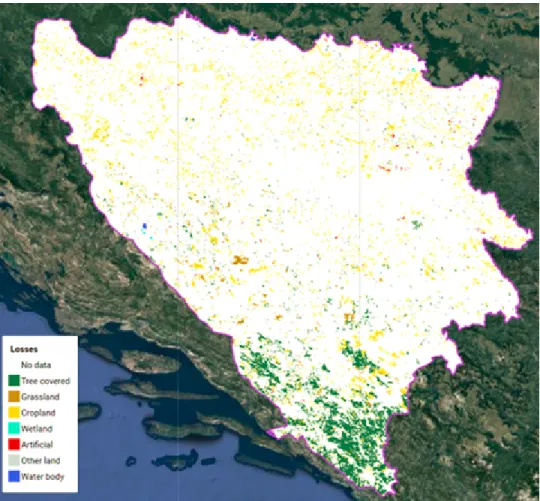
2. Human pressure affects the landscape characteristics, which affect the level of land sensitivity to degradation. Land abandonment and unsustainable use of rural and peri-urban areas are usually considered the main land cover-based drivers of land degradation[1]. There have been mainly two types of change that have increased land's sensitivity to degradation: decrease in croplands (converted into artificial areas or grass/shrubs) and increase of shrubs (transition of forest into shrubs, grassland and sparsely vegetated areas). Our study using CORINE data, shows that changes in land cover in Bosnia and Herzegovina for the periods 2000-2018 amount to 535,958 ha, i.e 10% of the country land cover types have changed (Figure1).
Figure 1: Land Cover change: Lost classes between 2000 and 2018 (Corine Data)
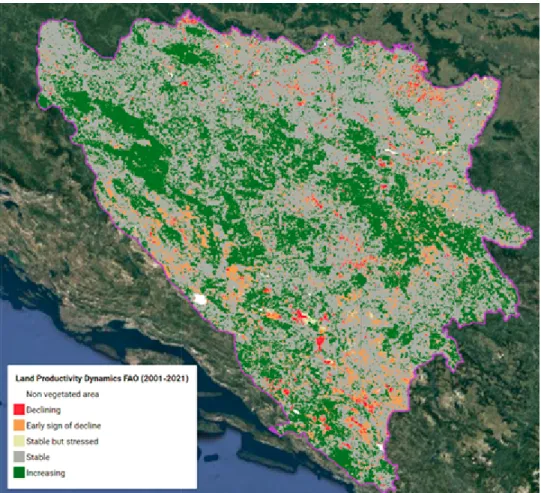
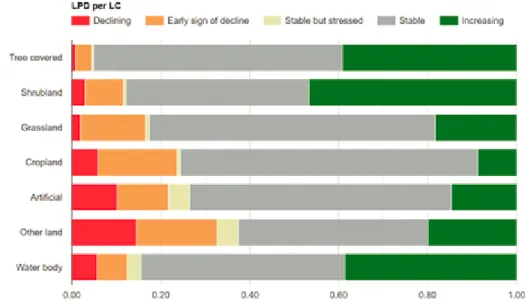
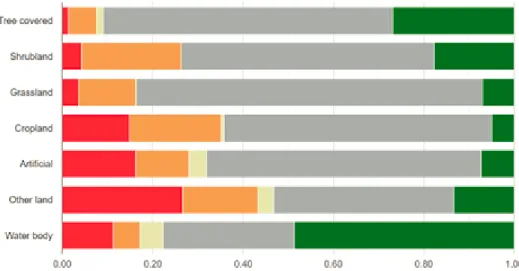
3. The analysis of Land Productivity Dynamic (LPD, Figure 2) shows that in the Federation of BiH land productivity has reduced on 84,011 ha, while early signs of reduction were observed on 379,048 ha in the period 2001-2021. A total area of land that is stable but under stress, from the productivity viewpoint, amounts to 35,044 ha. Productivity reduction in the Republic of Srpska is correlated with loss of agricultural land and forests, occurrence of extreme events like floods, drought and forest fires especially in Herzegovina as very vulnerable area. The areas of intensive agricultural production are the most affected one. Cropland is characterized by decreased land productivity on 187,880 ha or 3,68% territory for the observed period. Land productivity of forests, shrubs, grasslands and sparsely vegetated land, has been decreased on 356,028ha or 7% of the territory. Overall, grasslands and croplands represent the most unbalanced from a LDN perspective (Figure 3)
Figure 2: Land Productivity Dynamics (LPD) Map calculated using MODIS NDVI time series from 2001 to 2021 (Method from FAO published in https://doi.org/10.4060/cb7986en)
Figure 3: Distribution of LPD for each of the land cover classes of the new ESA Land Cover map (European Space Agency, WorldCover 10m resolution for 2020)
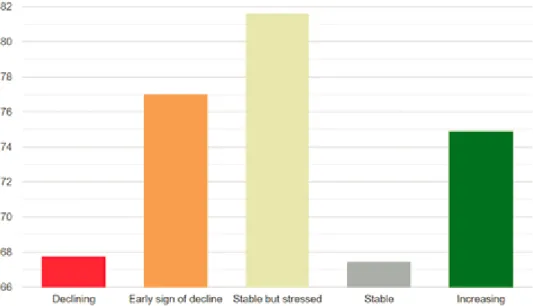
4. Soil organic carbon (SOC) stocks are of importance because of their role in the global carbon cycle. According to the data, the carbon content ranged between 0 to 174 t/ha, while the average is 70 t/ha. The category with carbon stocks amounting 50-110 t/ha represents the soils of medium
structure stability, fertility and water retention capacity. Higher SOC content is found in Forest, shrublands and grasslands, while cultivated land in general presents lower SOC content. Regarding LPD the areas with Early sign of Decline and Stressed productivity are the ones that also have higher SOC on average (figure 4).
Figure 4: Average SOC for each LPD category (According to the GSOC map available at http://54.229.242.119/GSOCmap/)
5. During the post-conflict and economic transition period, Bosnia and Herzegovina (BiH) has been facing numerous social, economic and environmental problems among which the land degradation stands out as one of the most crucial ones. Pursuant to a decision of the BiH Parliamentary Assembly, Bosnia and Herzegovina acceded the UNCCD in 2002 and became its full-fledged Party on 26th November 2002. Land use in BiH is affected by inadequate and unsound planning practices of resource utilization. In most cases, loss of agricultural land is caused by unplanned construction of residential and industrial facilities and infrastructure, unsustainable agriculture practices, wildfire, unreasonable exploitation of mineral raw materials and excessive erosion caused by deforestation and inadequate treatment of steep slopes, but also abandoned land due to internal and external migrations for the past 25 years. In BiH, 1.2 million people live on degrading agricultural land. The share of rural residents, who inhabit degraded agricultural land, is around 52% of the total rural population.
6. The United Nations Convention to Combat Desertification (UNCCD) has defined land degradation neutrality (LDN) as ?a state whereby the amount and quality of land resources necessary to support ecosystem functions and services and enhance food security remain stable or increase within specified temporal and spatial scales and ecosystems?. It means securing enough healthy and productive natural resources by avoiding degradation whenever possible and restoring land that has already been degraded. At its core are better land management practices and better land use planning that will improve economic, social and ecological sustainability for present and future generations.
7. Land Degradation Neutrality (LDN) represents a paradigm shift in land management policies and practices. It is a unique approach that counterbalances the expected loss of productive land with measures to avoid or reduce that degradation and the recovery of degraded areas. It places the measures to conserve, sustainably manage, and restore land in the context of land use planning. It has strategic implications to how the country plans and manages its land resources.
Threats and root causes of land degradation
Unsustainable Agricultural Practices:
8. Unsustainable land management is a direct human cause of land degradation through processes of terrain deformation, soil erosion by water and/or wind, compaction and soil crusting, subsidence and waterlogging, in addition to the loss of essential nutrient and organic matter, disruption of water cycle, salinization and alkalization, and acidification. Several practices associated with intensive agriculture accelerate these processes and have also have a major negative impact on biodiversity.
9. Agriculture, being one of the essential economic activities and economic development for BiH, has a great influence on land processes and various types of its destruction and degradation. In agricultural land, protection and preventive actions must be related to the preservation of its physical, chemical and biological properties. Agricultural land in Bosnia and Herzegovina was reported at 43.18
% of total land area in 2018, making 22110 sq. Km, according to the World Bank (2022). The arable land (%) in Bosnia and Herzegovina was reported at 20.1 % of total land area, totaling 1029000 hectares and making 0.30957 ha/person. The amount of permanent cropland was reported at 1.9531%
of total land area.
10. The loss of SOC due to conventional tillage, which is nowadays the almost exclusive method applied in the cultivation of crops in BiH, has a direct impact on nutrients availability to plants and to the overall condition of soil physical and chemical properties. Soil organic carbon is responsible for many soil functions and allows the provision of ecosystem services such as an improved agricultural production and storage and filtration of water. Soils are also the largest terrestrial carbon pool and thus SOC plays also a crucial role in the global carbon balance by regulating dynamic biogeochemical processes and the exchange of GHGs. There are no state or entity data that can be used to appraise the SOC content in BIH. On the other hand, through the LDN process, global data (ISRIC 2016) are used for the SOC estimation despite many uncertainties particularly in shallow soils on limestone that covers the south of the country.
11. The amount of SOC in soils is essential also for the stability of the soil structure. Soils having less SOC are less resilient to the impacts of factors that can seriously deteriorate soil structure, as for example compaction, which reduces soil porosity, thus limiting water and air circulation, impeding root growth and reducing biodiversity. Compaction can be induced in various ways; most often it is the use of heavy agricultural machinery, poor tillage especially if performed during periods of bad weather conditions and rainfall. Structural weakness of soils leads to increased erodibility, with changes in land use and management systems directly affecting the intensity and speed at which erosion happens. As an example, conventionally tillage may produce a soil loss that may exceed the rate of soil formation in more than 2 orders of magnitude. This means that, upon inadequate soil management, erosive processes can be particularly severe and result in accelerated erosion. The degree of soil erosion in many areas of BiH is considered nowadays more favorable than in the past. Reductions in soil erosion were likely due to displacement during and after the Civil War, and reduction of anthropogenic pressure on land.
However, many regions of BiH are still exposed to erosion. For instance, vineyards and orchards, as well as plough fields are normally situated on sloping relief surfaces and locations. In these lands, erosion of varying intensity occurs, with consequences for agricultural productivity, pollution and siltation of waterbodies.
12. Intensification of soil management can also lead to nutrient depletion ?issue that is exacerbated in soils having low amounts of SOC. Although fertilization at levels that sufficiently replenish nutrient depleted soils are needed for maintaining soil health and enabling sustained agricultural production, an inadequate or lowly efficient use of fertilizers ends in adverse impacts not only on soil structure but also on environmental pollution (contamination of soil, groundwater, waterways, rivers, lakes, seas, etc.) and biodiversity (invasion of weeds).
13. The main soil pollutants are primarily agrochemicals (fertilizers and pesticides), primarily nitrates, but also soil contamination with heavy metals. Environmental pollution caused by agricultural activities is currently a topic of concern not only to many experts but also to the general public,
especially in areas having issues with increased concentrations of nitrates, phosphates, pesticide residues and other pollutants in drinking water and soil, which often brings into question the quality of certain agricultural products. In the lowland areas of Posavina, in river valleys on alluvial deposits, and in karst fields where intensive production of crops, vegetable, and fruit is carried out, there is a considerable uptake of pollutants into terrestrial ecosystems, being a consequence of the application of more chemicals in the form of mineral fertilizers, and in some cases, as previously noted, organic fertilizers, with the issue of nitrogen often in the first place. Systematic soil fertility monitoring should be performed at least once every five years to obtain reliable data on the condition, fertility, and needs for its improvement. The priority of achieving high yields and producing good quality products is achieved using organic fertilizers, and the use of manure and mineral fertilizers should meet crop requirements for nutrients with a minimum of environmental pollution. The quantities should be based on the needs of the plants, the nutrient content of the manure and the soil reservoir. The total amount of nitrogen applied to the soil must not exceed 170 kg/ha (Nitrate Directive). Fertilizer consumption in Bosnia and Herzegovina was reported at 182 % of fertilizer production in 2018, making 84.76 Kg of fertilizer per hectare of arable land, according to the World Bank collection of development indicators, compiled from officially recognized sources in May of 2022.
14. Inadequate fertilization can also lead to soil acidification, which can be produced, in addition to natural processes, by the intensive use and application of inadequate agrotechnical measures, as well as pollution due to dry and wet deposition of air-pollutants. Acidic soils cover around 1/3 of the total soil resources in BIH (UNEP 2017). The reduced intake of organic matter and the use of exclusively mineral (nitrogen) fertilizers have also contributed to the more intensive process of soil acidification over the past decades. On the other hand, salinization is recognized as a land degradation driver typical of the agricultural regions of BIH, and the general conclusion is that high-quality soils (classes I, II, and III of soil capability) account for only 15%?16% of all soils (UNEP 2017).
15. Different types of soil, as well as the amount and distribution of rainfall in certain parts of Bosnia and Herzegovina further contribute to the impact of agricultural activities on the state and quality of the environment. An important condition for sustainable land management is the choice and type of agricultural production in accordance with the soil properties and the climate conditions of the area, and soil health should be maintained or improved by choosing the appropriate cultivation method and agricultural practices for a given crop.
16. The Good Agricultural Practice (GAP) Code forms the minimum standard for farm management that includes the protection of natural resources environmental management, workforce safety, animal health and welfare, food security, and health protection. The Code of Good Agricultural Practice is just a set of recommendations to help farmers improve their performance. It is normal for good agricultural practice to be supported by legislation. Implementing the Code in agricultural practice will be easy for some farmers, but in some areas, it will be difficult to implement because of the natural conditions, especially in marginalized areas. The Code requires farmers to contribute, to the best of their abilities, to the conservation of the natural environment, the conservation of soil fertility, and the maximum utilization of potential aimed at food production and the achievement of the quality of agricultural products. In order to minimize the negative impact of agricultural activities on the condition and degradation of land, it is necessary to take various measures and procedures that will help preventive conservation of land, improvement of the level of degradation, or its natural potential.
One of the important procedures is to know the natural properties of the soil, which is achieved through detailed pedological research and fertility studies. The identification and selection of a set of soil quality parameters to be monitored is of particular importance.
17. Climate Change: Climate change exacerbates the rate and magnitude of several ongoing land degradation processes and introduces new degradation patterns. Human-induced global warming has already caused observed changes in two drivers of land degradation: increased frequency, intensity and/or amount of heavy precipitation; and increased heat stress. In some areas sea level rise has exacerbated coastal erosion. Global warming beyond present day will further exacerbate ongoing land
degradation processes through increasing floods, drought frequency and severity, intensified cyclones, and sea level rise, with outcomes being modulated by land management.
18. Climate change-induced land degradation is very important in BIH, revealed through floods, drought and frequent wildfires in the recent decades. As an additional form of land degradation, floods, drought and wildfires are becoming more and more frequent over the past several years. Data of the Federal Office for Civil Protection indicate that at the level of FBiH, for the period 2010-2012, flood and landslide-induced damages amounted to approximately USD 51 million, while drought-induced damages amounted to USD 91,806,678.12. On the other hand, official reports of the Ministry of agriculture, forestry and Water Management of the RS, showed total economic damage caused by drought, and reflected through the reduction of corn and soybean production amounted to USD 50,480,182.94. Looking at the production of vegetables in the open air, the damage caused by the drought in 2017 amounted USD 26,610,910,59. Damage in the area of ??fruit production amounted USD 38,364,705.88. Therefore, weather conditions have significantly affected the agrarian sector of RS, with the most significant agricultural regions (Semberija, Posavina, Lijev?e Polje and Herzegovina) seriously affected by drought. This caused a decrease in production value of about 115million USD in just one year and one Entity.
19. At the same time, land degradation is a driver of climate change through emission of greenhouse gases (GHGs) and reduced rates of carbon uptake. Lower carbon density in re-growing forests, compared to carbon stocks before deforestation, results in net emissions from land-use change.
Forest management that reduces carbon stocks of forest land also leads to emissions, but global estimates of these emissions are uncertain. Cropland soils have lost 20?60% of their organic carbon content prior to cultivation, and soils under conventional agriculture continue to be a source of GHGs.
Agricultural practices also emit non-CO2 GHGs from soils and these emissions are exacerbated by climate change, contributing to feed the degradation loop.
20. Industry: Industry contaminates land through toxic pollutants and by deposition of pollutants directly to the air (dry and wet deposition). Emission of aero-pollutants sooner or later falls on the ground in an altered or non-altered form. Pollutants contaminate not only the land itself but can get to water bodies and to the food chain, jeopardizing ecological balance, ecosystem services and human health. Thermal power plants and cement production facilities in the areas of study are the main sources of dust and ash that contaminate arable land in their vicinity.
21. BiH has important coal deposits, and iron and bauxite ores. Coal is exploited at an area of 18,000 ha whereas the waste material disposal area takes up nearly 6,000 ha. Open cast mining or surface exploitation of mineral ore (coal, iron ore, bauxite and clay) has left about 15,000 ha of damaged land to date, and the main consequences of such exploitation are direct loss of land and land out of use in areas where waste material is disposed. Quite often, heavy metals contamination causes permanent distortion of the physical features of soil.
22. The laws on mining provide for the mandatory remediation of degraded areas and a land reclamation plan must be incorporated into the mining projects. In most cases, land reclamation is implemented by applying technical and biological measures, after which mined out areas can be used for agriculture or forestry. According to the Law on Environmental Protection of FBiH[2] and the Law on Environmental Protection in RS[3], the mines producing more than 50,000 tons annually, or those covering an area larger than five hectares, are obliged to have an environmental permit, carry out regular monitoring of emissions and report to competent institutions.
Pilot Sites
23. To better understand and present the location and information available on LDN and natural resources of the project selected Cantons and municipalities, the project designers have developed an
interactive Decision Support System (DSS) that was used during the PPG phase. It will be available for use, and further development during project implementation (as described in Output 2.1.1 of the alternative scenario). The DSS allows for context specific baseline establishment at the required scales, providing data at for different administrative units and landscape, with a set of spatial data layers, toolboxes and cross-analytical statistics. To access the project specific LDN DSS, please follow the provided link: https://projectgeffao.users.earthengine.app/view/ldn-bih
24. This system allows users to explore relevant baseline data, visualize maps and use it them for a wide range of scenarios and scales. The DSS allows to perform multi-criteria analysis and explore land cover transitions to select hotspot and areas of interest and thus serving as a basis for a future monitoring and reporting system. The possibility to explore the dataset in a dynamic way without any GIS requirement and in an intuitive environment also facilitates that more stakeholders can evaluate the quality and usefulness of the data, which contributes to understand how to improve the LDN indicators in the future. It also can provide a range of information on project demonstration sites as described below.
25. The most vulnerable regions affected with land degradation were identified during LDN Target setting process in BiH, implemented separately by each entity. Taking into account the state of the indicators in LDN Report (2018), two most important hot spots were identified. One is located in the South-eastern part of the country and the other in the North-eastern part. On meetings and expert workshops, the focal areas were further narrowed down to 4 cantons/municipalities (Figure 5), that will allow for better demonstration sites and be representative of the region for scaling up results.
26. For the Federation of Bosnia and Herzegovina (FBiH) the Tuzla Canton was chosen in the North-eastern part and for the Republic of Srpska (RS) the Bijeljina Municipality, from the standpoint of land degradation under anthropogenic influence. In the South-eastern and from the standpoint of natural influences, drought and fires, followed by erosion due to degradation processes, the Neretva Canton (FBiH) and Trebinje Municipality (RS) were chosen).
Figure 5: Project selected areas, Tuzla Canton and Bijeljina Municipality in the North-eastern part and Neretva Canton and Trebinje Municipality in the South-eastern part.
27. Tuzla Canton is one of the most degraded areas in (FBiH). The abandonment of traditional grazing methods in Tuzla Canton has led to the expansion of shrubbery and woody vegetation on pastures as well as the emergence of invasive species. Overgrowing of pastures has a negative impact on biodiversity and local communities, especially on people who are still engaged in animal husbandry, since suitable grazing sites are disappearing. Agriculture and food industry which provide significant income to many families in the basin, are also affected by the use of water of poor quality and the presence of pollutants. Tests carried out by the FBiH Institute of Agropedology indicate a continuous presence of organic pollutants as well as the presence of mercury in the amounts exceeding the officially permitted levels. Pollutants do not only contaminate the soil, but easily pass through the soil and contaminate groundwater. Plants absorb pollutants from the soil and transfer them to the food chain. The most fertile lands in this area are along the river Spre?a and the production from this zone could directly endanger the health of consumers as well as their right to access to safe food and foodstuffs. Also, the export of such products to the international market has been precluded since they do not meet the set quality standards. While the productivity trend is dominantly stable, for some land types like shrublands, grasslands and croplands the situation is very unbalanced with more areas in negative trends than in positive ones (Figure 6).
Figure 6: Distribution of LPD for each of the land cover classes in the Tuzla Canton
28. Bijeljina Municipality is one of the most important agricultural areas of the Republic of Srpska. Intensive agricultural production as the backbone of economic development, but commercial agriculture is negatively affecting land productivity and soil health. The local community identified frequent drought and floods as very important land degradation drivers, but also soil compaction and uncontrolled usage of fertilizers and pesticides. The agricultural producers especially highlighted the problem of deficiency of land resources for leasing and cultivation, which distinguishes them from other areas s where abandoned agricultural land is identified as an important factor of land degradation.
In addition, urbanization has been identified as pressure on land resources, where significant areas of fertile land are permanently lost due to urbanization. Investment into land rehabilitation measures would be an important prerequisite for achieving land degradation neutrality in this region.
29. Neretva Canton and neighboring Trebinje Municipality share many common features in their southern part that is dominated by semi-arid conditions. This area is impacted by extreme climatic phenomena such as heavy showers, winds, and even strong isolation. These climatic phenomena through erosion create recognizable areas of exposed karst and bare land area. This phenomenon happens mostly on the slopes, where it is impossible to form soil without landscaping and protection against erosion, the washed soil goes into the valleys where high quality and fertile soils are formed.
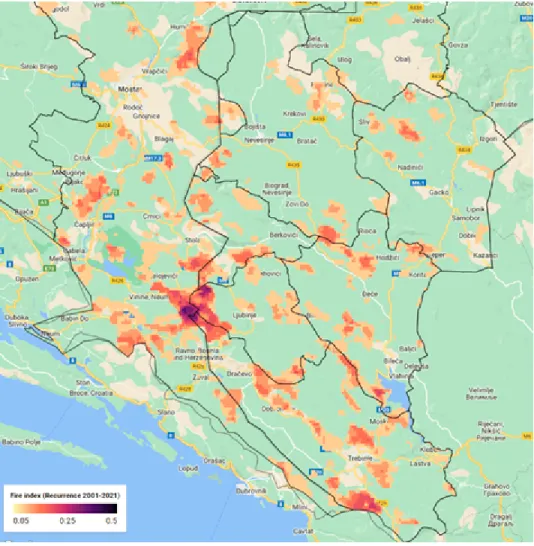
Many areas of karstic soil were used for intensive agriculture and abandoned after erosion reduced productivity. Erosion and grazing continued on these lands, exacerbated by high recurrence of fires in the last 20 years (figure 7).
Figure 7: Fire recurrence between 2001 and 2021. Values close to 1 indicate at least one burning event every year and values of 0.1 indicate 1 burning every 10 years. (Sources FAO:
https://doi.org/10.4060/cb7986en ).
30. While fire is one of the environmental and evolutionary pressures that has led to the diversity of plant and animal life on Earth, climate change and human activities have increased the frequency, spread, severity, and biological effects of fires, accelerating vegetation type conversion, species diversity and biomass loss, and soil erosion. Fire is widely used as a land management practice to produce a green pick in grazing areas or for land clearing of cultivated areas, with a direct impact on greenhouse gas emissions. In order to preserve arable land on slopes from erosion, it is necessary to establish long-term Mediterranean cultures such as e.g. olives, pomegranate, figs, vines, lavender and other medicinal herbs. In the case of grazing lands, it is regenerative management techniques that can improve vegetation and soil health.
31. One dominant factor in all the 4 selected areas is the fact that soil health, vegetation productivity and diversity and water quality are being affected by a combination of poor management practices of agricultural land and socioeconomic dynamics related to land tenure. Land abandonment is one side of the spectrum while leasing dynamics affect the most valuable and productive lands. Mining and industrial activities provide also additional pressure that mounts on that of frequent drought and floods to worsen land degradation processes. Restoration of degraded landscapes is conceived as a triple win solution to regain ecological integrity, enhance human well-being in deforested or degraded landscapes and resilience to climate change. While better management is needed on agricultural and grazing lands to avoid further degradation and build up resilience to extreme climatic conditions, thus
maintaining ecosystem services and productivity and avoiding events of land abandonment.
Additionally, activities related to rescuing old traditional best practices on land management and land products processes associated to food or medicinal herbs, could provide more spaces for gender related activities and land abandonment avoidance.
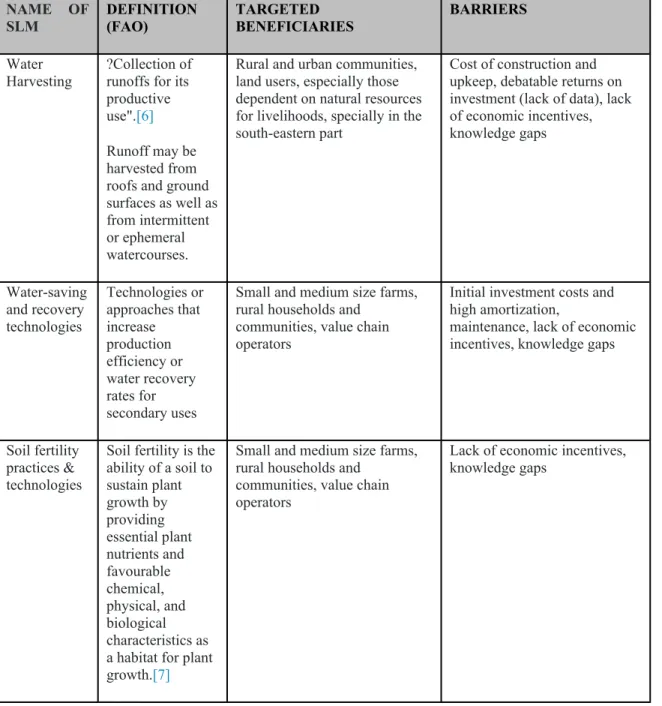
32. Working at field scale for the demonstration sites will require participatory stakeholder consultations with local producers and landowners, government agents, academics and professionals in the specific knowledge area, extension agents and other relevant partners from the value chain that is going to be targeted. A database of possible SLM to implement can be found in WOCAT[4], where some specific data and publications of BiH are also available[5]. Table 1 below provides a set of SLM that can be considered for a first approach at national level, but due that local conditions on each site are very particular, it should be adapted to each area with the participatory process to validate it. Then local users can have a basis of recommended practices for their sites from which to choose from.
Table 1: Description of the SLM technologies identified during project development:
NAME OF
SLM DEFINITION
(FAO) TARGETED
BENEFICIARIES BARRIERS
Water Harvesting
?Collection of runoffs for its productive use".[6]
Runoff may be harvested from roofs and ground surfaces as well as from intermittent or ephemeral watercourses.
Rural and urban communities, land users, especially those dependent on natural resources for livelihoods, specially in the south-eastern part
Cost of construction and upkeep, debatable returns on investment (lack of data), lack of economic incentives, knowledge gaps
Water-saving and recovery technologies
Technologies or approaches that increase production efficiency or water recovery rates for secondary uses
Small and medium size farms, rural households and
communities, value chain operators
Initial investment costs and high amortization,
maintenance, lack of economic incentives, knowledge gaps
Soil fertility practices &
technologies
Soil fertility is the ability of a soil to sustain plant growth by providing essential plant nutrients and favourable chemical, physical, and biological characteristics as a habitat for plant growth.[7]
Small and medium size farms, rural households and
communities, value chain operators
Lack of economic incentives, knowledge gaps
Soil
conservation practices &
technologies
Reversing the degradation of soil, water and biological resources and enhancing crop and livestock production through
appropriate land use and
management practices are essential components in achieving food and livelihood security[8]
Small and medium size farms, rural households and
communities.
Lack of economic incentives, knowledge gaps
Forest
Regeneration Forest
regeneration is the application of technology to allow forest to return to their ecological climax after trees have been harvested or have died from fire, insects, or disease.
Rural and urban communities, land users, especially those dependent on natural resources for livelihoods and drainage- basin communities, value chain and tourism operators
Initial investment costs, lack of economic incentives,
knowledge gaps
Rangeland
rehabilitation Process by which rangeland species return to a contextually appropriate species
composition and land productivity as stipulated by the Land Potential[9] and land management objectives
Pastoralists, rural households,
rural communities. Initial investment costs, lack of economic incentives,
knowledge gaps
Climate Smart Agriculture and integrated farm design
Climate-smart agriculture (CSA) is an approach that helps to guide actions needed to transform and reorient agricultural systems to effectively support
development and ensure food security in a changing climate.[10]
Integral, holistic design of the production space is a key element to the approach.
Small and medium size farms, rural households and
communities specially in the south-eastern part.
Initial investment costs, lack of economic incentives,
knowledge gaps
Wetlands and Riparian zone rehabilitation
Process by which riparian forest and wetland species return to their historic species composition and density
Rural and urban communities, land users, especially those dependent on natural resources for livelihoods, value chain and tourism operators
Initial investment costs, lack of economic incentives,
knowledge gaps
Remaining barriers
33. Weak institutional, policy and regulatory framework and lack of capacity in applying and promoting sustainable land management practices: Based on the BiH Constitution, environmental management is not institutionalized at the state level but is being carried out within the organizational structure of the entity governments, i.e., ministries on the entity level that have land-related jurisdiction and environmental issues in their portfolios. In Brcko District, environmental protection policy is a direct responsibility of the Government through its sectors for communal issues, agriculture and forestry. Lower level of environmental management is under the responsibility of cantonal ministries in the Federation BIH and municipalities in Republika Srpska. The improvement of the state of the environment in BiH should be a coordinated endeavour. To this effect, it is necessary to identify a mechanism which would facilitate a common approach in efforts to address this issue, as well as permanent regional and global participation with efficient, effective and coordinated cooperation with the entities and Brcko District, cantons and local communities, aimed at designing common measures against land degradation.
34. Weak institutional and regulatory context a as well as missing horizontal and vertical coordination among institutions at various governmental level are one of the main drivers of land degradation and are among the biggest barriers to sustainable land management system application.
There are no laws on land protection neither at state level nor entity or cantonal level. At the level of the Federation of BiH, there are three ministries relevant for land issues (the FBiH Ministry of
Environment and Tourism, the FBiH Ministry of Physical Planning and the FBiH Ministry of Agriculture Water Management and Forestry) as well as cantonal ministries or departments (10 cantons). However, there are no official mechanisms that require the institutions to exchange information and data and to coordinate their work in the area of land status monitoring, analysis and protection.
35. The general opinion is that the lack of the FBiH spatial plan opens up opportunities for non- institutional action and space management that is not in compliance with legal or any other sustainable forms and mechanisms. This is best manifested in activities relating to the adoption of spatial plans.
When it comes to spatial planning, there is also a pronounced problem of the lack of cooperation among sectors which is a major constraint as spatial planning must have a multi-sectoral character. The FBiH legislation has many deficiencies and requires review and harmonization. The existing legislation should be improved and enhanced by the principles and requirements imposed by the LDN approach.
Outcome 1.1 of the project will address this barrier.
36. Limited Capacity, and know-how for implementation of LDN Targets: The role of the local authorities is limited. Both decision makers and local communities need capacity building to understand the socio-economic gains from sustainable land management, sustainability practices and the practical guidance on how to implement sustainable land management practices on site. BiH authorities lack comprehensive guidelines for rehabilitation of degraded land, best measures to use and for sustainable land management needed to achieve land degradation neutrality as planned in their LDN Reports. The implementation of strategic documents and legal acts in the Federation of BiH is aggravated by the fact that the Federation of BiH has ten cantons that have their own competences for land management, environmental and spatial planning. The cooperation of relevant ministries is not at a satisfactory level, the strategies of various sectors are not harmonized, and this creates additional pressure on land and conflict in space.
37. With very scarce regulatory and procedural provisions, BiH lacks examples and experience in good practices of land conservation measures and activities. Over the past years (from the end of the war in 1995 onwards), little was done on tackling the rehabilitation of degraded land by investing in knowledge, resources capacity building and building experiences. Therefore, nowadays there is a lack of knowledge in all levels of government and local communities concerning sustainable land management approaches, land cultivation activities and common techniques.
38. While land degradation can occur as a result of natural processes, there is a widespread opinion that it mostly happens as a result of the impact of users? activity on the land and is often a
?social problem,? which can be prevented if the underlying causes are addressed properly. It is crucial to increase awareness of the importance of land as a natural and irreplaceable resource, educate public and human resources. Mobilizing citizens for the purpose of raising public awareness on the importance of land as a natural resource, and its preservation, represents a very important objective for restoring the degraded ecosystems within the country. Outcome 1.2 and 3.1 of the project will address this barrier.
39. Lack of information and Monitoring and reporting system for LDN roadmap: The lack of systematic land and soil monitoring, and of an information system of soil and land degradation is primarily linked to the lack of specific laws obliging to that. Furthermore, there are no official mechanisms that require the institutions to exchange information and data and to coordinate their work in the area of land monitoring, analysis and protection even within one entity. Systemic addressing of the issue of land protection against any type of degradation implies more active involvement of public and non-governmental organizations and of all citizens, in the process of making, adopting and implementing environmental decisions. Civil society and scientific community can significantly contribute to awareness raising efforts and education of population on problems causing land degradation and on land degradation consequences.
40. The Land Information System (LIS) foreseen by the Law on Agricultural Land (Official Gazette of FBiH, No. 52/09) and by the strategy of RS ?The Basis of Protection and Use of
Agricultural Land in RS? has not yet been established. Regular update of databases on spatial planning is also foreseen by the Law on Spatial Planning and Constructing in Brcko District (Official Gazette of BD No. 52/09). Since 2007, Pollution and Release and Transfer Registers (PRTRs) are partially in function in both political entities (Federation of Bosnia and Herzegovina and Republika Srpska) and Br?ko District (BD) in terms of reporting air pollution emissions by air polluters, but other forms of pollution (into land, soil, rivers) are still not reported.
41. Thus, there is no database of the state of agricultural/forest land in any of the entities, which would enable obtaining of data on agricultural/forest land and its losses to all stakeholders. A functional land monitoring system with quality and well-organized databases, so spatial analysis is facilitated and monitoring is enabled, is also lacking. The SOTER databases, which are the result of the FAO project ?Inventory of Land Resources 2000-2002?, and which could have been the basis for the Land Information System, are not up to date (although it partially exists in FBIH) regarding the state of land and the data required for the calculation of indicators monitored in NAP, including LDN indicators. The limited information available at national scale is restricted to basic land structure and use, soil classes and land ownership structures. In the specific case of soils, there is a particular lack of soil information, with BiH being absent from most European databases. Soil being an important component of land, its health features in the long-term goal of achieving land degradation neutrality within SDG Target 15.3, which specifically addresses soil/land degradation through Indicator 15.3.1 along with the LDN mechanism. Long and short-term development and investment decisions addressing the evaluation, prevention and restoration of degraded lands require integrated strategies and mechanisms that must, necessarily, be substantiated by accurate soil data.
42. The lack of adequate soil information is therefore a significant barrier regarding the achievement of LDN, as well as in the LDN target setting and reporting process. In many cases soil surveys were conducted decades ago, so the few available data do not reflect current conditions. In other cases, soil information exists, but a significant amount of it has been obtained under individual projects, resulting in fragmentation and low accessibility. Fragmentation is further exacerbated by the disconnection that may exist between government agencies whose mandated activities have direct and indirect impacts on land and soil, each of them maintaining separate and frequently unrelated databases. In other cases, soil information existed but was destroyed during the war, as, for example, the most complete overview of soil erosion of the country ?the Soil Erosion Map of the Socialistic Republic of BiH, developed between 1979 and 1985. This was reconstructed only for the RS and, currently, there is no reliable data on the areas affected by erosion in BiH at the national level and no erosion monitoring system is in place.
43. This means that, currently, the CORINE European database and the global datasets used for LDN process are the only sources of available data for the determination of baseline levels of SOC and for monitoring its changes, leading to unrealistic or inaccurate assessments of the actual situation at national and local scales. In addition, since SOC stocks can vary greatly in areas under the same land use/cover but different soil types, climate and management, the estimates of SOC change obtained from land cover/land use change disregard the SOC changes not linked to these transitions.
44. According to the 2018?s UNECE environmental performance review of BiH, there is also no adequate infrastructure for environmental sampling and analysis for emergency but also for routine inspections, meaning that immediate sampling and analysis of soil (as well as of air, water and waste) cannot be performed. These services are outsourced to private laboratories, are costly and cannot respond in the event of emergencies.
45. As a result of all this, the country is severely limited in its capacity to identify not only which locations and agricultural systems are degraded or have the highest risk of degradation, but also where to find the largest potential for C sequestration ?thus for increasing SOC stocks?, which is essential for leading the transformation from degrading systems to sustainably managed soil and lands, and crucial in the context of achieving LDN. Outcome 2.1 of this project will address this barrier.
ii. The baseline scenario and any associated baseline projects
46. In May 2017, the BiH Council of Ministers adopted an Action Program to combat land degradation and mitigate the effects of drought in Bosnia and Herzegovina (BiH NAP). This is the only state-level document which addresses the issue of land and combating land degradation. In this way, the basis for implementing the planned programs and measures has been created. As a result of the LDN process, on 31 October 2017, the Sarajevo Canton Government adopted the Cantonal Environmental Protection Plan where one of the operational goals (operational goal 4.3.) is the Implementation of UNCCD approach of ?land degradation neutrality? (LDN ? Land Degradation Neutrality) in accordance with UN SDG 15.3. goal. One of the measures provided is the Alignment of the legislation on the protection of agricultural and forest land with the EU and UN initiatives through the implementation of LDN, and the adoption of the Program of rehabilitation and planning of degraded land, abandoned solid waste landfills and the selection of new potential sites. In addition, a set of projects related to the rehabilitation and protection of land by 2022 was provided for in this plan.
The FBiH Ministry of Agriculture, Water Management and Forestry has started activities on amending the Law on Agricultural Land.
47. Active implementation of the FAO/GEF project ?Decision Support for Mainstreaming and Scaling up of Sustainable Land Management? (DS-SLM-GCP/GLO/337/GFF) started in December 2017. One of the project components is related to the promotion and integration of LDN into development policies and plans. This project is being implemented in ten municipalities, nine of which are in the Tuzla Canton area that is characterized as a hot spot in the LDN process. As a result of the LDN process, in 2017 the FBiH Ministry of Agriculture, Water Management and Forestry recommended to the FBiH Government to introduce the concept of land degradation neutrality.
48. Having recognized the importance of the LDN process, the Government of the Federation of BiH tasked the FBiH Ministry of Agriculture, Water Management and Forestry as well as cantonal ministries to work on drafting the land protection policies, to introduce and promote the land degradation neutrality concept into the process of planning and future development (FBiH Government Decision 2106/2016).
Associated baseline projects
49. The ongoing, continuous project Land use value map (executed at municipal and cantonal level), financed 100,000 EUR by the Federal Ministry of Agriculture, Water Management and Forestry, is analyzing the basic socio-economic factors affecting the methods of use of land area, primarily use of land. The main purpose of the project is to prepare thematic bases and maps, research and to analyze the area of a Municipality/Canton using GIS and remote sensing information sources (satellite and orthophoto). As outputs of this project , LD authorities in BiH will be capable to define balances of land area use methods, identify certain types of land damages and perform verifications through capability classes, as well as analysis of pedological characteristics of soil types.
50. Ongoing projects in RepublikaSrpska (BiH) related to the project:
? Construction of irrigation systems in Ljubinje(LDN hotspot area)which includes artificial accumulation and infrastructure for irrigation under pressure, budget 1,94 mil USD, duration 2020- 2023;
? Construction of irrigation systems in Aleksandrovac Laktasi (LDN hot spot area). It is planned to be used as pilot plots on irrigation technology, budget 0,88 mil USD, duration 2020-2023;
? Construction of irrigation systems in Trebinje (LDN hot spot area) infrastructure for irrigation under pressure, budget 6,18 mil USD, duration 2020-2023;
? Construction of irrigation systems in Semberija (Bijeljina) LDN hot spot area budget 9,29 mil USD, duration 2020-2023;.
51. Projects for the construction of irrigation systems are being implemented by the Ministry of Agriculture, Forestry and Water Management of the Republic of Srpska in cooperation with the World Bank. The projects aim is to rehabilitate and modernize existing irrigation systems, build new ones, and strengthen institutional capacity in the public and private sectors to ensure the sustainability and efficient use. Also, improvement of agricultural income for rural households with sustainable use of land resources represents additional benefits. The projects are of particular importance due to the fact that in the LDN hot spot regions, due to climate change, in the coming years there is an increased risk of drought and fire. Of the total value of the project, the World Bank finances 85% (through the loan), and a minimum of 15 percent will be provided by the Government of Srpska, beneficiaries and local communities.
52. Additionally, continuous projects in the RS entitled ?Basis for protection of development and usage of agricultural land? at the level of municipalities are financed by local governments (depending on the size and development of the municipality, approximately 25.000 EUR/municipality) represents strategic documents on the local level that are focused on land use along with drivers that cause land degradation under specific socio-economic conditions. Main sources of data are GIS and remote sensing information (satellite and orthophoto), that together with respecting pedological characteristics of soil types provide preconditions for recommendation on land use for different categories having in mind socio economic development, income of people dependant on agriculture, sustainable spatial planning and achievement of LDN on the local level. Four municipalities in the RS (Lakta?i, Doboj, Gradi?ka and ?amac) are now in process of creating local strategic document for land use planning.
53. UNDP in BiH project ?Interlinking Disaster Risk Management (IDRM) in Bosnia and Herzegovina? aims at strengthening Disaster Risk Reduction (DRR) policy and legal frameworks and enabling the implementation of disaster and climate risk management measures at all Government levels to protect citizens. Total cost of project is EUR 300,000.00 with duration of two years, starting February 2018, ending February 2020. Key activities include:
? Develop disaster response strategic capacity assessment and roadmap;
? Improve entity civil protection legislative framework;
? Improve local level disaster risk management through risk assessments and implementation of strategic DRR actions;
? Implementation of DRR measures in five municipalities.
54. Other Baseline project currently being implemented by FAO are listed below:
? TCP/BIH/3706 - To reduce vulnerability and resilience in disaster risk reduction in agriculture through strengthening capacity and coordination mechanisms (2019-2021, US$190,000):
The standalone project complements part of FAO activities within the Joint UN Programme UNDP, UNICEF, UNESCO, UNFPA, FAO, ?DRR for Sustainable development of Bosnia and Hercegovina 2018-2020? (UNJP/BiH/011/UNJ), financed by Switzerland. The project focuses on enhancing the established municipal DRR Platforms at state and entity levels, while strengthening local government?s disaster risk assessment capacities in agriculture through the municipal risk assessments. Additionally, the project aims at strengthening capacity and awareness of farmers and agricultural producers on DRR, and promote good practices and technologies to reduce the impact of natural hazards in the agriculture sector (by applying the FAO proprietary Farmer Field School (FFS) methodology).
? TCP/BIH/3802/C2 - Potentials of fast-growing plantation forests (2021-2022, US$63,000):
To address the impact of climate change on forests, FAO plans to conduct an assessment of potential locations for plantation forests in BiH, focusing on fast-growing wooden species along rivers, as well as prepare technical guidelines for the sustainable management of plantation forests to contribute and achieve a strong commitment to support a future climate change mitigation intervention in the forestry sector. Additionally, the project will support the discussions with national and sub-regional administration as well as municipalities and land owners to contribute to and achieve a strong commitment to support a future climate change mitigation intervention in the forestry sector through the establishment of fast-growing plantation forests while contributing to the sustainable economic development of rural areas in BiH.
? TP/BIH/3705 - Strengthening of the private and public sector capacities in priority value chains (2020-2021, US$153,000):
FAO is currently providing technical assistance in building the technical capacity of institutional staff, producer groups, farmers, advisory services, and local communities to develop potato, rural tourism and plum value chains, which have been selected as a result of consultations with all stakeholders (ministries, agencies, local governments, NGOs in sector). In the context of Bosnia and Herzegovina, special attention is given to the value-chain challenges of particular relevance to the regional economies, that are identified by applying FAO?s ?Sustainable Food Value Chain (SFVC) proprietary development framework?. Within the framework of this project two value chain analytical reports and three local plans will be developed.
? TCP/BIH/3801/C1 - To strengthen the administrative system to manage and support sustainable geographical indications (2021-2022, US$75,000):
FAO is starting to assist the National Food Safety Agency with the assessment of the geographical indications (GI) potential of Bosnia and Herzegovina through a countrywide awareness campaign on advantages of GIs and registration procedures for agriculture producers and agribusiness, municipalities. Being a marketing tool, GI can be instrumental for enhancing regional trade integration and market access by distinguishing the products in the market, supporting local production and rural development, contributing to local tourism and fighting with product counterfeiting.
? UNJP/BiH/011/UNJ - To support local DRR multi sectoral platforms (2019-2022, US$4.9mil.):
FAO is currently one of the UN Agencies (together with UNDP, UNICEF, UNESCO, and UNFPA) implementing the Joint Swiss UN Programme "Reducing Disaster Risk for Sustainable Development in Bosnia and Herzegovina", where FAO is responsible for strengthening the capacities of agriculture sector and vulnerable farmers in target localities to increase disaster preparedness and reduce disaster losses. The Programme aims to introduce and operationalise an integrated model of disaster risk governance and livelihood enhancement at the local level, as a springboard to a bottom-up introduction of DRR governance in Bosnia and Herzegovina.
National institutional and legal setup