Mainstreaming biodiversity conservation in the tourism sector of the protected areas and strategic ecosystems of San Andres, Old Providence and Santa Catalina islands
Part I: Project Information GEF ID
10578 Project Type FSP
Type of Trust Fund GET
CBIT/NGI CBIT NGI Project Title
Mainstreaming biodiversity conservation in the tourism sector of the protected areas and strategic ecosystems of San Andres, Old Providence and Santa Catalina islands Countries
Colombia Agency(ies) WWF-US
Other Executing Partner(s) Executing Partner Type Conservation International Foundation (CI) and Corporation for the Sustainable Development of
the Archipelago of San Andrés, Old Providence and Santa Catalina (CORALINA) Others GEF Focal Area
Biodiversity Taxonomy
Focal Areas, Biodiversity, Mainstreaming, Tourism, Ceritification - International Standards, Infrastructure, Certification -National Standards, Financial and Accounting, Payment for Ecosystem Services, Conservation Finance, Species, Wildlife for Sustainable Development, Threatened Species, Protected Areas and Landscapes, Productive Seascapes, Community Based Natural Resource Mngt, Coastal and Marine Protected Areas, Biomes, Coral Reefs, Mangroves, Influencing models, Convene multi-stakeholder alliances, Transform policy and regulatory environments, Strengthen institutional capacity and decision-making, Stakeholders, Private Sector, Financial intermediaries and market facilitators, Individuals/Entrepreneurs, Capital providers, Indigenous Peoples, Civil Society, Community Based Organization, Non-Governmental Organization, Type of Engagement, Participation, Consultation,
Communications, Public Campaigns, Behavior change, Education, Beneficiaries, Local Communities, Gender Equality, Gender Mainstreaming, Women groups, Gender results areas, Participation and leadership, Access and control over natural resources, Capacity Development, Knowledge Generation and Exchange, Capacity, Knowledge and Research, Knowledge Generation, Innovation, Learning, Indicators to measure change
Rio Markers
Climate Change Mitigation Climate Change Mitigation 0 Climate Change Adaptation Climate Change Adaptation 0 Duration
42 In Months Agency Fee($) 238,706
Submission Date 4/17/2020
A. Indicative Focal/Non-Focal Area Elements
Programming Directions Trust Fund GEF Amount($) Co-Fin Amount($)
BD-1-1 GET 1,522,500 17,083,463
BD-2-7 GET 1,129,794 2,116,079
Total Project Cost ($) 2,652,294 19,199,542
B. Indicative Project description summary
Project Objective
To promote biodiversity conservation mainstreaming in the tourism sector of the Protected Areas and strategic ecosystems of San Andres, Old Providence and Santa Catalina islands through the design and implementation of participatory governance models, effective policies and biodiversity friendly tourism products.
Project Component Financin g Type
Project Outcomes Project Outputs Trust Fund
GEF Amount($) Co-Fin Amount($)
Project Component Financin g Type
Project Outcomes Project Outputs Trust Fund
GEF Amount($) Co-Fin Amount($)
Component 1: Planning and Institutional Framework for a biodiversity focused tourism sector in the MPA, PAs and three islands of the Archipelago, in the context of the POMIUAC.
Technical Assistance
Outcome 1.1:
Biodiversity is mainstreamed into tourism for MPA, PAs and three islands of the Archipelago, for improved protection of corals, sandy beaches, mangroves and key species
Output 1.1.1: Interinstitutional coordination group created to advise and accompany the design and implementation of a new sustainable tourism plan for MPA, PAs and the three islands, in the context of POMIUAC, including active participation of the tourism private sector.
Output 1.1.2 Carrying capacity assessments and spatial use analysis of threatened ecosystems of MPA, PA and three islands for the design of environmental management measures to implement into the tourism sector.
Output 1.1.3: Sustainable tourism plan developed and under early implementation stages by responsible authorities (CORALINA and the Tourism Secretariat), as part of the POMIUAC.
Output 1.1.4: Technical assistance to local authorities to mainstream biodiversity conservation in the design and development of green and grey infrastructure projects (in the context of the POMIUAC and updated tourism plan).
GET 810,000 15,850,000
Project Component Financin g Type
Project Outcomes Project Outputs Trust Fund
GEF Amount($) Co-Fin Amount($)
Component 2:
Management of tourism impacts on the key biodiversity of the MPA, PAs and the three islands.
Technical Assistance
Outcome 2.1. Reliable information about tourism impacts on coral reef, sandy beaches, mangroves and key species in MPA, PAs and three islands is used by decision makers to respond to
environmental threats.
Outcome 2.2: Improved capacity of
CORALINA and local authorities to
effectively mitigate tourism impacts and manage corals, sandy beaches, mangroves and associated species in the MPA and PAs.
Output 2.1.1: Training, technical assistance and operational support for development and
implementation of a tourism impact monitoring program on 3 threatened ecosystems (mangroves, corals and sandy beaches).
Output 2.1.2: Training, technical assistance and operational support for development and
implementation of a tourism impact monitoring program for three (3) species most sensitive to tourism.
Output 2.2.1: Training and technical assistance to CORALINA to develop and implement emergency management measures for key species and ecosystems impacted by tourism in the MPA, PAs and three islands.
Output 2.2.2: Training and operational support to
CORALINA, SAI and DIMAR authorities (including basic equipment, maintenance, and field supplies) for improved management (including control and surveillance) of key threatened ecosystems and species.
GET 1,075,994 2,050,000
Project Component Financin g Type
Project Outcomes Project Outputs Trust Fund
GEF Amount($) Co-Fin Amount($)
Component 3:
Biodiversity mainstreaming in innovative coastal and marine local tourism development in the MPA, PAs and three islands.
Technical Assistance
Outcome 3.1:
Sustainable use of corals, sandy beaches, mangroves and key species is
mainstreamed into existing local tourism initiatives.
Output 3.1.1 Participatory selection of at least 5 local tourism initiatives from an existing portfolio with potential to mainstream biodiversity and development of their action plans.
Output 3.1.2 Technical assistance and key investments (equipment and materials) for supporting implementation of action plans (prepared under 3.1.1.)
Output 3.1.3 Marketing plans for the selected tourism initiatives.
Output 3.1.4: Business models for the selected local tourism initiatives developed and implemented.
Output 3.1.5: Awareness campaign implemented to improve tourist behavior in regard to the importance of biodiversity and the need for responsible tourism.
GET 470,000 600,000
Project Component Financin g Type
Project Outcomes Project Outputs Trust Fund
GEF Amount($) Co-Fin Amount($)
Component 4:
Monitoring and Evaluation, awareness raising and knowledge managemen
Technical Assistance
Outcome 4.1 Monitoring and evaluation plan finalized with on-time data collection, reflection and reporting to aid in results-based decision making and adaptive management
Output 4.1.1 Training of PMU and field staff on data
collection and reporting to track and analyze indicators of results framework and workplan
Output 4.1.2 Annual reflection meeting to track progress against work plan and results framework indicator targets for effective adaptive
management
Output 4.1.3 Project M&E plan implemented and reports — including project progress reports, results framework, midterm and terminal evaluation
GET 170,000 100,000
Sub Total ($) 2,525,994 18,600,000
Project Management Cost (PMC)
GET 126,300 599,542
Sub Total($) 126,300 599,542
Project Management Cost (PMC)
Total Project Cost($) 2,652,294 19,199,542
C. Indicative sources of Co-financing for the Project by name and by type
Sources of Co-financing Name of Co-financier Type of Co-financing Investment Mobilized Amount($)
GEF Agency WWF GEF In-kind Recurrent expenditures 330,000
Government CORALINA Archipelago Departmental Authority In-kind Recurrent expenditures 18,600,000
CSO CI-Colomnia In-kind Recurrent expenditures 269,542
Total Project Cost($) 19,199,542 Describe how any "Investment Mobilized" was identified
Not Applicable
D. Indicative Trust Fund Resources Requested by Agency(ies), Country(ies), Focal Area and the Programming of Funds
Agency Trust Fund Country Focal Area Programming of Funds Amount($) Fee($) Total($)
WWF-US GET Colombia Biodiversity BD STAR Allocation 2,652,294 238,706 2,891,000
Total GEF Resources($) 2,652,294 238,706 2,891,000
E. Project Preparation Grant (PPG) PPG Required
PPG Amount ($) 100,000
PPG Agency Fee ($) 9,000
Agency Trust Fund Country Focal Area Programming of Funds Amount($) Fee($) Total($)
WWF-US GET Colombia Biodiversity BD STAR Allocation 100,000 9,000 109,000
Total Project Costs($) 100,000 9,000 109,000
Core Indicators
Indicator 1 Terrestrial protected areas created or under improved management for conservation and sustainable use
Ha (Expected at PIF) Ha (Expected at CEO Endorsement) Ha (Achieved at MTR) Ha (Achieved at TE)
108.29 0.00 0.00 0.00
Indicator 1.1 Terrestrial Protected Areas Newly created
Ha (Expected at PIF) Ha (Expected at CEO Endorsement) Total Ha (Achieved at MTR) Total Ha (Achieved at TE)
0.00 0.00 0.00 0.00
Name of the
Protected Area WDPA ID IUCN Category
Total Ha (Expected at PIF)
Total Ha (Expected at CEO
Endorsement)
Total Ha (Achieved at MTR)
Total Ha (Achieved at TE)
Indicator 1.2 Terrestrial Protected Areas Under improved Management effectiveness
Ha (Expected at PIF) Ha (Expected at CEO Endorsement) Total Ha (Achieved at MTR) Total Ha (Achieved at TE)
108.29 0.00 0.00 0.00
Name of the Protected
Area WDPA ID
IUCN Category
Ha
(Expected at PIF)
Ha (Expected at CEO Endorsement)
Total Ha (Achieved at MTR)
Total Ha (Achieved at TE)
METT score (Baseline at CEO
Endorsement)
METT score (Achieved at MTR)
METT score (Achieved at TE)
Akula National Park
125689 Select
Name of the Protected
Area WDPA ID
IUCN Category
Ha
(Expected at PIF)
Ha (Expected at CEO Endorsement)
Total Ha (Achieved at MTR)
Total Ha (Achieved at TE)
METT score (Baseline at CEO
Endorsement)
METT score (Achieved at MTR)
METT score (Achieved at TE)
Akula National Park Jhonny Cay Regional Natural Park
125689 II SelectNational Park
5.30
Akula National Park Old Point Regional Mangrove Park
125689 II SelectNational Park
92.47
Akula National Park The Peak Regional Park
125689 II SelectNational Park
10.52
Indicator 2 Marine protected areas created or under improved management for conservation and sustainable use
Ha (Expected at PIF) Ha (Expected at CEO Endorsement) Ha (Achieved at MTR) Ha (Achieved at TE)
11,817.00 0.00 0.00 0.00
Indicator 2.1 Marine Protected Areas Newly created
Total Ha (Expected at PIF)
Total Ha (Expected at CEO
Endorsement) Total Ha (Achieved at MTR) Total Ha (Achieved at TE)
0.00 0.00 0.00 0.00
Name of the
Protected Area WDPA ID IUCN Category
Total Ha (Expected at PIF)
Total Ha (Expected at CEO
Endorsement)
Total Ha (Achieved at MTR)
Total Ha (Achieved at TE)
Indicator 2.2 Marine Protected Areas Under improved management effectiveness
Total Ha (Expected at PIF)
Total Ha (Expected at CEO
Endorsement) Total Ha (Achieved at MTR) Total Ha (Achieved at TE)
11,817.00 0.00 0.00 0.00
Name of the Protected
Area WDPA ID IUCN Category
Total Ha (Expected at PIF)
Total Ha (Expected at CEO
Endorsement)
Total Ha (Achieved at MTR)
Total Ha (Achieved at TE)
METT score (Baseline at CEO
Endorsement)
METT score (Achieved at MTR)
METT score (Achieved at TE)
Name of the Protected
Area WDPA ID IUCN Category
Total Ha (Expected at PIF)
Total Ha (Expected at CEO
Endorsement)
Total Ha (Achieved at MTR)
Total Ha (Achieved at TE)
METT score (Baseline at CEO
Endorsement)
METT score (Achieved at MTR)
METT score (Achieved at TE)
Akula National Park District of Integrated Management of the Marin Protected Area (MPA) of the Seaflower Biosphere Reserve
125689 VI SelectProtected area with sustainable use of natural resources
11,623.00
Akula National Park Jhonny Cay Regional Natural PArk
125689 II SelectNational Park
39.00
Akula National Park Old Point Regional Mangrove Park
125689 II SelectNational Park
155.00
Indicator 4 Area of landscapes under improved practices (hectares; excluding protected areas)
Ha (Expected at PIF) Ha (Expected at CEO Endorsement) Ha (Achieved at MTR) Ha (Achieved at TE)
Ha (Expected at PIF) Ha (Expected at CEO Endorsement) Ha (Achieved at MTR) Ha (Achieved at TE)
4363.00 0.00 0.00 0.00
Indicator 4.1 Area of landscapes under improved management to benefit biodiversity (hectares, qualitative assessment, non-certified)
Ha (Expected at PIF) Ha (Expected at CEO Endorsement) Ha (Achieved at MTR) Ha (Achieved at TE) 4,363.00
Indicator 4.2 Area of landscapes that meets national or international third party certification that incorporates biodiversity considerations (hectares)
Ha (Expected at PIF) Ha (Expected at CEO Endorsement) Ha (Achieved at MTR) Ha (Achieved at TE)
Type/Name of Third Party Certification
Indicator 4.3 Area of landscapes under sustainable land management in production systems
Ha (Expected at PIF) Ha (Expected at CEO Endorsement) Ha (Achieved at MTR) Ha (Achieved at TE)
Indicator 4.4 Area of High Conservation Value Forest (HCVF) loss avoided
Ha (Expected at PIF) Ha (Expected at CEO Endorsement) Ha (Achieved at MTR) Ha (Achieved at TE)
Documents (Please upload document(s) that justifies the HCVF)
Title Submitted
Indicator 5 Area of marine habitat under improved practices to benefit biodiversity (excluding protected areas)
Ha (Expected at PIF) Ha (Expected at CEO Endorsement) Ha (Achieved at MTR) Ha (Achieved at TE)
Indicator 5.1 Number of fisheries that meet national or international third party certification that incorporates biodiversity considerations
Number (Expected at PIF)
Number (Expected at CEO
Endorsement) Number (Achieved at MTR) Number (Achieved at TE)
Number (Expected at PIF)
Number (Expected at CEO
Endorsement) Number (Achieved at MTR) Number (Achieved at TE)
Type/name of the third-party certification
Indicator 5.2 Number of Large Marine Ecosystems (LMEs) with reduced pollutions and hypoxia
Number (Expected at PIF)
Number (Expected at CEO
Endorsement) Number (achieved at MTR) Number (achieved at TE)
0 0 0 0
LME at PIF LME at CEO Endorsement LME at MTR LME at TE
Indicator 5.3 Amount of Marine Litter Avoided
Metric Tons (expected at PIF) Metric Tons (expected at CEO Endorsement) Metric Tons (Achieved at MTR) Metric Tons (Achieved at TE)
Provide additional explanation on targets, other methodologies used, and other focal area specifics (i.e., Aichi targets in BD) including justification where core indicator targets are not provided
Number of direct beneficiaries disaggregated by gender as co-benefit of the GEF investment will be defined during PPG phase.
Part II. Project Justification
1a. Project Description
1. Global environmental problems, root causes and barriers that need to be addressed
Project Scope and Environmental Significance
The Seaflower Biosphere Reserve was declared in 2000 by UNESCO, due to its cultural and environmental values. Within this area, the project will be implemented in the Seaflower Marine Protected Area associated with the islands of San Andrés, Old Providence and Santa Catalina (11,623 ha including key coral reef and seagrass ecosystems of the total 6,501,700 ha of the Seaflower MPA) and in the three regional protected areas of Jhonny Cay (44.2 ha), Old Point (247.56 ha) and The Peak (10.52 ha). Interventions will also focus on the non-protected but key terrestrial ecosystems of the islands of San Andrés, Providencia and Santa Catalina, especially in the mangroves (133.93 ha) and sandy beaches (hectares to be determined during project development). The islands comprise a land area of 4,363.08 ha (Taylor et al., 2012) excluding the terrestrial part of regional protected areas, that include strategic marine and coastal ecosystems (GIS CORALINA, 2016). Table 1 presents a characterization of the PAs included in the project.
Table 1. Protected Areas included in the project
METT Score (year) Protected Area
Name
National Level Area Type Hectares WDPA ID IUCN category Area (hectares)
I II
1 District of integrated
management of the marine protected area (MPA) of the Seaflower Biosphere Reserve
MPA Area associated the islands (San Andrés, Providencia and Santa Catalina)
Marine 11,623 (of the total 6,501,700 ha from the Seaflower MPA)
VI Protected Area
(PA) with sustainable use of natural resources
11,623 37% (2009) 55,6%
(2013)
Terrestial 5.30
2 Jhonny Cay
Regional Natural Park
Regional Protected Area
Marine 38.90
II National Park 44.20 -
Terrestial 92.47 3 Old Point Regional
Mangrove Park
Regional Protected Area
Marine 155.09
II National Park 247.56 -
4 The Peak Regional Park
Regional Protected Area
Terrestial 10.52 II National Park 10.52 -
In 2005, the Seaflower Marine Protected Area was declared within the Seaflower Biosphere Reserve in Colombia[1]1, a category that was reaffirmed in 2014 when CORALINA (regional environmental authority in charge of the management, control and administration of the natural resources of the Archipelago) reasserted it as an Integrated Management District (DMI). This designation, recognized in the National System of Protected Areas, allows the development of sustainable activities from the cultural, ecological and economic point of view, such that "the Seaflower protected area must guarantee the conservation of representative samples of marine and coastal biodiversity, of the basic ecological processes that support the environmental offer of the Archipelago and of the social and cultural values of the population". This area covers 34% of the Colombian Caribbean territorial sea. It is one of the largest MPAs in the world and the largest in the Caribbean; covering 10% of the Caribbean Sea. The Seaflower MPA is found within the Western Caribbean Coral Reef Hotspot, identified by Conservation International, and contains about 78% of all the coral areas of Colombia (142,000ha). It is a Secondary Endemic Bird Area on the edge of the Western Flyway. Overall, the MPA contains more than 200,000 hectares of significant corals, mangroves and seagrass beds that provide feeding and breeding grounds for birds, reptiles, fish and invertebrates, including many endemic, vulnerable, threatened and endangered species (Prato & Newball, 2015).
The great diversity presented by the island areas of Colombia’s Caribbean is largely attributable to the fact that it is the third largest barrier reef in the world and, together with other ecosystems such as corals, mangroves, seagrasses, beaches, dry forests and deep marine environments, provides a propitious environment for iconic species of great relevance to the marine food webs and health of natural systems (CCO, 2014). The adjacent and surrounding areas of this reserve include globally important biodiversity, encompassing the largest and most productive open-ocean coral reefs in the Caribbean and providing a continuum of habitats that support significant levels of marine biodiversity.
With the presence of 192 Red-Listed species, the Seaflower Reserve is an important site for the conservation of endangered and threatened species of global concern. While the main islands are threatened with over-visitation, much of the Reserve remains under-explored, featuring barrier reefs, reef lagoons, reef slopes, deep coral plateaus, seamounts, deep coral reefs, mangroves, seagrass and algal beds, soft and hard bottoms, beaches, and open ocean. The Seaflower MPA provides an exceptional example of marine habitat diversity, complexity, and inter-connectivity on a regional basis, with a few overpopulated islands that threaten the surrounding natural capital.
Important characteristics of the Seaflower Biosphere Reserve include:
▪ Coral reef ecosystems: Of an estimated 60-70 scleractinian coral species (often referred to as hard or stony corals) found in the Caribbean Sea, at least 48 species are known to occur in the Seaflower MPA. The coral cover in the Reserve represents more than 76% of Colombia’s coral reefs.
▪ Sandy beaches: The beaches of the islands and atolls of the Seaflower MPA are crucial habitats for nesting populations of 4 IUCN Red-listed sea turtle species: the loggerhead turtle (Caretta caretta, EN), the hawksbill turtle (Eretmochelys imbricata, CR), the green turtle (Chelonia mydas, EN) and the leatherback turtle, (Dermochelys coriacea, CR). The surrounding ocean is home to another 188 RED-listed species of marine mammals, fish and invertebrates. The sandy beaches are also a tourism attraction.
▪ Mangroves: The three main islands are surrounded by coastal mangroves swamps and highly intact and productive associated coral reef ecosystems. Mangrove tree species include Rhizophora mangle, Avicennia germinans, Laguncularia racemosa and Conocarpus erectus, and host endemic fish and an endemic toad.
▪ Fish species: The Seaflower MPA also supports important commercial fish populations such as the queen conch, the spiny and spotted-spiny lobsters and various snapper and grouper species. Of an estimated 500-600 fish found in the Greater Caribbean region, 407 species have been recorded within the Seaflower MPA, of which 52 species (13%) are IUCN Red-listed.
▪ Bird species: The San Andres Archipelago is located at the edge of the western flyway and to date 126 migrant bird species have been documented in the MPA. Of these, it has been estimated that at least 85 migrant species belonging to 25 different families specifically use the island’s mangroves, wetlands and cays as stopover sites. The St. Andrew vireo, Vireo caribaeus (VU) is endemic to this area and includes 12 endemic subspecies.
▪ Other key species: The islands of Old Providence and Santa Catalina are home to a globally significant population of range-restricted Black Crab. The species inhabits the islands’ tropical dry forest and migrates to the sea to reproduce. The species suffered a 40 percent population decline between 2004-2014 (Caldas 2016) and is under consideration by IUCN to be listed as Endangered (EN).
The sandy beaches are an ecosystem of economic importance for the Archipelago, and a major driver of the “sun and beach” economy of the Caribbean island territories (Salas- Betin, 2009). From an ecological point of view, beaches are important areas (McLachlan, 1983) where emblematic species such as sea turtles nest and therefore are vital to fulfill their reproduction cycles.
Traditionally, the fishing sector has been one of the Archipelago’s main economic drivers. However, eight years after the International Court of Justice’s decision in which Nicaragua was granted title to territory and maritime delimitation to the area, and following Colombia’s 2016 peace agreement, the economy of the Archipelago has shifted.
Tourism has boomed, and tourism related activities have become the main threat to biodiversity in the Archipelago. Traditional fishing activities have decreased dramatically and the exponential demand for natural resources due to the increase of visitors to the Islands, has exposed the Archipelago, its ecosystems and biodiversity to a new set of threats that must be urgently addressed.
Tourism trends and economic significance in the San Andres Archipelago Reserve and the Caribbean.
Marine, coastal and island areas bring together an important set of productive activities that significantly affect the economies of local and national governments at different scales; as well as concentrating an abundance of natural resources that are directly related to regional economic productivity (UNEP, 2013). Considering that natural resources associated with economic activities are constantly and increasingly under pressure from urban planning, food and recreation, the governments are now called upon to create and apply marine and coastal management tools to guide actions toward the sustainable use of the seas and especially the coastal and insular areas (Ehler et al., 2013; Foley et al., 2010; Gilbert et al., 2015).
Currently, the tourism sector that is developing in the coastal and insular areas is considered one of the fastest growing private sectors worldwide. It has been noted that, due to the dynamic nature of the marine and coastal environment, any activity that interferes with the processes of these natural ecosystems may have consequences on their stability. Taking this into consideration with the magnitude of tourism demand, the development of the tourism sector must be fully integrated into government plans, policies and programs in order to guarantee the sustainable use of natural environments (Hal, 2001). Among the main environmental impacts that have been identified in association with tourism activities are noise pollution, the production of garbage and other waste, and physical damage to natural environments, all of which involve different general regulations at the international level and specific regulations in the countries according to the particularities of the activity (Moreau, 2009).
According to the Ministry of Commerce, Industry and Tourism (MINCIT), the tourism sector in Colombia has followed global trends, reaching an increase of 28% in 2017. Given the extraordinary biodiversity and its insular condition, the Archipelago of San Andrés, Old Providence and Santa Catalina is not exempt from this trend of expansion of the tourism industry. In fact, the Archipelago is an example of the natural resources exploitation that can result from the development of a “sun and beach” tourism model, which plays a very important role in the economy of the islands but constitutes also the main threat to the biodiversity of the Archipelago.
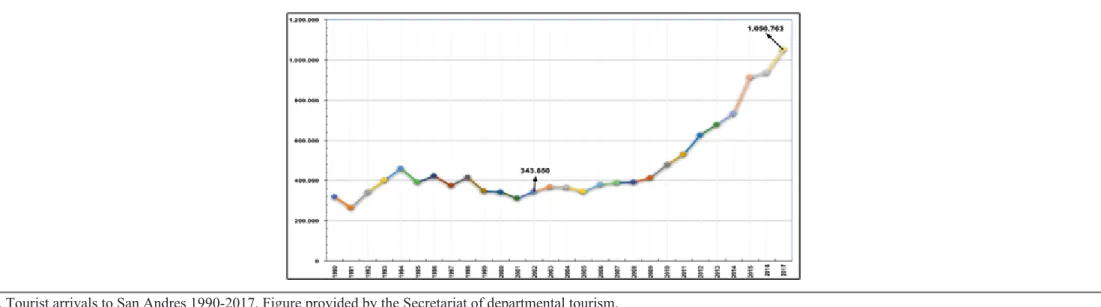
San Andres island is largely a conventional “sun and beach” destination, characterized by the construction of a large number of all-inclusive hotels, focused on the demand for mass tourism (Zuluaga, 2006). The Island of San Andres has experienced an exponential increase in tourism, with the number of visitors growing from 263,577 in 1991 to 1,050,763 in 2017 (Fig. 1) where 90% of the visitors who arrive have as their motive to undertake tourist activities. As a result of this important flow of visitors, a tourism development model has been implemented in the territory based on the standardization and sale of land, to provide tourism services to a floating population that exceeds the carrying capacity limits of the Archipelago. The tourism potential of the Archipelago has positioned this region as an attractive destination in the Caribbean, where many cultural and environmental assets have been increasingly put at risk due to the overwhelming pressure from the exponential growth of visitors (Coralina-Invemar, 2012).
Fig 1. Tourist arrivals to San Andres 1990-2017. Figure provided by the Secretariat of departmental tourism.
The exponential increase of the tourism sector has also been reflected in the amount of small-scale tourism services that are offered locally. Table 2 shows an overview of current tourism service providers in the Department and highlights a high percentage of locally-run lodgings, such as tourist housing accommodations (57%), Apart-hotels (20%), and Native places (7%) amongst others. The local population also provides other tourism-related services such as terrestrial transport, tourism agencies, nature tourism and ecotourism, gastronomic activities, and tour guide services.
Table 2. Total number of establishments and type of operators currently providing tourism services. Source: Secretariat of Tourism of the Department, 2019
Tourism Service Providers Total of establishments
Travel and Tourism Agencies 59
Operating Agencies 102
Wholesale Travel Agencies 3
Tourist Representation Offices 7
Tourist Guides 5
Terrestrial Transport Companies 2
Car Rental Companies 43
A&B Gastronomy Establishments 74
TimeShares Accommodations 4
Apart-hotel Accommodations 194
Hostels Accommodations 41
Hotel Accommodations 88
Tourist Housing Accommodations 542
Native Places Accommodations 65
Accommodations Albergues 7
Accommodations Camping 2
Other Types of Accommodations 3
Vacation Center Accommodations 1
Rural Farmhouses Accommodations 5
Accommodations Subtotal 947
Total 1246
Although the above explained tourism trend has benefited the economy of the islands - for instance hotel occupancy has remained at an average of 74% over the last 5 years (MINCIT) - the disorderly expansion of this model has brought negative consequences and is at the center of many conflicts and pervasive impacts on the territory and its local populations. The development of the Tourism Master Plan (PMT) for San Andrés island and its diagnosis (Consultur, 2002), revealed that the tourism sector -including local tourism- posed a high risk of environmental degradation in the Archipelago, derived from a disorderly growth that has not taken into account the carrying capacity of the territory or the necessary infrastructure and equipment, a situation that remains unsolved at present. Additionally, this tourist model has caused a competitive crisis in the tourism sector, with an increase on the offer of local services to the tourism sector, mainly related to lodging with only a few examples of successful sustainable local tourism initiatives.
In relation to local tourism development it is important to understand how since the 1950's a set of transformations were initiated and were of fundamental importance for life in the archipelago, where tourism would be added to agriculture, livestock and fishing as the basis of the economy of the islands. This was added to a migratory flow produced by the free port, generating a segmentation of the island population within its own territory, competing at the level of job offers where employers preferred to hire immigrant labor for activities related to tourism and trade (Salas, 2015). As a result, a local tourism sector was created, based on the Raizal community, which was considerably expanded once the number of visitors to the islands increased significantly.
Few documented and detailed information on local tourism is available, but it is known that about 50% of the total number of rooms available on the island of San Andres is provided by large national and international hotel chains (James, 2013) which receive most of the mass tourism, and the remaining percentage is supplied by the local population, where native lodges may represent more than 20% (Vega and Lopez, 2013). This type of accommodation (houses of patrimonial value owned by the island population) has grown
and generated interest from tourists, principally as a cheaper alternative. Today the islands present a situation where local accommodation has taken a strong hold and is competing with the traditional hotel industry. Clearly, tourism can be a source of economic income for the local population and it demands spaces that are preserved but not usually used to receive visitors, which ultimately challenges in maintaining a balanced relationship with the environment.
The Caribbean region is more dependent on tourism than any other region in the world. The sector accounts for over 15% of the GDP and 13% of jobs in the region. Tourism is the Colombian islands’ economic driver, representing nearly 40% of the Archipelago’s GDP (Govt. of San Andres, Providencia and Santa Catalina, 2012), equivalent to $184 million annually (Banco de la República de Colombia, 2012). The Caribbean’s tourism industry and the whole regional economy is dependent on the health of its coral reefs and other important coastal and marine ecosystems (including mangroves and seagrass), as well as fragile terrestrial habitats and species. A recent study by The Nature Conservancy (TNC) found that reef-adjacent activities generate an estimated $5.7 billion per year in the Caribbean from roughly 7.4 million visitors. When combined with reef-dependent tourism activities, they generate $7.9 billion total from roughly 11 million visitors (The Nature Conservancy, 2019).
Environmental problem
Coastal marine ecosystems in the Archipelago -- rocky shores, sandy beaches, mangrove forests, sea grass, wetlands and coral reefs -- are seeing their functionality impacted by tourism-related degradation. The loss of mangroves due to tourism infrastructure development diminishes the productivity of fish populations, thus affecting food security for local communities and increasing the risk of, and vulnerability to, natural disasters. It also accelerates the coastal erosion process. Similarly, the loss of vegetative cover has contributed to soil erosion and generated heavy sediment loads, which in turn have degraded the coral reefs, ultimately reducing the capacity of ecosystems to respond effectively to the impacts of climate change. Furthermore, mass tourism and high concentrations of human settlements in beach and coastal environments have caused significant impacts on natural and cultural areas. This has generated environmental problems such as inadequate solid waste management, insufficient wastewater management, degradation of critical ecosystems, coastal erosion, excessive noise pollution, and increased occupation of public space, among others.
The local resident population in the islands of the Archipelago (Raizales) belong to an ethnic community, recognized by Colombian government as peoples with specific rights, with an invaluable culture and traditional knowledge of its territory. This community is already suffering the first effects of climate change because their territories are more vulnerable, and their livelihoods depend on local production.
The three inhabited islands of the Archipelago (San Andrés, Old Providence and Santa Catalina) are small terrestrial areas with particular ecological, social and economic attributes that highlight their vulnerability. These attributes are mainly related to the maintenance of ecosystem interrelationships of the marine, coastal and land environments and a limited economic base that is highly exposed and vulnerable to external influences, with immediate, and in many cases irreversible, impacts (Taylor et al., 2012). This has led to the current challenges in the management and conservation of the natural resources of the Archipelago which require strategic and sustainable interventions with the involvement of the local community. The extent to which these ecosystems are impacted and how much the wildlife is disturbed is currently unknown. The proposed project seeks to improve biodiversity conservation and sustainable management of ecosystem services in San Andres, Old Providence and Santa Catalina islands through the design and implementation of participatory governance models, effective policies and innovative culturally-based and biodiversity friendly tourism products.
Tourism and Threats to Biodiversity
In order to identify and rank the threats to the priority ecosystems (project conservation objects), a threat analysis was carried out, based on a review of the existing literature on tourism and its impacts on the islands, as well as the results of the stakeholder consultation process and expert opinions. First, the conservation targets were identified as:
Mangroves, Sandy Beaches, Coral Reefs, and Seagrass. Then, the overall threats (including those from tourism and other sectors) to those conservation targets were identified.
The threats were rated, based on the criteria of scope (SC), severity (SE), and irreversibility (IR), according to their impacts on each of the conservation targets identified by the project. This exercise was socialized and validated by the technical teams of the Ministry of Environment and Sustainable Development, CORALINA, Conservation International and WWF Colombia. The results of the analysis are included as an Annex to the PIF and Table 3 shows a synthesis of the final threat prioritization.
Table 3. Analysis of threat impacts to target ecosystems.
DIRECT THREATS Mangroves Coral Reefs Sandy Beeches Seagrass Average across all
targets
Unplanned development of small-scale local tourism lodging.
Unplanned mass tourism infrastructure development in coastal areas (hotels, roads, piers, etc.).
Excessive physical presence of tourists in the prioritized ecosystems without carrying capacity consideration.
Uncontrolled solid waste disposal (from tourism and general population).
Unsustainable recreational water sport and motorized transportation activities.
Sewage disposal (from tourism and general population) into waterways, mangroves and reefs.
Unsustainable fishing (local artisanal) to feed tourism demand.
Overconsumption (by tourism sector) of freshwater from aquifers.
Overconsumption of endemic species (by tourism sector), such as the Black Crab.
Sand mining and dredging to satisfy demand for building materials (to feed a growing number of tourism infrastructure projects).
Unplanned urban development (expansion over natural ecosystems) to satisfy immigration of tourism employees.
KEY TO THREAT PRIORITIZATION
HIGH MODERATE - HIGH MEDIUM LOW
Considering the results of the exercise presented in the table above and according to the score agreed upon for each threat, the project will focus on addressing those threats categorized as high (in red) and moderate-high (orange) in the threat analysis, which are summarized in Table 4 below:
Table 4. Description of prioritized threats
Threats Impacts on BD
Unplanned development of small- scale local tourism lodging.
The unplanned development of the local tourism represents a high threat to biodiversity since there are no environmental norms regulating the expansion of this sector. This means, for example, that traditional Raizal constructions or infrastructure related to transport or mobility (roads, highways, or piers) can be built on key ecosystems, such as mangroves, and that these habitats are under serious threat of being destroyed. In recent years the number of local tourism initiatives has significantly increased in the islands, facilitating an increased number of tourists and an increased pressure on the island's ecosystems. Most local tourism initiatives do not adopt good environmental practices in recreational activities, and they offer products and services that directly affect the health of ecosystems. This situation will be further described below.
Unplanned mass tourism infrastructure development in coastal areas (hotels, roads, piers, etc.).
Mangrove and other coastal forest lands of San Andres have been cleared for developing mass tourism infrastructure which has, in turn, led to increased vulnerability to climate change impacts, coastal erosion and sedimentation on coral reefs. This has caused mortality and reef degradation across San Andres. Also, sandy beaches have decreased in the Archipelago, due to erosion caused by different factors, including climate change impacts.
Fragmentation of the mangrove forest compromises the ecological integrity and functionality of the ecosystem and degrades hydrological systems. This loss and fragmentation of habitat are threatening seabirds, shorebirds, migratory and resident species, as well as shellfish, crustaceans, and reef fish species.
The loss of beach habitat in the Archipelago due to erosion and massive infrastructure development are, in the Archipelago, threatening endangered turtle species and affecting black crab natural migration processes.
Lastly, the criteria for the use and type of materials for the construction of tourism-related infrastructure is based on conventional engineering approaches that do not integrate biodiversity conservation or climate change adaptation and resilience considerations. The disposal of surplus and residues from infrastructure development impacts coastal ecosystems -at different levels- in particular, the mangrove.
Excessive physical presence of tourists in the prioritized ecosystems without carrying capacity consideration.
The lack of a carrying capacity analysis for the islands means that there is great pressure on ecosystems and hence there is a demand for environmental services that far exceeds what the ecosystems can support. The vast number of tourists on the islands leads to a high frequency of visits to conservation objects, generating physical interaction with the ecosystems which disrupts biological processes.
More tourists imply an increase of the fishing efforts including illegal fishing and use of non-selective fishing gear and techniques that have wide-ranging ecological consequences (such as fish traps that catch small species and are often left behind which results in ghost-fishing) affecting the sustainability of commercially-important fishing resources, and creating a demand for consuming new fish species that were not considered in the past (i.e., parrot fish).
Selective removal of species from reef communities and beaches (such as queen conch, lobster, grouper, snapper, and parrot fish, among others) has adverse ripple effects on the integrity of the reef ecosystem.
An exorbitant presence of tourists implies an increase in light and noise pollution on the islands, which affects certain species of birds; it also results in an increase in the emissions that occur on the islands (due to the increase in transport) and in the discharge of wastewater into the ecosystems of the coastal marine territory.
Lastly, a great number of tourists results in overconsumption of freshwater from aquifers in tourism resort areas leading to degradation of water supply.
Uncontrolled solid waste disposal (from tourism and general population).
Uncontrolled solid waste disposal (especially plastic) into wetlands, water retention zones, and coastal areas leads to mortality of fish, birds, and turtles (among other species) when entangled or ingested by individuals.
Likewise, solid waste agglomerates on the beaches and mangroves affecting the health of species and generating considerable impacts on vegetation cover ecosystems such as forests and mangroves.
The organic matter associated with solid waste implies bacteria and microorganisms that generate compounds that acidify the water and eliminate oxygen which is vital for the life of aquatic species and cause contamination of water for human consumption and health problems.
Unsustainable recreational water sport and motorized
transportation activities.
Degradation of marine habitats from increased contact and disturbance, e.g. mooring and anchoring of dive boats, yachts, and, less frequently, cruise ships on or near coral reefs. Other recreational activities, such as the unregulated use of speed boats, and spear fishing are also destructive to wildlife.
Water transport can also result in collision damage on reefs, and mortality of mammals and sea turtles. Noise emissions from motorboats affect the wildlife associated with the water bodies.
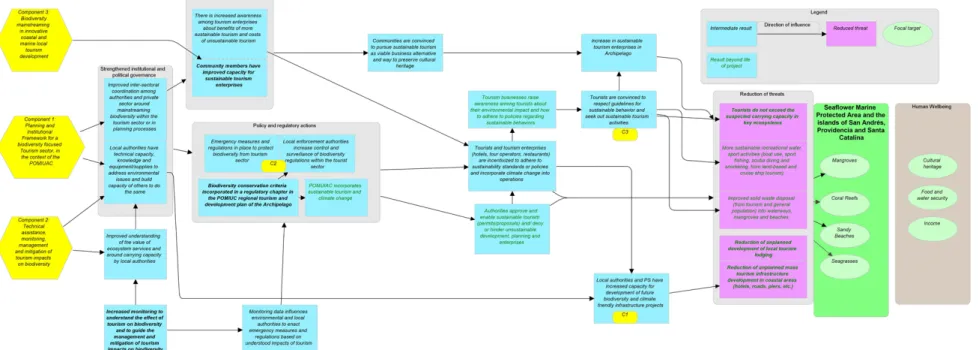
The relationships between threats and their contributing factors are illustrated in the conceptual model in Figure 2 below.
Figure 2. Project Conceptual Model
Barriers that Need to be Addressed
a. Weak local institutional capacities for mainstreaming biodiversity in the tourism sector planning.
These weaknesses are reflected in the absence of an effective inter-institutional governance model between the entities charged with regulating tourism and those in charge of protecting and conserving biodiversity and ecosystem services in the Seaflower Biosphere Reserve, creating a barrier to the adequate mainstreaming of biodiversity conservation
in the tourism sector. Also, the limited capacities of the competent authorities in terms of training, skills, equipment and knowledge of the area, is an additional barrier for the adequate management of biodiversity in the context of the tourism in the islands.
More effective inter-institutional coordination which includes all the relevant stakeholders (public and private) at the national and local level is needed to properly mainstream biodiversity conservation in the tourism sector and regulate the tourism industry. For the most part, institutions in charge of environmental and tourism areas work in isolation, and currently don’t have a shared vision for how to mainstream biodiversity conservation within the tourism sector or in planning processes. Regional governmental tourism entities have little experience regulating tourism in protected areas, which often reinforces the tendency to focus on the existing model of mass tourism.
In regards to spatial planning, there is no information with respect to the carrying capacity of the islands nor the value of the ecosystem services which are key to determining the potential zoning and the possible sustainable uses of the territory. These information gaps contribute to poor planning capacities and result in tourism that grows without control and negatively affects biodiversity.
The infrastructure developed on the islands is based mainly on conventional construction (grey infrastructure). No specific infrastructure projects with biodiversity conservation considerations have been developed on the islands and currently local authorities have expressed the necessity to acquire capacity in sustainable development, and on how to integrate biodiversity conservation considerations in future tourism infrastructure. The current project will aid in generating capacity amongst stakeholders to mainstream biodiversity conservation in green and gray infrastructure for current and future touristic project development.
b. Lack of sound data to understand the effect of tourism on biodiversity and to guide the management and mitigation of tourism impacts on biodiversity.
The absence of monitoring efforts to evaluate the tourism sector’s impact on the Reserve’s biodiversity and the associated economic impacts on ecosystem services is critical.
Currently, no database or data collection methods exist for measuring the tourism activities’ impact on protected areas and key biodiversity. Additionally, there is a data gap regarding ecosystem services associated with tourism in the Seaflower Reserve. This barrier results in the lack of necessary information to take the appropriate measures for adequate management of ecosystems and species. The local authority’s lack of capacity to respond efficiently leads to an inability to make informed and concrete decisions that support natural resource conservation.
c. Weak legal framework and enforcement.
There are gaps in the national regulations for the adequate management of tourism in strategic areas or ecosystems, and a lack of articulation amongst the environmental and economic development sectors. The weaknesses in the legal framework as well as the limitations in the application of policies leads to difficulty in the implementation enforcement of relevant legislation. Also, the competent authorities lack the proper training to effectively implement, control and survey the territory; and lack essential supplies for the fulfillment of their enforcing functions. Therefore, strengthening the authorities in terms of both their capacities and the equipment is fundamental in overcoming this barrier and obtaining more effective control and surveillance within the islands.
d. Limited local capacity in mainstreaming biodiversity conservation in existing local tourism businesses.
The weak institutional capacities and engagement, combined with the limited information available and the weak legal framework result in the islands being a conventional “sun and beach” destination, with very few examples of successful sustainable community-run tourism projects. Old Providence and Santa Catalina islands are well-positioned to cater to specialty tourism activities and ecotourism; however, existing products and services lack quality and diversity. Also, the local proprietors of such community initiatives often lack the capabilities to run a successful business and the resources to offer a biodiversity friendly portfolio of tourism activities. Given these constraints, it is necessary to strengthen the local tourism industry capacity and scope to promote the transformation of existing local businesses into sustainable businesses that ensure the conservation of biodiversity.
To address these gaps, it is necessary to structure an incentive to tourism businesses to adhere to sustainable standards and policies, engaging the tour operators and visitors of the area in conservation actions and the need of identifying a niche by taking up again their cultural values as ¨islanders¨ together with a strong biodiversity conservation approach.
2. Baseline Scenario and Associated Baseline Projects
Planning and Institutional Framework for a sustainable tourism sector.
The Corporation for Sustainable Development of the Archipelago of San Andres, Old Providence and Santa Catalina (CORALINA – local environmental authority), under the Ministry of Environment and Sustainable Development (MESD) and the Departmental Authority (Gobernación Archipelago) under the Colombian National Government, are the key government entities that manage the Seaflower Marine Protected Area and oversee the implementation of corresponding national and departmental plans and programs.
The evaluation and data analysis of the biodiversity values associated with the islands of San Andres, Old Providence and Santa Catalina, is a strong baseline that supports and validates the importance of this region and the need to strengthen conservation actions for their environmental resources. CORALINA as a local environmental authority have generated significant inputs which can be incorporated into policy programs in other government sectors.
The departmental authority has different units responsible for the administration of national policy applied to the local level. One of these agencies is the Secretary of Tourism, whose actions are based on a tourism plan adopted in 1995. As the time nears for the departmental authority to update the tourism plan, the opportunity arises to include more environmental considerations that will have an impact on a new sustainable tourism plan.
The local authorities, in accordance with their functions, regularly follow up and monitor aspects relevant to their jurisdiction. CORALINA generates data on the condition of critical ecosystems such as corals, sea grasses, mangroves and beaches, as well as key species. The departmental authority registers and monitors tourist activity on the islands by documenting the number of visitors, lodgings, restaurants, and other information. Although data is collected and monitored by local authorities, there is limited information to identify and define effective actions for the management of tourism and biodiversity conservation in the islands in an integrated manner.
The grey infrastructure built on the islands (mainly on the San Andres island) has not considered environmental criteria in the past. However, existing traditional architecture developed by the local Raizal population, for many generations, may be a valuable baseline to consider for new infrastructure projects on the islands.
Additionally, by Decree No. 415, March 13, 2017 the Ministry of Environment and Sustainable Development (MADS) unified different environmental instruments in the Archipelago Department of San Andrés, Old Providence and Santa Catalina, establishing that (for all purposes of environmental management), the Integrated Management and Management Plan of the Caribbean Insular Coastal Environmental Unit (Insular POMIUAC), is the only instrument articulating the regulations and ordinances of the territory of the Archipelago Department of San Andrés, Providencia and Santa Catalina responding adequately to the specialties and environmental needs of this jurisdiction. Accordingly, the Insular POMIUAC constitutes the norm of superior hierarchy and environmental determinant for the elaboration and adoption of the plans or schemes of territorial ordering or departmental ordering, in the Archipelago of San Andrés, Old Providence and Santa Catalina.
CORALINA is currently in the process of formulating the POMIUAC, and simultaneously is formally advancing a process of previous consultation of the same with the Raizal ethnic community. Tourism, as the main engine of the economy in the Archipelago of San Andrés, Providencia and Santa Catalina is prioritized in order to address its impacts on biodiversity and protected areas, and to prospectively adopt policy, regulatory and governance guidelines that promote the development of sustainable tourism in accordance with the guidelines of the Seaflower Biosphere Reserve.
Lastly, the local authorities from the Archipelago, according to their functions, maintain a relationship with the private sector associated to tourism at different levels, focusing on the actions implemented by the government programs, as well as on specific projects that are formulated and executed. An important baseline to emphasize in the framework of the last METT evaluation (2013), was the active participation of key actors including the private sector, in which limited awareness (by the population at large) regarding the importance of natural resources and biodiversity was identified, highlighting the association between the difficulty in committing to care for these resources and the unemployment and lack of economic alternatives for the local population.
Monitoring, management and mitigation of tourism impacts on biodiversity.
CORALINA, as the maximum environmental authority in the Archipelago, executes the national policies, plans and programs in environmental matters defined by the law of the National Development Plan and the Ministry of Environment. The entity has a particular condition which allows annual access to the Environmental Compensation Fund (FCE), an economic instrument that distributes resources among national corporations, and is managed by the Ministry of Environment. Therefore, through the submission of projects, CORALINA has acquired financial support from the national government for about 15 years to carry out the activities under its competence, such as monitoring, surveillance and
control at the environmental level, creation of awareness strategies, training and capacity building, development of sustainable production and consumption practices, management of water stress and adaptation to climate change, among others.
Regarding the monitoring of the coastal and marine resources, INVEMAR, the scientific institution in charge of the research of these ecosystems, has developed several protocols (2014) for the monitoring of sandy beaches, coral reefs, seagrasses, mangroves and aquatic birds (which was updated on 2018 through the resolution 1263). These methodologies have been reviewed, expanded and implemented by CORALINA, under the project “Protección de la Biodiversidad en la Región Suroccidental del Caribe” GRT/FM-11865-CO, in order to generate management and conservation strategies for key species, and obtain information regarding the state of the ecosystems. Within this project, feasibility studies have also been carried out to guarantee the implementation of conservation agreements and the quality of life of the Archipelago's fisherfolk. It has also been possible to maintain and reinforce four community monitoring programs (Reefcheck, Coral Nursery, Marine Mammals, and Chondrichthyans), as well as training, coaching, generation of guides, building and adaption of a specific zone related to important tourist activities developed within the islands of San Andrés and Old Providence, including: recreational diving, water sports, marine mammal sighting, tourist practices related to rays (Dayastis americana), and diving for chondrichthyan observation. Although the mentioned project has ended, these activities continue within the framework of the biological monitoring functions of CORALINA, which applies the protocols designed by INVEMAR annually.
The San Andres, Old Providence and Santa Catalina Archipelago department has the largest protected area in Colombia which was approved, declared and re-categorized, according to the Single National Registry of Protected Areas of Colombia (RUNAP), as a District of integrated management of the marine protected area (MPA) of the Seaflower Biosphere Reserve. Since the creation of this area and under two GEF projects, the Management Effectiveness Tracking Tool (METT) have been carried out in 2009 (with a score of 33%) and in 2013 (with a score of 55.6%) providing an important baseline on the status of the implementation of the management plan in this national protected area. The METT assessment has not been updated since then in the MPA. In addition, CORALINA, as the local environmental authority, manages three (3) regional protected areas since 2001. The management plans for these areas have been generated and implemented, but no evaluation of their management effectiveness has been conducted to date.
Lastly, The Archipelago government, following the guidelines of theNational Development Plan (NDP 2018 - 2022), is currently supporting economic strategies and instruments that make the productive sectors more sustainable, innovative and reduce their environmental impact.
Local biodiversity friendly tourism initiatives.
The existing tourism model in the Archipelago has caused a competitive crisis in the tourism sector, with a growing local tourism sector trying to capture some of the economic benefits the mass tourism sector represents in the Department, but through business that do not always integrate sustainability considerations, and lack technical and financial capacities. For this reason, CORALINA has created a Green Business Window by legal act (Resolution 055 of 2019), which has been promoting, encouraging and accompanying Green Businesses on the islands. The corporation decided to promote sustainable and environmentally friendly ventures, seeking to mitigate the evident damage on the Archipelago. The Green Businesses consider the economic activities that offer goods or services, and generate positive environmental impacts and also incorporate good environmental, social and economic practices with a life cycle approach, contributing to the conservation of the environment as natural capital that supports the development of the territory (ONVS 2014).
CORALINA has been accompanying 49 Green Businesses, through a revision process with different criteria gathered in 3 different qualification levels: (1) Economic, social and environmental compliance at a legal level; (2) Economic viability, positive environmental impact, useful life, use of recycled materials, social and environmental responsibility in the value chain, communication of its environmental services; (3) Environmental or social schemes, programs or recognitions implemented or received. This constitutes a very important baseline for directing actions to strengthen innovative local initiatives that incorporate tourism that benefits the conservation of the islands' natural resources.
This is consistent with one of the pillars of the National Development Plan, on the promotion of the economy through circular economy strategies where tourism and value chains play an important role in promoting local businesses. In this way, the National Development Plan consolidates the strategy of the orange economy as that which seeks to consolidate the cultural and creative industries. Likewise, the pillars of sustainable business are strengthened as a tool to diversify the economy and has a goal to consolidate at least 1865 verified green businesses at national level. This generates a national commitment that provides the opportunity to strengthen local initiatives and contribute to the conservation of strategic ecosystems and species and to their livelihoods.
At an institutional level, CORALINA is an active member of the Regional Network of Enterprises of the Department of San Andrés, as a strategic ally to promote and boost green businesses and their products in the region. Among the entities linked to the Regional Enterprise Network are The San Andres Islands Chamber of Commerce, the Departmental Government, SENA Regional San Andres, the Institute of Technical Vocational Training INFOTEP, the San Andres Islands Family Compensation Fund CAJASAI. This network gives the opportunity to articulate activities that are relevant to validate innovative tourism plans and make the corresponding investments and strengthening.
3. Proposed Alternative Scenario
The proposed project “Mainstreaming biodiversity conservation in the tourism sector of the protected areas and strategic ecosystems of San Andres, Old Providence and Santa Catalina islands” seeks to promote biodiversity conservation mainstreaming in the tourism sector in the Archipelago’s areas described above, through the design and implementation of participatory governance models and effective policies, management of tourism impacts on key ecosystems and species, and transforming existing local tourism activities into culturally-rich and biodiversity friendly and sustainable products.
The strengthening of capacities and the inter-institutional articulation with the small-scale private sector, as well as the first-hand knowledge of the impacts produced by tourism on biodiversity, will allow informed decision-making and the participatory implementation of measures for the effective management of ecosystems and their respective conservation. Likewise, the support and strengthening of biodiversity friendly and culturally-rich local tourism initiatives - based on the principles established by the national government regarding green businesses - will promote a change in the local tourism sector towards one that not only has an impact on conservation but also is an agent of change that can be used in favor of biodiversity.
The underlying theory of change of the project is: If the ecological, social and economic attributes of the Archipelago (San Andrés, Old Providence and Santa Catalina) are to be preserved, then an innovative model for sustainable tourism needs to be implemented in which there is (i) a consolidation of the sustainable tourism chapter as a strategic part of the Integrated Management Plan of the Coastal Environment; (ii) strengthening of authorities’ capacities and equipment for taking appropriate environmental measures and enforcing regulations that protect biodiversity; (iii) reliable, scientific information about tourism impacts on key biodiversity and institutional capacities developed to guide management and mitigation actions based on this information to reduce threats; and (iv) local tourism initiatives in the Archipelago transformed into biodiversity friendly and financially sustainable businesses.
In summary, the logic of the project’s Theory of Change is depicted in Figure 3 below.
Figure 3. Project Theory of Change
Components and Key Outcomes
The proposal has four components:
Component 1: Planning and institutional framework for a biodiversity focused tourism sector in the MPA, PAs and the three islands of the Archipelago, in the context of the POMIUAC.
The POMIUAC is a legal instrument that defines and guides the environmental planning and management of coastal areas of the Colombian territory, and through the development and implementation of a sustainable tourism plan, Component 1 seeks to integrate -into the POMIUAC- different strategies and regulations for mainstreaming biodiversity in the tourism sector of the Archipelago. This will be achieved with the participation of the key related institutions (public and private) at the local level and through the following outcomes and outputs:
Outcome 1.1: Biodiversity is mainstreamed into tourism for MPA, PAs and three islands of the Archipelago, for improved protection of corals, sandy beaches, mangroves and key species.
Output 1.1.1: Interinstitutional coordination group created to advise and accompany the design and implementation of a new sustainable tourism plan for MPA, PAs and the three islands, in the context of POMIUAC, including active participation of the tourism private sector.
An interinstitutional coordination group will be established to support the development of a sustainable tourism plan and to support implementation of the plan through the activities of Component 2 and 3. This inter-institutional coordination group will be made up of the competent authorities in environmental matters (CORALINA), administration of beaches (DIMAR), and tourism (Government). Also, it will include the participation of the various stakeholders in the islands, including private sector. Representatives of the hotel sector (large chains and local hotels) and of other related tourism services will participate in the generation of inputs as well as recommendations to harmonize planning measures with the economy and development of the islands and to better integrate biodiversity conservation objectives in the tourism strategy of the Archipelago.
Output 1.1.2: Carrying capacity assessments and spatial use analysis of threatened ecosystems of MPA, PAs and three islands for the design of environmental management measures to implement into the tourism sector.
Spatial analysis and carrying capacity assessments will be developed through consultancies as a practical tool for creating and establishing more rational management principles (to be included in the sustainable tourism plan) on how marine and coastal key ecosystems are used, considering the demand that this sector is generating in the Archipelago. The participation of representatives of the tourism sector in the islands will be of great importance for the development of the spatial analysis and the carrying capacity assessments.