Scaling up ecological corridors and transboundary connectivity through integrated natural resources management in the Ngotto Forest landscape and Mbaéré-Bodingué National Park
Part I: Project Information Name of Parent Program
The Congo Basin Sustainable Landscapes Impact Program (CBSL IP) GEF ID
10347 Project Type FSP
Type of Trust Fund GET
CBIT/NGI CBIT NGI Project Title
Scaling up ecological corridors and transboundary connectivity through integrated natural resources management in the Ngotto Forest landscape and Mbaéré-Bodingué National Park Countries
Central African Republic Agency(ies)
World Bank
Other Executing Partner(s):
Ministry of Water, Forests, Hunting and Fishing Executing Partner Type
Government GEF Focal Area Multi Focal Area Taxonomy
Knowledge Generation, Capacity, Knowledge and Research, Biodiversity, Restoration and Rehabilitation of Degraded Lands, Sustainable Land Management, Land Degradation, Forest and Landscape Restoration, Forest, Focal Areas, Influencing models, Convene multi-stakeholder alliances, Strengthen institutional capacity and decision-making, Transform policy and regulatory environments, Demonstrate innovative approache, Stakeholders, Private Sector, Beneficiaries, Communications, Gender Equality, Integrated Programs, Income Generating Activities, Sustainable Forest, Sustainable Agriculture, Community-Based Natural Resource Management, Congo, Protected Areas and Landscapes, Terrestrial Protected Areas, Community Based Natural Resource Mngt, Mainstreaming, Forestry - Including HCVF and REDD+, Tourism, Agriculture and agrobiodiversity, Species, Threatened Species, Wildlife for Sustainable Development, Biomes, Wetlands, Tropical Rain Forests, Climate Change, United Nations Framework Convention on Climate Change, Climate Change Mitigation, Agriculture, Forestry, and Other Land Use, Awareness Raising, Education, Strategic Communications, Local Communities, Type of Engagement, Partnership, Information
Dissemination, Consultation, Participation, Indigenous Peoples, SMEs, Civil Society, Non-Governmental Organization, Community Based Organization, Gender Mainstreaming, Sex- disaggregated indicators, Gender-sensitive indicators, Women groups, Capacity Development, Knowledge Exchange, Field Visit, South-South, Training, Workshop
Rio Markers
Climate Change Mitigation Climate Change Mitigation 1
Climate Change Adaptation Climate Change Adaptation 0
Submission Date 10/26/2020
Expected Implementation Start 6/30/2021
Expected Completion Date 6/30/2024
Duration 60In Months Agency Fee($) 684,619.00
A. FOCAL/NON-FOCAL AREA ELEMENTS
Objectives/Programs Focal Area Outcomes Trust Fund GEF Amount($) Co-Fin Amount($)
IP SFM Congo Promoting effective coordination for sustainable forest management GET 7,606,881.00 22,400,000.00
Total Project Cost($) 7,606,881.00 22,400,000.00
B. Project description summary
Project Objective
To improve governance and strengthen capacity in the forest and mining sectors in the CAR. Overall Goal of the GEF AF is to improve integrated natural resources management and sustainable rural livelihoods in the Ngotto Forest landscape and Mbaéré-Bodingué National Park.
Project Component Component
Type Expected
Outcomes Expected
Outputs Trust
Fund GEF Project Financing($) Confirmed Co-Financing($)
Project Component Component Type
Expected Outcomes
Expected Outputs
Trust Fund
GEF Project Financing($) Confirmed Co-Financing($)
1: 1: Institutional support:
Strengthening the governance and management frameworks for the Mbaéré-Bodingué National Park (MBNP) and corridor to the Dzanga-Sangha Protected Areas (DSPA) Aligned with CBSL IP component 2 (protected area management, landscape connectivity) and component 4 (knowledge management, regional cooperation)
Technical
Assistance 1.1. MBNP operations resumed 1.1.1.
Strengthened ecological and socioeconomic baselines of the MBNP 1.1.2.
Enhanced MBNP management planning (promoting a new
participatory model).
1.1.3. MBNP operations have resumed (ecological monitoring and anti- poaching) 1.1.4.
Improved MBNP infrastructure 1.1.5.
Enhanced sustainability of MBNP operations
1.2.
Strengthened monitoring capacities of Ministry of Environment and
Sustainable Development (MESD)
1.3.
Strengthened national and landscape- level (TNS) policy frameworks for natural resources management
1.3.1.
Improved policy dialogue and frameworks for integrated natural resource management in CAR 1.3.2.
Enhanced cross-border engagement (Sangha Trinational (TNS) landscape)
1.1. Updated MBNP baselines, Management Plan, key infrastructure, and operational support
provided to MBNP agents
1.1.1. Updated baselines of MBNP
1.1.2.
Management Plan updated and approved based on a participative process
1.1.3.
Operational support provided to MBNP agents of the Ministry of Water, Forests, Hunting and Fisheries (MWFHF)
1.1.4. Two base stations (Bambio, Ngotto) and two outposts (Kpoka, Ndele)
renovated, and 3 to 4 new outposts built.
1.1.5. MBNP long-term strategy established and technical and financial partners mobilized
1.2. Technical and monitoring capacities built with MESD to oversee the environmental impacts of economic activities (forestry, mining etc.) in the project area
1.3. Supported national and landscape-level policy
development and
coordination (i.e. cross sectoral platform, technical studies)
1.3.1. National cross-sectoral platform established;
Technical studies underpinning policies conducted;
1.3.2. Cross- border activities with TNS countries delivered (e.g.
data sharing, bilateral agreements, development of common tools etc.).
Participation in supporting regional workshops, including CBSL related events
GET 2,577,465.00 6,120,000.00
Project Component Component Type
Expected Outcomes
Expected Outputs
Trust Fund
GEF Project Financing($) Confirmed Co-Financing($)
2: Local development:
Promoting management models and economic
activities that contribute to the sustainable use and
regeneration of natural resources in the MBNP buffer zone and corridor to DSPA Aligned with CBSL IP component 1 (integrated land use management) and component 3 (sustainable use of forests by local
communities, management of production sector activities
Investment 2.1.
Strengthened Community- based land use and resource planning in Logging and Management Permits in the MBNP buffer zone
2.2.
Livelihoods in the MBNP area have been diversified through alternative economic activities
2.2.1.
Increased income and rural livelihoods diversification (for increased cash income and food security) 2.2.2.
Ecotourism potential of the MBNP area is assessed
2.3.
Enhanced capacities in the forest concessions in the project area to improve their sustainable practices
2.1.
Management committees established at the local level (in Agricultural and Human Occupation Zones (AHOZs) and Community Wildlife Zones (CWZs) and land-use plans adopted by the local committees and at the Municipality level.
2.2. Sustainable approaches to agriculture and forest-related value chains are implemented in the MBNP buffer zone, and its potential for ecotourism to create further economic opportunities is assessed
2.2.1.
Sustainable approaches to agriculture and forest-related value chains initiated and implemented in AHOZs & CWZs to support rural households
2.2.2.
Participatory inventory and catalogue of tourist sites and cultural activities is delivered in collaboration with Ministry of Arts, Culture and Tourism and the civil society
2.3. Agreements with supported forest
concessions made; Tools developed for concessions to identify and monitor high conservation value forests, and to monitor bushmeat hunting in concessions;
awareness and educational activities delivered for concession workers (and local
populations) on sustainable bushmeat management
GET 4,431,335.00 5,720,000.00
Project Component Component Type
Expected Outcomes
Expected Outputs
Trust Fund
GEF Project Financing($) Confirmed Co-Financing($)
3: Institutional Support
(mining) - No GEF Funds Investment 3.1. CAR has a policy in place defining its vision for mining and approaches to regulating the sector across Ministries
3.2. CAR’s Mining Code reflects best practice regarding fiscal conditions, institutional governance, and social and environmental standards
3.3. Enhanced capacity for granting and compliance monitoring of mineral rights and related permits
3.1. Mining policy developed and monitored with support from a mining sector working group.
3.2. Mining Code (2009) revised
3.3. GIS-based mining cadaster established and encompassing all licenses issued in the country (artisanal mining, semi-
mechanized, exploration and mining
concessions)
GET 3,310,000.00
Project Component Component Type
Expected Outcomes
Expected Outputs
Trust Fund
GEF Project Financing($) Confirmed Co-Financing($)
4: Institutional Support
(mining) - NO GEF Funds Investment 4.1.
Strengthened traceability of artisanal mining activities
4.2.
Registered artisanal miners are structured into cooperatives with enhanced capacities regarding economic, environmental and social practices
4.1. Artisanal Mining Registration System
established with increased registration at main mining sites in the project area (Southwest CAR)
4.2. Eight artisanal miner cooperatives (including women-led) in the project area receive small grant support from the project (30% of beneficiaries being women)
GET 3,980,000.00
Project Component Component Type
Expected Outcomes
Expected Outputs
Trust Fund
GEF Project Financing($) Confirmed Co-Financing($)
5: Project Management (M&E and Knowledge Management) Aligned with CBSL IP component 4 (knowledge management, regional cooperation)
Technical
Assistance 5.1.
Strengthened M&E system 5.2. Increased awareness, knowledge harvesting and dissemination of the project’s outputs.
5.1. Project monitoring and supervision activities conducted in an effective and efficient manner
5.2. Knowledge generated by the project is shared and
communicated with broader stakeholders to raise broad awareness on the project’s outputs and emerging knowledge, in particular in- country, and build the related capacities for both national, and regional transboundary cooperation
GET 251,881.00 480,000.00
Sub Total ($) 7,260,681.00 19,610,000.00
Project Management Cost (PMC)
GET 346,200.00 2,790,000.00
Sub Total($) 346,200.00 2,790,000.00
Total Project Cost($) 7,606,881.00 22,400,000.00
C. Sources of Co-financing for the Project by name and by type
Sources of Co-financing Name of Co-financier Type of Co-financing Investment Mobilized Amount($)
GEF Agency WB IDA Grant Investment mobilized 10,000,000.00
Civil Society Organization World Wildlife Fund Grant Investment mobilized 5,600,000.00
Donor Agency European Union Grant Investment mobilized 1,800,000.00
Donor Agency United States Agency for International Development (USAID) Grant Investment mobilized 5,000,000.00
Total Co-Financing($) 22,400,000.00 Describe how any "Investment Mobilized" was identified
The project has mobilized investments through incrementally leveraging synergies and complementarities with related initiatives and programs for an estimated associated co- financing of US$ 20.2 million. These investments include the World Bank’s Natural Resources Governance Project (US$10 million, 2018-2023) as the baseline parent project, the public-private partnership between CAR’s government and WWF to co-manage the Dzanga-Sangha Protected Area (DSPA) (US$ 5.6 million, 2020-2023), the European Union (EU) program for indigenous peoples in DSPA (1.8 million, 2020-2023), and the Artisanal Mining and Property Rights (AMPR) funded by USAID (US$9.8 million, 2018-2023) which addresses complex land and resource governance challenges in the artisanal and small-scale mining (ASM) (US$5 million qualify as co-financing). Significantly, the AMPR activities providing co-financing to component 2 (i.e. alternative economic activities) include i) introducing complementary livelihoods, including rejuvenating exhausted mining sites into spaces for productive agricultural activities; ii) and encouraging women and rural populations to adopt alternative livelihoods in an effort to mitigate the environmental damages of artisanal mining while also providing income and food security. In addition, other programs have been identified to provide complementary associated support due to significant operational synergies and a need for close coordination during project implementation. These include the REDD+ Preparation Project (US$ 4.5 million, 2017-2020) implemented by the World Bank and financed by the Forest Carbon Partnership Facility (FCPF) and the Central African Forest Initiative (CAFI), the EU program for the management of socio- economic local development, valorization of wildlife resources, and security in DSPA (US$ 2.8 million, 2019-2021), and the Strengthening Governance in the Gold and Diamond Sectors in CAR (GODICA) project (US$1.5 million, 2020-2022) implemented by the Belgian development agency (ENABEL) and focusing on transparent and efficient governance of minerals in CAR and on revenue generating alternatives for artisanal miners in southwest CAR.
D. Trust Fund Resources Requested by Agency(ies), Country(ies), Focal Area and the Programming of Funds
Agency Trust Fund Country Focal Area Programming of Funds Amount($) Fee($)
World Bank GET Central African Republic Biodiversity BD STAR Allocation 2,540,106 228,610
World Bank GET Central African Republic Land Degradation LD STAR Allocation 1,334,776 120,130
World Bank GET Central African Republic Climate Change CC STAR Allocation 1,196,372 107,673
World Bank GET Central African Republic Multi Focal Area IP SFM Congo Set-Aside 2,535,627 228,206
Total Grant Resources($) 7,606,881.00 684,619.00
E. Non Grant Instrument
NON-GRANT INSTRUMENT at CEO Endorsement
Includes Non grant instruments? No Includes reflow to GEF? No
F. Project Preparation Grant (PPG) PPG Required
PPG Amount ($) 183,486
PPG Agency Fee ($) 16,514
Agency Trust Fund Country Focal Area Programming of Funds Amount($) Fee($)
World Bank GET Central African Republic Biodiversity BD STAR Allocation 61,270 5,514
World Bank GET Central African Republic Land Degradation LD STAR Allocation 32,196 2,898
World Bank GET Central African Republic Climate Change CC STAR Allocation 28,858 2,597
World Bank GET Central African Republic Multi Focal Area IP SFM Congo Set-Aside 61,162 5,505
Total Project Costs($) 183,486.00 16,514.00
Core Indicators
Indicator 1 Terrestrial protected areas created or under improved management for conservation and sustainable use
Ha (Expected at PIF) Ha (Expected at CEO Endorsement) Ha (Achieved at MTR) Ha (Achieved at TE)
0.00 79,980.00 0.00 0.00
Indicator 1.1 Terrestrial Protected Areas Newly created
Ha (Expected at PIF) Ha (Expected at CEO Endorsement) Total Ha (Achieved at MTR) Total Ha (Achieved at TE)
0.00 0.00 0.00 0.00
Name of the
Protected Area WDPA ID IUCN Category Total Ha (Expected at PIF)
Total Ha (Expected at CEO
Endorsement) Total Ha (Achieved
at MTR) Total Ha (Achieved at TE)
Indicator 1.2 Terrestrial Protected Areas Under improved Management effectiveness
Ha (Expected at PIF) Ha (Expected at CEO Endorsement) Total Ha (Achieved at MTR) Total Ha (Achieved at TE)
0.00 79,980.00 0.00 0.00
Name of the Protected
Area WDPA ID IUCN
Category
Ha
(Expected at PIF)
Ha (Expected at CEO Endorsement)
Total Ha (Achieved at MTR)
Total Ha (Achieved at TE)
METT score (Baseline at CEO
Endorsement)
METT score (Achieved at MTR)
METT score (Achieved at TE)
Name of the Protected
Area WDPA ID IUCN
Category
Ha
(Expected at PIF)
Ha (Expected at CEO Endorsement)
Total Ha (Achieved at MTR)
Total Ha (Achieved at TE)
METT score (Baseline at CEO
Endorsement)
METT score (Achieved at MTR)
METT score (Achieved at TE) Akula
National Park Mbaéré- Bodingué National Park
125689
317281 SelectNational
Park
79,980.00 48.00
Indicator 4 Area of landscapes under improved practices (hectares; excluding protected areas)
Ha (Expected at PIF) Ha (Expected at CEO Endorsement) Ha (Achieved at MTR) Ha (Achieved at TE)
0.00 700693.00 0.00 0.00
Indicator 4.1 Area of landscapes under improved management to benefit biodiversity (hectares, qualitative assessment, non-certified)
Ha (Expected at PIF) Ha (Expected at CEO Endorsement) Ha (Achieved at MTR) Ha (Achieved at TE) 699,388.00
Indicator 4.2 Area of landscapes that meets national or international third party certification that incorporates biodiversity considerations (hectares)
Ha (Expected at PIF) Ha (Expected at CEO Endorsement) Ha (Achieved at MTR) Ha (Achieved at TE)
Type/Name of Third Party Certification
Indicator 4.3 Area of landscapes under sustainable land management in production systems
Ha (Expected at PIF) Ha (Expected at CEO Endorsement) Ha (Achieved at MTR) Ha (Achieved at TE) 1,305.00
Indicator 4.4 Area of High Conservation Value Forest (HCVF) loss avoided
Ha (Expected at PIF) Ha (Expected at CEO Endorsement) Ha (Achieved at MTR) Ha (Achieved at TE)
Documents (Please upload document(s) that justifies the HCVF)
Title Submitted
Indicator 6 Greenhouse Gas Emissions Mitigated
Total Target Benefit (At PIF) (At CEO Endorsement) (Achieved at MTR) (Achieved at TE)
Expected metric tons of CO₂e (direct) 0 12536223 0 0
Expected metric tons of CO₂e (indirect) 0 0 0 0
Indicator 6.1 Carbon Sequestered or Emissions Avoided in the AFOLU (Agriculture, Forestry and Other Land Use) sector
Total Target Benefit (At PIF) (At CEO Endorsement) (Achieved at MTR) (Achieved at TE)
Expected metric tons of CO₂e (direct) 12,536,223
Expected metric tons of CO₂e (indirect)
Anticipated start year of accounting 2020
Duration of accounting 20
Indicator 6.2 Emissions Avoided Outside AFOLU (Agriculture, Forestry and Other Land Use) Sector
Total Target Benefit (At PIF) (At CEO Endorsement) (Achieved at MTR) (Achieved at TE)
Expected metric tons of CO₂e (direct) Expected metric tons of CO₂e (indirect) Anticipated start year of accounting Duration of accounting
Indicator 6.3 Energy Saved (Use this sub-indicator in addition to the sub-indicator 6.2 if applicable)
Total Target Benefit Energy (MJ) (At PIF) Energy (MJ) (At CEO Endorsement) Energy (MJ) (Achieved at MTR) Energy (MJ) (Achieved at TE) Target Energy Saved (MJ)
Indicator 6.4 Increase in Installed Renewable Energy Capacity per Technology (Use this sub-indicator in addition to the sub-indicator 6.2 if applicable) Technology
Capacity (MW) (Expected at PIF)
Capacity (MW) (Expected at CEO Endorsement)
Capacity (MW) (Achieved at MTR)
Capacity (MW) (Achieved at TE)
Indicator 11 Number of direct beneficiaries disaggregated by gender as co-benefit of GEF investment
Number (Expected at PIF) Number (Expected at CEO Endorsement) Number (Achieved at MTR) Number (Achieved at TE)
Female 7,940
Male 7,940
Total 0 15880 0 0
Provide additional explanation on targets, other methodologies used, and other focal area specifics (i.e., Aichi targets in BD) including justification where core indicator targets are not provided
The Project is aligned with United Nations Framework Convention on Climate Change (UNFCCC), United Nations Convention to Combat Desertification (UNCCD), Convention on Biological Diversity (CBD) and Sustainable Development Goals (SDG). The project will promote sustainable landscape
management and increase the resilience of the rural population to climate change (SDG-15, SDG-13). It will contribute to poverty reduction and inclusive and sustainable economic growth (SDG-1, SDG-8). It aligns with 2020 Aichi Targets 1,2,5,7,11, 12, 14 and 15. - GEF indicators 1.2, 4.1 and 4.3: Activity 1.1 supports improved management effectiveness in MBNP (79,980 ha); Activities 1.2, 2.1, 2.2 and 2.3 support improved practices in the MBNP buffer zone (700,693 ha) including 699,388 ha to benefit biodiversity and 1,305 ha of production systems. - GEF indicator 6.1: Measures activities resulting in reducing emissions from deforestation and degradation in the target landscape (including MBNP and buffer zone, and corridor to DSPA). Net carbon sink is calculated over 20 years including 3 years of project implementation and 17 years of capitalization. (see EX-ACT calculation in Annex IX). - GEF indicator 11: Measures participation in activities supporting land-use planning (Activity 2.1) and small-scale agricultural & NFTP investment (Activity 2.2). There are 15,880
beneficiaries including 7,940 women (50%) and 2,380 indigenous peoples (15%).
Part II. Project Justification
1b. Project Map and Coordinates
Please provide geo-referenced information and map where the project interventions will take place.
Map of the project area. Coordinates: (3°55'28.2"N 17°14'27.1"E)
2. Stakeholders
Please provide the Stakeholder Engagement Plan or equivalent assessment.
A stakeholder engagement plan has been developed for the project and the summary of the key stakeholders is provided below. See Annex H of the GEF Data Sheet and Annex XIII of the Project Paper.
Stakeholder Roles and Responsibilities Ministry of Forest, Water,
Hunting and Fisheries (MWFHF)
Oversees the implementation of the Natural Resources Governance Project (NRGP) (World Bank’s parent project) and GEF activities and chairs the NRGP Steering Committee. GEF activities will strengthen the capacity and operational resources of MWFHF decentralized services in charge of MBNP management, including six agents and 10 eco-guards.
Ministry of Environment and Sustainable Development (MESD)
Amongst its mandates, MESD monitors the environmental and social impacts of economic activities in CAR. More particularly, GEF financing will support MESD’s decentralized services to oversee forestry and mining operators in the project area. MESD is a member of the NRGP SC and GEF focal point in CAR.
Ministry of Mining and Geology
(MMG) Coordinates the activities of the parent NRGP and GEF financing in support to the artisanal mining sector and forest-smart practices. The involvement of MMG will also be critical to GEF activities supporting national level policies and requiring inter-sectoral coordination. MMG is vice-chair of the Steering Committee.
Ministry of Agriculture and
Rural Development (MARD) Its decentralized services will support the implementation of revenue generating activities in the MBNP buffer zone (including land-use planning and investment in agricultural and NTFP value chains). MARD will also benefit from related capacity building activities implemented by the project.
Stakeholder Roles and Responsibilities Ministry of Land Management,
Decentralization and Local Development (MLMDLD)
Oversees the decentralization process in CAR including the transfer of competence to municipalities for local development. MLMDLD monitors activities of the parent NRGP and AFD’s SWRDP supporting municipalities in the MBNP periphery. It will also be involved in GEF activities supporting management committees of Agriculture and Human Occupation Zones (AHOZs) and Community Wildlife Zones (CWZs). MLMDLD is a member of the NRGP Steering Committee.
Prefectures Parent NRGP and GEF financing cover three Prefectures in South-West CAR, (Sangha-Mbaéré, Mambéré-Kadéï and Lobaye). Prefectures are the official representatives of the State in the area. All are members of the NRGP Steering Committee.
Municipalities As per the draft Code on Territorial Authorities, municipalities represent the administrative level for Local Development Plans (LDPs). The development of LDPs is supported by the parent NRGP and AFD’s SWRDP in 21 municipalities of South West CAR. The Local Development Committees (LDCs), the municipal consultation body for the LDPs, will be the gateway to the consultation process for the implementation of GEF activities.
WWF Co-manages the DSPAs with MWFHF, which also includes conservation and community development activities. WWF will execute (i.e. as a contractor to the project) GEF technical assistance activities related to conservation in MBNP as well as those supporting more sustainable practices for forestry companies.
Major national CSOs About ten local CSOs support the implementation of development projects including NRGP and AFD’s SWRDP (LDPs), World Bank’s REDD+
Readiness Project and WWF in the DSPA. These include the House of the Pygmy Child and Woman, the Sustainable Management of Natural Resources and the Environment, the Network of Indigenous and Local Populations of CAR (REPALCA), Education, Environment and Sustainable Development, Partnership Action for Community Development, Batali, Echelle and others. GEF activities will leverage their expertise and local presence in the MBNP area. For example, the project will support engagement with REPALCA and its experts to ensure due participation and consideration of indigenous populations in project activities and outcome.
Private Sector Forest concessionaires are the main private operators in the MBNP and corridor to DSPA. Their Forest Management Plans (FMPs) are critical component of land-use planning in the area. The artisanal mining sector is also an important local economic sector. It is partially structured in cooperatives, organizations or producer groups. GEF activities will support both sectors to improve sustainable practices.
Stakeholder Roles and Responsibilities
Tetra Tech Technical assistance operator in charge of implementing the mining component of the parent NRGP (Support for the Professionalization of Mining Cooperatives Program (APCM)) in association with local NGOs (including the Partnership Action for Community Development (APDC)).
NRGP Coordination Unit (CU) Oversees the implementation the parent NRGP and GEF activities including technical, fiduciary, and governance aspects. A biodiversity expert will be added to the CU to coordinate GEF activities more specifically. The expert will be based in the project area (Bambio or Ngotto).
Local Development Committees
(LDCs) Municipal level consultative body overseeing the development and implementation of Local Development Plans (LDPs). LDCs and their work on LDPs are supported by the parent NRGP and AFD’s SWRDP. They are composed of representatives of municipal services, decentralized administrations, civil society, CSOs, and the private sector. They will be the gateway for engaging municipalities in the MBNP periphery on GEF activities.
Local Communities and
Indigenous Peoples Direct beneficiaries of project activities. They will also be hired to the extent possible (e.g., through local NGOs, WWF etc.) to support the implementation of activities.
World Bank Administers the parent NRGP and its GEF financing and REDD+ Readiness Project. Provides technical supervision support to CAR during project implementation, as well as technical assistance.
United Nations Environment
Programme (UNEP) Lead agency of the GEF’s Congo Basin Sustainable Landscapes Impact Program (CBSL IP).
Primary beneficiaries of the GEF AF are the local forest-dependent communities in the MBNP periphery. Communities in the area mostly rely on artisanal small-scale mining, subsistence agriculture and hunting and as their main source of income. The GEF AF will support them to better manage their environmental and social impacts. It will also promote diversification of economic activities and encourage formalization to enhance socio-economic outcomes. Building on the parent project’s (i.e. World Bank’ NRGP) engagement with REPALCA on community development planning, the GEF AF will provide indigenous populations with culturally appropriate benefits. The proposed indicator on increased monetary income and non-monetary benefits is disaggregated accordingly. Other beneficiaries include authorities and administrations responsible for natural resources governance (including forest, environment, mining and agriculture). In line with the on-going decentralization process, the GEF will support municipalities and other
authorities to include sustainability principles in local development planning and action. The project will also help build technical capacity in decentralized administrations. This will in turn also allow them to fully engage in project activities and monitor results on the ground. At the national level, the GEF AF will provide targeted policy support and promote cross-sectoral coordination on land-use planning and natural resources governance.
Stakeholder engagement during project implementation will leverage the Local Development Committees (LDCs) established in targeted municipalities (with support from parent NRGP) as the official gateway to stakeholder engagement and consultation on GEF activities. The management committees for Agriculture and Human Occupation Zones (AHOZs) and Community Wildlife Zones (CWZs) which are proposed to be created or revitalized under the GEF grant will be overseen by the LDCs of the municipalities concerned. As per the model of the parent NRGP, the principles of Free, Prior and Informed Consent (FPIC) will be implemented with the support of local CSOs throughout GEF activities. The NRGP Steering Committee established in December 2018 will be complemented by a Local Steering Committee created to bring together the stakeholders representing the MBNP and facilitate exchanges, information sharing and conflict resolution on GEF supported activities. Steering Committee annual meetings will be critical to sharing information and collecting feedback from beneficiaries and authorities, at both the national and local level. They will also enable broader reporting and communication efforts on activities and outcomes, including with the CBSL IP Lead Agency (UNEP). As per the parent NRGP, communities and individuals who believe that they are adversely affected by the GEF activities may submit complaints to the existing project-level grievance redress mechanism (GRM) or the WB’s Grievance Redress Service (GRS). The NRGP GRM was established in June 2019 and its latest version (January 2020) accessible online. The establishment of a local office for the NGRP Technical Unit in the area targeted by GEF activities (Bambio or Ngotto) will facilitate day-to-day communication with stakeholders and beneficiaries. Regular supervision missions involving authorities (MEFCP, MEDD, MMG), NRGP TU and World Bank will provide additional oversight and capacity building regarding stakeholder engagement and communication.
In addition, provide a summary on how stakeholders will be consulted in project execution, the means and timing of engagement, how information will be disseminated, and an explanation of any resource requirements throughout the project/program cycle to ensure proper and meaningful stakeholder engagement.
Annex H describes the GEF AF stakeholder engagement framework, including a description of the engagement and consultation activities which took place during the GEF AF preparation, an identification of key project stakeholders, and the planned modalities for engagement during implementation including as to how public documentation and access to up-to-date information will be managed.
Select what role civil society will play in the project:
Consulted only;
Member of Advisory Body; Contractor; Yes
Co-financier;
Member of project steering committee or equivalent decision-making body; Yes Executor or co-executor;
Other (Please explain)
3. Gender Equality and Women's Empowerment
Provide the gender analysis or equivalent socio-economic assesment.
Natural resources such as forests, minerals, water, and land are critical assets that provide employment and growth opportunities for both men and women. Therefore, women's access to a more equitable role in decision making on the use of natural resources can potentially support productivity and growth. Women are key target beneficiaries of the project and is designed to increase economic opportunities, social development, and empowerment for women, ultimately leading to shared prosperity. The Gender Gap Analysis is provided in Annex I.
The project will make important contributions towards enhancing women’s access to and control over natural resources, improving women’s participation, and decision-making in governance structures related to management of natural resources and enhancing women’s access to socio-economic benefits and services. Agricultural and natural resources investments to support local communities enhance their livelihoods and reduce pressure on biodiversity will include, but not be limited to, sustainable land planning and alternative rural livelihoods and economic development, specifically income-generating activities in related value chains (e.g., agroforestry, NTFPs). These activities directly respond to gender gaps identified in enhancing voice and agency that women hold compared to men in ‘meaningfully’ participating in the management of local resources and the need to support diversification of women’s income-generating activities. Examples of activities providing non-monetary benefits include specific technical assistance to women groups on sustainable forest management and conservation, agricultural itineraries (e.g., agroforestry, NTFPs), storage and processing techniques, marketing to address prevalent lack of information and knowledge, and access to markets outside of their own communities. Revenue generating activities will include value chains specifically targeting women
and youth and benefit sharing systems (i.e. for cash-incentive mechanisms) will ensure fair income distribution. Moreover, the project will design activities to raise awareness around prevalence of gender-based violence and develop strategies to mitigate, prevent, and respond to GBV. The related indicator in the results framework will be “people residing in local communities adjacent to PNMB (national park) with increased monetary income and non-monetary benefits from improved natural resources management,” 50 percent of which are women. A sub-indicator “share of women represented in decision-making committees” (with a 50% target) is also added to capture and monitor the project’s contribution to enhancing women’s voice and agency in natural resources management.
Does the project expect to include any gender-responsive measures to address gender gaps or promote gender equality and women empowerment?
Yes
Closing gender gaps in access to and control over natural resources; Yes Improving women's participation and decision making Yes
Generating socio-economic benefits or services or women Yes
Does the project’s results framework or logical framework include gender-sensitive indicators?
Yes
4. Private sector engagement
Elaborate on the private sector's engagement in the project, if any.
The project will engage with the private sector in many ways:
- Management committees established and/or revitalized in AHOZs and CWZs (Activity 2.1) will include representatives of local private operators such as cooperatives/associations of smallholder farmers, forestry firms, hunting safari operators, etc. This will allow the project to leverage their market knowledge, technical know-how, and any potential operational synergy and opportunity for collaboration.
- The project will support smallholder farmer groups as well as upstream (e.g., input suppliers; agro-multipliers) and downstream operators (e.g., processing, intermediaries, transport) to strengthen agricultural and NTFP value chains and market networks (Sub-activity 2.2.1).
- Private forest concessions in the target area will receive technical assistance to implement sustainable practices that directly and indirectly impact biodiversity and habitat preservation (e.g., sustainable bushmeat management, monitoring high conservation value forests etc.) (Activity 2.3).
- The project will support the MWFHF to define long-term strategies and innovative models for the management of the MBNP and corridor to DSPA such as the Public Private Partnerships (PPP) in place in the DSPA with WWF or signed in April 2020 with African Parks for the Chinko Nature Reserve (Sub-activity 2.2.2).
5. Environmental and Social Safeguard (ESS) Risks
Provide information on the identified environmental and social risks and potential impacts associated with the project/program based on your organization's ESS systems and procedures
Overall Project/Program Risk Classification
*
PIF CEO Endorsement/Approval MTR TE
High or Substantial Measures to address identified risks and impacts
Elaborate on the types and risk classifications/ratings of any identified environmental and social risks and impacts (considering the GEF ESS Minimum Standards) and any measures undertaken as well as planned management measures to address these risks during implementation.
Please refer to the ISDS.
As a mitigation strategy, an Environmental and Social Management Framework (ESMF) has been prepared along with anIndigenous Peoples Planning Framework (IPPF), an Integrated Pest Management Plan (IPMP), a Process Framework (PF) and a Resettlement Framework (RF). All the documents were approved by the WB and subsequently
disclosed within the country on 07/09/2020 and on the World Bank external website on 07/09/2020 (link here : https://documents.worldbank.org/en/publication/documents- reports/documentlist?qterm=P171723).
Supporting Documents
Upload available ESS supporting documents.
Title Module Submitted
PID ISDS - P171723_09302020 CEO Endorsement ESS
ANNEX A: PROJECT RESULTS FRAMEWORK (either copy and paste here the framework from the Agency document, or provide reference to the page in the project document where the framework could be found).
Results Framework: The results framework for the project has been developed as part of the overall baseline WB-IDA project (presented below and Section VII of the Project Paper) which were also adjusted to take into consideration the COVID-19 disruptions. Note that GEF-funded activities correspond only to years 4, 5 and 6 of the overall result framework.The additional activities of the GEF AF that have been incorporated within are elaborated in Table 1 below to highlight the rationale for the new and revised indicators.
Contribution of the child project to the overall program impact: The GEF AF is a Child Project of the CBSL IP and under GEF-7 and thus aligned with the CBSL Theory of Change as detailed in Annex IV of the Project Paper. Supported by the CBSL Global Platform, the CAR’s Child Project will aim at catalyzing transformational change
in conservation and sustainable management of the Congo Basin through a landscape, transboundary approach to ensure sustainability and enhance its potential for scale up.
Landscape management presents an opportunity to scale and leverage interventions such that the whole is greater than the sum of individual interventions in terms of ecological and economic gains. The CAR’s Child Project, complementing the Bank’s NRGP parent project (IDA), as well as co-financed interventions, collectively promote integration and ecological connectivity across sectors and land-uses (forestry, biodiversity, mining, etc.) within the landscape. Connectivity between forested areas and biodiversity-rich protected areas is increased, and wildlife management, governance, and management effectiveness of existing protected areas are improved in collaboration with local communities and forest-dependent peoples. Sustainable forest-related value chains are promoted by empowering local communities, forest dependent people, and partnering with the private sector.
Interventions improve national and regional inter-agency coordination on efforts to maintain forest resources, protect biodiversity, enhance forest management, and restore forest ecosystems through enhanced knowledge and financing. CAR will deepen the CBSL IP work on some of these issues at the national level and strengthen engagement with neighboring TNS countries, Cameroon and Republic of Congo. Depending on priorities under the CBSL IP, priority activities for CAR in the context of the regional component of the CBSL Impact Program can include i) Sharing updated ecological and socioeconomic data (e.g., fauna populations and forest cover dynamics, human activities, including a focus on indigenous peoples, wildlife trafficking, etc.) ; ii) Aligning methodologies and analytical tools (e.g., biomonitoring, spatial distribution mapping, carbon stock estimates, valuation of ecosystem services, land-use planning, etc.) at the landscape level ; and iii) Establishing and/or strengthening transboundary or bilateral agreements (management of transboundary protected area, data exchange protocols, land-use planning, etc.). The dedicated knowledge management budget will also enable CAR’s participation in global and regional learning activities organized by the GEF-7 CBSL regional coordination project. It will allow for more effective knowledge dissemination in-country to reach broader stakeholders.
Response to COVID-19
The project will help CAR strengthen its pandemic response by mitigating negative socioeconomic impacts and supporting a resilient recovery for the country.[1]1 Beyond immediate health impacts, COVID-19 poses significant risk to people’s access to essential services, food, and livelihoods, especially for informal sector workers and vulnerable groups such as indigenous people who may be suddenly and more adversely impacted. Proposed activities will help communities strengthen local food supply chains and sustainable production by providing necessary inputs, technical assistance, and diversification opportunities. Cash-for-work incentives will support community engagement in ecological monitoring (e.g., eco-surveillant) and labor-intensive activities (e.g., Park’s trail rehabilitation, fire management, plantations, etc.) offering alternative income while
promoting environmental protection The project will also help reduce human exposure and vulnerability to zoonotic diseases in the project area. By implementing anti-poaching surveillance and supporting sustainable small-scale agriculture and other practices with lower impact on forests, the project will mitigate encroachment in animal habitats as well as the emergence and spread of zoonotic diseases. In addition, the project will help strengthen CAR’s surveillance and early warning systems for zoonotic diseases. Specific activities will include the identification of high-risk areas in the MBNP periphery and support to related wildlife monitoring. Implementation will leverage capacities of the DSPA veterinary laboratory (WWF) and coordinate with the Bank’s Regional Disease Surveillance Systems Enhancement Phase IV (REDISSE4).
[1] In line with the WBG’s operational response to COVID-19 in CAR.
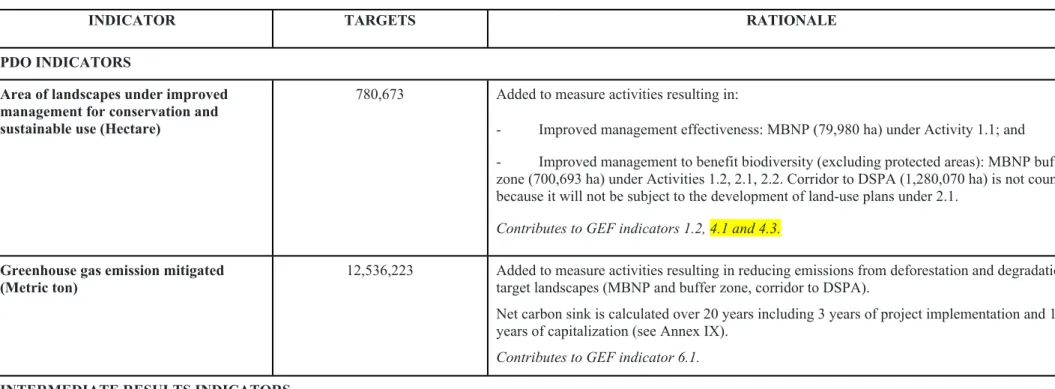
Table 1: GEF AF Indicators and rationale
INDICATOR TARGETS RATIONALE
PDO INDICATORS
Area of landscapes under improved management for conservation and sustainable use (Hectare)
780,673 Added to measure activities resulting in:
- Improved management effectiveness: MBNP (79,980 ha) under Activity 1.1; and - Improved management to benefit biodiversity (excluding protected areas): MBNP buffer zone (700,693 ha) under Activities 1.2, 2.1, 2.2. Corridor to DSPA (1,280,070 ha) is not counted because it will not be subject to the development of land-use plans under 2.1.
Contributes to GEF indicators 1.2, 4.1 and 4.3.
Greenhouse gas emission mitigated
(Metric ton) 12,536,223 Added to measure activities resulting in reducing emissions from deforestation and degradation in target landscapes (MBNP and buffer zone, corridor to DSPA).
Net carbon sink is calculated over 20 years including 3 years of project implementation and 17 years of capitalization (see Annex IX).
Contributes to GEF indicator 6.1.
INTERMEDIATE RESULTS INDICATORS
Component 1
Institutional forest and environment administration capacity strengthened (Yes/No)
Yes Revised to measure additional activities supporting the forest administration under Activity 1.1 (MBNP) and new activities supporting the environment administration under Activity 1.2.
MBNP with improved management effectiveness
METT score increases 100%
from the baseline.
Added to measure progress toward strengthening the governance and management frameworks for MBNP under Component 1.
Contributes to GEF indicator 1.2.
Component 2
People residing in local communities adjacent to MBNP with increased monetary income and non-monetary benefits from improved NRM
(disaggregated by vulnerable categories)
15,880 including 7,940 women (50%) and 2,380 indigenous peoples (15%)
Added to measure participation in activities supporting land-use planning (Activity 2.1) and small-scale agricultural & NTFP investment (Activity 2.2).
Contributes to GEF indicator 11.
Share of women represented in decision-
making committees (%) 50% Sub-indicator added to capture women’s voice and agency in activities supporting land-use planning (Activity 2.1) and small-scale agricultural & NTFP investment (Activity 2.2).
Forestry operators receiving technical assistance on improved sustainable practices
5 Added to measure participation in Activity 2.3 supporting forestry concessions (5).
Results Framework
COUNTRY: Central African Republic
Integrated Natural Resources Management in the Ngotto Forest and Mbaéré-Bodingué National Park Project Development Objective(s)
The project will aim to improve governance and strengthen capacity in the forest and mining sectors in the Central African Republic.
Project Development Objective Indicators by Objectives/ Outcomes
RESULT_FRAME_TBL_PDO
Indicator Name PBC Baseline Intermediate Targets End Target
1 2 3 4 5 6
Improve the governance and stengthen capacity in the forest sector Forest communities with access
to local development package
(Number) 0.00 0.00 0.00 0.00 3.00 7.00 11.00 11.00
Action: This indicator has been Revised
Rationale:
Targets pushed by 1 year.
Land area under sustainable landscape management practices
(CRI, Hectare(Ha)) 0.00 0.00 0.00 0.00 0.00 627,090.00 780,673.00 780,673.00
RESULT_FRAME_TBL_PDO
Indicator Name PBC Baseline Intermediate Targets End Target
1 2 3 4 5 6
Action: This indicator is New
Rationale:
Area of landscapes under improved management for conservation and sustainable use. Added to measure GEF AF activities resulting in:
· Improved management effectiveness: MBNP (79,980 ha) under Activity 1.1; and
· Improved management to benefit biodiversity (excluding protected areas): MBNP buffer zone (700,693 ha under Activities 1.2, 2.1, 2.2) Although the corridor to DSPA (1,280,070 ha) also receives support on landscape management through Activity 2.3 (forestry firms and mining cooperatives) it is not subject to land-use planning activities under 2.1 which are key to considering an area is under improved practices.
Contributes to GEF indicators 1.2, 4.1 and 4.3.
Greenhouse gas emission mitigated (Metric ton) (Metric
ton) 0.00 0.00 0.00 0.00 1,008,399.00 4,360,016.00 12,536,223.00 12,536,223.00
Action: This indicator is New
Rationale:
Added to measure activities resulting in reducing emissions from deforestation and degradation in the targeted landscape (MBNP and buffer zone, corridor to DPSA).
Net carbon sink is calculated over 20 years including 3 years of project implementation and 17 years of capitalization (see Annex IX).
Contributes to GEF indicator 6.1.
RESULT_FRAME_TBL_PDO
Indicator Name PBC Baseline Intermediate Targets End Target
1 2 3 4 5 6
Improve the governance and stengthen capacity in the mining sector Days required from diamond
extraction to diamond export
(Number) 90.00 90.00 90.00 70.00 50.00 30.00 30.00
Registered artisanal and small mining entities accessing small grants (of which 30% must be female) (Number)
0.00 0.00 0.00 30.00 30.00 30.00 30.00 30.00
Action: This indicator has been Revised
Rationale:
Targets pushed by one year.
Female recipients (Number) 0.00 0.00 0.00 10.00 10.00 10.00 10.00 10.00
Action: This indicator has been Revised
Male recipients (Number) 0.00 0.00 0.00 20.00 20.00 20.00 20.00 20.00
RESULT_FRAME_TBL_PDO
Indicator Name PBC Baseline Intermediate Targets End Target
1 2 3 4 5 6
Action: This indicator has been Revised
Regulatory framework operational for mining that adheres to international best practices (Yes/No)
No No No No No Yes Yes
Established mining policy and
mining working group (Yes/No) No No No Yes Yes Yes Yes
Action: This indicator has been Revised
Rationale:
Targets pushed by one year.
Improved artisanal miner
registration system (Yes/No) No No No Yes Yes Yes Yes
Revised mining code and
regulations (Yes/No) No No No No No Yes Yes
PDO Table SPACE
Intermediate Results Indicators by Components
RESULT_FRAME_TBL_IO
Indicator Name PBC Baseline Intermediate Targets End Target
1 2 3 4 5 6
Component 1 - Institutional support: Strengthen the fiscal and governance framework of the forest sector (Action: This Component has been Revised) Institutional forest and
environment administration
capacity strengthened (Yes/No) No No No Yes Yes Yes Yes Yes
Action: This indicator has been Revised
Rationale:
Revised (adding the environment administration in addition to forest administration only) to measure additional GEF AF activities supporting the forest administration under Activity 1.1 (MBNP) and new activities supporting the environment administration under Activity 1.2.
Berberati regional office
(Yes/No) No No No Yes Yes Yes Yes Yes
RESULT_FRAME_TBL_IO
Indicator Name PBC Baseline Intermediate Targets End Target
1 2 3 4 5 6
Action: This indicator has been Revised
Rationale:
Revised (adding the environment administration in addition to forest administration only) to measure additional GEF AF activities supporting the forest administration under Activity 1.1 (MBNP) and new activities supporting the environment administration under Activity 1.2.
M'Baiki regional office (Yes/No) No No No Yes Yes Yes Yes Yes
Action: This indicator has been Revised
National forest taxation information system established
and operational (Yes/No) No No No No Yes Yes Yes Yes
Action: This indicator has been Revised
Rationale:
Targets pushed by one year.
MBNP with improved management effectiveness
(Number) 24.00 24.00 48.00 48.00
RESULT_FRAME_TBL_IO
Indicator Name PBC Baseline Intermediate Targets End Target
1 2 3 4 5 6
Action: This indicator is New
Rationale:
Added to measure progress toward strengthening the governance and management frameworks for MBNP under Component 1.
Contributes to GEF indicator 1.2.
Component 2 - Local development: Support forest communities in planning and financing their development priorities Forest communities with
improved capacity in local
development planning (Number) 0.00 0.00 0.00 5.00 11.00 11.00 11.00 11.00
Action: This indicator has been Revised
Rationale:
Targets pushed by one year.
People residing in local
communities adjacent to MBNP with increased monetary income and non-monetary benefits from improved natural resources management (Number)
0.00 0.00 0.00 0.00 0.00 7,940.00 15,880.00 15,880.00
RESULT_FRAME_TBL_IO
Indicator Name PBC Baseline Intermediate Targets End Target
1 2 3 4 5 6
Action: This indicator is New
Rationale:
Added to measure participation in activities supporting land-use planning (Activity 2.1) and small-scale agricultural & NFTP investment (Activity 2.2).
Contributes to GEF indicator 11.
Of which women (Number) 0.00 0.00 0.00 0.00 0.00 3,970.00 7,940.00 7,940.00
Action: This indicator is New Of which Indigenous Peoples
(Number) 0.00 0.00 0.00 0.00 0.00 1,190.00 2,380.00 2,380.00
Action: This indicator is New Share of women represented in decision-making committees
(Percentage) 0.00 0.00 0.00 0.00 0.00 50.00 50.00 50.00
RESULT_FRAME_TBL_IO
Indicator Name PBC Baseline Intermediate Targets End Target
1 2 3 4 5 6
Action: This indicator is New
Rationale:
Sub-indicator added to capture women’s voice and agency in activities supporting land-use planning (Activity 2.1) and small-scale agricultural &
NTFP investment (Activity 2.2).
Forestry operators receiving technical assistance on improved
sustainable practices (Number) 0.00 0.00 0.00 0.00 0.00 2.00 4.00 5.00
Action: This indicator is New
Rationale:
Added to measure participation in Activity 2.3 supporting forestry concessions (5).
Component 3 - Technical assistance to improve mining sector policies and institutional governance Centralized data management
system for the mining sector established and operational (Number)
1.00 1.00 1.00 4.00 6.00 6.00 6.00 6.00
RESULT_FRAME_TBL_IO
Indicator Name PBC Baseline Intermediate Targets End Target
1 2 3 4 5 6
Action: This indicator has been Revised
Rationale:
Targets pushed by one year.
Component 4 - Local development -Formalization of the Artisanal Mining Sector Women-led mining cooperatives
(Number) 40.00 100.00
IO Table SPACE
Monitoring & Evaluation Plan: PDO Indicators Mapped
Indicator Name Definition/Description Frequency Datasource Methodology for Data
Collection Responsibility for Data Collection
Forest communities with access to local development package
A forest community will be considered benefiting access to local development package when at least two micro- projects (priority investments) as identified in its local development plan are
implemented and completed in the field satisfactorily to the community. Satisfaction measurement will be ensured through the establishment of feedback groups with the view to optimizing citizen
engagement.
Annually
Technical Unit (TU) within the MWFHF implementing the Natural Resources Governance Project (NRGP):
NRGP TU
NRGP TU
Land area under sustainable landscape management practices
The indicator measures, in hectares, the land area for which new and/or improved
sustainable landscape management practices have been introduced. Land is the terrestrial biologically productive system comprising soil, vegetation, and the associated ecological and hydrological processes;
Adoption refers to change of practice or change in the use of a technology promoted or introduced by the project;
Sustainable landscape management (SLM) practices refers to a combination of at least two technologies and approaches to increase land quality and restore degraded lands for example, agronomic, vegetative, structural, and management measures that, applied as a combination, increase the connectivity between protected areas, forest land, rangeland, and agriculture land.
Yearly
Delegated Implementing Agencies (DIA) in charge of activities under Component 2 of GEF AF.
- Baseline = 0 (Parent NRGP only)
- Year 4 = 0. MBNP Management Plan under development, land-use planning activities in the buffer zone are being implemented.
- Year 5 = MBNP area covered (MBNP Management Plan developed/approved, with conservation activities started) and 2/3 of the buffer zone is covered (2/3 of the simple management plans are developed/approved,
sustainable
agricultural/NFTP activities have started.)
- Year 6 = Entire zone covered.
NRGP CU
Greenhouse gas emission mitigated (Metric ton)
Parent NRGP (IDA) focuses on sectoral governance (forest, mining) and local development (basic services) is not expected to generate a significant reduction in GHG emissions.
Incremental funding from GEF is expected to generate GHG emission reductions from i) conservation in MBNP (activity 1.1) and avoided deforestation through land-use related investment to promote alternatives to slash-and-burn agriculture in MBNP and its buffer zone (activities 2.1, 2.2) and ii) reduced forest
degradation from improved practices of forestry operators in the MBNP buffer zone and corridor to DSPA (activity 2.3).
Annually
National Forest Monitoring Systems (NFMS) developed under the REDD+
Readiness Project (operated by MWFHF).
See Annex IX for
methodology and results on estimates. During
implementation data collection and interpretation of activity data for
deforestation and forest degradation will be done through the NFMS.
NRGP CU with MWFHF experts (NFMS).
Days required from diamond extraction to diamond export
Diamonds refers to all diamonds exported through legal Kimberly Process channels.
Annually
BEDCOR declaration and Kimberley Certification Process Scheme log books
NRGP TU
Registered artisanal and small mining entities accessing small grants (of which 30% must be female)
Entities implies cooperatives or associations
Annually
Third party small grants
implementor NRGP TU
Female recipients Male recipients
Regulatory framework operational for mining that adheres to international best practices
MMG NRGP TU
Established mining policy and mining working group
Improved artisanal miner registration system Revised mining code and regulations ME PDO Table SPACE
Monitoring & Evaluation Plan: Intermediate Results Indicators Mapped
Indicator Name Definition/Description Frequency Datasource Methodology for Data
Collection Responsibility for Data Collection
Institutional forest and environment administration capacity strengthened
The project will support two regional offices (Berberati &
M'Baiki) by granting operating resources, equipment and trainings with the ultimate goals to enforce forest and
environment law in the four prefectures (Lobaye, Sangha- Mbaéré, Mambere-Kadei and Nana-Mambere) covered by the regional offices.
Institutional capacity will be deemed strengthened when at least three sub-indicators below will be improved by at least 50%. For each sub-indicator, the project will establish baselines in year 1:
- number of field trips arranged per annum with the view to controlling the sound implementation of forest management plans (baseline to be established over the 5-year period 2012-2017);
- number of events arranged per annum with the view to fighting poaching (baseline to be established over the 5-year period 2012-2017);
- number of records of offenses registered per annum dealing with fauna (baseline to be established over the 5-year period 2012-2017);
- number of records of offenses registered per annum dealing with illegal logging (baseline to be established over the 5-year period 2012-2017);
NEW GEF AF:
- number of field trips arranged per annum by the MESD (DR1 in M'Baiki and DR2 in
Berberati) to perform environmental and social monitoring of economic activities.
Baseline new GEF AF sub- indicator to be established over the period 2014-2019.
Annually
Regional
Directorate (RD) 1 and RD 2 of MWFHF (incl.
MBNP agents) and RD1 and RD2 of MESD.
Baseline for the project has been set in April 2019 Institutional capacity will be deemed strengthened when at least three sub-indicators below will be improved by at least 50%.
- number of field trips arranged per annum with the view to controlling the sound implementation of forest management plans.
Baseline: 24 over the 4-year period 2014-2017 (6.00 + 1.00 = 7.00);
- number of events arranged per annum with the view to fighting poaching.
Baseline: 3 over the 4-year period 2014-2017 (0.75 + 2.00 = 2.75);
- number of records of offenses registered per annum dealing with fauna.
Baseline: 6 over the 4-year period 2014-2017 (1.50 + 1.00 = 2.50);
- number of records of offenses registered per annum dealing with illegal logging. Baseline: 1 over the 4-year period 2014-2017 (0.25 + 0.00 = 0.00).
NEW GEF AF:
- number of field trips arranged per annum by the MESD (DR1 in M'Baiki and DR2 in Berberati) to perform environmental and social monitoring of economic activities.
Baseline new GEF AF sub- indicator to be established over the period 2014-2019.
NRGP CU in collaboration with DRs of MWFHF and MESD.
Berberati regional office
Annually
Regional Directorate 2 of MWFHF (incl.
MBNP agents) and RD2 of MESD.
Baseline for the Berberati regional office has been set in April 2019
Institutional capacity will be deemed strengthened when at least three sub-indicators below will be improved by at least 50%.
- number of field trips arranged per annum with the view to controlling the sound implementation of forest management plans.
Baseline: 24 over the 4-year period 2014-2017 (6.00);
- number of events arranged per annum with the view to fighting poaching.
Baseline: 3 over the 4-year period 2014-2017 (0.75);
- number of records of offenses registered per annum dealing with fauna.
Baseline: 1 over the 4-year period 2014-2017 (0.25);
- number of records of offenses registered per annum dealing with illegal logging. Baseline: 6 over the 4-year period 2014-2017 (1.50).
NEW GEF AF:
- number of field trips arranged per annum by the MESD (DR1 in M'BaikiI) to perform environmental and social monitoring of economic activities.
Baseline new GEF AF sub- indicator to be established over the period 2014-2019.
NRGP CU in close cooperation with the regional offices (RDs).