Global Net-Zero Nature- Positive Accelerator
Integrated Programme
Review PIF and Make a recommendation
Basic project information
GEF ID 11085 Countries
Global (Chile, Costa Rica, Cote d'Ivoire, Indonesia, Mauritius, Mexico, Morocco, Nigeria, Tanzania, Thailand, Trinidad and Tobago, Viet Nam)
Project Name
Global Net-Zero Nature-Positive Accelerator Integrated Programme Agencies
UNEP, UNDP, UNIDO, FAO, ADB, CAF Date received by PM
4/10/2023
Review completed by PM 5/15/2023
Program Manager Filippo Berardi Focal Area Multi Focal Area
Project Type PFD
GEF-8 PROJECT IDENTIFICATION FORM (PIF) REVIEW SHEET
1. General Program Information
a) Is the Program Information table correctly filled, including specifying adequate executing partners?
Secretariat's Comments
*** PLEASE MARK CHANGES IN PFD IN YELLOW HIGHLIGHT FOR THE FIRST ROUND OF REVIEW, blue in the second and different colors in subsequent ones if relevant.
***
PPO Comments Cleared.
05/16/23, FB ____________
OUTSTANDING COMMENTS FROM PPO HERE BELOW:
PPOs second set of comments (dated today: 05-16-2023) is below:
While most of the comments provided on April 18th were addressed, some few were not:
Most of Cyril?s comments have been taken into account, except the one on project objective. He also noticed a small point on one indicator.
- Program objective. We noticed in the review sheet that the ?Objective statement was revised to align with proposed structure, activities, and indicators.? The latest PFD available in Portal indicates as Program Objective ?To accelerate investment and implementation of nature positive, net-zero pathways?. Looking at the indicators listed in the PFD document, it is unclear what metric will serve to measure the achievement of the Program Objective. These metrics are needed for evaluability. Perhaps the objective could relate more directly to what the project plans to measure around institutional support. It could for example refer about its work to inform collaborative policy development or to inform/strengthen national strategies.
- Core Indicator 6. The now included anticipated start year of accounting indicates 2029, which coincides with the expected completion year of the program. In case results in this area may start to take place earlier, please consider including an earlier start year.
- Financial numbers:
o Differences between Sources of funds table and Financing and PPG table remain for Costa Rica and Thailand child projects, i.e. the break-downs by implementing agencies are different between Sources of funds and Uses of funds. Please correct
Sources of funds table for both Costa Rica and Thailand to match with Financing and PPG table and the LOEs
___________________________
Cleared.
05/10/23, FB
___________________
4/14/23, FB
1. On the list of prospective executing entities, we note that UNDP is listed as one of the two executing entities for T&T. Please can you provide more details on this, as in the child project it is only indicated that UNDP will be a ?Fund Management Agency?, but unclear what that means.
Agency's Comments 05/16/23, UNEP
- Programme objective ? the objective has been now revised to: To strengthen institutions and catalyse investments for accelerated nature-positive, net-zero pathways.
- Core Indicator 6 ? we have amended the starting year of accounting to 2028 now instead (year 4 of project implementation).
- Financial numbers ? the discrepancy has now been corrected. The Source of Funds table now matches the GEF Financing and PPG table.
05/12/23, UNEP N/A
5/6/23 UNEP
For the Trinidad and Tobago project, the LoE indicates that project will be executed by a global organisation, so the PFD and the concept note have been amended (also in relation to the comment under 9.6 below). Nevertheless, as the executing agencies have already been tentatively identified (to be confirmed at the CEO Endorsement), a footnote has been put with a short explanation that the Ministry of Planning and Development has been identified as the lead government entity for the project. The project team will be housed within that Ministry and will work under the guidance of Ministry officials, in particular the Head of the Multilateral Environmental Agreements Division. The Ministry will provide guidance to the execution of the project to ensure its coherence with national policies and regulations and take decisions to approve project deliverables and activities and facilitate the project?s execution. The Ministry, through the project team, will prepare all project monitoring and evaluation reports, such as the PIR and half-yearly progress reports. UNDP will support the Ministry in financial management of the project, by contracting the project team and the project?s goods and services. Consistent with such contracting, it will make payments to contractors for effective delivery of services. It will manage all financial matters of the project, including with regards to financial reporting, audits, etc.
b) Are the Rio Markers for CCM, CCA, BD and LD correctly selected, if applicable?
Secretariat's Comments Cleared.
05/10/23, FB
_____________________
4/14/23, FB
1. Please select BD2 instead of BD1
Agency's Comments
05/12/23, UNEP N/A
5/6/23 UNEP
Thank you, it?s been corrected.
2. Program Summary
a) Does the program summary concisely describe the problem to be addressed, the program objective and the strategies to deliver the GEBs or adaptation benefits and other key expected outcomes?
b) Is the program's geographical coverage explicit, as well as the covered sectors? Does the summary explain how the program is transformative or innovative?
Secretariat's Comments CLEARED
05/15/2023, FB _____________
05/10/2023, FB
The summary provided is too long 1,600 words (tentative limit is 1/2 page). Please further revise it. \
A proposed text for the summary section that was sent via email for consideration.
____________________
4/14/23, FB
1. The Programme summary needs sharpening ? would benefit from good editing, to bring forward the key points. It needs to include:
i. A short statement on the interlinkages between the climate- nature twin crisis, and need to tackle them together.
ii. A short description of the problem/status quo (i. ambition gap to Paris alignment, ii. lack of coordination between climate and nature decisionmaking/policies -> maximise synergies +minimize trade offs) iii. Description of the approach/ ways to achieve the results
(including at national and global platform level)
iv. Mention of the innovation and transformational nature of the program which includes its explicit approach to tackling climate and nature together in the context of the long term economic planning and
development, with its cross sectoral and whole of economy/society approach and its focus on key aspects such as green public budgeting, requiring active engagement from multiple ministries for a true transformational impact.
v. Geographical scope/countries included. A statement of the fact that the Global Platform will add to the national child projects by providing technical assistance and bringing all the knowledge together.
vi. Mention of alignment with and contribution to the GBF vii. Short statement on key expected outcomes.
Agency's Comments 05/12/23, UNEP
Thank you, we have revised the Summary accordingly.
5/6/23 UNEP
1. The summary has been revised as requested.
3 Indicative Program Overview
a) Is the program objective statement concise, clear and measurable?
b) Are the components and outcomes sound, appropriate and sufficiently clear to achieve the program objective and the core indicators per the stated Theory of Change?
c) Are gender dimensions, knowledge management, and M&E included within the program components and appropriately funded?
d) Are the GEF program Financing and Co-Financing contributions to PMC proportional?
e) Is the PMC equal to or below 5%? If above 5%, is the justification acceptable?
Secretariat's Comments Cleared.
05/10/2023, FB A) Cleared.
B.1) Cleared.
B.2) Cleared.
C) Cleared.
D Cleared. The response provided is noted, also as complemented by discussions with Lead Agency. Lead Agency clarified that this will need more time to coordinate with all other child projects Agencies and to align with GEF policy on PMC. Will be checked at CEO Endorsement. Please strive for proportionality or provide justification otherwise.
________________
4/14/23, FB
A) Program Objective Statement (Comment provided by PPO): The Program objective statement is specific in that it aims to ?To accelerate implementation of nature positive, net-zero pathways?. It is unclear from the Program description and M&E section meant to list outcome indicators how this part of the Program Objective will be assessed. This is important to ensure adequate indicators are in place for evaluability as the program achievements will be evaluated against its objective. Likewise, the Program Objective is specific about the fact that the Program will invest ?in nature and new technologies? but most indicators listed in the Indicative Program Overview are about institutional support.
Please consider adding outcome indicators tracking this aspect or putting a stronger emphasis on institutional support in the Program Objective statement.
B.1) Components 1 to 3 are missing outcomes and outcome indicators for the INV portion. For components 1 and 3, while the INV amount is rather small, it is not entirely clear what that refers to, please clarify. For Component 2, the lack of indicators in the INV portion gives the impression that the program is only focused on TA whereas in reality there is a substantial own investment component and significant expectation of leveraging external financing. The outcomes (and their respective indicator) which are relevant for the INV portion of component 2 can be moved from the TA to the INV portion. Alternatively, a new indicator can be introduced for the INV portion only. For instance, the INV portion of component 2 could include an indicator that mimics indicator 2.2.1 (# of pilot projects generating practices and lessons for NZNP investments) but is expressed in terms of USD value of projects, instead of # of projects. We can discuss this.
B2) on 2.2.1: should this indicator be slightly rephrased to indicate ?# of pilot projects supported which are generating practices and lessons for NZNP investments?? Also, is this the same as saying ?number of NZNP investments supported??
C) Cleared.
D) The PMC for the co-financing resources is slightly lower, i.e. 3.7%, than the PMC for the GEF financing, i.e. 4.7% of total GEF financing, please amend of provide justification.
E) Cleared.
Agency's Comments 05/12/23, UNEP Thank you, duly noted.
5/6/23 UNEP
A) Objective statement was revised to align with proposed structure, activities, and indicators.
B) Component 2 was revised to include indicators to track the investment portion.
- Components 1 and 3 numeric portions revised to move INV portion to TA.
- 2.2.1 Indicators revised to address comments.
D) This is the initial estimate and will be further refined at the CEO endorsement.
4 Program Outline A. Program Rationale
a) Is the current situation (including global environmental problems, key drivers of environmental degradation, climate vulnerability) clearly and adequately described from a systems perspective and adequately addressed by the program design?
b) Has the role of stakeholders, incl. the private sector and local actors in the system been described and how they will contribute to GEBs and/or adaptation benefits and other program outcomes? Is the private sector seen mainly as a stakeholder or as financier?
c) Is the baseline situation and baseline projects and initiatives well laid out and how the program will build on these?
d) Have lessons learned from previous efforts been considered in the program design?
e) For NGI, is there a brief description of the financial barriers and how the program ? and the proposed financial structure- responds to these financial barriers.
Secretariat's Comments Cleared.
05/10/2023, FB
Thank you for the edits, the section is clearer now.
________________
4/14/23, FB
The section on program rationale needs strengthening, please consider the following aspects:
1. This section should cover the rationale of the IP, i.e. talking about the (a) need to raise ambition for climate and nature action and (b) the fact that the climate and biodiversity loss crisis are deeply intertwined and cannot be tackled independently, hence the need to be thought of together. It should include mention of the need to maximize synergies and minimize trade offs, hence the need to enhance coordination both at institutional, knowledge and financial level. ?All these aspects are included and highlighted in the GEF8 programming directions. Please use relevant elements from there.
2. Would suggest a structure along the following lines:
2.a Outline rationale and context as per (i) above
2.b Presents the general barriers/challenges as outlines (which look fine)
2.c Describe shortly the global program baseline, which is composed by countries at different stages of their net-zero race with some countries actively implementing their net- zero strategies and other still lacking the net-zero strategies/LTS, but most of them far from reaching their national climate goals. Outline the almost inexistent coordination between climate and nature agendas.
2.d Responding to this baseline/need & rationale, the program description needs to outline how it will (i) provide a global platform to identify, support, collect and organize
knowledge and successful models, to start building a global repository, and (ii) provide tailored TA to participating countries which can then contribute to the global knowledge beyond the participating countries.
3. There is a lot of space given to the coordination efforts with other relevant stakeholders, which is fine but it seems misplaced before we even describe what the program intends to do and how. This section should focus on the rationale instead. It can be mentioned in this section that there are many other relevant initiatives which the IP will link with, which are described later, but would avoid so much focus on those so upfront. Suggest moving all references to existing initiatives/organizations to the coordination section below.
4. This section also needs to say something about why this program is set as a program, and that there is need to develop global lessons on how to do NZNP work, which is currently in its infancy and fragmented. There is language to this end in the GEF8 programming directions that can be used as reference.
Agency's Comments 05/12/23, UNEP N/A
5/6/23 UNEP
1 and 2. This section has been revised following the comments above.
3. Text on the coordination effort with other relevant stakeholders has been moved to the coordination section as requested.
4. A paragraph has been added on why the Programme is set as such and the advantages of a programmatic approach in comparison to individual projects. See also section C on alignment with additional text on the benefits of having a Programme.
5 B. Program Description
5.1 a) Is there a concise theory of change (narrative and an optional schematic) that describes the program logic, including how the program design elements are contributing to the objective, a set of identified key causal pathways, the thrust and basis (including scientific) of the proposed solutions, how they provide a robust solution and listing the key assumptions underlying these?
b) Is there a description of how the GEF alternative will build on ongoing/previous investments (GEF and non-GEF), lessons and experiences?
c) Are the program components described and proposed solutions and critical assumptions and risks properly justified? Is there an indication of why the program approach has been selected over other potential options?
d) Incremental/additional cost reasoning: Is the incremental/additional cost reasoning properly described as per the Guidelines provided in GEF/C.31/12? Have the baseline scenario and/or associated baseline programs been described? Is the program incremental reasoning provisioned (including the role of the GEF)?
e) Are the relevant levers of transformation identified and described?
f) Is there an adequate description on how relevant stakeholders (including women, private sector, CSO, e.g.) will contribute to the design and implementation of the program and its components?
g) Gender: Does the description on gender issues identify any differences, gaps or opportunities linked to program objectives and have these been taken up in component description/s?
h) Are the proposed elements to capture, exchange and disseminate knowledge and lessons learned adequate in order to benefit future programs? Are efforts for strategic
communication adequately described?
i) Policy Coherence: How will the program support participating countries to improve, develop and align policies, regulations or subsidies to not counteract the intended program outcomes?
Secretariat's Comments CLEARED.
05/15/23, FB:
1. ok.
2. ok 3. ok 4. ok 5. ok 6. ok 7. ok
Previous comments:
C.
c. ok d. ok h 1. ok 2. ok 3. ok E. ok
05/10/23, FB
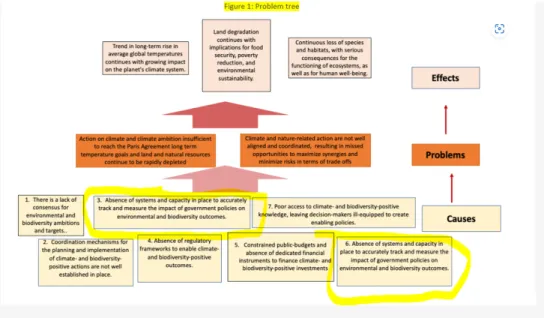
1. Please note causes 3 and 6 have the same text. Cause 6 should be related to barrier #6, which related to the fact that national governments lack robust tracking and measurement systems across both NZ and NP indicators to monitor progress at national level and take adaptive measures.
2. Please note there is a reference to "IDB 2022" that is not clear. Please amend/remove:
3. Table 1 is repetitive of the Chile Project Table in Annex H, please remove it and include a reference to the table in Annex H instead.
4. Some acronyms are not spelled out the first time they are used, please revise the document and correct this (e.g. SBA). Given that SBA is a key focus of the program, this should also be described in a sentence or two.
5. The acronym M/DB or DB/MDB is used several times and is confusing. Is the "DB"
part referring to National Development Banks? Instead of "DBs" would recommend to use instead either International Finance Institutions (IFIs) and/or Development Finance Institutions (DFIs) and/or National Development Banks (NDBs), depending of what is the intention. These are more common differentiation to designate development financial institutions, which also includes bilateral agencies such as AFD, KfW, etc.
6. The user guide for ENCORE is mentioned both in component 3 and on the new table of contribution of the Global Platform for Component 2. Please reftify this so that it is placed under one component, and not both.
7. Outcome 2.2 mentioned that ADB and CAF will be better integrating NZNP considerations "into the many ongoing TA projects". Why is this restricted to TA?
Shouldnt this also aim at eventual inclusion of NZNP considerations across the lending portfolios? this should be amended.
Previous comments:
A) Cleared.
B) Cleared.
C.a & C.b.) Cleared
C.c): Please adjust the width of the columns so the table occupy much less space. Right now, since the column with most of the text is narrow, the text is unnecessarily spread across several rows. Please follow the same procedure for the tables included in each component to highlight the deliverables of the Global Platform: in these instances too the table occupies much more space than needed, and in the printed version the table overlaps with the text. More generally, this seems to be a problem for many of the tables (e.g. table 5), please revise the tables to ensure text is displayed correctly and spacing within the table cells and between lines is done so that tables do not occupy excessive space.
C.d.) On the MDB coordination mechanism: thank you for including the new text. While the objectives and the functions outlined are appropriate, the governance and functioning modalities of the platform/mechanism will have to be further detailed at CEO ER stage.
To this end, it is important to ensure that the organization and convening responsibilities of the working group(s) be assigned based on criteria including: (i) Recognized thought leadership on the topics being covered, (ii) Willingness and ability of the convening organization to engage at an appropriate level of organizational seniority and expertise (e.g. at the Heads of Nature or Climate Division Chief/Lead Officer level); (iii) Ability to lead by example, for instance by having already adjusted internal structures to bring together nature and climate topics; and (iv) Ability and willingness to put in practice the outcomes, tools, guidance stemming from the work of the NZNP MDB coordination platform and to apply those to a subset of the institution's lending and TA
operations. These elements are considered necessary to ensure that the MDB coordination mechanism will be successful, and that participating MDBs/IFIs will be incentivized and motivated to actively participate and contribute. The ability of the convening MDB(s) to lead by example is key for the group to produce results. The proposed leadership
arrangements and governance for the mechanism will therefore have to be further assessed and fleshed out during PPG stage, including, for instance, through a design workshop or consultation between interested MDBs. These arrangements will be further assessed and verified by the GEF SEC at the time of the submission of the CEO ER, as a condition for technical clearance.
C.e). Cleared.
C.f). Cleared.
C.g). Cleared.
C.h). Thank you for the helpful additions related to this comment. Please note the following minor editorial aspects:
1. Several instances in the Stakeholder engagement section indicate that the "Global Platform "could" do X, Y, Z." Suggest using a more definitive language, such as "The Global Platform will look to establish/further evaluate at PPG stage the possibility of establishing/organizing/join forces with/etc.", clearly indicate that this will be further assessed at PPG Stage.
2. The sub-heading on "Stakeholder engagement" indicates that the Grantham Institute serves as a Secretariat of the Coalition of Finance Ministers for Climate Action. However, on the Coalition website (https://www.financeministersforclimate.org/secretariat-and- partners) the World Bank and IMF are listed as hosting the coalition, and the Grantham Institute is listed as Institutional Partner. Please clarify which one it is and ensure the most accurate affiliation is referred to in the PFD.
3. Please refer to the organization 2050 Pathways Platform with the correct name and spelling (capitalized). An abbreviation (2050 PP) can also be used. As of now, there are different ways this they are indicated in the document ("2050 pathway", "2050 Pathways", etc.) , which are not the correct name (2050 Pathways Platform).
D). Cleared.
E). On the Levers of Transformation, please find a way to add them in the Program Description section. As per comments provided above in this review sheet, the narrative provided in the Summary have to be cut since it is too long for the Summary section (please see proposed draft for Summary section sent by email), but it should be included in the Program Description.
F) Cleared.
G) Cleared.
H) Cleared.
I) Cleared.
____________________
4/14/23, FB
A) A) A TOC is provided, along with a short narrative about the causal pathways. Please consider the following comments:
1. 1. On the Problem Tree: between the Causes and the Problems as listed, there seems to be a missing layer. All the causes identified contribute to the key status-quo
observations/problems that this program is set to address:
a. the action on climate and climate ambition is not good enough and not aligned to the Paris Agreement long term temperature goals, and b. climate action and nature-related action are often thought of in a
vacuum without coordination with the other side, and this results in missed opportunities to maximize synergies and risks in terms of trade offs.
Suggest lump/merge the two orange boxes with the correspondent ones in the Effects layer, and make space in the problems to something more directly linked to the Program?s theory of change, such as the two points I listed above in this comment.
2. 2. On Effects:
a. The fourth box under Effects that reads: ?The world?s existing stock of infrastructure is responsible for an estimated 79% of global GHG emissions ?, is not so clear. Does it simply mean that infrastructure is responsible for 79% of global greenhouse gas emissions? And if so, how is this an effect of the problem with damage of fragile ecosystems and biodiversity, as outlined in the orange box below?
b. A reference to biodiversity loss in the effects is missing, only land degradation is listed (1.5 billion people impacted due to land degradation).
3. 3. On the TOC diagram: the ?causes? listed under the problem tree to the
actions/outcomes that are planned for and included in the theory of change ? so it is clear what corresponds to what. A numeric reference can be added to the causes boxes on the Problem Tree diagram (similar to the reference in the drivers) and then referenced in the relevant one of the 6 outcomes box in the ToC diagram. In other words: it should be clear which ?cause(s)? each outcome is responding to, so that its clear that no cause is left
unattended. If any cause/problem is not directly tackled by the program, or is outside the scope of the program?s activities, this should be indicated.
B) B. There is a description of how the Program will build on existing initiatives, and at national level child projects include mention of existing GEF projects/baselines.
C) C. On Program Components, they are well outlined in the section. Please consider the following aspects in the revision:
COMPONENT 1:
a. Please include a short description of the Global Platform and its separate set of component/outcomes: this would help differentiating the global platform structure from the Program structure (please check for instance the Plastics IP on this as it include a helpful table).
b. Output 1.1: the ?causes? listed under the problem tree to the actions/outcomes that are planned for and included in the theory of change ? so it is clear what corresponds to what.
c. Related to the previous point, Table 2 lists the
institutional/governance structures that are in charge of decision making in each country. The columns are misleading in some countries: for instance Tanzania says: ?strengthen cross ministerial coordination mechanism?, but then the selected column indicates ?new?. Please revise the table, and also clarify if ?new? means the child project will work to establish it. Still on Table 2: it sems confusing that the text
?governance framework? and ?plans and strategies? are placed in separate columns.
COMPONENT 2
d. This Component is missing a coordination mechanism to ensure participation, inputs, engagement and validation from DFIs, particularly MDBs. This is needed to link theory and capacity building to
financing. The IP looks to ensure that the design of NZNP strategies and LTSs is closely and directly linked to pipeline generation and implementation of projects to move from concept to action. To this end, the perspective of and inputs from development finance institutions and particularly MDBs is crucial, given their role in supporting the system transformation and transitions towards NZ and NP economies. Several MDBs have been involved in efforts to collaborate on the modalities for support to developing countries for the development of LTSs. In addition, MDBs have been collaborating on Nature too, with the issuance of the COP26 Joint Statement by the MDBs on Nature, People and Planet, including on developing a relevant taxonomy and tracking methodologies for nature-positive investments. In light of this, there is a clear opportunity to leverage this work and build on it, including through working directly with MDBs to continue the work on NZNPs outlined in their COP26 Statement, and to link this to the work of other GEF Agencies involved in the NZNPA IP. This IP needs to make efforts to facilitate this incipient dialogues, and link the Global Platform Knowledge component to the practical and on-the-ground investment work that MDBs are doing. A Collaborative Mechanism between MDBs should be envisaged to ensure the Program has relevance with MDBs, DFIs, and other providers of financing for NZNP implementation, and to ensure a coordinated approach to, inputs in and ownership of the NZNP Strategies by multilateral financial institutions in the countries where the child projects will be implemented, thus promoting co- investment and scaling up of the GEF-funded downstream pilots. Please consider including this as a separate outcome and indicator in the Component 2 structure. During the Global Platform design/PPG stage
the most suitable partners/Agencies to carry out these functions will need to be identified and engaged appropriately.
e. Overall from reading the description of the component, the fact that a large share of the program financing (through the child projects) will be going towards specific investments is not coming across strongly enough. From what is presented, it seems the program is structured mostly as TA, with at the most some ?investment facilitation? being requested by the participating countries. Please include a clear statement before Table 5 that clearly indicate that the child projects will co-invest program?s own resources in several of the pilot projects that have been identified.
f. Linked to the previous point, the first outcome indicator for Outcome 2.2 seems unclear in indicating whether we are referring to projects that have been at least supported or also co-invested in by the program, or if we are counting any pilot project that in Country X would be benefitting from the TA activities and hence generating ?practices and lessons for NZNP investments. What is the intention?
COMPONENT 3
g. Outcome 3.2: the first sentence under the heading ?Capacity development and knowledge exchange sounds very general and not specific enough, it should be revised to make it more compelling. Also, who are these services for, who is the audience? How will it be offered? Please try to be more specific.
h. Figure 3: linked to the previous comment: (i) please consider further elaborating in the PFD regarding the possible design/governance structures (working groups? Communities of practices? Etc) that will be used by the Global Platform to interact with the three groups identified.
The concern is that we should move beyond mapping, to institutionalizing (some of these) relationships or at least provide appropriate venues/settings to facilitate exchange towards Program activities and objectives. (ii) Please indicate what the * refers to for some of the orgs listed.
D) D). Incremental reasoning and additionality of the GEF intervention is already covered from a previous comment indicating the need to further describe baseline and alternative scenario. No need for further comments.
E) E). Levers of Transformation: please provide a brief overview indicating how these are addressed. the GEF-8 4 levers for transformation: (i) governance and policy; (ii) financial leverage; (iii) multistakeholder dialogue; and (iv) innovation and learning Levers 1-3 mirror Programs components, innovation needs a bit more explanation (as described elsewhere in this review
sheet). https://www.thegef.org/sites/default/files/documents/2022- 03/GEF_R.08_28_GEF8_Strategic_Positioning_Framework.pdf
F) F: On Stakeholder engagement (comment provided by PPO): While the PFD incorporates some description on the importance of civil society as a key stakeholder it does not go further to describe how they will contribute to the design and implementation of the program and its components. In addition, it seems that the submission has not uploaded to the portal documents tab any stakeholder engagement plan or assessments that have been done during the PFD preparation phase. Agency should provide some additional information on how civil society, women groups, IPLC etc. will be engaged in the design and implementation of the program and to also upload any assessments done at this stage
G) G: GENDER (provided by PPO):
a. In all references to stakeholders/civil society, please request the Agency to include specifically, women's groups/women's organizations, or gender expertise (when referring to other organizations);
b. On the NZNP Accelerator Steering Committee (SC) membership, in addition to gender balance, please ask Agency to also ensure that there is gender expertise.
c. There was a reference to the GBF having 20 targets. There are 23 Targets. Please request Agency to correct this.
H) H: Cleared. this is addressed.
I) I. Policy Coherence: this is one of the key objectives of this Program, however, it is not mentioned enough. We suggest including clear reference to this as objective in the Project Summary, and in the list of Barriers (section on ?Incentives in national policy
frameworks? for instance, as subsidies for fossil fuels would not be policy coherent with feed in tariffs for renewables, for instance). We would like to bring this objective more forward in the description of the program.
Agency's Comments 05/12/23, UNEP
1. Thank you, this has been corrected, it was actually cause 3 that had to be adjusted.
2. The reference to "IDB, 2022" has been removed.
3. The Table 1 has been removed and a reference to Annex H has been added.
4. The acronyms have been revised and a short paragraph has been added on the description of the SBA.
5. We have adopted the acronym MDBs and DFIs and revised the document throughout.
6. Reference to ENCORE has been deleted from Component 3 and kept only in Component 2 with a short description.
7. The comment has been addressed.
Previous comments:
C)
c. The tables have been adjusted to take less space as suggested, however, once copied into the portal they change format and there they cannot be further changed, hence some of the tables still occupy a lot of space.
d. Duly noted.
h.
1. The text has been revised to include more precise and determinative wording as suggested.
2. We have revised the document to refer to the Grantham Institute as the institutional partner for the Coalition of Finance Ministers for Climate Action.
3. The reference to 2050 Pathways Platform has been adjusted throughout the document as requested.
E) The levers of transformation have now been also added to the section on Programme Description.
5/6/23 UNEP A) ToC
1-3. Identified problems have been aligned with GEF-8 programmatic NZNP raised issues: Lack of ambitious targets on climate and nature and lack of coordination of the two global agendas. Identified effects have been corrected, for language and data. Numerical reference has been added connecting the causes to the Programme outcomes.
B) Ok.
C)
Component 1:
a. A short description of the Global Child Project outcomes has been added.
b. and c. Global Child Project activities have been described under each component briefly and a detailed description of proposed activities has been added to the Global Child Project concept note.
Table 2 has been revised, however, the two columns for plans and strategies and governance frameworks have been kept, as they point to two separate things.
Component 2:
d. Component 2 has been updated to include an MDB NZNP Coordination Structure; this is also reflected in the Programme coordination arrangements.
e. Updated text has been included in the PFD above the Table 5 to reflect GEF funding and co-financing in pilots.
f. The indicator has been changed to the following, ?# of pilot projects supported by the NZNP Program, which are generating practices and lessons for NZNP investments?
Component 3:
g. First sentence on stakeholder engagement has been revised.
f. A detailed description on the type of collaboration envisaged with each stakeholder group has been added; details on specific collaboration will be added at CEO Endorsement stage.
E) Levers of transformation and how they will be addressed have been added, in the summary, as well as in the country priorities.
F) Engagement with civil society entities, women?s groups, and so on is expected to happen mostly at Child Project level, for which the details are provided in the Country Child Project concept notes. An initial stakeholder engagement mapping has been now included in the core of the PFD. The consultations with Implementing Agency have been also reflected in the core of the PFD. More detailed stakeholder engagement plan will be developed at the CEO Endorsement stage.
G)
a. Noted and revised as requested.
b. Ensuring gender experts as part of the SC might not be feasible, however, it has been added that gender-related issues should at all times be included in the agenda of the SC, as well as the technical documentation drafted by the Global Child Project.
c. This part has been now deleted and the reference is no longer part of the PFD.
I)
Policy coherence has been added as a key objective of the Programme, as well as in the barrier section and is more visible throughout the document.
5.2 Program coherence and consistency
a) How will the program design ensure resilience to future changes in the drivers and allow for adaptive management needs and options?
b) Is the potential for achieving transformative change through the integrated approach adequately described? How is the program going to be transformative or innovative? Does it explain scaling up opportunities?
c) Are the countries or themes selected as child projects under the program appropriate for achieving the overall program objective?
d) Are the descriptions of child projects adequately reflective of the program objective and priorities as described in the ToC?
e) Is the financing presented in the annexed financing table adequate to meet the program objectives?
Secretariat's Comments CLEARED.
04/14/23, FB
a) The governance structure allows for adaptive management.
b) The program has potential to achieve transformation by setting a clear path,
milestones/targets, providing capacity building and financing to achieve long term climate
& nature impacts.
c) Countries have been selected based on their potential to achieve programs objectives.
d) Yes.
e) Yes.
Agency's Comments N/A
5.3 Program Governance, Coordination and Cooperation with Ongoing Initiatives and Programs
a) Are the program level institutional arrangements for governance and coordination, including potential executing partners, outlined on regional, national/local levels and a rationale provided? Has a program level organogram / diagram been included, with description of roles and responsibilities, and decision-making processes?
b) Is there a description of coordination and cooperation with ongoing GEF and non-GEF financed initiatives, projects/programs (such as government, private sector and/or other bilateral/multilateral supported initiatives in the program area, e.g.).
Secretariat's Comments CLEARED.
05/15/23, FB:
3. ok 5. ok 05/10/23, FB On Governance:
1. Cleared.
2. Cleared.
3. Cleared.
On Coordination and cooperation:
1. Cleared.
2. Cleared.
3. It remains unclear why EBRD is listed in the last paragraph of the section, while AFDB and IDB are listed in the bullet list? EBRD, like AfDB and IDB have not been engaged prior to PFD submission. They are equally important MDBs, and the current presentation seems to imply that we establishing or envisioning collaborations at different speeds for the institutions listed in the bullet list and for the EBRD and BOAD. If the differentiation is based on the definition of "regional partners", then IDB and AfDB also fit in that categorization. This is potentially a sensitive section of the PFD, so we recommend accuracy. If a differentiation is to be made, it could be based on partners which have already been consulted and engaged, vs prospective partners with which no engagement took place to date and engagement is planned for PPG stage. Please rectify.
4. Cleared.
5. under the section heading "COOPERATION WITH ONGOING INITIATIVES"
can you please add another subheading in italic, similar to the ones included below ("Collaboration on sharing/coordinating knowledge...", "Collaboration on
monitoring/tracking achievements of goals...", "Collaboration on leveraging
finance/investments...", etc), which indicates that the first few organizations listed (UNEP
FI, UNEP-WCMC, CPI, Climate Promise) are direct partners of the Program? As presented, they don't fall into a clear categorization under the general heading of ongoing initiatives.
_____________________________
04/14/23, FB On Governance:
1. 1. Please consider adding also a paragraph describing the role of the co-lead agencies 2. 2. Regarding the Steering Committee: is the annual frequency enough? Is there a need
for all Agencies for child projects (UNEP, UNDP and UNIDO) to come together more often to focus more specifically on project implementation problems and promote cross pollinations/co-troubleshooting? Please consider if and how this be done.
3. 3. ON country focal points: it is noted that the idea is that only 3 country focal points will rotate on each annual steering committee event. Is there an expectation that the country focal points would come together as a group to discuss specific experiences and promote south south exchange/cross pollination of the type indicated in their TORs, other than the program steering committee annual meetings?
On Coordination and cooperation:
Under section COOPERATION WITH ONGOING INITIATIVES:
1. 1. A cooperation with NDC partnership is mentioned. Please elaborate on this if discussions and agreement have been made with NDCP.
2. 2. "The Programme can also leverage UNEP FI's various working groups and thematic initiatives to advance cooperation on key NZNP topics, such as climate risk assessment,??
: The PFD needs to be more precise. Will the program leverage these other specialized groups? If so, how will this be done (it is not described in the global platform child project).
3. 3. BOAD and AfDB are mentioned as potential regional partners. Will EBRD also be approached for this role?
4. 4. UNDP?s Climate Promise is mentioned: it would be advisable to have a short para to describe what it does and how will be engaged.
Other comments provided by PPO:
Coordination and Cooperation with Ongoing Initiatives and Programs. This section includes Table 7 and a justification of expected results. Please move the justification part under the Core Indicator section in the dedicated text field about methodologies and justification of target level. There is no need for the Table 7 which is redundant with the data entered in Portal.
Agency's Comments 5/12/23, UNEP
On coordination and cooperation:
3. EBRD has now been added to the bullet list as suggested.
5. A subheading ?Coordination with direct partners of the Programme? has been added as suggested.
5/6/23 UNEP On Governance:
1. Role of co-leads has been added to the coordination section.
2. Steering committee frequency has been increased to twice per year and included in the text. Informal Implementing Agency information exchange meetings have also been added to improve information flow and learning across the Child Projects.
3. Cross learning is a key feature of the Programme and will engage all Country Child Project focal points. A text has been added elaborating that the Global Child Project management team will organise meetings with the Country Child Project focal points. The description of the Country Child Project focal points? roles and responsibilities now includes further functions, responsibilities, and engagement.
On Coordination and cooperation:
1. Collaboration with NDC partnership will be further explored at CEO Endorsement.
2. More details on UNEP FI have now been provided, but additional information will need to be added at CEO Endorsement stage on how the Programme will cooperate with UNEP FI working groups and alliances. Work done with UNEP FI and the NZNP MDB
Coordination Structure could be linked to help coordinate with the 3 UNEP FI climate Alliances (insurance, asset owners and banking).
3. EBRD will be approached for engagement in a similar way to BOAD and AfDB at CEO Endorsement. EBRD will also be included in the NZNP MDB Coordination Structure.
4. Paragraph on UNDP Climate promise has been added, but more details on how the Programme will engage with them will be added at CEO Endorsement.
PPO Comment
- The justification part has now been moved under the Core Indicator section and the Table 7 has been removed.
5.4 Program-level Results, Monitoring and Reporting
a) Are the global environmental benefits and/or adaptation benefits identified? Does the PFD describe how it will support the generation of multiple environmental benefits which would not have accrued without the GEF program?
b) Are the identified core indicators calculated using the methodology and adhering to the overarching principles included in the corresponding Guidelines
(GEF/C.62/Inf.12/Rev.01GEF/C.54/11/Rev.01)?
c) Are the program?s targeted contributions to GEBs (measured through core indicators and additional listed outcome indicators) / adaptation benefits reasonable and achievable? Are the GEF Climate Change adaptation indicators and sub-indicators for LDCF and SCCF properly documented?
d) Other Benefits: Are the socioeconomic benefits resulting from the program at the global, national and local levels sufficiently described?
e) Is the described approach to program level M&E aiming to achieve coherence across child projects and to allow for adaptative management?
Secretariat's Comments CLEARED.
05/15/23, FB:
A.1. ok B.b. ok
_________________________
05/10/23, FB On GEBs:
A.1) Is seems there are discrepancies between emission reduction amounts in the child project concepts and teh information in the portal (e.g. Chile). Please correct them and resubmit.
A.2) Cleared.
On core indicators:
B) comments from PPO:
a. Cleared.
b. Not addressed, please clarify which section of the PFD includes a short description of the general approach taken by child projects in calculating their contribution to CI.6, 3 and 4. Please add a short description in below the table of indicators.
c. Cleared C) Cleared D) Cleared
E) Please allow additional time for me to check with PPO about the proposed arrangement before clearing this item.
F) Clearance by PPO to be confirmed.
___________________
04/14/23, FB
A) A) On GEBs are identified, however:
1. CI.6: The expected emission reductions seem to have a cost-efficiency which is lower (i.e. they are more expensive) than what observed in other large GEF7 programs such as the sustainable cities and e-mobility Programs. More specifically, Costa Rica, Chile, Morocco, Tanzania and T&T and Mexico have very low emission reductions, despite relatively large GEF + co-financing envelopes in most cases, which may also explain why we are getting lower-than-expected cumulative amount as per my comment above. Please review the calculation sheet for these countries and verify if the assumptions presented are in line with common practice for GEF projects. Noting that different causality factors are used by different projects, please verify these have been applied reasonably, after the additional lens of cost/tons is applied. The table presented below presents the cost efficiency of emission reductions for each child project, with Costa Rica and Morocco as clear outliers. Considering the size of the project, Mexico would also look somewhat underestimated.
2. CI3: this indicator sits currently at 10x the initial estimates, mostly because of the huge amount expected from Indonesia (780k ha), or 80% of the program results on CI3. On the other hand, CI4 is blank for Indonesia. Please revise these estimates and clarify if a (significant?) portion of expected CI3 results should not be reframed as CI4 results. Please refer to the GEF8 guidance on core indicators on CI3 and CI4:
B) On Core Indicators;
A) Core Indicators (comments from PPO):
a. - Core Indicators 3 and 4 indicate high level of expected results. Can the Agency confirm that these results will take place as a direct results of Program activities? Some of the concept note seem to infer such results may take place indirectly as a consequence of the
implementation of plans, but without dedicated investments from the Program. Please adjust downward if this is the case. The GEF-8 Results Measurement Framework guidelines (GEF/C.62/Inf.12/Rev.01) state that ?Only direct outputs and outcomes are captured through Core and Sub-Indicators?. The Agency may wish to capture any indirect results elsewhere in the project results framework.
b. - Core indicator 6. Kindly indicate in the dedicated text field below the Core Indicator section the general methodological approach followed (e.g. causality factor) to identify expected results under this indicator. This matters as it?s at the core of this program. Please also include the Anticipated start year and Duration of accounting.
c. - Core Indicator 11. Please ensure the beneficiaries captured are only Direct beneficiaries. Child project concept note point to the fact that some indirect beneficiaries are also captured. Please discard these as they should not be captured under this indicator as per the indicator?s definition available in pages 24-25 of the GEF-8 Results Measurement Framework guidelines.
B) C) GEBs are reasonable/achievable but comments provided above need to be addressed.
C) D) Socio-economic benefits: No, please include a short description of the general socio- economic benefits that can be expected from the implementation of the program. the program invest significant resources in generating evidence based action, through socio- economic analysis, so it is expected to be impactful in generating and maximizing socio- economic benefits. However, a short description of this is missing.
D) E) On M&E ? yes the approach is described. However, please consider if more flexibility is needed regarding the fact that it is indicated that ?. A Mid Term Evaluation (MTE) of the NZNPA IP will be carried out under the Global Platform after all Country Child Projects have reached the mid-point of their implementation and have conducted their own Mid Term Reviews?: what happens in case of significant delays of one or more of the Child projects?
F) Other comments provided by PPO on M&E section:
F.1. The section mentions a ?forthcoming GEF Monitoring policy?, whereas no such policy is planned. Please remove ?forthcoming? as GEF/C.56/03/Rev.01 is still under implementation.
F.2. Table 6 is hardly legible. Can it be pasted in a different way?
Agency's Comments 5/12/2023, UNEP On GEBs:
A) 1. The discrepancies have now been corrected, and several Child Projects have also further revised/corrected their GHG emissions estimates (Chile, Mexico, Nigeria).
On core indicators:
B) b. We have now fixed the issue with the portal and the description is now visible.
5/6/2023 UNEP A)
1. The GHG emissions reduction estimates have been revised for Costa Rica, Chile, T&T, Mexico, and Morocco.
2. CI3 and CI4 have been revised for Indonesia, as per guidance.
B)
a. The estimates for CI3 and CI4 have been revisited and adjusted for relevant Child Projects. We confirm GEF guidance has been followed for these estimations and no indirect contributions have been included in the calculations.
b. Based on the information and guidance available, estimations for CI6 have been undertaken for all Child Projects. The estimations have also relied on expert opinion to attribute the overall emissions. Given the significance of the upstream component in the Programme, this has been agreed on as the adequate approach. Anticipated start year and duration of accounting have also been added.
c. The estimations for CI11 have been revisited and adjusted for relevant Child Projects, however, a few of the Child Projects (Cote D?Ivoire, Morocco, Nigeria, Tanzania, and Viet Nam) still have a very high estimation compared to other projects. To further align the approach, UNEP is discussing additional necessary revisions. This will be addressed during CEO Endorsement.
C) Ok.
D) Description on socio-economic benefits has been provided.
E) The paragraph on M&E has been revised following the current guidance from the GEF.
An MTE for the Programme shall not be undertaken due to the issues mentioned in the comments. Furthermore, the GEF Policy does not require Programme-level MTE. Each Child Project will undertake its own Mid Term Evaluation/Review, as well as its Terminal Evaluation/Review. The Programme Terminal Evaluation will be done once at least 60%
of all Child Projects have reached operational completion and have conducted their own Terminal Evaluation/Reviews, and/or at least 80% of the overall budget of the Programme has been expensed. The revised text has been included in the PFD.
F) Word ?forthcoming? has been deleted from the respective text. Table 6 has been repasted in a more legible manner.
5.5 Risks to Achieving Program Outcomes
a) Are climate and other main risks relevant to the program identified and adequately described? Are mitigation measures outlined and realistic? Is there any omission?
b) Are the key risks and mitigation measures that might affect implementation and the achievement of outcomes adequately rated?
c) Are environmental and social risks and impacts adequately screened and rated and consistent with requirements set out in SD/PL/03?
Secretariat's Comments CLEARED.
05/10/23, FB a) Cleared.
_________________________
04/14/23, FB a) RISKS:
1. Risk are identified, but not all mitigation measures are well developed, and in fact most are missing. Please revise the risk registry to include sound description of relevant risk mitigation measures/approaches.
2. Climate Risk: Please also indicate that country child projects will have to conduct a full climate risk screening and adopt adequate risk management measures, including through adjustment in project design. Please also mention that child projects will have to follow STAP guidelines on climate risk screening for GEF projects.
b) b) Cleared. YES c) c) Cleared. YES
Agency's Comments 5/12/23, UNEP N/A
5/6/23 UNEP a)
1. Risks have been revised and mitigation measures added for each of the identified risks.
2. Climate risk: Indication of climate risk screening has been added for Child Projects.
6 C. Alignment with GEF-8 Programming Strategies and Country/Regional Priorities 6.1 a) Is the program adequately aligned with Focal Area and IP Elements, and/or LDCF/SCCF strategy?
*For IPs: is the program adequately aligned with the Integrated Program goals and objectives as outlined in the GEF 8 programming directions?
Secretariat's Comments CLEARED.
05/15/23, FB
_________________________________
05/10/23, FB
thank you for the new text. Please note:
a. The post-2020 GBF should be referred throughout the document with the official designation of "Kunming-Montreal Global Biodiversity Framework" - please amend.
b. Please add GBF target 14 to the list of relevant targets as this IP is specifically designed to contribute to integration of BD/nature consideration into (climate) policies and budgetary processes.
c. Still on the GBF section, given that CI 3 is being tracked, the IP also contributes to GCF Target 2. Please consider adding it.
_________________________
04/14/23, FB
Regarding alignment with the GEF 8 programming strategy/directions: the PFD needs to include a section on:
1. Alignment with the GEF8 Programmatic approach and how the IP utilizes the GEF8 levers of transformation.
2. Alignment with the NZNPA IP objectives (a short para is enough)
3. Alignment with Focal Areas objectives and MEAs priorities for the relevant focal areas for which GEBs are generated at Program Level (CCM, BD, LD). This section should also include a table/bullet list to list the different targets of the Global Biod Framework that the IP contributes to (an example of this was shared with Geordie and Ruth).
4. A short section on national priorities
5. The paras on selection criteria and selection process can be shortened to accommodate for the additional text requested above.
Agency's Comments 5/12/23, UNEP
a. The reference to the Kunming-Montreal Global Biodiversity Framework has now been corrected throughout the document.
b. and c. Targets 14 and 2 have now been added.
5/6/23 UNEP
1. A paragraph has been added on GEF-8 programmatic approach, as well as alignment of GEF-8 levers of transformation.
2. A paragraph has been added on alignment with NZNP IP objectives.
3. A section has been added on alignment with relevant MEAs.
4. A subsection on national priorities has been summarised in a table and a few short paragraphs have been added as well.
5. The section on selection criteria and process has been shortened.
b) Child project selection criteria: Are the criteria for child project selection sound and transparently laid out?
Secretariat's Comments CLEARED
04/14/23, FB Yes.
Agency's Comments N/A
6.2 Is the program alignment/coherent with country / regional / global priorities, policies, strategies and plans (including those related to the MEAs and to relevant sectors)?
Secretariat's Comments CLEARED
04/14/23, FB Yes.
Agency's Comments N/A 7 D. Policy Requirements
7.1 Are the Policy Requirement sections completed?
Secretariat's Comments CLEARED
04/14/23, FB Yes.
Agency's Comments N/A
7.2 Environmental and Social Safeguards
Have safeguard screening document and/or other ESS document(s) attached and been uploaded to the GEF Portal? (annex D)
Secretariat's Comments CLEARED
04/14/23, FB Yes.
Agency's Comments N/A 8 Other Requirements
Knowledge Management
8.1 Has the agency confirmed that a project level approach to Knowledge Management and Learning has been included in the PFD?
Secretariat's Comments CLEARED
04/14/23, FB Yes.
Agency's Comments N/A 9 Annexes
Financing Tables (Annex A and Annex H) 9.1 GEF Financing Table:
a) Is the proposed GEF financing (including the Agency fee) in line with GEF policies and guidelines? Are they within the resources available from (mark all that apply):
Country STAR allocation?
Secretariat's Comments
CLEARED. (pending any additional comment from PPO) 05/10/23, FB
_______________
04/19/23, PPO
1. Child project ID11089- Costa Rica: the IP Matching Incentive ratios by focal area are not correct while overall ratio is 3:1. Please correct matching incentive amounts by each focal area to achieve the correct 3:1 ratio. Please don?t change country STAR allocation amounts.
2. Child project ID 11097- Morocco: please change the GEF financing table and PPG table so that country STAR allocation by BD, CC, and LD match with Sources of funds table:
Agency's Comments 5/12/23, UNEP Duly noted.
5/6/23 UNEP
1. The IP Matching Incentives for Costa Rica have been revised, while keeping the STAR allocation amounts, as requested. A new LoE reflecting these changes has been issued.
2. The GEF financing table and PPG table for Morocco have been revised to match the Sources of funds table.
Non-STAR Focal Area allocation?
Secretariat's Comments N/A
Agency's Comments N/A
LDCF under the principle of equitable access?
Secretariat's Comments N/A
Agency's Comments N/A SCCF A (SIDS)?
Secretariat's Comments N/A
Agency's Comments N/A
SCCF B (Tech Transfer, Innovation, Private Sector)?
Secretariat's Comments N/A
Agency's Comments N/A Focal Area Set Aside?
Secretariat's Comments N/A
Agency's Comments N/A IP Set Aside
Secretariat's Comments See above.
Agency's Comments 5/6/23 UNEP
Comments above have been addressed.
IP Contribution
Secretariat's Comments See above.
Agency's Comments 5/6/23 UNEP
Comments above have been addressed.
For Child Project Financing information (Annex H)
b) Are the IP Matching Incentives amounts correctly calculated according to the country STAR focal areas? allocated amounts? Are the IP contributions aligned with the Program?
The allocated amounts (including Agency Fee) match those in LoE?
c) Project Preparation Grant Table: Are the IP Matching Incentives amounts correctly calculated according to the country STAR focal areas? allocated amounts? The allocated amounts (including PPG Fee) match those in LoE? Is the requested PPG within the
authorized limits set in Guidelines? (pop up information?) If above the limits, has an exception been sufficiently substantiated?
d) Sources of Funds Table: Are the allocated sources of funds for each and every one of the three STAR Focal Areas within the Country?s STAR envelope by the time of the last review?
e) Indicative Focal Area Elements Table: (For IPs) The selected Indicative Focal Area element corresponds to the respective IP?
f) (For non-IPs) The selected Indicative Focal Area Elements are aligned with the respective Program?
g) Co-financing Table: Are the indicative expected amounts, sources and types of co-financing provided and consistent with the requirements of the Co-Financing Policy and Guidelines?
Secretariat's Comments Cleared.
05/10/2023, FB
A new LOE was issued and the numbers in the portal match.
_________
04/26/2023, IP Coordination Team:
1. Nigeria Child Project: after discussion with the OFP, we request the agency to revise the numbers / allocations of sources of funding for the Nigeria Child project according to the table provided below:
Agency's Comments 5/12/23, UNEP N/A
/6/23 UNEP
A new LoE has been issued for Nigeria and the Child concept note has been revised accordingly.
9.2 Project Preparation Grant (PPG): if PPG for child projects has been requested: has the PPG table been included and properly filled out adding up to the correct PPG and PPG fee totals as per the sum of the child projects?
Secretariat's Comments See above.
Agency's Comments 5/6/23 UNEP
Comments above have been addressed.
9.3 Sources of Funds for Country STAR Allocation
Does the table represent the sum of STAR allocations sources utilized for this program?
Secretariat's Comments See above.
Agency's Comments 5/6/23 UNEP
Comments above have been addressed.
9.4 Indicative Focal Area Elements For non-IP Programs
Does the table contain the sum of focal area elements and amounts as per the sum of the child projects?
Secretariat's Comments N/A
Agency's Comments N/A 9.5 Indicative Co-financing
Are the indicative amounts, sources, and types of co-financing adequate and reflect the
ambition of the program? Has the subset of co-finance which are expected to be investment mobilized been identified and defined (FI/GN/01)?
Secretariat's Comments CLEARED
04/14/23, FB Yes.
Agency's Comments N/A Annex B: Endorsements
9.6 Has the program and its respective child project been endorsed by the GEF OFP/s of all GEF eligible participating countries and has the OFP name and position been checked against the GEF database at the time of submission?
Secretariat's Comments CLEARED.
05/15/23, FB
______________________
05/10/23, FB:
1. Morocco: the portal title still does not match the LOE: Please check and revise Annex H (Table 1 is included as text, and is duplicative of Annex H, and should be deleted as it only creates confusion).
2. Other items cleared, pending final PPO review.
______________________________________
04/18/23, FB
Please find below the information we found in the Letters of Endorsement (LoEs) vis-?- vis the information in Portal. In red color you will find the fields that are inconsistent (a copy of the excel source file for this table is attached to the email with PPO comments on the PFD, which is uploaded on the portal?s document section for this IP). Please note that the financial information needs to be carefully reviewed to ensure consistency with LOEs, as well as amounts revision information as provided by the GEFSEC. For example: in the LoE from Chile the total allocation for BD is $250,000, but in Portal is $2,290,000. What matters is that the figures in Portal need to match the figures in LoE.