Designing and planning a supply chain network (SCN) is a complex process, mainly due to uncertainty in demand. FSSSCDP - Food Sustainable Stochastic Supply Chain Design and Planning model FSCM - Food Supply Chain Management.
Introduction
- Contextualization and problem statement
- Purpose and goals of the master dissertation
- Master dissertation structure
- Concepts and definitions
The first chapter made a brief contextualization and description of the problem that will be studied in this master's thesis. In conclusion, optimizing SC design and planning is a complex process, but it is essential for effective supply chain management.
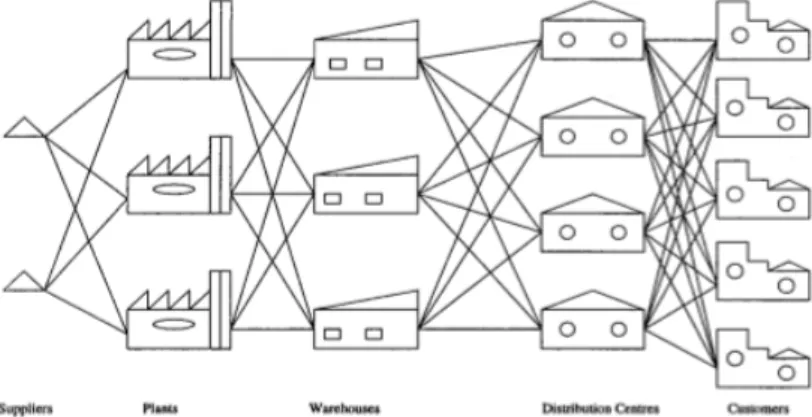
State-of-the-art literature
Uncertainties within supply chain network design and planning
- Contextualization of uncertainty in supply chain network design
- Dealing with uncertainty
- Evolution of supply chain network design and planning models integrating
- Conclusions
Finally, the objective function of this approach is to minimize the economic added value. This model took into account the uncertainty in demand and its objective function is to minimize the expected net present value.
Green supply chain and sustainable supply chain management
- Contextualization and general concepts
- Models considering environmental issues in the SCN design
- Researches in sustainable supply chain management proposed in the existing
- Conclusions
Also, greenhouse gas emissions have been considered responsible for climate change and one of the most harmful elements for the environment (Chaabane et al., 2012). The model includes two objective functions: minimization of total costs (including fixed establishment costs, environmental protection investments, transportation costs and handling costs); and minimizing the total CO2 emission throughout the supply chain.
Food Supply Chains
- Food supply chain network
- Food supply chain characteristics
- Models regarding food supply chains
- Conclusions
There is also a growing concern about the environmental impact of the supply chain (Van der Vorst et al., 2009; Shukla and Jharkharia, 2013; Aung and Chang, 2014). In general, the makespan minimization is associated with the minimization of the project duration (Kyriakidis et al., 2012).

Problem characterization and methodology of the master dissertation
Problem characterization
Methodology of the master dissertation
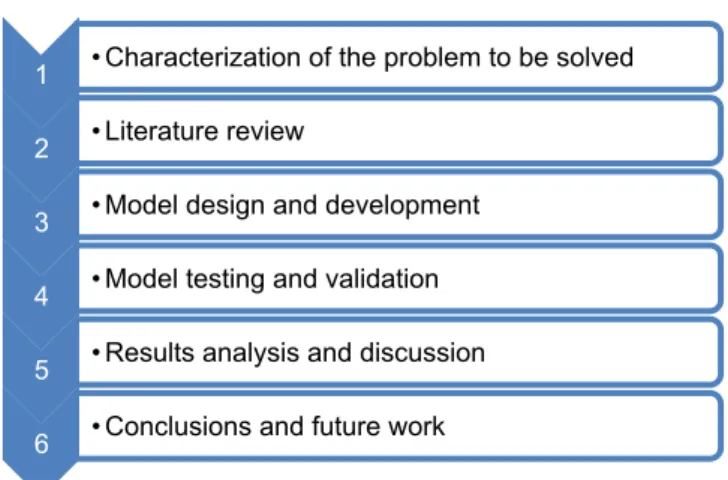
The first step corresponds to the first chapter and includes the characterization and contextualization of the investigated issue, including the motivation to analyze and study this deficiency in the research. Finally, the concepts related to food supply chains are addressed in this step, as the model to be developed will be applied to two examples of food supply chain networks. The proposed model addresses the supply chain network design and planning problem and integrates uncertainty factors; optimization of environmental impacts; and the particularities of a food supply chain, such as shelf life and how to deal with perishability.
At this stage, the mathematical formulation of the problem is presented and assumptions and simplifications are made. This stage corresponds to Chapter 4 and is the most critical for the Master's thesis, as it is considered the largest contribution of this research. In the fourth stage, the developed model is tested and validated using the proposed mathematical model on two FSCN cases.
After that, the conclusions of the master's dissertation, as well as suggestions for future work to be carried out, are presented in the sixth phase, which corresponds to chapter 7 of the dissertation.
Mathematical model definition
Model Framework
- Resource-Task-Network
- Life cycle assessment approach
- Two-stage stochastic programming model
- ε-constraint method
- Problem Characterization
- Data collection
- Definition of the procedure for obtaining solutions
- Simplifications and assumptions
The variables in the first stage correspond to the binary variables associated with the location of supply chain units (such as facilities, warehouses, distribution centers and food hub), the selection of suppliers (in terms of material availability and not related to negotiations or more specific aspects of the suppliers). In addition, the selection of the distribution structure is considered as first-stage variables, since the distribution has a huge influence in the food supply chain through influencing the perishability of the products and thus on their shelf life. Three demand scenarios (optimistic, expected and pessimistic) are defined and the probability of each scenario occurring.
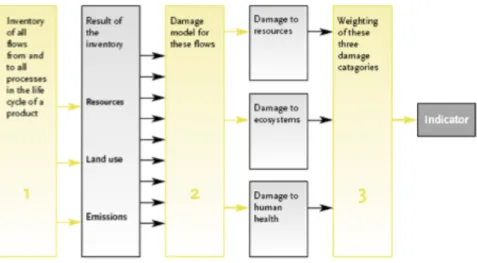
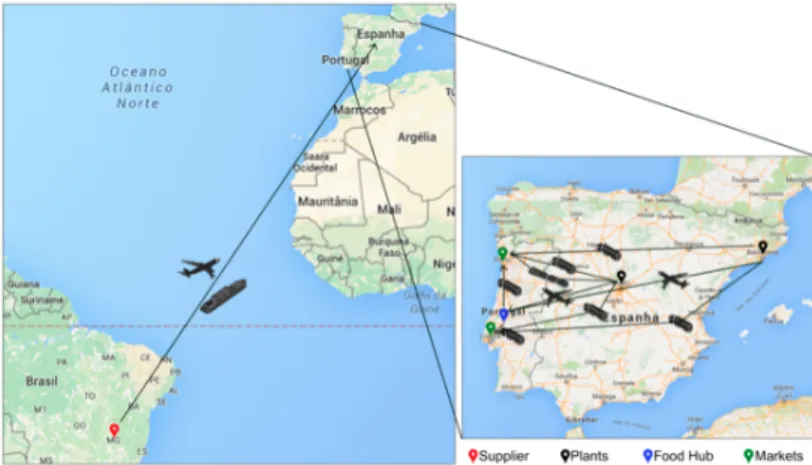
For example, in the case of supply chain network design and planning, a series of operations that constitute a production process of a product will be considered as a task where a technological resource can support several technological processes. In this master's thesis, the calculation of the Eco-Indicator 99 takes into account all emissions generated by the SCN, and only the damage to human health is calculated. A superstructure containing all possible locations of the entities of the supply chain network, that is, all technological resources such as production, storage and distribution (taking into account fixed locations for suppliers and markets and potential locations for factories, distribution centers and food hubs);
In terms of transport costs, the mathematical model considers the costs associated with all transport options between all entities of the SCN.
Mathematical formulation
- Stochastic Supply Chain Design and Planning model
- Sustainable Stochastic Supply Chain Design and Planning model
- Food Sustainable Stochastic Supply Chain Design and Planning (FSSSCDP)
- Solving the multi-objective mixed-integer model
The supply chain network design and planning model allows modeling the case where there is more than one resource to perform a transportation activity between two entities. This subsection describes the constraints and objective function of the Stochastic Supply Chain Design and Planning (SSCDP) model. Equation (4) defines the allocation of distribution resources, allowing the choice of more than one vehicle to transport resources between two entities in the supply chain network.
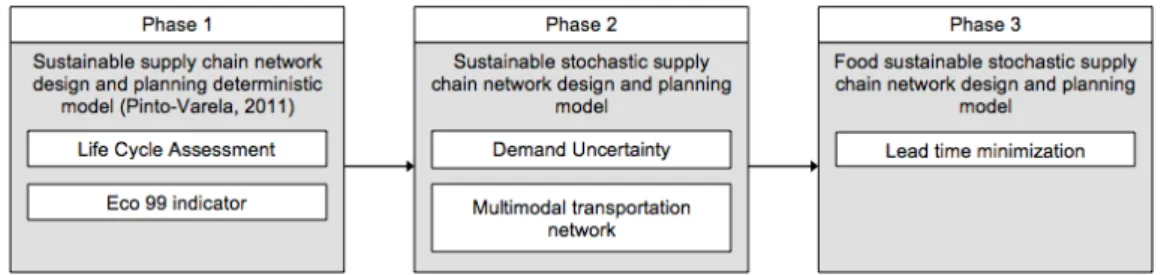
This approach enables the optimization of the design and planning of the supply chain network by analyzing the trade-off between the total cost of supplying the market (the added value of satisfying the entire demand), the environmental impacts and the impact on the delivery time. The economic objective function for supply chain planning and scheduling is defined in Equation (30) by maximizing the annual profit of the SC. In the supply chain network, utility consumption is associated with electricity consumed from the actual operation of resource technologies and from warehouses and distribution centers.
The ε-constraint method is used in this master's thesis to solve the multi-objective mixed-integer model presented in subsection 4.2.3 – the FSSSCDP model.
Conclusions
However, in the case of the transport tasks related to road loads, where more than one resource is available to perform the same task, there is a need to define another constraint. Equation (42) models those cases, where 𝐸𝑐𝑟!"# represents the number of resource r needed to perform the transport task between two entities within the supply chain, under uncertainty scenario m, and is calculated based on the ratio of the flow to carry and the maximum capacity of resource available to perform this transport task Note that in this model it is assumed that only road connections have the possibility to perform the same transport task with more than one resource.
On the other hand, equation (43) guarantees that if there is any flow in a road traffic link between two entities (𝜉!"#>0), this road traffic link must exist (𝑁 given that the parameter M is a large number , which corresponds to the maximum material flow. In addition, the supply chain flow time must not exceed the planning horizon defined by H, as shown by Equation (44). Using the methodology explained in Figure 10, the model can be briefly presented as follows: optimistic, expected, and pessimistic ) and a two-stage stochastic modeling approach is used.
In addition, the model is a multi-objective formulation that considers: (i) maximizing annual profit; (ii) reduction of environmental impacts; and (iii) shorten the flow time after the SCN.
Examples
Example 1
- Mono-objective deterministic model
- Multi-objective deterministic model
- Mono-objective stochastic model
- Multi-objective stochastic model
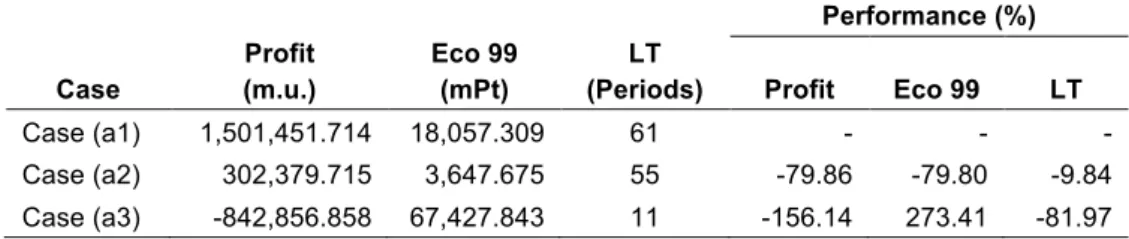
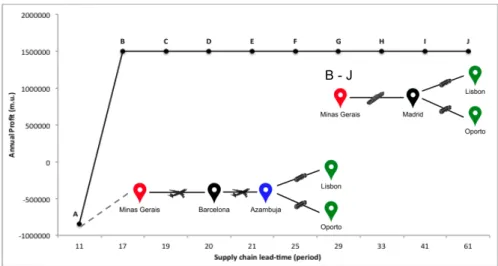
On the other hand, case (a3) consisting of the supply chain lead time minimization represents the lower annual profit. Case (b2) analyzes the supply chain network obtained by the annual profit maximization, considering the environmental impacts and lead time minimization simultaneously as constraints of the model. Solution A corresponds to the results for the supply chain lead time minimization (case (a3)) and the solution J corresponds to the results for the annual profit maximization (case (a1)), which has already been investigated in subsection 5.1.1. .
The annual profit of SC is the main objective function, and the environmental impacts and flow time of SC are the constraints of the model. Maximization of annual profit, minimization of environmental impacts and minimization of flow time of SC corresponding to cases (c1), (c2) and (c3) are carried out. As explained, case (d2) investigates annual SC profit maximization considering environmental impacts and SC preparation time as model constraints.
On the other hand, the trade-off between environmental impacts and SC lead time is shown in Figure 34.

Example 2
- Mono-objective deterministic model
- Multi-objective deterministic model
In solution point C, both suppliers in Hong Kong and Minas Gerais supply the factory's facilities in Madrid and Rotterdam through sea freight. The factory in Madrid supplies the markets of Porto, Lisbon and Barcelona; and the factory in Rotterdam supplies Paris and Barcelona. The factory in Madrid distributed products to the markets of Lisbon, Porto and Barcelona; and the factory in Rotterdam supplies the markets in Paris and Barcelona.
Finally, solutions E – K represent the same supply chain network similar to solution point D, but in solutions E – K the Rotterdam plant only supplies the Paris market. At point A, a factory in Rotterdam opens, receiving material from both suppliers by air. As in solution point A, the Rotterdam plant supplies Lisbon and Porto by sea and Paris by road.
The plant located in Rotterdam distributes products by road to Barcelona and Paris; and the plant in Madrid supplies Porto, Lisbon and Barcelona, also by road.

Conclusions
Appendix N summarizes the main results for all solution points for case (f2) regarding the results for the three objective functions (annual profit, environmental impacts and supply chain lead time), the relative optimality gap and performance of each solution compared to solution point H , which is a solution with a higher annual profit. Comparing solution A to solution H, note that supply chain time is reduced by 58% at a cost of 106% of annual profit, leading to an unprofitable solution; and a 204% increase in environmental impacts. Nevertheless, comparing solution E with solution H, it is possible to reduce the supply chain flow time by 26% at the expense of 2% annual profit and 33% increase in environmental impacts.
Also, regarding the relative gap of each solution, solutions A – D and F have no relative gap, referring to the optimal solutions.
Conclusions and future work
On the other hand, usually the mathematical formulation of supply chain network design and planning problems translates into large mixed integer programs. Robust supply chain network design with service level against disruptions and demand uncertainties: A real-life example. Integrating financial statement analysis into the optimal design of supply chain networks under uncertain demand.
Annex A - Summary of literature review on supply chain network design and planning models under uncertainties. Annex B - Summary of literature review on supply chain network design and planning models that incorporate environmental issues. Annex E - Food Sustainable Stochastic Supply Chain Design and Planning (FSSSCDP) Model Indices, Arrays, Parameters, Variables and Abbreviations.