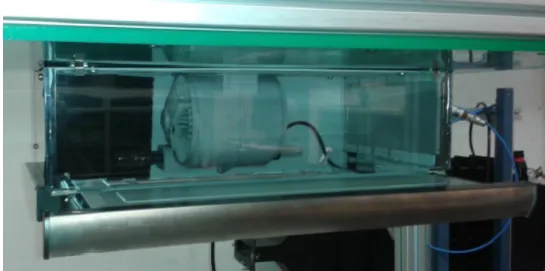
This work is focused on the acoustic characterization and optimization of a kitchen hood, in particular the sirocco fan inside it. To improve noise emissions, the effects of some noise control methods were tested; in particular, the results show that noise reduction on the built-in fan between 4-7 dB or 3-4 dB(A) is achieved only by changing the spiral geometry.
List of Tables
Nomenclature
U1 Tangential velocity of the air at the blade inlet U2 Tangential velocity of the air at the blade outlet ui Components of local fluid velocity. W1 Relative speed of the air at the wing inlet W2 Relative air speed at the wing outlet Subscripts.
Glossary
Introduction
Motivation
State-of-the-art
Farassat formulas 1 and 1A are solutions of the FW-H equation with surface (surface integral formulations) when the surface is moving at subsonic speed. Recently, Farassat and Casper developed a new formulation (Farassat 2B) [23] based on the time integral of the acoustic pressure, which is well suited for broadband noise prediction when extensive turbulence simulation is available.
Objectives
Characterization of the Range Hood
The impeller rotation speed for both positions was measured by Garcia [24] using a PIV (Particle Image Velocimetry) method; the first position (P1) rotates the rotor at 1300 rpm and the second position (P2) rotates it at 2000 rpm.
Theorethical Background
- Turbomachinery
- Nature of centrifugal fan noise
- Description of the Experiments
- Discussion of results
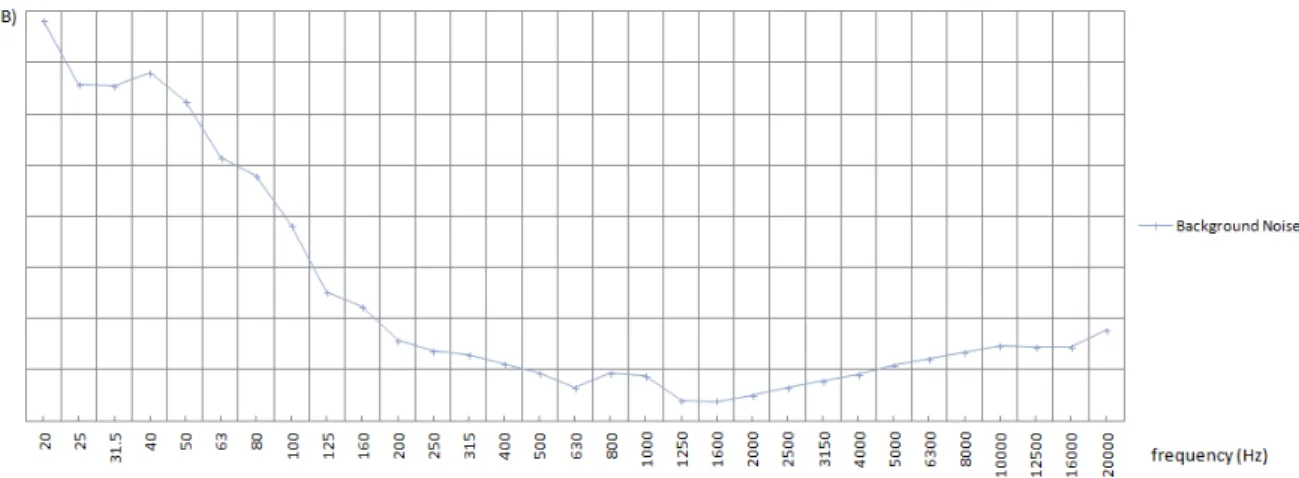
- Background Noise
- Motor
- Motor and volute
- Unhoused impeller
- Housed impeller
- Housed impeller with outlet duct
- Whole range hood without outlet duct
The broadband noise is generated by the turbulent flow acting on the solid surfaces of the impeller blades and volute. In this section, the effect on the noise emission of the engine on the cochlea attached together is analyzed. The aim of this experiment is to get a general idea of the sound spectra of the unhoused fan.
In this subsection, the noise emission of the built-in impeller is analyzed. The results of the experiments performed for the two operating positions of the extractor hood are shown in Figure. Finally, a clear reduction in the OASPL in dB is noted compared to the case without housing.
This effect may be related to the end reflection losses which occur at the end of the channel.

Noise Control
- Increasing cut-off clearance
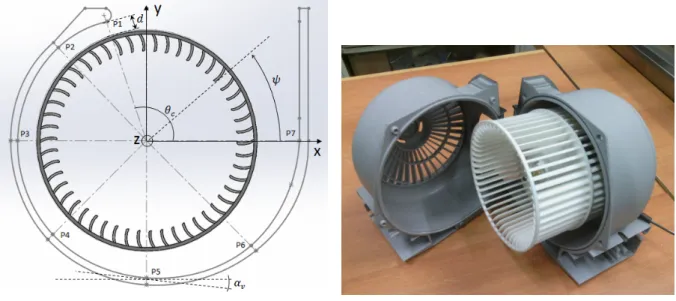
- Changing volute geometry
- Staggering blades
- Inclining cut-off or blades
- Changing the number of blades
- Introducing the use of resonators
- Isolation of vibrations
- Changing the inlet diameter and bell mouth radius
- Changing the blade geometry
Early in 1976, Neise [2] proposed modifications of the volute tone radius to minimize the pressure fluctuations in this zone. 42] on an industrial centrifugal fan of a refrigerator shows a reduction of 3 dB on the proposed fan system at the BPF compared to the previous design by increasing only the radius of curvature of the spiral tongue. Another way to control fan noise can be achieved by inducing a phase shift of the source pressure to reduce the noise component related to the tonal noise at BPF [28].
In a study made by Lyons and Platter [43], a maximum reduction of the tone at BPF of 10 dB is reported, with no loss in the fan efficiency. Nevertheless, since the noise reduction effect of staggered blades is based on the local cancellation of the shear pressure, one must assume that the obtainable noise reduction depends on the shear clearance. Another way to reduce centrifugal fan noise is by replacing the cut-off of the scroll volute with the mouth of a quarter-wavelength resonator, also called closed pipe resonator.
Therefore, the optimization of the bell mouth geometries and the inlet diameter does not seem to provide any benefits for improving the sound quality of the investigated fan.
![Figure 5.1: Sketch of a sirocco double inlet fan (a) Standard impeller; (b) modified impeller [2].](https://thumb-eu.123doks.com/thumbv2/123dok_br/19768629.0/47.892.297.602.429.566/figure-sketch-sirocco-double-standard-impeller-modified-impeller.webp)
Tested control methods
Isolation of vibrations
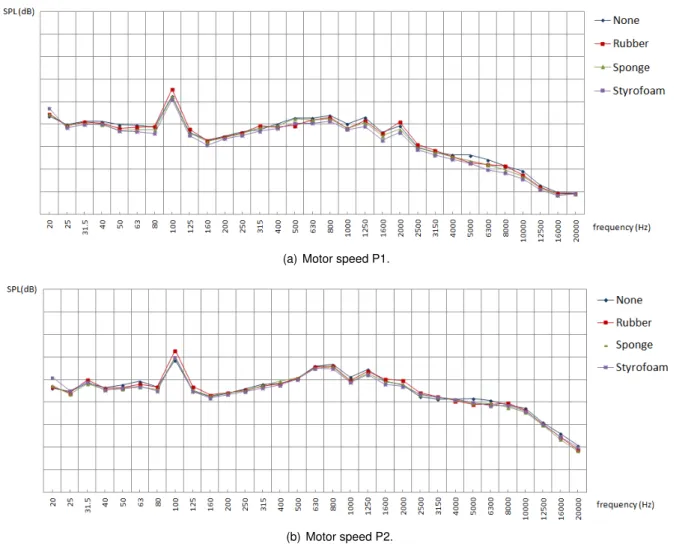
By comparing the sound emissions with and without the materials in question, it is concluded that the introduction of the selected materials between the engine and the casing did not have any positive impact on the acoustic emissions. Since it was not possible to reduce the propagation of the vibrations at 100 Hz at the motor, it will now be tested the effect of isolating vibrations from the coil to the outer box by placing rubber plates at the mountings (Fig. 6.3). Acoustic measurements were made at the positions described under section 4.2.7 (for the entire hood without outlet duct).
For an easier comparison between acoustic emissions with and without rubber plates, let's take the example of measurements made 40 cm away from the outer box (Figure 6.4). It was found that the introduction of rubber vibration isolation plates from the housing to the outer box had no significant effect on the noise spectra at audible frequencies, with even a slight increase in OASPL for both operating positions (about 1 dB for the microphone position shown in Figure 6.4). .
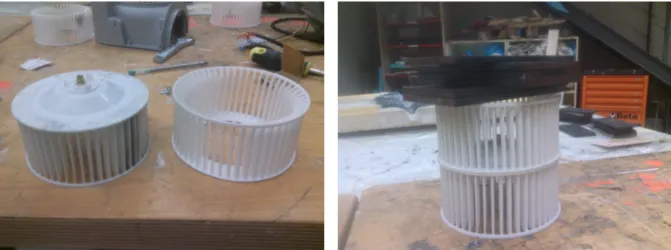
Staggering blades
For an easier comparison between the measured data of the original impeller and staggered blade impeller, see Fig. As expected, the spectra shape of the housed fan with the original and staggered blades is similar, since the staggered blades are known to only have an effect on the BPF tones, which is not even visible in the case under study. However, the experiments with the housed fan with the blades shifted showed a slight decrease in the noise emissions over a wide range of frequencies, compared to the original fan design.
This drop was more pronounced for frequencies below 2000 Hz, with A-weighted OASPL reductions of up to 2 dB(A) at the measured microphone positions. However, a small increase of the sound emitted at 100 Hz is noted, resulting in a slight increase in the OASPL in dB (up to 2 dB for the measured positions) due to the fact that it is the largest contributor to the overall noise is emitted in dB; as it is already known, the origin of this peak is not related to aerodynamic causes, but rather to the motor electromagnetic vibrations; thus a deterioration of the car. Therefore, it seems reasonable to assume that the stagger of the blades had a positive effect on the noise emissions of the fan, with a slight reduction of the broadband noise over a wide range of frequencies.
Casing and volute tongue redesign
An increased total pressure is also recognized along the side walls of the volute. Thus, the volute radius of curvature will also be increased, so that a better control of the flow is achieved, which turns from the axial to the radial direction. This leads, as explained in section 5, to improvements in the flow conditions in general and, as a result, to a reduction in noise generation.
Due to the fact that no other volute with a different geometry was available, the aforementioned rotation angle was used in the process of redesigning the scroll. The CFD analysis containing the total pressure information at the mid-meridian section of the fan for the new volute geometry is shown in Fig. 6.7) and the redesigned one (Fig. 6.9) a significant reduction in the total pressure along the side walls is observed. of the volute and the outlet channel, as a result of a better flow direction.
In addition, these changes in the volute geometry also led to an increase in the overall efficiency of the fan around 42% [24].

Computational acoustics
- Aerodynamic study (CFD)
- Fluid volume modeling
- Meshing
- Turbulence model
- Boundary conditions
- Acoustic far-field (FAST c )
- Theoretical Background
- Assumptions
- Generation of Inputs
- Input Specifications
- Description of main.m
- Applicability of FAST c to centrifugal fans
- Results
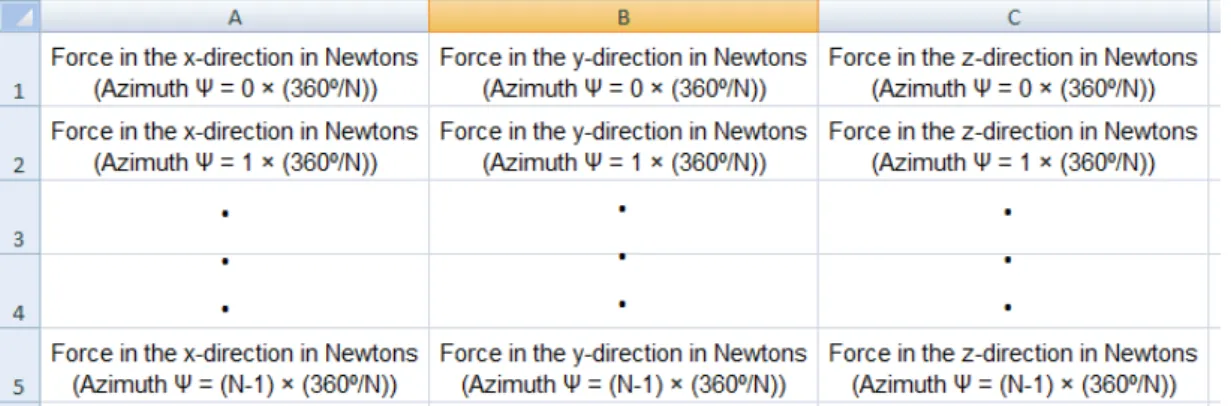
Therefore, it was not possible to determine the radial component of the velocity along the azimuthal direction. The radial component of the velocity will therefore be neglected and it is assumed that the blades only have tangential speed. It is composed of 3 columns, respectively the forces on the x-, y- and z-directions of the lower half of.
The purpose of this step is to create a blade profile with the number of nodes specified by the user using the Xfoil command. The airfoil generated by this routine with the case study impeller specifications is presented in the figure. Therefore, in order to obtain comparable results, it is necessary to ensure that the relative movement of the vane with respect to the position of the microphone is almost the same in both cases.
It can therefore be argued that the formulation used cannot provide accurate results in the prediction of the noise emitted by the built-in fan.
Conclusions and future work
The calculated noise spectra for both cases are almost the same, leading to the conclusion that the actual noise reduction verified by the experiments for the redesigned cochlea is due to improvements in the flow conditions on the inner walls of the cochlea. Moreover, the calculated contribution of the dipolar sources to the total radiated noise is large compared to the monopolar sources, which is in accordance with the assumptions made. For future work it would be interesting to investigate more about the existing possibilities to reduce the sound radiation at twice the line frequency, as this is the one that contributes the most to the OASPL measured in dB; For example, understand whether the physical phenomena behind the vibration at this frequency are an internal fault in the engine's electrical system.
If so, consider the hypothesis of changing the engine model and, if not, conduct a detailed study to redesign the engine mountings with the volute so that the engine vibrations are not so amplified. Finally, some modifications can be made to the acoustic instrument to take into account the noise generated by the current passing through the inner walls of the cochlea and to simulate scattering effects, which could be done through the use of a Boundary Element Method (BEM).
Bibliography
Reduction of the aerodynamic tonal noise of a forward-curved centrifugal fan by changing the volute tongue geometry. Three Dimensional Flow Analysis and Improvement of Slip Factor Model for Forward Curved Blade Centrifugal Fan.KSME International Journal. Noise reduction of centrifugal fan using resonators and active noise control technique. International Journal of Mechanical Engineering, 2:9–20, Sep 2013.
A numerical study on the effects of design parameters on the performance and noise of a centrifugal fan. Journal of Sound and Vibration. Prediction and reduction of internal frequency noise of centrifugal fan blades in a cooler. Application of Numerical Optimization Technique in the Design of Centrifugal Fan with Forward Curved Blades. JSME International Journal Series B.
Numerical simulation of the flow field for an entire centrifugal fan and analysis of the effects of blade inlet angle and impeller spacing.
Appendix A
Scale of 1/3 octave bands
Appendix B
Appendix C
Vibrational isolation of the motor
Vibrational isolation of the volute
Impeller with staggered blades
Redesigned Volute