Analyzing the Influences of the Buyer-Supplier Relationship on the Manufacturing Flexibility
Rogerio Odivan Brito Serrãoa Paulo Roberto Tavares Dalcola
a Industrial Engineering Department, Pontifical Catholic University of Rio de Janeiro (PUC-Rio).
ABSTRACT
This study investigates the relationships among supply chain members and its impact on the operationalization of manufacturing flexibility. It is proposed a conceptual model and conducted a field work involving four manufacturing companies to study the influence of four aspects of buyer-supplier relationship (trust/commitment, information sharing, supplier development and joint product development) on three external dimensions of manufacturing flexibility (mix, new products and volume). From the field work the buyer- supplier relationships are analyzed and their general characteristics and effects on the operationalization of manufacturing flexibility and manufacturing performance are presented. The analysis of scope and achievability factors indicated little explored flexible options, the presence of potential flexibility or the underutilization of flexible resources in the companies. Finding ways for operationalizing flexibility must be prioritized in order to obtain competitive advantage in manufacturing systems. This work shows how buyer-supplier relationships can influence external dimensions of manufacturing flexibility and manufacturing performance.
Keywords: Manufacturing flexibility, buyer-supplier relationships, manufacturing performance
INTRODUCTION
Flexibility is widely recognized as one of the most important sources of competitive advantage for companies in extremely competitive environments.
The growing dispute for markets, short product life cycles, rapid technological advances, demand variations, increasing customization and demand for short delivery periods are examples of factors that determine the need for flexibility in production systems.
Suppliers’ involvement and the consideration of their strategic role in the supply chain and in strategic definitions of manufacturing companies are considered essential aspects for increasing competitiveness (Cousineau et al., 2004; Krause et al., 1998). In addition, it must be noted that suppliers have enhanced their role in the supply chain, especially due to the intensive industrial restructuring process during recent years in which the outsourcing of production processes has been the main consequence. Thus, flexibility in the production environment of the supply chains of manufacturing companies, especially in the search for its characterization as a source of competitive advantage, has become greatly relevant.
Several trends have emerged in the relations between the members in the supply chain (Helper, 1994; Morris and Imrie, 1993; Matthyssens and Van den Bulte, 1994; Lyons et al., 1990; Imrie and Morris, 1992; Simatupang and Sridharan, 2002). These trends have led companies from an adversarial relationship model to a more cooperative model (Simatupang and Sridharan, 2002; Bensaou, 1999; Lyons et al., 1990; Humphreys et al. 2001) which emphasizes several changes in the producer’s behavior towards its suppliers.
Considering the buyer-supplier relationship, this new approach demands more flexible initiatives and is based on a vision of “close relationships” between buyers and suppliers, which can influence diverse aspects of companies’
strategies, among them, manufacturing flexibility.
The consideration of the role of members of the supply chain in the companies’ flexibility can be found in the studies of Chang et al. (2006), Duclos et al. (2003), Das (2001), Suarez et al. (1995, 1996), Olhager (1993), Pérez and Sánchez (2001), Koste (1999) and Narasimhan and Das (1999, 2000). Though the study of relations in the supply chain gained importance in research, influence of the buyer- supplier relationship regarding its effects on dimensions of flexibility, with impact on manufacturing performance was not sufficiently analyzed.
This work focuses on the relationships among companies in the
supply chains and studies the influence of buyer-supplier relationships on manufacturing flexibility. The general objective is to analyze the operationalization of manufacturing flexibility, with focus on the aspects of relationships in the supply chain and their impact on manufacturing flexibility, considering the different aspects of buyer-supplier relationship based on two research questions (RQ):
RQ1: How are buyer-supplier relationships characterized regarding trust/commitment, information sharing, supplier development and joint product development?
RQ2: What is the influence of buyer-supplier relationship on manufacturing flexibility and on manufacturing performance?
This work is structured as follows. Firstly it are characterized several aspects of manufacturing flexibility and buyer-supplier relationships. Secondly it is proposed a conceptual model for analyzing the interaction among the buyer-supplier relationships and the manufacturing flexibility. After that the results from an exploratory fieldwork based on a multiple case study describe the influences of the buyer-supplier relationships aspects on the external dimension of manufacturing flexibility and manufacturing performance while answering the research questions. It should be noted that the intention was not to argue for any analytical generalization but only to answer the research questions. Finally it is presented the conclusion remarks.
NATURE OF FLEXIBILITY
What can be noted in the different definitions found in the literature about flexibility is a convergence of aspects that show it as an ability (Slack, 1992; Upton, 1994; D’Souza and Willams, 2000; Frazelle, 1986) or capacity (Golden and Powell, 2000; Zelenovic, 1982) that an organization has for changing (Slack, 1992; Upton, 1994) or reacting (Upton, 1994) to the changes that have happened in the environment, in respect of time, cost and effort involved (Upton, 1994). Also it is known that manufacturing flexibility is a multidimensional concept composed of several dimensions and elements (Slack, 1987, 1992; Upton, 1994, 1995; Koste, 1999; Koste and Malhotra, 1999; D’Souza and Williams, 2000).
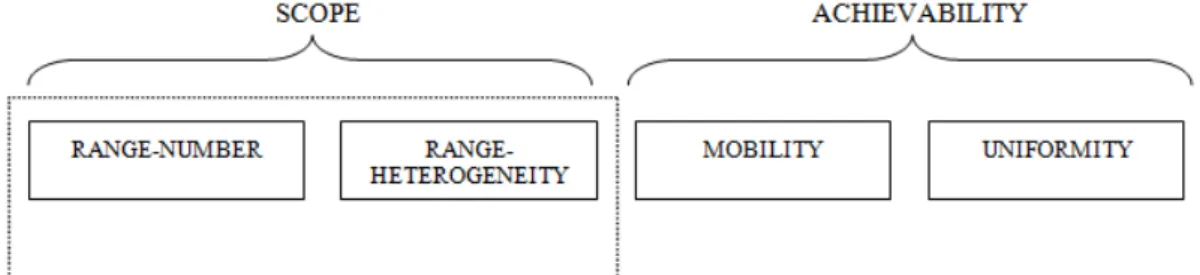
The work of Koste and Malhotra (1999) can be considered as a reference for summarizing the elements of flexibility: range number, range heterogeneity, mobility and uniformity. They define these four elements as components that
may be used for defining the domain of any dimension of manufacturing flexibility (Koste and Malhotra, 1999). Koste et al. (2004) proposed two new conceptually distinct factors for manufacturing flexibility dimensions: scope and achievability of flexible responses (Figure 1). The scope factor is composed of the range number and range heterogeneity elements, and captures the scope of flexible responses, in terms of total range and diversity of options (i.e., operations, products, etc.) that the organization can obtain. The achievability factor is composed of the mobility and uniformity elements, and denotes the achievement associated with flexible responses. In an expanded vision of the concept of achievability factor, Koste et al. declared that this factor captures the short term (transient) and long term (durable) penalties which the organization incurs for seeking flexible response.
Figure 1 – Characterization of manufacturing flexibility elements by scope and achievability factors
Koste and Malhotra (2000) consider the individual contribution of each of the four elements of flexibility. According to this point of view, greater flexibility is attributed to the resource or the system that shows the highest values for range number, range heterogeneity, mobility and uniformity. This vision can be extended to analysis of the scope and achievability factors, considering that a company effectively uses its flexibility when it reaches high levels of scope (range number and range heterogeneity) and achievability (mobility and uniformity). Though demonstrating high levels for both factors simultaneously is considered very difficult, (Koste et al., 2004), it can be considered that with more improvements acquired in relation to these factors, more flexible will the production system be. The scope and achievability factors can be used to analyze the level of actual flexibility shown by the production system.
PORTFOLIO OF BUYER-SUPPLIER RELATIONSHIPS
There are several works dealing with the classification of buyer-
supplier relationships (Bensaou, 1999; Skjoett-Larsen, 1999). In this paper, emphasis is given to the classification of Bensaou (1999) since, apart from being a representative classification; it provides a managerial vision for the types of buyer-supplier relationship. This portfolio is divided into four general categories: strategic partnership, market exchange, captive producer and captive supplier according to the level of specific investments made by both partners, considering specific tangible and intangible investments. The relationships are described below (Bensaou, 1999, pp. 36-37):
•Strategic Partnership: both parties have posted highly idiosyncratic assets into the relationship.
•Market Exchange: neither of the parties has developed specialized assets to work with the other; they may work together using general- purpose assets.
•Captive Buyer: the buyer is held hostage by a supplier free to switch to another customer.
•Captive Supplier: the supplier enters the trap of unilaterally making idiosyncratic investiments to winand keep the business with the customer.
DEFINING THE ASPECTS OF BUYER-SUPPLIER RELATIONSHIP In order to characterize the buyer-supplier relationship it is proposed four aspects of the buyer-supplier relationship: trust/commitment, information sharing, supplier development and joint product development. The general characteristics of these aspects are presented below according to their importance in developing buyer-supplier relations.
Trust/commitment
Several authors have studied the effects of trust/commitment in the relations among business partners in the supply chain, as can be seen in the works of Johnston et al. (2004), Lai et al (2005), Ford (1984), Gao et al. (2005) and Dyer and Chu (1997, 2000).
Dyer and Chu (2000, p. 260) provide a definition for trust as being
“one party’s confidence that the other party in the exchange relationship will
not exploit its vulnerabilities”. In a relationship among members of a supply chain, trust and commitment are central aspects, especially for building and developing strategic alliances and inter-company cooperation (Dyer and Chu, 2000; Johnston et al., 2004; Humphreys et al., 2001). For these relationship objectives, Dyer and Chu (2000) highlight the importance of companies cultivating confidence and controlling opportunism, especially when they possess specific investments in the relationship. Also, according to Dyer and Chu, trust in the buyer-supplier relationship can be seen as an important source of competitive advantage due to three aspects: (1) it lowers transaction costs, (2) facilitates investments in relation-specific assets, and (3) leads to superior information sharing routines between the partners.
Information sharing
Exchanging information is a common and important activity in the supply chain. Information sharing aims at adequate visibility of the businesses through internal functions and organizations as a whole and is composed of information like availability of resources (e.g. capacity, inventories, training), performance status (e.g. time, quality, costs and flexibility) process status (e.g.
estimated demand, orders, delivery, replacement and services) and contract status (Simatupang and Sridharan, 2002).
Through information sharing, members of the supply chain can extract knowledge from the information exchanged, which can be used, for example, as inputs for the product development project or for improving production processes (Simatupang and Sridharan, 2002).
Simatupang and Sridharan (2002) draw attention to the problem of asymmetric information among members of the supply chain which happens when the parties involved in the transaction possess different levels of private information regarding demand conditions, product, and the operations in the supply chain. According to Simatupang and Sridharan (2002, p. 17): “the problem of asymmetric information arises because participating firms generally lack the knowledge required about each other’s plans and intentions to adequately harmonize their services and activities”. These authors emphasize that the low willingness of members in the supply chain to share with their partners their private information entirely and with confidence is probably due to the economic value (actual or perceived) of this information. Consequently, it is possible that difficulties may arise in the decision making process due to limited information or, in the best of hypotheses, good estimates based on the
data available or perceptions of experienced decision makers. Finally, such decisions may not produce the ideal solution (or even close to it) for the supply chain.
Supplier development
Supplier development may be defined as “any effort by a buying firm to improve a supplier’s performance and/or capabilities to meet the buying firm’s short- and/or long term supply needs” (Krause, 1999, p. 206). Supplier development can represent a strategic weapon for the buyer. According to Krause (1999), if the performance and qualifications of the suppliers are considered poor, the buyer’s competitive strategy could be compromised.
In practice, supplier development is seen in a wide gamut of activities to improve the performance or training; these range from limited informal evaluations of suppliers and subsequent request for improving performance, to extensive actions that may include training (formal or informal) of the supplier’s personnel and investments in improving the supplier’s processes (Krause and Ellram, 1997). Based on previous research, Krause and Ellram (1997) and Krause et al. (1998) consider the diversity of activities that can be associated with the process of supplier development, which include: (1) introducing competition into the supply base, (2) supplier evaluation as a prerequisite for further supplier development activities, (3) raising performance expectations, (4) recognition and awards for outstanding suppliers, (5) promise of increased present and future businesses if the supplier performance improves, (6) training and education of a supplier’s personnel, (7) exchange of personnel between the two firms, and (8) buyer’s direct investments in a supplier. Krause et al. (1998) noted that companies tend to follow an evolutionary process in developing and improving the performance of their supply base. It is, thus, a process of advancement of strategies in the quest for competitive advantage based on the search for training and improved performance of suppliers.
Joint product development
Cousineau et al. (2004) discuss the matter of integrating the supplier in the product development process, considering that many companies have used this strategy for gaining competitive advantage. According to them, one of the main difficulties in the supplier integration process is the way the interaction between the producer and its suppliers is managed.
Considering that the process of developing new products can be made
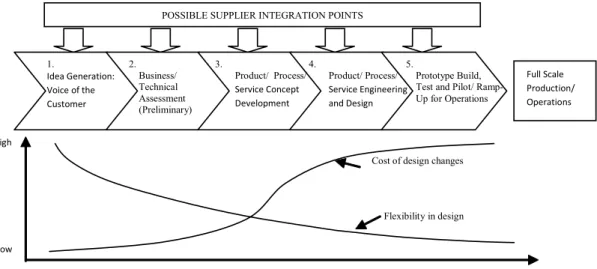
up of a series of events, from idea generation to the final production stage, there is a variety of possibilities for integrating the supplier in this process, as suggested by Handfield et al. (1999) (Figure 2).
Figure 2 shows the progress of cost and flexibility during the course of a typical project (Monczka et al., 1999). Early supplier involvement in the product development project generates various benefits in terms of cost, flexibility, quality, development time, functional characteristics and product technology.
Meanwhile, several barriers to this early involvement (McIvor and Humphreys, 2004) may arise, both on the part of the producer and the supplier. These include opportunism of the producer to extract advantage while generating competition among its suppliers in the project activities, resistance shown by the project people to supporting greater involvement of suppliers, suspicions about the supplier’s loyalty regarding opportunism in using the producer’s proprietary information and lack of sufficient resources for buyer-supplier interaction.
POSSIBLE SUPPLIER INTEGRATION POINTS
Full Scale Production/
Operations 1.
Idea Generation:
Voice of the Customer
2. Business/
Technical Assessment (Preliminary)
3. Product/ Process/
Service Concept Development
4. Product/ Process/
Service Engineering and Design
5. Prototype Build, Test and Pilot/ Ramp- Up for Operations
Low High
Cost of design changes
Flexibility in design
Time
Figure 2 – Progress of cost and flexibility during the product development stages (adapted from Monczka et al., 1999)
RESEARCH METHODOLOGY
This study was exploratory in nature. The research methodology followed included the definition of a conceptual model that was used as a
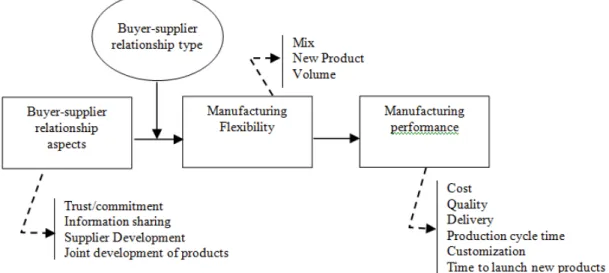
Figure 3 – Model for analyzing buyer-supplier relationships and manufacturing flexibility
It is considered that, in terms of competitive advantage, the main group of flexibility dimensions to be included in a manufacturing strategy is that which reference during the data analysis. A fieldwork was conducted with four companies in different Brazilian industrial sectors, in order to allow a wide- view of the buyer-supplier relationships. The main data was collected trough structured interviews using questionnaires with close-ended questions.
Following the interviews several technical visits to each company took place in order to collect additional information by direct observation technique.
THE CONCEPTUAL MODEL
To define a model for analyzing buyer-supplier relationships and manufacturing flexibility, the moderating effect of the buyer-supplier relationship type was considered. This model is shown in Figure 3. According to Sharma et al. (1981), a moderating variable may be defined as one which systematically modifies the form and/or the intensity of the relationship between an independent variable and a dependent variable. Conceptually, in the model in Figure 3, the type of buyer-supplier relationship acts as the moderator of the effects of this relationship’s aspects on manufacturing flexibility. As a hypothesis, this moderation is due to the effects of the aspects of the buyer-supplier relationship on the improvement of the levels of manufacturing flexibility. In an extended approach, the model envisages incidence of indirect effects of this moderation on manufacturing performance, through manufacturing flexibility.
is best perceived by customers, i.e., external flexibilities, such as flexibility of mix, new products and volume. In this way, the external flexibilities are directly related to the company’s competitiveness (Chang et al., 2003) so that it is expected that these flexibility types are more affected by the buyer-supplier relationship aspects.
DEFINING MEASUREMENT ITEMS
Measurement items for the three external dimensions of manufacturing flexibility (mix, new products and volume) were selected from the literature.
To evaluate these dimensions, several measures proposed by Koste et al.
(2004), Jack and Raturi (2002), Sethi and Sethi (1990) and Gerwin (1993) can be used. Also it can be considered the scope and achievability factors proposed by Koste et al. (2004) to describe and compare the levels of flexible responses.
To evaluate manufacturing performance, scales that are essentially qualitative (indirect) can be used. Several studies, like those of Narasimhan et al. (2004), Das (2001), Pagell and Krause (2004), have used indirect measures as an alternate scale for evaluating manufacturing performance. Indirect scales are used to bypass possible difficulties in obtaining direct measures (like economic measures) and to provide an overview of manufacturing performance. This study considers the generalized measures taken from the work of Das (2001). These measures are associated with cost, quality, delivery, production cycle time, customization, ‘responsiveness’ and time to introduce new products, relating to internal objectives and primary competition.
Aspects of buyer-supplier relationship are characterized based on the adaptation of several scales developed in previous researches. Thus, for the trust/commitment aspect, the works of Krause (1999), Johnston et al. (2004), Gao et al. (2005), Dyer and Chu (2000), Prahinski and Benton (2004) became the reference for the development of adapted measures. For the information sharing aspect, measures adapted by Krause (1999), Krause and Ellram (1997) can be used. For the supplier development aspect, measurement items can be extracted and adapted from the works of Krause (1999), Krause and Ellram (1997) and Krause et al. (1998). Finally, the joint product development aspect can use the adaptation of the scales developed by Hartley et al. (1997), Ragatz et al. (1997) and Primo and Amundson (2002).
These measures were used in a field work focusing on aspects of buyer-supplier relationships and its impact on manufacturing flexibility and
manufacturing performance as follows.
THE FIELDWORK
Four medium and large companies belonging to representative sectors of the industry in the region of Rio de Janeiro/Brazil were selected. For questions of confidentiality, they were named COMPANY A, COMPANY B, COMPANY C and COMPANY D. Table 1 shows some characteristics of these companies. Data was collected by means of a questionnaire distributed to key informants in each company (Kumar et al., 1993). Key informants were those plant managers who possessed detailed information about the production process and about the main strategic policies of the company with regard to relationships with the main suppliers. In other words, they were the experts in each company. In this manner, it was interviewed one key informant in each company occupying the position of Industrial Manager (Company A), Production Coordinator (Company B), Production Manager (Company C), and Industrial Director (Company D). Moreover, technical visits were made to the facilities of each company to directly observe and gather information about the ground reality of these companies. It was sought multiple sources of evidence such as observation, examination of company documents, simply interviews with other informants from the same company and from people that have relevant relationships with the company. Thus, the information collected as above was used to conduct several cross checking. Nevertheless, it must be stressed that this is an exploratory study and no analytical generalization can be argued for.
While preparing the questionnaire, it was used assertive questions for which the respondents could rank their opinion by means of a 3 or 5 point scales. In addition, some of the questions were framed for eliciting ‘yes’ or
‘no’ responses, regarding their occurrence in the company, and for some, commentaries regarding the responses were requested. Also included were open-ended questions so that the respondent could express his general perception regarding a specific item.
Table 1 - Charactristics of the companies studied
ASPECTS OF BUYER-SUPPLIER RELATIONSHIP IN THE COMPANIES STUDIED
It is presented here a comparison of the buyer-supplier relationship aspects in order to facilitate the visualization of the common practices and strategies to the four companies studied. The objective of these analyses is to answer the first research question (RQ1).
Regarding the supplier’s trust/commitment to the relationships, the characteristics of the companies studied, as contained in Table 2, can be highlighted.
As defined by Dyer and Chu (1997), trust in the buyer-supplier relationship can be translated into a source of competitive advantage, based
on the aspects of possible reduction in transactional costs, decisions making support regarding investments in the relationship specific assets and the possibility of increasing information sharing between the partners. In addition, the perspective of Johnston et al. (2004) supports this meaning regarding greater cooperation between members of the supply chain as an incentive for improving performance and satisfaction on the part of the buyers. From Table 2, it can be seen that all the companies value and seek to maintain the levels of confidence and commitment of the suppliers in the relationship. This point view is important and shows the engagement of both the producer and the supplier in maintaining long-term and increasingly more reliable relationships.
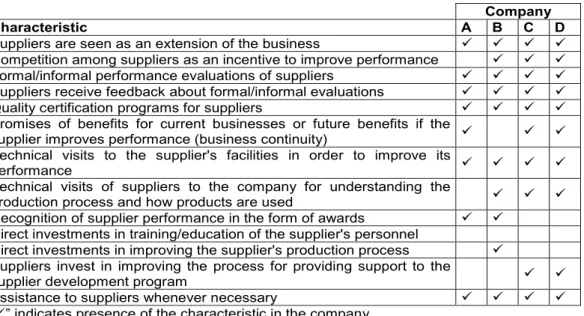
As regards supplier development in the relationships, the corresponding practices and strategies used by the companies studied can be highlighted as in Table 3.
Company
Characteristic A B C D
Suppliers currently invest in improving processes
Long-term relationship with principal suppliers
Suppliers do not see the treatment as opportunistic
Problems in the relationship are resolved together
There is joint planning in the relationship regarding future business There is confidence that the supplier offers quality products/services “” indicates presence of the characteristic in the company
Table 2 – Supplier’s trust/commitment in the buyer-supplier relationships
Table 3 – Supplier development in the buyer-supplier relationships
Company
Characteristic A B C D
Suppliers are seen as an extension of the business Competition among suppliers as an incentive to improve performance Formal/informal performance evaluations of suppliers Suppliers receive feedback about formal/informal evaluations
Quality certification programs for suppliers
Promises of benefits for current businesses or future benefits if the
supplier improves performance (business continuity) Technical visits to the supplier's facilities in order to improve its
performance
Technical visits of suppliers to the company for understanding the
production process and how products are used
Recognition of supplier performance in the form of awards Direct investments in training/education of the supplier's personnel
Direct investments in improving the supplier's production process Suppliers invest in improving the process for providing support to the
supplier development program
Assistance to suppliers whenever necessary
“” indicates presence of the characteristic in the company
The vision of the companies studied regarding condition of suppliers as an extension of their businesses is clear. This can easily be associated with the modern supply chain concepts, especially with regard to interconnections and interdependences among the links in the chain. In spite of this vision, the general behavior of the companies studied is to not make direct investments in their suppliers, whether through training/education of personnel or through process improvements. This can stifle the positive effects (or generate negative) regarding the potentialities that can be created from these investments, as observed by Krause (1999).
What could be observed in the companies studied was the commitment of partnership for the continuity of business. This characteristic is important and shows that the improvement of performance on the part of suppliers was not associated with the promise of new business (current or future) but with continuity of business.
The objectives of process improvement are supported in the form of periodic formal/informal evaluations with the suppliers being informed of the results through feedback from the buyers. Another method supported by the buyers for ensuring the process of seeking improvements is the utilization of certifications like ISO.
Moreover, there are frequent technical visits (of the suppliers to the producer’s facilities and vice versa) and technical assistance to suppliers with the objective of problems solving in the production process and to help in identifying and making improvements. Also highlighted is the attitude of buyers towards creating competition among their suppliers, especially based on price.
This may restrict the vision of partnership between the manufacturer and supplier if this practice assumes characteristics of relationships that view only the economic aspect (market exchange).
Regarding information sharing in the relationships, the characteristics of the practices and strategies used by the companies studied are highlighted in Table 4.
The companies studied share information regularly with their suppliers and are willing to release any information that can potentially improve the processes of the suppliers, as long as the information is not proprietary. Table 4 shows the common types of information exchange in the buyer-supplier relationship, with emphasis on technical specifications, status of process/
performance, availability of resources and non-proprietary technologies. The most common method used for sharing this information is the Internet.
Table 4 – Information sharing in the buyer-supplier relationships
Company
Characteristic A B C D
Frequent sharing of information with suppliers
Release of any information that can potentially improve the supplier's
processes
Sharing of proprietary information with suppliers
Types of information shared:
- structure of production costs
- technical specifications
- status of the process
- availability of resources
- proprietary technologies
- non-proprietary technologies
- status of performance
Information technology and strategies used:
- EDI
- ERP
- MRP
- JIS/JIT/Kanban
- Intranet
- Internet
- Telephone/Fax/Radio
- Committees/discussion groups
“” indicates presence of the characteristic in the company
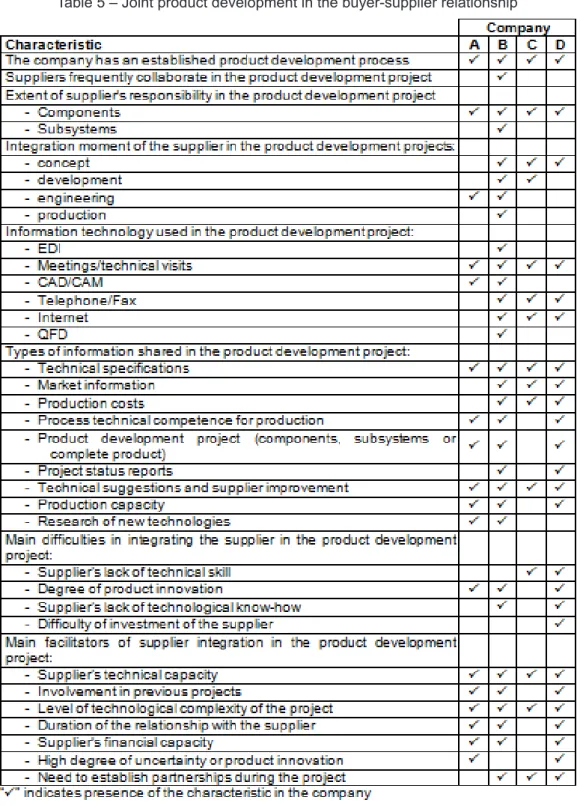
Finally, joint product development with suppliers in the relationships of the companies studied is characterized in Table 5.
Each company has its own product development process. Integration of the suppliers in this process is not frequent and when this happens, the sup- pliers are generally invited to collaborate in component projects. The right time for integration is variable. Integration throughout the process was observed only in COMPANY B. Table 5 also shows the most frequently types of infor- mation shared during the product development process; what stood out in all the companies were the technical specifications and suggestions and supplier improvement.
Table 5 – Joint product development in the buyer-supplier relationship
Among the difficulties in integrating the supplier in the project development process of the companies studied, the degree of product innovation can be considered as the main obstacle. Difficulty of obtaining investments on the part of the suppliers was indicated by only one company as a potential obstacle to this integration. On the other hand, the main facilitators indicated for integrating the supplier in the product development process are the supplier’s technical capacity and the project’s level of technological complexity, involvement in previous projects, duration of relationship with the supplier, supplier’s financial capacity, and the need to establish partnerships during the project.
IMPACT OF BUYER-SUPPLIER RELATIONSHIP ON MANUFACTURING FLEXIBILITY AND PERFORMANCE
It is described here the impact of the aspects of buyer-supplier relationship on the three external flexibility dimensions: mix, new products and volume. These effects are described based on comparison of the scope and achievability factors in each flexibility dimension. It is considered that these two factors portray the operationalization level of manufacturing flexibility. In addition, the perception of the respondents regarding the effects of operationalizing these three flexibility dimensions on manufacturing performance due to the five generalized performance indicators is described.
The description of this analysis is for answering the second research question (RQ2).
i) Influence of the buyer-supplier relationship aspects on manufacturing flexibility in the companies studied.
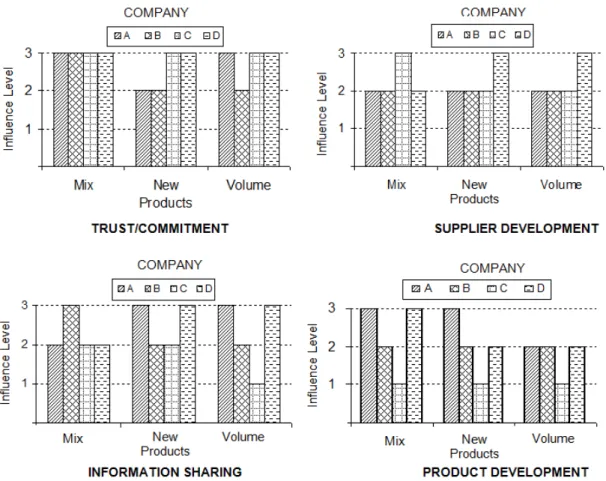
The respondents’ perceptions regarding the influence of each aspect of the buyer-supplier relationship in defining flexibility of the companies presented in Figure 4 are based on the following scale: 1 – Low Influence, 2 – Moderate Influence and 3 – High Influence.
In Figure 4, the variations in the respondents’ perceptions regarding the influences of each aspect of buyer-supplier relationship on the dimension of manufacturing flexibility were noted. Some behavioral patterns of the companies can be observed. For example, the trust/commitment aspect of the supplier was indicated as having high influence on the flexibility of mix in all the companies. Similarly, this aspect was also cited as having high influence on the flexibility of new products (except COMPANIES A and B –
moderate influence) and on the flexibility of volume (except COMPANY B – moderate influence). The importance given to these influences suggests a change of vision the companies are going through, whether spontaneously or due to competitive market pressures, to develop a perspective of “strategic partnership” relationships, in the trust/commitment aspect of the supplier.
Figure 4 – Influence of the buyer-supplier relationship aspects on manufacturing flexibility
The supplier development aspect was considered as having moderate influence on the dimension of flexibility in almost all the companies studied, except for the flexibility of mix in COMPANY C and flexibilities of new products and volume in COMPANY D. This level of influence is significant and could be explored by the companies to a greater extent. Though these companies see suppliers as an extension of their businesses and exercise diverse efforts towards improving the performance of the suppliers, especially those related
to technical assistance, technical visitors and periodic evaluations (with feedback), they do not invest directly in training or improving the supplier’s processes.
The information sharing aspect also was indicated as having moderate or high influence on the three dimensions of flexibility (except flexibility of volume in COMPANY C – low influence). The fact that companies frequently share different types of information with their suppliers probably favored this perception.
Finally, the joint product development aspect also received indications of moderate or high influence on the dimensions of manufacturing flexibility in a majority of the companies studied, except in COMPANY C, which considers this influence low in all the three flexibility dimensions analyzed. This company develops products highly customized to the requirements of its customers.
Though it has a product development process with a sufficiently varied mix, it rarely integrated the suppliers in this development, since it practically
‘verticalizes’ the entire process.
ii) Scope and achievability of manufacturing flexibility in the companies studied
Figure 5 summarizes the opinions of the respondents regarding the scope and achievability factors in the production processes of the companies studied. For each flexibility dimension, a set of assertive questions was presented, based on the following scale: 1 – Totally Disagree; 2 – Disagree;
3 – Neither agree nor disagree; 4 – Agree; 5 – Totally Agree.
In Figure 5, it can be noted that the differences in perception regarding the levels of actual flexibility in the companies studied are quite pronounced by the variations in the values of achievability and scope. COMPANIES A, C and D show scope values greater than achievements values in all the three external dimensions of flexibility considered – flexibility of mix, flexibility of new products and flexibility of volume. This may signify the presence of flexible options not totally explored by these companies, or even, low performance in using these options. This generates a buffer of potential flexibility in the production process. COMPANY D shows the lowest values for these two factors in the three dimensions, and all of them are less than the group average. Consequently, a low flexibility level in the process of this company could be associated. COMPANIES A and C have their scope and achievability factors higher than the group averages, suggesting greater flexibility of these
companies. Finally, COMPANY B shows achievability values greater than the scope for dimensions of mix and new products, suggesting that in this company, both the utilization and the management of the flexible options are done very efficiently. This can be emphasized due to COMPANY B having shown the greatest occurrences of practices and strategies characteristic of the aspects of buyer-supplier relationship. Moreover, COMPANY B has a well automated production process and highly flexible labor.
iii) Influence of the level of manufacturing flexibility on indicators of manufacturing performance
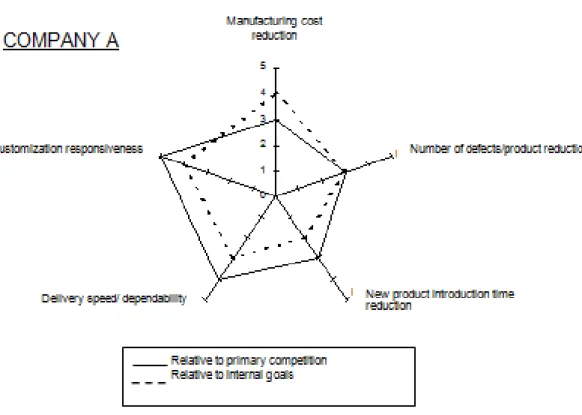
The respondents were requested to indicate their opinion regarding the influence of the level of manufacturing flexibility on five indicators of manufacturing performance. The responses follow two perspectives: regarding the company’s internal objectives and regarding primary competition. The scale used indicates the satisfaction regarding each indicator in the following manner: 1 – unsatisfactory, 2 – little satisfactory, 3 – satisfactory, 4 – very satisfactory and 5 – extremely satisfactory. The replies of respondents from each company can be seen in Figures 6 (6a, 6b, 6c and 6d).
It is noticed that the effects of manufacturing flexibility in terms of reducing production costs have their results more visible in the perspective of meeting the internal objectives of the companies than in relation to objectives associated with primary competition.
COMPANIES A and D show highest response levels to product customization relating to primary competition. This suggests that these companies are effectively using their flexibility to generate competitiveness in the market, considering their competitive performance objectives. COMPANY B, whose respondent admits that the facility has a mix of products quite rigid regarding introducing customizations based on customer requirements, would be in an adverse situation. Also, COMPANY B has other direct competitors who gain market share by allowing their customers to interfere in their product mix, customizing models of vehicles incorporating the desired characteristics, before the product acquired enters the production process.
It is seen that in COMPANY A, with the exception of the indicator of reduction of production costs, performance higher than the internal objectives was indicated, relating to primary competition. In fact, COMPANY A is one of the leaders in the market it operates and these results show its competitive position supported by its level of flexibility. In COMPANY B, dissatisfaction was
Figure 5 – Scope and Achievability factors of Manufacturing Flexibility
noted regarding performance in relation to the level of flexibility in the company, considering primary competition. In this case the gain in competitiveness was perceived only in the aspect of reduction in the number of defects per product.
Finally, in COMPANY C was indicated the greatest balance between internal and external performance.
Figure 6a – Manufacturing flexibility and the indicators of manufacturing performance
Figure 6b – Manufacturing flexibility and the indicators of manufacturing performance
Figure 6c – Manufacturing flexibility and the indicators of manufacturing performance
Figure 6d – Manufacturing flexibility and the indicators of manufacturing performance
SUMMARY AND CONCLUDING REMARKS
In this work, relationships in the supply chain were discussed and the portfolio of buyer-supplier relationships was portrayed based on four cases studies in manufacturing companies. Two research questions were created to serve as references for the empirical study. The first question dealt with investigating how the four aspects of buyer-supplier relationship were characterized in the companies studied. The second question sought to investigate the effects of the buyer-supplier relationship on manufacturing flexibility and their indirect effects on manufacturing performance.
In order to answer the first research question, the behavior of each company was described with regard to aspects of trust/commitment, supplier development, information sharing and joint product development in the relationship with its suppliers, based on a comparative analysis of common behavior among the companies. It was noticed that buyers look for more confidence and commitment on the part of the suppliers and for maintaining long term relationships, showing a tendency for relationships increasingly
aimed at “strategic partnership”. Regarding supplier development, companies see suppliers as an extension of their businesses, showing their perception regarding the supplier’s role in their supply chain. Companies do not directly invest in their suppliers but develop quality certification programs and encourage improvements in the suppliers’ processes, helping them with technical assistance and visits to their facilities for resolving problems.
Regarding information sharing, companies did not show willingness to disclose proprietary information or technologies to suppliers. On the other hand, they are ready to share any information that may potentially improve the suppliers’
processes and generate benefits for them. Among the types of information commonly shared, technical specifications, process/performance status and availability of non-proprietary resources and technologies were highlighted.
Internet was the most common means used for this sharing. With regard to joint product development, companies declared that they have their own internal processes which integrate suppliers with little frequency; participation of suppliers in component development was more common. The moment of supplier integration in the product development process differs among the companies studied. The principal obstacles to this integration were associated with the degree of product innovation. On the other hand, the following were indicated as favorable to supplier integration in the process: supplier’s technical capacity, level of technological complexity of project, participation in previous projects, duration of relationship with the supplier, supplier’s financial capacity and the need to establish partnerships during the project.
In response to the second research question, the perceptions of companies regarding the impact of the buyer-supplier relationship on the three external dimensions of manufacturing flexibility considered in the study and on the performance of manufacturing were described. Such perceptions were quite varied but some common behavior could be perceived as influence of the aspect of trust/commitment on the three dimensions of flexibility. It was seen that the gradual increase in the levels of confidence and commitment between producer and supplier, especially in business relations, characterizes the search for closer relationships of the “strategic partnership” type. The development aspect of suppliers had its effects indicated as moderate over the dimensions of flexibility in a majority of the companies. Information sharing too, frequently, has the indication of moderate or high influence on the three dimensions of flexibility. Finally, joint development of products, though suppliers are rarely integrated, was perceived as moderately or highly influential, except
COMPANY C which did not consider this aspect important for the functioning of the three flexibilities covered in the study.
The scope and achievability factors were considered while investigating the level of actual flexibility in the production processes. With the exception of dimensions of mix and new products in COMPANY B, all the other companies indicated scope factors higher than the respective achievability factors for the flexibility dimensions. Occurrence of a scope factor higher than the achievability factor suggests (1) the presence of little explored flexible options, or (2) the presence of potential flexibility, or even (3) the underutilization of flexible resources in the companies studied. In the specific case of COMPANY B, the presence of an achievability factor greater than the scope might have been generated by a more efficient treatment of flexible resources, both in usage and in administration, which resulted in its superior performance.
In the analysis of the perceptions about the level of flexibility on manufacturing performance, an overview was sought to understand the extent to which the buyer-supplier relationship aspects affected the competitive nature of companies. In COMPANY A, a higher gain in competitiveness was noticed in relation to its performance indicators. In COMPANY B, these indicators were not more so good, while in COMPANY C there was a greater balance in these indicators. In COMPANY D, the response to product customizations requested by customers was the performance indicator which met the objectives related to primary competition more than the respective internal objectives. Generally, companies showed the ability to attain the internal objectives more easily than objectives associated with their primary competition.
Though results of the multiple cases study adequately portray the reality of the four companies in the sample, such results cannot be generalized for the industrial context they pertain to. It is perfectly knowledgeable that there are several limitations in drawing conclusions based on only four companies. For generalization of the results to be possible a larger sample, including different industrial sectors and different regions together with statistical methods, must be used based on the conceptual model of research. Despite this, considering the complexity of the subject and lack of empirical data, the analysis and the results of this study represent an important reference for preparing research that can be generalized.
REFERENCES
Bensaou, M., (1999) “Portfolios of buyer-supplier relationships”, Sloan Management Review, Vol. 40, No.4, pp.35-44.
Chang, S. C.; Chen, R. H.; Lin, R. J. and Sheu, C., (2006) “Supplier involvement and manufacturing flexibility”, Technovation, Vol. 26, No.10, pp.1136-1146.
Chang, S. C.; Yang, C. L.; Cheng, H. C. and Sheu, C., (2003)
“Manufacturing flexibility and business strategy: an empirical study of small and medium sized firms. International Journal of Production Economics, Vol.
83, No.1, pp.13-26.
Cousineau, M.; Lauer, T. W. and Peacock, E., (2004) “Supplier source integration in a large manufacturing company”, Supply Chain Management: an International Journal, Vol. 9, No.1, pp.110-117.
D’Souza, D. E. and Williams, F. P., (2000) “Toward a taxonomy of manufacturing dimensions”, Journal of Operations Management, Vol. 18, No.
5, pp.577-593.
Das, A., (2001) “Towards theory building in manufacturing flexibility”, International Journal of Production Research, Vol. 39, No. 18, pp.4153-4177.
Duclos, L. K.; Vokurka, R. and Lummus, R., (2003) “A conceptual model of supply chain flexibility”, Industrial Management and Data Systems, Vol. 103, No. 6, pp.446-456.
Dyer, J. H. and Chu, W., (1997) “The economic value of trust in supplier- buyer relations”, Working paper #W-0145a, MIT.
Dyer, J. H. and Chu, W., (2000) “The determinants of trust in supplier- automaker relationships in the U.S., Japan, and Korea”, International Journal of Business Studies, Vol. 31, No. 2, pp. 259-285.
Ford, D., (1984) “Buyer/seller relationships in international industrial markets”, Industrial Marketing Management, Vol. 13, No. 2, pp. 101-112.
Frazelle, E. H., (1986) “Flexibility: a strategic response in changing times”, Industrial Engineering, Vol. 18, No. 3, pp.17-20.
Gao, T.; Sirgy, M. J. and Bird, M. M., (2005) “Reducing buyer decision- making uncertainty in organizational purchasing: can supplier trust,
commitment, and dependence help?”, Journal of Business Research, Vol. 58, pp.397-405.
Gerwin, D., (1993) “Manufacturing flexibility: a strategic perspective”, Management Science, Vol. 39, No. 4, pp. 395-410.
Golden, W. and Powell, P., (2000) “Towards a definition of flexibility: in search to the Holy Grail?”, Omega, Vol. 28, No. 4, pp. 373-384.
Handfield, R. B.; Ragatz, G. L; Petersen, G. L. and Monczka, R. M., (1999)
“Involving Suppliers in New Product Development”, California Management Review, Vol. 42, No. 1, pp. 59-82.
Hartley, J. L.; Meredith, J. R.; Mccutcheon, D. and Kamath, R. R., (1997)
“Suppliers’ contributions to product development: an exploratory study”, IEEE Transactions on Engineering Management, Vol. 44, No. 3, pp. 258-267.
Helper, S. R., (1994) “Three steps forward, two steps back in automotive supplier relations”, Technovation, Vol. 14, No. 10, pp. 633-640.
Humphreys, P. K.; Shiu, W. K. and Chan, F. T. S., (2001) “Collaborative buyer-supplier relationships in Hong Kong manufacturing firms”, Supply Chain Management: an International Journal, Vol. 6, No. 4, pp. 152-162.
Imrie, R. and Morris, J., (1992) “A review of recent changes in buyer- supplier relations”, Omega, Vol. 20, No. 5-6, pp. 641-652.
Jack, E. P. and Raturi, A., (2002) “Sources of volume flexibility and their impact on performance”, Journal of Operations Management, Vol. 20, pp. 519- 548.
Johnston, D. A.; Mccutcheon, D. M.; Stuart, F. I. and Kerwood, H. (2004),
“Effects of supplier trust on performance of cooperative supplier relationships”, Journal of Operations Management, Vol. 22, pp.23-38.
Koste, L. L. and Malhotra, M. K., (1999) “A theoretical framework for analyzing the dimensions of manufacturing flexibility”, Journal of Operations Management, Vol. 18, No. 1, pp.75-93.
Koste, L. L. and Malhotra, M. K., (2000) “Trade-offs among the elements of flexibility: a comparison from the automotive industry”, Omega, Vol. 28, No.
6, pp.693-710.
Koste, L. L., (1999) “Measurement of manufacturing flexibility and its implications for supply chain management”, Ph.D. dissertation, Darla Moore
School of Business, University of South Carolina.
Koste, L. L.; Malhotra, M. K. and Sharma, S., (2004), “Measuring dimensions of manufacturing flexibility”, Journal of Operations Management, Vol. 22, No. 2, pp.171-196.
Krause, D. R. and Ellram, L. M., (1997) “Success factors in supplier development”, International Journal of Physical Distribution and Logistics Management, Vol. 27, No. 1, pp. 39-52.
Krause, D. R., (1999) “The antecedents of buying firms’ efforts to improve suppliers”, Journal of Operations Management, Vol. 17, pp. 205-224.
Krause, D. R.; Handfield, R. B. and Scannell, T. V., (1998) “An investigation of supplier development: reactive and strategic process”, Journal of Operations Management, Vol.17, pp.39-58.
Kumar, N.; Stern, L. W. and Anderson, J. C., (1993) “Conducting interorganizational research using key informants”, Academy of Management Journal, Vol. 36, No. 6; pp. 1633-1651.
Lai, Kee-hung; Cheng, T. C. E. and Yeung, A. C. L., (2005) “Relationship stability and supplier commitment to quality”, International Journal of Production Economics, Vol. 96, No. 13, pp. 397-410.
Lyons, T. F.; Krachenberg, A. R. and Henke Jr., J. W., (1990) “Mixed motive marriages: what’s next for buyer-supplier relations?”, Sloan Management Review, Vol. 31, No. 3, pp. 29-36.
Matthyssens, P. and Van den Bulte, C.,(1994) “Getting closer and nicer:
partnerships in supply chain”, Long Range Planning, Vol. 27, No. 1, pp. 72-83.
McIvor, R. and Humphreys, P., (2004) “Early supplier involvement in the design process: lessons from the eletronics industry”, Omega, Vol. 32, pp.
179-199.
Monczka, R.; Handfield, R.; Frayer, D.; Ragatz, G. and Scannell, T., (1999) “New product development: strategies for supplier integration”, ASQ Press: Milwaukee, WI.
Morris, J. and Imrie, R., (1993) “Japanese style subcontracting – its impact on European industries”, Long Range Planning, Vol. 26, No. 4, pp. 53- 58.
Narasimhan, R. and Das, A., (1999) “An empirical investigation of the
contribution of strategic sourcing to manufacturing flexibilities and performance”, Decision Sciences, Vol. 30, No. 3, pp. 683-718.
Narasimhan, R. and Das, A., (2000) “An empirical examination of sourcing’s role in development manufacturing flexibilities”, International Journal of Production Research, Vol. 38, No. 4, pp. 875-893.
Narasimhan, R.; Talluri, S. and Das, A., (2004) “Exploring flexibility and execution competencies of manufacturing firms”, Journal of Operations Management, Vol. 22, No. 1, pp. 91-106.
Olhager, J. (1993), “Manufacturing flexibility and profitability”, International Journal of Production Economics, Vol.30/31, pp.67-78.
Pagell, M. and Krause, D., (2004) “Re-exploring the relationship between flexibility and the external environment”, Journal of Operations Management, Vol. 21, pp. 629-649.
Pérez, M. P. and Sánchez, A. M., (2001) “Supplier relations and flexibility in the spanish automotive industry”, Supply Chain Management: an International Journal, Vol. 6, No. 1, pp.29-38.
Prahinski C.; Benton W. C., (2004) “Supplier evaluation: communication strategies to improve supplier performance”, Journal of Operations Management, Vol. 22, pp. 39-62.
Primo, M. A. M. and Amundson, S. D., (2002) “An exploratory study of supplier relationships on new produt development outcomes”, Journal of Operations Management, Vol.20, No. 1, pp.33-52.
Ragatz, G.; Handfield, R. B. and Scannell, T. V., (1997) “Success factors for integrating suppliers into new product development”, Journal of Production and Innovation Management, Vol. 14, No. 3, pp. 190-202.
Sethi, A. K. and Sethi, S. P., (1990) “Flexibility in manufacturing: a survey”, The international journal of flexible manufacturing systems, Vol. 2, No. 4, pp.
289-328.
Sharma, S.; Durand, R. M. and Gur-Arie, O., (1981) “Identification and analysis of moderator variables. Journal of Marketing Research, Vol. 18, pp.
291-300.
Simatupang, T. M. and Sridharan, R., (2002) “The collaborative supply chain”, International Journal of Logistics Management, Vol. 13, No. 1, pp. 15-
30.
Skjoett-larsen, T., (1999), “Supply chain management: a new challenge for researchers and managers in logistics”, International Journal of Logistics Management, Vol. 10, No. 2, pp. 41-53.
Slack, N., (1987) “The flexibility of manufacturing systems”, International Journal of Operations and Production Management, Vol. 7, No. 7, pp. 35-45.
Slack, N., (1992) “The manufacturing advantage: achieving competitive manufacturing operations”, Mercury Books, London.
Suarez, F. F.; Cusumano, M. A. and Fine, C. H., (1995) “An empirical study of flexibility in manufacturing”, Sloan Management Review, Vol. 37, No.
1, pp. 25-32.
Suarez, F. F.; Cusumano, M. A. and Fine, C. H., (1996) “An empirical study of manufacturing flexibility in printed circuit board assembly”, Operations Research, Vol. 44, No. 1, pp. 223-240.
Upton, D. M., (1994) “The management of manufacturing flexibility”, California Management Review, Vol. 36, No. 2, pp. 72-89.
Upton, D. M., (1995) “What really makes factories flexible?”, Harvard Business Review, pp. 74-84.
Zelenovic, D. M., (1982) “Flexibility: a condition for effective production systems”, International Journal of Production Research, Vol. 20, No. 3, pp.
319-337.
ABOUT THE AUTHORS
Rogerio Odivan Brito Serrão is an Assistant Professor in the Industrial Engineering Department at the Pontifical Catholic University of Rio de Janeiro (PUC-Rio). He received his M.Sc. and Ph.D. degrees in industrial engineering from there in 2001 and 2005, respectively, and his B.Sc. degree in mechanical engineering from Federal University of Pará.
E-mail addresses: [email protected]
Paulo Roberto Tavares Dalcol currently is an Associate Professor in the Industrial Engineering Department at the Pontifical Catholic University of Rio de Janeiro. He received his M.Sc. degree in industrial engineering from there
in 1972 and a Ph.D. degree in industrial sociology from the Imperial College of Science and Technology, University of London, in 1985. His teaching and research interests are in design and control of production and manufacturing systems, technology and production organization, and manufacturing flexibility.
E-mail addresses: [email protected]
ARTICLE INFO:
Received: January, 2009 Accepted: August, 2009