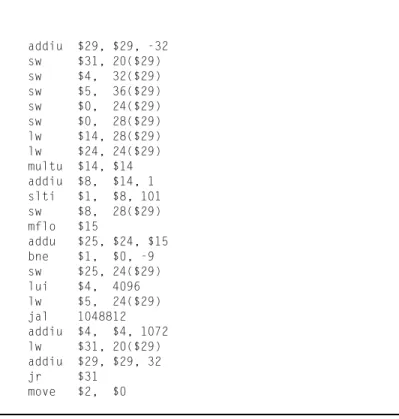
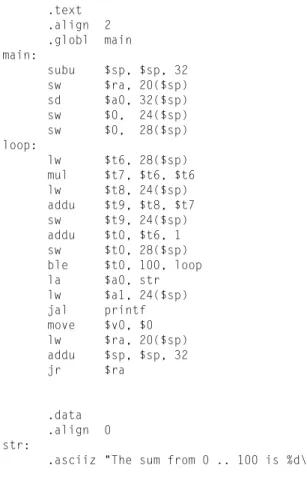
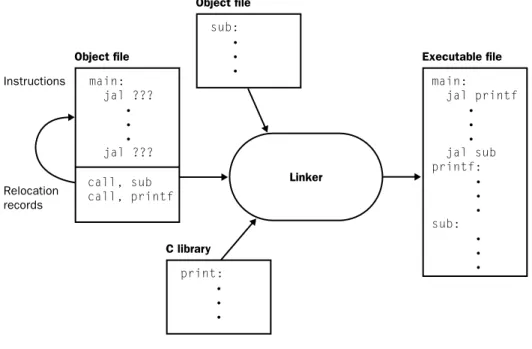
Assembly language is more readable than machine language because it uses symbols instead of bits. An assembler translates an assembly language file into an object file, which is linked with other files and libraries into an executable file. A compiler translates a program written in a high-level language (such as C or Pascal) into an equivalent program in machine or assembly language.
An assembly language programmer, on the other hand, has tight control over the execution of instructions. The final reason to use assembly language is that no high-level language is available on a given computer. Another disadvantage is that assembly language programs are longer than equivalent programs written in a high-level language.
Assembly language programs are longer and more difficult to write and read than high-level language programs. An assembler translates a file of assembly language statements into a file of binary machine instructions and binary data. Defines the sequence of bytes produced by this directive: . asciiz "The swift brown fox jumps over the lazy dog".
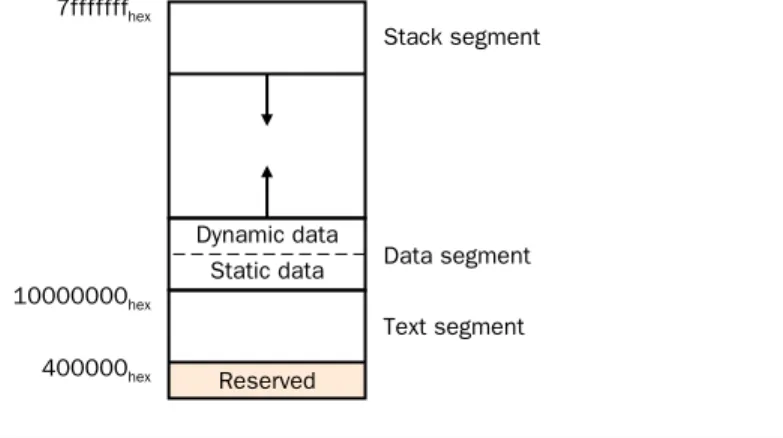
Static data (starting at address 10000000hex) contains objects whose size is known to the compiler and whose lifetime - the interval during which a program can access them - is the program's entire execution.

Procedure Call Convention
Register $sp (29) is the stack pointer pointing to the last location on the stack. The frame consists of the memory between the frame pointer ($fp), which points to the first word of the frame, and the stack pointer ($sp), which points to the last word of the frame. The stack grows down from higher memory addresses, so the frame pointer points above the stack pointer.
The execution procedure uses the frame pointer to quickly access values in its stack frame. For example, an argument in the stack frame can be loaded into register $v0 with the instruction. A stack frame can be built in many different ways; however, the caller and callee must agree on the order of steps.
All remaining arguments are pushed onto the stack and appear at the beginning of the stack frame of the called procedure. Establish the frame pointer by adding $sp to the stack frame size minus four and storing the sum in the $fp register. The frame pointer ($fp) points to the first word in the stack frame of the currently executing procedure.
The first four arguments are passed in registers, so the fifth argument is the first one stored on the stack. Upon entry, the main routine creates its stack frame and saves the two registers stored with the callees that it will modify: $fp and $ra. The frame is larger than required for these two registers because the calling convention requires the minimum stack frame size to be 24 bytes.
Since main must also store $fp, its stack frame must be two words larger (remember: the stack pointer is kept double-word aligned). However, it complicates code generation because a procedure must access its stack frame with $sp, whose value can change during a procedure's execution if values are pushed onto the stack. The thank function first stores its return address in its stack frame and its arguments in callee-stored registers, since the routine may make calls that must use registers $a0–$a2 and $ra.

Exceptions and Interrupts
Window Interface ( xspim )
Set the value in a registry or memory location. print Prints the value in a register or memory location. breakpoint Set or clear a breakpoint or list all breakpoints. terminal Raise or hide the console window. mode Set SPIM operation modes. Each source instruction appears as a comment to the first instruction into which it is translated.). SPIM does not simulate caches or memory latencies, nor does it accurately reflect floating-point operation or the latencies of multiply and divide instructions.
When you single-step or examine memory, the instructions you see are different from the source program. For example, on a big-endian machine, the directive .byte0,1,2,3 would result in a word of memory containing . The byte order of SPIM is the same as the byte order of the host machine driving the simulator.
To request a service, a program loads the system call code (see Figure A.17) into register $v0 and arguments into registers. System calls that return values put their results in register $v0 (or $f0 for floating-point results). The print_int system call is passed an integer and prints it to the console.
The system calls read_int, read_float, and read_double and reads an entire line of input up to and including the newline. If there are fewer than n – 1 characters on the current line, read_string reads through the newline and again terminates the string with null. Warning: Programs that use these syscalls to read from the terminal should not use memory-mapped I/O (see section A.8).
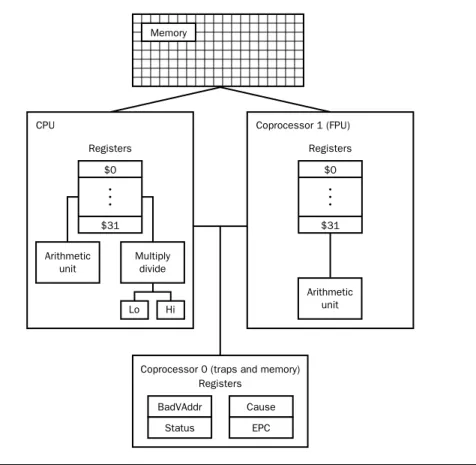
A MIPS processor consists of an integer processing unit (the CPU) and a collection of coprocessors that perform additional tasks or operate on other types of data, such as floating-point numbers (see Figure A.18). SPIM simulates most of the first two and completely omits details of the memory system. The bare machine provides only one memory addressing mode: c(rx), which uses the sum of the immediate c and register rx as the address.
MIPS R2000 Assembly Language
Place the logical AND of the rs register and the extended zero immediate in the rt register. Place the logical OR of the rs register and the extended zero immediate in the rt register. MIPS has a floating-point (1-numbered) coprocessor that operates on single-precision (32-bit) and double-precision (64-bit) floating-point numbers.
Because these registers are only 32 bits wide, two are required to hold double values, so only floating point registers with even numbers can hold double precision values. The flag set by floating-point comparison operations is read by the CPU with its bc1t and bc1f instructions. Calculate the absolute value of the floating-point double (single) in register fs and put it in register fd.
Calculate the sum of the floating-point doubles (singles) in the fs and ft registers and put it in the fd register. Compare the double floating point in the fs register with the one in ft and set the floating point condition flag to true if they are the same. Compare the floating-point double in the fs register with the one in ft and set the floating-point condition flag to true if the first is less than or equal to the second.
Compares the floating point double in register fs with the one in ft and sets the condition flag true if the first is less than the second. Convert the single-precision floating-point number or integer in register fs to a double-precision number and place it in register fd. Convert the double precision floating point number or integer in register fs to a single precision number and place it in register fd.
Convert double or single precision floating point number in register fs to an integer and put it in register fd. Calculate the quotient of the floating point doubles (singles) in registers fs and ft and put it in register fd. Calculate the product of the floating point doubles (singles) in registers fs and ft and put it in register fd.
Ignore the floating-point double (single) in register fs and put it in register fd. Calculate the difference of the floating-point doubles (singles) in registers fs and ft and put it in register fd.
Concluding Remarks
Assembly language programming requires a programmer to trade useful features of high-level languages, such as data structures, type checking, and control constructs, for complete control over the instructions a computer executes. However, the cost of this level of attention is assembly language programs that are longer, take longer to write, and are more difficult to maintain than high-level language programs. The second trend is the introduction of new processors that are not only faster, but in the case of processors that execute multiple instructions simultaneously, are also more difficult to program by hand.
In addition, the rapid development of the modern computer favors high-level language programs that are not tied to a single architecture. Large applications are written by teams of programmers and require the modularity and semantic control capabilities provided by high-level languages. The final word on the MIPS instruction set and assembly language programming on these machines.
A.5 [15] <§A.7> The simple exception handler always returns to the instruction after the exception. This works fine, unless the instruction causing the exception is in a branch's delay slot. A.6 [5] <§A.9> Using SPIM, write and test an addition machine program that repeatedly reads in integers and adds them to a running sum.
The program should stop when it gets an input that is 0 and print the sum at that point. A.7 [5] <§A.9> Using SPIM, write and test a program that reads in three integers and prints the sum of the two largest of the three. A.8 [5] <§A.9> Using SPIM, write and test a program that reads a positive integer using the SPIM system calls.
If the integer is not positive, the program must terminate with the message "Invalid input"; otherwise, the program must output the digit names of integers separated by exactly one space. You can only move one disk at a time, i.e. the top disk from any of the three pegs to the top of any of the other two pegs. You can use the C program on the next page to help you write an assembly language program.