Participation in the assessment processes in problem-based learning: Experiences of the social science students in Lithuania; https://doi.org/10.3390/educsci11110678. Assessing the application of content and language integrated learning in a multilingual classroom; https://doi.org/10.3390/educsci11120808.
Strategies for Flipped Learning in the Health Professions Education in South Korea and Their Effects
A Systematic Review
- Introduction
- Materials and Methods 1. Study Design
- Results
- Discussion
- Conclusions
Study designs should therefore be chosen carefully to clearly assess the effects of flipped learning. The effects of flipped learning on nursing students’ self-directed learning and information competence.J.

The Continuous Intention to Use E-Learning, from Two Different Perspectives
- Theoretical Framework and Hypotheses
- Methodology 1. Participants
- Findings and Discussion 1. Data Analysis
- Discussion and Conclusions
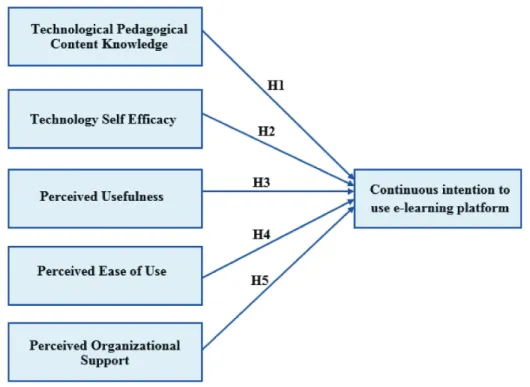
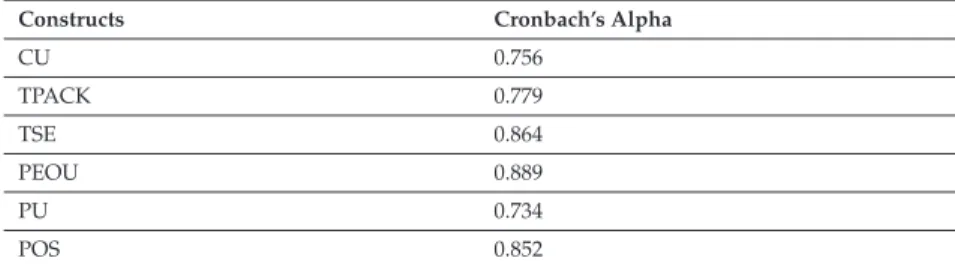
Thus, the sample size of 372 correct responses was appropriate, according to [71], because - given the required sample size - the sample size of 372 is a higher figure. Student acceptance of virtual laboratory and practical work: An extension of the technology acceptance model.Computer.
Multi-Class Assessment Based on Random Forests
Material and Methods 1. Methodology
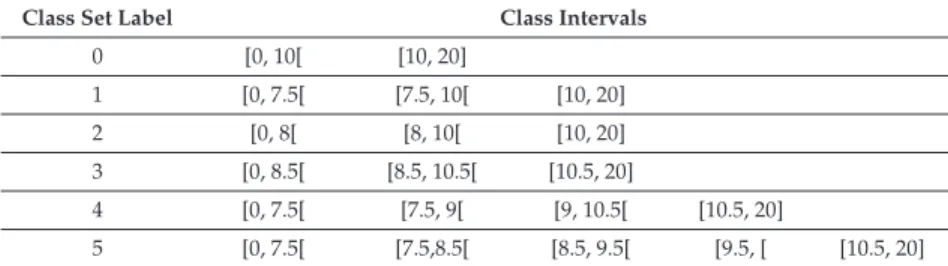
The intersection of the six models' predictions can be represented as shown in Figure 6. The "Virtual" column represents the results of the models with class balancing performed by splitting them and the "Balanced".
Evaluating Learning Space Designs for Flipped and
Collaborative Learning: A Transactional Distance Approach
Materials and Methods
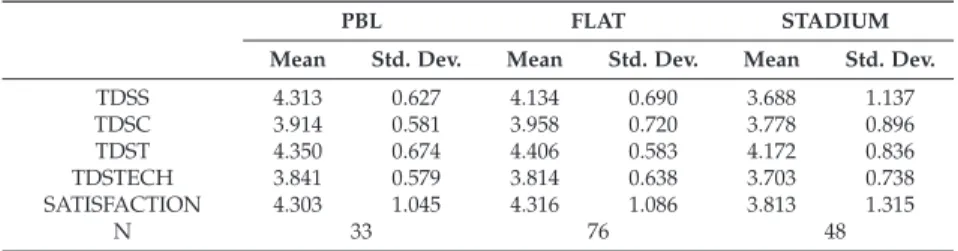
Figure 7 shows photographs of the actual and flat PBL classroom used by our students when they completed the transactional distance survey scale. Figure 9 shows photographs of the actual stadium and flat classrooms used by our students when they completed the transactional distance survey scale.
Further Research
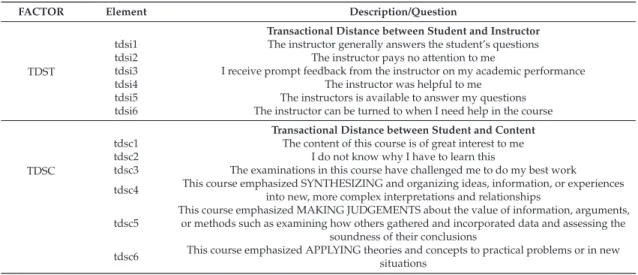
Data Availability Statement: The data presented in this study are available upon request from the corresponding author. Transactional distance between student and content tdsc1 The content of this course is of great importance to me. Transactional distance between student and student tdss1 I learned a lot from observing the interactions between the students tdss2 The students in this online class challenged me to do my best work.
Revisiting Zhang's Transactional Distance Scale: Refinement and Validation Using Structural Equation Modeling. Distance education.
A Qualitative Assessment of the Pedagogical Process at Czech Public Universities
- Quality and Its Measurement
- Key Parameters of Education in the Czech Republic
- Materials and Methods
- Results
- Discussion and Conclusions
Various approaches to assessing the quality of university institutions exist in the available professional literature. Quality” is initially assessed on the basis of the number of pupils per standardized pedagogical staff member. Number of students and the quality of the pedagogical equipment from the point of view of individual universities.
The highest quality of the educational process is therefore observed in the first group of art UP.

Effect on Procrastination and Learning of Mistakes in the Design of the Formative and Summative Assessments
A Case Study
Results and Discussion
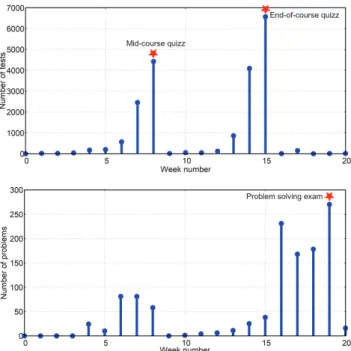
This means that students knew their scores for the 60% of the final grade (quizzes were automatically scored when completed, and the scores for the lab reports and post-lab questions, which are usually high, were also known). The description of the correct calculation procedure for the tasks was not given to the students. The same cannot be said about the design of the summative assessment, which should definitely be changed.
All parts of the summative assessment must have a minimum score for the students to pass the course, even if this is not possible right now.
Organizational Differences among Universities in Three Socioeconomic Contexts: Finland, Spain and Ecuador
Relational Coordination Approach
Materials and Methods 1. Data Collection and Survey
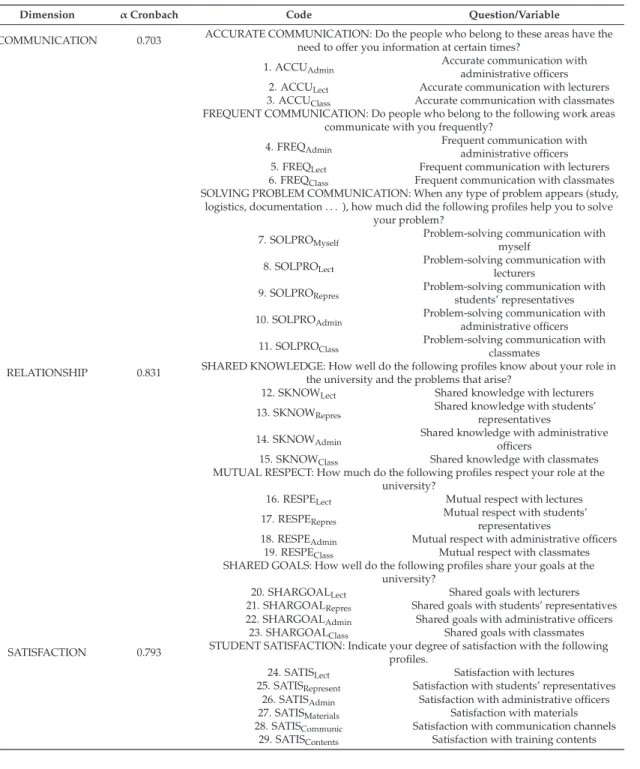
11 communication dimension variables, 12 relational dimension variables and 6 variables related to student satisfaction level were used. Significant differences were found for most RC variables by university and satisfaction (p-value < 0.05). Nonsignificant variables were those associated with classmates and student representatives in the two dimensions of RC.
Organization for Economic Co-operation and Development (OECD). Program for International Student Assessment (PISA).
Moodle Quizzes as a Continuous Assessment in Higher Education: An Exploratory Approach in Physical Chemistry
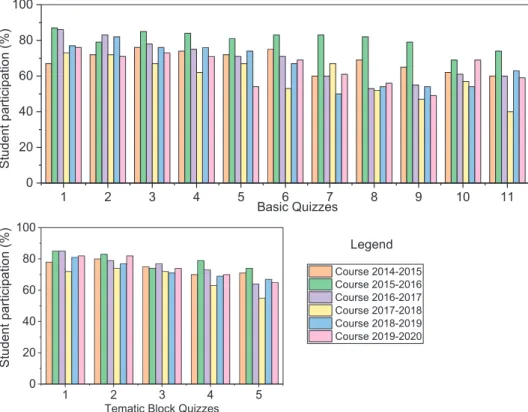
Results and Discussion 1. Participation in the Quizzes
A detailed analysis by academic year allows us to know the dynamics and development of participation. Furthermore, the dispersion of the IF and the discrimination index (DI) of each item in each quiz have been analyzed to know the item effectiveness in distinguishing between students with different cognitive abilities (Figure S1, left). This effect is probably due to the fact that the first subjects are already studied in the bachelor's grade, while the subjects in the last blocks are completely new, which means an effort in the learning process.
However, the BQs serve as a self-evaluation of the knowledge acquired in class for almost 70%.
Conclusions
Furthermore, similar results obtained in this experience over the years with different student populations would also demonstrate the validity and reliability of the designed quizzes. Towards a pedagogical model for science education: bridging educational contexts with a blended learning approach. Open learning. Time pressure in online scenario-based construction safety quizzes and its effect on student performance.
Shepard, L.A. Assessment in the classroom: evaluation of texts; National Institute for Educational Evaluation: Distrito Federal, Mexico, 2006.
Authentic Assessment Implementation in Natural and Social Science
Research Methods
The samples were randomly selected and were representative of each faculty of the State University of Malang. Data collection using primary data was collected through a questionnaire in the form of closed questions. In the research process, research data was collected through Google Form by distributing the link to different WAg lecturers in each faculty and institution by asking for help from the unit heads (faculty and institutions) open to all lecturers and students of the State University of Malang.
Post-research activities are the writing of research results in the form of research articles for publication.
Result and Discussion
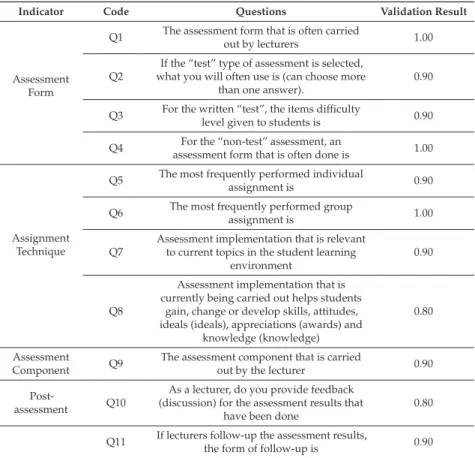
Natural science applies more questions to higher-order thinking than to the field of social science. Table 5 shows that individual assignments in the form of writing articles have a significant difference between social sciences and natural sciences. Measured tests are more commonly used in the field of natural science using higher-order thinking skills questions.
Measured tests were mainly used in the natural sciences using questions of higher level thinking skills.

Impact of Governance Factors over Lecturers’ Scientific Research Output: An Empirical Evidence
Literature Review 1. Governance Factors
The work of [38] also mentioned that this mechanism, which is characterized by decentralization and empowerment, positively influences the output of scientific research. 30] defined that the leadership factor group of several factors has the greatest positive influence on the output of scientific research. The work of [29] and [35] showed that the explicit support of scientific research activities by the university has a positive effect on the scientific research results of teachers.
Similarly, some other studies concluded that one of the institutional factors for improving the result of scientific research is financial support [5,7,20].

Methods 1. Research Design
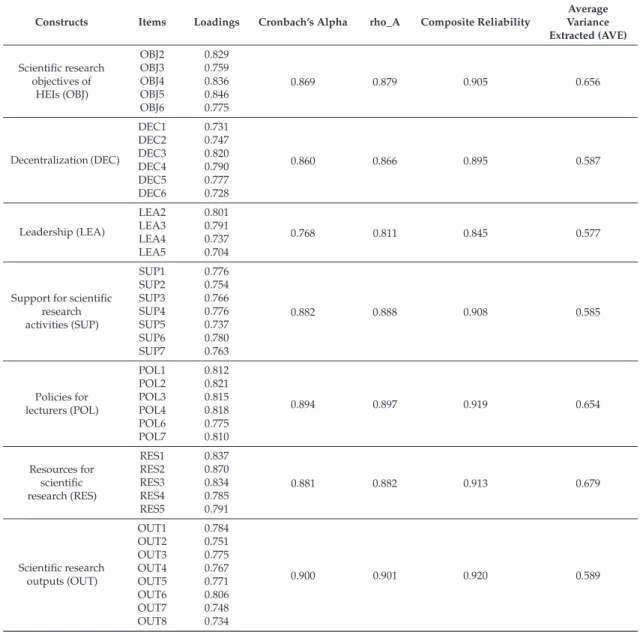
According to the literature review and the proposed hypotheses, a research model was developed with the following factors: scientific research goals for higher education institutions, management, decentralization, policies for teachers, support for scientific research activities and resources for scientific research. In terms of scientific research areas, the social sciences have the highest share at 55%, while the natural sciences account for 45%. First, thet-test and ANOVA approaches were adopted to determine the differences in scientific research performance between teacher groups according to their demographic characteristics.
The factors are coded as follows: OBJ = research objectives of HEIs, DEC = decentralization, LEA = leadership, POL = policies for lecturers, SUP = support for scientific research activities, RES = resources for scientific research and OUT = results research. Appendix A).

Results
With regard to the scientific research area, there is a difference in scientific research output between teacher groups, according to the sig. With regard to the managerial position, there is a difference in scientific research output between teaching groups, according to the sig. In terms of graduating abroad, there is a difference in scientific research output between teacher groups, according to the sig.
More specifically, the average value shows that the result of scientific research is higher for lecturers who graduated abroad.
Discussion
In general, this study has built a model and verified the influence of governance factors on the research results of lecturers. Sixth, the results of the thet test and ANOVA show that there is a difference in research output between the groups of lecturers. First, this study uses a non-probability sampling method, so PLS-SEM has not been analyzed by different groups of educators (according to demographic characteristics) to understand the influence of governance factors on research outcomes by groups.
Second, this study explores the influence of governance factors based only on lecturers' perceptions of their research output.
Conclusions
To date, most of the studies consider only the institutional, environmental and personal factors that influence the results of scientific research. Lecturers are provided with the necessary equipment for scientific research (computers, internet, printers, laboratory equipment, etc.). Lecturers are supported with funding for internationally indexed publications/applicants for intellectual property/commercialization of scientific research products.
OUT8 The number of scientific research awards that I and my students receive tends to increase every year.
Needs Analysis of Psychosocial Module Development Based on Psychoeducation Approach for Public University Students
Methodology
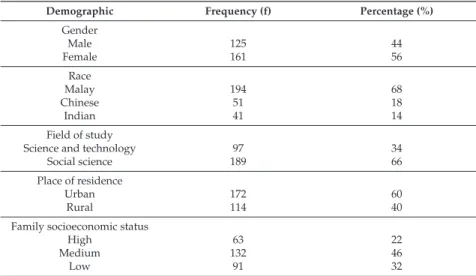
Regarding the evaluation of the needs for the development of a psychosocial module, a total of 234 respondents agreed on the need to develop a psychosocial module. Table 2 shows the evaluation of the need for psychosocial module development based on the demographics as discussed. Meanwhile, and 78% of respondents agreed that constructs of the ability to express emotions, probability of making mistakes, and interaction and communication should be included in the psychosocial module.
Psychological well-being of college students: Validation of the personal-social responsibility and well-being module.J.
Participation in the Assessment Processes in Problem-Based Learning: Experiences of the Students of Social Sciences
Research Methodology 1. Context
Following the idea of "hermeneutic circle", the researcher moved between a part of the text and the whole text [51]. This included the diminishing role of the teacher and, in particular, the active participation of students in the assessment process. The students have emphasized that the assessment, which reinforces improvement, is an inseparable part of the PBL course.
They felt cheated because their empowerment in assessing the educational process was only superficial.
Discussion and Conclusions
Problem-based learning (PBL): Real-world applications to foster (inter)disciplinary learning and integration. New Dir. Formative and Summative Evaluation of Problem-Based Learning Tutorial Session Using a Criterion-Referenced System.J. New forms of assessment in problem-based learning: The added value of the students' perspective. Stud.
Influence of problem-based learning games on effective computer programming in higher education.Educ.
Assessment and Evaluation in Active Learning
Implementations: Introducing the Engineering Education Active Learning Maturity Model