
887-XII “On enterprises in Ukraine”, decrees of the Cabinet of Ministers, presidential edicts, joint decisions of the Cabinet of Ministers of Ukraine and the National Bank of Ukraine. A good example of the obstacles to the progress of the Ukrainian productive sector is the case of so-called. The basic components of the MSTQ system and their respective functions are described in the.
In the case of New Approach directives, compliance with regional EU standards ensures compliance with the directives.

Metrology
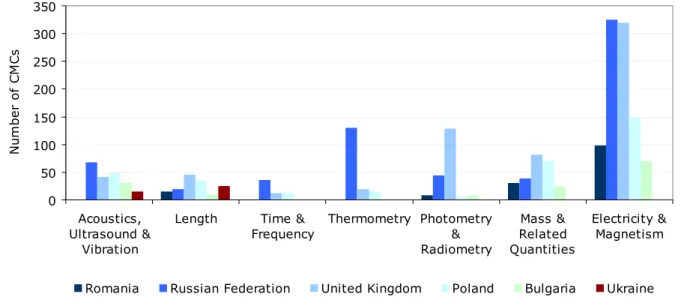
The relevant NSC-IM measurement standards include a total of thirteen physical quantities (Figure 5).22 It offers the measurement standards necessary for the basic functioning of the Ukrainian. This is a potential reflection of the need for further investment in metrology equipment at NSC-IM. In other words, the number of physical quantities checked is in no way a "measure" of the level of sophistication (or accuracy) of the national metrology institute.
This means that measurements in the Ukrainian economy traceable to measurements of national metrology institutes are not recognized abroad. After the collapse of the Soviet Union, access to international traceability in metrology became a challenge in Ukraine, as the country faced the challenge of adopting a decentralized approach to metrology and ensuring uniformity of measurement and traceability to SI23 units. In an effort to align with the international metrology system, Ukraine has become an associate member of the CGPM Meter Convention, the main international treaty in the field of metrology.
One way to ensure international traceability of measurements is to become a signatory to the Mutual Recognition Arrangement of the International Bureau of Weights and Measures (CIPM MRA). Ukraine's membership in the CIPM MRA thus demonstrates that its National Metrology Institutes have begun to move away from the GosStandards used in the Soviet Union to operate according to ISO/IEC 17025.24 The Laboratories of the National Metrology- however, institutes have yet to demonstrate that they operate according to international best practices as none of them have yet to be accredited by a signatory of an ILAC, IAF or EA mutual recognition accreditation agreement. These measurement comparisons have become the main international reference for information on technical capabilities of national metrology institutes, are the basis of the international recognition process for signatories to the CIPM MRA and are necessary for countries to report the results of their testing, inspections and certification processes in the abroad are accepted.

Standards and Technical Regulations
Since standards in Ukraine are mandatory for virtually all goods and many services, unlike in EU and OECD countries where they are mostly voluntary, Ukrainian standards essentially fulfill the role of technical regulations and serve state control purposes rather than the improvement of industrial competitiveness. While the trend for technical regulations in EU and OECD economies is to specify the end result (e.g. guaranteeing that a product is safe under specific conditions of use) without specifying the details of how this is achieved, in Ukraine products must comply with a plethora of detailed technical requirements (e.g. use of specific materials and quantities). The imposed Ukrainian technical regulations are outdated and are formed by a complex framework of state and industry standards (OST27) [15] from the Soviet era.
These technical regulations are often outdated (a legacy of old Soviet days) and slow down the implementation of innovative technologies. 25 The Act on Standards, Technical Regulations and Procedures for Conformity Assessment has been adopted with assistance from the EU. In addition, there are two decrees of the Cabinet of Ministers (having the power of independent laws): the Decree on Standardization and Certification (of May 10, 1993) and the Decree on State Control for Compliance with Standards, Norms and Rules and on Responsibility for Their Violence (April 8, 1993 ).
Although Ukraine is a member of the main regional and international standardization bodies (Table 3), it has yet to harmonize its stock of standards with that of its primary trading partner. 29 Ukraine ranks 78th in the Global Competitiveness Ranking and 139th for doing business; these rankings are due in part to the high cost and complexity of complying with technical regulations. European New Approach directives together with ENs could provide a flexible alternative to existing technical regulations in Ukraine.

Conformity Assessment
Product certification
The accuracy of the contents of the pre-packed container (measured volume, 1.0 litre) appears only in Cyrillic characters (1.0 ДM3 ± 1.5%; i.e. 1.0 dm3 ± 1.5%) which are not internationally accepted symbols are from the Système International d'Unit (SI). The capacity (volume) of the liquid is expressed only in Cyrillic sign (0.5 Л, to denote half a liter) and the measurement accuracy is not specified. Box 3 illustrates an unusual situation where a shortcoming of the accreditation scheme also leads to unnecessary duplication of certification.
Determining package size and shelf life of products often leads to recalls for recertification, increasing the actual cost (10-15% for each certification). Since Ukraine has not yet signed the Mutual Recognition Agreement of the European Cooperation for Accreditation (EA), test results from Ukrainian accreditation laboratories for export are not trusted by EA members. To give just one example, a company must receive a so-called "hygienic conclusion" from the Ministry of Health with the corresponding certification of the goods and services of DerzhStandard.
This is a certification that has no meaning in Europe; it increases the price of the goods to be produced, because literally every corner has to be checked and certified. 42 On approval of the procedure for customs clearance of imported goods (products) which are subject to mandatory certification in Ukraine (as last amended on December 24, 2005). An excellent example of the unacceptable violation of the basic "non-discrimination" principle of the WTO TBT is provided by Procter & Gamble's battles with the Ukrainian authorities.

Quality System Certification
On March 3, 1998, the State Committee for Standardization, Certification and Metrology (DerzhStandard) revoked Proctor & Gamble's laundry detergent certificates, which reportedly cost the company $135,000 to obtain. DerzhStandard claimed that the formula used to produce Procter & Gamble's soap power was of inferior quality and aimed at the poor Ukrainian public.
Accreditation
Additionally, NAAU is slightly slower than other countries in providing its accreditations, which may discourage organizations from applying for accreditation. Bulgaria Ukraine Poland Turkey Spain minimum time required to obtain an accreditation after requesting it (in months). As indicated in Table 4, NAAU is not a signatory to the European Cooperation for Accreditation Multilateral Agreement (EA MLA).
In addition, Ukraine is not a member of the International Accreditation Forum (IAF) or a full member46 of the International Association for Laboratory Accreditation (ILAC), the two main international accreditation organizations.
![Figure 7 : Number of accredited testing and calibration laboratories in several countries Source: World Bank Survey (2008) of accreditation bodies [17]](https://thumb-eu.123doks.com/thumbv2/123dok_br/19421724.0/26.892.225.660.112.351/figure-number-accredited-testing-calibration-laboratories-countries-accreditation.webp)
The View of Small and Medium Enterprises
One of the key findings of the IFC survey is that the current system of technical regulation in Ukraine is in urgent need of reform. The findings of the assessment are consistent with the results of the last round (2005) of the Business Environment and Enterprise Performance47 survey, which was carried out on the joint initiative of the EBRD and the World Bank. Among the macroeconomic indicators surveyed (listed as “over time” and “by country”) that measure business difficulties are “macroeconomic instability” and.
In Ukraine, the percentage of companies that perceive uncertainty about regulatory policies as a problem when doing business has fallen from to approx.
Recommendations
The current regulatory environment hinders economic growth as it harms competitiveness and creates barriers to innovation (introduction of new technology is subject to bureaucratic approval from regulatory agencies). These indicators are only slightly better than the average for most Eastern European and Central Asian countries and probably reflect Ukraine's ongoing preparation for EU accession. The Accreditation Body must function as an entity independent of any ministry or any institution that owns or operates laboratories or certification bodies.
The practicality of the UkrCEPRO certification system should be conceptually reviewed in accordance with the voluntary nature of the standards as its very existence may not even be justifiable. Ukraine's national accreditation body, NAAU should sign EA, ILAC and IAF MRA and national metrology institute, NSC-IM should conduct more regional and international interlaboratory measurement comparisons. The entire administrative system run by the DSSU headquarters - uniting all MSTQ institutions under one roof - needs to be carefully reviewed.
As far as the regional centers are concerned, the functions of directors of MSTQ state enterprises seem to conflict with the tasks of state inspectors in performing state control and metrological control at the highest level. Also, legal metrology, which is under the control of DSSU, is not yet clearly defined in Ukraine.
Conclusions
Frota is associate professor and researcher at the Pontifical Catholic University of Rio de Janeiro, Brazil, currently head of the Graduate Program in Metrology and Standards for Quality and Innovation. Member of the Russian Academy of Metrology, member and founder of the Brazilian Society of Metrology. Jean-Louis Racine is a science, technology and innovation specialist for the Europe and Central Asia region of the World Bank.
At the World Bank, his work focuses on policies and programs to support technology diffusion and innovation, as well as quality national infrastructure. He is the author of the book (2007) Quality Systems and Standards for a Competitive Edge (published by the World Bank). Prathima Rodrigues works in the Private and Financial Sector Department of the World Bank's Europe and Central Asia region, where she specializes in quality national infrastructure.
Final report of the survey conducted within the framework of the IFC Ukraine Business Enabling Environment Project (2,100 entrepreneurs were surveyed across Ukraine, summer 2007. Frota (June 2008) to assess Ukraine's national quality infrastructure, as part of the regional study of the World Bank (EW-P108324-ESW BB).17] Ongoing World Bank Survey (2008) on the legal status and institutional performance of the MSTQ national quality infrastructure of transition economies of Europe and Central Asia (ECA) as part of the World Bank-coordinated regional study by the Private and Financial Sector Development, Europe and Central Asia, the World Bank.


![Figure 5: Number of physical quantities operated by national metrology institutes Source: World Bank Survey (2008) of Metrology Institutes [17]](https://thumb-eu.123doks.com/thumbv2/123dok_br/19421724.0/14.892.222.670.216.429/physical-quantities-operated-national-metrology-institutes-metrology-institutes.webp)
![Figure 6: Number of calibration services (2007) normalized by industry value added Source: World Bank Survey (2008) of Metrology Institutes [17]](https://thumb-eu.123doks.com/thumbv2/123dok_br/19421724.0/14.892.269.606.813.1044/figure-number-calibration-services-normalized-industry-metrology-institutes.webp)

![Figure 8: Origins of national standards catalogue in select countries Source: World Bank Survey (2008) of national standardization bodies [17]](https://thumb-eu.123doks.com/thumbv2/123dok_br/19421724.0/19.892.188.663.423.661/figure-origins-national-standards-catalogue-countries-national-standardization.webp)
