The Institute for International Trade Negotiations (ICONE) is an independent non-profit organization founded in 2003. The Institute has developed expertise in trade policy and international negotiations, developing economies and agricultural trade, agricultural modeling and land-use change, agricultural-based biofuels and sustainability.
Executive Summary
Although the gaps between the standards vary, there is a very important gap that is common to all and relates to compliance with certain points of Brazilian legislation, particularly environmental (Forestry Code), labor (overtime, shifts and breaks) and worker health and safety. (NR-31). Another important gap identified, also related to compliance with legislation, is the need for structural adjustments, especially in mills with older plant configurations.
Introduction
This report describes and compares the general characteristics, sustainability criteria (production and chain of conservation), management structures and system operations of the analyzed initiatives and standards and also presents the results of the interviews with producers and other supply chain actors and certifiers. This allows an understanding of the extent to which compliance with the law is or is not sufficient to ensure compliance with the analyzed certification.
Presentation of analyzed initiatives
The Bonsucro certificate is valid for three years, the ISCC certificate is valid for one year and the RSB certificate is valid for a maximum of two years, depending on the risk class assigned to the certified operations (discussed further in the system operation benchmark). An important difference between the standards is that only Bonsucro requires all certified parties to join the organization.
Methodology
- Definition of comparison criteria and framework for benchmark of Production standards
- Definition of comparison criteria and framework for benchmark of Chain of custody Standards
- Definition of comparison criteria and framework for benchmark of system operations
- Compilation of results and notes on presentation of results
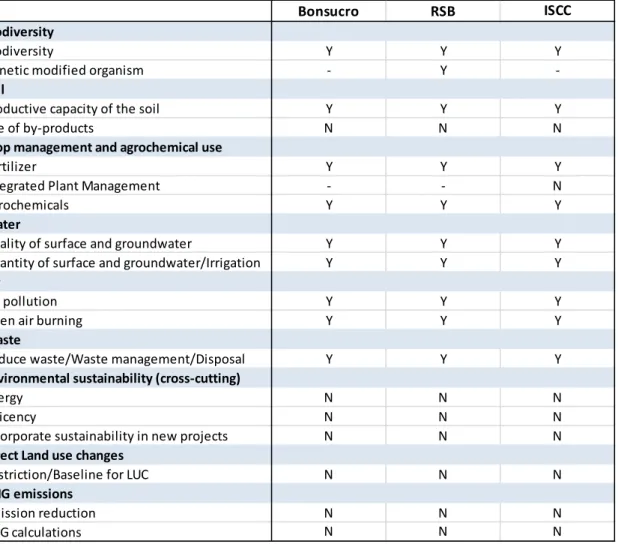
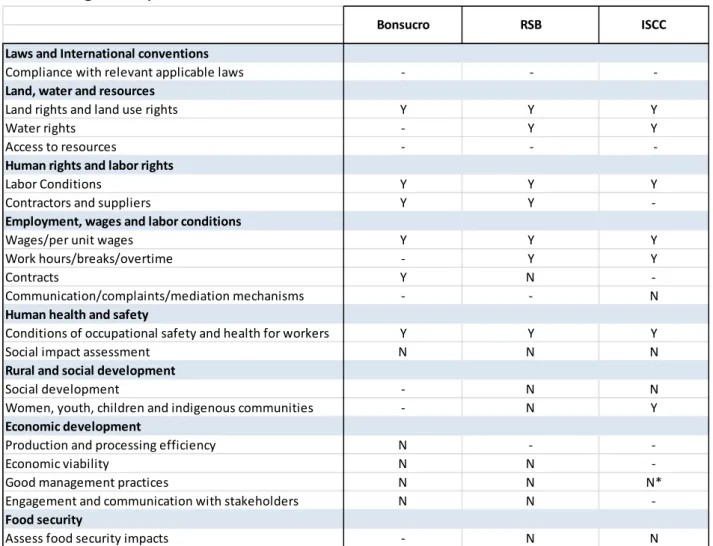
Finally, the requirements of the standards were compared with Brazilian legislation based on the question: Are the criteria covered by Brazilian legislation. After the criteria were defined, we assessed the standards' availability of information in each category on a yes/no basis (presented in a table), and we also conducted a qualitative assessment of the comparison.
Benchmark results
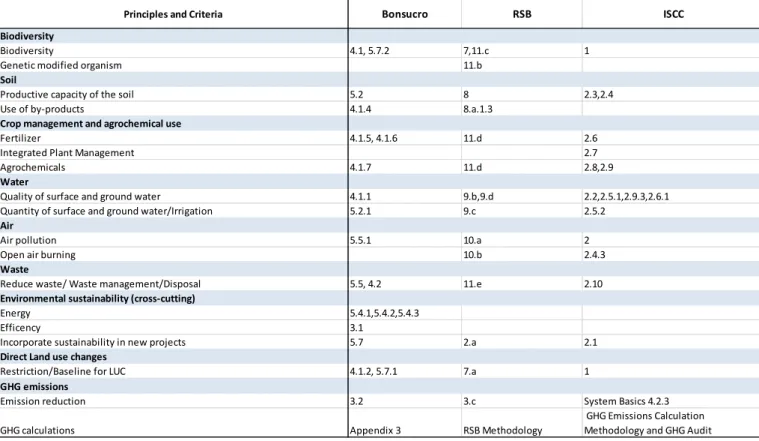
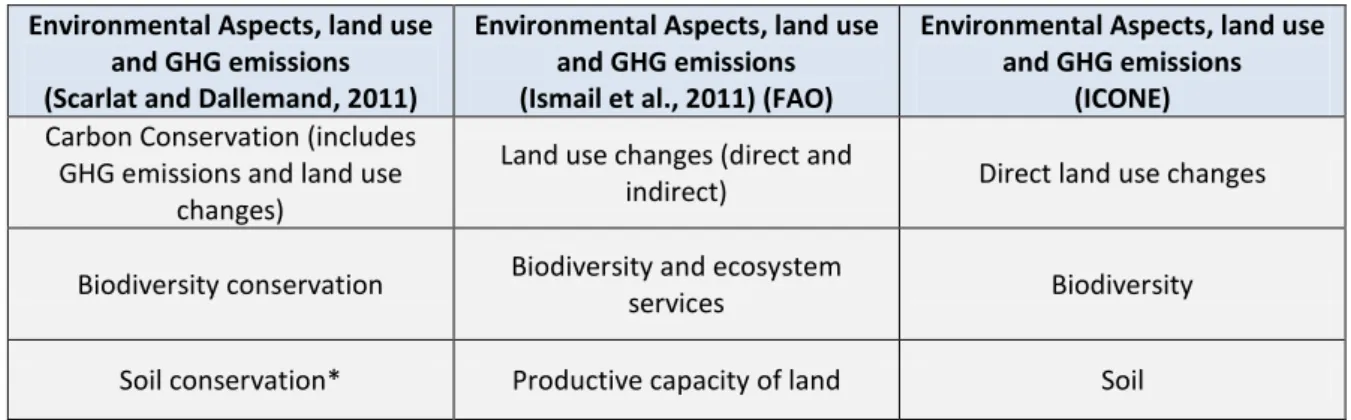
Production Standards: Environmental, Land Use and GHG Emissions
However, being a signatory or member does not mean that Brazil does not allow the use of the chemicals listed in the RSB and RSB-EU standards. RSB and RSB-EU have criteria for handling waste, minimizing waste and avoiding pollution of the environment.

Production Standards: Socio-Economic and Food Security
RSB, Bonsucro and ISCC include major requirements on working conditions related to compliance with core International Labor Organization (ILO) labor conventions: freedom of association and the effective recognition of the right to collective bargaining (Conventions 87 and 98); elimination of all forms of forced or compulsory labor (Conventions 29 and 105);. This category includes criteria related to requiring contractors and/or suppliers to comply with human rights and labor standards. The RSB and ISCC criteria only relate to third-party labor contracting and are therefore covered by law.
RSB and ISCC have key requirements related to payment based on units or production, rather than hours. RSB is the only standard that has a primary requirement regarding working hours and overtime. Only RSB and ISCC have criteria related to overtime and working hours, but these issues are already covered by national legislation.
There are no laws related to this issue in Brazilian law, so this is a request that goes beyond the law.

Chain of Custody Standards
In the Bonsucro standard, there are no requirements for calculations of greenhouse gas emissions within the chain of custody, only in the production standard. In the Bonsucro EU standard, there are additional information requirements regarding the inclusion of data on greenhouse gas emissions in the documentation for certified products. The calculation method is the same as that used in the production standard, which is described in Appendix 1 to the chain of custody standard.
The methods for calculating greenhouse gas emissions in the chain of custody standards are the same as for the production standards. Therefore, the comparisons made in the production standard benchmark above are also valid in the case of the chain of custody requirements for greenhouse gas calculation. The mass balance system is the lowest in the hierarchy that is EU-RED compliant.
Suppose the first operator in the chain of custody decides to implement the identity preservation system for traceability.

Governance, transparency and public disclosure of information
It is also responsible for Bonsucro's overall decisions, the content of the standard and for the committees created as needed to address specific issues. The committees are formed by members of the board and other Bonsucro members, as well as moderators or consultants, as appropriate. The ISCC was an initiative of the German Ministry of Food, Agriculture and Consumer Protection through its Agency for Renewable Resources5.
However, unlike the other initiatives analyzed, the ISCC is not a member of the ISEAL alliance. When a first version of the standard was ready (in 2009), a public conference was held (about 100 people participated) and public consultation took place until mid-2010. All three standards have the list of compliant companies publicly available, but only RSB has the certification decision information available online (i.e. the certification report of the certification body).
RSB has all feedback on each principle of the first version of the standard available online.
System Operations
It is important that the standard-setting organization is not responsible for the conformity assessment of the standards in order to avoid conflicts of interest. All three of the initiatives analyzed have certification/verification bodies unrelated to the governance mechanisms of the standard-setting organisation. Such requirements are established to ensure appropriate compliance assessment of the standards and audit quality.
A risk assessment is required in the process of applying for a certificate to identify and manage risks related to the operations of operators and the stability and integrity of the RSB system. Such systems are implemented to ensure the security and integrity of certification initiatives and systems. The purpose of the risk management approach is to enable operators and certification bodies to focus on areas of RSB standards that increase risk to the certification system.
All elements of the supply chain seeking certification must complete their own risk assessment based on the ISCC risk factors and the three ISCC risk categories: low, medium and high.
Assessment of the IDB Scorecard
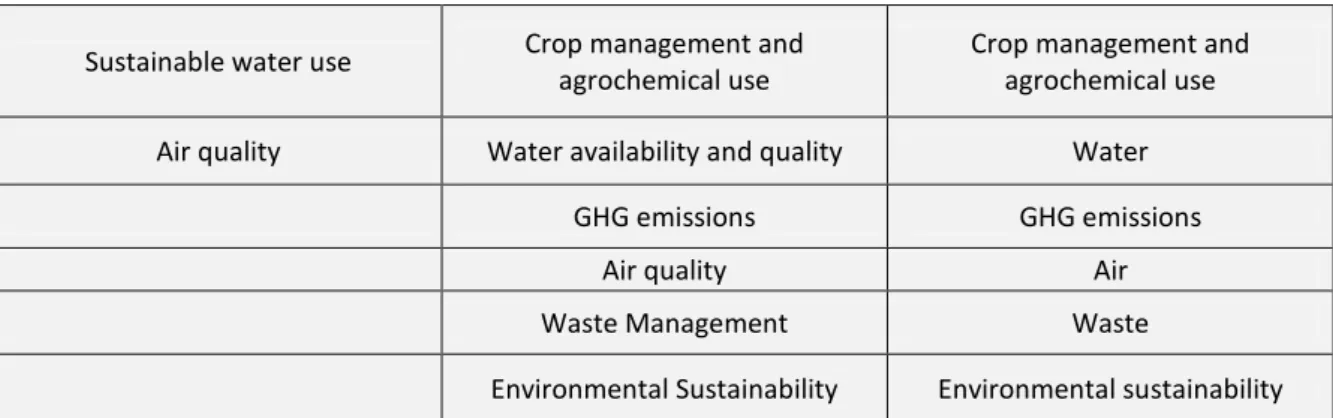
The scorecard does not generally address issues of economic development, and many issues that are addressed in the standards in detailed sub-categories are covered in one category in the scorecard (e.g. employment, wages and working conditions in the benchmarking category under human rights and workers' rights in indicator categories). Environmental sustainability (intersectoral) Energy balance, Distribution/assessment of impacts on the environment and society Direct changes in land use Carbon emissions due to changes in land use. Land, water and resources Land ownership; Change in access to Human Rights and Labor Rights Human Rights/Labor Rights resources.
Rural and social development Local income generation/local grower arrangements/community development/Impacts on indigenous people.

Gap Analysis
In addition, some issues were noted regarding the Bonsucro parameters for production (Bonsucro calculator), which in some cases are stricter than the law and therefore require adjustments (such as water return and fertilizer use). Finally, there are some problems related to compliance with environmental and worker health and safety legislation, which were also minor or are already being addressed. During the interviews, it became clear that most of the difficulties are related to compliance with Brazilian legislation and not to the criteria in which the standard goes beyond the law for Bonsucro.
For the chain of custody standard, there are clear problems in relation to the requirements on paper and what is actually done and certified. Again, it is clear that most difficulties for the implementation of the production standard are related to legal compliance, especially environmental legislation and other problems identified for Bonsucro. The implementation of the standard required separation of documents and training of people, but no changes in the normal processes.
Based on our interviews with manufacturers and certification bodies, there are other difficulties, in addition to legal compliance issues, related to the implementation of the standard.
Conclusions and recommendations
Institute for International Trade Negotiations – www.iconebrasil.org.br Página 66. medium producers and third party areas) can be limited by another gap common to all three standards: compliance with Brazilian legislation, especially environmental and labor and worker health and safety. The RSB and the ISCC production standards were not implemented in Brazil in the certification of sugarcane biofuel (although both had pilot projects in the country), mainly because Bonsucro was the preferred standard among Brazilian sugarcane producers. We identified two main reasons explaining such preference: 1) the standard is more objective and does not have additional criteria included in the other two standards related to HCVA, food security and ILUC; 2) it also certifies sugar (although ISCC is in the process of implementing ISCC Plus, which will also allow this option within the system). This leads to the inclusion of such issues in the standards in a very conservative way and in the involvement of the standards initiatives in the related methodological and scientific discussions.
In conclusion, Bonsucro is currently the most viable alternative as implementation gaps for RSB and ISCC are widening in the near term. This could pose a problem with existing and new certifications in the future once the EU sets definitions for HCVA and ILUC. But even for Bonsucro, expanding certification will require industry efforts, as there are still many gaps in compliance with national legislation.
There is great potential for harmonization of standards and systems, as demonstrated by ISCC and by companies operating in the industry.
Support Information
Use of by-products: includes all criteria related to the use of agricultural by-products. Open-air burning: criteria related to open-air burning as part of the production cycle. Inclusion of sustainability in new projects: criteria related to the inclusion of sustainability concepts (social and environmental) in new projects.
Compliance with relevant applicable laws: includes all criteria related to compliance with relevant national laws and international conventions. Social development: includes criteria related to the provision of social services to employees and social environment. Economic viability: includes criteria related to promoting the economic viability and sustainability of biofuel operations.
Involvement and communication with stakeholders: includes criteria related to the involvement and participation of stakeholders in the processes.