Het opnemen van strategische plannen in een EA komt met verschillende uitdagingen, waaronder het representeren van strategie in een EA en van de relatie tussen een bepaalde strategie en de rest van de EA, inclusief het operationele niveau. We hebben een theoretische fundering ontwikkeld, gebaseerd op een studie van de management literatuur, om capabilities en resources te gebruiken in de EA discipline.
Introduction 9
Introduction
- Context and Motivation
- Challenges
- Research Objectives
- Research Hypothesis
- Approach
- Non-scope and Limitations
- Thesis Structure
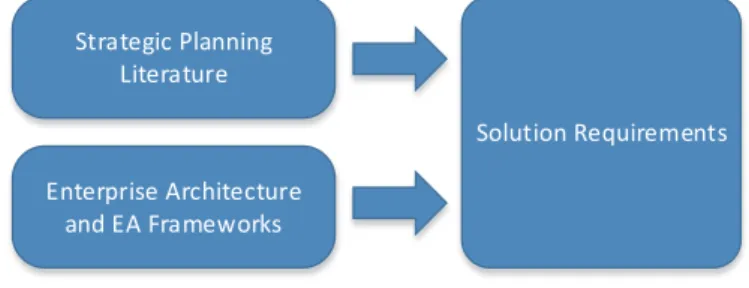
The discipline of Enterprise Architecture (EAD) was established to support the design, modeling and management of the various components (or parts) of an enterprise and their interactions (Lankhorst, 2005) (Ross, Weill and Robertson, 2006). The aim of the thesis is to integrate the company's strategic plans into the discipline of enterprise architecture.
Strategic Planning
- Strategic Planning Theories
- Strategic Planning Models
- Goal-Based Strategic Model
- Other Strategic Planning Models
- Resources and Capabilities in the Enterprise
- Resource-based Theories
- Capability-based Theories
- Conclusions
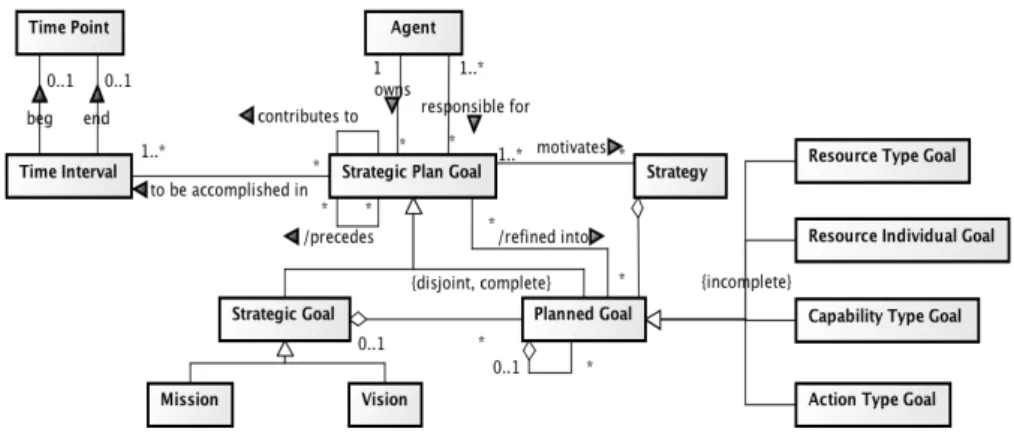
In the field of design, one or more executives and consultants determine the strategy to be followed in the company. To define the Goal-Based strategic model, it is necessary to express the mission, vision and planned goals of the company.
Enterprise Architecture
- Introduction
- Requirements for Strategic Plan Support in EA
- Description of Strategic-level Concerns
- Capabilities and Resources for Handling Enterprise Strategic Level Concerns
- Traceability of Strategic Plans to Operational Aspects In order to proper introduce strategic plans into EA, being able to trace the
- Coherent Architectural Descriptions
- Current Support for Strategic Plans in EA Frameworks
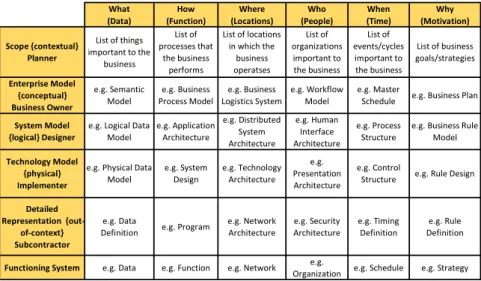
- The Zachman Framework for Enterprise Architecture The Zachman framework was introduced by John Zachman in his seminal
- The ISO Reference Model for Open Distributed Processing (ISO RM-ODP)
- Department of Defense Architecture Framework (DoDAF) The Department of Defense Architecture Framework (DoDAF) is an architecture
- MODAF
- OMG Business Motivation Model (BMM)
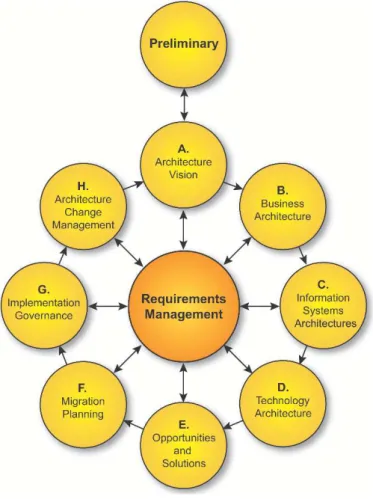
- The Open Group Architecture Framework (TOGAF)
- Summary
- Discussions
Furthermore, it would not be possible to trace the company's mission and vision to the operational part of the company. It aims to "enable the capture and presentation of information in a rigorous, coherent and comprehensive way that aids the understanding of complex issues".
Ontological Basis
- Introduction
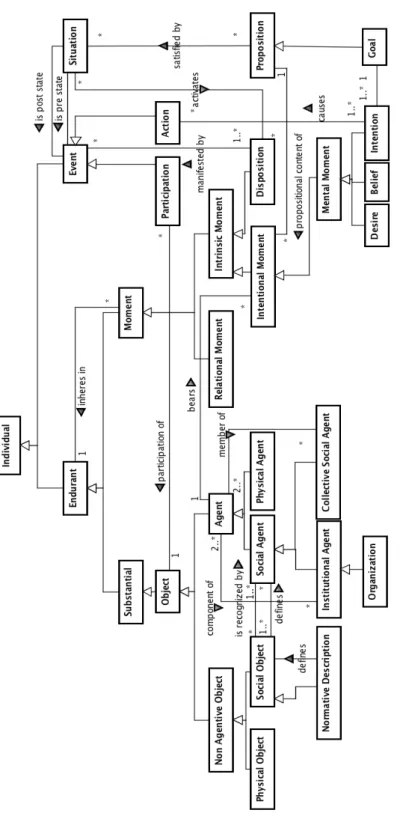
- The Unified Foundational Ontology (UFO)
- Endurants
- Intentional and Social Elements
- Bratman’s Intention, Plans and Practical Reasoning Theory
- Ontological Analysis Approach
Furthermore, concepts from the domain of discourse (captured in the theoretical foundation) should be represented by modeling elements of the language under consideration (Weber, 1997) (Moody, 2009). Some concepts within the discourse domain may be too complex to be covered by a single modeling element. In this case, these domains of discourse concepts can be represented by a pattern of modeling elements in the modeling language.
Capturing Strategic Plans in EA
- A Conceptual Model for Strategic Plans
- Strategic Plan Goals
- Refinement and Decomposition Between Goals
- Strategy
- Timing Constraints
- Responsibility for Goal Achievement and Delegation Goals might also be treated by the enterprise individually or in a bundle, and
- Further Goal Achievement Details
- Modeling Strategic Plans in EA
- The Current ArchiMate Motivation Extension
- Proposed Extension for Modeling Strategic Plans in ArchiMate
- Related Work
- Strategic Plans in Enterprise Architecture Frameworks In 1992, Zachman and Sowa introduced a “why” column in the Zachman
- Strategic Planning on Goal Modeling Languages
- Conclusions
The agent believes that when he achieved his newly defined goals, his original goals would be easier to achieve (ie, the agent believes that when he achieves these goals, he will be 'closer' to achieving his original goal). This is represented in the conceptual model of Figure 13 as the (incomplete) specializations of planned goals. We have presented a conceptual model for strategic plans and extended ArchiMate to support the representation of the concepts in the model.

Current Support for Modeling Capabilities and Resources
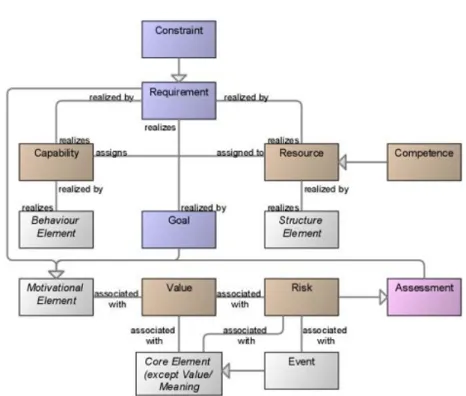
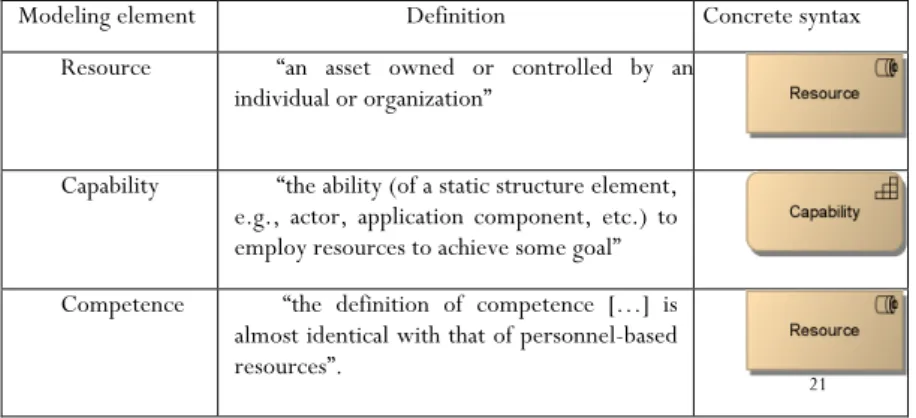
Similarly to other previous ArchiMate extension proposals (e.g. the motivation extension presented in (Quartel, Engelsman and Jonkers, 2010), the initial development of BSVC has been carried out without a strict definition of the semantics of the proposed modeling elements (Azevedo et al . , 2011). Capability "the ability (of a static structural element, e.g. actor, application component, etc.) to use resources to achieve some goal". Similarly, resources can be realized using structural elements, and resources can be allocated capabilities (as in the case of 'Car Damage Assessment Resource' and 'Claim Handling Capability').
Ontological Analysis of Resource
- Resource Context of Usage (R1)
- Resources Control (R2) and Agentive Resource vs Non- Agentive Resource (R3)
- Resources Properties and Instances
- Lack of Clarity on Required Resources
In the example above, "John" acts as a "resource for automotive damage assessment" in some organizational context (for example, in the damage assessment process). In these cases, the language does not specify whether one or more individuals instantiating the role (mixin) represented by the resource are required, used, or controlled in a particular context. Auto Damage Estimator” is a resource in the “auto damage inspection process” for “automobile damage estimation expertise” but should not be considered a “premium collection” process source.

Ontological Analysis of Capability
- Individual vs Type of Individuals
- Diverse Interpretations and Unknown Capabilities
- Lack of Clarity on Manifested Capabilities
In the latter, it is not possible to know which object is to acquire the disposition. It is not possible in language to express which structural element has a capacity, including the capacities an organization has, unless the capacity is realized by a behavioral element. In the later, it is not possible to know which object will acquire the ability.
Ontological Analysis of Competence
- Diverse Interpretations and Unknown Object
- Construct Redundancy
The interpretation of the concept of competence points to the same ontological construct as the interpretation of the concept of ability. C2.2 Competence is of the same type of disposition as an ability that is manifested (or acquired according to a given interpretation) by the performance of a behavioral element (event). C3 The interpretation of the concept of competence points to the same ontological construct as the interpretation of the concept of ability.
Revisited Support for Modeling Capabilities and Resources
- Resource
- Structure Element and Its Specializations
- The Behavior Element Concept
- The Capability Concept
- The Capability-enabling Bundle Concept
This means that the object represented by the structure element has an outline of the type that the capability represents. This means that the object assigned the capability represented by the structure element or the structure element playing the resource role obtains a disposition of the type represented by the capability by executing the behavior element. The 'Insurance Ability' is realized by the 'Sales Ability', the 'Policy Administration Process', the 'Collect Premium Business Function' and.

Related Work
In (Recker et al., 2010) the authors performed an ontological analysis to the Business Process Modeling Notation (BPMN). In (Santos Jr et al., 2010) the authors defined the semantics of the ARIS framework concepts and relationships in terms of UFO. Azevedo et al., 2011) performed an ontological analysis of the ArchiMate motivation extension proposal, revealing problems and suggesting improvement recommendations.
Conclusions
They are thus able to accommodate future changes in the operational parts of the enterprise architecture while realizing the higher levels of capabilities and resources. This creates a loose coupling between higher-level functions and other operational enterprise architecture elements, contributing to flexibility and maintainability of the resulting enterprise architecture descriptions. The main role of ontological analysis has been to provide us with a rigorous framework for analyzing the modeling constructs.
Validation
Introduction
The case study is taken from strategic management literature and is used to demonstrate the relevance of capabilities and resources to the enterprise architecture discipline. This case study is instructive in that it links capabilities and resources to business objectives at a strategic level and to EA at an operational level. Modeling the strategic plan in EA using our proposal revealed requirements for the implementation of the company's strategic plan that were not previously addressed by the company in its regular strategic planning process.
Case Study: Toyota Supplier Capability Enhancement 23
- Preparation
- Toyota Objectives
- Toyota Capabilities
- The Toyota Model Without the Capability Concept
- Concluding Remarks
Toyota had several drivers for some of its goals, such as 'Demand Fluctuations' and 'Model Mix Changes'. This helped the company reduce its rotor inventory and its regular inventory, realizing "Just-in-Time Manufacturing Capability" and thus addressing Toyota's assessment. With the capability concept, the relationships between the optimized element and "why" the element/product is optimized become clear.

Case Study: IT Consolidation for an European Energy Supplier
- Preparation
- Identifying drivers & problem(s), business strategy and strategic capabilities
- Analyzing baseline capability gaps and creating baseline heat capability map
- Relating capability gaps to the baseline architecture
- Using resource portfolio management approaches and creating a target architecture and target capability map
- Concluding remarks
This case demonstrates the usefulness of the capability concept to support a capability improvement process. Furthermore, the company is able to allocate resources to the performance of the capabilities and to design new business processes to achieve the desired situation. In this process we make use of the links between the strategic capabilities and the operational capabilities shown in the lower part of Figure 30.

- Preparation
- UFES Strategic Planning
- Strategic Planning within Departments
- The UFES Strategic Plan Model
- The Strategic Plan and EA
- Discussions
- Concluding Remarks
In the above subsections, we have modeled the strategic plan as currently detailed in the university's strategic plan. Integrating lecturers, assistant professors and associate professors into the goals of further education was not described in the university's strategic plan. Such operational aspects were not discussed in the university's strategic planning document and would inevitably affect the operational aspects of the EA.

Conclusions
Enterprise strategic plans were modeled including mission, vision, planned goals, and characteristics of enterprise goals, such as composition and timing. Further, the solution was required to allow enterprises to express their capabilities and resources, supporting the use of resource-based and capability-based theories of enterprises. This was mainly demonstrated by the second and third case studies, in which the enterprises relied on capabilities and resources, respectively, to capture the improvement of the enterprise's supplier and to support the reconfiguration of the enterprise itself.
Conclusions and Future Work
Main Contributions
- Strategic Plans in Enterprise Architecture
- Capabilities and Resources in Enterprise Architecture We have explored and precisely defined a semantic foundation for the usage
- Traceability Between Strategic Plans and Enterprise Architecture Operational Aspects
- Strategic Plans and Capabilities in ArchiMate
By defining that capabilities can be performed by enterprise behavior, such as business processes, and that structural elements in the enterprise can have capabilities, we have linked the operational aspects of enterprise architecture to enterprise capabilities. By defining the intent to have and the intent to perform a capability, as well as allowing their representation, we have allowed the enterprise to relate the operational aspects of the enterprise architecture to the enterprise's goals. We have extended the ArchiMate enterprise architecture modeling language to enable the modeling of strategic enterprise plans, as presented in Chapters 5.
Objectives and Thesis Hypothesis Discussion
In the second case study, presented in section 7.2, the company had been able to selectively allocate resources to the performance of skills and design its business processes in order to achieve the desired situation (a concern at the strategic level ). Consequently, the enterprise had been able to plan the provision of skills and resources necessary to achieve the desired state, without requiring a complete and extended view of business processes and tasks. The enterprise in the third case study, presented in section 7.3, had also been able to selectively allocate resources to performance capabilities, designing new services and business processes to achieve the desired situation.
Further Research Opportunities
- EA Planning
- Strategic Plan Monitoring
- The Ontological Basis
- Revisit the Modeling Extensions After Appropriation by the Community
We recognize that the approach could at least benefit companies similar to the companies in the case studies conducted in this assignment. We believe that this work indirectly influenced the ArchiMate 3.0 specification, particularly in its implementation. Further analysis of the modeling extensions proposed in this thesis is desirable, taking into account the pragmatic impact of the changes on the ArchiMate standard and its users.

Resource
Capability
Course of Action and Outcome
2015) 'Towards Capturing Strategic Planning in EA', in Enterprise Distributed Object Computing Conference (EDOC), 2015 IEEE 19th International. Reconsidering the Basic Premises of Strategic Management”’, Strategic Management Journal, 12, pp. 2015) ‘Towards Capturing Strategic Planning in EA’, in Enterprise Distributed Object Computing Conference (EDOC), 2015 IEEE 19th International. 2011) ''n Ontologie-gebaseerde semantiek vir die motiveringsuitbreiding om te argimateer', in Proceedings - IEEE International Enterprise Distributed Object Computing Workshop, EDOC.
10.1109/EDOC.2011.29
2000) 'The ontological foundation of Enterprise Information systems' REA', Annual Meeting of the American Accounting Association, p. 2005) 'Complexity and Clarity in conceptual modeling: comparing mandatory and optional properties', Data &. The case of software process ontology', in Proceedings of the XI Iberoamerican Workshop on Requirements Engineering and Software Environments, pg 2013) 'Towards Ontological Foundations for the Conceptual Modeling of Events', in Conceptual Modeling. 2013) 'Using a foundational ontology to investigate the semantics behind i* language concepts', in Proceedings of the CEUR Workshop, p. 2011) 'Ontology-based transformation framework from TROPOS to AORML', Social Modeling for Requirements Engineering, Collaborative Information Systems Series, p.
10.1109/IEEESTD.2000.91944
2011) “Bridging Enterprise Architecture Requirements for Architecture”, in Studies in Computational Intelligence, p. 2001) “The Impact of Knowledge Sharing, Organizational Capability, and Partnership Quality on IS Outsourcing Success”, Information &. 2000) “Vision Revisited: Telling the Story of the Future”, The Journal of Applied Behavioral Science, 36(1), p. 2011). 2009) “From Resource Base to Dynamic Capabilities: An Investigation of New Firms”, British Journal of Management, 20, p. 2001) “Strategic Planning (in Non-Profit or For-Profit Organizations)”, Free Management Library. A subculture-based multilevel analysis, Information Systems Research, 22(1), p. 2004) Capabilities, business processes, and competitive advantage: dependent variable selection in empirical tests of the resource-based view, Strategic Management Journal, 25(1), p. 2010) 'Ontological shortcomings of process modeling in practice', European Journal of Information Systems. 2004) "A reference methodology for performing ontology analyses", in Conceptual Modeling--ER.