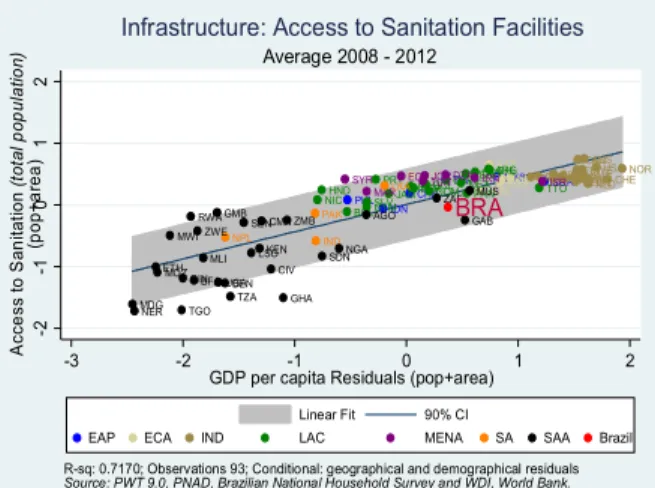
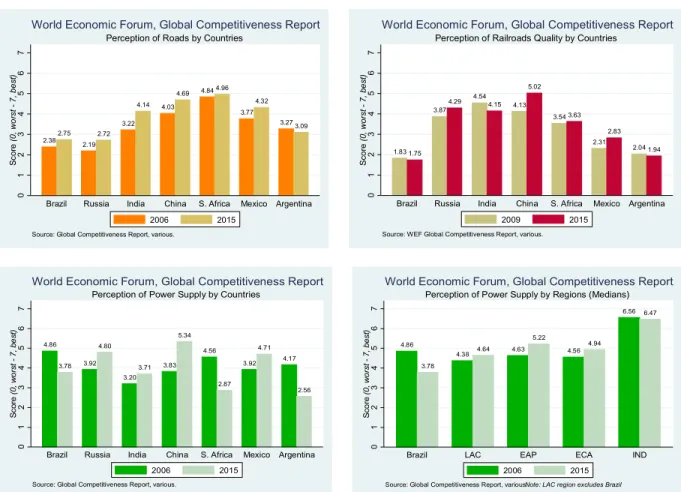
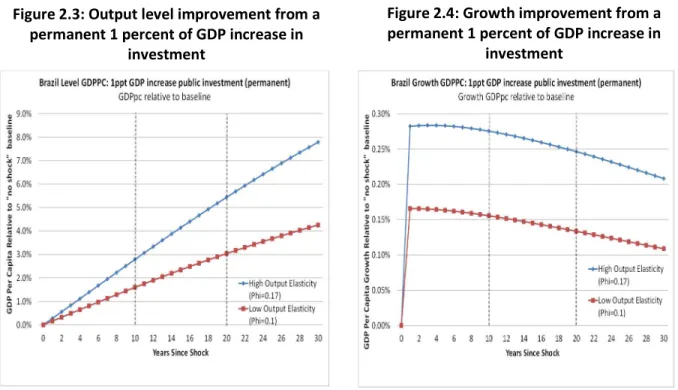
First, an international benchmarking analysis is used to determine the size and significance of the infrastructure gap in Brazil. But such changes alone will not significantly improve the quality of Brazil's infrastructure. To illustrate the extent of Brazil's infrastructure gap in different areas of the economy, this study conducted a comparative analysis.
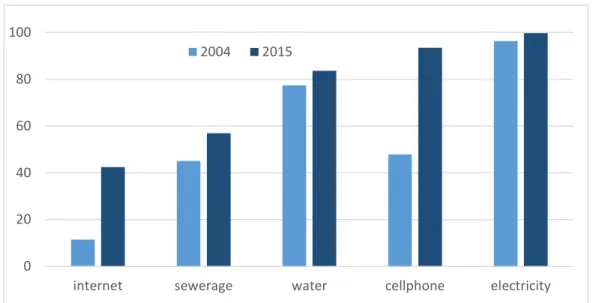
Data from the WEF's annual report on global competitiveness shows that the quality of Brazil's infrastructure looks worse than its own. Given the size and heterogeneity of Brazil, it is not surprising that access to infrastructure services varies widely between regions (Table 1.1).
Brazil’s Underinvestment in Infrastructure 5
In other countries in the region, private investment has offset the decline in public investment. In Chile, for example, the decline in public investment was more than offset, leading to an increase in the rate of investment in infrastructure from 3.1 percent of GDP in the 1980s to 5.2 percent between 2000 and 2006. For example, in the United Kingdom, public financing share is between 20-25 percent of infrastructure financing, and in India 50-55 percent.
In the baseline scenario, 45.3 percent of the investment gap—equivalent to 1.91 percent of GDP—is attributed to transport infrastructure, reflecting Brazil's particularly large deficits in this sector. In the electricity sector, the investment gap is about 1.2 percent of GDP above historical levels.

Brazil’s Investment Inefficiencies as a Cause for the Gap
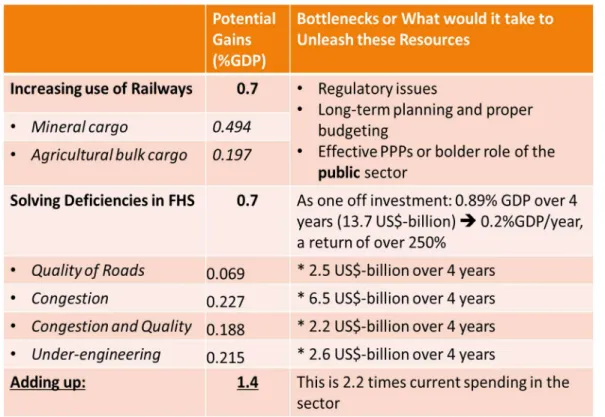
First, we look at allocative and operational inefficiencies in the transport and water and sanitation sectors. Quantifiable annual inefficiencies in the transport and water sectors amount to 2.1 percent of national GDP. By addressing allocative inefficiencies in the transport modal mix matrix and operational inefficiencies in the Federal Highway System (FHS), Brazil could potentially save 1.4 percent of GDP, which is 2.2 times the current annual investment in the transport sector.
Addressing operational inefficiencies in the water sector could save an additional 0.7 percent of GDP. The latter is more than three times the level of investment in the water and sanitation sector. A rough estimate of annual savings from bulk solid mineral transportation is in the order of $11.8 billion (0.5 percent of GDP) with an additional $4.7 billion for agricultural cargo (0.2 percent). percent of GDP) – see Table 3.1.
Transport documents 39. accounting for more than half of the transport cost savings for minerals) and in the North East for agriculture (accounting for 43% of the transport cost savings for agriculture). To calculate operating inefficiencies in the highway sector, we quantify the potential reduction in user operating costs (time savings and vehicle operating costs) if these deficiencies were eliminated. In the water sector, inefficiencies can mainly be attributed to underpricing and the poor management of water utilities.
Even more so than with federal infrastructure projects, management capacity was the main problem. Most projects experienced delays in the physical execution of works (46 percent), the suspension of works before completion (16 percent), and had low-quality final results (31 percent). Because some of these grant agreements were in the same city, only 5 of the 59 municipalities (8.5 percent) had no problems with their contracts.
Why Brazil Invests Poorly 18
TCU and CGU reports contain a thorough and largely uncontested diagnosis of the weaknesses in Brazil's public investment process. The responsibility of the CPTGV is to analyze large infrastructure projects (with a cost above R$50 million) and to verify their technical and socio-economic feasibility, before they are included in the PPA. Similarly, the monitoring and evaluation of the PPA, carried out by the CMA, became a requirement in 2005.
However, the impact of such initiatives is limited due to the poor assessment norms and guidance and low technical capacity in the CMA. About 10,000 amendments are inserted into the budget annually, representing on average about 20 percent of the discretionary expenditures included in the LOA (Tollini 2009). The previous section documented widespread inefficiencies in the operation and maintenance of the road network, as well as large losses among water utilities.
In the transport sector and the water and sanitation sector, an additional problem is the fragmentation of the regulatory environment. 21 The most extreme example was in the oil and gas sector, where the regulator (ANP) had full pension only 21 percent of the time. In addition to the annual audit of government financial statements, the TCU prepares a special dedicated report on the audit of public works (Fiscalização de Obras.
The increased scrutiny of infrastructure projects has its roots in a 1995 Congressional Commission of Inquiry report that resulted in the adoption of a recommendation that TCU report to Congress annually on the results of project audits. In a formal sense, TCU's mandate is strong and in line with international good practices. In the UK, on the contrary, the decision to suspend a project is the responsibility of the executive and not the legislature.

Has Involvement of the Private Sector Helped Overcome Inefficiencies?
Most importantly, the fact that many weaknesses and irregularities are discovered through FISCOBRAS and other audit procedures carried out by TCU clearly indicates the level of weakness in the project implementation arrangements that occur and can justify , TCU mediation rate. The level of intervention of the TCU, however, is also a function of the legislator's specific role in exercising control. Due to a lack of planning capacity, Brazil has increasingly relied on unsolicited private sector bids as a substitute for government project preparation and evaluation over the past two decades.
Reporting directly to the Presidency of the Republic, it has the authority to coordinate various government agencies. Contractual uncertainty is also one of the main reasons why a project finance market does not exist and the bulk of infrastructure finance still comes from public sources. Project finance is the practice of financing based on the cash flows of a project, "where the collateral is assets and receivables from the same project" (see Box 2).
The Borrower shall be a corporation incorporated for the sole purpose of implementing the financed project in order to separate the cash flows, assets and risks of the project. The projected Debt Service Coverage Ratio (DSCR) for each year of the operational phase of the project to be at least 1.3. With the onset of the fiscal crisis in Brazil in 2014, the authorities have begun to rethink the role of BNDES in financing infrastructure and look for alternative sources of commercial financing.
Sponsors must mobilize capital market financing as part of a long-term financing package. In sectors with natural hedges against foreign exchange risk, such as airports, ports, parts of the energy sector, etc., foreign investment could also come through long-term foreign financing. 31 Brazil has the largest inflation-linked market among emerging market economies and one of the largest in the world.
The Political Roots of Brazil’s Infrastructure Gap
Work is also being done to develop regulatory risk products, including through the Agência Brasileira de Guarantias Econômicas e Financeiras (ABGEF), where project sponsors and financiers obtain liquidity support while a rebalancing clause is litigated in the courts, as well as deepening the insurance market including the use of performance bonds. All of these efforts are welcome, but will likely fall short unless more public attention and resources are devoted to creating a robust project pipeline. The release of funds for legislative changes is routinely used as a bargaining chip in exchange for legislative support in Congress.
There is therefore a weakening of the incentive for the ministry releasing the resource to commit to its proper application. 86, 2015, which required the release of funds for individual amendments in the sum of at least 1.2 percent of the net current revenue of the Union (VRL). With a R$674 billion RCL in 2015, this means the mandatory allocation of resources in the order of R$8.1 billion.
Although a part of these funds allocated by the amendments can still be confiscated, the substantive part is no longer the main object of confiscation.
Towards Improved Infrastructure Governance in Brazil
The PPI is part of the President's office, reflecting the high priority the administration attaches to the initiative. BNDES is part of the PPI governing body with the specific task of giving advice on financial structuring with a view to attracting greater commercial funding in the financial package. While the latter requires a change in legislation, many of the problems in environmental licensing will be solved by better planning and project preparation.
Despite some shortcomings, the bill closes many loopholes in the current legal system and sufficiently addresses many of the problems associated with politicization and interference. In particular, the rules on appointments to the governing bodies of state-owned companies can lead to less politicized and more competent appointments. Second, the announced reforms of BNDES' operational procedures and the introduction of the TLP as a long-term interest rate converging to market conditions are major advances.
This is likely to reduce the need for budgetary sequestration (contingencemento) as a tool of fiscal management and thereby increase the predictability of the planning and budget process. A new law on public finances is finally under consideration to clarify the governance of the budget process and the management of public finances more broadly. The law, already provided for in the Constitution, but not yet approved, would increase the effectiveness of the budget and, in particular, of public investments.
The PPA should coincide with the four-year term of the president, which would be presented and voted on in the first months of the first year of the term. Credible revenue estimates would restore the LDO's role as an instrument for setting the medium-term fiscal framework. A promising approach would be to create a multi-year investment budget linked to a database of projects, following the Chilean and South Korean experiences.
Uma Perspectiva Brasileira, edited by Fernando Veloso, Pedro Cavalcanti Ferreira, Fabio Giambiagi and Samuel Pessoa. Trends and quality of decentralized public investments." In Decentralization and Infrastructure in the Global Economy: From Gaps to Solutions, edited by Jonas Frank and Jorge Martinez.