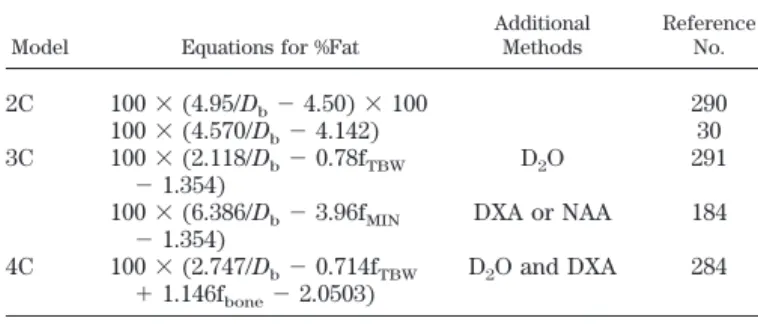
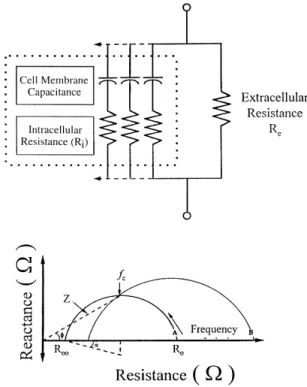
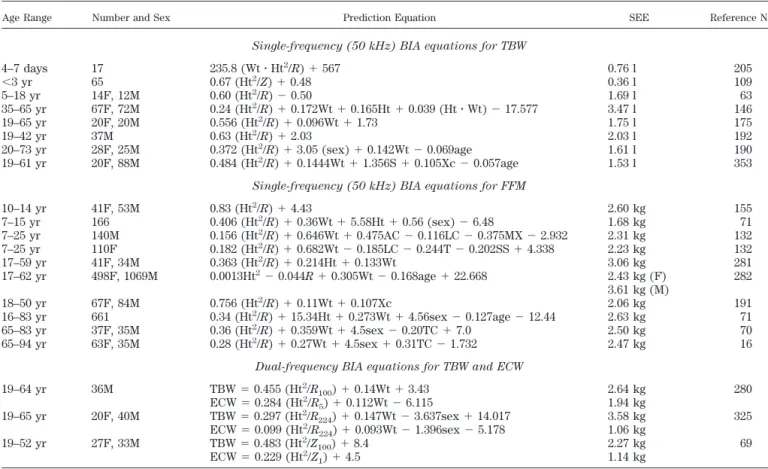
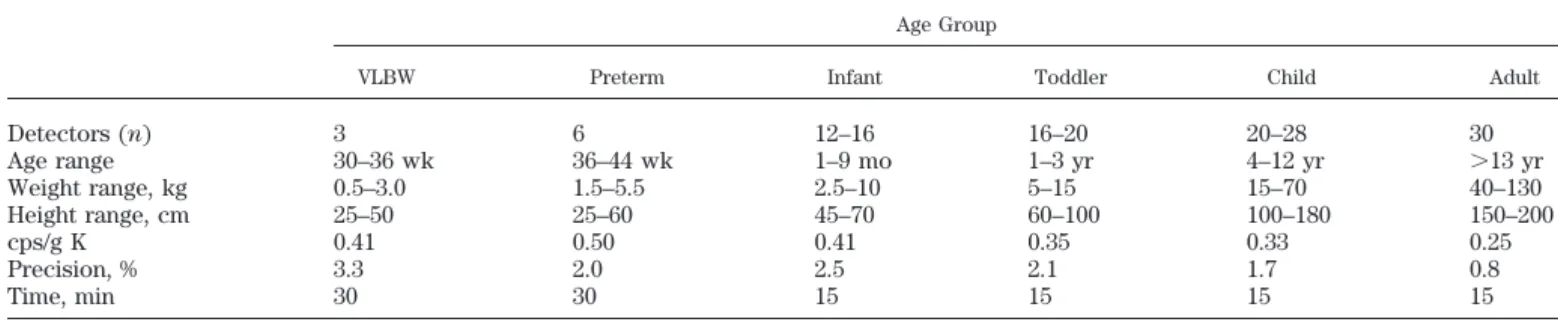
It's interesting to note that the basic 2-C models tend to start at either end of the spectrum (for example, counting 40K is an elementary model, while body density is an example of a whole-body model). The classical relationship of pressure versus volume, at a fixed temperature, is used to solve for the volume of the chamber in question. Measurements of total body water (TBW), ECW, and intracellular water (ICW) require corrections for overexpansion, imbalance, and excretion of the tracers.
For the molecular (level 2 model) and higher levels of the multilevel model, the single molecule that makes up the highest fraction of body mass is water. In healthy adults, TBW accounts for⬃73% of the FFM or 60% of body weight for non-obese subjects (171).

WHOLE BODY COUNTING AND NEUTRON ACTIVATION ANALYSIS
Two commercial instruments have been developed (EM-Scan, Springfield, IL), one for infants and the other for adults. The length of a baby's body is short enough that a static measurement can be made; that is, if the outer coils are about twice the length of the body, then the baby can be placed in the middle of the coils for the measurement. For adults, the whole body is scanned, and information is collected at 64 positions along the length of the body, and the output is analyzed using Fourier analysis (324).
However, it has been suggested that the use of a multi-frequency TOBEC coupled with Fourier analysis could provide a measurement of each fluid subcompartment, although no subsequent studies have demonstrated this use.
Total Body Potassium
The basic TOBEC concept would indicate that it is relatively insensitive to fluid or electrolyte shifts between the intracellular and extracellular spaces; therefore, it has only been used to monitor TBW (49, 50). Although the differences for TBK/FFM are relatively small, this effect is amplified when TBK is used with the 2-C model to derive an estimate of body fat mass (248, 334). However, TBK serves as the best choice for normalizing metabolic parameters among subjects (246).
The high accuracy of the TBK measurement has been established, although its absolute mass accuracy is less firmly established. For example, a direct confirmation of TBK values has not been obtained by human cadaver analyses, although it has been found to be accurate in animal measurements (unpublished data). In general, the accuracy of the whole-body measurement of TBK is 1-5% for adults, which decreases slightly for the preterm infant (91).
As noted earlier, TBK is considered the best body composition index for assessing body cell mass, the. The future research direction of TBK should not focus on using it with the 2-C model to estimate fat, but instead on the more sophisticated multi-compartment models where a measurement of BCM is needed. A combination of techniques, such as TBK, BIS, and DXA, should provide more complete judgment in the 3-C model of body composition.
Neutron Activation Analysis
DUAL-ENERGY X-RAY ABSORPTIOMETRY
Absorptiometric Principle
Bone Mineral Measurements
A number of alternative schemes have been proposed using the BMC and BA data in various combinations to derive a more accurate estimate of the true bone density. However, none of these have found widespread acceptance for clinical use over the simpler BMD estimation based on the BMC/BA. The results of a whole body DXA scan provide values for a 3-C model that is somewhat like that of the level 4 multicompartment model in that a specific tissue, namely skeletal mass, can be examined.
Dual-energy X-ray absorptiometry also provides information on the general anatomical distribution of bones in the body. The DXA-derived estimates of FM have been shown to agree well with values obtained using the 2-C models or level 1 and level 2 models (149, 150). It should be noted that although DXA provides a measure of body space without bone tissue, it does not specifically measure protein mass; i.e. estimated for the lean mass.
Despite these limitations, DXA technology represents a significant advance in body composition measurement techniques. This procedure, which requires some cooperation from the subject, can be performed in a few minutes at a very low dose (typically ⬍10 . Sv), and results can be obtained immediately. Dual-energy X-ray absorptiometry has clearly achieved a dominant role in the measurement of bone loss for the clinical diagnosis of osteopenia and osteoporosis (181).
Newer generation DXA instruments have been developed that only use fan-beam technology, but further research is needed to determine their accuracy for tracking changes in body composition.
Triple-Energy X-ray Techniques
MAGNETIC RESONANCE IMAGING AND COMPUTED TOMOGRAPHY
Magnetic Resonance Imaging
Animal models and human cadaver studies have been used to verify the accuracy of estimates of adipose tissue mass and its anatomical distribution. Abdominal subcutaneous adipose tissue and visceral adipose tissue, both the intraperitoneal and retroperitoneal deposits, were dissected in three human cadavers. For example, the relative contributions of each subcompartment to total abdominal adipose tissue mass have been investigated in weight loss programs with and without exercise and/or drug therapies.
The MRI-derived estimates for abdominal SAT and VAT will serve as a reference measure of adiposity for testing the efficacy of future therapies for obesity.
Computed Tomography
In addition, the comprehensive works of Cheek (42) and Forbes (114) describe body composition during human growth. Collectively, these studies along with the work of Moore et al. 221) provides a cornerstone of human body composition research at the elemental, cellular, and tissue levels. In this section, a summary of some of the types of changes reported in body composition over the human lifespan is presented.
These examples cannot be all-inclusive and do not represent a meta-analysis of the data, but serve to illustrate the range of information that is known.
Infants
Since these pioneering efforts, a number of newer or more sensitive techniques have been developed that have allowed us to examine many of these relationships in greater detail and to determine the degree of biological variability seen in the healthy general population with respect to gender. , ethnicity, age and sexual maturation. There are also concerns about the accuracy of some instruments' calibrations for these body measurements (166, 167). It is generally assumed that the relative bone, lean tissue and fat ratios that make up body weight remain unchanged for the child after 2 years of age; that is, during this period of steady growth, there are increases in the various compositional compartments so that there is no change in the overall composition of the body.
Children
Adults
MEASUREMENT OF CHANGES IN BODY COMPOSITION
If body composition measurements are obtained only once for an individual, then the most common use is to estimate that person's status relative to a reference population. An individual's body composition value can be expressed as a percentage of the expected or predicted normal value, usually after adjustment for variation attributed to sex, ethnicity, age, and body mass index and height. For this application, the absolute accuracy of the measurement is less important because the ability to detect a statistically significant change is more dependent on the accuracy of the measurement.
Estimates for the accuracy errors for each of the methods are also included in Table 13. These tend to be higher than the precision errors reflecting the difficulty associated with a calibration that must account for the full range of biological variations, such as body size and proportions, which often affect the parameters being measured; that is, the measurement techniques may have good reproducibility, but the estimated quantity (mass, volume, surface area, or density) for a specific body compartment for the individual is less certain. The estimated MDC values for an adult (based on the body composition estimates for the ICRP-23 Reference Man model, ref. 296) are also provided in Table 13, both in absolute units and in percent.
Unlike the clinical setting where body composition measurements are used to evaluate the status of an individual patient, the research applications of these measurements are usually focused on assessing the effectiveness of a specific therapy or treatment regimen for a group of subjects. In this case, the statistical ability to identify a significant change in body composition is not only dependent on the measurement precision, but also the biological variability of the body composition parameter in the research population and the sample size of the study group. Thus, in designing a research protocol that relies on the detection of significant changes in body composition as an endpoint, the relationship presented above for.
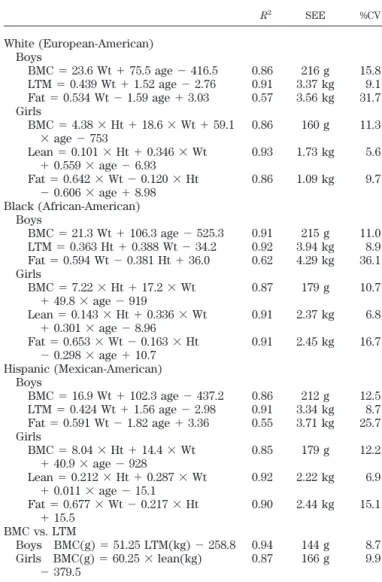
Predictive equations for estimating mean body composition in children by age, weight, and height.
SUMMARY
Determinants of body composition measured by dual-energy X-ray absorptiometry in Dutch children and adolescents.Am. Improvement in accuracy of whole-body dual-energy X-ray absorptiometry and regional body composition analysis: validation using piglets and methodological considerations in infants. Pediatrician. Partitioning body composition of cancer patients by measurement of total body nitrogen, potassium and water. Metabolism.
Measurement of body composition in 9–11-year-old children using dual-energy X-ray absorptiometry, skinfold thickness measurements, and bioimpedance analysis. Am. Validation of the tetrapolar bioelectrical impedance method. to assess human body composition.J. Assessment of fat-free mass by bioelectrical impedance measurements of the human body. Am. Population. Dual-energy X-ray absorptiometry for whole body and regional bone, mineral and soft tissue composition. Am. Evaluation of a new plethysmograph for measuring human body composition. Med.
Evaluation of dual-energy X-ray absorptiometry for assessment of body composition in piglets and neonates. Use of dual-energy X-ray absorptiometry in body composition studies: not yet a "gold standard." Am. A new TOBEC instrument and procedure for assessing body composition: use of Fourier coefficients to predict lean body mass and total body water. Am.