
Findings: The impact of the digital economy as measured by the technology proxy – internet, mobile and fixed broadband – on the economic growth of OECD countries depends on their level of development and the measures of the technologies that the digital economy. This longitudinal study aims to analyze the impact of the digital economy on economic growth in OECD countries, with these countries being divided into groups based on their level of development (transition and innovation countries). The results suggest that the impact of the digital economy as measured by the technology proxy – internet, mobile and fixed broadband – on the economic growth of OECD countries depends on their level of development and the technologies measures that capture the digital economy . .
In the second part, we elaborate on the literature review of the digital economy and economic growth. Several authors have emphasized the importance of the digital economy measured by ICT in the economic growth of countries. Lee et al. 2012) found a positive impact of ICT on economic growth in developed countries of sub-Saharan Africa, but a negative relationship in developing countries.
Hypothesis 3a (H3a): High levels of fixed broadband subscriptions are negatively associated with economic growth in more developed countries. Hypothesis 3b (H3b): A high level of fixed broadband subscriptions is positively related to the economic growth of LDCs.
DATA ANALYSIS AND METHODOLOGY
As a method of assessing the impact of the digital economy on countries' economic growth, in February 2021 a series of indicators were collected for each OECD country from the World Bank's World Development Indicators (WDI) that measure economic growth, the digital economy , and macroeconomic conditions. Economic growth is measured using GDP per capita at constant 2010 prices as the dependent variable. GDP per capita at constant prices is the most commonly used indicator to measure economic growth (World Bank, 2021) and is used in a logarithm as used by Myovella et al.
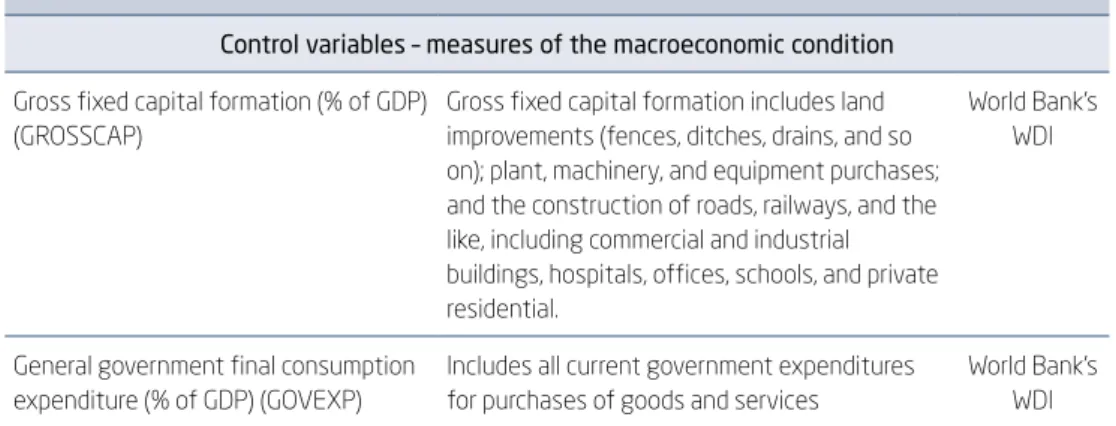
As measures of the digital economy, a technology proxy was used that considers mobile-cellular telephone subscriptions per 100 inhabitants, a percentage of individuals using the Internet, and fixed broadband subscriptions per 100 inhabitants, which have implications for the economic growth of countries such as found by empirical studies referred to above. According to the economic literature, some variables explain the economic growth of countries, such as gross capital formation (grosscap), public expenditure (govexp), population growth (pop) and economic openness (eopen). Fixed broadband subscriptions (fixed . subscriptions to high-speed access to the public Internet) per 100 inhabitants.
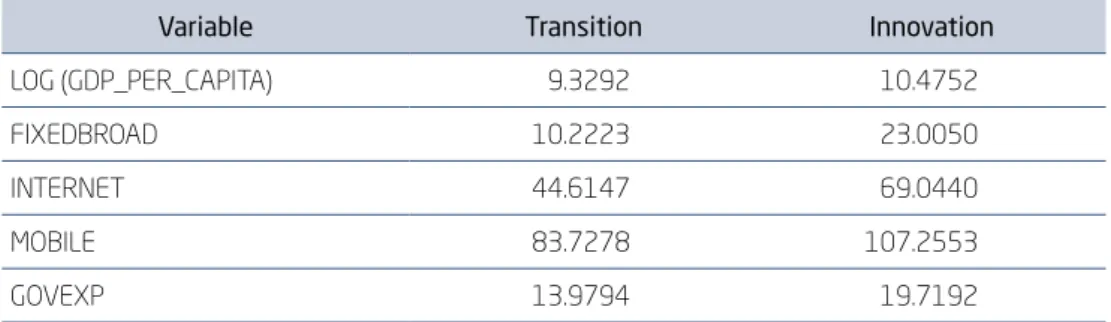
Gross fixed capital formation includes land improvements (fences, ditches, sewers, etc.); plant, machinery and equipment purchases; Taking into account the primary objective and the formulated hypotheses, we used a quantitative methodology, such as Myovella et al. Therefore, we performed a descriptive statistical analysis of the variables used (Table 3) for a sample of all OECD countries and groups of countries ranked according to their degree of development (Table 4) and correlation analysis (Table 5).
This was accomplished using a panel Generalized Method of Moments (GMM) method using a fixed cross-section (Greene, 2018; Wooldridge, 2001) in Eviews10 software. Because the sample consists of panel data, compared to ordinary least squares or two-stage least squares, the GMM method is more efficient because it corrects for heteroskedasticity or autocorrelation problems common in this type of sampling. Instrumental variables (independent variables and control variables) allow solving the moment equation ( b = E(z ́x)-1 E(z' y)), and its sample equivalent is the instrumental variable estimator ( bVI =(z'x) -1z' y).
RESULTS AND DISCUSSION
The results of the estimated regressions (Table 6) show that the digital economy is measured by the technology proxy considering Table 4 (conclusion). Thus, the independent variables and the control variables explain more than 90% of the variation in economic growth in OECD countries, measured as GDP per capita. This independent variable no longer explains GDP per capita, the economic growth of the transition countries.
Thus, Hypothesis 1 on high rates of mobile telephony subscriptions is positively related to economic growth, regardless of the development of OECD countries. The effects of individuals using the Internet on GDP per capita are stronger in transition countries (0.44%) than in innovation countries (0.27%) and considering all OECD countries (0.36%). These results are in line with the latest empirical studies that found that high percentages of Internet users have a positive and significant effect on the economic growth of countries (Bahrini & Qaffas, 2019;.
However, the impact of the Internet on economic growth depends on the countries' stage of development. High levels of fixed broadband subscriptions harm economic growth when looking at all OECD countries (model 1) and in the innovation country group (model 2), but are positively related in the transition country group (model 3). Thus, the impact of fixed broadband subscriptions on GDP per per capita of countries' level of development (Bagheri & . Rodrigues, 2017), with a negative effect in more developed countries (innovation countries) and a positive effect in less developed countries (transition countries), confirming hypothesis 3a and 3b.
The effect of the latter services is three times greater in the economic growth of countries, as they reduce the prices of broadband connections, which enables more significant innovations and improvements in business performance. The effect of technological convergence, as measured by mobile-cellular subscriptions, the percentage of individuals using the Internet, and fixed-broadband subscriptions, on economic growth has a more positive effect on transition countries in general, despite the variable mobile-cellular tel. telephone subscriptions are no longer relevant to explaining GDP per capita. Regardless of the level of development of the OECD countries, the effect of the control variables on GDP per capita is the same in the three models (govexp has a negative impact, while grosscap and pop have a positive impact on all models). ), except for tradeopen, which has a positive impact on GDP per capita in models 1 and 2.
The result of the macroeconomic variable tradeopen on economic growth varies according to the level of development of countries; in the least developed countries, barriers to trade, dependence on the export of primary raw materials, weak infrastructure and large distances between markets explain the negative impact of this variable on economic growth.
FINAL REMARKS
We found a positive impact of the Internet on the GDP per capita of all OECD countries, even if we divide them into transition and innovation countries. We observe a positive impact of the mobile phone on the economic growth of OECD countries, if we consider them as a whole and in the group of innovative countries. However, it was found that there is a negative impact of the group of transition countries and fixed broadband on the economic growth of OECD countries (transition countries and innovation countries).
We can therefore conclude that ICTs positively influence the development of the economies of the European Union. There are many countries in the European Union where prices for these services are exorbitant. To accelerate the development of the digital economy, the various regional actors (government, academia and companies) must work to increase the levels of qualification in the higher education of the population, the development of R&D partnerships and incentives.
The development of patents should be reviewed and improved in order to increase the innovation performance of regions (Farinha et al., 2020; Lopes et al., 2019a). The originality of this study is due to its assessment of the impact of the digital economy on GDP per capita in all OECD countries. This empirical study contributes to clarifying the existing literature on this topic and leaving measures that can improve the performance of digital economies, which are important for the operation of the digital agenda in Europe.
As future lines of inquiry, we can cross the variables of this study with those present in the Global Competitiveness Report, the Global Entrepreneurship Monitor or the Regional Innovation Scoreboard. The database can be updated in the coming years and the results can be compared with this study. This study can also be repeated in other regions of the globe, making it possible to compare countries in the variables under study.
It would still be essential to use more measures of the digital economy, allowing for a more holistic analysis of the impact of information communication technologies on countries' economic growth.
ACKNOWLEDGEMENTS
We also suggest measures that reduce the digital divide, increase the use of digital technologies by households, higher education institutions, companies and governments, and promote and stimulate ICT skills among Internet users, especially in less developed countries. It may also be worthwhile to replicate the present study in insular/island regions or in more remote regions of countries as different results may be found.
Modeling information and communication technology cybersecurity externalities spillover effects on sustainable economic growth. The role of ICT use for economic growth in the sub-Saharan African (SSA) region. The level of penetration of information and communication technology as a driver of economic growth and development in Africa.
Short- and long-term dynamics of venture capital and economic growth in a digital economy: A study of European countries. Information communication technology (ICT) infrastructure and economic growth: A causal relationship emerging from cross-country panel data. The Impact of Information and Communication Technology and Financial Development on Economic Growth in OPEC Developing Economies.
The relationship between entrepreneurship and economic growth: a comparative analysis of groups of countries. ICT as a source of economic growth in the information age: empirical evidence from the period 1996–2005.

