The complete version of the quality manual and its annexes are available at www.iscte-iul.pt. We are extremely pleased to be able to present this abridged version of the internal quality assurance system. In this case, the consistent and persistent leadership of Professor António Caetano has been crucial for the achievement of the current level of quality.
ISCTE-IUL's quality assurance system has reached a significant level of development, well reflected in the integration, already implemented, of the various sub-systems that contribute to the quality of teaching, research, operation of services, relationship with society, and the institution's operational and strategic management. A large part of the tension created by the implementation of quality assurance is precisely derived from a culture of indulgence, together with the normality attributed to those anomalies. With the implementation of the faculty staff performance evaluation system and the weight given to this procedure, that figure has decreased and now the problem has disappeared.
The same happens with all the initiatives linked to quality assurance, in addition to the involvement of the specific quality systems mentioned in the manual. The quality of the knowledge produced is "accredited" by peer consensus and by peer citations.
Quality Manual
INTRODUCTION
- QM approval, revision and distribution
- Structure of the QM
- QM legal framework and reference documents
In addition to the definition of a quality assurance policy and the formalization of its procedures, higher education institutions must also include mechanisms for formal approval, periodic review and monitoring of their study cycles and other activities through the collection and analysis of the most relevant data (e.g. SGQA , 2010; Amaral, 2011). The current revision of QM is based on a number of recommendations resulting from accreditations, both national (SIGQ-IUL certification by A3ES) and international (EUA, AACSB; EUR-ACE), as well as the results of audits regarding the ISO9001 standard. to which SIGQ-IUL also corresponds. ISCTE-IUL's application for this type of assessment has also contributed to an internal discussion and analysis involving all SIGQ-IUL's actors (internal stakeholders – students, faculty members, researchers and other staff as well as external stakeholders).
The changes made to the organizational structure of ISCTE-IUL (Resolution No. 59/2014) have also influenced the changes made to SIGQ-IUL and the consequent revision of the manual. Regular review of the MK is biennial, but can be done whenever it may be necessary to incorporate a modification. The current version of the QM was approved on 16 November 2015 and is available for consultation on the ISCTE-IUL Internal Information Portal (MyISCTE), on the ISCTE-IUL Quality websites (http://iscte-iul .pt /quem_somos/qualidade/documentos_garantia_qualidade) and on the website of the Office for Studies, Evaluation, Planning and Quality (GEAPQ) (http://iscte-iul.pt/servicos/).
GEAPQ is responsible for the controlled original version of the QM and for its continuous update (when there are changes/revisions in the processes, procedures, regulatory orders, standards and guidelines related to quality assurance), archive (physical/paper and electronic) copy), publication and disclosure. ISCTE-IUL's Quality Manual outlines the organizational arrangements, responsibilities, processes, objectives and indicators that make up SIGQ-IUL, as well as the principles that guide its implementation and monitoring. This Manual also describes SIGQ-IUL's functioning, namely: the articulation of ISCTE-IUL's strategy for the quality policy; the responsibilities and relationships between the government bodies participating in the conception, validation, achievement and improvement of prescriptive guidelines and quality assurance actions; the processes, plans and reports that demonstrate quality assurance at ISCTE-IUL.
Finally, the description of the ways to involve the internal and external stakeholders; production and transmission of relevant information to the stakeholders, as well as SIGQ-IUL's ongoing monitoring, assessment and improvement (audit of system management). Revised ESG approved by the ministerial conference in Yerevan on 14-15 May 2015: European Association for Quality Assurance in Higher Education. A3ES, Accreditation Agency for Higher Education Glossary (n/d), available at:< http://www.a3es.
Revised ESG approved by the Ministerial Conference in Yerevan, on 14-15 May 2015: European Association for Quality Assurance in Higher Education – ENQA, 2015.
INSTITUTIONAL COMMITMENT AND POLICY FOR QUALITY
- Policy and strategy for quality
- Mission and goals
- Ethics, responsibility and sustainability
- ISCTE-IUL organisational structure
ISCTE-IUL quality policy is based on sharing the institution's mission, vision and strategic goals. ISCTE-IUL believes that realizing this mission must take place at all levels: individual, organization and society. Recognition of ISCTE-IUL's high-quality action at these three levels is crucial to its institutional reputation in its areas of scientific activity.
Internationalization of teaching, research and knowledge transfer activities, as well as of faculty members and students, which fully integrates ISCTE-IUL into international research and education networks; Guaranteeing timely information and adequate interaction within services and between services and entities that make up ISCTE-IUL;. These objectives are in line with the general strategy of ISCTE-IUL and are translated into goals defined every year in the activity plans involving ISCTE-IUL schools and other decentralized organic units, services and subsidiaries.
ISCTE-IUL is committed to promoting high standards of ethical behavior among its employees, faculty members, researchers and students, consistent with the standards established in its regulations. ISCTE-IUL's Ethics Committee Bylaws were published in 2011, formalizing the Ethics Committee as a rectorial advisory body on ethical issues related to ISCTE-IUL's areas of teaching and learning, scientific research, community service and institution functioning . The ISCTE-IUL Academic Code of Conduct emphasizes the set of general principles that guide the actions and behavior of the members of the academic community with respect to intra-institutional relationships.
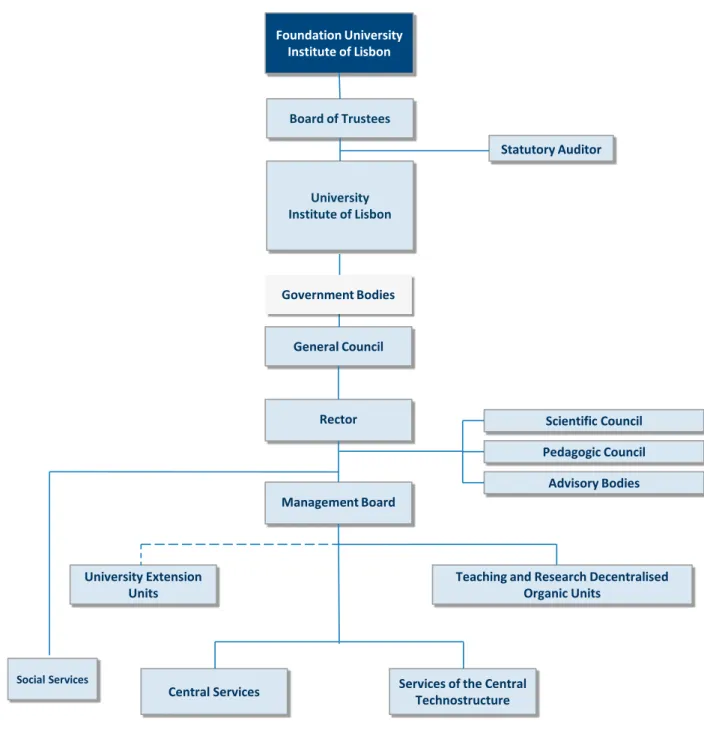
In terms of responsibility, ISCTE-IUL seeks to take into account the impact of its decisions and activities on the internal community and society, including the preoccupation with social equality and justice, as well as on the various dimensions of the environment. ISCTE-IUL belongs to Fundação ISCTE – Instituto Universitário de Lisboa (May 2009) managed by the Board of Trustees. ISCTE-IUL's organizational structure includes teaching and research organic units; university extension units focused on external interaction (via subsidiaries); and social services.
O Regulamento de Serviços do ISCTE-IUL (Regulamento n.º 83/2015, Diário da República, n.º 38, de 24 de fevereiro de 2015) encontra-se disponível no portal de informação interno do ISCTE-IUL - MyIscte e na Internet (http://www.iscte-iul. pt/home.aspx).
ISCTE-IUL INTERNAL QUALITY ASSURANCE SYSTEM (SIGQ-IUL)
- SIGQ-IUL organisation
- SIGQ-IUL organisational structure and responsibilities
Quality Assurance Commission (CGQ) Responsibilities
The commission is chaired by a Vice-Rector for the respective area and includes the quality director and the quality manager appointed by the Rector to manage the System's implementation and monitoring. The meeting's notice, together with the agenda, must be sent at least eight days before the date of the meeting;. The decisions taken by CGQ are recorded in minutes drawn up by the GEAPQ and made available on ISCTE-IUL's intranet.
The CGQ president may invite other heads of organic units when their participation is deemed pertinent to the subject under discussion.
Quality Assurance Advisory Board (ConCQ) Responsibilities
The meeting notice must be sent together with the agenda at least 15 days before the meeting date. ConCQ's recommendations are recorded in protocols prepared by GEAPQ and made available on the Internet;.
Curricular Analysis Commission (CA Responsibilities
Studies, Evaluation, Planning and Quality Office (GEAPQ)
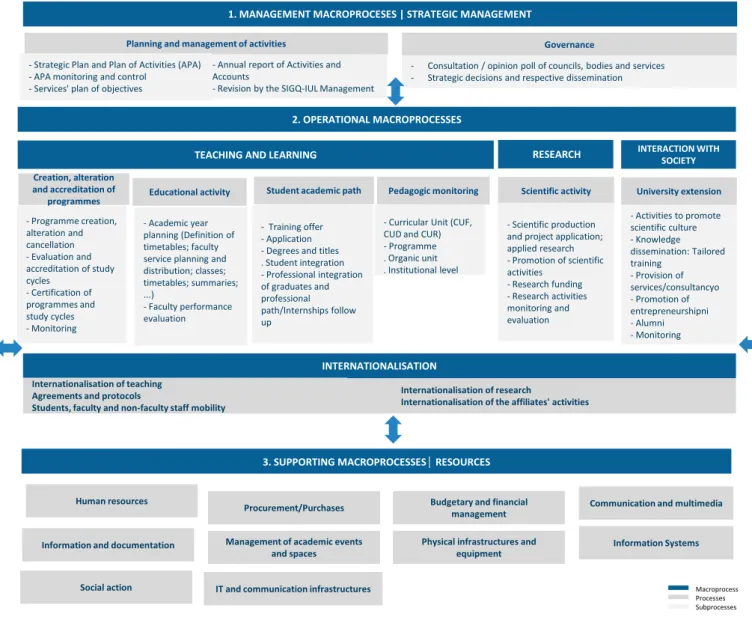
- SIGQ-IUL process-oriented approach
- Participation of the (internal and external) stakeholders in SIGQ-IUL
- Quality monitoring and assessment
- Strategic management
- Teaching and learning
- Research
- Interaction with society
- Internationalisation
- Resources
- ISCTE-IUL information and management integrated system
- Information systems
- Meritus
- Continuous monitoring, evaluation and improvement of SIGQ-IUL (SIGQ revision)
Work directly under the coordination of the Quality Director in the operational implementation of the policies and goals defined by the Management Representative. Branch managers, to analyze the achievement of planned activities, quality assurance procedures and alignment with ISCTE-IUL objectives; Department directors, to analyze the implementation of activities and achievement of the academic plan in its various aspects;.
ISCTE-IUL has developed its own platform (i-meritus) which is connected to the academic, research and management information systems (Fénix, Ciência-iul and SAP) which enables the automatic integration of the majority of the information needed for assessment. The latter includes questions related to the functioning of the CU, the student's self-evaluation in the CU and the performance of the CU's teachers. In the survey carried out in the 2nd semester, this group also includes the students' opinion on the quality of ISCTE-IUL's facilities, resources and services, their opinion on SIGQ-IUL and on the programme.
It will be made available to the Statutory Authorities of ISCTE-IUL and will be available in the Academic Management System for reference by the entire ISCTE-IUL community. SWOT analysis of the activity conducted by the school during the reporting academic year. The report includes the implementation of the annual activity plan with the level of achievement of the different axes related to the areas of the mission of ISCTE-IUL and its strategic goals.
ISCTE-IUL's eight railway companies have their own rules and prepare an APA within the framework of the strategic action plan proposed by the Chancellor and approved by the General Council. Faculty staff's participation in educational actions carried out by affiliated companies is subject to the Rector's approval. The ISCTE-IUL Strategic Plans (Quadrennial) as well as the Annual Activity Plans have supported the monitoring of the performance of the various services and the respective management and support processes.
The ISCTE−IUL portal (http://iscte-iul.pt/home.aspx) is one of the main means of disseminating the Institution's training offer (external communication). Obtaining this certification ensures a higher degree of autonomy for IES in the assessment/accreditation processes of the various study cycles. Since 2009, ISCTE-IUL has received APCER Certification every year, under the ISO 9001 standard.