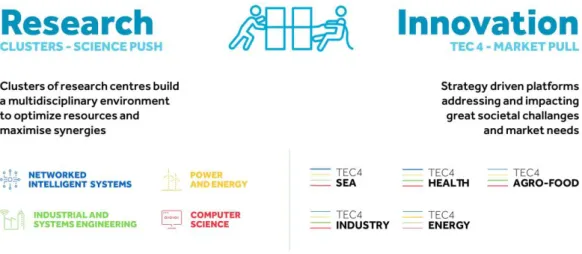
Each cluster is directly coordinated by a member of the board with the support of a cluster council, composed of the centers. A TEC4 initiative structures and gives coherence to INESC TEC's activity towards specific markets, and integrates and formulates the competences of the relevant centres. The external monitoring, orientation and evaluation of the innovation and technology transfer activities is entrusted to the Business Advisory Board, where the economic sectors of relevance to INESC TEC are represented.
The Data Protection Officer directs the implementation at INESC TEC of the General Data Protection Regulation. Initiatives such as the creation of a research data repository and active participation in the Portuguese node of the Research Data Alliance, led by INESC TEC, contribute to strengthening the alignment with open science policies.

Context
As part of its recommendations, the BOHEMIA study identified 19 likely future scenarios with disruptive implications and associated priority directions for EU research and innovation. Remote sensing is at the forefront of the big data revolution, a field of intense international competition.” This includes many facial/gesture recognition devices embedded in personal systems, such as wearable and wearable brain-reading helmets, as well as third-party systems such as cameras and other scanners.
Vision and contribution
Future vision of the domain
As is clear from the target scenario, “The benefits of various sensors and networks in all major policy areas can hardly be overemphasized. The availability of data and advances in processing capabilities have led to a qualitative step forward in the understanding of emotions. Also, in emerging application areas of communication technology, such as smart cities or the Internet of Things, machine learning methods are of central importance.
Cluster contribution
Cluster research lines
POWER AND ENERGY
Associated Centers: Center for Industrial Engineering and Management (CEGI), Center for Telecommunications and Multimedia (CTM), Laboratory for Artificial Intelligence and Decision Support (LIAAD), Center for Robotics Autonomous Systems (CRAS), Center for Information and Computer Graphic Systems (CSIG) ), High Assurance Software Laboratory (HASLab), Center for Enterprise Systems Engineering (CESE).
Presentation
Future vison of the domain
The vision of the PE cluster is aligned with EU policies for digitalisation, energy efficiency and increasing integration of renewables, as described below in the following strategic research vectors. These vectors highlight the main challenges facing the core center and define the requirements that other scientific competencies, located in the associated centers, must develop in order to meet the future requirements of the sector. The digitization of the energy sector requires a multidisciplinary approach and the co-creation of new business models.
However, digital technologies are only a basic infrastructure to integrate advanced mathematics17, such as distributed mathematical optimization, data-driven optimization, hybridization of classical mathematical optimization, metaheuristics and/or machine learning, data assimilation and control theory. Basic research in this area will increase the competitiveness of the PE group and its centers and will materialize the application of artificial intelligence (AI) in the field of energy, covering human-centric and network use cases. Full and sustainable decarbonisation of the energy system requires significant advances in state-of-the-art technology and a combination of new computational, hardware and regulatory solutions.
The R&D needs will be identified through preliminary studies (simulation of alternative operating scenarios) that evaluate the behavior of the electricity system and anticipate the requirements that the industry will have in the future. This requires new mathematical algorithms based on convexification and decomposition techniques and human-in-the-loop approaches, which provide fast and clear advice and address local technical problems that can be caused by DRES. However, there are still two major barriers to achieving replicability and scalability: (a) regulation has been a bottleneck for this paradigm to scale; (b) cybersecurity and interoperability have also limited implementation in the field of these innovative concepts.
In this context, new regulatory frameworks must be proposed to support disruptive models, such as peer-to-peer trading, but taking into account the fundamentals of the electrical system, i.e. to meet the proper quality of service required by the end user.
Cluster contribution
The main challenge of this line of research is the design of the requirements for a secure connection of a completely new set of distributed energy resources during a deep technological revolution, in addition to a flexibility that will be mostly placed over the availability of end users to participate in the operation of the electrical system. The appropriate modeling and optimization of the electrical system are fundamental conditions for this new operating paradigm, based on distributed energy resources. The main challenges come from the lack of sufficient information from the manufacturers about the characteristics of new technologies, which poses a difficulty with the accuracy of the models for use during simulation.
This promotes the use of data-driven approaches, based on historical data (when available), and also close interaction with manufacturers to enable a realistic representation of the system. For modeling purposes, a thorough evaluation of existing and future technological solutions is mandatory to define the basis of new simulation models that will support the representativeness of the network components. The digitization of the energy sector requires new data-driven methodologies for forecasting, optimization and prescriptive analysis, enabling the creation of new services for end users.
This RL is the stepping stone for the digitization of the energy sector and requires a multidisciplinary approach and co-creation of new business models that will greatly benefit from the presence of other research centers (such as CEGI and LIAAD) to improve knowledge and techniques that CPES has in the last 3 year explored. The inclusion of new assets, with significant life-cycle uncertainty, together with entirely new operating strategies for more conventional assets, makes this RL fundamental to the operation of the electrical system of the future. The main challenges come from the lack of data from many of the assets and lack of casuistics for the different scenarios to study, in a system under a profound change.
Many existing solutions use proprietary communications and technology, making some measures difficult to apply.
INDUSTRIAL AND SYSTEMS ENGINEERING
Systems' interoperability and semantic integration of the data produced by the different systems are of great importance to extract relevant knowledge. Part of this knowledge is applied in the development of algorithms aimed at optimizing the resources involved in providing the service and improving the quality of the service. On the other hand, focusing on the entire supply chain, the Cluster will explore the developments of the blockchain to address the new challenges caused by external on-demand logistics.
The design of 'go to market' and 'value capture' strategies is a key factor in value creation. RL2 – Operations Research and Management Science: Decision Support in a Digitized Industry Research Line Definition. To achieve the fullness of Cluster's vision of an ever-customer-centric integrated supply chain in real-time, decision-making strategies and tools must be developed.
The changing manufacturing context requires new design insights to inform the development of management systems as well as execution systems in the context of the growing adoption of data-driven manufacturing. For example, the success of industrial and mobile robotics applications is highly dependent on integration with the connected factory of the future. The use of industrial collaborative workstations with intelligent sensors, vertical integration and IoT-based information architectures play an important role in these processes and are one of the Center's many contributions to the Cluster Vision.
This is essential to achieve an in-depth understanding that feeds and inspires the design and innovation process, as well as to evaluate the effect of the new solutions.
Structural actions planned for 2020
COMPUTER SCIENCE
The mission of the Computer Science Cluster is to achieve international excellence in both fundamental and applied research, with a strong emphasis on technology innovation and transfer that benefits society at large. Our commitment spans many core areas from programming languages and rigorous software development to complex information systems, from data processing to large-scale computing, from embedded systems to virtual environments, and from security to quantum computing, with the goal of bringing better intelligence to everything. The Cluster is heavily involved in Technology Transfer activities, either as Advanced ICT Consultancy or Innovative System Development, in areas such as Agriculture, Electronic Government, Energy, Healthcare, Earth and Ocean Observation, Industry and Telecommunications.
With the advent of the Internet of Things, it is expected that in the coming years we will find computing devices embedded in all kinds of equipment and devices. The presence of all these sensors and computing devices produces enormous amounts of data, which challenges current information retrieval tools and creates opportunities for a new generation of machine learning and data mining approaches, helping to shape future decision support instruments. Human-machine interaction is changing and becoming more immersive and inclusive, merging virtual and real worlds, a move seen in computer games, but this will also reach other levels of society.
The European Defense Fund, with an overall budget of €13 billion, aims to increase Europe's ability to protect and defend its citizens and will provide EU-funded grants for collaborative projects that address new and emerging threats. future of defense and security and aiming to bridge technological gaps;. The new €9.2 billion Digital Europe program aims to bring the benefits of digital transformation to all European citizens and businesses, and will boost investment in high-performance computing and data, artificial intelligence, cyber security and advanced digital skills; . Similarly, the ENEI national research and innovation strategy for smart specialization, which aligns with regional and sectoral strategies, identifies ICT as one of the 15 smart strategic priorities.
All these European, national and regional funding programs open up a wide range of opportunities for the cluster to intervene in its key research areas.
Vision and contribution 3.4.3.1 Future vision of the domain
Cluster contribution