Dieta enriquecida com Persea americana e sua associação com 5-ASA no modelo de inflamação intestinal induzida por TNBS em ratos. Avaliação da atividade antiinflamatória do chaya em modelo experimental de inflamação intestinal induzida por TNBS em ratos. Avaliação da atividade antiinflamatória intestinal de Persea americana e sua associação com 5-ASA em modelo experimental de inflamação intestinal induzida por TNBS em ratos.
Avaliação da atividade antiinflamatória intestinal da 4-metilesculetina no modelo experimental de colite induzida por DSS em linhagens de camundongos geneticamente selecionados. Avaliação do efeito anti-inflamatório intestinal de alimentos enriquecidos com Euterpe Oleraceae Scrubs. Avaliação da atividade antiinflamatória intestinal de Cnidoscolus aconitifolius e Bertholletia excelsa em modelo experimental de inflamação intestinal induzida por TNBS em ratos.
Avaliação da atividade anti-inflamatória intestinal de Persea americana em modelo de indução de TNBS em ratos.
Introduction
The incidence and prevalence of IBD is increasing at alarming rates around the world, indicating its emergence as a public health problem (Molodecky et al., 2012). The nutritional interventions can also play an important role in the control of IBD (Ruemmele, 2016), based on the close interaction between food habits and quality of life, intestinal microbiome bacterial composition and intestinal immune system activation status (Guinane & Cotter, 2013; Lee et al. ., 2015; Magrone & Jirillo, 2013). Some bioactive food constituents are associated with reducing intestinal inflammation, including probiotics, fibers, phytochemicals, vitamins, minerals, herbs, peptides-proteins, bioactive lipids, polyphenols and others (Lee et al., 2015; Uranga et al., 2016). .
The avocado fruit's carbohydrates are composed of approx. 80% dietary fiber, consisting of 70% insoluble and 30% soluble fiber (Dreher & Davenport, 2013; Naveh et al., 2002). Furthermore, glutathione, phenolic compounds, magnesium, lutein/zeaxanthin and cryptoxanthin and antioxidants vitamins such as E and C, vitamins A, K, B, (Dreher & Davenport, 2013; Li et al., 2013).
Material and Methods
Colons were opened longitudinally and scored for gross macroscopic damage on a scale of 0–10, according to the criteria described by Bell, Gall, & Wallace, 1995, and. A representative colon fragment located 0.5 cm above the lesion was collected for histological slide preparation and stained with hematoxylin and eosin (HE) for microscopic injury analysis. An adjusted microscopic injury score was assigned on a 0–27 scale as described by Stucchi et al., 2000.
The floor of the arena is divided into three concentric circles (15, 34 and 55 cm in diameter respectively), which are divided into 16 segments (quadrants), with a center circle. Relative organ weights were calculated from the organ-to-body weight ratio multiplied by 100 (Michael et al., 2007).
Results
Blood samples from groups of healthy mice fed a normal or 20% enriched diet were collected in anticoagulant-free tubes, kept at room temperature for 30 minutes, and centrifuged at 4000 rpm for 20 minutes at 4°C, for biochemical analysis such as aspartate aminotransferase (AST), alanine aminotransferase (ALT), alkaline phosphatase (AP), gamma-glutamyltransferase (GGT), urea, albumin, creatinine, total cholesterol, high-density lipoprotein (HDL), high-density lipoprotein low (LDL), very low density lipoprotein (VLDL) and triglycerides on the Cobas Mira Plus-Chemistry Analyzer (Roche Diagnostic Systems, USA). Treatment with the diet enriched with avocado pulp at a concentration of 20% was able to significantly reduce the extent of the lesion and the weight/length ratio (Table 2). Animals that received a diet enriched with avocado pulp at a concentration of 20% showed significant inhibition of MPO activity, also reducing colonic IL-1β, TNF-α and INF-γ levels and counteracting the depletion of GSH induced from the inflammatory process (Fig. 2).
The animals fed with enriched diet 5 and 10% showed a significant decrease in colonic IL-1β levels only (Fig. 2). The group fed an enriched diet containing 20% avocado pulp was able to restore colon cytoarchitecture and reduce inflammatory cell infiltration into mucosa and submucosal layers caused by TNBS instillation. Indeed, avocado pulp promoted the reduction of ulceration, edema, vascularization and mucus depletion compared to the TNBS control group (Fig. 3).
These results were reflected in a significantly reduced microscopic score of 15 attributed to samples from animals treated with avocado pulp at 20% compared to the score of 21 from the TNBS control group. Healthy animals fed a diet enriched with 20% avocado pulp did not show any behavioral changes, such as irritability, vocalization, piloerection, strabismus, ptosis or ataxia, compared to animals receiving normal food during the experimental period. In the EPM test, animals fed either normal or enriched food explored the open and closed arms, but with a high number of entries and time spent in the open arms (Figure 4), with no significant differences between groups.
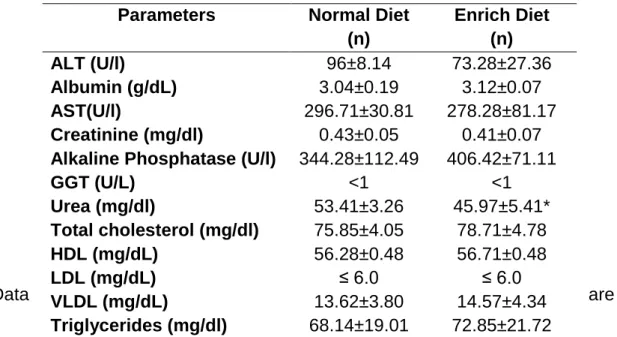
Colon samples from healthy animals that received for 28 days normal diet or enriched diet with avocado pulp in concentration of 20% did not have significant differences in biochemical analyzes in all evaluated parameters (MPO, TNF-α, IL-1β, GSH and INF-γ ) as demonstrated in Figure 2. The serum sample analyzes of animals that received normal diet or enriched diet 20% showed no significant differences in all biochemical parameters evaluated, except for a decrease in urea levels (Table 3). In analysis of relative organ weight, the animals fed enriched diet with avocado pulp showed significant increase in liver (Table 4).
Discussion
Studies show that the anti-inflammatory action of oleic acid could be related to its ability to inhibit the enzyme Δ5 desaturase, avoiding the reduction of linoleic acid to arachidonic acid (de Silva et al., 2014; . Nieto et al., 1998), with a consequent reduction in leukotriene B (LTB), an important inflammatory mediator. In addition, oleic acid can inhibit LTA (leukotriene A) 4 hydrolase, the enzyme that converts LTA to LTB (Mesa García et al., 2006). In fact, olive oil, composed of nearly 80% oleic acid, exhibits intestinal anti-inflammatory activity characterized by reduced COX-2 and iNOS activities, inhibition of NF-κB and MAPK pathways, and upregulation of PPAR-γ signaling (S. Sánchez -Fidalgo et al., 2013).
Indeed, oleic acid promotes apoptosis and attenuates activation of intestinal and circulatory T cells (Cárdeno et al., 2014). Oleic acid also prevents the formation of IL-8 under oxidative stress conditions and decreases secretion of TNF-α, IL-1β and INF-γ (Cárdeno et al., 2014; Mesa García et al., 2006; Reddy & Naidu, 2016) , similar to results promoted by avocado pulp in our study. Avocado has approximately 13% linoleic acid, which is metabolized to γ-linolenic acid and dihomo-γ-linolenic acid, generating prostaglandins via the cyclooxygenase pathway (Vázquez et al., 2004).
Recent studies show that combination of fatty acids has better therapeutic benefits in colitis compared to the same compounds administered alone (Miles & Calder, 2015; Reddy & Naidu, 2016) and this integrated action of PUFAs and MUFAs on the immune system includes modification of different immune functions (de Pablo et al., 2002). Studies show antioxidant compounds are better absorbed in the presence of fatty acids, especially tocopherols, vitamin A, D and carotenoids (Mesa García et al., 2006). Moreover, administration of fatty acids with antioxidants promotes better improvement in patients with CD (Geerling et al., 2000) and also in DSS model (Camuesco et al., 2006; S. Sánchez-Fidalgo et al., 2012).
These combined compounds are able to restore intestinal architecture, avoid GSH depletion, inhibit MPO activity and reduce TNF-α and IL-1β levels (Camuesco et al., 2006; Geerling et al., 2000; S. Sánchez -Fidalgo et al observed when consuming P. Avocado is also a source of fiber (Dreher & Davenport, 2013; Naveh et al., 2002), which could be fermented by gut bacteria to produce short-chain fatty acids (SCFAs) such as acetate , propionate and butyrate. These acids play a role in maintaining the health of the colon, increasing intestinal barrier function and acting as anti-inflammatory and modulator of the intestinal immune system (Bloemen et al., 2010;.
Conclusion
Estudos mostram que a polpa e o óleo da espécie possuem diferentes concentrações de compostos secundários (Pacheco-Palencia, Talcott et al. 2008), o. E o óleo de açaí foi 3 vezes mais potente na inibição de células de carcinoma de cólon (Pacheco-Palencia, Talcott et al. al. A indução do processo inflamatório foi realizada pelo método descrito por (Morris, Beck et al. 1989), com pequenas modificações.
O Índice de Atividade da Doença (DAI) foi determinado conforme metodologia adaptada de Chen et al. A diminuição do consumo alimentar pode refletir a intensa dor abdominal causada pelo processo inflamatório intestinal (Campos, Waitzberg et al. 2002). A MPO é um importante marcador bioquímico que caracteriza a infiltração de neutrófilos e a intensidade da inflamação tecidual (Kato, Nagao et al. 2003).
Penido, Costa et al. 2005), mostraram que o óleo de andiroba na dose de 400 mg/kg exibiu atividade anti-inflamatória no modelo de edema de pata induzido por oócito-histamina em camundongos. Outros estudos também demonstraram a atividade antioxidante do óleo da espécie Carapa guianensis (Salgado e Santos 2014, Milhomem-Paixão, Fascineli et al. 2016) e sugerem que essa atividade antioxidante se deve à presença de grupos lipídicos no óleo bruto ( Salgado e Santos 2014). Estudos mostram que o consumo de ácido oleico está associado à prevenção da colite ulcerosa (de Silva, Luben et al. 2014).
Assim como o nosso, outro estudo também observou que a dieta enriquecida com azeite de oliva extra virgem, também rico em ácido oleico, melhorou o processo inflamatório intestinal induzido por DSS em camundongos (Sanchez-Fidalgo, Sanchez de Ibarguen et al. 2012). Estudos indicam que a atividade antiinflamatória do ácido oleico está associada à sua capacidade de inibir a enzima Δ 5 dessaturase, que inibe a redução do ácido linoleico a ácido (Nieto, Fernandez et al. 1998, de Silva, Luben et al. De fato , estudos com azeite de oliva, que é composto por 80% de ácido oleico, mostraram que ele possui atividade antiinflamatória intestinal por reduzir COX-2 e iNOS, inibir NF-κB e a via MAPK e promover a regulação do PPAR-γ ( Sanchez-Fidalgo, Cardeno et al. 2013).
É a única semente comercializada internacionalmente, cuja coleta é feita exclusivamente em áreas de mata nativa (CLAY, SAMPAIO et al. 2000). O selênio é considerado um mineral essencial para o corpo humano (Barbeiro 2012), e sua concentração em nozes varia de 8-83 μg Se/g (Gonzaga, Martens et al. 2005). O consumo de nozes também melhorou o perfil lipídico e a função microvascular de adolescentes obesos (Maranhão, Kraemer-Aguiar et al. 2011).
Além disso, a castanha do Brasil representa uma importante fonte de selênio, que é um importante componente da enzima antioxidante glutationa peroxidase (Senthilkumaran, Balamurugan et al. 2012).