The feedback received included requests for a manual to guide trainers in using the GWP IWRM ToolBox to supplement their course materials. He is a Senior Visiting Lecturer in the Department of Civil Engineering at the University of Zimbabwe and coordinates the implementation of the GWP IWRM ToolBox training for WaterNet Master students in the SADC region.
TEACHING IWRM AT UNIVERSITY LEVEL
Sample lectures are provided in detail so that they can be directly applied to any class.
IWRM DISCIPLINES
The natural environment and climate
GWP (2009) Water Management, Water Security and Climate Change Adaptation: Early Impacts and Essential Responses, Background Paper Nr. Barbados: Cooperation and Enforcement - the missing pieces of the puzzle in the management of the Graeme Hall Swamp (#477).
Water law and policy
In terms of water ownership, the state owns all natural resources within its territory; however, its sovereignty is not unlimited. National law provides a framework for the allocation of water use rights, both for consumptive (including permanent removal of water) and non-consumptive (including temporary removal of water from the water system, authority to pollute or right to blocked the water). National law also addresses the provision of water services for domestic and other purposes, such as irrigation.
In terms of water resource management, location can have major implications and lead to potential. Public health laws affect water supply and sanitation, as does land tenure reform. These policies provide a framework for the development and management of water resources and all their competing uses, such as sanitation, irrigation, hydropower development and environmental needs, as well as the essential services that water provides.
Access to water is unequal, and the scarcity of water compared to other goods raises the question of its value. The recognition of water as a social good was translated into a UN resolution as one of the fundamental human rights. Water institutions can be considered one of the most important components of water governance because they determine the policies and management of IWRM.
Social aspects
Haiti: Impacts of the 2010 Earthquake on Water and Sanitation in Port-au-Prince (No. 469) Romania: Lessons from Water Security Plans for Small Water Supply Systems Developed by Schools (No. 427). Arbitration is a more flexible mechanism that leaves composition discretion to the parties. 7 UN (2012) 'Mavrommatis Palestine Concessions.' Summaries of Judgments, Advisory Opinions and Orders of the Permanent Court of International Law.
The water sector has been a pioneer in understanding that the involvement of both men and women in water management is essential to ensure development opportunities and equitable management. The central role of women in water management has been formally recognized since the International Conference on Water and the Environment in 1992 (Dublin Principle No. 3 on the role of women in water management). In many countries, mainly developing countries, girls and women are the ones responsible for fetching and securing water for domestic and agricultural purposes, yet men occupy a majority, if not all, of the decision-making positions.
Gender mainstreaming is “a strategy by which the concerns and experiences of women and men become an integral dimension of the design, implementation, monitoring and evaluation of policies and programs in all political, economic and social spheres, so that women. Despite a high level of awareness of the importance of gender equality in water management, 22 percent of the 134 countries that participated in a 2012 UN survey on the use of integrated approaches to water resources management felt that gender mainstreaming in water management was not important to them. GWP (2006) Integrating Gender into Integrated Water Resources Management Strategies and Plans: Practical Steps for Practitioners, Technical Brief no.
Planning and decision-making
IWRM DISCIPLINES UNEP/MAP, PAP/RAC, GWP Med and UNESCO-IHP (2015) An Integrative Methodological Framework (IMF) for Coastal, River Basin and Aquifer Management. Cap-Net, UNDP and GWP (2005) IWRM Plans: Training Manual and Operational Guide GWP (2013) The Role of Decision Support Systems and Models in Integrated Watershed Management, Technical Focus Paper No. The first step in facilitating participatory processes is to identify all potential stakeholders in a project or a decision-making process.
A communication tool to avoid disputes over water resources is shared vision planning, which facilitates communication throughout a project or decision-making process. Transboundary: Collection of Land Degradation, Biodiversity Loss and Water Resources Management in the Kagera and Nyando Catchments of the Lake Victoria Basin (#384) Benelux: Farmers' Participation in Water Conservation (#29). For that reason, a good IWRM planning process should include social, environmental, economic and risk assessments.
To do this, the planning process must take into account not only development options within the water sector itself, but also development scenarios and relationships between other sectors that may have an impact on water resources (e.g. water demand or water quality). Similarly, the impact of water management decisions in other economic sectors (e.g. tourism, agriculture, health) should be an integral part of the analyzes made during the planning process. GWP (2013) The role of decision support systems and models in integrated river basin management, Technical Focus Paper no.
Economics
IWRM DISCIPLINES The value of water in alternative uses is important to the rational allocation of water as a scarce resource (using the concept of 'opportunity cost'), whether through regulation or economic means. The full value of water consists of its use value – or economic value – and its intrinsic value. The investment is necessary for the conservation, management and development of the natural resources that underlie water supply (watersheds, river basins, river courses, wetlands, aquifers) and for the creation of hard and soft infrastructure that provides its services to the humanity (pipelines, dams, treatment plants, pumps, distribution systems, hydroelectric power stations).
There are also external costs of water use (e.g. pollution) which can be penalized by taxes and charges according to the polluter pays principle. The financing of the entire water sector should be coherent, but different parts of it probably need different financial solutions. It also leads to allocative efficiency (ie water will be used for activities where it represents high value).
A special form of water pricing is the use of subsidies - financial assistance given by the government to certain groups (poor people, farmers). IWRM DISCIPLINES New categories of financing instruments are payments for ecosystem services (PES) and payments for tradable water-related rights (eg water abstraction rights, water pollution rights or wetland development rights). Transboundary: BEAM – Aral Sea Basin Economic Allocation Model (#432) Chile: System of household water use subsidies (#404).
Technical infrastructure
Water supply and wastewater treatment are fundamental indicators of a society's health and quality of life. Finally, a recycling process and reuse of water should be considered after wastewater treatment of wastewater, as a way to increase the water supply for certain activities. From waste to water: gray water reuse in the Middle East (2006) International Development Research Center (IDRC) at TheWaterChannel.
Technical innovations to ensure increased efficiency in water systems are essential to ensure a sustainable water supply for people around the world. Population growth, changing demographics and climate change effects on hydroclimatic variables are just three examples of ongoing processes that reduce the lifetime of almost any technical solution for water supply/. Rain harvesting technology or rainwater control measures are good instruments to increase water supply.
In this way, technical innovations can reduce the need for new water supply or wastewater treatment facilities. From an IWRM perspective, technical innovations should be accompanied by a change in water culture, making individuals more aware of the need to save water (especially in countries with abundant water resources). Non-Conventional Water Resources Program in the Mediterranean Sea (2016) GWP Med Small Water Retention Measures (2014) GWP CEE.
EXAMPLE LECTURES
GUIDING QUESTIONS
Using the case study "Panama Canal Watershed Management", the author cites "traditional centralized approaches" and "limited public consultation" as examples of political-cultural aspects that have inhibited the implementation of IWRM. Water is stored in the atmosphere, on the surface of the earth and underground. Water stored in the atmosphere can move relatively quickly from one part of the planet to another.
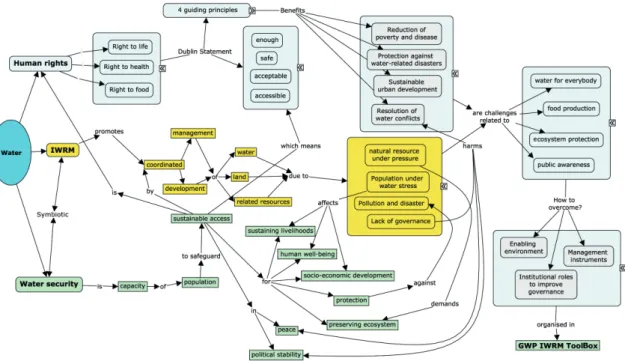
As defined by the United Nations, water security is “the ability of the population to ensure sustained access to adequate quantities of water of acceptable quality to sustain livelihoods, human well-being and socio-economic development, to ensure protection against water-borne pollution and water-related disasters water, and for the preservation of ecosystems in an atmosphere of peace and political stability". 5. Pakistan: A Successful Urban Water Partnership Model in Karachi (No. 440) India: Conservation and Management of Bhoj Wetlands (No. 329). GWP (2009) Managing the Other Side of the Water Cycle: Making Wastewater an Asset, Background Paper No.
This and other educational videos are the result of the 3-year research project, "The Sacred Relationship," by the Native Counseling Services of Alberta, led by a circle of Cree elders and led by a team of Indigenous and Western scholars committed to reconciliation the relationship between Indigenous peoples and the rest of Canada. Ministerial Declaration of the World Water Council (2000) of The Hague on water security in the 21st century. Haiti: The Effects of the 2010 Earthquake on Water and Sanitation in Port-au-Prince (#469) Tools.
In the mid-1800s, people did not have a water supply directly to their homes. A significant number of its population is totally dependent on the water of the Coffee River for domestic use and subsistence farming. However, this requires the consumption of large quantities of water and will mean greater pollution of the Coffee River.
State C is a populous state with a highly developed economy that depends almost exclusively on the water of the Coffee River.