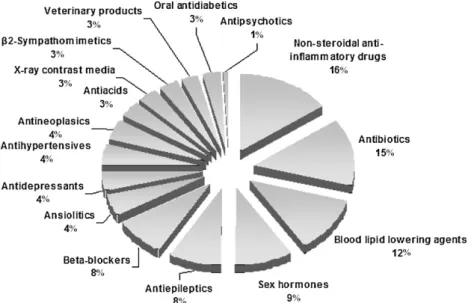
Introduction
Sources of environmental contamination
Countries and regions around the world differ in terms of disease prevalence, waste treatment processes, cultural customs or economic constraints related to the pharmaceutical market[8]. However, it appears that urban regions are the main sources of contamination due to the proximity of hospitals and STP facilities.
Environmental fate
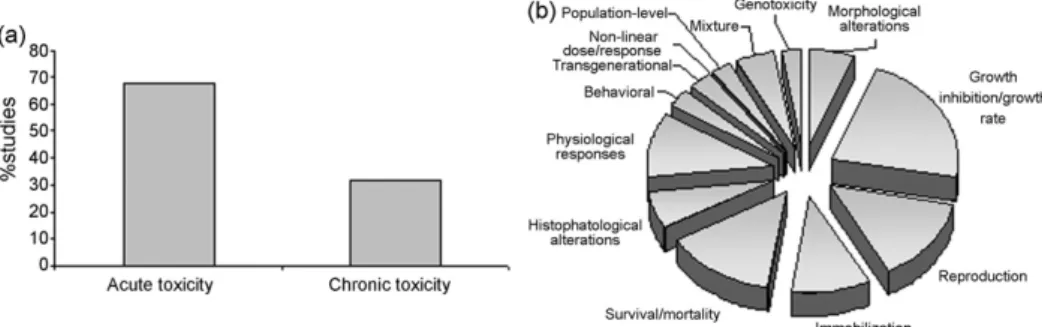
Ecotoxicology
Non-steroidal anti-inflammatory drugs
Non-steroidal anti-inflammatory drugs are weak acids that act by reversible or irreversible inhibition of one or both isoforms of the cyclooxygenase enzymes, COX-1 and COX-2, involved in the synthesis of various prostaglandins from arachidonic acid [62]. Prostaglandins also play an important role in the synthesis of avian eggshells and by inhibiting their synthesis, shell thinning has been observed[64]. Chronic toxicity tests performed on rainbow trout (Oncorhynchus mykiss) demonstrated cytological changes in the liver, kidneys and gills after 28 days of exposure to just 1g L−1 of diclofenac.
For a concentration of 5g, L−1 renal lesions were evident as well as drug bioaccumulation in liver, kidney, gills and muscle[66,67]. Examples of concentrations (ng L−1) of non-steroidal anti-inflammatory drugs measured in different aquatic environments. Metabolite;†—Data not available; ND—Not Detected; SPE—Solid Phase Extraction; GC–MS—Gas chromatography with mass spectrometry detection; GC–MS/MS—Gas chromatography with tandem mass spectrometry detection; GC-NCI-MS—gas chromatography-negative chemical ionization-mass spectrometry; HPLC–MS/MS—High-performance liquid chromatography with tandem mass spectrometry detection; LC-QqLIT-MS—Liquid Chromatography-Quadrupole-Linear Ion Trap-Mass Spectrometry Detection.
Ibuprofen has been detected in STP effluents at concentrations that can reach 28g L−1[14] (Spain) (Table 1). Two metabolites of ibuprofen (carboxyl-ibuprofen and hydroxyl-ibuprofen) were also found in surface water and in a Swedish STP (influent and effluent)[21,72].

Blood lipid lowering agents
With the water flea, Daphnia magna population growth rate was significantly reduced for concentrations ranging from 0 to 80 mg L−1[75]. A decrease in activity of the freshwater amphipod Gammarus pulex was noted when in contact with ibuprofen concentrations of 1 and 10 ng L-1, the latter value corresponding to the LOEC3 obtained for behavioral change [76]. Ibuprofen has also been found in rivers and drinking water[22] which may widen the scope of the problem to public health.
Acute toxicity tests performed on the rotifer Brachionus calyciflorus, the water flea Ceriodaphnia dubia and the fairy shrimp Thamnocephalus platyurus showed that naproxen had LC504 and EC505 values within 1–100 mg L−100 mg L−1 toxic products, which were more fintotoxic. Once again, degradation products were shown to be more toxic with EC50 values of 26 and 62g L−1 for C. Metabolite;†—Data not available; ND—Not Detected; SPE—Solid Phase Extraction; GC–MS—Gas chromatography with mass spectrometry detection; GC–MS/MS—Gas chromatography with tandem mass spectrometry detection; GC-NCI-MS—gas chromatography-negative chemical ionization-mass spectrometry; HPLC–MS/MS—High-performance liquid chromatography with tandem mass spectrometry detection; LC–MS/MS—Liquid chromatography with tandem mass spectrometry detection.
For concentrations ≤1000g L−1, clofibric acid did not significantly affect cell density and growth rate of the first, nor did it affect the survival of the rest. All these drugs were found to be present at concentration levels in the order of ng L−1 or low.
Antibiotics
Isidori et al [113] studied the acute and chronic toxicities caused by bezafibrate, fenofibrate and gemfibrozil and their photoproducts on non-target organisms, finding that they did not significantly affect exposed organisms (LC50 values ranged from 39.69 up to 161.05 mg L −1). When goldfish (Carassius auratus) were exposed to 1.5g L-1 gemfibrozil for 14 days, a more than 50% reduction in plasma testosterone levels was observed [114], demonstrating that this drug may also act as an endocrine disruptor. breaker. As the main active metabolite of several fibrate compounds, clofibric acid is widely used for toxicity evaluation due to its high degree of persistence in the environment.
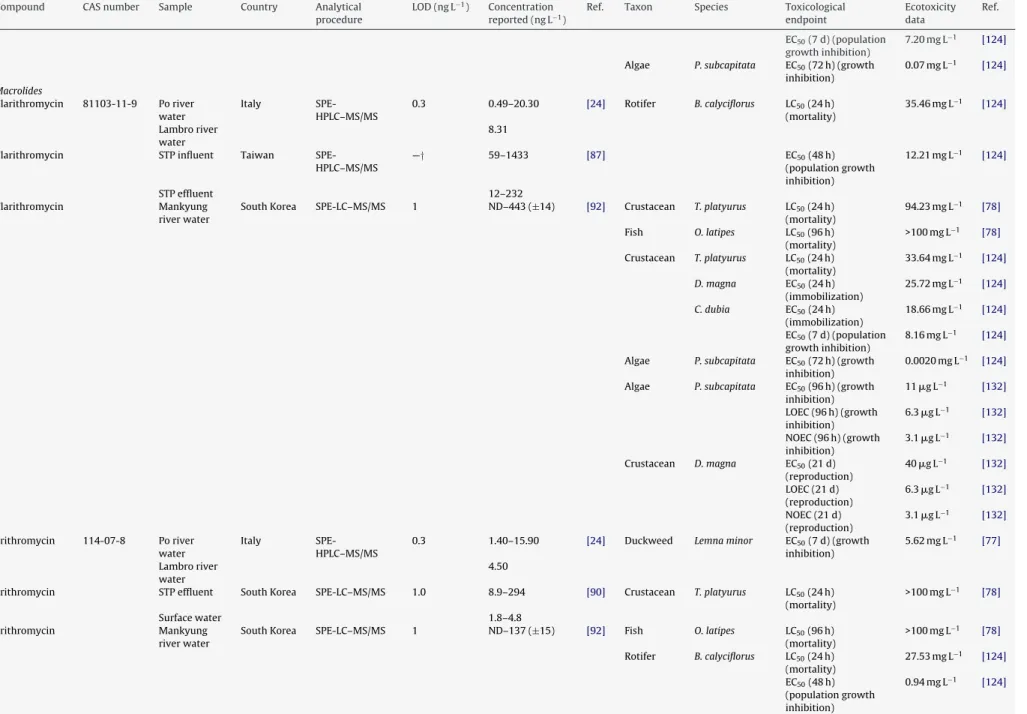
Conversely, exposure to concentrations above 10g L−1 and up to 100g L−1 increased the proportion of male offspring produced by D. ND—Not detected;†—Data not available; SPE – solid phase extraction; GC–MS—gas chromatography with mass spectrometry detection; HPLC–MS/MS—High-performance liquid chromatography with tandem mass spectrometric detection; LC-FD—Liquid Chromatography with Fluorescence Detection; LC–MS—Liquid Chromatography with Mass Spectrometry Detection; LC–MS/MS—Liquid Chromatography with Tandem Mass Spectrometric Detection. Eleven commonly used antibiotics were evaluated in organisms belonging to different trophic levels (V. fischeri, D. magna, Moina macrocopa and O. latipes).
Other drugs such as sulfathiazole, trimethoprim and enrofloxacin also showed similar effects on these two cladocerans in a dose-dependent manner. In addition to aquatic systems, antibiotics belonging to the fluoroquinolone class have also been found in sediments in concentrations that can reach 4.8 mg kg−1[141].
Sex hormones
Surface waterND 17␣-ethinyl estradiolSTPinfluentGermanySPE-LC–MS/MS2.0(LOQSTPinfluent STPeffluent0.4(LOQSTPefluent)1.7(±1.3) Berlin surface water 02efluent.1.1.3) Berlin surface water 02efluent. radiolSTPinfluentItalySPE-LC–MS/MS1.6(STPinfluent) ND[163] STPefluent1.1(STPefluent)ND Tibrer River water0.4(Tibrer River water)ND–1 17␣-EthinylestradiolGroundwaterFranceSPE-LC–MS/MS Mestranol72-33-3SurfacewaterMSALLE-GNNo detected ] 5PE-4-G2 Extraction ;SPME—SolidPhaseMicro-extraction;LLE—Liquid–LiquidExtraction;GC–MS—GaschromatographywithMass Spectrometry Detection;LC–MS/MS—Liquid Chromatography with TandemMassSpectrometry Detection;dph—dayspost-hatch. On the other hand, E shows the effect on E2 and not the effect of E2. production or survival ofC According to many authors, the concentrations of estrogen detected in the environment cannot pose a threat to humans.
Estrogens were found in water samples (Table 4) at low ng L−1 concentrations, but pose a greater risk to non-target organisms than previously demonstrated.
Antiepileptics
Beta-blockers
Data not available; ND: not detected; SPE—Solid Phase Extraction; HPLC–MS/MS – High-performance liquid chromatography with tandem mass spectrometry detection; LC–MS/MS—Liquid chromatography with tandem mass spectrometry detection.

Antidepressants
Antineoplasics
Metabolite; ND—Not Detected;†—Data Not Available; SPE-Solid Phase Extraction; HF-LPME—Hollow Fiber Supported Liquid Phase Microextraction; HPLC–MS—High-performance liquid chromatography with mass spectrometry detection; LC–MS—Liquid chromatography with mass spectrometry detection; LC–MS/MS—Liquid chromatography with coupled mass spectrometry detection. Data not available; SPE-Solid Phase Extraction; GC–MS—Gas Chromatography with Mass Spectrometry Detection; HPLC–MS/MS—High-performance liquid chromatography with coupled mass spectrometry detection;. The acute and chronic toxicity of tamoxifen and its photoproducts was studied by DellaGreca et al.[191], showing that both the active pharmaceutical product and its photoproducts affected rotiferB.
However, since chronic toxicity data are very sparse, further studies are needed to elucidate the potential effect of life cycle exposure to these compounds in aquatic organisms.
X-ray contrast media
Mixture effects
Pharmaceuticals and legislation: what does legislation say?
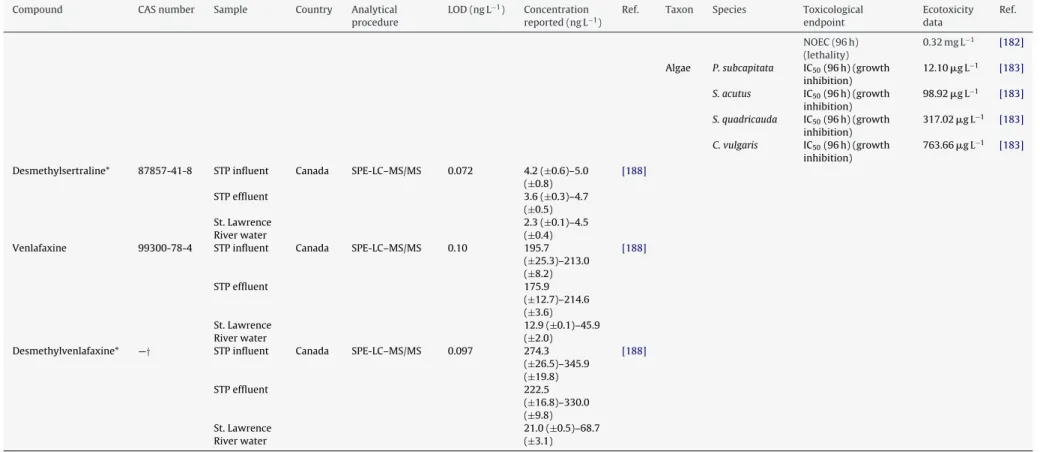
IopromideGroundwaterAustraliaSPE-LC–MS/MS AlgaeS.subspicatusEC50(72h)(growth inhibition)>10.0gL−1[158] IopromideSTPefluent South KoreaSPE-LC–MS/MS CrustaceanD.magnaEC500(24h)−1(24h)(immobilization)>10.0gL−1[158] 1(24h) impact on AustraliaDI -LC–MS/MS STPeffluent<200 IopromideDanube river waterGermanySPE- HPLC–MS/MS IopromideSurface waterGermanySPE-HPLC–MS Drinking water<50 IopromideSTPeffluentGermanySPE-LCQ–MS/MS50(7EC0T2MS/MS50)(00(7) 22d) (reproduction)>1.0 gL −1[158] Rhine river water10(LOQsurface and drinking water)150 Drinking water40 FishD.rerioLC50(96h) (mortality)>10.0gL−1[158] L.idusLC50(48h) (mortality)>10.0gL −1†available ;ND—Notdetected;DI-LC–MS/MS—Direct Injection Liquid Chromatography-TandemMassSpectrometry;SPE—SolidPhaseExtraction;HPLC–MS—HighPerformanceLiquid Chromatography with Mass Spectrometry Detection;HPLC–MS/MSform-Light Detection with Mass/MS Detection—HighPhaseThrom ;LC–MS /MS—Liquid chromatography with tandem mass spectrometry detection. This institution requires environmental assessments to obtain marketing authorizations, which are specified in the "Guidance for Industry-Environmental Assessment of Human Drug and Biologic Applications" [214]. In order to harmonize the guidelines governing these environmental impact assessments, the EU, the US and Japan have produced two guidelines: "Environmental Impact Assessments (EIAs) for Veterinary Medicinal Products (VMPs) - Phase I" [215] and "Environmental Impact Assessment (EIAs) for Veterinary Medicinal Products (VMPs) - Phase I" [215] and "Environmental Impact Assessment (EIAs) for Veterinary Medicinal Products (VMPs) - Phase I" [215] and "Environmental Impact Assessment (EIAs) for Veterinary Medicinal Products (VMPs) - Phase I" [215] Impact assessment for veterinary medicinal products — Phase II guidance" [216] so that environmental fate and toxicity data obtained could be used to obtain marketing authorization in all these regions.
Conclusions
Kümmerer (Red.), Pharmaceuticals in the Environment: Sources, Fate, Effects and Risks, Springer, Berlyn, 2001, pp. Kümmerer (Ed.), Pharmaceuticals in the Environment: Sources, Fate, Effects and Risks, Springer, Berlyn, 2001, pp. Aga (Ed.), Fate of Pharmaceuticals in the Environment and in Water Treatment Systems, CRC Press, Taylor en Francis, 2008, pp.
Hühnerfuss, Drugs and personal care products as ubiquitous pollutants: occurrence and distribution of clofibric acid, caffeine and DEET in the North Sea, Sci. Heberer, Occurrence, fate and disposal of pharmaceutical residues in the aquatic environment: a review of recent research data, Toxicol. Voulvoulis, Household disposal of pharmaceuticals as a route to aquatic contamination in the UK, Environ.
Frimmel, Pharmaceutical residues in the aquatic environment and their significance for drinking water production, in: K. Foran, Changes in reproductive timing following chronic exposure to ibuprofen in Japanese medaka, Oryzias latipes, Aquat. Hutchinson, Acute and chronic effects of ibuprofen in the mollusk Planorbis carinatus (Gastropoda: Planorbidae), Ecotoxicol.
Trudeau, The human lipid regulator, gemfibrozil bioconcentrates and reduces testosterone in the goldfish, Carassius auratus, Aquat. Zuccato, Antibiotics in the environment: occurrence in Italian STPs, fate, and preliminary assessment on algal toxicity of amoxicillin Environ. Yoshimura, Evaluation of antimicrobials for veterinary use in the ecotoxicity test using microalgae, Chemosphere.
Liu, Determination of selected antibiotics in Victoria Harbor and Pearl River, South China using mass spectrometry coupled with high-performance liquid chromatography-electrospray, Environ. Iguchi, Functional links between two estrogen receptors, environmental estrogens and sexual cessation in the cockroach (Rutilus rutilus), Environ. Barceló, Fate and toxicity of emerging pollutants, their metabolites and transformation products in the aquatic environment, Trends Anal.

![Fig. 2. Schematic representation of pharmaceutical biotransformation to increase their polarity (adapted from Reference [35]).](https://thumb-eu.123doks.com/thumbv2/123dok_br/19633593.0/2.892.462.822.430.486/schematic-representation-pharmaceutical-biotransformation-increase-polarity-adapted-reference.webp)
![Fig. 3. Representative sources and fate of pharmaceuticals in the environment (adapted from Reference [6]).](https://thumb-eu.123doks.com/thumbv2/123dok_br/19633593.0/3.892.74.431.81.376/fig-representative-sources-fate-pharmaceuticals-environment-adapted-reference.webp)