Lecture3iDensitymatri
Recommended reading Nielsen chapter Z 9
Feymann chapter
21.10 The Trace
The trace of an operator is defined as the sum of its diagonal entries:
tr(A)=X
i
hi|A|ii. (1.71)
It turns out that the trace is the same no matter which basis you use. You can see that using completeness: for instance, if|aiis some other basis then
X
i
hi|A|ii=X
i
X
a hi|aiha|A|ii=X
i
X
a ha|A|iihi|ai=X
a ha|A|ai. Thus, we conclude that
tr(A)=X
i
hi|A|ii=X
a
ha|A|ai. (1.72)
The trace is a property of the operator, not of the basis you choose. Since it does not matter which basis you use, let us choose the basis| iiwhich diagonalizes the operator A. Thenh i|A| ii= iwill be an eigenvalue ofA. Thus, we also see that
tr(A)=X
i
i=sum of all eigenvalues ofA . (1.73)
Perhaps the most useful property of the trace is that it iscyclic:
tr(AB)=tr(BA). (1.74)
I will leave it for you to demonstrate this. Simply insert a convenient completeness relation in the middle ofAB. Using the cyclic property (1.74) you can also move around an arbitrary number of operators, but only in cyclic permutations. For instance:
tr(ABC)=tr(CAB)=tr(BCA). (1.75)
Note how I am moving them around in a specific order: tr(ABC) , tr(BAC). An example that appears often is a trace of the form tr(UAU†), whereUis unitary operator.
In this case, it follows from the cyclic property that tr(UAU†)=tr(AU†U)=tr(A)
Thus, the trace of an operator is invariant by unitary transformations. This is also in line with the fact that the trace is the sum of the eigenvalues and unitaries preserve eigenvalues.
Finally, let| iand| ibe arbitrary kets and let us compute the trace of the outer product| ih |:
tr(| ih |)=X
i
hi| ih |ii=X
i
h |iihi| i 19
Mathematicians before
westart with the physics
let
usreview the concept of trace of
anoperator
The sum over|iibecomes a 1 due to completeness and we conclude that
tr(| ih |)=h | i. (1.76)
Notice how this follows the same logic as Eq. (1.74), so you can pretend you just used the cyclic property. This formula turns out to be extremely useful, so it is definitely worth remembering.
20
Density Matrices and thermal status
Let
usreview
abit the Gibbs formalisms
wecausielen
asystem described by
aHamiltonian H with eigenstuff
H Em Im Lm
iIf this system
is inequilibrium then the probability to find
it in state In will be given by
In
ePEm
22
Moreover
inequilibrium the expectation value of any observable
A is given by
A Cml Atm In 3
We
may
evenask the following question is there
aquantum
state 143 which would allow
usto write 3
asA
441A 14
Notpossible ca
the answer
in moFor instance
onecould naively try
askate
like in E FI In CST
But then
4gives
XIA 143 E Smt Alm Im
m m
which is not like
3It will
coincidewith
3if A happens to be diagonal
inthe basin Im But only in that
caseThe moral of the story
inthat it
isnot possible to attribute
a
net in so
athermal state The only exception of
course isat
zerotemperature where the system tends to the ground state
In
orderto attribute
aquantum state to the system
wehave to generalize the motion of beets The generalization
iscalled
adensity matrix which
weusually write
asf the density matrix of the thermal state is defined
asf fImlm
othe expectation value of 4A in
3 can thenbe written using
the trace
asaz tr C
which in the
same astr ga
Below
I willtry to better motivate why
anobject such
as6
makes
senseBut before doing
solet
mejust show you something neat the decomposition of H
asin
imakes it convenient to study functions of H For instance
HE f Ent in soul
H3 Em EI in Kmt
and
so onThus if f
seis
somearbitrary function then
f H f f En 1m3cm
8we
just apply f C
tothe eigenvalues and multiply by the projectors
In Kmt
If
we nowlook at
G we seethat
g.szqe E.PT PFmtmkml Z a
This is
avery neat and very powerful way of writhing the thermal state what is nice about it is that it makes
noreference
to any
specific basin it simply writes the state directly
as afunction
of the Hamiltonian
The partition function
can alsobe written in
aneat way
z trCEP Go
because
EPH my
ePH Im
ePEM z
Thus the expectation value 77 may also be written
as
a7 tIf p C
Chapter 2
Density matrix theory
2.1 The density matrix
A ket| i is actually not the most general way of defining a quantum state. To motivate this, consider the state|n+iin Eq. (1.47) and the corresponding expectation values computed in Eq. (1.48). This state is always poitingsomewhere: it points at the directionnof the Bloch sphere. It is impossible, for instance, to find a quantum ket which is isotropic. That is, whereh xi=h yi=h zi=0. That sounds strange. The solution to this conundrum lies in the fact that we need to also introduce someclassical uncertaintyto the problem. Kets are only able to encompass quantum uncertainty.
The most general representation of a quantum system is written in terms of an operator ⇢called thedensity operator, ordensity matrix. It is built in such a way that it naturally encompasses both quantum and classical probabilities. But that is not all. We will also learn next chapter that density matrices are intimately related to entanglement. So even if we havenoclassical uncertainties, we will also eventually find the need for dealing with density matrices. For this reason, the density matrix is the most important concept in quantum theory. I am not exaggerating. You started this chapter as a kid. You will finish it as an adult. :)
To motivate the idea, imagine we have a machine which prepares quantum systems in certain states. For instance, this could be an oven producing spin 1/2 particles, or a quantum optics setup producing photons. But suppose that this apparatus is imperfect, so it does not always produces the same state. That is, suppose that it produces a state
| 1iwith a certian probabilityp1or a state| 2iwith a certain probability p2and so on. Notice how we are introducing here aclassical uncertainty. The| iiare quantum states, but we simplydon’t knowwhich states we will get out of the machine. We can have as manyp’s as we want. All we need to assume is that satisfy the properties expected from a probability:
pi2[0,1], and X
i
pi=1 (2.1)
Now letAbe an observable. If the state is | 1i, then the expectation value ofA will beh 1|A| 1i. But if it is| 2ithen it will beh 2|A| 2i. To compute the actual
21
The results above
arefor thermal skates but the idea of
adensity matrix is absolutely general To motivate the reasoning
behind this I introduce below
aconstruction of the density
matrix which is
meregeneral Hopefully it will clarify the logic
behind these objects
expectation value ofAwe must therefore perform anaverage of quantum averages:
hAi=X
i
pih i|A| ii (2.2)
We simply weight the possible expectation valuesh i|A| iiby the relative probabilities pithat each one occurs.
What is important to realize is that this type of averagecannotbe writen ash |A| i for some ket| i. If we want to attribute a “state” to our system, then we must generalize the idea of ket. To do that, we use Eq. (1.76) to write
h i|A| ii=tr A| iih i|
Then Eq. (2.2) may be written as hAi=X
i
pitr
A| iih i| =tr⇢ AX
i
pi| iih i| This motivates us to define thedensity matrixas
⇢=X
i
pi| iih i| (2.3)
Then we may finally write Eq. (2.2) as
hAi=tr(A⇢) (2.4)
which, by the way, is the same as tr(⇢A) since the trace is cyclic [Eq. (1.74)].
With this idea, we may now recastallof quantum mechanics in terms of density matrices, instead of kets. If it happens that a density matrix can be written as⇢=| ih |, we say we have apure state. And in this case it is not necessary to use⇢at all. One may simply continue to use| i. For instance, Eq. (2.4) reduces to the usual result:
tr(A⇢)=h |A| i. A state which is not pure is usually called amixed state. In this case kets won’t do us no good and wemustuse⇢.
Examples
Let’ s play with some examples. To start, suppose a machine tries to produce qubits in the state|0i. But it is not very good so it only produces|0iwith probabilityp. And, with probability 1 pit produces the state|1i. The density matrix would then be.
⇢=p|0ih0|+(1 p)|1ih1|= p 0
0 1 p
! .
22
Or it could be such that it produces either|0ior|+i=(|0i+|1i)/p 2. Then,
⇢=p|0ih0|+(1 p)|+ih+|=1 2
1+p 1 p
1 p 1 p
! .
Maybe if our device is not completely terrible, it will produce most of the time|0iand every once in a while, a state| i=cos✓2|0i+sin✓2|1i, where✓is some small angle.
The density matrix for this system will then be
⇢=p|0ih0|+(1 p)| ih |= p+(1 p) cos22✓ (1 p) sin✓2cos2✓ (1 p) sin✓2cos✓2 (1 p) sin22✓
!
Of course, the machine can very well produce more than 2 states. But you get the idea.
Next let’s talk about something really cool (and actually quite deep), called the ambiguity of mixtures. The idea is quite simple: if you mix stu↵, you generally loose information, so you don’t always know where you started at. To see what I mean, consider a state which is a 50-50 mixture of|0iand|1i. The corresponding density matrix will then be
⇢= 1
2|0ih0|+1
2|1ih1|=1 2
1 0 0 1
! .
Alternatively, consider a 50-50 mixture of the states|±iin Eq. (1.11). In this case we get
⇢= 1
2|+ih+|+1
2| ih |=1 2
1 0 0 1
! .
We see that both are identical. Hence, we haveno way to tellif we began with a 50-50 mixture of|0iand|1ior of|+iand| i. By mixing stu↵, we have lost information.
2.2 Properties of the density matrix
The density matrix satisfies a bunch of very special properties. We can figure them out using only the definition (2.3) and recalling thatpi2[0,1] andP
ipi=1 [Eq. (2.1)].
First, the density matrix is a Hermitian operator:
⇢†=⇢. (2.5)
Second,
tr(⇢)=X
i
pitr(| iih i|)=X
i
pih i| ii=X
i
pi=1. (2.6)
This is thenormalizationcondition of the density matrix. Another way to see this is from Eq. (2.4) by choosingA=1. Then, sinceh1i=1 we again get tr(⇢)=1.
We also see from Eq. (2.8) thath |⇢| iis a sum of quantum probabilities|h | ii|2 averaged by classical probabilitiespi. This entails the following interpretation: for an arbitrary state| i,
h |⇢| i=Prob. of finding the system at state| igiven that it’s state is⇢ (2.7)
23
Besides normalization, the other big property of a density matrix is that it ispositive semi-definite, which we write symbolically as⇢ 0. What this means is thatits sandwich in any quantum state is always non-negative. In symbols, if| iis an arbitrary quantum state then
h |⇢| i=X
i
pi|h | ii|2 0. (2.8)
Of course, this makes sense in view of the probabilistic interpretation of Eq. (2.7).
Please note that this doesnot mean that all entries of⇢are non-negative. Some of them may be negative. It does mean, however, that the diagonal entries are always non-negative, no matter which basis you use.
Another equivalent definition of a positive semi-definite operator is one whose eigenvalues are always non-negative. In Eq. (2.3) it already looks as if⇢is in di- agonal form. However, we need to be a bit careful because the| iiare arbitrary states and do not necessarily form a basis (which can be seen explicitly in the examples given above). Thus, in general, the diagonal structure of⇢will be di↵erent. Notwithstanding,
⇢is Hermitian and may therefore be diagonalized by some orthonormal basis| kias
⇢=X
k
k| kih k|, (2.9)
for certain eigenvalues k. Since Eq. (2.8) must be true for any state| iwe may choose, in particular,| i=| ki, which gives
k=h k|⇢|ki 0.
Thus, we see that the statement of positive semi-definiteness is equivalent to saying that the eigenvalues are non-negative. In addition to this, we also have that tr(⇢)=1, which implies thatP
k k =1. Thus we conclude that the eigenvalues of⇢behave like probabilities:
k2[0,1], X
k
k=1. (2.10)
But they are not the same probabilitiespi. They just behave like a set of probabilities, that is all.
For future reference, let me summarize what we learned in a big box: the basic properties of a density matrix are
Defining properties of a density matrix: tr(⇢)=1 and ⇢ 0. (2.11) Any normalized positive semi-definite matrix is a valid candidate for a density matrix.
I emphasize again that the notation⇢ 0 in Eq. (2.11) means the matrix is positive semi-definite, not that the entries are positive. For future reference, let me list here some properties of positive semi-definite matrices:
• h |⇢| i 0 for any state| i;
• The eigenvalues of⇢are always non-negative.
• The diagonal entries are always non-negative.
• The o↵-diagonal entries in any basis satisfy|⇢i j| p⇢ii⇢j j. 24
2.3 Purity
Next let us look at⇢2. The eigenvalues of this matrix are 2kso tr(⇢2)=X
k
2k1 (2.12)
The only case when tr(⇢2)=1 is when⇢is a pure state. In that case it can be written as⇢=| ih |so it will have one eigenvaluep1 =1 and all other eigenvalues equal to zero. Hence, the quantity tr(⇢2) represents thepurityof the quantum state. When it is 1 the state is pure. Otherwise, it will be smaller than 1:
Purity=P:=tr(⇢2)1 (2.13)
As a side note, when the dimension of the Hilbert spacedis finite, it also follows that tr(⇢2) will have a lower bound:
1
d tr(⇢2)1 (2.14)
This lower bound occurs when⇢is themaximally disordered state
⇢=Id
d (2.15)
whereIdis the identity matrix of dimensiond.
2.4 Bloch’s sphere and coherence
The density matrix for a qubit will be 2⇥2 and may therefore be parametrized as
⇢= 0BBBBB
@
p q
q⇤ 1 p 1CCCCC
A, (2.16)
wherep2[0,1] and I used 1 pin the last entry due to the normalization tr(⇢2)=1.
If the state is pure then it can be written as| i=a|0i+b|1i, in which case the density matrix becomes
⇢=| ih |= |a|2 ab⇤ a⇤b |b|2
!
. (2.17)
This is the density matrix of a system which is in asuperpositionof|0iand|1i. Con- versely, we could construct a state which can be in|0ior|1iwith di↵erent probabilities.
According to the very definition of the density matrix in Eq. (2.3), this state would be
⇢=p|0ih0|+(1 p)|1ih1|= p 0
0 1 p
!
. (2.18)
25
This is a classical state, obtained from classical probability theory. The examples in Eqs. (2.17) and (2.18) reflect well the di↵erence between quantum superpositions and classical probability distributions.
Another convenient way to write the state (2.16) is as
⇢= 1
2(1+s· )=1 2 0BBBBB
@
1+sz sx isy
sx+isy 1 sz
1CCCCC
A. (2.19)
wheres=(sx,sy,sz) is a vector. The physical interpretation ofsbecomes evident from the following relation:
si=h ii=tr( i⇢). (2.20)
The relation between these parameters and the parametrization in Eq. (2.16) is h xi=q+q⇤,
h yi=i(q q⇤), h zi=2p 1.
Next we look at the purity of a qubit density matrix. From Eq. (2.19) one readily finds that
tr(⇢2)= 1
2(1+s2). (2.21)
Thus, due to Eq. (2.12), it also follows that
s2=s2x+s2y+s2z1. (2.22) Whens2 = 1 we are in a pure state. In this case the vectorslies on the surface of the Bloch sphere. For mixed statess2 <1 and the vector is inside the Bloch sphere.
Thus, we see that the purity can be directly associated with the radius in the sphere.
This is pretty cool! The smaller the radius, the more mixed is the state. In particular, the maximally disordered state occurs whens=0 and reads
⇢=1 2
1 00 1
!
. (2.23)
In this case the state lies in the center of the sphere. A graphical representation of pure and mixed states in the Bloch sphere is shown in Fig.2.1.
2.5 Schr¨odinger and von Neumann
We will now talk about how states evolve in time. Kets evolve according to Schr¨odinger’s equation. When Schr¨odinger’s equation is written for density matrices, it then goes by the name ofvon Neumann’s equation. However, as we will learn, von Neumann’s equation is not the most general kind of quantum evolution, which is what we will call a Quantum Channel orQuantum Operation. The theory of quantum operations is awesome. Here I just want to give you a quick look at it, but we will get back to this many times again.
26
Pauli matrices on Yj ry f i re IE
The Bloch sphere helps
usunderstand why thermal estates have to be mined stakes Take for instance
h
Iz
OH Koz
z owz
The thermal state in then
s EPH
1EP fpnn
Z
2cosh
13h12and
as we sawin lecture
sTz
S
s
coz tanh PI 03h I
1
If ph
a toothen hot
o Sthin in the north pole of Beech's sphere
But when ph
a 0then coz
sowhich in the equator
Now
comes
the key point if the state was pure then when Liz
o
the spin
would have to be pointing somewhere
onthe Ny plane A pure
state of
agerbil
isalways painting
samewhere this is something
that would be easily detectable experimentally Bet it's not what
we
find On
thecontrary what
wefind
in that when ph
00the spin doesn't paint anywhere which is only possible if the spin
isin the center of Bloch's sphere this neatly shows I
think why thermal estates
arenaturally mixed
Thet ooolimity
Remember
ourprevious discussions about infinite temperatures If the system has dimension d when
T oooall storks became
equally einely with
In d
1 izThis
manbecomes much
moreobvious in terms of density
matrices pH
f
e i31
r eBH
If
T ooop
o 0and thus
e
PH
Iidentity matrix Cia
Moreover for
asystem with dimension d
I d
15
Thes ein f I
76T ooo de
which in the unanimally ruined state
The prob of finding the system in
anarbitrary state
to Eq
2 8above
wowbecomes
0
1814 de I 441
0de I 771
At
T ooothe system is equally likely to be found in every state
of the Hiebert space
Enample qubits
usfutrits
The density matrices for
a Z level and 3 levelsystem arreuning
they
arediagonal would have the form
Po
a I a f Pr
If
wethink about it
adiagonal state of
a Zlevel system is always thermal
ithat
ingiven Po
andP
lPo
we canalways
find
avalue of P such that
pEo PE
e
Po
eP
lPo
e
PEO
ePEI
ePEE EPI
If p Po
wemay need p
coBut still
we canalways
view equbit diagonal state
asthermal For qutrits however this is not
in general the
case we nowhave
2independent probabilities early
2because Pz
lPo P and in general
we
cannot find
asingle number p which fits both
I'm just saying all this to call attention to the special
structure of thermal estates thermal estates
arespecial because the populations appear
in avery specific proportion related to the
value of p
F narnple.ro
The Q H 0 in characterized by creation and annihilation
operators at and
aThey
aresuch that
ftammmm 3 CI
8and at
pmfmI Int
19
a
In FT lm
sthe Hamiltonian then reads H tw ata Yz
2eThe partition function
wascomputed in lectures and reeds
2
a epts wk
2l e
Btw
thus the thermal density matrix becomes
geq
eB
bwje pt.hu Zz
of 6 Pauli states,Ek= p1
6| kih k|, with
| 1i=|z+i= 1 0
!
, | 2i=|z i= 0
1
! ,
| 3i=|x+i= 1 p2
11
!
, | 4i=|x i= 1
p2 11
!
, (2.52)
| 5i=|y+i= 1 p2
1 i
!
, | 6i=|y i= 1
p2 1
i
! .
This POVM is not minimal: we have more elements than we need in principle. But from an experimental point of view that is actually a good thing, as it means more data is available.
2.8 The von Neumann Entropy
The concept of entropy plays a central role in classical and quantum information theory. In its simplest interpretation, entropy is a measure of the disorder (or mixed- ness) of a density matrix, quite like the purity tr(⇢2). But with entropy this disorder acquires a more informational sense. We will therefore start to associate entropy with questions like “how much information is stored in my system”. We will also introduce another extremely important concept, calledrelative entropywhich plays the role of a “distance” between two density matrices.
Given a density matrix⇢, the von Neumann entropy is defined as
S(⇢)= tr(⇢log⇢)= X
k
klog k, (2.53)
where kare the eigenvalues of⇢. Working with the logarithm of an operator can be awkward. That is why in the last equality I expressedS(⇢) in terms of them. The logarithm in Eq. (2.53) can be either base 2 or basee. It depends if the application is more oriented towards information theory or physics (respectively). The last expression in (2.53), in terms of a sum of probabilities, is also called theShannon entropy.
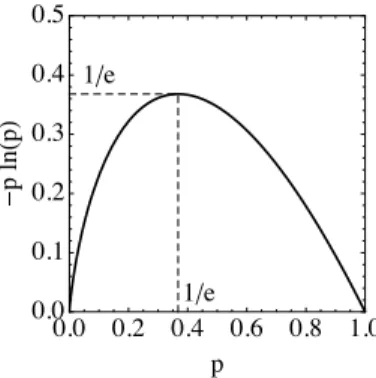
The entropy is seen to be a sum of functions of the form plog(p), wherep2[0,1].
The behavior of this function is shown in Fig.2.3. It tends to zero both whenp!0 and p! 1, and has a maximum at p =1/e. Hence, any state which has pk =0or pk=1 will not contribute to the entropy (even though log(0) alone diverges, 0 log(0) is well behaved). States that are too deterministic therefore contribute little to the entropy.
Entropy likes randomness.
Since each plog(p) is always non-negative, the same must be true forS(⇢):
S(⇢) 0. (2.54)
35
The generalization of the Shannan entropy to density matrices
is called the
vonNeumann entropy
In terms of Xu
wesimply get the
Shannon entropy
Moreover, if the system is in a pure state,⇢=| ih |, then it will have one eigenvalue p1=1 and all others zero. Consequently, in a pure state the entropy will be zero:
The entropy of a pure state is zero. (2.55)
In information theory the quantity log(pk) is sometimes called thesurprise. When an
“event” is rare (pk ⇠0) this quantity is big (“surprise!”) and when an event is common (pk⇠1) this quantity is small (“meh”). The entropy is then interpreted as theaverage surpriseof the system, which I think is a little bit funny.
��� ��� ��� ��� ��� ���
���
���
���
���
���
���
�
-���(�)
�/�
�/�
Figure 2.3: The function plog(p), corresponding to each term in the von Neumann en- tropy (2.53).
As we have just seen, the entropy is bounded from below by 0. But if the Hilbert space dimensiondis finite, then the entropy will also be bounded from above. I will leave this proof for you as an exercise. What you need to do is maximize Eq. (2.53) with respect to thepk, but using Lagrange multipliers to impose the constraintP
kpk =1.
Or, if you are not in the mood for Lagrange multipliers, wait until Eq. (??) where I will introduce a much easier method to demonstrate the same thing. In any case, the result is
max(S)=log(d). Occurs when ⇢= I
d. (2.56)
The entropy therefore varies between 0 for pure states and log(d) for maximally disor- dered states. Hence, it clearly serves as a measure of how mixed a state is.
Another very important property of the entropy (2.53) is that it is invariant under unitary transformations:
S(U⇢U†)=S(⇢). (2.57)
This is a consequence of the infiltration property of the unitariesU f(A)U†= f(UAU†) [Eq. (1.58)], together with the cyclic property of the trace. Since the time evolution of closed systems are implemented by unitary transformations, this means that the entropy is a constant of motion. We have seen that the same is true for the purity:
unitary evolutions do not change the mixedness of a state. Or, in the Bloch sphere
36
picture, unitary evolutions keep the state on the same spherical shell. For open quantum systems this will no longer be the case.
As a quick example, let us write down the formula for the entropy of a qubit. Recall the discussion in Sec.2.4: the density matrix of a qubit may always be written as in Eq. (2.19). The eigenvalues of ⇢are therefore (1±s)/2 where s = q
s2x+s2y+s2z represents the radius of the state in Bloch’s sphere. Hence, applying Eq. (2.53) we get
S =
✓1+s 2
◆log✓1+s 2
◆ ✓1 s 2
◆log✓1 s 2
◆
. (2.58)
For a pure state we haves = 1 which then givesS = 0. On the other hand, for a maximally disordered state we haves=0 which gives the maximum valueS =log 2, the log of the dimension of the Hilbert space. The shape ofSis shown in Fig.2.4.
��� ��� ��� ��� ��� ���
���
���
���
���
���
���
���
���
�
�(ρ)
��(�)
Figure 2.4: The von Neumann entropy for a qubit, Eq. (2.58), as a function of the Bloch-sphere radiuss.
The quantum relative entropy
Another very important quantity in quantum information theory is thequantum relative entropyorKullback-Leibler divergence. Given two density matrices⇢and , it is defined as
S(⇢|| )=tr(⇢log⇢ ⇢log ). (2.59) This quantity is important for a series of reasons. But one in particular is that it satisfies theKlein inequality:
S(⇢|| ) 0, S(⇢|| )=0 i↵⇢= . (2.60)
The proof of this inequality is really boring and I’m not gonna do it here. You can find it in Nielsen and Chuang or even in Wikipedia.
37
Eq. (2.60) gives us the idea that we could use the relative entropy as a measure of thedistancebetween two density matrices. But that is not entirely precise since the relative entropy does not satisfy the triangle inequality
d(x,z)d(x,y)+ +d(y,z). (2.61) This is something a true measure of distance must always satisfy. If you are wondering what quantities are actual distances, thetrace distanceis one of them2
T(⇢, )=||⇢ ||1:=tr q
(⇢ )†(⇢ ). (2.62)
But there are others as well.
Entropy and information
Define the maximally mixed state⇡ =Id/d. This is the state we know absolutely nothing about. We have zero information about it. Motivated by this, we can define the amount of information in a state⇢as the “distance” between⇢and⇡; viz,
I(⇢)=S(⇢||⇡).
But we can also open this up as
S(⇢||1/d)=tr(⇢log⇢) tr(⇢log(Id/d))= S(⇢)+log(d).
I know it is a bit weird to manipulateId/dhere. But remember that the identity matrix satisfiesexactlythe same properties as the number one, so we can just use the usual algebra of logarithms in this case.
We see from this result that the information contained in a state is nothing but
I(⇢)=S(⇢||⇡)=log(d) S(⇢). (2.63)
This shows how information is connected with entropy. The larger the entropy, the less information we have about the system. For the maximally mixed stateS(⇢)=log(d) and we get zero information. For a pure stateS(⇢) = 0 and we have the maximal information log(d).
As I mentioned above, the relative entropy is very useful in proving some mathe- matical relations. For instance consider the result in Eq. (2.56). If we look at Eq. (2.63) and remember thatS(⇢|| ) 0, this result becomes kind of obvious:S(⇢)log(d) and S(⇢)=log(d) i↵⇢=1/d, which is precisely Eq. (2.56).
2The fact that⇢ is Hermitian can be used to simplify this a bit. I just wanted to write it in a more general way, which also holds for non-Hermitian operators.
38
Respansefenctions
A very
commonproblem in statistical mechanics
isthat of measuring the response of
asystem to
acertain external
stimulus This is usually formulated
asfollows
Wehave
asystem
with Hamiltonian Ho
wethen apply
astimulus
xwhich couples
to some operator A such that the Hamiltonian changes to
H
t231
of
coursethe coupling doesn't have to be like this But this kind
of coupling terms out
tobe quite common the most important
example is that of
aspin system ecerpled to
amagnetic field
sothat H Ho h Sz
GI
will work with 237 for
nowthough because
Iwant to emphasize that the results
arealso
validbeyond spin systems
the quantity
we nawwant to evaluate
inthe response of the system to the stimulus
xay
etr
A eP't
25tr
ePH
what
Iwant to show in that this
canbe written
assA
26where F
T enZ
You already showed
26in the problem set for the
easeof spin
But here
Iwould like to go through
a merecareful proof because
there is actually
asubtlety involved related to whether
ornot A
and Ho commute
The
reasonis that in order to write something like
26 weneed to
earnpete pH
2
e2h
If Ho A
0then
we canwrite
e
pH
ePHO epXA
In thin
easee
P't
eP'to epia
and 2 ERA p A EP A EP PA
22
since A commutes with itself Then
p A
ePH when Ho A
ozz
2,2
eBH
so
that going from 251 to
26 ineasy
a
f Z Fent If
But if H
Ato competing 2
ePHI 2x
innot trivial Quite
surprisingly
though Eq 267 continues to hold Let's
seewhy
It
isuseful
tohave the following BCH expansion
inmind
let Kcx denote
ourarbitrary operator then
eN dd f
Kdd tz 4
Kd 3
e usyou
canverify this formula by series expanding the exponentials in
both sides in
aTaylor series
287
shows
inthat
tocompete de it matters whether
what DX
or
not dI commutes with
KIf they
dothen it's easy If they
DX
don't then
weset
atin principle infinite series
For
ourproblem KC
xp Ho
tp XA
so21 pa
we
then get
2x
a
eP't PA I
kPA CK CK PA
1 ePH Ca
But
nowcomes the fun part let's earmpute
tr If
eP't tr pa
ePH Iz
tr Ex pa
eB't
30
what want
wetr Ex pa
eP J
t
Using the cyclic property of the trace
we canwrite the End
team
astr Capa
etr f
kp A
etr PA
ketr pa
e ktr panek
0
since
kand
eearmmute the
same isalso true for all other
serums in 128 Thus
wereach the quite nice conclusion that
tr eBH ptr AEBH csi
the derivation of 126 therefore renren.ms unaltered
evenif
A
and
Ho
donot commute
Susceptibility
the susceptibility is defined
asthe sensitivity of
ato
changes in
X 2C
A 22 2132
Ilugging in the definition of
CAtogether with
X I trfA P
2X fr
epH
22
ad tr ca
eBH trae
z
22X
Iz tr CA
ePH p CA
2
The first term
in abit tricky If Ho
A 0 we can use277 to get
X f tr AZ
ePH p a
2
Z
pfcA7 133
thin result is quite nice It shows that the susceptibility the sensitivity of CA to changes in X is actually related to the
variance of a ie to the fluctuations of A ins equilibrium
when Ho A to Eq 33
nolonger holds In this
easeit
in useful to
usethe following Feymmann integral tricky
a e
B pojds
ePHS Aep Hs
ePH gu
Thin identity is actually
aconsequence of 1287 It is
demonstrated
in the appendix below
wethen get
X Tf as tr A
ePASA EPH
ePH p ca
2or
x.io
EPAeP A 1352
If Ho
A a othin clearly reduces to 133 But written like this
it
clearly shows how He A f
oaffects X
The susceptibility
indefined for any X However suite often
one isinterested in the value of
Xgov X
rothis
is
linear response theory
we
apply
aninfinitesimal perturbation and analyze how the
system responds to it To leading
order
wemay in thin
easecompete
X from the unperturbed state Ho
iX
ep f jds A
ePHOSA EPH's AI go
where So tr C EP Izo
in athermal average
overthe
unperturbed
Hamiltonian Ho
App fymmmti
gwihded.tw
e
discussed in Eq 267 the following BCH expansion
dote dd ECK IF j.cn a If 33
i i eca
we can
rewrite this in terms of
anintegral identity
dueto
Feynman which
canbe quite useful To
dothat recall the
traditional
BC it expansions
e
y
eYt x y X Ex Y CA
2comparing with CA
1 we seethat the coefficients
are abit off
For instance
inCA 7 the factor of Yz multiplies K
Kwhereas
in ca
2it multiplies
xEX YJ
We can
fix this by introducing
somearmillary integrals
first
sf
K KJds
0 s K Ksince
ds
s42 Continuing in the
sameway
K
Ek
KJds
KCri
kI'm not doing anything with the operators just playing with
the coefficients
Eg CA I may then be rewritten
asu
daff ds K SEK
k i
k En
Ke
and if
we wereearmpane thin with CA 27
we see
that the
integrand is precisely in the usual BCH forum
d Jds
e sde di
e Kse k
changing
ss
s we earnalternatively write this
asK
KS KS
dd
efois
eDI di
e0
Thus to summarize
ddzek