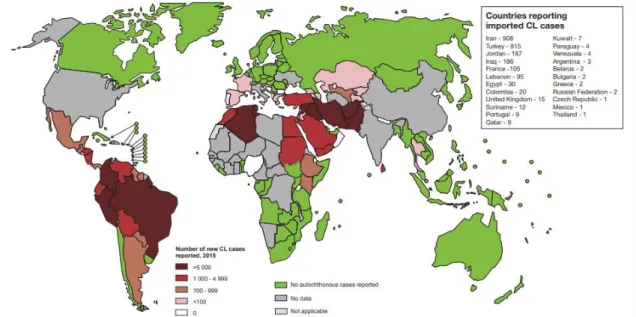
For example, in recent decades, the number of cases of leishmaniasis among international travelers (tourists and businessmen) has increased. The increase in the number of leishmaniasis cases observed during the last 25 years worldwide is due to several factors (STEVERDING, 2017).
LITERATURE REVISION
- THEORETICAL REFLECTIONS ON HEALTH GEOGRAPHY
- LEISHMANIASIS AS A FOCUS OF HEALTH GEOGRAPHY
- THE GEO-HISTORICAL CONTEXT OF LEISHMANIASIS
- LEISHMANIASIS - A BRIEF REVIEW OF THE DISEASE, TREATMENT AND DIAGNOSIS
However, the organization of the population in the cities is a facilitator for the development of certain diseases (PERHOUSKEI; BENADUCE, 2007). Often the patient has to interrupt the treatment to take care of the side effects caused (TIUMAN et al., 2011).

FINAL CONSIDERATIONS
For parasitological analysis, visualization of the parasite is essential for the certainty of the diagnosis, carried out by examination of the amastigote forms (intracellular forms of Leishmania) by biopsy of the lesion for anatomopathological examination, culture in artificial media and inoculation in a hamster. Creating a network information system with other countries in South America, to maintain a dialogue on the control of the disease.
Identification of Leishmania chagasi isolated from symptomatic and asymptomatic dogs with healthy skin seropositive for leishmaniasis in the municipality of Rio de Janeiro, Brazil. Resistance of Leishmania (Viannia) braziliensis to nitric oxide: correlation with antimony therapy and TNF-a production.
CUTANEOUS LEISHMANIASIS IN LATIN AMERICA - INCLUDING REGIONS BORDERING BRAZIL - A BRIEF REVIEW
- INTRODUCTION
- METHODS
- RESULTS AND DISCUSSION
- ETIOLOGICAL AGENTS OF LEISHMANIASIS
- LEISHMANIASIS RESERVOIRS
- TRANSMISSION AND BIOLOGICAL CYCLE OF LEISHMANIASIS
- PATHOGENESIS OF CUTANEOUS LEISHMANIASIS
- DIAGNOSIS AND TREATMENT OF CUTANEOUS FORMS OF LEISHMANIASIS
- CUTANEOUS LEISHMANIASIS: EPIDEMIOLOGICAL ANALYSIS IN LATIN AMERICA INCLUDING BORDER REGIONS
- FINAL CONSIDERATIONS
- REFERENCES
The history of the disease mentions pre-Columbian ceramics dating from 400 to 900 years old that were found in the Americas, produced by Peruvian Indians. Therefore, it is necessary to maintain the balance of ecosystem interactions (Figure 1), due to the link between the environment, animal health and human health. The main reservoirs of Leishmania are wild mammals, which participate in the primary transmission cycle and serve as the source of the disease (LYRIO et al., 2017).
The transmission of the disease takes place through hematophagous insects called phlebotomines (sand flies), through the bite of infected females that have previously fed on the blood of an infected mammal (MAROLI et al., 2013). The development of the infection will depend on the immunogenic profile of the vertebrate host, which is strongly related to the cellular immune response, and the virulence of the infected Leishmania species, resulting in different clinical forms of CL (MOSSER; EDELSON, 1984; SILVEIRA et al. ., 2008). The literature reports the occurrence of lymphadenopathy consisting of enlarged lymph nodes near the site of parasite inoculation.
Endemic countries in Latin America, which presented the highest number of registered cases in the period according to statistical data from the regional.

TREATMENT FOR LEISHMANIASIS – A CURRENT PERSPECTIVE FOR AN OLD CHALLENGE
LITERATURE REVIEW
- THE DIVERSITY OF SPECIES OF LEISHMANIA AND VECTORS
- LEISHMANIASIS: A BRIEF REVIEW OF THE EPIDEMIOLOGICAL SITUATION
- LEISHMANIASIS: A CORRECT DIAGNOSIS IS ESSENTIAL FOR THE ASSERTIVENESS IN THE THERAPEUTIC APPROACH
- WHAT DOES THE SCIENTIFIC LITERATURE REPORT ABOUT RESEARCH WITH NEW DRUGS FOR THE TREATMENT OF LEISHMANIASIS?
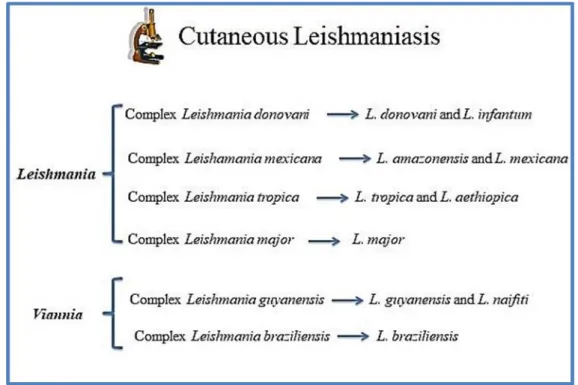
Flow diagram of the Leishmania species complex causing Cutaneous Leishmaniasis and its respective parasites in each group. Flow diagram of the Leishmania species complex causing Visceral Leishmaniasis and its respective parasites in each group. Almost 90% of cases of mucocutaneous leishmaniasis occur in the Plurinational State of Bolivia, Brazil and Peru.
In addition, there is the acute form of VL, characterized by high and persistent fever, hepatosplenomegaly, weight loss, without leukopenia with prolongation of the disease (RATH et al., 2003). In the endemic areas, the diagnosis is made mainly by analyzing the biopsy of the lesion (if any) using microscopy. Thus, it is likely that its excess, due to its intrinsic interaction with mitochondria, may cause alteration in the action potential of the parasite's mitochondria (CROFT et al., 2006).
If given in small doses, it can be very effective against the proteins of microorganisms (VENAZZI et al., 2006).
ANTI-LEISHMANIAL ACTIVITY OF MARINE NATURAL PRODUCTS FROM THE GREEN ALGAE PRASIOLA CRISPA
ALGAE
Bryothamnion triquetum were collected by scuba diving in the Atol das Rocas Biological Reserve in the state of Rio Grande do Norte. Gracilaria caudata were collected from a marine culture in the coastal area of Icapuí, Ceará state. Osmundaria obtusiloba were collected from Rasa beach in Armação de Búzios, north of the state of Rio de Janeiro.
Kappaphycus alvarezii (a cultivated seaweed) was collected in Paraty, in the southern part of the state of Rio de Janeiro. The protozoa in the infective form (promastigote) was provided by the Laboratory of Surveillance for Leishmaniasis at the National Institute of Infectology (INI), FIOCRUZ (Laboratório de Vigilância em Leishmanioses do Instituto Nacional de Infectologia (INI), . FIOCRUZ). When necessary, samples were thawed and cultured in liquid Schneider's medium and kept in the incubator (BOD) at 28°C.
Parasites used to interact with human macrophages were in stationary phase, between days 3 and 5 of culture.
HUMAN MONONUCLEAR CELLS
CHEMICALS
PROCESS FOR OBTAINING EXTRACTS AND FRACTIONS FROM ALGAE
The results of the anti-leishmanial profile of the six crude extracts obtained from five different algal species showed that the green alga, Prasiola crispa, had the highest activity. The fractions used were from the Prasiola crispa extract with the solvent ethyl acetate, which received the respective numbering of F5, F7, F8, F9, F10, F11 and F12. The extracts derived from algal species as previously described were tested for their effect on Leishmania braziliensis promastigote viability.
Parasite viability was checked by Trypan Blue staining by counting the number of parasites in a Neubauer chamber using conventional optical microscopy (Olympus BX41). The analyzed data were calculated in the GraphPad Prisma® program, with the help of which graphs were created to compare the differences in parasite survival/mortality in each of the experimental models with different algal extracts. To investigate the most active potential of the fractions obtained from algae, the determination of the concentration that was able to inhibit 50% of the growth of Leishmania (V.) braziliensis after 24 hours of incubation (EC 50) was calculated.
Parasites were harvested and resuspended in HANK balanced salt solution (HBSS), and parasite numbers were counted in a Neubauer chamber.
ISOLATION OF PERIPHERAL BLOOD MONONUCLEAR CELLS (PBMC) AND PURIFICATION OF MONOCYTES
Then promastigotes (5x10⁶ cells/ml) were incubated with Alamar Blue (10% v/v) for 6 hours at 28°C, according to the protocol described by Raz et al.
CYTOTOXICITY ASSAY
STATISTICAL ANALYSIS
RESULTS
Leishmania braziliensis promastigotes (1x10⁶ cells/ml) were incubated in Schneider's medium at 28°C in the presence or absence of algal-derived fractions for 24 and 48 h. Image (b) shows that DMSO had no effect on the biological activity of the parasite. Observation by phase-contrast optical microscopy showed that rosettes adhered to the culture plate regardless of the culture medium flow (data not shown).
The control situations (L. braziliensis in Schneider's medium and L. braziliensis incubated in the presence of DMSO diluted in Schneider's medium) showed an increased metabolic activity of the parasite (towards 1.5). Promastigotes of Leishmania braziliensis (1x10 cells/ml) were incubated in Schneider's medium for 24 hours at 28°C in the presence or absence of fractions 7, 10, and 11 derived from algae. Control situations (L. braziliensis in Schneider's medium or L. braziliensis incubated in the presence of DMSO diluted in Schneider's medium) showed increased metabolic activity of the parasite.
Graphical display of linear regression for fractions with and without concentration transformation for Log10 according to the coefficient.

DISCUSSION
Since rosettes are a special form of the Leishmania life cycle, they can be considered as a target for new forms of treatment and prevention of leishmaniasis. These authors pointed out the probability of occurrence of genetic recombination in vitro without passage of promastigotes through insect vectors. 2010) were the first to present molecular, physiological, and morphological evidence that rosettes represent a bona fide stage in the Leishmania life cycle, and these authors suggest that NeuPSA-based vaccines or drugs may also be useful in the prevention or treatment of leishmaniasis (IOVANNISCI et al., 2010). Furthermore, sialic acids on the surface of developing Leishmania donovani are implicated in mediating attachment, phagocytosis, and modulation of the innate immune response and signaling pathways to establish successful L.
Interestingly, all the tested fractions tended to increase the metabolic activity of human macrophages, and especially fraction 7 showed an overflow effect of inducing metabolic activity of human macrophages in all the tested concentrations compared to fractions 10 and 11. To evaluate significant differences in quantitative results obtained by optical microscopy, linear regression of the results was calculated. However, the analysis of the concentration capable of inhibiting 50% of L braziliensis viability after 24 hours of treatment (EC50) showed that fractions 10 and 11 (EC50 22 µg/ml and 41 µg/ml respectively) are the best candidates, with better anti-leishmanial profiles against L.
In the case of pathogens such as Leishmania that present many life stages, it is necessary to study all forms of this specific parasite, including rosettes.
ACKNOWLEDGEMENTS
EC50 = 22 µg/ml) with an anti-leishmanial potential superior to that of Glucantime® (EC50. = 89 µg/ml); moreover, it was not cytotoxic to human macrophages.
Natural infection of Lutzomyia ovallesi (Diptera: Psychodidae) with parasites of the Leishmania braziliensis complex in a limited focus of cutaneous leishmaniasis in northern Venezuela. Demographic and spatiotemporal distribution of cutaneous leishmaniasis in the Souf oasis (Southeastern Algeria): 13-year results. Epidemiological profile of oriental plague caused by Leishmania parasites in a new endemic focus of cutaneous leishmaniasis, southern Iran.
A new situation of cutaneous leishmaniasis after the Syrian civil war in the city of Gaziantep in the southeastern region of Turkey. Alamar Blue® test for determination of African trypanosomes (Tb rhodesiense and Tb gambiense) drug susceptibility in vitro. Evaluation of B7-1 (CD80) and B7-2 (CD86) costimulatory molecules and dendritic cells on the immune response in leprosy.
Status of the American tegumentary leishmaniasis in the state of Rio de Janeiro, Brazil, from 2004 to 2013.
EDITOR
Dilvani Oliveira Santos
A brief overview of the scientific literature reporting some promising results obtained with the experimental treatment of leishmaniasis - pages 54 – 56. Final thoughts...a simple contribution to improve in the short term the current panorama of leishmaniasis - pages 21 and 22 .Flowchart of the Leishmania species complex causing Cutaneous Leishmaniasis and its associated parasites in each group – page 48.
Flow chart of the Leishmania species complex causing Visceral Leishmaniasis and its associated parasites in each group – page 48. Presentation of Leishmania species and lutzomia vectors corresponding to the endemic countries of Latin America (from 2015 to 2019) – page 32. List of Latin American countries and numbers of Leishmaniasis cases registered at the border – page 40.
Optical microscopy analysis of the anti-leishmanial potential of crude extracts derived from algae against L.