Nowadays, natural cork stoppers are used for all types of wines, from the centennial to the latest (Jové, Pareras et al. 2021). Colmated cork holders are made from natural cork where the lenses are covered with cork powder and glue (Suffo, Sales et al. 2022). Phenolic compounds are compounds of the secondary metabolism of plants with over 8000 identified compounds (Pérez-Jiménez, Neveu et al. 2010).
These compounds can be extracted from cork with a bottled wine model solution (Pinto, Oliveira et al. 2019). Description of semi-volatile (GC-MS) and volatile (HS-SPME-GC-MS) compounds that can pass from cork with methanol and wine model solution (Pinto, Oliveira et al. 2019). Besides the volatile fraction, polyphenols can be extracted from cork into wine model solutions (Azevedo, Fernandes et al. 2014, Reis, Coelho et al. 2020).

Chapter 1- Characterization of the cork polyphenolic fraction from different regions of the Iberian Peninsula able to migrate to wine
Most importantly, the taste properties of these compounds play a role in the aging of wines (Pocock et al., 1994). 35 can react with wine components such as (+)-catechin, forming a new family of ellagitannin derivative compounds called corklins (Azevedo et al., 2017). The extraction was carried out for 45 days (3 times longer than described in Mislata et al. 2020) to maximize the extraction of compounds (Mislata, Puxeu et al. 2020).
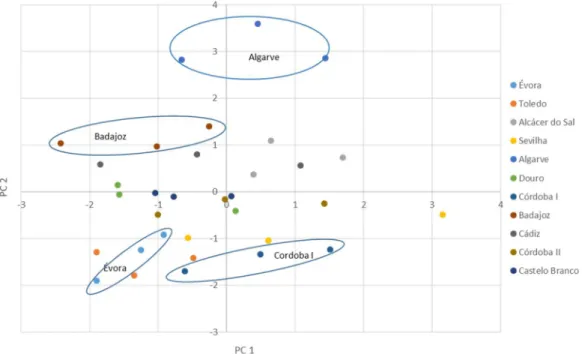
The total content of polyphenols in a filtered solution of wine model solutions that had been in contact with cork for 45 days was determined according to the Folin–Ciocalteu method adapted to the microscale (Arnous, Makris et al. 2001). The FRAP assay developed by Benzie & Strain (Benzie and Strain 1996) was performed as described in (Azevedo, Fernandes et al. 2010). 2020 suggests that the tree's genetic information or its expression plays a much more important role in the chemical composition of cork than the drought that occurs during cork growth (Leite et al., 2020).
This fact comes from the contribution of larger amounts of gallic, sinapic, caffeic acid and vanillin (Figure 2 and Table 2) (Fernandes, Fernandes et al. 2009). These compounds have also been described as some of the compounds that migrate from cork stoppers into model wine solutions (Azevedo et al., 2017). A similar phenolic profile has already been described in the literature after the direct extraction of phenolic compounds from triturated cork (Varea, Garcia-Vallejo, et al., 2001).
Caffeic acid and vanillin, together with vescalagin, are described as reactive with the main wine components giving rise to more complex compounds (corklins and pyranoanthocyanins) (Azevedo et al., 2017) (Table 2). Furthermore, the reduction capacity of the wine model solutions was assessed using the FRAP method.

Optimization of the ultrasound-assisted extraction for the maximized recovery of bioactive phenolic compounds from cork
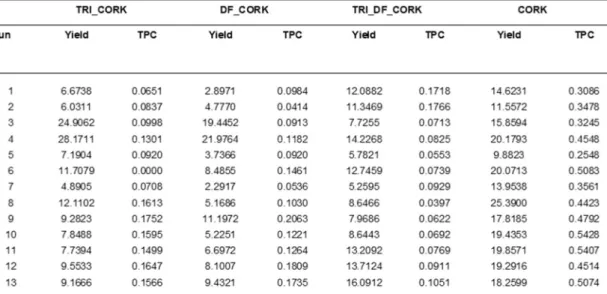
49 food components at lower processing temperatures (Vilkhu, Mawson, Simons, & Bates, 2008), such as phenolic compounds from plants and food by-products (Sun et al., 2022). In this context, proper optimization of ultrasonic extraction conditions such as solvents, temperature, time, particle size and solids-solvent ratio is required for maximum recovery of phenolic compounds from cork by-products (Sridhar, Ponnuchamy, Kumar, Kapoor, Vo, & Prabhakar, 2021) . Before being submitted to the UAE, cork samples were subjected to various pre-treatments such as trituration and degreasing (alone or in combination) to increase the recovery of phenolic compounds.
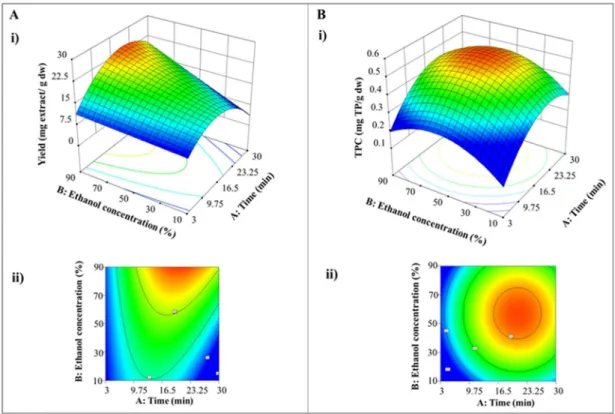
Trituration was the least efficient treatment for the extraction of phenolic compounds from the cork samples, giving lower values compared to the control sample (Table 3). Regarding TPC, the linear and quadratic effects of time and ethanol concentration on the recovery of phenolic compounds from CORK samples were statistically significant (p<0.01) (Figure 2B). One explanation for this behavior was that mixtures containing intermediate ethanol concentrations are more capable of interacting with phenolic compounds from corks of intermediate polarity (Table 3) (Babotă et al., 2022).
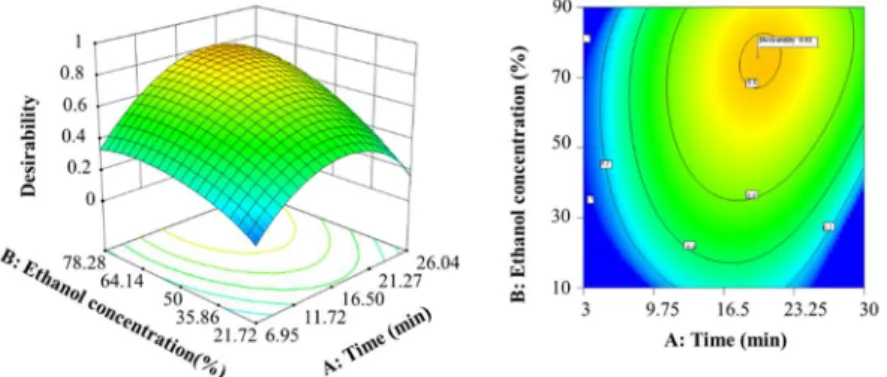
To the best of our knowledge, there is no description in the literature of optimizing the extraction of phenolic compounds from cork with UAE. To the best of our knowledge, there are no works using UAE to extract phenolic compounds from cork samples, so our results cannot be compared with the literature. Extraction conditions must be optimized to ensure successful extraction of phenolic compounds with biological activity.
Migration of phenolic compounds from different corks to wine model solutions: antioxidant and biological relevance. Ultrasound-assisted extraction of bound phenolic compounds from the residue of Apocynum venetum tea and their.

Sustainable valorization of cork waste through an efficient microwave-assisted extraction of phenolic compounds
The main goal of this work was to valorize cork waste through an optimized and sustainable extraction of bioactive phenolic compounds. Identification and Quantification of Total Phenolic Compounds (TPC) by High Performance Liquid Chromatography (HPLC) Coupled to Diode Array Detector (DAD) and Tandem Mass Spectrometry (MS/MS) Analysis. Furthermore, Table 2 shows all the compounds identified and quantified in the 28 runs involved in the central composite design for the microwave-assisted extraction of cork.
Despite the already described phenolic compounds found in cork, the presence of the vescalagin ethanol derivative (m/z - 977) should be noted, which can be explained by the reactivity of vescalagin in cork with the ethanol in the MAE extraction. process (Table 2). TPC: Total phenolic content was calculated as the sum of all phenolic compounds identified and quantified in cork waste extracts by LC-MS/MS. The same happens with the % ethanol in the solvent, causing a concomitant increase in EY, as already reported (Moreira, Barroso et al. 2017).
As already mentioned, temperature was the main factor influencing the extraction of phenolic compounds from cork waste. Previous results observed a similar cellular disruption favoring the extraction of phenolic compounds from UAE and MAE (Huma, Jayasena et al. 2018). Optimization of ultrasound-assisted extraction for maximum recovery of bioactive phenolic compounds from cork industry waste.
Phenolic compounds and fatty acids from acorn (Quercus spp.), the main dietary components of free-range Iberian pigs. Optimization of ultrasound- and microwave-assisted extraction for the determination of phenolic compounds in peach by-products using experimental design and liquid chromatography–tandem mass spectrometry.

Chapter 1- Interaction between salivary proteins and cork phenolic compounds able to migrate to wine model solution
Phenolic compounds are a large family of secondary metabolites produced by plants (Harborne et al., 1993; Randhir et al., 2004). Phenolic compounds from the cork extract were fractionated by low-pressure column chromatography according to the method described by Fernandes (Fernandes et al., 2011). Subsequently, the supernatant was analyzed to quantify the different SP families that remained in solution after the interaction with the phenolic compounds.
Values were normalized to the initial concentration of each phenolic compound to compare phenolic compounds within fractions. Fractions M2 and M3 were those with the highest total concentration of SP-precipitated phenolic compounds ( Figure 3A ). In general, for these fractions, regardless of the initial concentration, the concentration of precipitated phenolic compounds is quite similar.
Surprisingly, for each fraction the profile of the precipitated phenolic compounds is not the same along the studied concentrations. Within the phenolic compounds of fraction M2, the profile of the precipitated compounds is not the same (Figure 3B). All these changes in precipitation ability emphasize the important role that the structure of the phenolic compounds plays on the interaction with SP (Deaville et al., 2007; Soares et al., 2007).
Some of the phenolic compounds studied exist in different fractions, such as gallic acid and castalagin. It has previously been reported that the studied phenolic compounds can migrate from cork stoppers to wine at the studied concentrations (Azevedo et al., 2014).

On the Limits of Anthocyanins Co-Pigmentation Models and Respective Equations
In summary, provided that K'a is calculated from the pH-dependent absorbance of anthocyanins in the absence of auxiliary pigment (standard procedure), Eq. 131 copigmentation constants with flavyl cationic quinoid base and anionic quinoid base (Brouillard et al, 1991). At this pH, the spectral changes reflect the formation of a complex with the flavyl cation.
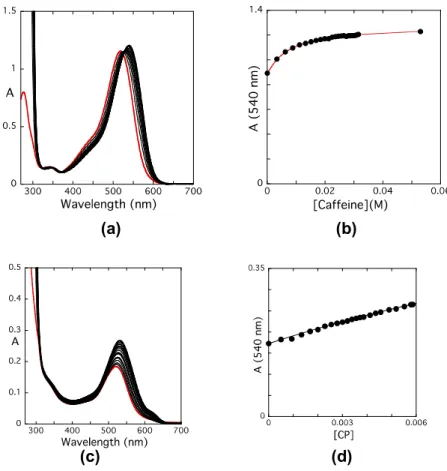
The model was also tested for oenin in the presence of the co-pigment pentagalloyl glucose (PGG) (Scheme 1). Representation of the oenin absorption in water (10% ethanol) at 523 nm as a function of PGG concentration at pH=0 (purple squares) and pH=3.5 (black circles). While KAH+CP is the 1:1 association constant for the co-pigment with flavylium cation, the significance of KCBCP remains to be clarified.
The mole fractions of CB components in the absence of co-pigment are given by equation (2.17). From equation (2.22) the mole fraction of AH+, as well as those of other species, is calculated. Equation (2.32) is the general expression that accounts for the 1:1 co-pigmentation taking into account the possibility of complexation with any multistate species.
Eq.(2.36) is correct if [AH+] and [AH+CP] are the concentrations of the flavylium cation and its complex, which are variables changed by addition of co-pigment. Another incorrect expression (but not the value of the respective constants) was reported by some of the present authors7.
Chapter 3- Copigmentation of Anthocyanins with Copigments Possessing an Acid-Base Equilibrium in Moderately Acidic Solutions
To reduce the intrinsic uncertainty of the fittings, KAH+CP and rAH+CP should be calculated at pH≈1 when the flavylium cation is the only species. A global fit of all these allows for the calculation of the four parameters rAH+CP, KAH+CP, rCP and KCBCP with good accuracy. The normalization of the amplitudes (sum=1) gives directly the mole fractions of flavylium cation, quinoidal base, cis-chalcone and the respective complexes.
The adjustment allows determining the parameters a0, b0 and c0 (a0+b0+c0=1) for the global equilibrium constant K^a(cp). As shown in the Appendix, the same mole fractions can be written in terms of equilibrium and copigmentation constants, Equations 30 to Equations 31. Calculation of equilibrium and copigmentation constants for a copigment with an acidity constant over the working pH range.
In this case, the possibility of a different interaction of the anthocyanin species with the acidic and basic forms of the copigment is considered. Reversed pH jumps controlled by stopped current cannot access the mole fractions of the trans-chalcone. The initial value corresponds to the fraction of the CB2 species and the amplitude of the trace to the amount of Ct at equilibrium.
Then, solutions with different concentrations of sinapinic acid were obtained by adding small volumes of solution B to solution A. In Table 2, the parameters resulting from the global fitting of the data reported in Fig.