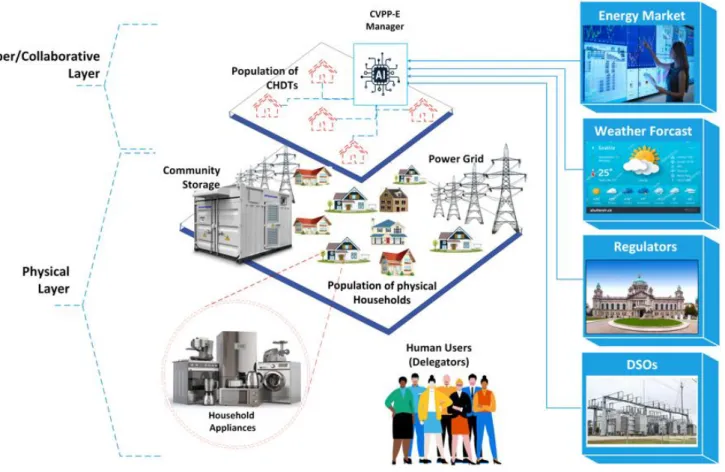
As an additional contribution, the notions of family cognitive digital twins (CHDT) and collaborative virtual power plant ecosystem (CVPP-E) are two complementary concepts that have been suggested to help along the same line [6]. The potential applicability of these concepts has been demonstrated in several previous works using prototype models of CVPP-E and CHDT. This block enables the CHDT to be aware of the following: (1) the community's goal(s); (2) the digital profile, consisting of (a) the value system of the physical twin and (b) the delegated autonomy of the physical twin assigned to the CHDT; and (3) IoT data block, consisting of (a) historical data and (b) current states of embedded devices.
This block enables the CHDT to be aware of the following: (1) the community's goal(s); (2) the digital profile, consisting of (a) the value system of the physical twin and (b) the delegated autonomy of the physical twin assigned to the CHDT; and (3) IoT data block, consisting of (a) historical data and (b) current states of embedded devices. A full explanation of the decision-making procedures used by the decision block is given in [8]. In the context of CVPP-E, the influence block is used to model scenarios that can help to understand how incentives can influence decision making.
The CVPP-E could be a digital twin representing the top tier of the city, which can be called a process twin in terms of digital twin technology [35]. The demonstration covered the different parts of the model and the applied modeling techniques. The Cronbach alpha technique [48] is used to test the internal consistency/reliability of the collected data.
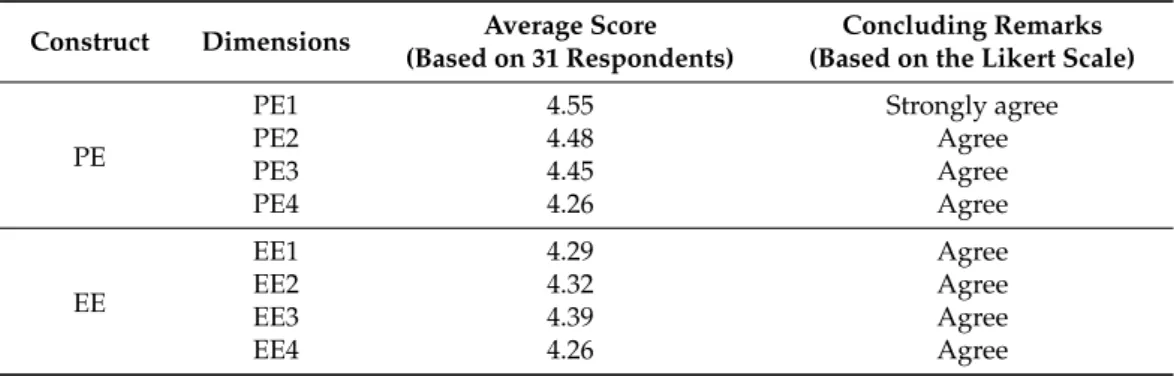
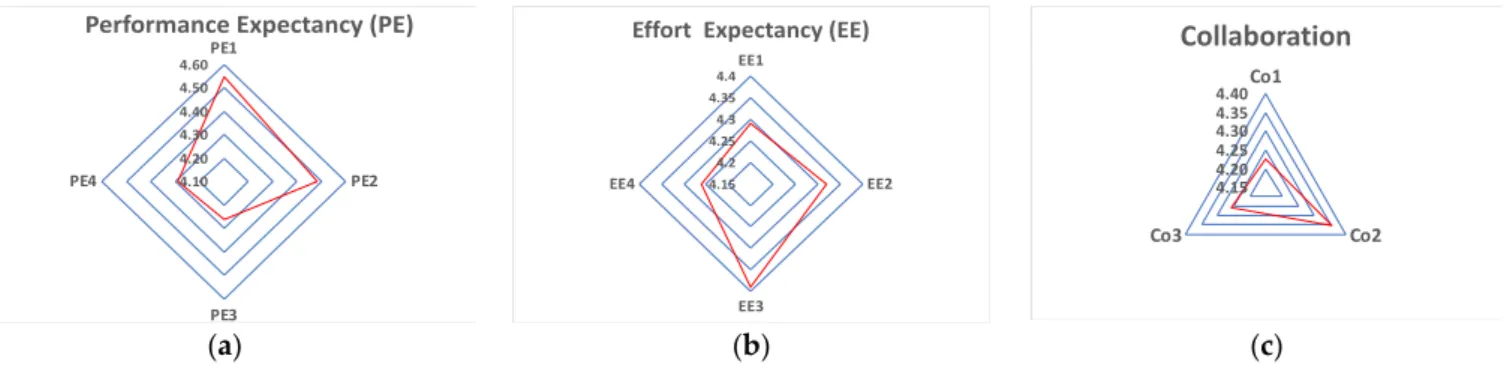
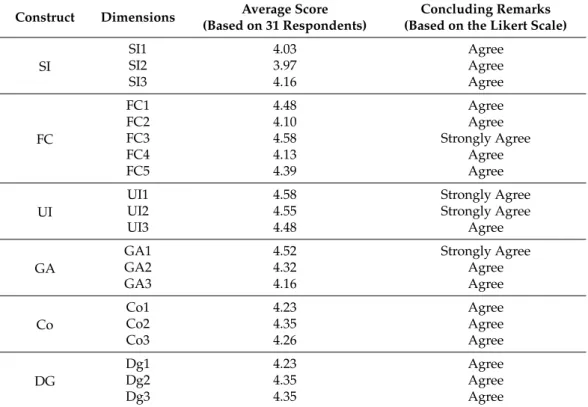
The overall conclusion of the study is that respondents agreed with all eight constructs and 28 dimensions of the CVPP-E/CHDT model.
Simulation Models of the Collaborative Behaviors
This could have helped generate interesting discussions about the collaborative aspects of the model. This could have helped generate interesting discussions about the collaborative aspects of the model. Minimum VO formation threshold (this refers to the minimum number of accepted invitations that makes the formation of a VO a viable venture) = 25% of the population.
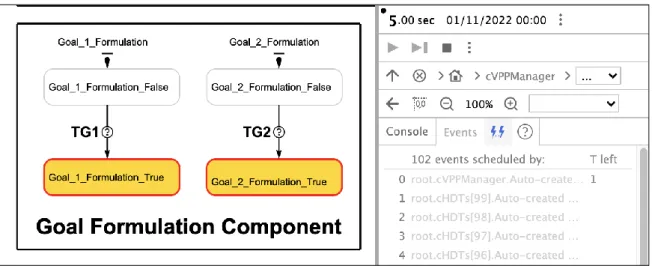
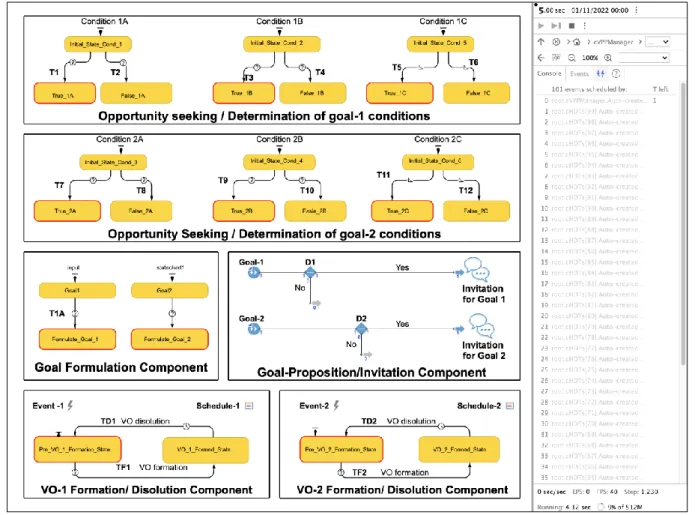
Figure 8 shows a discrete event component of the model that is used to broadcast messages from the manager to all CHDTs. This figure shows two model components that are used to represent a VO for goal 1 and a VO for goal 2. Each model component includes two possible states, that is, (1) the state before the formation of the VO and (2) the state VO formed.
A value system can be in one active state at a time, either the "true" state or the "false" state of the value system. However, if any of the value system's active states are in the "incorrect" state (dormant), that value system can be inferred to be incompatible with the respective community goals. In this delegation part, only one of the two states can be active at a time.
PD1 means that the CHDT has the authority to delegate any of the three devices. In the initialization phase of the model, one of the four PV systems is randomly assigned to a customer. A model of four integrated PV systems with integrated local energy storage system.
The "battery full" state is determined by whether the state of charge (SoC) is greater than or equal to (≥) 90% of the storage capacity. The "battery empty" state is determined by whether the state of charge (SoC) is less than or equal to (≤) 30% of the storage capacity.
Results and Discussion
For example, the total contribution expected from all those who accepted the invitations should match the expected projections of the community manager. The total population of CHDTs considered in the ecosystem for this study was 100 and the VO formation threshold was 25, so 25% of the total population was used. However, when the population of delegated CHDTs is high, the proportion of the population likely to accept the invitation would be high and the chances of VO formation are equally high, as seen in case 3.
The reason for this is that almost half of the population is undelegated from the start. In Table 5, the result of the model showing the percentage of CHDTs that rejected targets 1 and 2 for all three cases is presented. The collaborative effect of the proposed concepts is seen when the CHDTs make collective decisions.
Table 5 shows the outcome of the model, showing the percentage of CHDTs that rejected targets 1 and 2 for all three cases. The collaborative effect of the proposed concepts is seen when the CHDTs make collective decisions. The results, as shown in Figure 22a, suggest that all CHDTs were aware of the schedule, duration, and delegated autonomy.
The consumption observed during the vending widow is the result of the 90% CHDTs who have not joined the VO. In Figure 22c we consider case 3, which resulted in a VO consisting of 90% of the population with full delegated autonomy. The results, as shown in Figure 22a, indicate that all CHDTs were aware of the schedule, duration and delegated autonomy.
In Figure 22c, we consider case 3, which led to a VO consisting of 90% of the population with full delegated autonomy. In Figure 23a,b, we show the modeled impact characteristics that were obtained from two different CHDTs, i.e., CHDT-1 and CHDT-2. Finally, in Figure 24d, CHDT 6 has been positive since the start of the model run.

Sharing (%)
Sharing (%)
Sharing (%)
Conclusions and Future Work
The study has also shown the cooperation possibilities of the main actors in these ecosystems. Such data from CHDTs can be used to assess the impact of the disruptive event and help plan the response. Directive (EU of the European Parliament and of the Council to promote the use of energy from renewable sources.Off.
State of the Energy Union 2021 — Contributing to the European Green Deal and the recovery of the Union;. In Proceedings of the 2022 11th International Conference on Renewable Energy Research and Application (ICRERA), Istanbul, Turkey, September 18–21, 2022; pp. In Proceedings of the 2nd International Conference on Distributed Sensing and Intelligent Systems (ICDSIS 2021), Hefei, China, June 18–20, 2021; p.p.
In Proceedings of the International Conference on Innovative Computing, Intelligent Communication and Smart Electrical Systems (ICSES) 2022, Chennai, India, 24–25 September 2021; p. In Proceedings of the 7th International Conference on Smart and Sustainable Technologies (SpliTech) 2022, Split/Bol, Croatia, 5-8 July 2022; p. In Proceedings of the International Conference on e-Commerce and e-Government (ICECEM) 2021, Dalian, China, 26 September 2021; p.
In Proceedings of the 2021 IEEE Second International Conference on Smart Technologies for Power, Energy and Control (STPEC), Bilaspur, India, 19–22 December 2021; page In Proceedings of the 2021 IEEE 4th International Conference on Industrial Cyber-Physical Systems (ICPS), Victoria, BC, Canada, 10–13 May 2021;. In Proceedings of the 2021 2nd International Conference on Computational Engineering and Intelligent Control (ICCEIC), Chongqing, China, 12–14 November 2021; page
In Proceedings of the 37th Conference on Design of Circuits and Integrated Circuits (DCIS) 2022, Pamplona, Spanje, 16–18 november 2022; pp. In Proceedings of the 2022 Research, Invention and Innovation Congress: Innovative Electricals and Electronics (RI2C), Bangkok, Thailand, 4–5 augustus 2022; pp. In Proceedings of the 22nd International Conference of the System Dynamics Society, Oxford, VK, 25-29 juli 2004;.