In 2009, Mexico saw the start of a new pandemic caused by a new Influenza A virus subtype H1N1, which then spread to most of the world, with the World Health Organization (WHO) increasing the number of confirmed H1N1- set deaths at a minimum of 18,499. people (WHO, 2011), although it is estimated that more than 284,000 people worldwide died from Swine Flu (CDC, 2012). As of 2020, a highly contagious new SARS-Cov virus was responsible for a deadly outbreak that increased the death toll to 251,059 people (CSSE, 2020) in just over 4 months since the day the WHO was first notified was reported of the existence of a pneumonia of unknown etiology in Wuhan, China, on December 31, 2019. In light of the current pandemic situation caused by the novel coronavirus, the world's economy has declined and many countries are faced with with severe economic recession scenarios.
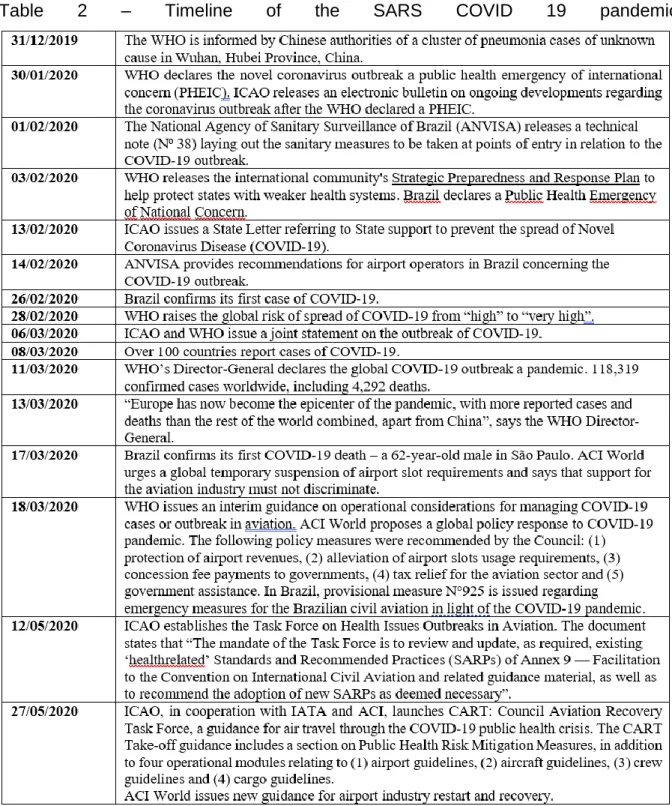
Likewise, this paper aimed to perform a specific analysis of the procedures suggested and/or required by Brazilian regulatory agencies. This study aims to: .. a) provide an overview of the H1N1 and COVID-19 pandemics through a chronological list of the most impactful events in aviation.. b) analyze the guidance provided by regulatory agencies and associations for airports and airlines in the midst of the H1N1 pandemic regarding economic actions and strategies;. In April 2009, a novel influenza A (H1N1) virus of swine origin was identified as the cause of human infection and associated acute respiratory illness in Mexico, which subsequently spread to the United States and most of countries of the world and overseas territories (WHO). , 2010).
Commercial and trade routes were absolutely key for the spread of the bubonic plague through Asia, Europe and the Mediterranean in the XIV Century (COSSAR, 1994; HELMS, 2018). As previously featured in Helms (2018), aviation can be a vector in disease spread, as it speeds up the process of how quickly certain diseases reach different parts of the world.
In fact, the responsibility to coordinate, share knowledge and act against emerging epidemics lies not only with the ICAO and the WHO, but also with all civil aviation authorities, public health authorities and every party involved in the aviation sector, such as airlines and airports. CAPSCA, short for Collaborative Arrangement for the Prevention and Management of public health events in Civil Aviation (ICAO, 2015). First, pandemic flu phases were first classified by the WHO in 1999 to differentiate levels of risk and necessary government responses.
These stages can be briefly defined as follows: stages 1-3 portray a scenario in which there are mainly animal infections, with few human infections; stage 4 is defined by sustained human-to-human transmission; in stage 5, human-to-human spread of the virus is confirmed in at least two countries in a WHO region; Phase 6, the pandemic phase, begins when community-level outbreaks are recognized in at least one other country in another WHO region, in addition to the criteria defined in Phase 5; and unlike past revisions, post-peak and post-pandemic phases were added, which represent the possibility of repeated events and disease activity at seasonal levels, respectively (WHO, 2009). As of 1 August 2010, worldwide more than 214 countries and territories or foreign communities reported laboratory-confirmed cases of pandemic H1N1 influenza 2009, including over 18,449 deaths (WHO, 2011). On 25 April 2009, WHO declared a Public Health Emergency of International Concern, known as PHEIC, due to a new influenza A (H1N1) virus.
They often advise to follow procedures from published regulations, such as the IHR 2005 and other advice on public hygiene, and do not tell in practical terms what national aviation and public health authorities as well as airports and airlines should do. As published on ACI's Airport Preparedness Guidelines for Communicable Disease Outbreaks, the responsibility for managing the risk of communicable diseases at airports rests primarily with the local/regional/national public health authority and the relevant airport operator (ACI, 2020). 03/18/2009 Mexico began picking up cases of what would later be identified as the swine flu.
27/04/2009 WHO Director-General raised the influenza pandemic alert level from stage 3 to stage 4, based on data showing person-to-person spread and the ability of the virus to cause outbreaks at the community level. The second meeting of the IHR Emergency Committee was held to review the data – based on the Committee's advice, the WHO director-general recommended (1) not closing borders, (2) not restricting international travel, (3) people who are ill enough to delay international travel and (4) people who develop symptoms after international travel to seek medical attention. 04/29/2009 The WHO raised the influenza pandemic alert level from stage 4 to stage 5, meaning a pandemic was imminent, and urged all countries to put their preparedness plans into action.
01/11/2009 WHO said that worldwide more than 199 countries and foreign territories/communities have reported laboratory-confirmed cases of pandemic H1N1 influenza 2009, including over 6,000 deaths.
THE COVID-19 PANDEMIC
Until this day, ANVISA had worked on actions to address the pandemic in Brazil, according to its phases, and helped organize the Brazilian Influenza Pandemic Preparedness Plan. 25/01/2010 The protocol for handling pandemic influenza at ports, airports and borders in Brazil was updated. Source: Prepared by the authors based on documents from the World Health Organization (WHO), International Civil Aviation Organization (IATA) data.
METHODOLOGY
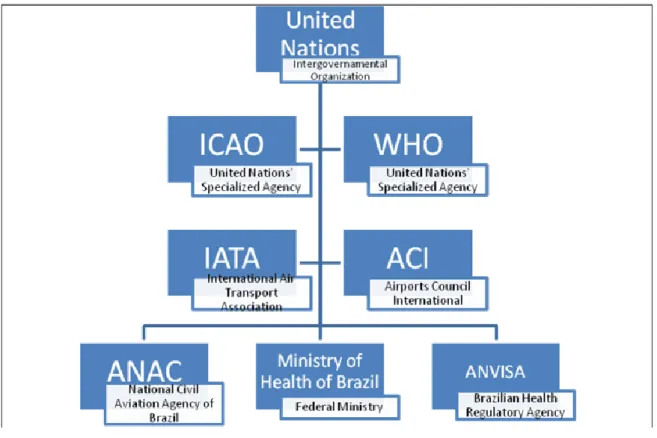
Last but certainly not least, National Agencies are the ultimate form of action when dealing with aviation health measures during a pandemic. As ICAO, IATA and ACI issue guidelines and orientations rather than specific measures to be taken on their own, national agencies are usually in a position to develop plans to deal with the epidemic at the country's ports of entry ; in the case of this study, airports. A qualitative study has been conducted to analyze, understand and evaluate all the guidelines of the above organizations and agencies.
The number of organizations studied was previously determined to limit a line of research and increase the quality of the study. The main means of communication used by international organizations and national agencies are their websites; . therefore, this research is primarily informed by guidelines issued online by these agencies. The timeline for the COVID-19 pandemic related to this study runs from its onset to September 2020.
ANALYSIS AND DISCUSSION
- HOW PREPARED WERE THESE AGENCIES AND ORGANIZATIONS TO FACE A PANDEMIC?
- WHAT WERE THEIR RECOMMENDATIONS?
- HOW DID BRAZILIAN NATIONAL AGENCIES ACT UPON THEM?
- WHAT HAS BEEN DONE AS A PRECAUTIONARY MEASURE AND/OR IMPROVED IN ORDER TO FACE FUTURE PANDEMICS?
Four years before the start of the H1N1 outbreak, the International Health Regulations (IHR 2005) were adopted by the fifty-eighth World Health Assembly and entered into force two years later, in 2007. This document gathers important instructions regarding public health response to the international spread of disease – making it a crucial handbook to guide public health parties in the safest, most appropriate actions during infectious disease outbreaks. An article published by the WHO states that the interventions to mitigate the spread of infectious diseases will have a potentially greater impact if they are implemented as close as possible to the source of the epidemic threat (KHAN et al., 2013).
One thing to think about before jumping to any conclusions when comparing the aviation sector's preparedness for the H1N1 and COVID-19 pandemics is that the world has become much more technological over the past 10 years. The COVID-19 pandemic emerged as a relentless one, spreading from China to other continents very quickly. When dealing with a situation as global as a pandemic, and although 193 countries are ICAO Contracting States (ICAO, 2019), it is inevitable that politics will be part of the picture and thus prevent optimal compliance with action. determined. plans against the international spread of a disease.
In response to the H1N1 pandemic, the World Health Organization issued technical guidelines and recommendations for the aviation sector, many of which were developed in In essence, ICAO reinforced the World Health Organization's recommendation that the recommended travel restrictions are not justified as they would do little to stop the spread of the virus, but would be very disruptive to the global community (ICAO, 2009). In addition, ICAO in this document refers exclusively to the 1944 Convention on Civil Aviation, IHR 2005 and CAPSCA, which should primarily require States Parties to: (1) ensure that air transport services remain uninterrupted; (2) comply with additional guidance issued by ICAO and facilitate the exchange of relevant information between airports and air carriers and public health authorities; (3) follow the IHR 2005 and WHO recommendations and advisories issued in relation to this outbreak and; (4) if those States Parties considering the introduction of health measures in addition to those recommended by the WHO do so in accordance with the IHR 2005 (ICAO, 2009).
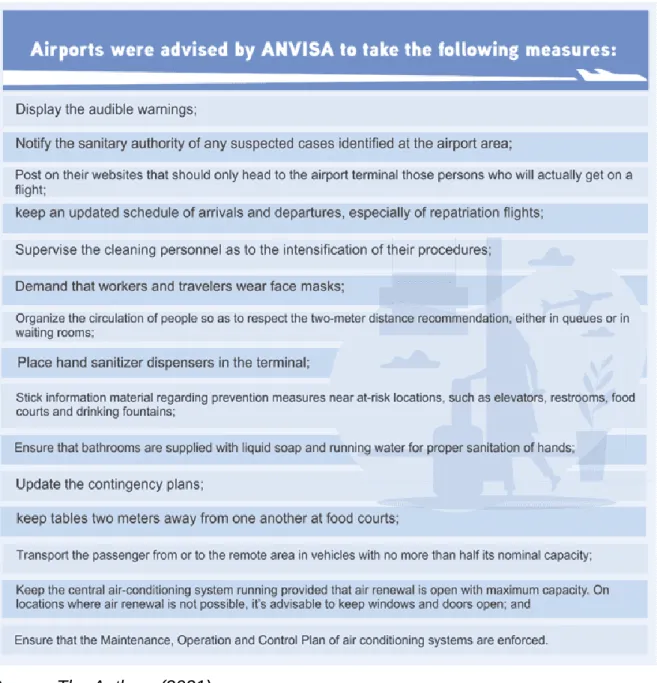
Unlike the H1N1 outbreak, travel restrictions were imposed by the Brazilian government during the COVID-19 pandemic. Due to the emerging public health emergency, Anvisa is stressing the need to adhere to social distancing and isolation measures. Pay attention to the recommendations of the Ministry of Health, Anvisa and local governments through official communication channels.
COVID-19 has been a real test for the aviation and public health sectors on so many levels. Regarding the sanitary aspect, the process of aircraft cleaning has definitely been improved. One essential tool that will be used in future pandemics is the online tools and portals that collect information and redirect the user to the right websites.

FINAL CONSIDERATIONS
While months of dealing with COVID-19 can certainly provide a whole new level of improved preparedness, it can paradoxically reduce adherence by losing its novelty characteristic, in addition to population fatigue from various imposed restrictions. It cannot be emphasized enough that all citizens should be aware of their responsibility and follow the directions given by public health authorities.
Evidence for COVID-19 virus targeting to the CNS: tissue distribution, host-virus interaction, and proposed neurotropic mechanisms. Severe acute respiratory syndrome coronavirus 2 (SARS-CoV-2) and coronavirus disease-2019 (COVID-19): the epidemic and challenges. Integrating historical, clinical, and molecular genetic data to elucidate the origin and virulence of the 1918 Spanish influenza virus.