Volume 2: Presentation Material
Behrooz Parhami
Department of Electrical and Computer Engineering University of California
Santa Barbara, CA 93106-9560, USA E-mail: [email protected]
© Oxford University Press, Fall 2001
This instructor’s manual is for
Computer Arithmetic: Algorithms and Hardware Designs, by Behrooz Parhami ISBN 0-19-512583-5, QA76.9.C62P37
©2000 Oxford University Press, New York, http://www.oup-usa.org
For information and errata, see http://www.ece.ucsb.edu/Faculty/Parhami/text_comp_arit.htm All rights reserved for the author. No part of this instructor’s manual may be reproduced, stored in a retrieval system, or transmitted in any form or by any means, electronic, mechanical,
photocopying, recording, or otherwise, without written permission. Contact the author at:
ECE Dept., Univ. of California, Santa Barbara, CA 93106-9560, USA ( [email protected] )
Preface to the Instructor’s Manual
This instructor’s manual consists of two volumes. Volume 1 presents solutions to selected problems and includes additional problems (many with solutions) that did not make the cut for inclusion in the text Computer Arithmetic: Algorithms and Hardware Designs (Oxford University Press, 2000) or that were designed after the book went to print. Volume 2 contains enlarged versions of the figures and tables in the text as well as additional material, presented in a format that is suitable for use as transparency masters.
The fall 2001 edition Volume 1, which consists of the following parts, is available to qualified instructors through the publisher:
Volume 1 Part I Selected solutions and additional problems Part II Question bank, assignments, and projects
The fall 2001 edition of Volume 2, which consists of the following parts, is available as a large file in postscript format through the book’s Web page:
Volume 2 Parts I-VII Lecture slides and other presentation material
The book’s Web page, given below, also contains an errata and a host of other material (please note the upper-case “F” and “P” and the underscore symbol after “text” and “comp”:
http://www.ece.ucsb.edu/Faculty/Parhami/text_comp_arit.htm
The author would appreciate the reporting of any error in the textbook or in this manual, suggestions for additional problems, alternate solutions to solved problems, solutions to other problems, and sharing of teaching experiences. Please e-mail your comments to
or send them by regular mail to the author’s postal address:
Department of Electrical and Computer Engineering University of California
Santa Barbara, CA 93106-9560, USA
Contributions will be acknowledged to the extent possible.
Behrooz Parhami
Santa Barbara, Fall 2001
Table of Contents
Part I Number Representation 1 Numbers and Arithmetic 2 Representing Signed Numbers 3 Redundant Number Systems 4 Residue Number Systems Part II Addition/Subtraction
5 Basic Addition and Counting 6 Carry-Lookahead Adders 7 Variations in Fast Adders 8 Multioperand Addition Part III Multiplication
9 Basic Multiplication Schemes 10 High-Radix Multipliers 11 Tree and Array Multipliers 12 Variations in Multipliers Part IV Division
13 Basic Division Schemes 14 High-Radix Dividers 15 Variations in Dividers 16 Division by Convergence Part V Real Arithmetic
17 Floating-Point Representations 18 Floating-Point Operations 19 Errors and Error Control
20 Precise and Certifiable Arithmetic Part VI Function Evaluation
21 Square-Rooting Methods 22 The CORDIC Algorithms
23 Variations in Function Evaluation 24 Arithmetic by Table Lookup Part VII Implementation Topics
25 High-Throughput Arithmetic 26 Low-Power Arithmetic 27 Fault-Tolerant Arithmetic 28 Past, Present, and Future
Part I Number Representation
Part Goals
Review fixed-point number systems (floating-point covered in Part V) Learn how to handle signed numbers Discuss some unconventional methods Part Synopsis
Number representation is is a key element affecting hardware cost and speed
Conventional, redundant, residue systems Intermediate vs endpoint representations Limits of fast arithmetic
Part Contents
Chapter 1 Numbers and Arithmetic
Chapter 2 Representing Signed Numbers Chapter 3 Redundant Number Systems Chapter 4 Residue Number Systems
1 Numbers and Arithmetic
Go to TOC Chapter Goals
Define scope and provide motivation
Set the framework for the rest of the book Review positional fixed-point numbers Chapter Highlights
What goes on inside your calculator?
Ways of encoding numbers in k bits Radix and digit set: conventional, exotic Conversion from one system to another Chapter Contents
1.1 What is Computer Arithmetic?
1.2 A Motivating Example
1.3 Numbers and Their Encodings
1.4 Fixed-Radix Positional Number Systems 1.5 Number Radix Conversion
1.6 Classes of Number Representations
1.1 What Is Computer Arithmetic?
Pentium Division Bug (1994-95): Pentium’s radix-4 SRT algorithm occasionally produced an incorrect quotient
First noted in 1994 by T. Nicely who computed sums of reciprocals of twin primes:
1/5 + 1/7 + 1/11 + 1/13 + . . . + 1/p + 1/(p + 2) + . . . Worst-case example of division error in Pentium:
4 195 835 3 145 727
1.333 820 44...
1.333 739 06...
c = = Correct quotient
circa 1994 Pentium double FLP value;
accurate to only 14 bits (worse than single!) Humor, circa 1995
Top Ten New Intel Slogans for the Pentium:
9.999 997 325 It’s a FLAW, dammit, not a bug 8.999 916 336 It’s close enough, we say so 7.999 941 461 Nearly 300 correct opcodes
6.999 983 153 You don’t need to know what’s inside 5.999 983 513 Redefining the PC –– and math as well 4.999 999 902 We fixed it, really
3.999 824 591 Division considered harmful
2.999 152 361 Why do you think it’s called “floating” point?
1.999 910 351 We’re looking for a few good flaws 0.999 999 999 The errata inside
Hardware (our focus in this book) Software
–––––––––––––––––––––––––––––––– –––––––––––––––––––––––––––
Design of efficient digital circuits for Numerical methods for solving primitive and other arithmetic operations systems of linear equations, such as +, –, ×, ÷, √, log, sin, and cos partial differential equations, etc.
Issues: Algorithms Issues: Algorithms Error analysis Error analysis
Speed/cost tradeoffs Computational complexity Hardware implementation Programming
Testing, verification Testing, verification General-Purpose Special-Purpose
–––––––––––––– ––––––––––––––––
Flexible data paths Tailored to application Fast primitive areas such as:
operations like Digital filtering +, –, ×, ÷, √ Image processing Benchmarking Radar tracking
Fig. 1.1 The scope of computer arithmetic.
1.2 A Motivating Example
Using a calculator with √, x2, and xy functions, compute:
u = ... 2 = 1.000 677 131 “1024th root of 2”
---
10 times
v = 21/1024 = 1.000 677 131
Save u and v; If you can’t, recompute when needed.
10 times
---
x = (((u2)2)...)2 = 1.999 999 963 x' = u1024 = 1.999 999 973
10 times
---
y = (((v2)2)...)2 = 1.999 999 983 y' = v1024 = 1.999 999 994
Perhaps v and u are not really the same value.
w = v – u = 1 × 10–11 Nonzero due to hidden digits (u – 1) × 1000 = 0.677 130 680 [Hidden ... (0) 68]
(v – 1) × 1000 = 0.677 130 690 [Hidden ... (0) 69]
A simple analysis:
v1024 = (u + 10–11)1024 ≅ u1024 + 1024 × 10–11u1023 ≅ u1024 + 2 × 10⁻⁸
Finite Precision Can Lead to Disaster
Example: Failure of Patriot Missile (1991 Feb. 25)
Source http://www.math.psu.edu/dna/455.f96/disasters.html
American Patriot Missile battery in Dharan, Saudi Arabia, failed to intercept incoming Iraqi Scud missile
The Scud struck an American Army barracks, killing 28 Cause, per GAO/IMTEC-92-26 report: “software problem”
(inaccurate calculation of the time since boot) Specifics of the problem: time in tenths of second as measured by the system’s internal clock
was multiplied by 1/10 to get the time in seconds Internal registers were 24 bits wide
1/10 = 0.0001 1001 1001 1001 1001 100 (chopped to 24 b) Error ≅ 0.1100 1100 × 2–23 ≅ 9.5 × 10⁻⁸
Error in 100-hr operation period
≅ 9.5 × 10–8 × 100 × 60 × 60 × 10 = 0.34 s
Distance traveled by Scud = (0.34 s) × (1676 m/s) ≅ 570 m This put the Scud outside the Patriot’s “range gate”
Ironically, the fact that the bad time calculation
had been improved in some (but not all) code parts contributed to the problem,
since it meant that inaccuracies did not cancel out
Finite Range Can Lead to Disaster
Example: Explosion of Ariane Rocket (1996 June 4)
Source http://www.math.psu.edu/dna/455.f96/disasters.html
Unmanned Ariane 5 rocket
launched by the European Space Agency
veered off its flight path, broke up, and exploded only 30 seconds after lift-off (altitude of 3700 m)
The $500 million rocket (with cargo) was on its 1st voyage after a decade of development costing $7 billion
Cause: “software error in the inertial reference system”
Specifics of the problem: a 64 bit floating point number relating to the horizontal velocity of the rocket
was being converted to a 16 bit signed integer An SRI* software exception arose during conversion because the 64-bit floating point number
had a value greater than what could be represented by a 16-bit signed integer (max 32 767)
*SRI stands for Système de Référence Inertielle or Inertial Reference System
1.3 Numbers and Their Encodings
Numbers versus their representations (numerals)
The number “twenty-seven” can be represented in different ways using numerals or numeration systems:
||||| ||||| ||||| ||||| ||||| || sticks or unary code
27 radix-10 or decimal code (27)ten 11011 radix-2 or binary code (11011)two XXVII Roman numerals
Encoding of digit sets as binary strings: BCD example Digit BCD representation
0 0 0 0 0 1 0 0 0 1 2 0 0 1 0 3 0 0 1 1 4 0 1 0 0 5 0 1 0 1 6 0 1 1 0 7 0 1 1 1 8 1 0 0 0 9 1 0 0 1
Encoding of numbers in 4 bits:
Unsigned integer ± Signed integer
Signed fraction 2's-compl fraction
Floating point Logarithmic
Fixed point, 3+1
±
e s log x
Radix point
0 2 4 6 8 10 12 14 16
−2
−4
−6
−8
−10
−12
−14
−16
Unsigned integers Signed-magnitude 3 + 1 fixed-point, xxx.x Signed fractions, ±.xxx 2’s-compl. fractions, x.xxx 2 + 2 floati ng-point, s × 2^e e in [−2, 1], s in [0, 3]
2 + 2 logarithmic (log = xx.xx)
Fig. 1.2 Some of the possible ways of assigning 16 distinct
codes to represent numbers.
1.4 Fixed-Radix Positional Number Systems
( xk–1xk–2 . . . x1x0 . x–1x–2 . . . x–l )r =
∑
i=–l k–1
xi ri One can generalize to:
arbitrary radix (not necessarily integer, positive, constant) arbitrary digit set, usually {–α, –α+1, ... , β–1, β} = [–α, β] Example 1.1. Balanced ternary number system:
radix r = 3, digit set = [–1, 1]
Example 1.2. Negative-radix number systems:
radix –r, r ≥ 2, digit set = [0, r – 1]
The special case with radix –2 and digit set [0, 1]
is known as the negabinary number system Example 1.3. Digit set [–4, 5] for r = 10:
(3 -1 5)ten represents 295 = 300 – 10 + 5 Example 1.4. Digit set [–7, 7] for r = 10:
(3 -1 5)ten = (3 0 -5)ten = (1 -7 0 -5)ten Example 1.7. Quater-imaginary number system:
radix r = 2j, digit set [0, 3].
1.5 Number Radix Conversion u = w . v
= ( xk–1xk–2 . . . x1x0 . x–1x–2 . . . x–l )r Old
= ( XK–1XK–2 . . . X1X0 . X–1X–2 . . . Xx–L )R New Radix conversion: arithmetic in the old radix r Converting whole part w: (105)ten = (?)five
Repeatedly divide by five Quotient Remainder 105 0 21 1
4 4 0
Therefore, (105)ten = (410)five
Converting fractional part v: (105.486)ten = (410.?)five Repeatedly multiply by five Whole Part Fraction .486 2 .430 2 .150 0 .750 3 .750
3 .750 Therefore, (105.486)ten ≅ (410.22033)five
Radix conversion: arithmetic in the new radix R Converting the whole part w
((((2 × 5) + 2) × 5 + 0) × 5 + 3) × 5 + 3
|---| : : : : 10 : : : : |---| : : : 12 : : : |---| : : 60 : : |---| : 303 : |---|
1518
Fig. 1.A Horner’s rule used to convert (22033)five to decimal.
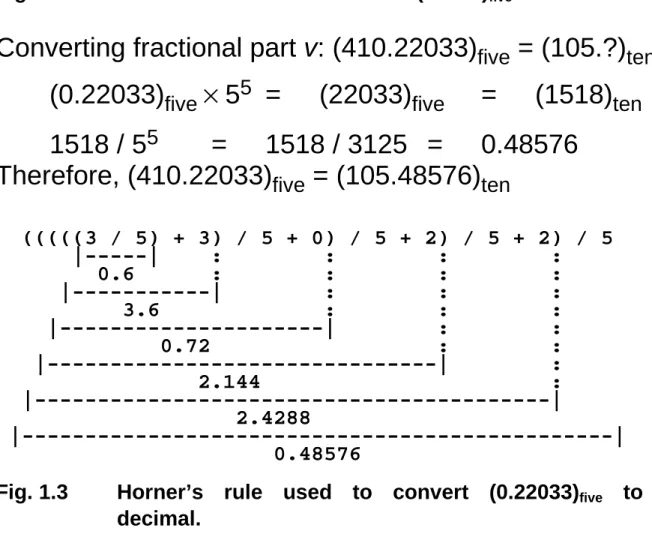
Converting fractional part v: (410.22033)five = (105.?)ten (0.22033)five × 55 = (22033)five = (1518)ten 1518 / 55 = 1518 / 3125 = 0.48576
Therefore, (410.22033)five = (105.48576)ten
(((((3 / 5) + 3) / 5 + 0) / 5 + 2) / 5 + 2) / 5 |---| : : : : 0.6 : : : : |---| : : : 3.6 : : : |---| : : 0.72 : : |---| : 2.144 : |---|
2.4288
|---|
0.48576
Fig. 1.3 Horner’s rule used to convert (0.22033)five to decimal.
1.6 Classes of Number Representations Integers (fixed-point), unsigned: Chapter 1 Integers (fixed-point), signed
signed-magnitude, biased, complement: Chapter 2 signed-digit: Chapter 3
(but the key point of Chapter 3 is
use of redundancy for faster arithmetic, not how to represent signed values) residue number system: Chapter 4
(again, the key to Chapter 4 is
use of parallelism for faster arithmetic, not how to represent signed values) Real numbers, floating-point: Chapter 17
covered in Part V, just before real-number arithmetic Real numbers, exact: Chapter 20
continued-fraction, slash, ... (for error-free arithmetic)
Part V Real Arithmetic
Part Goals
Review floating-point representations Learn about floating-point arithmetic Discuss error sources and error bounds Part Synopsis
Combining wide range and high precision Floating-point formats and operations The ANSI/IEEE standard
Errors: causes and consequences
When can we trust computation results?
Part Contents
Chapter 17 Floating-Point Representations Chapter 18 Floating-Point Operations
Chapter 19 Errors and Error Control
Chapter 20 Precise and Certifiable Arithmetic
17 Floating-Point Representations
Go to TOC Chapter Goals
Study representation method offering both wide range (e.g., astronomical distances) and high precision (e.g., atomic distances) Chapter Highlights
Floating-point formats and tradeoffs Why a floating-point standard?
Finiteness of precision and range The two extreme special cases:
fixed-point and logarithmic numbers Chapter Contents
17.1 Floating-Point Numbers
17.2 The ANSI/IEEE Floating-Point Standard 17.3 Basic Floating-Point Algorithms
17.4 Conversions and Exceptions 17.5 Rounding Schemes
17.6 Logarithmic Number Systems
17.1 Floating-Point Numbers
No finite number system can represent all real numbers Various systems can be used for a subset of real numbers Fixed-point ± w . f low precision and/or range Rational ± p / q difficult arithmetic
Floating-point ± s × be most common scheme
Logarithmic ± logbx limiting case of floating-point Fixed-point numbers
x = (0000 0000 . 0000 1001)two Small number y = (1001 0000 . 0000 0000)two Large number Floating-point numbers
x = ± s × be or ± significand × baseexponent Two signs are involved in a floating-point number.
1. The significand or number sign,
usually represented by a separate sign bit 2. The exponent sign,
usually embedded in the biased exponent (when the bias is a power of 2,
the exponent sign is the complement of its MSB)
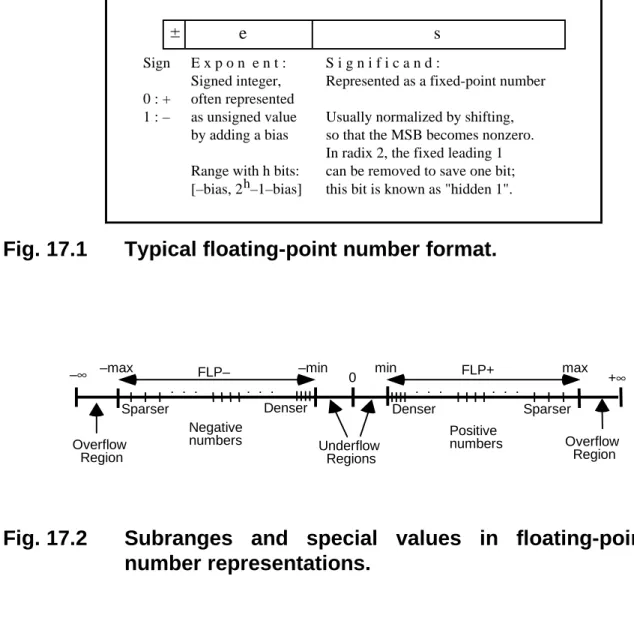
E x p o n e n t : Signed integer, often represented as unsigned value by adding a bias Range with h bits:
[–bias, 2 –1–bias]h
S i g n i f i c a n d :
Represented as a fixed-point number Usually normalized by shifting, so that the MSB becomes nonzero.
In radix 2, the fixed leading 1 can be removed to save one bit;
this bit is known as "hidden 1".
Sign 0 : + 1 : –
± e s
Fig. 17.1 Typical floating-point number format.
–∞ FLP– 0 FLP+ +∞
Underflow Regions Overflow
Region
Overflow Region max min
Denser Sparser
Positive numbers Negative
numbers
–max –min
Denser Sparser
. . . . . . . . . . . .
Fig. 17.2 Subranges and special values in floating-point number representations.
17.2 The ANSI/IEEE Floating-Point Standard
Short (32-bit) format
Long (64-bit) format
Sign Exponent Significand 8 bits,
bias = 127, –126to127
11 bits, bias = 1023,
–1022to1023
52 bits for fractional part (plus hidden 1 in integer part) 23 bits for fractional part
(plus hidden 1 in integer part)
Fig. 17.3 The ANSI/IEEE standard floating-point number representation formats.
Table 17.1 Some features of the ANSI/IEEE standard floating- point number representation formats
–––––––––––––––––––––––––––––––––––––––––––––––––
Feature Single/Short Double/Long
–––––––––––––––––––––––––––––––––––––––––––––––––
Word width (bits) 32 64
Significand bits 23 + 1 hidden 52 + 1 hidden Significand range [1, 2 – 2–23] [1, 2 – 2–52] Exponent bits 8 11
Exponent bias 127 1023
Zero (±0) e + bias = 0, f = 0 e + bias = 0, f = 0 Denormal e + bias = 0, f ≠ 0 e + bias = 0, f ≠ 0 represents ±0.f×2–126 represents ±0.f×2–1022 Infinity (±∞) e + bias = 255, f = 0 e + bias = 2047, f = 0 Not-a-number (NaN) e + bias = 255, f ≠ 0 e + bias = 2047, f ≠ 0 Ordinary number e + bias ∈ [1, 254] e + bias ∈ [1, 2046]
e ∈ [–126, 127] e ∈ [–1022, 1023]
represents 1.f × 2e represents 1.f × 2e min 2–126 ≅ 1.2 × 10–38 2–1022 ≅ 2.2 × 10–308 max ≅ 2128 ≅ 3.4 × 1038 ≅ 21024 ≅ 1.8 × 10308 –––––––––––––––––––––––––––––––––––––––––––––––––
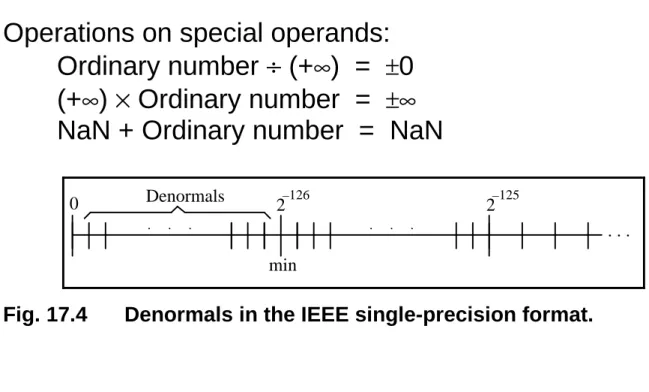
Operations on special operands:
Ordinary number ÷ (+∞) = ±0 (+∞) × Ordinary number = ±∞
NaN + Ordinary number = NaN
0 Denormals 2–126
2–125
. . . . . .
min
. . .
Fig. 17.4 Denormals in the IEEE single-precision format.
The IEEE floating-point standard also defines
The four basic arithmetic op’s (+, –, ×, ÷) and x must match the results that would be obtained if intermediate computations were infinitely precise Extended formats for greater internal precision
Single-extended: ≥ 11 bits for exponent ≥ 32 bits for significand bias unspecified, but exp range ⊇ [–1022, 1023]
Double-extended: ≥ 15 bits for exponent ≥ 64 bits for significand
exp range ⊇ [–16 382, 16 383]
17.3 Basic Floating-Point Algorithms Addition/Subtraction
Assume e1 ≥ e2; need alignment shift (preshift) if e1 > e2:
(±s1×be1)+(±s2×be2) =(±s1×be1)+(±s2/be1–e2)×be1 = (±s1±s2/be1–e1)×be1= ±s×be Like signs: 1-digit normalizing right shift may be needed Different signs: shifting by many positions may be needed Overflow/underflow during addition or normalization
Multiplication
(±s1×be1) × (±s2×be2) = ± (s1 × s2) × be1+e2
Postshifting for normalization, exponent adjustment
Overflow/underflow during multiplication or normalization Division
(±s1×be1) / (±s2×be2) = ± (s1/s2) × be1–e2 Square-rooting
First make the exponent even, if necessary √(s ×be) = s × be/2
In all algorithms, rounding complications are ignored here
17.4 Conversions and Exceptions Conversions from fixed- to floating-point Conversions between floating-point formats
Conversion from high to lower precision: Rounding ANSI/IEEE standard includes four rounding modes:
Round to nearest even [default rounding mode]
Round toward zero (inward) Round toward +∞ (upward) Round toward –∞ (downward) Exceptions
divide by zero overflow
underflow
inexact result: rounded value not same as original invalid operation: examples include
addition (+∞) + (–∞) multiplication 0 × ∞
division 0 / 0 or ∞ / ∞ square-root operand < 0
17.5 Rounding Schemes
Round
xk–1xk–2 . . . x1x0. x–1x–2 . . . x–l
⇒
yk–1yk–2 . . . y1y0. Special case: truncation or choppingChop
xk–1xk–2 . . . x1x0. x–1x–2 . . . x–l
⇒
xk–1xk–2 . . . x1x0.chop(x)
–4 –3 –2 –1
x
–4 –3 –2 –1 1 2 3 4
4 3 2 1
chop(x)
–4 –3 –2 –1
x
–4 –3 –2 –1 1 2 3 4
4 3 2 1
Fig. 17.5 Truncation or chopping of a signed-magnitude number (same as round toward 0).
Fig. 17.6 Truncation or chopping of a 2’s-complement number (same as downward-directed rounding).
–4 –3 –2 –1
x
–4 –3 –2 –1 1 2 3 4
4 3 2 1
Fig. 17.7 Rounding of a signed-magnitude value to the nearest number.
Ordinary rounding has a slight upward bias
Assume that (xk–1xk–2 . . . x1x0. x–1x–2)two is to be rounded to an integer (yk–1yk–2 . . . y1y0.)two
The four possible cases, and their representation errors:
x–1x–2 = 00 round down error = 0 x–1x–2 = 01 round down error = –0.25 x–1x–2 = 10 round up error = 0.5 x–1x–2 = 11 round up error = 0.25
Assume 4 cases are equiprobable ⇒ mean error = 0.125 For certain calculations, the probability of getting a midpoint value can be much higher than 2–l
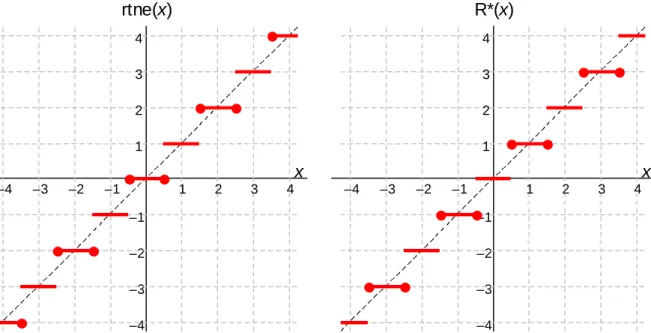
rtne(x)
–4 –3 –2 –1
x
–4 –3 –2 –1 1 2 3 4
4 3 2 1
R*(x)
–4 –3 –2 –1
x
–4 –3 –2 –1 1 2 3 4
4 3 2 1
Fig. 17.8 Rounding to the nearest even number.
Fig. 17.9 R* rounding or rounding to the nearest odd number.
jam(x)
–4 –3 –2 –1
x
–4 –3 –2 –1 1 2 3 4
4 3 2 1
Fig. 17.10 Jamming or von Neumann rounding.
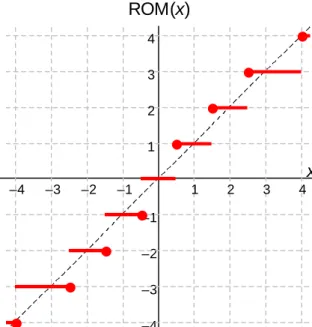
32×4-ROM-Round
xk–1 . . . x4x3x2x1x0. x–1 . . . x–l
⇒
xk–1 . . . x4y3y2y1y0 . |–––––––––––| |––––––| ROM Address ROM DataThe rounding result is the same as that of the round to nearest scheme in 15 of the 16 possible cases, but a larger error is introduced when x3 = x2 = x1 = x0 = 1
ROM(x)
–4 –3 –2 –1
x
–4 –3 –2 –1 1 2 3 4
4 3 2 1
Fig. 17.11 ROM rounding with an 8 ×× 2 table.
We may need result errors to be in a known direction Example: in computing upper bounds,
larger results are acceptable,
but results that are smaller than correct values could invalidate the upper bound
This leads to the definition of directed rounding modes upward-directed rounding (round toward +∞) and downward-directed rounding (round toward –∞)
(required features of the IEEE floating-point standard)
up(x)
–4 –3 –2 –1
x
–4 –3 –2 –1 1 2 3 4
4 3 2 1
chop(x) = down(x)
–4 –3 –2 –1
x
–4 –3 –2 –1 1 2 3 4
4 3 2 1
Fig. 17.12 Upward-directed rounding or rounding toward +∞∞ (see Fig. 17.6 for downward-directed rounding, or rounding toward –∞∞).
Fig. 17.6 Truncation or chopping of a 2’s-complement number (same as downward-directed rounding).
17.6 Logarithmic Number Systems sign-and-logarithm number system:
limiting case of floating-point representation x = ±be × 1 e = logb |x|
b usually called the logarithm base, not exponent base
Sign
Implied radix point e
±
Fixed-point exponent
Fig. 17.13 Logarithmic number representation with sign and fixed-point exponent.
The log is often represented as a 2’s-complement number (Sx, Lx) = (sign(x ), log2|x|)
Simple multiply and divide; harder add and subtract Example: 12-bit, base-2, logarithmic number system 1 1 0 1 1 0 0 0 1 0 1 1
∆
Sign Radix point
The above represents –2–9.828125 ≅ –(0.0011)ten number range ≅ [–216, 216], with min = 2–16
19 Errors and Error Control
Go to TOC Chapter Goals
Learn about sources of computation errors consequences of inexact arithmetic
and methods for avoiding or limiting errors Chapter Highlights
Representation and computation errors Absolute versus relative error
Worst-case versus average error Why 3 × (1/3) is not necessarily 1?
Error analysis and bounding Chapter Contents
19.1 Sources of Computational Errors 19.2 Invalidated Laws of Algebra
19.3 Worst-Case Error Accumulation
19.4 Error Distribution and Expected Errors 19.5 Forward Error Analysis
19.6 Backward Error Analysis
19.1 Sources of Computational Errors
FLP approximates exact computation with real numbers Two sources of errors to understand and counteract:
Representation errors
e.g., no machine representation for 1/3, 2 , or π Arithmetic errors
e.g., (1 + 2–12)2 = 1 + 2–11 + 2–24 not representable in IEEE format
We saw early in the course that errors due to finite precision can lead to disasters in life-critical applications Example 19.1: Compute 1/99 – 1/100
(decimal floating-point format, 4-digit significand in [1, 10), single-digit signed exponent)
precise result=1/9900≅1.010×10–4(error≅10–8or0.01%) x = 1/99 ≅ 1.010 × 10⁻² Error ≅ 10–6 or 0.01%
y = 1/100 = 1.000 × 10⁻² Error = 0
z = x –fp y = 1.010 × 10⁻² – 1.000 × 10–2= 1.000 × 10⁻⁴ Error ≅ 10–6 or 1%
Notation for floating-point system FLP(r, p, A)
Radix r (assume to be the same as the exponent base b) Precision p in terms of radix-r digits
Approximation scheme A ∈ {chop, round, rtne, chop(g), ...}
Let x = res be an unsigned real number, normalized such that 1/r ≤ s < 1, and xfp be its representation in FLP(r, p, A) xfp = resfp = (1 + η)x
A = chop –ulp < sfp – s ≤ 0 –r × ulp < η ≤ 0 A = round –ulp/2 < sfp – s ≤ ulp/2 |η| ≤ r × ulp/2
Arithmetic in FLP(r, p, A)
Obtain an infinite-precision result, then chop, round, . . . Real machines approximate this process by keeping g > 0 guard digits, thus doing arithmetic in FLP(r, p, chop(g))
Error analysis for FLP(r, p, A)
Consider multiplication, division, addition, and subtraction for positive operands xfp and yfp in FLP(r, p, A)
Due to representation errors, xfp = (1 + σ)x , yfp = (1 + τ)y xfp ×fp yfp = (1 + η)xfpyfp = (1 + η)(1 + σ)(1 + τ)xy
= (1 + η + σ + τ + ησ + ητ + στ + ηστ)xy
≅ (1 + η + σ + τ)xy
xfp /fp yfp = (1 + η)xfp/yfp = (1 + η)(1 + σ)x/[(1 + τ)y]
= (1 + η)(1 + σ)(1 – τ)(1 + τ2)(1 + τ4)( . . . )x/y
≅ (1 + η + σ – τ)x/y
xfp +fp yfp = (1 + η)(xfp + yfp) = (1 + η)(x + σx + y + τy) = (1 + η)(1 + σx + τy
x + y )(x + y)
Since |σx + τy| ≤ max(|σ|, |τ|)(x + y), the magnitude of the worst-case relative error in the computed sum is roughly bounded by |η| + max(|σ|, |τ|)
xfp –fp yfp = (1 + η)(xfp – yfp) = (1 + η)(x + σx – y – τy) = (1 + η)(1 + σx – τy
x – y )(x – y)
The term (σx – τy)/(x – y) can be very large if x and y are both large but x – y is relatively small
This is known as cancellation or loss of significance
Fixing the problem
The part of the problem that is due to η being large can be fixed by using guard digits
Theorem 19.1: In floating-point system FLP(r, p, chop(g)) with g ≥ 1 and –x < y < 0 < x, we have:
x +fp y = (1 + η)(x + y) with –r–p +1 < η < r–p–g+2 Corollary: In FLP(r, p, chop(1))
x +fp y = (1 + η)(x + y) with |η| < r–p+1
So, a single guard digit is sufficient to make the relative arithmetic error in floating-point addition/subtraction comparable to the representation error with truncation
Example 19.2: Decimal floating-point system (r = 10) with p = 6 and no guard digit
x = 0.100 000 000 × 103 y = –0.999 999 456 × 102 xfp = .100 000 × 103 yfp = – .999 999 × 102 x + y = 0.544×10⁻⁴ and xfp + yfp = 10–4, but:
xfp +fp yfp = .100 000 × 103 –fp .099 999 × 103 = .100 000 × 10–2
Relative error = (10–3 – 0.544×10⁻⁴)/(0.544×10–4) ≅ 17.38 (i.e., the result is 1738% larger than the correct sum!) With 1 guard digit, we get:
xfp +fp yfp = 0.100 000 0 × 103 –fp 0.099 999 9 × 103 = 0.100 000 × 10–3
Relative error = 80.5% relative to the exact sum x + y but the error is 0% with respect to xfp + yfp
19.2 Invalidated Laws of Algebra
Many laws of algebra do not hold for floating-point arithmetic (some don’t even hold approximately)
This can be a source of confusion and incompatibility Associative law of addition: a + (b + c) = (a + b) + c a = 0.123 41×105 b = –0.123 40×105 c = 0.143 21×101 a +fp (b +fp c)
= 0.123 41×105 +fp (–0.123 40×105 +fp 0.143 21×101) = 0.123 41 × 105 –fp 0.123 39 × 105
= 0.200 00 × 101 (a +fp b) +fp c
= (0.123 41×105 –fp 0.123 40×105) +fp 0.143 21×101 = 0.100 00 × 101 +fp 0.143 21 × 101
= 0.243 21 × 101
The two results differ by about 20%!
A possible remedy: unnormalized arithmetic a +fp (b +fp c)
= 0.123 41×105 +fp (–0.123 40×105 +fp 0.143 21×101) = 0.123 41 × 105 –fp 0.123 39 × 105 = 0.000 02 × 105 (a +fp b) +fp c
= (0.123 41×105 –fp 0.123 40×105) +fp 0.143 21×101 = 0.000 01 × 105 +fp 0.143 21 × 101 = 0.000 02 × 105 Not only are the two results the same but they carry with them a kind of warning about the extent of potential error Let’s see if using 2 guard digits helps:
a +fp (b +fp c)
= 0.123 41×105 +fp (–0.123 40×105 +fp 0.143 21×101) = 0.12341×10⁵ –fp 0.1233857×105 = 0.24300×101 (a +fp b) +fp c
= (0.123 41×105 –fp 0.123 40×105) +fp 0.143 21×101 = 0.100 00 × 101 +fp 0.143 21 × 101 = 0.243 21×101 The difference is now about 0.1%; still too high
Using more guard digits will improve the situation but does not change the fact that laws of algebra cannot be assumed to hold in floating-point arithmetic
Examples of other laws of algebra that do not hold:
Associative law of multiplication
a × (b × c) = (a × b) × c Cancellation law (for a > 0)
a×b = a×c implies b=c Distributive law a×(b+c) = (a×b)+(a×c) Multiplication canceling division
a × (b / a) = b
Before the ANSI-IEEE floating-point standard became available and widely adopted, these problems were exacerbated by the use of many incompatible formats
Example 19.3: The formula x = –b ± d, with d = b2 – c , yielding the roots of the quadratic equation x2+2bx +c =0, can be rewritten as x = –c / (b ± d)
Example 19.4: The area of a triangle with sides a, b, and c (assume a ≥ b ≥ c) is given by the formula
A= s(s–a)(s–b)(s–c)
where s = (a+ b +c)/2. When the triangle is very flat, such that a ≅ b + c, Kahan’s version returns accurate results:
A = 14 (a+(b+c))(c–(a–b))(c + (a–b))(a+(b–c))
19.3 Worst-Case Error Accumulation
In a sequence of operations, round-off errors might add up The larger the number of cascaded computation steps (that depend on results from previous steps), the greater the chance for, and the magnitude of, accumulated errors With rounding, errors of opposite signs tend to cancel each other out in the long run, but one cannot count on such cancellations
Example: inner-product calculation z =
∑
1023i=0 x(i)y(i)Max error per multiply-add step = ulp/2+ulp/2=ulp Total worst-case absolute error = 1024ulp
(equivalent to losing 10 bits of precision)
A possible cure: keep the double-width products in their entirety and add them to compute a double-width result which is rounded to single-width at the very last step
Multiplications do not introduce any round-off error Max error per addition = ulp2/2
Total worst-case error = 1024 × ulp2/2
Therefore, provided that overflow is not a problem, a highly accurate result is obtained
Moral of the preceding examples:
Perform intermediate computations with a higher precision than what is required in the final result
Implement multiply-accumulate in hardware (DSP chips) Reduce the number of cascaded arithmetic operations;
So, using computationally more efficient algorithms has the double benefit of reducing the execution time as well as accumulated errors
Kahan’s summation algorithm or formula
To compute s =
∑
n–1i=0 x(i), proceed as follows s ← x(0)c ← 0 {c is a correction term}
for i = 1 to n – 1 do
y ← x(i) – c {subtract correction term}
z ← s + y
c ← (z – s) – y {find next correction term}
s ← z endfor
19.4 Error Distribution and Expected Errors MRRE = maximum relative representation error MRRE(FLP(r, p, chop)) = r–p+1
MRRE(FLP(r, p, round)) = r–p+1/2
From a practical standpoint, however, the distribution of errors and their expected values may be more important Limiting ourselves to positive significands, we define:
ARRE(FLP(r, p, A)) =
⌡
⌠
1/r 1
|xfp – x|
x
dx x ln r 1/(x ln r) is a probability density function
0 1 2 3
1/2 3/4 1
Significand x 1 / (x ln 2)
Fig. 19.1 Probability density function for the distribution of normalized significands in FLP(r = 2, p, A).
19.5 Forward Error Analysis
Consider the computation y = ax + b and its floating-point version:
yfp = (afp ×fp xfp) +fp bfp = (1 + η)y
Can we establish any useful bound on the magnitude of the relative error η, given the relative errors in the input operands afp, bfp, and xfp?
The answer is “no”
Forward error analysis =
Finding out how far yfp can be from ax + b, or at least from afpxfp + bfp, in the worst case
a. Automatic error analysis
Run selected test cases with higher precision and observe the differences between the new, more precise, results and the original ones b. Significance arithmetic
Roughly speaking, same as unnormalized arithmetic, although there are some fine distinctions
The result of the unnormalized decimal addition .1234 × 105 +fp .0000 × 1010 = .0000 × 1010
warns us that precision has been lost c. Noisy-mode computation
Random digits, rather than 0s, are inserted during normalizing left shifts
If several runs of the computation in noisy mode yield comparable results, then we are probably safe d. Interval arithmetic
An interval [xlo, xhi] represents x, xlo ≤ x ≤ xhi
With xlo, xhi, ylo, yhi > 0, to find z = x / y, we compute [zlo, zhi] = [xlo /∇fpyhi, xhi /∆fpylo]
Intervals tend to widen after many computation steps
19.6 Backward Error Analysis
Backward error analysis replaces the original question How much does yfp deviate from the correct result y?
with another question:
What input changes produce the same deviation?
In other words, if the exact identity yfp = aaltxalt + balt
holds for alternate parameter values aalt, balt, and xalt, we ask how far aalt, balt, xalt can be from afp, bfp, xfp
Thus, computation errors are converted or compared to additional input errors
Example of backward error analysis yfp = afp ×fp xfp +fp bfp
= (1 + µ)[afp ×fp xfp + bfp] with |µ| <r–p+1=r × ulp = (1 + µ)[(1 + ν)afpxfp + bfp] with |ν|<r–p+1=r × ulp = (1 + µ)afp (1 + ν)xfp + (1 + µ)bfp
= (1 + µ)(1 + σ)a (1 + ν)(1 + δ)x + (1 + µ)(1 + γ)b
≅ (1 + σ + µ)a (1 + δ + ν)x + (1 + γ + µ)b
So the approximate solution of the original problem is the exact solution of a problem close to the original one
We are, thus, assured that the effect of arithmetic errors on the result yfp is no more severe than that of r × ulp additional error in each of the inputs a, b, and x