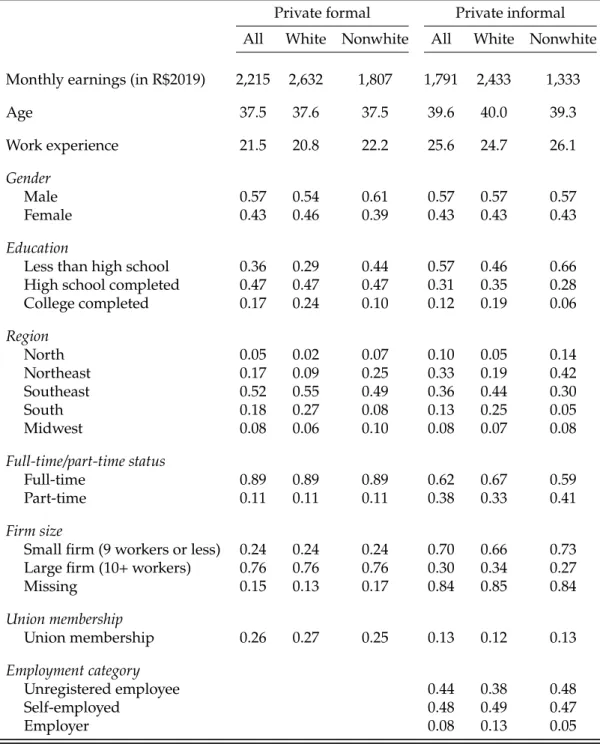
What is the role of minimum wage increases in the 2000s in the dynamics of racial inequality in Brazil. We conclude that the minimum wage increase of the 2000s led to a large decline in the economy-wide racial income gap in Brazil. The distribution of monthly income in PNAD shows a large increase around the minimum wage in the informal sector.
Descriptive Statistics on the Bindingness of the Minimum Wage
3 The effect of the 2000-2009 minimum wage reforms on racial wage compression
Methodology and Sample
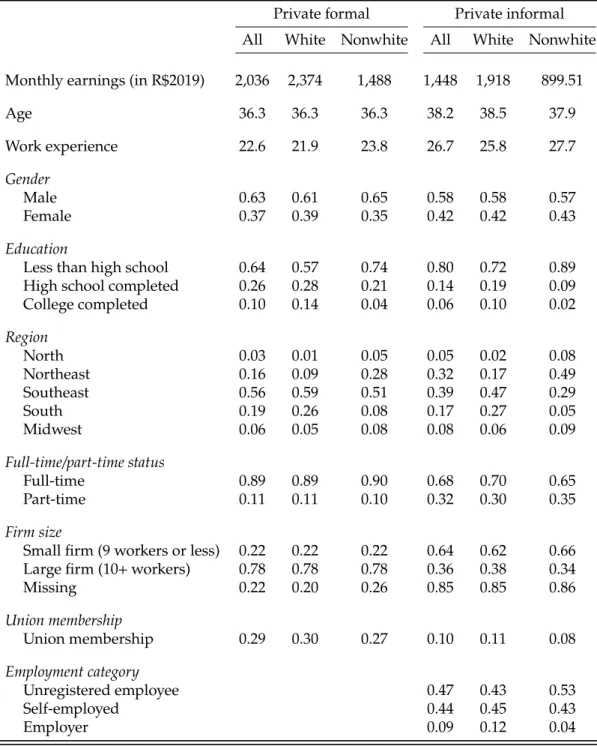
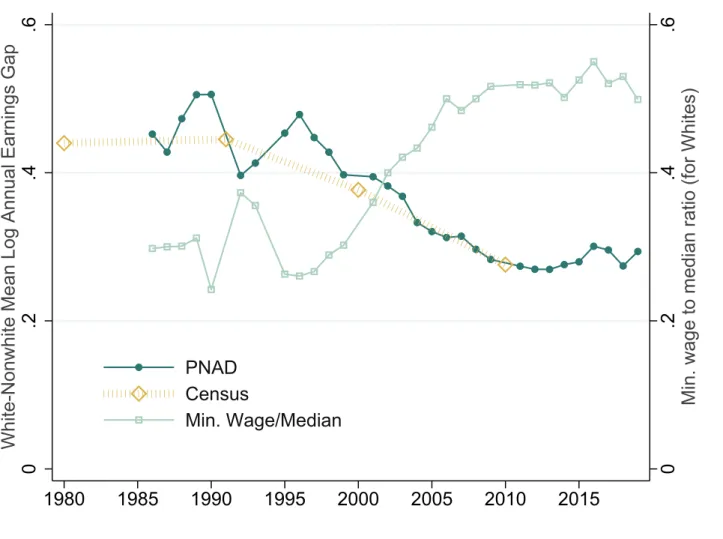
In the current analysis to focus on a conceptualization of racial inequality similar to the literature on black-white earnings differences in the US, we exclude individuals who identify as "Amarelos" and "Indigenas" (less than 2% of the population). We also exclude workers with extremely low (below 5.5 log points) or extremely high (above 10.5) real monthly income.11 We focus on full-time workers or workers working more than 40 hours per week (i.e. 89% of workers in the formal private sector and about 65% of workers in the informal private sector and about 65% of workers in the private informal sector 221 and see tables 1 95, 221 and 395 in statistics). That's because the federal minimum wage is set in terms of monthly earnings for full-time 44-hour-a-week contract workers.12 We make no restrictions on an employee's industry or occupation.
Estimates at the national level
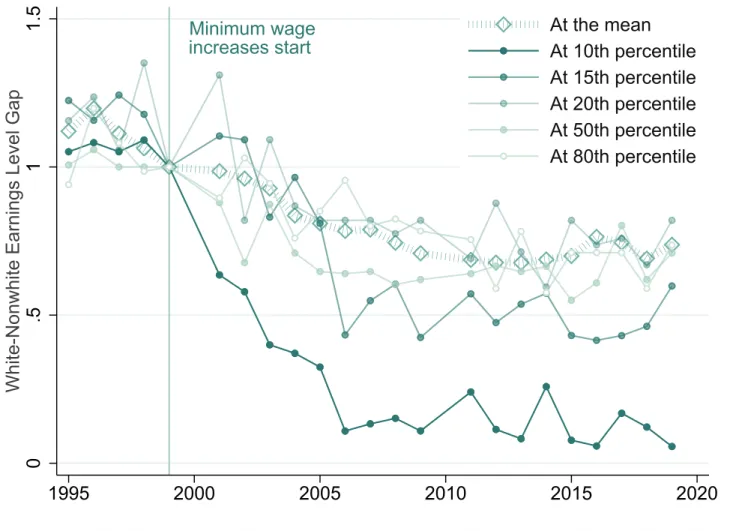
Looking at the evolution of the income level gap at higher percentiles, we find that the minimum wage had smaller effects at the 15th percentile. As we move above the 15th percentile, we find that the racial earnings gap approaches the median gap. One interpretation of this result is that there are no widespread differential effects between racial groups above the 20th percentile nationally.
Estimates at the regional and state levels
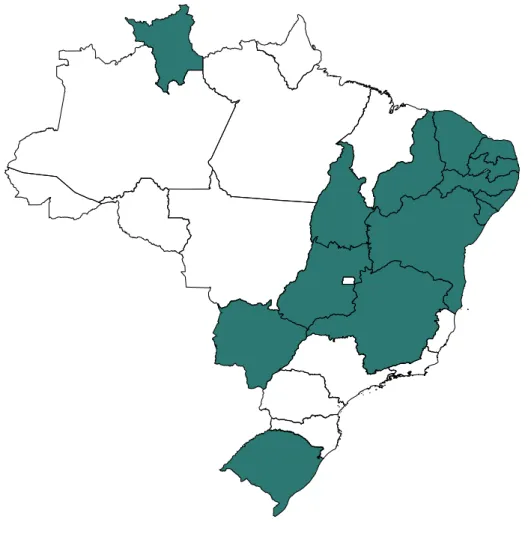
How effective has the minimum wage been in reducing racial wage inequality in the poorest countries. We find that in the Northeast, the minimum wage effectively eliminated racial wage inequality for the bottom 20% over 3 years (see Figure 8). The minimum wage had a stronger effect on racially depressing wages in the Northeast than in disadvantaged states up to the 30th percentile.
4 Reallocation of workers to the informal sector
Identification strategy
In the 15th percentile, we show that the effect of the minimum wage on racial wage compression is stronger compared to. Above this percentile (whether we look at the 25th, 30th, 40th, or 50th), we find that the wage gap develops in parallel in both types of countries—a fact consistent with the idea that factors unrelated to the minimum wage explain the reduction in racial inequality higher up the distribution. We use the same methodology as above and compare the evolution of the earnings gap in the Northeast with its evolution in disadvantaged countries.
Results
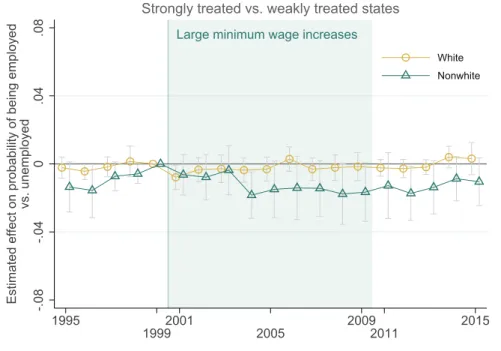
Even when pooling our estimates from 2001 to 2009,14 we cannot rule out the absence of statistically significant differences between racial groups (see Table 4). We repeat the analysis only among low-wage workers, excluding workers who earn more than 130% of the minimum wage. Overall, we find that we can rule out redistributions from the formal to the informal sector by more than -0.27 for all workers (in absolute terms) and by more than -0.4 among non-white workers (see Table 4).15 In other words, we can rule out that the increase in the minimum to median wage from 30% to more than 50% in less than a decade in Brazil caused a redistribution of non-white workers from the formal to the informal sector. above 4%, and for all workers above 2.7%.
Discussion
Although not enforced in the informal sector, the minimum wage is de facto the norm for low-wage individuals. Instead, a lack of reallocation and a rise in the minimum wage in the informal sector is more consistent with oligopsonistic competition between informal and formal employers (Berger et al., 2019). Besides small reallocation effects overall, the minimum wage increases did not cause substantial reallocation of non-white workers to the informal sector relative to white workers.
5 Employment effects of minimum wage increases
Identification strategy
In such an economy, an increase in the minimum wage would lead to the redistribution of the lowest productivity workers from formal to informal employment, as employers would lose revenue by paying these workers the minimum wage. Conditional on being below the new minimum wage, non-white and white workers are paid the same, so the increase is the same for the two groups. Based on this result, employers do not appear to have incentives to substitute away from nonwhite workers and toward white workers, or vice versa, in the private formal sector.
Results
Discussion
6 Conclusion
We analyze the effect of the large increases in the minimum wage that occurred between 1999 and 2009. This can be explained by the fact that the minimum wage is de facto mandatory in the informal sector (excluding agriculture, domestic workers and the self-employed). As a result, the minimum wage increase of the 2000s led to a large reduction in the economy-wide racial income gap in Brazil.
Does the increase in the minimum wage explain the decline in wage inequality in Brazil? Example: Adults 25-54, white or non-white, employed in the private sector (formal sector only), working full-time (ie, 40 hours per week or more), not missing the monthly income variable. The full series of monthly income distributions in the formal and informal sectors is available on our slideshow.
Example: Adults 25-54, white or non-white, employed in the private sector (formal sector only), working full time. Notes: The complete series of monthly earnings distributions from 1995 to 2015 with both the share and absolute number of workers in the y-axis is. The minimum-to-median wage is calculated among White adults 25-54 employed in the private sector (formal sector only), who work full-time (i.e. 40 hours per week or more), with no missing monthly earnings variable.
Sample: adults aged 25-54, white or non-white, employed in the private sector (formal sector only), working full-time (i.e., 40 hours per week or more), no missing monthly income variable. Sample: Panels (a) to (c) are composed of adults aged 25-54, white or non-white, employed in the private sector (formal or informal), working full-time (i.e., 40 hours per week or more), with no missing monthly income variable. Sample: Panel (a) consists of adults aged 25-54, white or non-white, employed in the private sector (formal or informal), employed full-time (i.e., 40 hours per week or more), no missing variable for monthly income, as well as unemployed adults aged 25-54.
Panel (b) consists of adults in panel (a) and adults aged 25–54 who are not employed. For the regression of the log of annual earnings: adults aged 25 to 55, non-white or white, employed full-time, employed in the private formal sector. The effect of the monthly wage is calculated only among private formal employees, as the minimum wage only formally applies to this sector.
Appendix A Public data sources: census and labor force sur- veys (1960-2019)
Census (1960-2010)
Labor force surveys
- Pesquisa Nacional por Amostra Domiciliar (PNAD) (1976 - 2015)
- PNAD Contínua (2012-2019)
- Monthly Employment Survey, Pesquisa mensal de emprego (PME) (1980-2016) The Monthly Employment Survey is a sample survey conducted monthly by IBGE since 1980
We reconstruct a measure of the number of years of schooling for those years, in order to construct a measure of potential experience in the labor market. In all years, we use the labor market information for the worker's main job (earnings, weekly hours, etc.) – the most relevant to our study, and the only information collected across all years in the survey. It is only in the most recent years that the survey has added questions about the other jobs in the reference week and about previous jobs during the year.
It includes more rural areas than the PNAD, and this may explain some of the differences in the labor market statistics, especially in the Northeast, where a large part of the population lives in a rural area (see Figure A3). At the national level, however, the characteristics of workers in the private formal and informal sectors are highly consistent for all and across racial groups (see Tables 2 and 2). In 2002, this survey underwent a major design change, giving rise to the PME-Nova, with a significantly larger questionnaire and differences in the definition of labor market participation as well as in the rotation scheme of the samples.
However, PME does not assign the same identification number to every individual in the household during the interviews. PME-Nova was discontinued in February 2016 and replaced by PNAD Continuous, a quarterly survey that started in the first quarter of 2012. Sample: Adults aged 25-54, white or non-white, employed in the private sector (formal or informal), working full-time (i.e., 40 hours per week or more), no missing monthly income variable.
Example: Adults 25-54, white or non-white, employed in the private sector (either formal or informal), working full-time (ie, 40 hours per week or more), no missing monthly income variable.
Appendix B Data with restricted access: Linked employer- employee data (RAIS) (1995-2017)
Content and access
Information on race
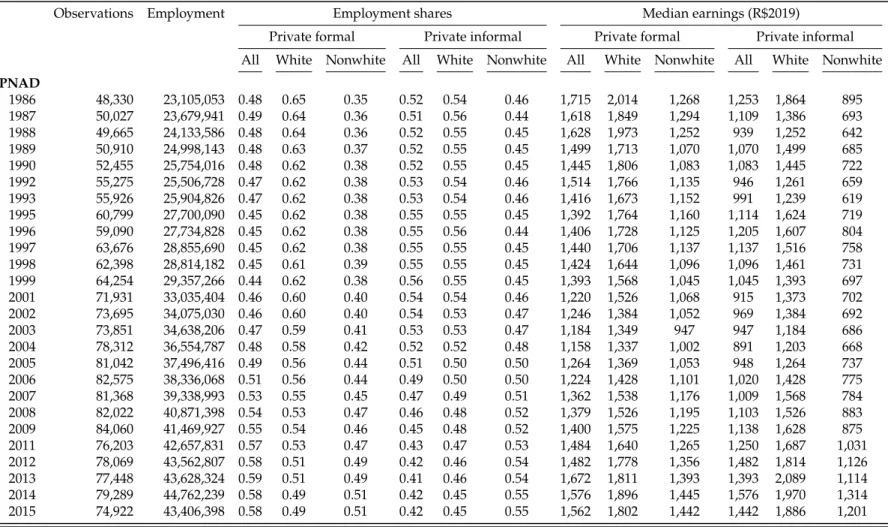
Third, it shows that indigenous and Asian workers make up a relatively small portion of the sample (red line). Fourth, it shows that the proportion of white employees (maroon line) decreases over time, while the proportion of non-white employees (green line) increases over time. To see this more clearly, panel (b) in Figure B3 compares the proportion of white and non-white workers depending on belonging to either race group.
The share of white-skinned workers in private formal employment is therefore decreasing, which is documented by PNAD surveys, but these shares are systematically higher than in PNAD surveys. Because we focus on white-nonwhite comparisons, and because the proportion of white workers is greater in RAIS than in PNAD, we consider some cases in which workers have more than one modal racial group, as follows. Panels (c) and (d) of Figure B3 present similar graphs to those in panels (a) and (b), but assign each worker to their own racial group based on our imputation strategy.
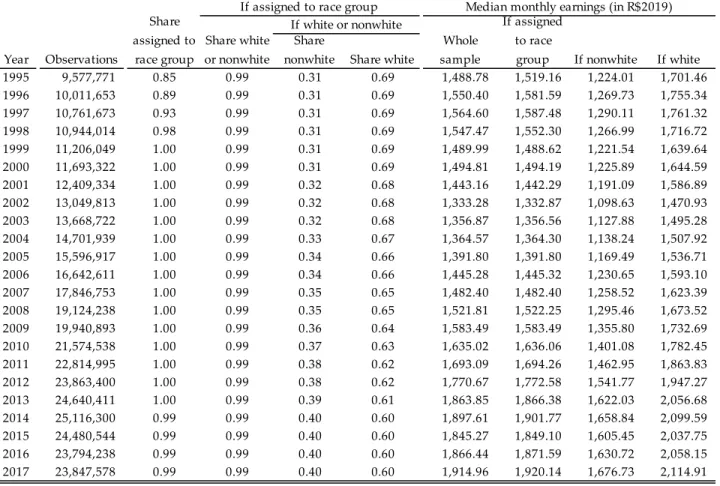
Third, the decrease in the share of unspecified racial group workers leads to increases in both the share of white workers and the share of nonwhite workers. Fourth, Panel (d) shows that the share of white and nonwhite workers, subject to assignment to each race group, is quite similar between 1995 and 1998 compared to 1999–2001, which is also the case in the PNAD surveys. Therefore, our imputation of race groups in years for which we do not have the race variable in the data appears to lead to some systematic bias on the part of particular race groups.
We also note that, with our imputation strategy, the share of white workers remains higher in RAIS than in PNAD surveys.
Consistency between RAIS and PNAD/PNAD continua
Journal bins (monthly wage/minimum wage) White - PNAD, September earnings White - RAIS, contracted wage Non-white - PNAD, September earnings Non-white - RAIS, contracted wage. Journal bins (monthly wage/minimum wage) White - PNAD, September earnings White - RAIS, contracted wage Non-white - PNAD, September earnings Non-white - RAIS, contracted wage.

Appendix C The minimum wage in Brazil
All Changes in the Nominal MW
Appendix D Additional Figures & Tables