Ge is not found in eternity in the free state, but always in combination with other elements. In the presence of air, water slowly dissolves a thin evaporated film of Ge, presumably due to GeO2's significant solubility.

Electrochemistry
The electrical potential values of selected electrochemical reactions of germanium are shown in Table 2.4, 80 and are compared with those of tin and lead in the following potential diagram. The reduction of Ge upon dropping mercury has been studied in detail, and a review of published work is given by Nazarenko.
Detection of Germanium
A comprehensive discussion of the subject is beyond the scope of this review, but a partial list of reported work using common shells is given in Table 2.7. 111-114 The applicability of pulsed neutron irradiation has also been demonstrated by the use of short-lived 73mGe (t1/2=0.50 s) for the detection of germanium.

Production of Germanium Radioisotopes
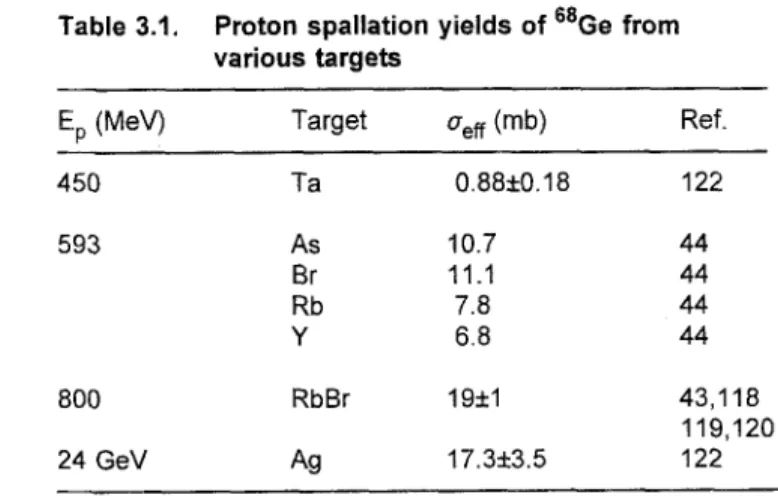
122 A summary of the cross section of 68Ge production via sputtering reactions is given in Table 3.1. In Fig.
A Summary of the Chemical Behavior of Carrier-free Germanium-68
Germanium-68 forms radiocolloids in moderately acidic solutions (0.1-5 M) in the presence of sulfide ions; these colloids can be centrifuged and filtered from the solution. A significant portion of the carrier-free 68Ge is adsorbed by Pyrex from strong nitric and perchloric acid solutions (>6 M), and the adsorption is almost quantitative on 300 mg of Pyrex glass powder within 4 hours.
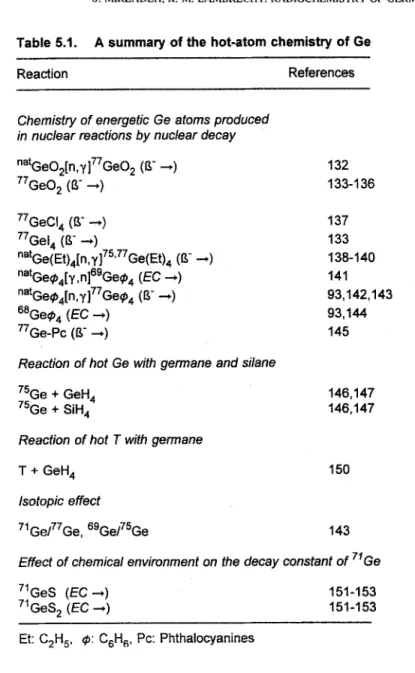
Hot-Atom Chemistry
These free radicals are believed to play an important role in the formation of the radioactive species (volatile and non-volatile). Another aspect of Ge hot atom chemistry deals with the reaction of energetic tritium with the germanes.
Separation Methods
- Volatilization and Gas Chromatography
- Precipitation and Coprecipitation
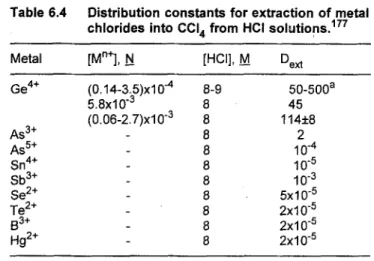
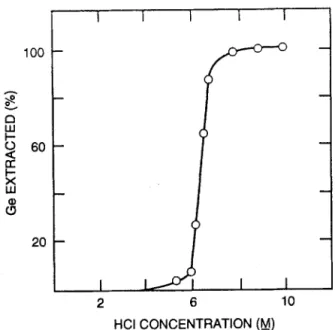
- Extraction
The separation and purification of germanium based on the volatilization method takes advantage of the volatility of GeH 4 and GeCI 4. 131 The effects of the initial concentration of an HCI solution on the degree of distillation of carrier-free 68Ge are shown in Fig. studies yielded a value of 40+4 for the 68Ge distribution constant from the distillation of the azeotropic solutions of HCI.
To further increase the selectivity, GeS 2 is precipitated after the separation of Ge by distillation from acid chloride solutions in the presence of the oxidizing agents (see previous section). These results agree with the results of the adsorption experiments, in which the highest adsorption of carrier-free 68Ge on the sulfides of bismuth and mercury was observed (see Sect. 4). The influence of the nature of the amine on extraction of GeF62-, as a function of HF concentration is shown in Fig.
From the above equation, it is clear that the sharp drop in extraction at both ends of the pH range is due to

L IIII lli II
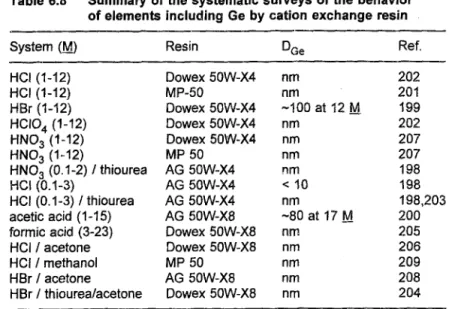
Although the process seems attractive in the sense that separation is independent of the oxidation states of arsenic, the authors are aware of only one brief report by Sewastjanow 172 for separation based on this system. The systematic surveys of the behavior of elements on anion exchange resins are summarized in Table 6.9. The distribution coefficient reaches a value of ~200 in 10 M HCI, where the volatility of the germanium chloride is also noticeable.
211 However, some of the earlier reports show significant adsorption of germanium on anion exchange resins from -1 M__ HF solution. 218 The behavior of germanium in sulfuric acid in anion exchangers has not been studied, but no adsorption could be expected given the fact that germanium forms no or very weak complexes with sulfate ions (as with phosphate ions). Studies of the absorption properties of germanium in inorganic ion exchangers have mainly focused on the development of biomedical 68Ge-68Ga generators [see Sect.
13~ Typically, the magnitude and irreversibility of the adsorption increases when the metal oxides are prepared from acidic solutions.
Electrodeposition
Electrolysis of Ge 4+ from a basic or acidic solution, or from a solution containing complexing agents (e.g. phosphates, oxalates, tartrates, etc.) is usually incomplete and results in only a black layer of thin layer of germanium that adheres poorly to the electrode. . For current densities of 1-10 mA.cm "2 the hydrogen overpotential of Ge is sufficiently high (V in 2 M H2SO4) to explain the inertness of Ge in solutions that are free from oxidizing agents. The overpotential values of Ge are comparable to those for Fe, Ni and Co, but significantly smaller than Zn.
The fact that the electrodeposition of Zn in an acid bath is hindered by the presence of trace amounts of Ge is attributed to lower overpotential of Ge. From solutions of GeCI 4 or Gel 4 in ethylene glycol, diethylene glycol and glycerin it is possible to obtain thick deposits of Ge which adhere strongly to the electrode. Quantitative electrodeposition of 68Ge (in amounts up to 10 mg) from saturated solutions of ammonium chloride has been reported.
The suitability of 68Ge as a positron source has been suggested for positron trapping in metal lattices which is a well recognized technique to study vacancies.
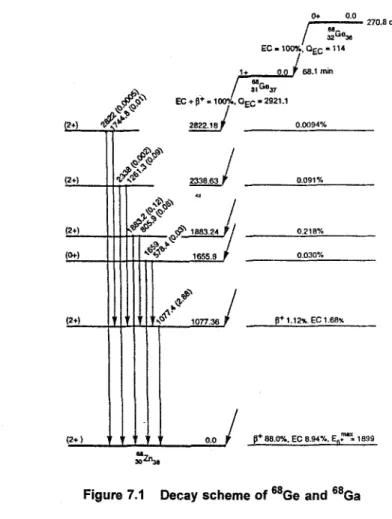
Ge(68)--*Ga(68) Generator in Biomedical Research
In one of the first generators, Ga (not carrier-free) was extracted in acetylacetone (dissolved in cyclohexane) from a buffer solution containing Ge. The only reported evaporation-based generator utilizes the significant vapor pressure of the chlorogermanium compounds from strong aqueous HCI. Subsequently, 68Ga was removed from the surface of the evaporation pan with 0.1 M HCl or 0.1 M NaCl.
Alternatively, carrier-free 68Ge was adsorbed on Sb20 5 , and 68Ga was eluted with an oxalate solution at pH 5-11. For this purpose, the 68Ga-EDTA complex (or any other complex) is usually destroyed with concentrated HCI after the addition of a carrier. Based on this research, a generator was proposed from which the 68Ga can be eluted directly in an ionic form.
The yield of 68Ga from the generator was reproducible at 60% after 600 elutions, while the breakthrough of 68Ge remained.
0.005M EDTA
Ga(71)[v,6"JGe(71): A Radiochemical Detector for the Solar Neutrino
Radiation from solar fusion processes is emitted in the form of neutrinos (v), which have the ability to penetrate from the center of the sun upwards to its surface and into space. The flux of high-energy neutrinos* from the Sun was measured by Davis and co-workers 264 in a very difficult radiochemical experiment using a process called "inverse 6" decay. In addition, in order to minimize the contribution of cosmic rays to the production of 3TAr, this experiment had to be carried out deep underground.
Recent results from the Ga detector, 268 as well as an independent neutrino-electron elastic scattering measurement using a water Cherenkov detector, 269 have confirmed the low neutrino capture rate. The significant suppression of the low-energy neutrino flux from the Sun points to a new fundamental property of the elusive neutrino. Germanium-71 produced in Ga is separated by heterogeneous extraction into dilute HCl in the presence of H 2 O 2 after addition of 160 µg Ge carrier to each tank.
The 71Ge activity is measured by the 10.4-keV K-shell electron signal (produced by the decay of the electronically excited 71Ga daughter) in anticoincidence with the signals from the Nat detector.

Separation of Germanium Radioisotopes from Various Media
- MHcI 1 H202
34;,OBAC I
I AQUEOUS Ge
Rapid Separation of Germanium Isotopes from Fission Products 273
HCI and together with a Ge carrier (0.1-10 rag) and a trace amount of 68Ge (to determine the chemical yield) were placed in flask B, flask A contained 12 ml of 9.5 M_M_ HCI and before adding the contents of flask B to A , flask A and outlet tube were partially emptied.
RIE I
Determination of Germanium by Neutron Activation
In a procedure for the determination of germanium in geological material 1, a sample of 400 pieces of powdered geological material was irradiated in a reactor with a thermal neutron flux of 2.5x10¹² n.s'l.cm'2 for a period of 15 hours. The residue was dissolved in 5 ml H 2 O, brought to near boiling for a few minutes and then transferred to a 40 ml centrifuge cone. The germanium was then back-extracted into 10 ml H 2 O for 2 min and the aqueous phase was transferred to a 40 ml centrifuge cone and H 2 SO 4 was added to make the solution 2.5 M in acid.
Thin-Layer Chromatographic Separation of Carrier-free 77As from 77Ge127
Work at Oak Ridge National Laboratory was sponsored by the United States Department of Energy under contract DE-AC05-84OR21400 with Martin Marietta Energy Systems, Inc. The authors would like to thank Dr. Russ) Knapp, Jr~, ORNL Nuclear Medicine Group, for his continued support and review of the final draft, K. The authors are grateful for permission from various journals to reproduce many of the figures and tables in this monograph.
Germanium (Supplement), Gmelin Handbook of Inor.qanic and Or.qanomettallic Chemistry, Gmelin, Frankfurt (reprint 1958). in German, conclusion of literature 1954). Germanij, Gmelin Handbook of Inorganic and Organometallic Chemistry, Gmelin, Frankfurt (reprint 1961). in German, conclusion of literature 1931). Compounds Ge(CH~)3R and Ge(CzHs)3R, Gmelin Handbook of Inor,kanic and .Or,qanomettallic Chemistry, Gmelin, Frankfurt (1989).
Mirzadeh, S., Some observations on the chemical behavior of carrier-free 68Ge PhD thesis, University of New Mexico (1978).
Electrochemistry
Nagame, Y., Nakahara, H. and Furukawa, M., "Excitation function for reactions on zinc induced by a and 3He particles", Radiochim. Makariunas, K., Makariuniene, E. and Dragunas, A., "Effect of Chemical Structure on the Rate of Radioactive Decay of Germanium-71," Hyperfine Interaction. Sauvenier, Gh., and Duyckaerts, G., "Dosage Polarographique Germanium dans des Minerals et Concentres Germaniferes," Anal Chim.
Kuroda, R., Ishida, K., and Kiriyama, T., "Adsorption behavior of a number of metals in hydrochloric acid on a weakly basic anion exchange resin," Anal Chem. Kiriyama, T., and Kuroda, R., "Distribution coefficients of metals in a strong basic anion exchange resin in aqueous thiocyanic acid," Anal Chim. Oguma, K., and Kudoda, R., "Thin-Layer Chromatographic Behavior of a Number of Metals on DEAE-Cellulose in Organic Solvent-Sulphuric Acid Mixtures," J.
Oguma, K. and Kudoda, R., "Thin-Layer Chromatographic Behavior of Metal Ions on DEAE-Cellulose in Mixtures of Titian Acid and Organic Solvents".