Ontological Foundations for Software
Requirements with a Focus on Requirements at Runtime
Bruno Borlini Duartea, Andre Luiz de Castro Lealb, Ricardo de Almeida Falboa, Giancarlo Guizzardia Renata S. S. Guizzardia, and Vítor E. Silva Souzaa,⇤
aOntology & Conceptual Modeling Research Group (NEMO) – Department of Computer Science – Federal University of Espírito Santo (UFES)
E-mail: [email protected], {falbo, gguizzardi, rguizzardi, vitorsouza}@inf.ufes.br
bDepartment of Mathematics – Federal Rural University of Rio de Janeiro (UFRRJ) E-mail: [email protected]
Abstract.The use of Requirements at Runtime (RRT) is an emerging research area. Many methods and frameworks that make use of requirements models during software execution can be found in the literature. However, there is still a lack of a formal and explicit representation of what RRT are and what are the primary goals of their use. Still, most RRT proposals have their own modeling languages and ways to represent, specify and make use of requirements at runtime, thus resulting in a domain with overloaded concepts. In this paper, we intend to clarify the main notions involved in RRT, establishing an explicit common conceptualization regarding this domain. To do so, we need first to understand what software execution is, as well as what re- quirements are. Thus, we present three related domain ontologies: the Software Ontology (SwO), an ontology about software nature and execution, the Reference Software Requirements Ontology (RSRO), which addresses what requirements are and types of requirements, and the Runtime Requirements Ontology (RRO), which extends SwO and RSRO to represent the nature and context of RRT. For developing these ontologies, we follow SABiO, a well-established Ontology Engineering method. Moreover, all the three ontologies are grounded in the Unified Foundational Ontology (UFO) and are integrated into the Software Engineer- ing Ontology Network (SEON). Finally, as prescribed by SABiO, the ontologies are evaluated using ontology verification and validation techniques.
Keywords: Software Requirements, Runtime, Ontology, UFO, SEON
1. Introduction
In recent years, we have witnessed a growing interest in software systems that can monitor their envi- ronment and, if necessary, change their requirements in order to continue to fulfill their purpose (Dalpiaz et al., 2013; Souza et al., 2013a). This particular kind of software usually consists of a base system re- sponsible for the main functionality, along with a component that monitors the base system, analyzes the data and then reacts appropriately to make sure that the system continues to execute its required functions.
There are many works in the literature that propose different solutions to this issue, such as adaptive or autonomic systems, e.g., (Huebscher and McCann, 2008; Cheng et al., 2009; de Lemos et al., 2013).
We are especially interested in those that deal with this monitoring–adaptation loop using requirements models at runtime. In this context, proposals use different kinds of models and terms to represent what are the system requirements, specify what is to be monitored and prescribe how to adapt. As result, the vocabulary used by these methods is very similar, but the semantics of the entities present in their models are not always the same, thus resulting in a domain with overloaded concepts. In other words, that means that the same name could be used to identify things that are ontologically completely different, and because of that, they have different natures and identities in the real world. This is the case of the termrequirement.
One can refer to requirement as an artifact, described in a requirements specification; someone else can
*Corresponding Author: UFES - Departamento de Informática (CT7), Av. Fernando Ferrari, 514, Goiabieras, Vitória, ES, Brazil; E-mail: [email protected].
1570-5838/17/$17.00 c 2017 – IOS Press and the authors. All rights reserved
understand a requirement as an intention of a stakeholder. Although it seems that we are talking about the same entity, that is not true because they are not ontologically the same.
The construct overload problem, i.e., the same construct used to represent two or more domain entities, and other fairly common problems such as construct redundancy, i.e., a single entity is represented by two or more constructs, have motivated us to develop a domain reference ontology on the use ofRequirements at Runtime(RRT). Bydomain reference ontologywe mean a domain ontology developed with the goal of making a clear and precise description of domain entities for the purposes of communication, learning and problem-solving. A reference ontology is a special kind of conceptual model, representing the con- sensus within a community. It is a solution-independent specification and, thus, it does not focus on max- imizing certain computational properties. In other words, when developing a reference ontology, quality attributes such as precision and truthfulness to the underlying domain are never sacrificed in favor of these computational properties (Guizzardi, 2007).
The goal of this work is to provide a formal representation of the use of RRT, giving a precise de- scription of the domain entities and establishing a common vocabulary to be used by software engineers and stakeholders within the RRT domain, including the distinctions underlying the nature of requirements during the execution of a software system.
However, before capturing the conceptualization underlying the use of RRT, we need to understand two important notions: the first one is what does it mean to run software; the second one is what requirements really are. Thus, we decided to tackle this problem with a divide-and-conquer approach and develop three ontologies. The first, called Software Ontology (SwO), covers the part of the domain about software nature and how it is executed at runtime. The second, called Reference Software Requirements Ontologies (RSRO), focuses on requirements in general, their main types, and how they are documented. The third and most specific one, is called Runtime Requirements Ontology (RRO). RRO extends RSRO and SwO, focusing on the use of requirements during software execution.
The ontologies presented here are intended to be used for conceptual clarification and terminological systematization of the existing approaches, in sub-areas like adaptive systems, requirements monitoring, context-aware systems and so on, as well as for serving as a knowledge framework for developing and re-engineering RRT approaches. Furthermore, they can be used as a conceptual model for tools developed for these purposes. Operational versions of the ontologies could be implemented in languages like OWL, for a formal annotation of the models used by these proposals, providing traceability of the requirements during their life-cycle, from design-time to runtime. Lastly, the ontologies can be used for interoperabil- ity purposes, allowing frameworks that make use of requirements at runtime to inter-operate. All three ontologies are integrated into the Software Engineering Ontology Network (SEON) (Ruy et al., 2016).
SwO, RSRO and RRO were developed following the process defined by SABiO (Falbo, 2014), an on- tology engineering method, and using UFO (Guizzardi, 2005) as foundational ontology. As recommended by SABiO, SwO, RSRO and RRO were evaluated by verification and validation activities. Verification was accomplished by checking if the Competency Questions initially raised were answered by the respective ontology. Validation was done by instantiating the ontologies with data extracted from real world projects using three frameworks that propose the use of requirements at runtime, namely FLAGS (Baresi et al., 2010), ReqMon (Robinson, 2006) andZanshin(Souza, 2012). Finally. it is important to mention that the ontologies were built in this modular way (instead of one big ontology), so that they can be easily found and reused later.
This paper is an extended version of (Duarte et al., 2016). For this version, we present as main contribu- tion three ontologies — SwO, RSRO and RRO — and integrate them into an ontology network (SEON).
Moreover, we provide a formal characterization for the domain specific categories as well as constraints involving them. Lastly, we instantiated the ontologies using other two RRT frameworks, improving vali- dation. The verification process was also improved, through the definition of test cases.
The rest of the paper is structured as follows. Section 2 summarizes the general concepts of the RRT domain. In particular, it presents the results of systematic mapping of the literature we performed in the area. Section 3 describes the methodology used to build SwO, RSRO and RRO. Section 4 introduces the ontological foundations for the proposed ontologies. Sections 5, 6 and 7 present SwO, RSRO and RRO,
the main contributions of this paper. Section 8 discusses how the ontologies were evaluated. Section 9 compares related work. Finally, Section 10 concludes the paper.
2. Background
This section presents, in Section 2.1, the basic concepts about the use of requirements at runtime that are responsible to provide the theoretical background for the development of this work. Section 2.2 presents the results of the systematic mapping that were performed to capture the consensual knowledge about the requirement at runtime domain. It also presents three frameworks that propose the use of requirements at runtime:Zanshin, ReqMon and FLAGS. These frameworks are used to instantiate SwO, RSRO and RRO, as a form of validation in Section 8. They were chosen because: (i) they are all present in the systematic mapping of the literature on Requirements at Runtime (RRT) that was used as a knowledge base for the ontologies; (ii) they are widely accepted by the RRT community, with many publications over the years;
and (iii) because they differ in the way they treat/deal with RRT.
2.1. Requirements at Runtime
Requirement Engineering (RE) is the field of Software Engineering (SE) concerned with understanding, modeling, analyzing, negotiating, documenting, validating and managing requirements for software-based systems (Cheng and Atlee, 2007). In the RE literature, there is a strong overloading of the termrequirement and, hence, different texts refer to requirements in different possible senses, for example, as an artifact, as an intention, as a desire or as a property of a system.
The seminal work by Zave and Jackson (1997) defines the termrequirementas a desired property of an environment, which comprehends the software system and its surroundings, that intends to express the desires and intentions of the stakeholders concerning a given software development project. A require- ment, however, can be seen as an intention or a desire when acting as a high-level requirement, or as an artifact, when documented as part of a specification. In turn, such documentation can have different levels of abstraction, for instance, depending on whether it is part of an early requirements analysis or a machine- readable artifact (file) that allows reasoning over requirements during the execution of the software. Fea- tures such as the latter have motivated research on the topic ofRequirements at Runtime(RRT) (Bencomo et al., 2011).
For instance, Feather et al. (1998) monitor violation of requirements using Linear Temporal Logic ex- pressions that are observed by a monitoring component at runtime in order to try and reconcile system re- quirements and behavior. Requirements are documented using a Goal-Oriented RE (GORE) approach for design-time purposes and as the aforementioned logical expressions for runtime purposes. TheRequire- ments Reflectionapproach (Bencomo et al., 2010a) proposes not only that requirements be reified as run- time entities but that they keep traceability to the architectural models and all the way back to high-level goals.
Souza et al. (2013b) define arequirement at runtimeas the classes or scripts that represent the require- ments being instantiated during the execution of a program, i.e., a compiled code artifact loaded in mem- ory to represent the fact that someone (or something) is using the system in order to satisfy a require- ment. Qureshi and Perini (2010) have a similar vision, as they understand that arequirement at runtimeis expressed by the users requests, which are captured by the software user interface and also monitored in order to check if it is in an agreement with the original specifications. More recently, Dalpiaz et al. (2013) propose, in the context of GORE, the distinction between a Design-time Goal Model—used to design a system—and a Runtime Goal Model—used to analyze a system’s runtime behavior with respect to its requirements.
These and other works illustrate the diversity of concepts, models and features that have been proposed in the field of RRT, showing us that there is no consensual definition about what is a runtime requirement and thatRequirementis a complex entity that can exist during the entire software life-cycle, since design-
time until runtime. However, the use of requirements as a runtime entity is a fairly recent and there is no formal representation about this domain in the literature. This lack of a formal and consensus-based description has motivated us to develop a reference ontology about this domain. The purpose is to unify an interpretation for requirements and then to characterize how it relates to other intimately connected elements in the RRT domain.
2.2. A Systematic Mapping of the Literature
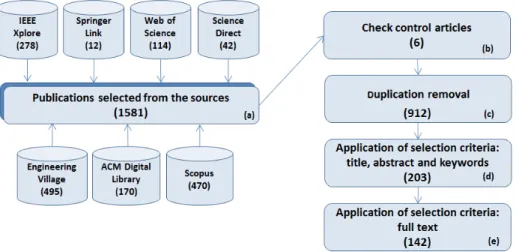
To identify proposals that use RRT, we performed a systematic mapping of the literature as a knowledge acquisition activity (as opposed to relying solely on the opinion of a few domain experts from our research group). Kitchenham and Charters (2007) define a Systematic Mapping as an extensive study on a specific topic that intends to identify evidence available on this theme. Following their method, we applied the steps illustrated in Figure 1.
Fig. 1. Steps of the Systematic Mapping process on RRT.
First, we defined asearch stringthat intended to cover all the relevant aspects of our research, and applied it in several search engines, in an attempt to find most studies existing in the literature about the research domain. In total, 1581 studies were returned by the search string. The search string was validated by checking if the control articles(6) that were chosen beforehand were retrieved from the databases.
Next, papers returned from all search engines were combined and duplicate entries were removed. As result of this step, 912 studies remained. Then, we applied two filters, considering inclusion and exclusion criteria established at the beginning of the process. In this first filter, only the abstracts were read to evaluate if a paper should be selected or excluded from the mapping. Then, the selected publications (203) were once again analyzed against the selection criteria, but now considering the full text of the publication. To help reduce bias, publications were analyzed in the second filter by different specialist from the first. As result, 142 publications were found to satisfy the selection criteria, which accounts for a 91,02% reduction from the starting 1581 results. These 142 publications were read, the research questions were answered and the information gathered with the systematic mapping were used as the primary source of knowledge to build RRO.
During the mapping, we classified publications by purpose of use of RRT, separating them in two major categories:Monitor RequirementsandChange Requirements. The former covers publications that propose checking if requirements defined at design time are being achieved at runtime, whereas the later covers papers in which requirements are used not only as guidelines to monitoring but also as rules on how the system should adapt to keep satisfying its requirements. Although the results of the mapping are briefly summarized here, the mapping is not in the scope of this paper.
2.3. The Zanshin Framework
Zanshin(Souza, 2012; Souza et al., 2013a,b) is an RE-based framework created for the development of adaptive systems. Its main idea is to make elements of the feedback loop responsible to provide adap- tivity important entities in the requirements models used by the framework. To do that,Zanshinuses re- quirements models based on GORE (Goal-Oriented Requirements Engineering) to represent system re- quirements.Zanshin’s specific models are augmented with new elements, called Awareness Requirements (AwReqs) and Evolution Requirements (EvoReqs) that, when combined with classic GORE constructs (goals, softgoals, tasks, AND-OR refinements, and so on), are able to represent monitoring and adaptation strategies during the execution of a software system.
Figure 2 presentsZanshin’s basic architecture.AwReqsare requirements that refer to the state of other requirements of a software system at runtime. In other words,AwReqsare responsible for representing the parts of the system that the stakeholders want it to be able to adapt.EvoReqsare requirements that describe how other requirements are supposed to adapt/evolve in response to anAwReqfailure.EvoReqsact directly over system requirements through a set of adaptation strategies. During runtime, they are responsible to ensure that the system is fulfilling what was previously specified by the stakeholders.
Fig. 2.Zanshin’s architecture representation (Souza, 2012)
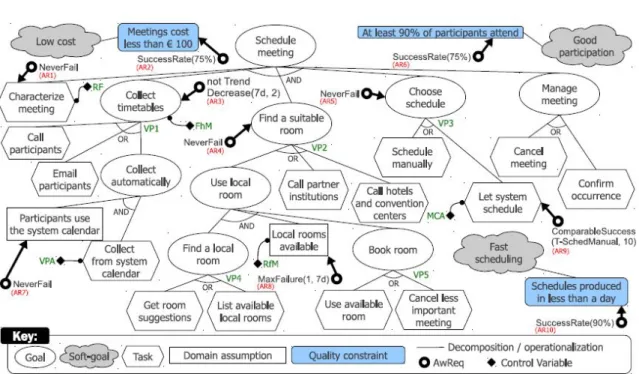
Figure 3 represents the requirements model of a Meeting Scheduler system created as a proof-of-concept for theZanshinframework.AwReqsappear in the Meeting Scheduler requirements model as small bold circles with arrows, pointing out to the elements of the system that need to have their states monitored.
EvoReqsare not graphically represented in the requirements model, however, they are implemented as a code artifact that will be executed byZanshinwhen anAwReqfails. For instance, if, for some reason, a meeting cannot be properly scheduled in the system, AR1 (NeverFail, at the top-left corner of Figure 3) will trigger theEvoReq Retry Characterize Meeting, that will make the system perform a rollback, wait for 5 seconds, and then try to schedule the meeting again. The rest of the model and the other elements of the modeling language are better described in (Souza, 2012).
2.4. ReqMon Framework
ReqMon (Robinson, 2006) is a framework for monitoring software systems requirements at runtime.
ReqMon was developed with the main objective of improving the visibility of conformity policies inside a software system and to be used by system users that have permissions to receive information about the satisfaction of the system requirements. The ReqMon framework presents a requirements definition language based on KAOS (Van Lamsweerde et al., 1991), a systematic methodology for requirements elicitation and analysis to be used in design-time, and a software tool built to provide a requirements monitoring service during runtime.
Fig. 3. Requirements model of a Meeting Scheduler, created with theZanshinapproach (Souza, 2012)
Figure 4 presents ReqMon’s architecture and its main components. The Event Capturer is responsible to monitor and capture, during runtime, any deviation in the requirements of the main system, i.e, the system being monitored. The Analyzer updates the status of the main system monitors and the Repository acts like a database of events, persisting a history of the monitored indicators.
Fig. 4. ReqMon framework architecture (Robinson, 2006)
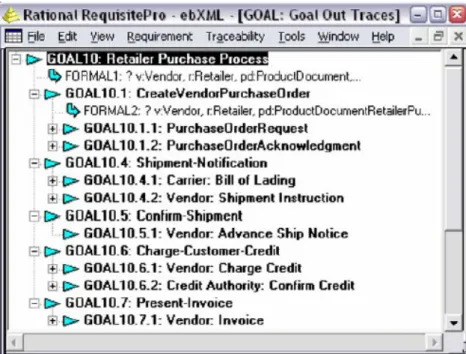
Figure 5 presents the Retailer Purchase goal tree, from an e-commerce application that is used in (Robinson, 2006) to illustrate the use of ReqMon. Since ReqMon uses a KAOS-based language to rep- resent its requirements, all goals have a formal definition. The language, in order to account for runtime variability, makes use of temporal operators. At runtime, goals (the root-goalRetailer Purchaseand its subgoals) can be monitored by a tool called ReqMon Designer Model.
LikeZanshin, ReqMon characterizes requirements as goals, also understanding them as complex en- tities that exist both at design-time and runtime of a software system, organizing them in requirements models that aim to provide requirements traceability during the software life-cycle. However,Zanshinand ReqMon are different in the sense that the former is focused on adaptations/evolution of a software system through changes in its requirements, while the latter is focused on monitoring the system and verifying if the requirements are being fulfilled. These similarities and differences are the main reasons why they were chosen to be instantiated to validate RRO.
Fig. 5. ReqMon representation ofRetailer Purchasegoal tree (Robinson, 2006)
2.5. FLAGS Framework
The Fuzzy Live Adaptive Goals for Self-Adaptive Systems (FLAGS) (Baresi et al., 2010; Pasquale et al., 2011) is a GORE-based framework for designing self-adaptive systems which extends the KAOS model (Van Lamsweerde et al., 1991), adding the concept of adaptive goals. Adaptive goals are live runtime entities, consisting of requirements that are responsible for defining the countermeasures that must be performed in order to keep system goals satisfied. Countermeasures may act by updating an existing requirement (relaxing or tightening), replacing it for a new one or even preventing it from being violated.
In other words, countermeasures are responsible to change the live goal model that is kept by the system.
Figure 6 presents the FLAGS runtime infrastructure that allows requirements being used as runtime entities that provide adaptation capabilities to the system. In order to support requirements evolution, FLAGS works at the process and goal levels, managing two models at runtime: the FLAGS model and the implementation model. The first has requirements and adaptation goals, while the second includes the definition of the process and the monitoring and adaptation capabilities that are necessary at the process level.
The Process Reasoner is the core component of the architecture, being responsible for controlling the adaptation at the process level. To accomplish that, it monitors the runtime data that is collected to check if the conditions for an adaptation are satisfied. It is also responsible to send to the Goal Reasoner, runtime data that is used to change elements in the goal model. At the goal level, if a designer creates a new version of the FLAGS model using the Graphical Designer, live instances of this model are sent to the Process Reasoner, which propagates the changes to the running and next process instance of the system.
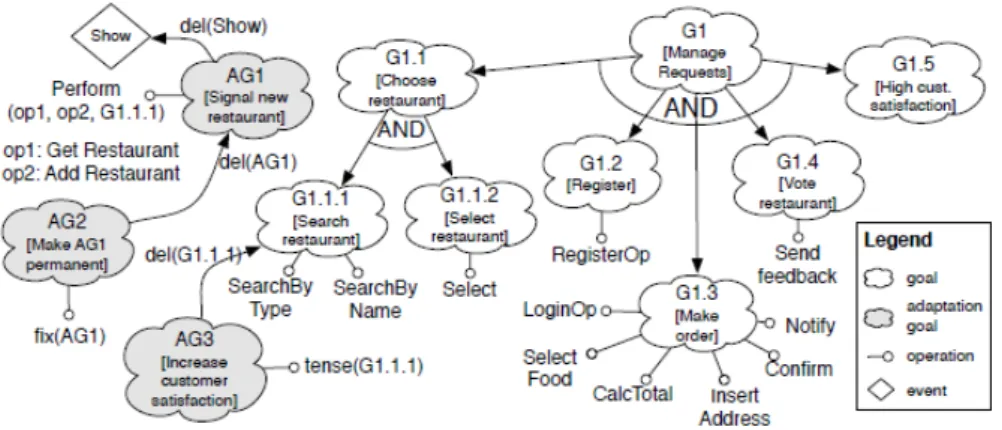
To illustrate the method, Figure 7 presents the FLAGS model for a web application called Click&Eat.
White clouds are the main goals for Click&Eat, gray clouds represent the adaptation goals that define the adaptation capabilities of the system. The small circles represent the operationalizations of the adaptive goals, which define the exact actions that must be performed when an adaptation condition is triggered. In comparison toZanshinand ReqMon, FLAGS also treats requirements as goals, and live goals models are also used at runtime as first-class citizens. However, FLAGS is closer toZanshin, since it also deals with runtime requirements-based adaptation, even creating a runtime entity that defines how the requirements
Fig. 6. FLAGS Runtime infrastructure (Pasquale et al., 2011)
needs to change. Other examples and a better description of the FLAGS modeling language can be found in (Baresi et al., 2010).
Fig. 7. FLAGS model for a Click&Eat web application (Pasquale et al., 2011)
Lastly, it is important to mention that adaptation goals proposed by FLAGS, monitoring requirements used by ReqMon andAwReqsandEvoReqsproposed byZanshinare examples of requirements being used at runtime, whose characteristics and properties are discussed in Section 7.
3. Methodology
To develop the ontologies presented in this paper, we used SABiO, a Systematic Approach for Building Ontologies (Falbo, 2014). SABiO supports the development of domain reference ontologies, as well as the design and coding of operational ontologies. We chose SABiO because it has been successfully used to develop domain ontologies, in particular Software Engineering reference domain ontologies, includ- ing the ones already integrated in SEON, such as: Software Process Ontology – SPO (Bringuente et al., 2011), Software Measurement Ontology – RSMO (Barcellos et al., 2010) and the Reference Ontology on Software Testing – RooST (de Souza et al., 2017).
SABiO’s development process comprises five main phases, namely (Falbo, 2014): (1) Purpose Identifi- cation and Requirements Elicitation; (2) Ontology Capture and Formalization; (3) Design; (4) Implemen- tation; and (5) Test. These phases are accompanied by support processes, such as knowledge acquisition, reuse, documentation and evaluation. SABiO aims at developing both reference ontologies (phases 1 and 2) and operational ontologies (phases 3, 4 and 5). In this work, we are interested in building only domain reference ontologies, thus we performed only the first two phases. Although we did not implement the ontologies, we designed test cases for them.
In the Purpose Identification and Requirements Elicitation phase, we started defining the purpose, scope and intended uses for each ontology. Next, we identified Competency Questions (CQs) as func- tional requirements for the domain ontologies. CQs are questions that the ontology should be able to an- swer (Grüninger and Fox, 1995). Analogously with the traditional Requirements Engineering (RE), be- sides representing functional requirements, CQs help to refine the scope of the ontology. They are also used in the ontology verification process to check if the ontology elements (concepts, relations, proper- ties and axioms) are able and sufficient to answer the CQs (Falbo, 2014). Moreover, it is important to highlight that CQs for SwO, RSRO and RRO were refined during each ontology development process.
CQs were raised through several meetings with domain experts and through the analysis of international standards (for RSRO) and results of the systematic mapping presented in Section 2 (for SwO and RRO), in a bottom-up strategy, starting with simpler questions and proceeding to find more complex ones.
As non-functional requirements for the three ontologies, we defined that they would: be grounded on a well-known foundational ontology (NFR1); be based on consensual work from the literature (NFR2);
and to be integrated to the Software Engineering Ontology Network (SEON) (Ruy et al., 2016), reusing existing networked ontologies, or other relevant ontologies already published in the literature (NFR3).
For NFR1, we grounded our ontologies in the Unified Foundational Ontology (UFO) (Guizzardi, 2005;
Guizzardi et al., 2008). UFO provides a set of entities and relations types, that are useful for Conceptual Modeling. Also, UFO is the foundational ontology that is suggested by SABiO. In Section 4, we present the fragment of UFO used to provide the ontological foundations for SwO, RSRO and RRO.
To satisfy NFR2, we followed different approaches for each ontology. In the case of SwO, we took Wang et al.’s Ontology of Software Artifacts (Wang et al., 2014) as basis, as well as the results of the systematic mapping we performed in the RRT domain. These results were useful, since they reveal very relevant notions related to software being executed at runtime. It is important to say that, although we were inspired by Wang et al.’s work, besides encompassing what software is and its artifactual nature — aspects addressed in (Wang et al., 2014) — SwO focuses also on software execution.
In the case of RSRO, we studied relevant standards, such as CMMI (SEI/CMU, 2010) and SWE- BOK (Bourque et al., 2014), and selected publications, including classic Requirements Engineering pa- pers (Kotonya and Sommerville, 1998; Wohlin et al., 2005; Robertson and Robertson, 2012). We chose these references because they are widely accepted by the RE community, including the software indus- try, and, in some sense, represent common aspects of the RE domain. Moreover, we explored the work of Guizzardi et al. (2014), who did an ontological interpretation of non-functional requirements based on definitions provided by UFO.
In the case of RRO, it is important to highlight that the RRT domain its fairly new (according to our research, around 16 years), in particular when compared with traditional Software Engineering. Thus, there is still a lack of standards and capability models that focus on the use of requirements at runtime.
Based on that, we decided to investigate this domain by means of a systematic mapping of the literature (briefly reported in Section 2.2), and thus to gather consensual information about the RRT domain.
Regarding NFR3, to build both SwO and RSRO, we reused parts of SEON’s core ontology on software process (SPO), in particular its sub-ontology about software artifacts, as well as the ontologies developed by Wang et al. (2014) regarding software artifacts (named here OSA), and by Guizzardi et al. (2014) concerning requirements (named here NFRO). This approach required us to integrate these ontologies to SEON’s Software Artifact ontology. Finally, SwO and RSRO were reused to build RRO. In this way, all the resulting ontologies were integrated to SEON. This reuse and integration process is further discussed in Section 4.
Given the requirements and the results of the systematic mapping, we started capturing the concepts and relations of our ontologies, and building their conceptual models. This task was highly iterative and involved weekly meetings in which the primary aspects of the ontologies were discussed and defined.
These meetings were attended by several specialists in the areas of Requirements Engineering and Ontol- ogy Engineering (expanding the initial group of four engineers involved in the systematic mapping), who played different roles depending on the context: in requirement elicitation meetings, they acted as Domain Experts on Requirements and RRT, whereas in verification meetings, in which the many versions of the ontologies were analyzed and polished, they also played the role of Ontology Engineers. The resulting reference models and primary products of this work are presented in Sections 5, 6 and 7.
Finally, as prescribed by SABiO, once the reference ontologies are developed, they need to be eval- uated. SABiO’s Evaluation Process comprises two main perspectives: (i) Ontology Verification: aims to ensure that the ontology is being built correctly, in the sense that the output artifacts of an activity meet the specifications imposed on them in previous activities. (ii)Ontology Validation: aims to ensure that the right ontology is being built, that is, the ontology fulfills its specific intended purpose. To evaluate the three ontologies, we applied two evaluation approaches, namely: assessment by humans, and data-driven evalu- ation (Brank et al., 2005). For evaluating the reference ontologies as a whole (intended purposes, compe- tency questions and conceptual models), expert judgment was performed. In particular, for addressing on- tology verification, we built tables indicating which ontology elements (concepts, relations, and axioms) are able to answer each competency question, as suggested by SABiO. For evaluating if the reference ontologies are able to represent real world situations, concepts and relations of the ontologies were instan- tiated using data extracted from examples of methods described in Section 2, in a data-driven approach to ontology validation. Finally, we defined test cases for the ontologies, showing how the competency questions should be answered when using the instantiations as test case inputs.
4. Ontological Foundations
As discussed above, for building SwO and RSRO, we reused Wang et al.’s Ontology of Software Arti- facts – OSA (Wang et al., 2014), and the ontological interpretation of non-functional requirements-related notions – NFRO (Guizzardi et al., 2014), as well as SEON’s Artifact sub-ontology. Moreover, all three developed ontologies were grounded in UFO. In this section, we briefly discuss these ontological founda- tions.
4.1. UFO
The Unified Foundational Ontology – UFO (Guizzardi, 2005; Guizzardi et al., 2008) is a well- established foundational ontology that has been developed based on a number of theories from Formal On- tology, Philosophical Logics, Philosophy of Language, Linguistics and Cognitive Psychology. We chose UFO because it has been constructed with the primary goal of developing foundations for conceptual modeling. Consequently, UFO addresses many essential aspects for conceptual modeling, which have not received a sufficiently detailed attention in other foundational ontologies (Guizzardi, 2005). Examples are the notions of material relations and relational properties. For instance, this issue did not receive up to now a treatment in DOLCE (Masolo et al., 2003), which focuses solely on intrinsic properties (qualities).
Moreover, UFO offers a complete set of categories to tackle the specificities of the targeted domain and it has been successfully employed in a number of semantic analyses, such as the one conducted here (see detailed discussion in (Guizzardi et al., 2015)).
UFO is composed of three main parts: UFO-A, an ontology of endurants (Guizzardi, 2005); UFO-B, an ontology of perdurants/events (Guizzardi et al., 2013); and UFO-C, an ontology of social entities (both endurants and perdurants) built on top of UFO-A and UFO-B (Guizzardi et al., 2008). In Figure 8, we present only a fragment of UFO containing the categories that are germane for the purposes of this article.
Moreover, we illustrate these categories and some contextually relevant relations using UML (Unified
Modeling Language) class diagrams. These diagrams are used here primarily for visualization. The reader interested in an in-depth discussion and formal characterization of UFO is referred to (Guizzardi, 2005;
Guizzardi et al., 2008, 2013; Benevides et al., 2010).
Fig. 8. Fragment of UFO showing Goals, Agents and Intentions.
Endurants and Perdurants are Concrete Individuals, entities that exist in reality and possess an identity that is unique.Endurantsare entities that do not have temporal parts, but persist in time while keeping their identity (e.g., a person).Perdurants, also calledEvents, are composed by temporal parts (e.g., a trip) (Guizzardi et al., 2013, 2016).
Substantialsare existentially independentEndurants. They can be agentive (Agent), i.e., bear inten- tional properties (states) such as beliefs, desires, intentions; or non-agentive (Object).Agentscan bear special kinds of moments called Intentional Moments. AnIntentionis a specific type ofIntentional Momentthat refers to a desired state of affairs for which anAgentcommits to pursuing (e.g., the intention of a student to take an exam). AGoalis aProposition(the propositional content of anIntention) that can be satisfied by aSituation, i.e., a portion of the reality that can be comprehended as a whole, iff the Situationis the truthmaker of thePropositionexpressed by theGoal(Guizzardi et al., 2008).Functions andDispositionsareIntrinsic Moments, i.e., existentially dependent entities that are realizable through the occurrence of anEvent. This occurrence brings about aSituation.
4.2. NFR Ontology
Based on UFO, Guizzardi et al. (2014) present an interpretation of the difference between Functional and Non-Functional Requirements (FRs/NFRs), a frequently used categorization scheme in Requirements Engineering. As Figure 9 shows, requirements areGoals(as in UFO) and can befunctionaland/ornon- functional requirements.Functional Requirementsare those which refer toFunctions, whereasNFRs refer toQualitiestakingQuality Valuesin particularQuality Regions. Because the distinction between FRs/NFRs is usually accepted in the Requirements Engineering community and, also, because it is very relevant for the RRT domain, we decided to reuse this ontology in our work. The fact that the ontology is also grounded in UFO made the reuse simpler.
Moreover, the NFR Ontology is the only ontology we are aware of that combines the following char- acteristics: it is grounded on a foundational ontology (in fact, the same foundational ontology we use);
provides a precise criteria for differentiating between FRs and NFRs; deals with vagueness in NFRs.
These characteristics equip the ontology to support the process of requirements engineering by helping to clarify the elicitation and representation of software requirements as well as their satisfaction conditions (including the case of vague NFRs). By reusing this ontology, our proposal in this paper inherits these benefits.
Fig. 9. Non-functional Requirements and related concepts (Guizzardi et al., 2014).
4.3. Ontology of Software Artifacts
In Wang et al.’s Ontology of Software Artifacts – OSA (Wang et al., 2014), software is a special kind of entity that is capable of changing while maintaining its numerical identity. These changes (i.e., a simple bug fix or an entirely new release) are necessary for the natural evolution of software and are also one of the engines that move the software industry. When we start to think in specific software such as, e.g., Microsoft Excel, this fact becomes clearer: Excel has many releases and even more versions throughout its 30 years of existence, but has always maintained its identity as Microsoft’s spreadsheet software.
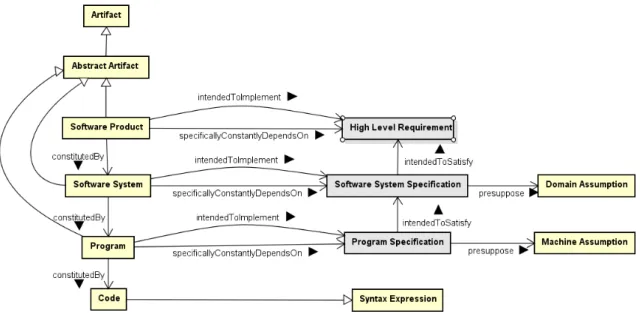
To try to answer questions like “what does it mean for software to change?”, “what is the difference between a new release and a new version?” and to address the ontological reasons for software being able to change while maintaining its nature, Wang et al. (2014) propose an ontology of software inspired by the Requirements Engineering literature, depicted in Figure 10, which shows a fragment of the original ontology. OSA makes the distinction between three artifacts:Software Product,Software Systemand Program. It also deals with the differences between aProgramseen as a piece ofCodeand as a process, running in a medium.
AProgramis a special type ofAbstract Artifact, i.e., a non-physical entity created by humans (Ir- mak, 2013), with temporal properties and constituted byCode(a sequence of machine instructions). A Programis created with the purpose of performing a function of a given type, which is specified in a Program Specification. TheProgramis considered anAbstract Artifactbecause of its complex nature:
it behaves as a universal since it has characteristics that are repeatable in its copies, but it also does not exists outside space and time, unlike a universal.
ASoftware Systemis constituted by a set ofProgramsand intends to determine the behavior of the machine towards the external environment. This behavior is specified by the Software System Speci- fication. TheSoftware Productis considered anAbstract Artifactthat intends to implement theHigh Level Requirements, which represent the stakeholders intentions and goals.
It is important to mention that, although OSA is grounded in DOLCE, it is based in a part of DOLCE that is completely mappable to UFO. Thus, we could reuse it straightforwardly. Furthermore, OSA is the
Fig. 10. Fragment of the Ontology of Software Artifacts (Wang et al., 2014).
only ontology we are aware of that combines the following characteristics: it is grounded in a foundational ontology (whose portion used by OSA is mappable to the one we use); it explicitly accounts for the different identity conditions and dependence relations of the multiple artifacts involved in a software ecosystem; and is built over the background of an established requirements engineering framework (the model of Zave and Jackson (1997)).
The use of OSA can bring several benefits to the work proposed here. Firstly, because it can potentially allow us (in a future extension to this ontology) to differentiate among the requirements that can be related to different software-associated artifacts (e.g., licensed software products requirements versus program requirements). Secondly, as discussed by Wang et al. (2014), by properly distinguishing all these kinds of software-associated artifacts, OSA can support a next-generation of more advanced software configuration management processes and tools. By reusing the OSA ontology, the models proposed here inherit these finer-grained distinctions made by the original ontology. For instance, as a by-product of this process, this could afford improving the management of several potential configuration items that appear in the proposed ontologies (e.g., different types of requirements specification) by associating them with different software-associated artifacts.
4.4. SEON
The ontologies developed in this work were integrated to the Software Engineering Ontology Network (SEON) (Ruy et al., 2016). An ontology network is a collection of ontologies related together through a variety of relationships, such as alignment, modularization and dependency. A networked ontology, in turn, is an ontology included in such a network, sharing concepts and relations with other ontologies (Suárez- Figueroa et al., 2012). SEON is designed seeking to: (i) take advantage of well-founded ontologies (all its ontologies are ultimately grounded in UFO); (ii) provide ontology reusability and productivity, supported by core ontologies organized as Ontology Pattern Languages (Falbo et al., 2016); and (iii) solve ontology integration problems by providing integration mechanisms (Ruy et al., 2016).
In its current version, SEON has a core ontology of software processes (SPO), as well as domain on- tologies for the main technical Software Engineering sub-domains, namely requirements, design, coding and testing, and for some management sub-domains, namely software measurement, project management, configuration management, and quality assurance. Figure 11 presents an overview of SEON (its complete specification is available athttps://nemo.inf.ufes.br/projects/seon/). Each circle rep-
resents an ontology. The circle in the center is the core ontology, the ones closer to the borders are domain ontologies already integrated in SEON. The circles’ sizes vary according to the ontologies’ sizes in terms of number of concepts (represented inside the circles in parenthesis). Lines represent links between net- worked ontologies, and line thickness represents the coupling level between them (in terms of number of relationships between concepts in different ontologies).
Fig. 11. SEON: The Network view (Ruy et al., 2016).
Concerning requirements, ReqON is SEON’s ontology subnetwork devoted to requirements. The Ref- erence Software Requirements Ontology (RSRO), presented in Section 6, is the main ontology in the re- quirements domain. It captures the most general notions regarding requirements, which are valid for many Requirements Engineering approaches. The Goal-Oriented Requirements Ontology (GORO) (Negri et al., 2017) focuses on the basic notions of Goal-Oriented Requirements Engineering. The Requirements De- velopment Process Ontology (RDPO) (Ruy et al., 2016) aims at representing the activities, artifacts and stakeholders involved in the software requirements development process. Finally, the Runtime Require- ments Ontology (RRO), which is presented in Section 7, addresses the use of requirements at runtime.
RSRO and SwO extend SEON’s Software Process Ontology (SPO), more precisely, SPO’s Artifacts sub-ontology. As Figure 12 shows,Artifactsare objects intentionally made to serve a given purpose in the context of a software project or organization.Stakeholdersmay be responsible for them.Artifactscan be simple or composite, depending on their mereological structure. AComposite Artifactis anArtifactthat is composed by two or moreArtifacts. On the other hand, aSimple Artifactis an atomic one, anArtifact that cannot be decomposed in others. In other words, if anArtifactis composite, then it must have at least two disjoint (non-overlapping) parts, which can be simple, composite or any combination of both.
SPO also classifies artifacts according to their natures. ASoftware Productis defined as one or more computerProgramstogether with any accompanying auxiliary items, such as documentation, delivered under a single name, ready for use (e.g., Microsoft Word, Eclipse IDE). A Software Itemis a piece of software, produced during the software process, not considered a complete Software Product, but an intermediary result (e.g., a component). A Document, in turn, is any written or pictorial, uniquely identified information related to the software development, usually presented in a predefined format (e.g.,
Fig. 12. SEON’s view regarding Software and Related Artifacts.
a requirements document, a report). AnInformation Itemis a piece of relevant information for human use, produced or used by an activity (e.g, a component description, a bug report). AModelis a representation (abstraction) of a process or system from a particular perspective (e.g., a use case model, a class model).
In Section 5, we present SwO, the SEON’s Software Ontology, which is strongly based on OSA. In fact, SwO incorporates parts of OSA to SEON.
5. Software Ontology (SwO)
The Software Ontology (SwO) aims to capture the complex artifactual nature of software. Software, is a complex entity constituted of different types of artifacts, such as software systems, programs and code. SwO is a domain reference ontology that aims to explain this complex software nature and how it is materialized inside a computer, being executed and producing results that go beyond the limits of the machine, directly affecting the real world. Since it is a fairly general ontology, closer to the core level than RSRO and RRO, SwO is widely reusable for developing more specific domain ontologies, as it is the case of RRO, but also to describe other types of software, such as Software Service and Multimedia Systems.
SwO aims to answer the following CQs:
– CQ1:What is a software product?
– CQ2:What is a software system?
– CQ3:What is a program?
– CQ4:When is a program functionally in conformance with its specification?
– CQ5:What is a running program?
– CQ6:Where does a running program execute?
– CQ7:What can be observed from a running program execution?
As Figure 13 shows, SwO extends part of the Software Artifact sub-ontology of SPO, while incorpo- rating concepts from OSA. In this figure, concepts from SwO are shown in white (those reused from OSA are prefixed by OSA), concepts from SPO are shown in green, and concepts from UFO are shown in grey.
As in OSA, aSoftware Productis constituted ofSoftware Systems. However, in SPO, it is made ex- plicit that, as aComposite Artifact,Software Productincludes also other artifacts, such asDocuments, ModelsandSoftware Items. Thus, aSoftware Productis constituted of one or moreSoftware Sys- tems, together with any accompanying auxiliary items, such as documentation, delivered under a single name, ready for use (e.g., Astah modeling tool, Microsoft Word, Eclipse IDE).
Like in OSA, aSoftware System(a subtype of Software Item in SwO) is constituted ofPrograms, and intends to implement aSystem Specification(a subtype ofDocument in SwO). AProgram, in turn, is also defined as aSoftware Item, a piece of software, produced during the software process, not considered a completeSoftware System, but which aims at producing a certain result through execution on a computer, in a particular way, given by the Program Specification, which is aDocument that
Fig. 13. Conceptual model fragment of SwO.
belongs to the solution domain, describing structural and functional information about theProgramwith enough detail that would allow implementation and maintenance. AProgramis constituted byCode(a subtype ofSoftware Item) written for a specific machine environment (e.g., Microsoft Excel for MacOS).
A portion of Codecan implement a Program Specification, which, in turn, may intend to satisfy a System Specification.
Since aProgram Specificationdescribes a set ofSoftware Function Universals, we can introduce another important notion: the satisfaction of the specification. Axiom A1 captures this notion in SwO: a Programpis functionally in conformance to itsProgram Specificationpsif and only ifpimplements exactly the sameSoftware Function Universalsthat are described byps. In other words, for a program to be functionally in conformance with its specification, it must implement exactly the same set ofSoftware Function Universalsthat are described by theProgram Specification.
8p:P rogram, ps:P rogramSpecif ication f unctionallyConf ormant(p, ps) (A1) () (8sf u:Sof twareF unctionU niversal describes(ps, sf u)
$implements(p, sf u))
To run aProgram, one must have a copy of the program and execute it. Irmak (2013) defines such copy as physical dispositions of particular computer components (e.g., the hard drive) to do certain things. He then describes the execution of the program as a kind of event, the physical manifestation of the aforemen- tioned dispositions. This copy, being a disposition, is a kind of endurant and, thus, can change qualitatively while maintaining its identity, unlike an event, which cannot change (Moltmann, 2007; Guizzardi et al., 2016).
In SwO, aLoaded Program Copyis a complex Disposition that is constituted by one or moreSoft- ware Functions, which are, in turn, instances ofSoftware Function Universals. When the software development process is accomplished correctly, theSoftware Functionsthat constitute the (loaded) pro- gram copy are instances of the exactSoftware Function Universalsdescribed by theProgram Spec- ificationand successfully implemented by theProgram. With that said, the relations constituted by and implements must respect Axiom A2: if aLoaded Program Copylpcis the materialization of aProgram pthat implements aSoftware Function Universalsf u, then there must exist aSoftware Functionsf that is instance ofsf uand constituteslpc.
8lpc:LoadedP rogramCopy, p:P rogram materializationOf(lpc, p) (A2)
!(8sf u:Sof twareF unctionU niversal implements(p, sf u)
! 9sf:Sof twareF unction instanceOf(sf, sf u)^constitutedBy(lpc, sf))
As in Irmak (2013), aProgram Copy Executionis an Event representing the execution of theLoaded Program Copy running in aMachine. Thus, Program Copy Executionis the event of the physical manifestation of the dispositions represented as the complex dispositionLoaded Program Copy, that inhere in theMachine. In this context, theMachineparticipates in theProgram Copy Executionplaying the role ofController, as defined by Axiom A3.
8pce:P rogramCopyExecution, lpc:LoadedP rogramCopy, m:M achine (A3)
executionOf(pce, lpc)^inheresIn(lpc, m)!participatesIn(m, pce)^Controller(m)) AProgram Copy Execution, as an event, brings about a particular situation (the post-state of the event in the sense of UFO-B, as discussed in (Guizzardi et al., 2013). We term this situation here anObservable State. As discussed in (Guizzardi et al., 2013), a Situation is a particular configuration of a part of reality that can be understood as a whole, akin to notion of state of affairs in the philosophical literature.
Situationscan be characterized by the presence of objects, their intrinsic and relational moments and by the values that the qualities of these objects assume in certain quality regions, and so on. We assume here that anObservable Stateis a situation resulting from the execution of a program copy, which involves qualities and quality values (qualia) of the Machinein which theLoaded Program Copyinheres, as well as of entities residing in thatMachine(including theLoaded Program Copyitself).
As mentioned earlier in Section 4, SwO is strongly based on OSA. It incorporates several concepts presented in OSA, such asSoftware System,System Specification,Program,Program Specification andCode, to SEON. However, there are differences that need to be explained.
The main difference is that in SEON (and thus SPO and SwO), we assume a software process view on software artifacts. This means that software artifacts are intentionally produced by activities of the software process, and that these artifacts must be made explicit. This explains why we considerSystem and Program Specification as Documents. In SEON, for them to be considered asArtifacts, these specifications should be documented, as recommended by software quality models and standards. In OSA, on the other hand, specifications may exist only in the developer’s mind. Moreover, in OSA, Codeis considered just aSyntax Expression, which is not anArtifact. However, in SwO,Codeis considered anArtifact(more precisely, aSoftware Item), since it is also intentionally produced by activities of the software development process.
Another difference is that OSA does not handle complex artifacts being constituted of artifacts of the same time. For instance, aProgramcan only be constituted byCode, it cannot be constituted by other programs. This is also true for the other artifacts that are presented in OSA, namelySoftware System (that is constituted by one or manyPrograms) andSoftware Product(that is constituted by one or many Software Systems). Thus, OSA does not care about concepts such as sub-system or sub-program. SwO, on the other hand, admits the existence of sub-systems and sub-programs, since artifacts can be simple or composite.
6. Reference Software Requirements Ontology (RSRO)
The Reference Software Requirements Ontology (RSRO) aims to capture the most general notions re- garding requirements, which are valid for Requirements Engineering in general. These notions basically regard the what, how and who w.r.t. requirements, i.e. what a requirement actually is and how they may be classified, who is interested in which requirement, and how requirements and their context (i.e. assump- tions) are documented. Moreover, just like SwO, RSRO was developed to be reused and extended by other ontologies, representing the many facets of Requirements Engineering, such as Goal-Oriented Require- ments Engineering approaches (Negri et al., 2017) or the use of requirements at runtime. To be as gen- eral as possible, the scope of RSRO is very narrow, and it aims to answer only the following competency questions:
– CQ8:What is a requirement?
– CQ9:What are the main types of requirements?
– CQ10:How are requirements documented?
– CQ11:Who are the main stakeholders involved with requirements?
– CQ12:What is an assumption in the context of RE?
Figure 14 shows RSRO’s conceptual model. In this figure, concepts from RSRO are shown in blue, while concepts from other ontologies follow the color convention introduced in Section 5. This ontology is strongly based on the ontological interpretation of Non-Functional Requirements made by Guizzardi et al. (2014). Concepts reused from (Guizzardi et al., 2014) are prefixed byNFR. Concepts from UFO, when necessary, are also present to show how RSRO is grounded in UFO.
Fig. 14. Conceptual Model of RSRO.
As in (Guizzardi et al., 2014), aRequirementis aGoal in the sense of UFO, i.e., the propositional content of anIntentionthat inheres in anAgent, which in the Requirements Engineering domain is repre-
sented by aStakeholder. Thus,Requirements Stakeholderis the role played by aStakeholder, when requirements are elicited from her. Axiom A4 describes the derived relation1elicited from:
8r:Requirement, ri:RequirementIntention, rs:RequirementStakeholder (A4) propositionalContentOf(r, ri)^inheresIn(ri, rs)!elicitedF rom(r, rs)
When aRequirementis documented in some kind of requirements document (e.g., as result of a re- quirements documentation activity in the Requirements Engineering process), there is a Requirement Artifactdescribing theRequirement. ARequirement Artifactis anInformation Itemthat is responsible for keeping relevant information for human use.Requirement Artifactsare put together in a document, calledRequirements Documentby aRequirements Engineer, who is said responsible for this docu- ment. Moreover, Axiom A5 holds: if aRequirementris elicited from aRequirements Stakeholderrs, andris described in theRequirements Artifactra, thenrsis interested inra.
8r:Requirement, rs:RequirementStakeholder, ra:RequirementArtif act, (A5) elicitedF rom(r, rs)^describes(ra, r)!interestedIn(rs, ra)
It is important to say that, although Axiom A5 holds, the relationinterested inis not a derived relation, since there may be other stakeholders who are also interested in a requirement artifact, other than those from whom the corresponding requirement has been elicited.
Requirementsare categorized intoFunctionalandNon-Functional Requirements (NFRs)(Guiz- zardi et al., 2014).Functional Requirementsare those which refer toSoftware Function Universals.
In other words, they are directly related to what a system needs to do, i.e., to the functionalities it needs to provide for its users. For instance, a very likelyFunctional Requirementin a meeting scheduler software system would be that the system needs to provide a way to schedule meetings. RegardingNFRs, there are several types of them. In particular, aProduct Quality Requirementis an NFR that refers to aQuality Characteristicof the system, i.e., they are related to qualities of the software and specify how well the system executes its functionalities. For example, in the meeting scheduler, a possibleNFRwould be that the system needs to be 100% compliant with any HTML 5.1 Internet browser. This distinction between functional and non-functional requirements is also reflected in requirement artifacts and, thus, axioms A6 and A7 hold:
8f r:F unctionalRequirement, ra:RequirementArtif act, (A6) describes(ra, f r)!F unctionalRequirementArtif act(ra)
8nf r:N onF unctionalRequirement, ra:RequirementArtif act, (A7) describes(ra, nf r)!N onF unctionalRequirementArtif act(ra)
Finally,Assumptionsdescribe states-of-affairs in the environment of interest that theStakeholders believe to be true, i.e., they are thepropositional contentofStakeholder Beliefs. They do not express the Intention of an Agentas Goals do, but a Belief that a certain configuration of properties, i.e., a situation type, exists in the environment. Representing such situations is sometimes necessary because they need to be considered in a given solution to a specific problem. For a deeper discussion about assumptions, see (Negri et al., 2017).
1Derived relations, i.e., relations deduced by derivation rules, are represented in UML diagrams preceded by a "/"
7. Runtime Requirements Ontology (RRO)
The Runtime Requirements Ontology (RRO) focuses on the notions related to the use of requirements at runtime. The purposes and intended uses of RRO include, among others, the following: to establish a common understanding of the main concepts used in several RRT frameworks, aiming at allowing them to interoperate; to provide a common conceptual model to be used for developing and reengineering RRT frameworks and systems. Taking these purposes and intended uses for RRO, the following competency questions were defined for it:
– CQ13:What is the relation between a program and its requirements?
– CQ14:What is a requirement at runtime?
– CQ15:How are requirements used at runtime?
– CQ16:Which program is the target of a program that uses runtime requirements?
– CQ17:When is a program that uses RRT considered internal or external to a system?
Figure 15 shows RRO’s conceptual model. In this figure, concepts introduced in RRO are shown in yellow, while concepts from the other ontologies follow the previously used color convention.
Fig. 15. Conceptual Model of RRO.
An important distinction of RRO is betweenRuntime Requirement Artifacts, those that can be used by Program Copy Executionsat runtime, from their non-runtime counterparts, named Design Time Requirement Artifacts. This distinction captures the fact that the description of requirements in artifacts can occur in several ways, like a text in natural language that is written in the software requirements specification, during design-time (represented in RRO as aDesign Time Requirement Artifact), or in a computational file that could be processed by a program. The latter, if meant to be used at runtime, constitutes aRuntime Requirement Artifact.
Having bothDesign TimeandRuntime Requirement Artifactaccounts for an important distinction.
Although most of the classic Requirements Engineering literature deals with requirements as entities that
exist only at design time, this particular distinction exists, and it is widely accepted in the Runtime Re- quirements literature, as it can be seen in works of Dalpiaz et al. (2013), Souza et al. (2013a), Whittle et al.
(2010), Borgida et al. (2013), Bencomo et al. (2010b), among others.
Runtime Requirement Artifactis further specialized into two specific subtypes: Monitoring Run- time Requirement Artifactdefines the criteria for verifying if a requirement is being satisfied or not at runtime; on the other hand,Change Runtime Requirement Artifactspecifies changes on the system’s behavior, in order for the software system to keep fulfilling the goals it has been designed for. As examples of Monitoring Runtime Requirement Artifactwe can mention the monitoring requirements used by ReqMon framework and theAwReqsproposed by Zanshin. As example of aChange Runtime Require- ment Artifact, we can cite theEvoReqs, also from Zanshin (see Section 2). Also, although we did not find, during the systematic mapping, any proposal that collapses aMonitoring Runtime Requirement Artifactand aChange Runtime Requirement Artifactin a single entity, we believe that this is possible.
In fact, there is no ontological constraint that forbids the combined runtime requirement artifact to exist.
Moreover, theincomplete meta-property applied to this generalization set leaves open the possibility of existence of other types of requirements at runtime that were not addressed by the current version of RRO.
For properly linking requirements to its use at runtime, we need to relate Program(from SwO) to Requirement Artifact(from RSRO). AProgram Specificationintends to satisfy someRequirement Artifacts. Thus, aProgramthat intends to implement a Program Specificationalso intends to satisfy theseRequirement Artifacts, and thus, Axiom A8 holds: if aProgrampintends to implement aProgram Specificationps, andpsintends to satisfy aRequirement Artifactra, thenpintends to satisfyra.
8p:P rogram, ps:P rogramSpecif ication, ra:RequirementArtif act (A8)
intendsT oSatisf y(ps, ra)^intendsT oImplement(p, ps)!intendsT oSatisf y(p, ra) AnRRT Programis aProgramthat is built intending to satisfy at least oneRuntime Requirement Artifact. The aforementioned distinction between runtime requirement artifacts also reflects inRRT Pro- grams (and in the correspondingLoaded Program Copiesthat materialize them and in theProgram Copy Executionsthat are executions of the latter). Thus,RRT Programis specialized inCompliance Program, representing thoseRRT Programsthat intend to satisfy at least oneMonitoring Runtime Re- quirement Artifact, andAdaptation Program, representing thoseRRT Programsthat intend to satisfy at least oneChange Runtime Requirement Artifact. The generalization set ofRRT Programis also not disjoint, since the same program can intend to satisfy, at the same time, both aMonitoring Runtime Requirement Artifact and aChange Runtime Requirement Artifact. In fact, the findings from the mapping study we performed show that manyRRT Programs intend to satisfy requirement artifacts of these two types. Finally, someRRT Programsare built to act over (monitor/change) specific programs.
When aProgramis the target of anRRT Program, we say that it plays the role of aTarget Program.
ALoaded RRT Program Copyis the materialization of anRRT Program, while anRRT Program Copy Execution is the execution of aLoaded RRT Program Copy. AnRRT Program Copy Exe- cutionusesRuntime Requirement Artifactsas resources. ACompliance Program Copy Execution usesMonitoring Runtime Requirement Artifacts, and monitors aExecution Statethat is produced by anotherProgram Copy Execution, saidTarget Program Copy Execution. While using requirements at runtime, we are not interested in situations arising from the execution of any program, but only in those arising from the Target Program Copy Executions. For this reason, aCompliance Program Copy ExecutionmonitorsExecution States, i.e., the situations arising from theTarget Program Copy Ex- ecution. TheCompliance Program Copy Executionmonitors the Execution Statesto verify if the runtime requirements comply with the criteria specified in theMonitoring Runtime Requirement Arti- facts. If one or more requirements are not being fulfilled accordingly, anAdaptation Program Copy Ex- ecutioncan trigger changes in the theLoaded Program Copybeing monitored, which is said aLoaded Target Program Copy, by usingChange Runtime Requirement Artifacts. In other words, in the RRT domain (cf. Section 2), requirements are used not only to monitor (which can be done by observing the eventsof execution, referred to by Irmak) but also to adapt (i.e., change) a program. In that case, neither
events(which are immutable) nor thecopyat the hard drive (which is not running) can help. We are, thus, interested in theLoaded Target Program Copyas the materialization of aTarget Program, inhering in aMachine, e.g., a copy of Microsoft Excel loaded in primary memory by MacOS on my MacBook, which will, at some point, be executed again with its new/changed properties, that were changed based on the adaptation guideline that is described in aChange Runtime Requirement Artifact. This new execution with new properties will produce a newExecution State, that may (or may not) be in conformance with the requirements, that were not being fulfilled before de adaptation.
Like theRRT Programgeneralization set, the generalization set ofRRT Program Copy Execution (and also of Loaded RRT Program Copy) is not disjoint, since the same RRT Program Copy Ex- ecutioncan use, at the same time, both aMonitoring Runtime Requirement Artifactand aChange Runtime Requirement Artifact. Moreover, it is important to say that the very same software system (as it is defined in (Wang et al., 2014) — a set of programs, with distinct functionalities, working together and constituting a complex system) can be constituted by programs of many of these types (namely: Com- pliance, Adaptation andTarget Programs) at the same time. In other words, we can have the case of a complex software that is responsible for a specific main task, but which is also built with aggregated modules that are responsible for monitoring the execution of this target functionality and trigger changes, whenever they are necessary. Based on that, it is important to notice that compliance and adaptation pro- grams can be internal components of asoftware system(which can be constituted by many programs with many functionalities) or external applications that communicates with theLoaded Target Program Copy through specific channels. This distinction between external and internalRRT Programsis reflected in axioms A9 and A10:
8rrtp:RRT P rogram, tp:T argetP rogram, s:Sof twareSystem (A9)
isT argetOf(tp, rrtp)^constitutes(tp, s)^constitutes(rrtp, s)!internalT o(rrtp, s)
(A10) 8rrtp:RRT P rogram, tp:T argetP rogram, s:Sof twareSystem
isT argetOf(tp, rrtp)^constitutes(tp, s)
^¬constitutes(rrtp, s)!externalT o(rrtp, s)
It is important to notice that these formulae do no exclude the case of anRRT Programthat is internal to one system and external to another. Furthermore, compliance and adaptation program copies, when ex- ecuting, are also subject to being monitored/changed by other executions of loaded compliance/adaptation programs, forming hierarchies of monitoring/adaptation systems. This happens because the typeTarget Programcan be understood as a role played by aProgramin the scope of theis target of relation.
8. Evaluation
To evaluate SwO,RSRO and RRO, we performed Ontology Verification & Validation (V&V) activities.
Considering the guidelines proposed by SABiO (Falbo, 2014), all three ontologies were evaluated in three steps. First, in an assessment by human approach to ontology evaluation (Brank et al., 2005), we performed a verification activity by means of expert judgment, in which we checked whether the concepts, relations and axioms defined in the ontologies are able to answer their competency questions. Next, since a reference ontology should be able to represent real world situations, to validate SwO, RSRO and RRO, in adata-driven approach to ontology evaluation (Brank et al., 2005), we instantiated their concepts and relations using data extracted from projects using the different frameworks presented in Section 2.
Finally, using the results of the two previous evaluation activities, we designed test cases to check if the ontologies answer the competency questions when instantiating them with data extracted from real case situations. In what follows, each one of these evaluation steps are described in more details.
8.1. Verification by Experts
For verifying SwO, RSRO and RRO, we started by manually checking if the concepts, relations and axioms defined in them are able to answer their competency questions (CQs). This approach enabled us to check not only if the CQs were answered, but also whether there were irrelevant elements in the ontology, i.e. elements that do not contribute to answer any of the questions. Table 1 illustrates this verification process for SwO, showing which elements of the ontology (concepts, relations, properties and axioms) answer each one of the Competency Questions (CQs) of SwO. Analogously, Table 2 and Table 3 present the verification process for RSRO and RRO, respectively. These tables can also be used as a traceability tool, supporting ontology change management.
Table 1
SwO Verification against its Competency Questions.
CQs Description,ConceptsandRelations Axioms
CQ1 What is a software product?
Software Productis aComposite Artifactconstituted bySoftware Systemsand otherArtifacts. – CQ2 What is a software system?
Software Systemisconstituted byProgramsandintends to implementaSystem Specification. – CQ3 What is a program?
Programissubtype ofSoftware Item,constituted byCodeandintends to implementaProgram Spec-
ification. –
CQ4 When is a program functionally in conformance with its specification?
ProgramimplementsSoftware Function Universalsandintends to implementProgram Specification
thatdescribesSoftware Function Universals A1
CQ5
What is a running program?
Loaded Program Copyis amaterialization ofProgramthat isconstituted bySoftware Functions.
ProgramimplementsSoftware Function Universals, whileLoaded Program Copyisconstituted by Software Function.
Program Copy Executionis anexecution ofLoaded Program Copy.
A2
CQ6 Where does a running program execute?
Loaded Program Copyinheres inMachine.
Machineparticipates inProgram Copy Execution, when it plays the role (subtype of) of aController. A3 CQ7 What can be observed from a running program execution?
Program Copy Executionbrings aboutanObservable State. –
8.2. Validation
Concerning ontology validation, SABiO suggests that the ontology should be capable of properly rep- resenting real world situations. Based on that, we instantiated the ontologies using data extracted from three examples: the ZanshinMeeting Scheduler example (Souza, 2012), the E-Commerce Application used by Robinson (2006), and FLAGS Click&Eat Web portal example (Pasquale et al., 2011). These three examples were already presented in Section 2.
Table 4 illustrates the results of the instantiation with the Zanshin Meeting Scheduler example, Ta- ble 5 presents the instantiation for the e-commerce application, and Table 6 presents the instantiation us- ing the FLAGS framework. As mentioned in Section 2, these frameworks were chosen because they are well-defined approaches that we found during the systematic mapping of the literature, and because they propose distinct ways to represent and use requirements at runtime. Also, it is important to mention that these tables present concepts from all three ontologies. Thus, SwO, RSRO and RRO are being validated at the same time. Since RRO extends and reuses many of SwO’s and RSRO’s concepts, we believe that a separated validation would bring no advantage.
The successful instantiation of SwO, RSRO and RRO with data coming from these three well-accepted Runtime Requirements frameworks gave us indications of the appropriateness of the proposed ontology as a reference model of this domain.