NOTICE: this is the author’s version of a work that was submitted for publication in Electric Power Systems Research. Changes resulting from the reviewing, publishing process, such as peer review, editing, corrections, structural formatting, and other quality control mechanisms may not be reflected in this document. Changes may have been made to this work since it was submitted for revision and publication. A definitive version was subsequently accepted and published in Electric Power Systems Research, DOI: 10.1016/j.epsr.2013.08.006
Optimization Models for an EV Aggregator Selling Secondary
1
Reserve in the Electricity Market
2 3
R.J. Bessa* and M.A. Matos 4
INESC TEC - INESC Technology and Science (formerly INESC Porto) and FEUP - Faculty of Engineering, University of Porto, 5
Portugal 6
7
Abstract
8
Power system regulators and operators are creating conditions for encouraging the participation of the 9
demand-side into reserve markets. The electric vehicle (EV), when aggregated by a market agent, holds 10
sufficient flexibility for offering reserve bids. Nevertheless, due to the stochastic nature of the drivers’
11
behavior and market variables, forecasting and optimization algorithms are necessary for supporting an 12
EV aggregator participating in the electricity market. This paper describes a new day-ahead optimization 13
model between energy and secondary reserve bids and an operational management algorithm that 14
coordinates EV charging in order to minimize differences between contracted and realized values. The 15
use of forecasts for EV and market prices is included, as well as a market settlement scheme that includes 16
a penalty term for reserve shortage. The optimization framework is tested in a test case constructed with 17
synthetic time series for EV and market data from the Iberian market.
18 19
Keywords: Electric vehicle, aggregator, optimization, electricity market, secondary reserve, regulation 20
reserve.
21 22
Nomenclature
23
µ: ratio between upward and downward secondary reserve;
24
Ѱ: costs associated to deviations between actual charging and accepted bids;
25
φ: convex loss function;
26
Ф: costs associated to reserve shortage;
27
α: penalization coefficient for secondary reserve capacity shortage;
28
γ: penalization coefficient for reserve not supplied (electrical energy);
29
∆t: time step (length of the time interval) of time interval t;
30
Et: optimized electrical energy for time interval t;
31
Et,j: optimized electrical energy for charging the jth EV in time interval t;
32
*Correspondence to: Ricardo Bessa, INESC Porto, Campus da FEUP, Rua Dr. Roberto Frias, 378, 4200 - 465 Porto Portugal. Telf:
+351 22 209 4208. Fax: +351 22 209 4050. E-mail: [email protected]
E*t,j: electrical energy consumed by the jth EV in time interval t;
33
H: set of time intervals from the optimization horizon;
34
plug
Hˆj : forecasted availability (or plugged-in) period of the jth EV;
35
plug
Hj : availability (or plugged-in) period of the jth EV;
36
λtup: number of equivalent minutes of dispatched upward reserve in interval t;
37
λtdown: number of equivalent minutes of dispatched downward reserve in interval t;
38
Mt: total number of EV plugged-in at time interval t;
39
πt-: negative imbalance unit cost of time interval t;
40 πt
+: positive imbalance unit cost of time interval t;
41
Pjmax: maximum charging power of the jth EV;
42
max t0
P : maximum, constant and feasible charging power of the EV fleet in time interval t0. 43
min t0
P : minimum, constant and feasible charging power of the EV fleet in time interval t0. 44
down j
Pt, : downward secondary reserve power of the jth EV for time interval t;
45
up j
Pt, : upward secondary reserve power of the jth EV for time interval t;
46
t0
P′: operating point (or actual preferred operating point);
47
down
Pt
0′ : available downward secondary reserve power;
48
up
Pt
0′ : available upward secondary reserve power;
49
down
Pt
0 : downward secondary reserve power that can be sustained during interval t;
50
up
Pt
0 : upward secondary reserve power that can be sustained during interval t;
51
upper
Pt
0 : upper power limit that guarantees full availability of downward reserve power in time interval t0; 52
lower
Pt
0 : lower power limit that guarantees full availability of upward reserve power in time interval t0; 53
ptsurplus: price for positive imbalances of time interval t;
54
ptshortage: price for negative imbalances of time interval t;
55
pˆt: day-ahead energy price forecast for time interval t;
56
cap
pˆt : forecasted capacity price of secondary reserve;
57
down
pˆt : forecasted price for dispatched downward reserve;
58
up
pˆt : forecasted price for dispatched upward reserve;
59
pt: day-ahead energy price for time interval t;
60
Rˆj: forecasted charging requirement of the jth EV;
61
j
Rt,
0 : residual charging requirement of the jth EV at beginning of time instant t0; 62
down
RNSt : downward reserve not supplied in time interval t;
63
up
RNSt : upward reserve not supplied in time interval t;
64
T: time interval of the last plugged-in EV to depart;
65
tfinal: last time interval of the availability period;
66
tinitial: first time interval of the availability period;
67
vk: slack variable;
68
1. Introduction
69
The participation of loads in ancillary services markets has gained relevance in the recent years [1], in 70
particular with the deployment of the smart-grid concept with bidirectional communication [2]. The 71
electric vehicle (EV), when aggregated by a market agent, is a suitable candidate for selling reserve 72
services in the electricity market [3].
73
Secondary (or regulation) reserve consists in loads and generators under direct real-time control of the 74
system operator (SO), via automatic generation control (AGC), for increasing or decreasing 75
generation/consumption. The response time is very fast (e.g., less than 30 seconds) and is used to bring 76
back the frequency and the interchange programs to their nominal values (i.e., reduce the area control 77
error – ACE).
78
The current market rules do not allow the participation of small loads and generators (e.g., the 79
minimum bid is generally around megawatts),and even if small bids are allowed, the AGC would need to 80
send control signals to each EV supplying secondary reserve.
81
The solution proposed by several authors is an EV aggregator acting as an intermediary between EV 82
drivers, the electricity market and the SO [4][5]. Almeida [6] describes a control scheme for integrating 83
aggregated EV in the AGC operation of interconnected systems. In this framework, the AGC sends set- 84
points to aggregators that, afterwards, distribute individual set-points among the plugged-in EV. This 85
reduces significantly the communication burden and increases its reliability.
86
The work of this paper explores a solution where the EV aggregator controls directly the charging of 87
EV plugged-in in slow charging points and sells secondary reserve power in the electricity market.
88
The vehicle-to-grid (V2G) mode was not considered in this paper. Instead, the reserve is supplied by 89
establishing a preferred operating point (POP) [7]. The POP consists in the EV consumption level that can 90
be increased (downward reserve) or decreased (upward reserve) limited by zero and by the maximum 91
charging power. For instance, an EV charging at 2kW could provide 2 kW of upward regulation until it 92
reaches “zero load” and 1 kW of downward regulation if the maximum charging power is 3 kW.
93
Compared to V2G, this solution does not require additional investment in equipment, and it reduces the 94
costs with battery wear and losses in the charger [7].
95
Different algorithms for supporting the participation of EV in the reserve market were proposed in the 96
literature. Sortomme and El-Sharkawi [8] propose three heuristic strategies and equivalent optimal 97
analogues to define the POP and regulation reserve bids of an EV aggregator. Han et al. [9] describe a 98
dynamic programming based algorithm to calculate regulation power bids from EV. Rotering and Ilic 99
[10] describe two dynamic programming optimization algorithms for an optimal controller installed in an 100
EV. One algorithm optimizes the charging rates and periods for minimizing the cost, and the other 101
maximizes the profit from selling regulation power. Wu et al. [11] discuss pricing schemes to induce the 102
participation of EV in frequency regulation services.
103
All the aforementioned algorithms assume that perfect forecasts are available for all the variables. In 104
fact, when designing bidding optimization models, it is necessary to consider the need to forecast these 105
variables and the occurrence of forecast errors. Pantos [12] presents a stochastic optimization algorithm 106
for the participation in the electricity market (energy and regulation reserve), which includes uncertainties 107
related to the market price and driver’s behavior. Han et al. [13] propose a probabilistic model for 108
modeling the achievable power capacity of an EV aggregator when providing regulation reserve. Bessa et 109
al. [14] described an optimization model for energy and secondary reserve bids. A naïve forecasting 110
approach was used for producing forecasts for aggregated values of the EV variables. Bessa and Matos 111
[15] compared two alternative approaches to optimize the participation of an EV aggregator in the day- 112
ahead energy market (reserve was not considered). The two algorithms use, as input, forecasts for the EV 113
variables produced by statistical models. The same authors present in [16] a day-ahead optimization 114
model and operational management algorithms for day-ahead and hour-ahead manual (or balancing) 115
reserve bids.
116
Compared to Pantos [12] and Han et al. [13], the optimization approach proposed in this present paper 117
characterizes the EV individually, which as shown in [15], provides a more accurate representation and 118
coordinates the EV individual charging for mitigating forecast errors. Furthermore, the formulation of the 119
optimization models proposed in this present paper contemplates the specific characteristics of secondary 120
reserve. For instance, the models that will be described in section 3 are formulated to be robust to the 121
variability (in size and direction) of the net electrical energy from the secondary reserve dispatch. The 122
influence of forecast errors is also studied, in particular its impact on reserve shortage situations, and a 123
market settlement scheme with a penalty term for reserve shortage situations is also proposed. Finally, an 124
operational management algorithm is also described, which is essential to coordinate the EV charging 125
during the operating hour to comply with the market commitments, while in [12] this was identified as 126
future work.
127
Compared to the approach described by Bessa et al. [14], the present paper makes several innovations:
128
the formulation of the optimization problem includes the possibility of offering a reserve band in both 129
upward and downward directions; it disregards the need to forecast the reserve direction and participation 130
factor; the optimization uses forecasts for each EV; an operational management algorithm is proposed for 131
coordinating EV charging and for minimizing the difference between contracted and realized values of 132
energy and reserve. Compared to the approach described by Bessa and Matos [16] for the manual reserve, 133
the day-ahead and operational management problems described in this paper are different, since they were 134
developed taking into account the characteristics of secondary reserve. For example, the proposed day- 135
ahead optimization model does not derive the reserve bids based on the forecasted reserve direction (that 136
was found to be almost random), but it offers a reserve band in both directions and the operational 137
management algorithm is based on a strategy that redefines the EV fleet’s operating point in order to 138
maximize the available secondary reserve.
139
The remaining of the paper is organized as follows: section 2 describes the problem and the specific 140
characteristics of secondary reserve; section 3 formulates the day-ahead optimization problem; section 4 141
describes the operational management algorithm and how the aggregator redefines the EV fleet’s 142
operating point; section 5 proposes two new market settlement schemes; the test case results are presented 143
and discussed in section 6; section 7 presents the overall conclusions.
144
2. Problem Description
145
2.1 Electricity Market Framework 146
The EV aggregator participates in the day-ahead electrical energy market with bids to purchase energy, 147
which are paid at a single marginal price.
148
In addition to this market session, a day-ahead session for secondary reserve capacity is also 149
considered. Two examples of market sessions for this reserve type are the secondary reserve market in the 150
Iberian electricity market (MIBEL) [17] and the regulation reserve market in CAISO (California ISO) 151
[18].
152
This reserve is generally contracted in a day-ahead basis (e.g. Portugal, Spain, Italy and the Alberta 153
region), and even in markets with hour-ahead sessions, a major fraction of the reserve is contracted day- 154
ahead (see the case of CAISO [18]). There are two possible market-clearing schemes: a sequential market 155
(typically European markets) where the energy market takes place first, followed by a market for 156
secondary reserve; a market where energy and reserve requirements are jointly cleared (typically U.S.
157
markets). The approach described in this paper makes no distinction between these two schemes, but a 158
sequential market-clearing is assumed in this paper since the Iberian market is used as test case in section 159
6.
160
The aggregator presents a bid with a reserve band (in MW) that is divided into upward and downward 161
directions, and the reserve is remunerated with two prices: available capacity price (in €/MW) that results 162
from the capacity allocation of the secondary reserve market; dispatched capacity price (in €/MWh) that 163
may result from the balancing market.
164
The aggregator is a price-taker, which means that the bids made by the aggregator do not affect the 165
market-clearing price of energy and reserve. The price-taker assumption is valid when there is sufficient 166
competition in the market and a single market agent does not have a large quota of the market (i.e., 167
market power). Nevertheless, if the size of the aggregator’s bid becomes significant, even if it remains a 168
price-taker, it will shift the merit order curve and change the market-clearing price. In this case, it is not 169
possible to decouple the price forecast from the buying/selling bids computed with the optimization 170
problem.
171
In general, the electricity markets have hourly or half-hourly time steps. For the secondary reserve 172
market, the power in the reserve bid is assumed to be constant during the market interval. An EV 173
aggregator may not be able to offer constant power during a complete hour because several EV can depart 174
and arrive during that interval. For instance, the aggregator can have 1000 EV plugged-in during a half- 175
hour and 800 EV during the second half-hour. If all EV are charging at 2 kW (but with a maximum 176
charging power of 3 kW), the aggregator can offer 1MW of downward reserve in the first half-hour and 177
0.8 MW in the second. However, in an hourly time interval, the average power would be 0.9 MW, which 178
can only be attained during the first half-hour.
179
Therefore, in this paper a change in the current market rules is assumed to promote the participation of 180
EV in secondary reserve. The market time interval remains one hour, which means that from the market- 181
clearing it results an hourly price, but the secondary reserve bid submitted by the EV aggregator is 182
decomposed in sub-hourly intervals of predefined length ∆t and with constant power. In the 183
aforementioned example, assuming ∆t equal to 30 minutes, the downward reserve bid would be: 1 MW 184
for the first half-hour and 0.8 MW for the second. The time length ∆t is a predefined value and it should 185
be defined in accordance to the average trip duration time. Note that most of the electricity markets 186
created complex bids to accommodate specific characteristics of conventional generation units (e.g., 187
minimum run times). Thus, this can be seen as an additional complex bid designed for EV aggregators 188
(and also for other types of flexible loads). This change demands a new market-clearing algorithm that 189
takes into account complex bids from the EV aggregator.
190
2.2 Characteristics of the Secondary Reserve 191
In the absence of perturbations, the events handled by secondary reserve are usually minute-to-minute 192
random fluctuations inside the operating period, but in some cases, this reserve can also be used to handle 193
large deviations between load and generation (e.g. unplanned outage or loss of synchronism from a 194
generator). Despite being contracted on an hourly basis, the secondary reserve is mobilized for short 195
periods-of-time (e.g., 5 minutes). Secondary reserve must only be used to correct the ACE and not for 196
other purposes, such as to minimize unintentional energy imbalances [19].
197
This contrasts with manual (or balancing) reserve that is frequently used for periods of more than one 198
hour to solve energy imbalances, such as forecast errors from renewable energy. According to Hirst [20], 199
manual reserve (called load-following by the author) differs from secondary (called regulation by the 200
author) in two important aspects: (a) it is used over long periods of time compared to secondary reserve;
201
(b) the changes in reserve direction are frequently predictable and have similar daily patterns [16].
202
This reserve has specific characteristics that must be considered when developing optimization models 203
for an EV aggregator.
204
The first characteristic is that, despite being contracted on an hourly basis, secondary reserve is 205
normally not dispatched in the same direction during the complete hour. In an hourly period, the reserve 206
can be dispatched in one direction during a period below one hour (e.g., upward reserve during 40 207
minutes), while in other cases, it can be dispatched in both directions (e.g., 10 minutes of upward and 50 208
minutes of downward reserve).
209
Figure 1 depicts the histograms for the number of equivalent minutes of dispatched secondary upward 210
reserve of a hydro and a thermal power plant in Portugal. The number of equivalent minutes corresponds 211
to the ratio between the dispatched reserve power (energy in MWh) and its available reserve power 212
(power in MW).
213
Figure 1: Histograms for the number of equivalent minutes of the upward secondary reserve of a hydro (Alqueva) and thermal (Lares) power plants in Portugal for the year 2011.
The two histograms show a wide variation of the number of equivalent minutes. This means that, when 214
making a reserve bid, the aggregator does not know, with certainty, the reserve dispatch duration. For 215
example, for a downward reserve bid of 1 MW, a value of 20 minutes in the histogram corresponds to 216
dispatching this reserve power only during 20 minutes and no dispatch in the remaining 40 minutes and, 217
in this case, the EV fleet only charges 0.33 MWh of electrical energy (instead of the expected 1 MWh). In 218
contrast to generation units, this creates a problem for EV since their charging requirements must be 219
satisfied and the aggregator does not know beforehand, with certainty, the quantity of electrical energy 220
charged as downward reserve. The same is valid for upward reserve.
221
The number of equivalent minutes of dispatched secondary reserve is generally low. For instance, the 222
annual average value of the hydropower plant is 22 minutes for upward and 24 minutes for downward 223
secondary reserve.
224
A second characteristic, and in contrast to the assumption made in literature about the EV aggregator 225
participation in the secondary reserve market (see for instance reference [9]), is that the net electrical 226
energy from reserve provision in each hour is different from zero. Figure 2a depicts the histogram of the 227
total net energy of secondary reserve in Portugal, during the year 2011. As shown in the histogram, the 228
net energy is frequently different from zero. An asymmetrical regulation signal adds uncertainty to the 229
battery state of charge after each hour.
230
Figure 2: (a) Histogram of the net electrical energy of secondary reserve in Portugal for the year 2011 (negative value is upward reserve, positive is downward reserve); (b) Autocorrelation function (ACF) of the
net electrical energy of secondary reserve in Portugal for the year 2011.
A third characteristic, and linked to the second one, is that it is challenging to produce forecasts with 231
acceptable accuracy for this net energy. Figure 2b depicts the autocorrelation plot of the total net energy 232
of secondary reserve in Portugal, during the year 2011. This plot shows an autocorrelation below 0.25 for 233
all time lags, and the value for t-1 is only around 0.25. This low value of serial dependency suggests that 234
there is a low amount of information in the past values of the time series, which makes it challenging to 235
produce forecasts with acceptable accuracy. This is consistent with the expected random nature of the 236
secondary reserve dispatch.
237
To conclude, the analyses conducted in this section showed the following:
238
• the duration period of the dispatched reserve is variable, and in general, lower than one hour;
239
• the net energy from the reserve dispatch is frequently different from zero, and it is difficult to 240
forecast its value with acceptable accuracy.
241
Therefore, the formulation of the day-ahead optimization problem, which will be presented in section 242
3, should include constraints that allow a degree of flexibility in handling situations where the available 243
reserve in the previous intervals was not dispatched in one direction (on the contrary to what was planned 244
by the aggregator) or was dispatched only for a limited period of time in one direction.
245
2.3 Participation in the Electricity Market 246
Figure 3 depicts the sequence of tasks for the participation in the day-ahead energy and secondary 247
reserve markets. The gate closure and period for submitting bids are the ones from the Iberian electricity 248
market.
249
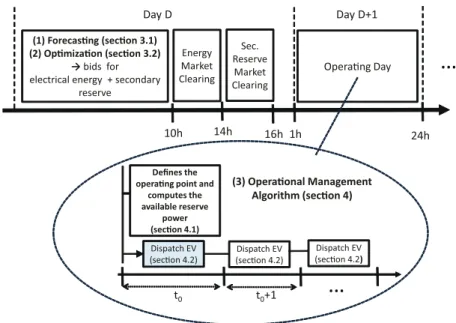
Figure 3: Sequence of tasks for the participation in the day-ahead energy and secondary reserve markets.
In the first phase, the aggregator, at day D, forecasts the EV charging requirement and availability, the 250
energy, and reserve prices (described in section 3.1). This forecasted information is the input, in a second 251
phase, of a day-ahead optimization model (for next day D+1) that computes the bids for the energy and 252
secondary reserve markets (described in section 3.2).
253
During the operating day (day D+1), before the beginning of each time interval t0 (with length ∆t), the 254
aggregator redefines the EV fleet operating point, computes the available upward and downward reserve 255
power, and communicates this information to the SO (described in section 4.1). The aggregator dispatches 256
the EV for meeting the fleet’s operating point for each time interval (t0, t0+1,…) and places the plugged-in 257
EV on standby to supply upward and downward reserve in response to an AGC request. An operational 258
management algorithm is used to coordinate the EV charging (described in section 4.2). A penalty term is 259
applied for cases with reserve power shortage.
260
3. Day-ahead Energy and Reserve Optimization
261
Section 2.2 discussed the characteristics of secondary reserve and concluded that it is not possible to 262
produce forecasts with acceptable quality for the hourly AGC regulation signal. Thus, the formulation of 263
the day-ahead optimization problem described in this section disregards this information, and the goal is 264
to obtain robust solutions that assure an acceptable reliability of the secondary reserve provision as well 265
as an attractive income to the aggregator and the EV in its portfolio.
266
The algorithm uses, as input, forecasts for several variables that are briefly described in section 3.1.
267
3.1 Input Variables and Forecasts 268
The EV load is modeled with two variables: availability period and charging requirement. The EV 269
availability is the time-period when the EV is plugged-in for charging. It is a binary variable indicating 270
whether or not the EV is plugged-in for charging in each time interval with length ∆t.
271
The charging requirement of the EV is the total energy needed to get from the initial state-of-charge 272
(SOC) (i.e., when the EV arrives for charging) to the target SOC defined by the EV driver for the next 273
trip, including the losses from the charger. A charging requirement value is always associated to an 274
availability period. For example, an EV with battery size of 24 kWh parking with a 50% SOC (12 kWh) 275
and with target SOC of 100%, needs 12 kWh to reach full battery plus 1.33 kWh of charger losses. Thus, 276
the charging requirement is 13.33 kWh.
277
These variables are obtained from the advanced metering infrastructure installed in households. In this 278
framework, it is assumed that the EV driver, when plugged-in for charging, communicates the target SOC 279
and expected departure hour to the aggregator. If this information is not communicated, the aggregator 280
will assume a target SOC of 100% by default.
281
The availability period is a binary time series forecasted with a generalized linear model (GLM) [21]
282
with the response variable following a binomial distribution. After forecasting the availability period, the 283
corresponding charging requirement is forecasted with non-parametric bootstrapping. A complete 284
description of the forecasting algorithm can be found in [15].
285
The day-ahead energy price is forecasted with an additive model (using cubic splines) and using the 286
following variables as explanatory variables: lagged variables of the price (i.e., t-1, t-2, t-3), forecasted 287
wind power penetration, periodic function for the hour of the day and day of the week.
288
The secondary reserve has two prices: price for available reserve capacity and price for dispatched 289
reserve. The price for available reserve capacity is forecasted with an ARIMA model selected using the 290
function auto.arima R package forecast [22]. The price for dispatched reserve is an irregular time series 291
forecasted with the Holt-Winters model with trigonometric functions [23].
292
3.2 Formulation of the Optimization Model 293
The decision variables of the optimization problem are: optimized energy (Et,j) for charging the jth EV 294
in time interval t (i.e., the preferred operation point – POP), the upward and downward secondary reserve 295
power (Pt,jdown and Pt,jup) of the jth EV for time interval t. The energy and reserve bids are the sum of the 296
individual values of each EV (i.e., the decision variables associated to each EV - Et,j, Pt,jdown and Pt,jup).
297
The optimization problem is formulated assuming that there is a single reserve capacity price. In 298
markets with separated sessions for upward and downward secondary reserve, the modification would be 299
a different capacity price for each direction.
300
The objective function is the minimization of the total cost, and it has the following components: (a) 301
cost of purchasing energy; (b) income from reducing the consumption (dispatched upward reserve); (c) 302
cost from charging EV as downward reserve; (d) income from having available secondary reserve power.
303
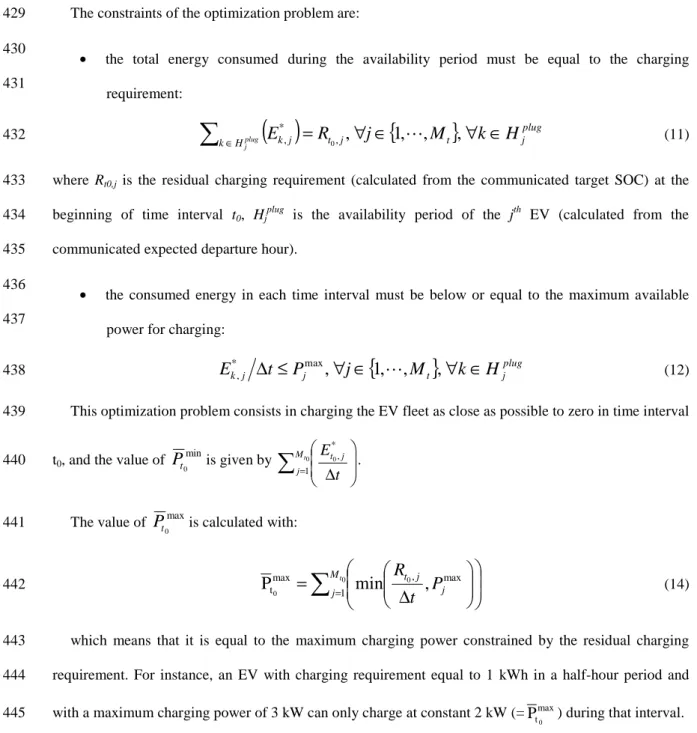
It can be written as:
304
( ) ( )
( ) ( )
∑ ∑ ∑
∑ ∑
∈
=
=
= =
+
⋅
−
∆
⋅
⋅
+
∆
⋅
⋅
−
⋅
H
t M
j
down j t up
j t cap
t M
j
down j t down
t
M j
M j
up j t up
t j t t
t t
t t
P P p
t P
p
t P p
E p
1 , ,
1 ,
1 , 1 ,
ˆ ˆ
ˆ ˆ
min
(1)305
where
pˆ is the forecasted energy price, t pˆ is the forecasted price for dispatched upward reserve, tup 306
down
pˆt is the forecasted price for dispatched downward reserve, cap
pˆt is the forecasted price for available 307
reserve capacity, Mt is the number of EV plugged-in at time interval t, ∆t is the length of time interval t, H 308
is the set of time intervals of the optimization period (e.g., for one day with ∆t=0.5 hr, H ranges between 1 309
and 48).
310
The constraints of the optimization problem are described in the following paragraphs.
311
The method for computing the reserve band is as follows: first, the charging requirements are satisfied 312
considering the purchased energy and the upward reserve band, and then, the downward capacity is the 313
remaining capacity (below the maximum charging power, Ptmax) in each time interval t.
314
The first point leads to the following constraint:
315
( )
j{
t}
H t
up j t j
t
P t R j M
E
plug j
, , 1 ˆ ,
ˆ ,
−
,⋅ ∆ = ∀ ∈ ⋯
∑
∈ (2)316
where
i
Rˆ is the forecasted charging requirement of the jj, th EV, and plug
Hˆj is the forecasted availability 317
period of the jth EV.
318
The second point leads to the following constraint for downward reserve:
319
{ M } t H
j P P
t
E
t,j∆ +
tdown,j≤
jmax, ∀ ∈ 1 , ⋯ ,
t, ∀ ∈
(3)320
The upward reserve band is limited by the energy bid in each time interval:
321
( E t ) j { M } t H
P
tup,j≤
t,j∆ , ∀ ∈ 1 , ⋯ ,
t, ∀ ∈
(4)322
and its total is limited by the charging requirement in each availability period:
323
( )
j{
t}
H t
up j
t
t R j M
plug
P
j
, , 1 ˆ ,
ˆ ,
⋅ ∆ ≤ ∀ ∈ ⋯
∑
∈ (5)324
Constraint (5) is included to avoid the aggregator from offering a total upward reserve greater than the 325
total energy that the EV fleet can consume (i.e., the charging requirement). For example, without this 326
constraint, an EV parked for 10 hourly intervals with a forecasted charging requirement of 1.5 kWh could 327
offer upward reserve in 9 intervals. This would give
∑
t∈Hˆplugj( )
Et,j =10⋅1.5=15kWh and 328( )
∑
∈ plug ⋅∆ = ⋅ =Hj t
up j
t t kWh
ˆ P, 91.5 13.5 for meeting the charging requirement. If in one of these intervals 329
upward reserve is not dispatched, this strategy would harm significantly the reliability of upward reserve 330
and increase the penalty costs for reserve shortage (topic that will be discussed in section 5); the inclusion 331
of constraint (5) limits
∑
∈ plug(
⋅∆)
≤Hj t
up j
t t kWh
ˆ P, 1.5 .
332
The total downward reserve is also constrained by the charging requirement:
333
( )
j{
t}
H t
down j
t
t R j M
P
plug j
, , 1 ˆ ,
ˆ ,
⋅ ∆ ≤ ∀ ∈ ⋯
∑
∈ (6)334
With the constraint (7), the aggregator can only offer upward reserve in a specific interval if the EV is 335
able to offer an energy bid (Ek,j) with the corresponding quantity both in the same and subsequent time 336
intervals. This increases the robustness of the bidding optimization since it forces the EV to be capable of 337
consuming the quantity that is offered as upward reserve. Otherwise, considerable penalization (topic 338
discussed in section 5) could be incurred if upward reserve cannot be supplied. This constraint consists in 339
postponing EV charging by offering upward reserve:
340
( P t )
kk tt( ) E
kjj { M
t} t H
tk t k
up j k
final
final
⋅ ∆ ≤ ∑ ∀ ∈ ∀ ∈
∑
== , == ,2 , 1 , ⋯ , ,
(7)341
where tfinal is the last time interval of the forecasted availability period, i.e. plug
j
final H
t ∈ ˆ . 342
In (7), the total consumption reduction between t and tfinal must be below or equal to half of the energy 343
bid in the same period. For example, if the aggregator in time interval t=1 offers an energy and upward 344
reserve bid of 1.5 kW, it must present an additional energy bid of 1.5 kWh in any interval t>1 of the 345
availability period, otherwise the constraint is violated.
346
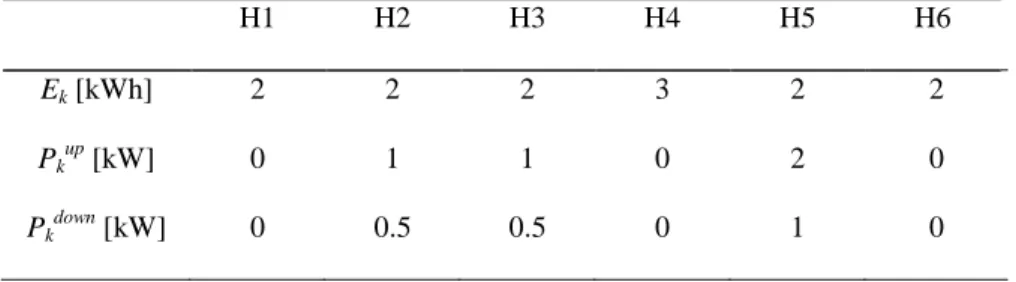
In order to illustrate this constraint, Table 1 presents two candidate solutions for offering upward 347
reserve with an EV plugged-in during six hours (i.e, ∆t=1 hour) and with a charging requirement of 9 348
kWh and maximum charging power of 3 kW.
349
Table 1: Set of charging solutions of an EV offering upward reserve power in a six-hour availability period with a charging requirement of 9 kWh.
Solution (a), with constraint (7), is unfeasible because the charging requirement is already satisfied 350
after interval H3, and the aggregator makes an upward reserve offer in intervals H5 and H6 where it is not 351
able to supply if requested by the TSO.
352
Solution (b) is feasible. For instance, in interval H3 the EV offers 3 kW of upward reserve, and it 353
consumes additional 3 kW in the remaining time intervals (H4 in this case).
354
It is important to stress that constraint (7) offers robust solutions since the available reserve power in 355
the current interval is not affected even if the upward reserve is dispatched in lower quantities during 356
previous intervals. For instance, if the reserve in interval H1 of solution (b) is not fully dispatched, there 357
would be a surplus of consumed electrical energy compared to what was planned, but the aggregator can 358
consume less in interval H2 (if necessary) to compensate this surplus at a cost of an energy imbalance 359
penalty.
360
The reserve band is divided into upward and downward directions with the following equality:
361
{ 1 , , } , ,
,
,
,
P j M t H
P
tupj= µ ⋅
tdownj∀ ∈ ⋯
t∀ ∈
(8)362
In the Iberian market, the reserve band is divided into 2/3 for upward and 1/3 for downward, so the 363
value of µ is 2. In markets without a rule for splitting the reserve band, the value of µ can be defined by 364
considering the reserve prices, or the reserve reliability (e.g., estimate a µ from historical data that leads 365
to the minimum reserve shortage), or a trade-off between both criteria.
366
The optimization problem of Equations (1)-(8) is an LP problem that can be solved using any 367
commercial or non-commercial LP solvers.
368
After, solving the LP problem, a post-processing phase is applied to the downward reserve band. In 369
order to create sufficient flexibility for supplying upward reserve, the purchased energy is higher than the 370
charging requirement [see equation (2)]. Thus, a post-processing phase is necessary to eliminate 371
downward reserve bids from the time intervals where the total purchased energy is above the charging 372
requirement. This is performed with the values of Et,j calculated by solving the LP problem and with the 373
following equation:
374
( ( ) ) ( )
( )
>
+
∆
⋅
≤ +
∆
⋅
= −
∑
∑
∑
=
=
=
j t
t
k k j
down j t
j t
t
k k j
down j t down
j t t
t
k k j
down j j
t
if P t E R
R E t
P if P E R
P
initial
initial initial
, ˆ 0
, ˆ ˆ ,
min
, ,
, ,
, ,
, (9)
375
where tinitial is the first time interval of the availability period, i.e. tinitial∈Hˆplugj . 376
After adjusting the downward reserve band, the upward reserve band is also adjusted with equality (8).
377
Equation (9) increases the robustness of the downward reserve bid since, even in cases where the 378
upward reserve from the previous intervals is not dispatched, the aggregator is able to supply the 379
downward power in the subsequent intervals regardless of the dispatched upward reserve.
380
Table 2 presents a potential solution for energy and reserve bids of one EV with charging requirement 381
of 9 kWh. In this example, the downward reserve power bid in interval H5 is removed in the post- 382
processing phase, since the sum of Ek between intervals H1 and H4 is already equal to the charging 383
requirement. Therefore, there is a risk that the EV may not be able to make available a downward reserve 384
power of 1 kW in interval H5. For instance, if in interval H2 only 0.5 kWh is dispatched as upward 385
reserve and in interval H3 only 0.2 kWh, the total electrical energy after interval H4 would be 8.3 kWh, 386
and, since it can only charge additional 0.7 kWh, the EV is unable to guarantee a downward reserve 387
power of 1 kW in interval H5. In this case, the aggregator only offers downward reserve during the first 388
four intervals.
389
Table 2: Example of a charging solution of an EV offering upward and downward reserve power in a six-hour availability period with a charging requirement of 9 kWh.
4. Operational Management Algorithm
390
The previous section described the day-ahead optimization model for deriving the energy and 391
secondary reserve bids. During the operating day, the aggregator coordinates the EV charging to comply 392
with the AGC signal and deliver secondary reserve with acceptable reliability. This section describes an 393
operational management algorithm to meet this goal. This algorithm is divided into two phases: first, the 394
redefinition of the EV fleet operating point and the calculation of the available reserve power (section 395
4.1), and then, the coordination of the EV charging to comply with the AGC requests (section 4.2).
396
4.1 Redefinition of the Operating Point and Calculation of the Available Reserve Power 397
The aggregator, 15 minutes before the beginning of time interval t0 (e.g., necessary time to activate 398
tertiary or balancing reserve if necessary), using the information from the plugged-in EV (i.e., 399
communicated target SOC and expected departure hour), calculates the available reserve power in both 400
directions for that interval and communicates this information to the SO. These values are updated during 401
the operation hour since the available reserve power can be reduced if the reserve is dispatched in one 402
direction during a long period.
403
The first step for computing the available reserve consists in determining the operating point P't0 of the 404
EV fleet. The operating point is a constant charging level that the aggregator can sustain during the 405
complete interval t0 by coordinating the EV fleet charging and from which the upward and downward 406
reserves are supplied.
407
Without the presence of uncertainty, the operating point would be equal to the accepted energy bid.
408
However, because of forecast errors, the operating point will deviate from the energy bid, which creates 409
energy imbalances and decreases the availability of secondary reserve. Therefore, the aggregator should 410
define an operating point during the operational phase that guarantees the contracted reserve at a cost of 411
increasing the energy imbalances. The following paragraphs describe a procedure that re-calculates the 412
operating point (using the energy bid as reference), in order to maximize the availability of secondary 413
reserve.
414
First, the aggregator, before the beginning of time interval t0, and using the information of all plugged- 415
in EV, computes two variables: min
t0
P , minimum, constant and feasible charging power of the EV fleet in 416
time interval t0; max
t0
P , maximum, constant and feasible charging power of the EV fleet in time interval t0. 417
The value of min
t0
P is computed by solving an LP optimization problem with the following objective 418
function:
419
( ( ) ) ( ( ( ) ) )
[ ∑ = − + ∑
Tk=t + k− ∑
Mj= k j ]
M
j t j
k
t1
E
*, 1E
1E
*,0 0
0
0
min ϕ ϕ
(10)420
where Ek,j* is the decision variable and corresponds to the actual energy consumed by the jth EV, t0 is 421
the first time interval of the optimization period, Ek is the result (or accepted bid) from the day-ahead 422
optimization model, φ is a piecewise loss function and T is the time interval of the last plugged-in EV to 423
depart. The loss function φ is a convex function with the following form:
424
( )
<
⋅
−
≥
= ⋅
+−0 ˆ ,
0 ˆ ,
u u
u u u
k k
π
ϕ π
(13)425
where πk+ and πk- are the forecasted penalization prices for positive and negative deviations 426
respectively. These two prices are forecasted with the Holt-Winters model for irregular time series [23].
427
This convex function can be converted into a linear function by using its epigraph form [24].
428
The constraints of the optimization problem are:
429
• the total energy consumed during the availability period must be equal to the charging 430
requirement:
431
( )
t j{
t}
jplugH
k plug
E
kjR j M k H
j
= ∀ ∈ ∀ ∈
∑
∈ ,, 1 , , ,
*
, 0
⋯
(11)432
where Rt0,j is the residual charging requirement (calculated from the communicated target SOC) at the 433
beginning of time interval t0, Hjplug is the availability period of the jth EV (calculated from the 434
communicated expected departure hour).
435
• the consumed energy in each time interval must be below or equal to the maximum available 436
power for charging:
437
{
t}
jplugj j
k
t P j M k H
E
*,∆ ≤
max, ∀ ∈ 1 , ⋯ , , ∀ ∈
(12)438
This optimization problem consists in charging the EV fleet as close as possible to zero in time interval 439
t0, and the value of min
t0
P
is given by∑
=
∆
0 0
1
*
t , M j
j t
t E . 440
The value of max
t0
P
is calculated with:441
∑
=
=
0∆
00 1
, max max
t
min ,
P
Mjt t jP
jt R
(14) 442
which means that it is equal to the maximum charging power constrained by the residual charging 443
requirement. For instance, an EV with charging requirement equal to 1 kWh in a half-hour period and 444
with a maximum charging power of 3 kW can only charge at constant 2 kW (= tmax
P0 ) during that interval.
445
These two variables, together with the accepted energy bid (Et0), are used to define the operating 446
point. Figure 4 depicts three situations that may occur in terms of energy bid value and the variables 447
required to calculate the EV fleet operating point.
448
Figure 4: Variables required to redefine the operating point of the EV fleet.
In situation (a), the accepted energy bid is within the minimum and maximum consumption power 449
limits. In order to guarantee full availability of the reserve power, the operating point should be within 450
two limits: upper power limit that guarantees full availability of downward reserve power in time interval 451
t0 (Pt0upper =Pt0max −Pt0down), and lower power limit that guarantees full availability of upward reserve 452
power (Pt0lower =Pt0min+Ptup0 ). Depending on the accepted energy bid value, the following can occur:
453
• if Ptupper Ptlower
0
0 ≥ (any operating point between Ptlower
0 and Ptupper
0 allows full availability of the 454
reserve, thus it is selected the closest point to the energy bid) 455
if
E
t0∆ t ∈ [ P
t0lower, P
t0upper] ⇒ P '
t0= E
t0∆ t
456
if
P
tlowerE
tt P
tP
tlower0 0 0
0
> ∆ ⇒ ' =
(the operating point is made equal toP
tlower0 since 457
it is the closest point to the energy bid) 458
if
P
tupperE
tt P
tP
tupper0 0 0
0
< ∆ ⇒ ' =
(the operating point is made equal toP
tupper0 since 459
it is the closest point to the energy bid) 460
• if Pt0upper<Pt0lower,P't0=Et0 ∆t (any change in the operating point value would increase the 461
reserve availability in one direction, at the cost of the other direction; the choice is to maintain 462
the operating point equal to the energy bid value) 463
In situation (b), the accepted energy bid is below the minimum consumption power level. The 464
operating point is defined as follows:
465
• if Ptupper Ptlower Pt Ptlower
0 0 0
0 ≥ ⇒ ' = (the operating point is made equal to Ptlower
0 since it is the 466
closest point to the energy bid);
467
• if Pt0upper<Pt0lower,P't0=min
(
Pt0upper,Pt0min)
(it is not possible to offer the full contracted reserve 468in both directions; if Ptupper
0 is greater than min
t0
P , it is not possible to offer upward reserve power 469
and the operating point is made equal to min
t0
P ; if it is lower, the operating point is made equal to 470
upper
P
t0 and it is possible to offer upward reserve between this point and min
t0
P ).
471
In situation (c), the accepted energy bid is greater than the maximum consumption power level. The 472
operating point is defined as follows:
473
• if Ptupper Ptlower Pt Ptupper
0 0 0
0 ≥ ⇒ ' = (the operating point is made equal to Ptupper
0 since it is the 474
closest point to the energy bid);
475
• if Pt0upper<Pt0lower,P't0=min
(
Pt0lower,Pt0max)
(it is not possible to offer the full contracted reserve 476in both directions; if Ptlower
0 is greater than max
t0
P , it is not possible to offer downward reserve 477
power and the operating point is made equal to max
t0
P ; if it is lower, the operating point is made 478