Last but not least, I would like to thank all my friends and family for their support, motivation and encouragement to make this work happen. Currently, this training is carried out through traditional teaching methods that are mentioned as outdated for the current generation, the so-called.
Introduction
- Introduction
- Context
- Problem Statement
- Contributions
- Thesis Structure
However, each professional should also refresh and update (in case of protocol changes) his or her knowledge of the Sepsis Fast Track protocol. In this thesis we described the Sepsis Fast Track serious game aimed at teaching and training healthcare professionals of hospital emergency departments about the Sepsis Fast Track protocol.
Background
Serious Games
- Serious Games for clinical education
- Sepsis Serious Games
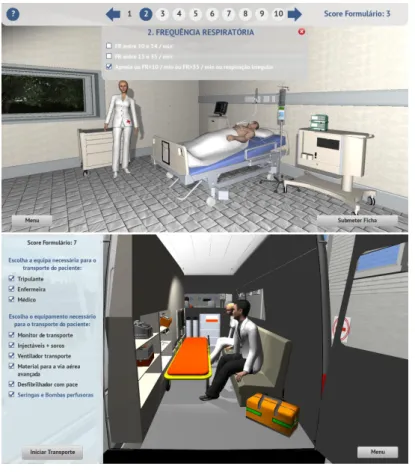
In the next subsection, several serious games developed for clinical education are reviewed, including a sepsis serious game. It is a first-person serious game and takes place in a virtual environment where the player has to navigate.
Serious Games Models and Frameworks
- Experiential Gaming Model
- Problem-based Gaming Model
- Input-Process-Outcome Game Model
- Game Cycle
- User judgements
- User behaviour
- System feedback
- Debriefing
- Learning Outcomes
- Four-dimensional Framework
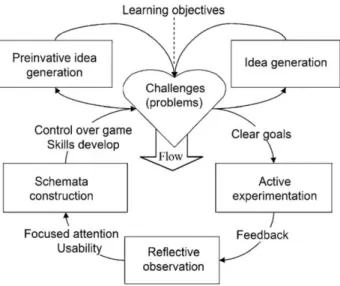
The model describes learning, which is a construction of cognitive structures, as a cyclical process carried out through direct experience in the game world. In the input-process-outcome game, the overview of the game model provides a link between the game cycle and the achievement of learning outcomes.
Summary
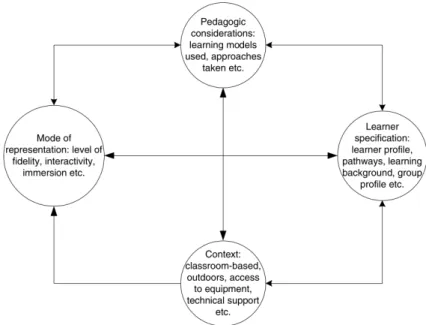
This dimension promotes practitioners' reflection on methods, theories, models and frameworks used to support learning practice. This dimension therefore also includes considerations of how learning content is embedded and personalized to support the more differentiated learning approaches.
Sepsis Fast Track Serious Game
Introduction
Learners and Context
How the patient's data regarding Sepsis Fast Track must be registered on the hospital's IT system (including activation). How to interact with the hospital's IT system, namely to request additional tests and to record patient data regarding the Sepsis Fast Track.
Sepsis Fast Track Protocol
- Identification of a Possible Sepsis Case
- Sepsis Case Confirmation and Therapy
Also in the IT system, the nurse should activate a Sepsis Fast Track alert that identifies the patient with a suspected sepsis infection. Next, the physician should check the patient's central venous pressure, if it is less than 8 mmHg new fluid therapy should be performed.

Game Stages
- Briefing
- Game Experience
- Game Mechanics
- Debriefing
ECG monitor control allows measurement of the patient's heart rate (according to SIRS, it is positive if it is greater than 90 beats per minute). To trigger this mechanic, the player must click on the patient and then select the Blood Gas option from the patient's menu (Figure 3.24). Ask Information is a mechanic that allows the player to ask the nurse about the patient's medical condition.
Ask patient's central venous pressure allows the player to know what the patient's central venous pressure is. The nurse advises the player to reevaluate the patient's condition as a result of the last therapeutic action.

Game Environment
- Identification of a Possible Sepsis Case Phase
- Sepsis Case Confirmation and Therapy Phase
- IT System
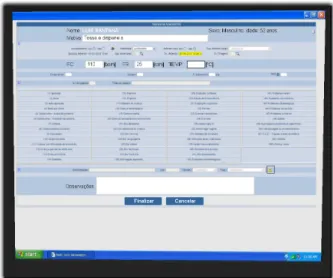
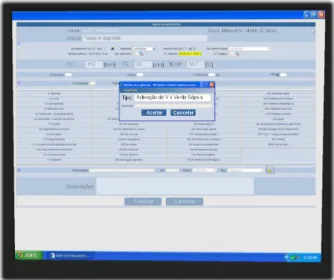
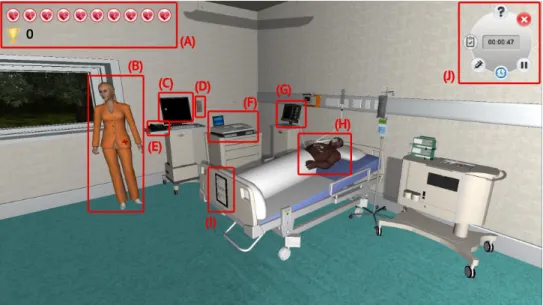
The user interface of the IT system is presented in more detail in 3.5.3. F) Vital signs monitor Enables measurement of the patient's heart rate. This is where nurses and doctors have to register each patient's information, in this case on the Sepsis Fast Track. Namely, registering the patient's SIRS and complaints, activating Sepsis Fast Track, filling out the Sepsis Fast Track form, requesting additional examinations, among others.
A goal of this serious game is to increase the use of the current IT system for the registration of the Sepsis Fast Track cases, both by nurses and doctors. To counteract the lack of IT system usage by healthcare professionals, every element of the real IT system related to the Sepsis Fast Track is present in the game.
User Interface
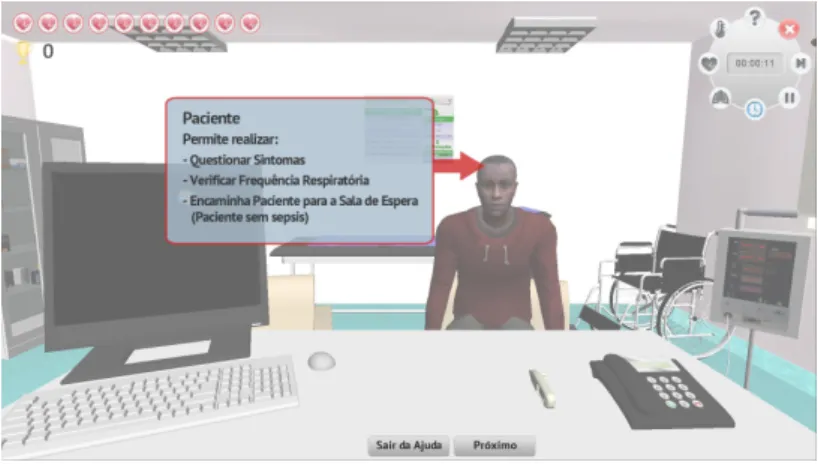
- Information/Options Head-up Display (HUD)
- Score, Lives and Real-time Feedback
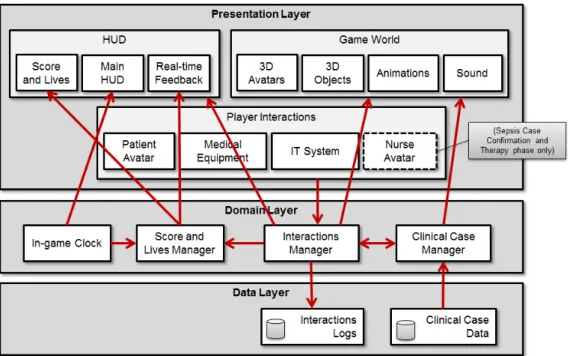
Pause Allows the player to pause the game, which also pauses the time count, which is an important aspect of sepsis diagnosis. Real-time feedback is an important game feature and is also presented to the player, as shown in Figure 3-47. This feedback allows the player to know whether the procedure he or she performed was done right or wrong.
If a procedure is done correctly, the player is presented with that information and the corresponding points he or she earned. If a procedure is done incorrectly, in addition to that information, the player is advised of the correct procedure and informed of the lives he or she has lost.

Implementation
- Architecture
- Modifiability and Extensibility
- Data Logging
- Clinical Cases
The output of the procedures performed by the player depends on the clinical case, so this module works together with the Clinical Case Manager. The Clinical Case Manager's responsibility is to handle all data from each clinical case (from Clinical Case Data) and to generate the Game World accordingly. The bottom layer is the data layer, which contains all the data from the serious game.
One feature of this serious game is the data logging of the player's actions during gameplay. In Figure 3.51, an example of the player's data log file is presented for the identification of a possible sepsis case game's phase.
Summary
Each clinical case consists of clinical case characteristics, patient personal data and medical data for the phase of identification of a possible case of sepsis and confirmation of a case of sepsis and therapy. The patient's medical data to identify the possible stage of the case of sepsis: complaints, symptoms, temperature, heart rate, respiratory rate. Patient health data for the sepsis case confirmation phase and therapy: clinical history, exclusions, Glasgow comma, systolic blood pressure, diastolic blood pressure, urine flow, central venous pressure, physical examination result, lactate, additional examinations required, supplementary test results, report of arterial blood gas, venous blood gas report.
The patient's medical data for the confirmation phase of the sepsis case and therapy may change over time, according to the player's actions. The game was described as consisting of the following main phases, namely the main menu, selection of clinical cases, debriefing, the game experience consisting of the identification of a possible case of sepsis and the confirmation and therapy of the case of sepsis, and debriefing. The game experience is the stage in which players play the serious game, which, depending on their role, can be Identifying a possible case of sepsis for nurses or confirming and treating a case of sepsis for doctors.
Evaluation
Introduction
Identification of a Possible Sepsis Case Evaluation
- Evaluation Methodology
- Demographic Characterization and Gaming Habits
- Results
- In-game Data Logs
- Hospital IT System Logs
- Discussion
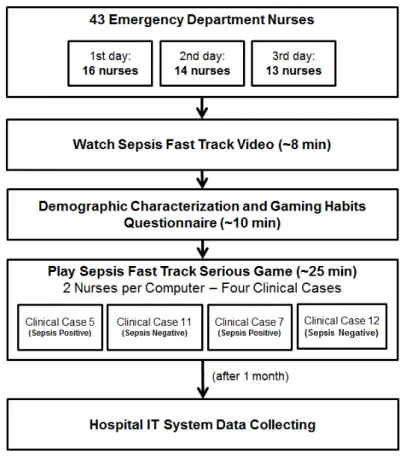
The evaluation of the Sepsis Fast Track serious game focused on two aspects: the analysis of the in-game data logging and the hospital IT system logs. Call Physician responsible for Sepsis Fast Track is a procedure that only applies to the clinical cases with criteria to activate the Sepsis Fast Track. In relation to the nurses' evaluation, these logs reveal information about the number of patient admissions in the emergency department and the number of Sepsis Fast Track activations.
As shown in these graphs, the number of Sepsis Fast Track activations is clearly lower than the number of patient admissions. The most unsuccessful procedure was Registry Data (IT system) (with a total of 5 errors in the first three clinical cases played), mainly because nurses forgot to activate the Sepsis Fast Track alert.
Sepsis Case Confirmation and Therapy Evaluation
- Evaluation Methodology
- Demographic Characterization and Gaming Habits
- Results
- Interviews Results
- In-game Data Logs
- Hospital IT System Logs
- Discussion
Do you agree that the game helps you understand the importance of sepsis fast track protocol. Most of the doctors present stated that this serious game was a good tool to learn and refresh the Sepsis Fast Track protocol, namely to systematize its procedural sequence. 6 of the 11 doctors present and 1 of the 4 practicing doctors did not perform this procedure properly.
This may include the patient's medical status and the validation or non-validation of the sepsis fast track. Given the lack of proper documentation of the forms in the IT system, especially the Sepsis Fast Track form, we feel that this serious game would not significantly improve it.

Summary
Conclusions
Conclusions
All the above features were implemented in Sepsis Fast Track serious game which we believe is essential for the better user experience and further learning outcomes. In both evaluation phases, the players' actions during the game were logged in order to evaluate their performance. In addition, we returned to the hospital after one month to collect IT system data logs to understand if there had been an improvement in Sepsis Fast Track healthcare.
Due to the factor of unpredictability that exists in the treatment of medical care, the data related to the number of rapid activations of sepsis varied considerably in the analyzed months. In conclusion, we believe that the serious Sepsis Fast Track game has a lot of potential to be used as a real training tool for the Sepsis Fast Track protocol.
Future Work
In order to evaluate the effects of this serious game on the work practices of emergency room health professionals, an evaluation study was done in the hospital facilities. They explained that the interaction the game allows facilitates enhanced learning rather than listening to someone teach and explain protocol to them in a traditional academic setting. However, more studies need to be conducted to understand whether it is consistently effective and efficient as a training tool.
To engage the players and add a better challenging factor to this game, implementing a scoreboard that lists the players with the highest scores would be an improvement. The game's GUI was not designed by a graphic designer and would improve a lot if it did.
Appendix A
Questionnaire for Demographic Characterization
Caracterização da Amostra
Instruções
Hábitos de Jogo
Joga habitualmente videojogos?
Com que idade jogou pela primeira vez videojogos e em que contexto?
Conhecimentos Prévios
Appendix B
Clinical Cases
- ID 1 Sepsis Positive Identification True
- ID 2 Sepsis Positive Identification True
- ID 3 Sepsis Positive Identification True
- ID 4 Sepsis Positive Identification True
- ID 5 Sepsis Positive Identification True
- ID 6 Sepsis Positive Identification True
- ID 7 Sepsis Positive Identification True
- ID 8 Sepsis Positive Identification True
- ID 9 Sepsis Positive Identification True
- ID 10 Sepsis Positive Identification false
- ID 11 Sepsis Positive Identification false
- ID 12 Sepsis Positive Identification false
Queixas Estou tossindo há 3 dias, estou tossindo com escarro escuro difícil de sair e estou muito cansado, às vezes sinto que não estou respirando o suficiente. Queixas Meia hora atrás, de repente, comecei a sentir uma pontada nas costas e desde então tenho falta de ar e tosse. Queixas Estou com tosse seca há alguns dias e estou cansado, hoje estou com falta de ar.
Queixas Tenho muita falta de ar, o oxigênio não está mais fazendo nada e tenho mais tosse, com expectoração esverdeada. FO2Hb Aleatório Aleatório Aleatório Aleatório FMetHb Aleatório Aleatório Aleatório Aleatório Aleatório FCOHb Aleatório Aleatório Aleatório Aleatório Aleatório FHHb Aleatório Aleatório Aleatório Aleatório Aleatório.
Bibliography
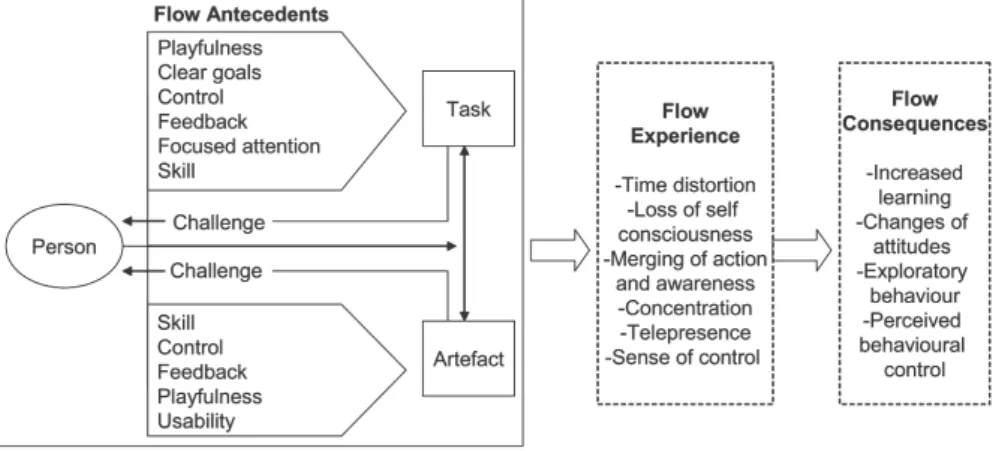
Serious Game Design: consider "theories and techniques on game development to use a profession." A person-artifact-task (pat) model of flow antecedents in computer-mediated environments. International Journal of Human-Computer Studies.