Session Types for Functional Multithreading ∗
Vasco Vasconcelos
†Ant´ onio Ravara
‡Simon Gay
§October 15, 2004
1 Introduction
Communication in distributed systems is typically structured around protocols, which specify the sequence and form of messages passing over communication channels. Correctness of such systems implies that protocols are obeyed.
The theory ofsession types[6, 10, 11, 20] allows the specification of a protocol to be expressed as a type; when a communication channel is created, a session type is associated with it. Such a type specifies not only the data types of individual messages, but also the state transitions of the protocol and hence the allowable sequences of messages. By extending the standard methodology of static typechecking, it becomes possible to verify, at compile-time, that an agent using the channel does so in accordance with the protocol.
The theory of session types has been developed in the context of the π- calculus [15, 19], an idealized concurrent programming language which focuses on inter-process communication. Session types have not yet been incorporated into a mainstream programmming language, or even studied theoretically in the context of a standard language paradigm: functional, imperative or object- oriented. Vallecillo et al. [21] use session types to add behavioural information to the interfaces of CORBA objects, and use Gay and Hole’s [6] theory of subtyping to formalize compatibility and substitutability of components, but they have not attempted to design a complete language.
The Vault [3] and Cyclone [9] languages extend C with facilities for safe control of stateful resources. In Cyclone, locks must be acquired and released;
Vault goes further by allowing operations on a resource to be statically checked against an automaton which specifies valid transitions. In contrast, session types are specialized to communication channels as a particular kind of resource, but as a result they enable further typechecking in association with each state
∗A revised and extended version of the paper in Concur 2004, volume 3170 of LNCS, pages 497–511, Springer-Verlag, 2004.
†Departamento de Inform´atica, Faculdade de Ciˆencias, Universidade de Lisboa, 1749-016 Lisboa, Portugal.
‡CLC and Departamento de Matem´atica, Instituto Superior T´ecnico, 1049-001 Lisboa, Portugal.
§Department of Computing Science, University of Glasgow, Glasgow G12 8QQ, UK.
transition: typechecking verifies the types of individual messages, as well as verifying that a sequence of messages obeys a given protocol. (These languages are further discussed in section 7.)
In previous work [5] we have presented a language supporting typed func- tional programming with inter-process communication channels, but we only considered individual processes in isolation. Here we address collections of func- tional threads communicating via channels. This formulation allows us to prove a runtime safety property: well-typed programs do not misuse channels.
By transferring the concept of session types from theπ-calculus to a multi- threaded functional language with side-effecting input/output operations, we show that static checking of session types could be added to a language such as Concurrent ML [18], at least without imperative features. In particular we have addressed the key differences between a conventional programming style and the programming notation of theπ-calculus:
• The operations on channels are independent terms, rather than prefixes of processes, so we have introduced a new form of typing judgement which describes the effect of a term on channel environment.
• We have separated creation and naming of channels, and because this introduces the possibility of aliasing, we represent the types of channels by indirection from the main type environment to the channel environment.
The structure of the paper is as follows. In Section 2 we explain session types in connection with a progressively more sophisticated example. Sections 3, 4 and 5 define the syntax, operational semantics and type system of our language.
In Section 6 we present the runtime safety result. In Sections 7 and 8 we discuss related and future work.
2 Session Types and the Maths Server
Input, Output and Sequencing Types. First consider a server which pro- vides a single operation: addition of integers. A suitable protocol can be defined as follows.
The client sends two integers. The server sends an integer which is their sum, then closes the connection.
The corresponding session type, from the server’s point of view, is S=?Int.?Int.!Int.End
in which ? meansreceive, ! means send, dot (.) issequencing, andEndindicates the end of the session. The type does not correspond precisely to the specifica- tion, because it does not state that the server calculates the sum. However, the type captures the parts of the specification which we can reasonably expect to verify statically. The server communicates with a client on a channel calledu;
we think of the client engaging in asession with the server, using the channel ufor communication. In our language, the server looks like this:
server u=letx=receiveuin lety=receiveuin sendx+y onu or more concisely: send(receiveu) + (receiveu)onu.
Interchanging ? and ! yields the type describing the client side of the protocol:
S=!Int.!Int.?Int.End
and a client implementation uses the server to add two particular integers; the code may usexbut cannot use the channeluexcept for closing it.
client u=send2 onu send3 onu
letx=receiveuincode
Branching Types. Now let us modify the protocol and add a negation oper- ation to the server.
The client selects one of two commands: add or neg. In the case ofadd the client then sends two integers and the server replies with an integer which is their sum. In the case of neg the client then sends an integer and the server replies with an integer which is its negation. In either case, the server then closes the connection.
The corresponding session type, for the server side, uses the constructor &
(branch) to indicate that a choice is offered.
S = &hadd: ?Int.?Int.!Int.End,neg: ?Int.!Int.Endi Both services must be implemented. We introduce acaseconstruct:
server u=caseuof {
add ⇒send(receive u) + (receiveu)on u neg ⇒send−(receiveu)onu}
The type of the client side uses the dual constructor⊕(choice) to indicate that a choice is made.
S=⊕hadd: !Int.!Int.?Int.End,neg: !Int.?Int.Endi A client implementation makes a particular choice, for example:
addClientu=selectadd onu negClientu=selectneg onu
send2on u send7 onu
send3on u letx=receiveuin code
letx=receiveuincode
Note that the type of the subsequent interaction depends on the label which is selected. In order for typechecking to be decidable, it is essential that the label add or neg appears as a literal name in the program; labels cannot result from computations.
If we add a square root operation, sqrt, then as well as specifying that the argument and result have typeReal, we must allow for the possibility of an error (resulting in the end of the session) if the client asks for the square root of a negative number. This is done by using the ⊕constructor on the server side, with optionsok anderror. The complete English description of the protocol is starting to become lengthy, so we will omit it and simply show the type of the server side.
S= &hadd: ?Int.?Int.!Int.End, neg: ?Int.!Int.End,
sqrt: ?Real.⊕hok: !Real.End,error:Endii
This example shows that session types allow the description of protocols that cannot be easily accommodated with objects, that is, with sequences of the form: selecta method;sendthe arguments;receivethe result.
Recursive Types. A more realistic server would allow a session to consist of a sequence of commands and responses. The corresponding type must be defined recursively, and it is useful to include aquit command. Here is the type of the server side:
S= &hadd: ?Int.?Int.!Int.S, neg: ?Int.!Int.S,
sqrt: ?Real.⊕hok: !Real.S,error:Si, quit:Endi
The server is now implemented by a recursive function, in which the positions of the recursive calls correspond to the recursive occurrences ofS in the type definition. To simplify the theory we decided not to include recursive types in this paper; the interested reader may refer to report [5].
Function Types. We have not mentioned the type of theserver itself. Clearly, it accepts a channel (in state &hadd:. . .,neg:. . .i), and returns nothing (de- scribed by theUnit type). The body of the function “consumes” the channel, leaving it in a state ready to be closed (described by typeEnd). We write all this as follows, wherecis the (runtime) channel denoted by the (program) variable u.
server::c: &hadd:. . .,neg:. . .i;Chanc→Unit;c:End serveru=case uof {add⇒. . . ,neg ⇒. . .}
Note how the function type describes, not only the type of the parameter and that of the result, but also, its effect on channelc. It can also be useful to send
functions on channels. For example we could add the component1 eval: ?(Int→Bool).?Int.!Bool.End
to the branch type of theserver, with corresponding server code, to be placed within the server’scaseabove.
eval ⇒send(receive u)(receiveu)onu
A client which requires a primality test service (perhaps the server has fast hardware) can be written as follows.
primeClient::c: ⊕ hadd:. . .,neg:. . .,eval:. . .i;Chanc→Unit;c: End primeClientu=selecteval onu
sendisPrime onu sendbigNumber onu letx=receiveuincode
Establishing a Connection. How do the client and the server reach a state in which they both know about channelc? We follow Takeuchi, Kubo and Honda [20], and propose a pair of constructs: requestv for use by clients, andacceptv for use by servers. In use, request and accept occur in separate threads, and interact with each other to create a new channel. The valuev in bothrequest andaccept, denotes the common knowledge of the two threads: ashared name used solely for the creation of new channels. We may then write:
server :: [&hadd:. . .,neg:. . .,eval:. . .i]→Unit server x=letu=acceptxin (case uof . . .;closeu) negClient:: [&hadd:. . .,neg:. . .,eval:. . .i]→Unit
negClient x=letu=requestxin(selectneg onu . . .;closeu)
Note that the same type for the shared name x is used both for the server and for the client; it is theaccept/requestconstruct that distinguishes one from the other. This is also where we introduce the operation to close a channel:
accept/requestcreates a channel;closedestroys it.
Sharing Names. In order for a name to become known by a client and a server, it must be created somewhere and distributed to both. To create a new, potentially shared, name, we writenew. To distribute it to a second thread, we forka new thread, in whose code the name occurs.2 Our complete system creates a namexand launches three threads (a server and two clients), all sharing the newly created name.
system::Unit
system=letx=new in
fork negClientx; forkaddClient x; forkserver x
1We often omit the empty channel environment on each side of the arrow.
2Alternatively, we maysendxonan existing channel.
Given the above implementation ofserver, one of the clients will be forever requestingx. Fortunately, it is easy to extend theserver to accept more than one connection in its life time.
server :: [&hadd:. . .,neg:. . .,eval: . . .i]→Unit server x=letu=acceptxin fork (case uof . . .;closeu)
server x
Sending Channels on Channels. Imagine two clients that need to coop- erate in their interaction with the server: one client establishes a connection, selects the neg operation, and sends the argument; the second client receives the result. Afterselectingneg, the first client must provide the second with the channel to the server. In order to do so, both clients must share a name of type ?(?Int.End).End (call this typeS) and establish a connection for the sole purpose of transmitting the server channel.
askNeg:: [hadd:. . .i]→ [S]→Unit getNeg:: [S]→Unit
askNeg x y=letu=requestxin getNeg y=letw=accepty in selectneg on u;send7onu letu=receive win letw=requesty in leti=receiveuin senduon w;closew closeu;closew;code It is instructive to follow the evolution of the state (the type) of channels c and d, connected to variables u and w, respectively. After the execution of the first line of getNeg, d has type S =?(?Int.End).End; after the second line, d is reduced to End, but c shows up with type ?Int.End; after the third line both channels are of type End, that is, ready to be closed. By the end of the fourth line, we gather no more information on channels c and d, for they are now closed. That is the sort of analysis our type system performs.
After sending a channel, no further interaction on the channel is possible.
Note thataskNeg cannotclose u, for otherwise the channel’s client side would be closed twice (inaskNeg and ingetNeg). On the other hand, channelwmust be closed at both its ends, byaskNeg and bygetNeg.
Channel Aliasing. As soon as we separate creation and naming of channels, aliasing becomes an issue. Consider the function below.
sendSendu v= send1 onu;send2onv
FunctionsendSend can be used in a number of different ways including the one whereuandv become aliases for a single underlying channel.
sendTwice:: c: !Int.!Int.End;Chanc→Unit;c:End sendTwicew=sendSendw w
Clearly our type system must track aliases in order to be able to correctly typecheck programs such as this. Our approach is to introduce indirection into
type environments. In the body of functionsendSend, the types ofuandvare bothChanc. The state ofc, initially !Int.!Int.End, is recorded separately.
Free Variables in Functions. If we write
sendFreev= send1 onu;send2onv
then functionsendSend becomesλu.sendFree. In order to typesendTwice, thus effectively aliasinguandv insendSend, we must have3
sendFree::c: !Int.!Int.End;Chanc→Unit;c:End
sendSend::c: !Int.!Int.End;Chanc→Chanc→Unit;c:End
in a typing environment associating the type Chan c to the free variable uof sendFree. However, if aliasinguandv is not sought, then we must have
sendFree::c: !Int.End, d: !Int.End;Chan c→Unit;c:End, d:End
sendSend::c: !Int.End, d: !Int.End;Chan c→Chand→Unit;c:End, d:End in a typing environment containingu:Chand. Note how this type forsendFree captures channel changes, parameters to the function or not.
Polymorphism. We have seen that sendFree admits at least two different types. In order to allow for code reuse we work with a type-free syntax, and type our functions as many times as needed, potentially with different types.
The paragraph above showed ashare/not-share kind of polymorphism. Other forms includechannel polymorphism andsession polymorphism. For the former consider
sendTwiceSendTwice::c: S, d:S;Chanc→Chan d→Unit;c: End, d:End sendTwiceSendTwicex y=sendTwicex;sendTwicey
where S is !Int.!Int.End. Here sendTwice must be typed once with channel c, and another with channeld. For the latter we have:
sendQuad::c: !Int.!Int.!Int.!Int.End;Chanc→Unit;c:End sendQuadx=sendTwicex;sendTwicex
wheresendTwice must be typed once withc: !Int.!Int.!Int.!Int.End, and a second time withc: !Int.!Int.End.
3 Syntax
Most of the syntax of our language has been illustrated in the previous section;
here we define it formally by the grammar in Figure 1 (cf. [14]).
We usechannel identifiersc, . . .,name identifiersn, . . .,term variablesx, . . ., andlabels l, . . ., and definevalues v,expressions e,threads t, andconfigurations C. To simplify some definitions, we use (νa) to stand for either (νc) or (νn).
3We abbreviate Σ;T→(Σ;U→V; Σ0); Σ0to Σ;T →U→V; Σ0.
v::=c| n|x|λx.e |recx.v |true|false| unit
e::=t| vv|if v then eelsee|new|acceptv |requestv |
sendv onv |receivev |casev of {li⇒ei}i∈I |selectl onv |closev t::=v |letx=eint |forkt;t
C::=hti |(C|C)|(νn)C| (νc)C
Figure 1: Syntax of values, expressions, threads and configurations
(C,|,huniti) is a commutative monoid (S-Monoid) (νn)C1|C2≡(νn)(C1|C2) ifnnot free inC2 (S-ScopeN) (νc)C1|C2≡(νc)(C1|C2) ifcnot free inC2 (S-ScopeC)
Figure 2: Structural congruence
Channel identifiers and name identifiers are not available in the top-level syntax of threads; they arise only during reduction, in arequest/acceptsynchro- nization, and in anewoperation, respectively, as described in section 4.
In section 2 we used several derived constructors. An expression e;t (sometimes implied in our examples by the indentation) is an abbreviation for let y = e in t, provided y does not occur free in t. Idioms like send (receivec)(receive c) on c need appropriate de-sugaring into consecutive lets, making the evaluation order explicit. We sometimes “terminate” threads with an expression rather than a value: a threade is short forletx=e in x.
Recursive function definitions must be made explicit withrec.
4 Operational Semantics
The binding occurrences arexin λx.e,rec x.e, letx=ein t, n in (νn)C and cin (νc)C. Free and bound identifiers are defined as usual and we work up to α-equivalence. Substitution, of values for variables, is defined as expected. We define a reduction semantics on configurations (figure 3), making use of a simple structural congruence relation [15] (figure 2), allowing for the rearrangement of threads in a configuration, so that reduction may happen.4
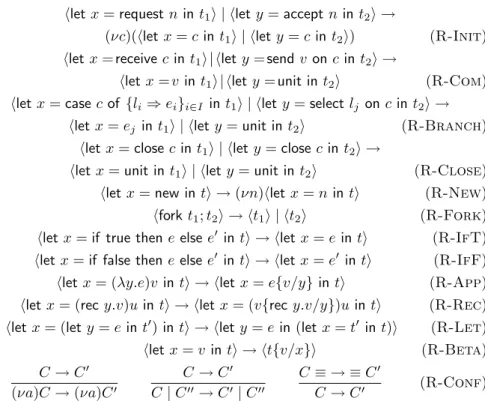
We now explain the reduction rules. R-Init synchronizes two threads on a shared name n, creating a new channel c known to both threads. Rules R-Com, R-Branch, and R-Close synchronize two threads on a channel c:
R-Comtransmits a value v from one thread to the other; R-Branch, rather
4We could easily arrange for structural congruence to garbage collect all threads of the formhvi, forvclosed.
hletx=requestnint1i | hlety=acceptnint2i →
(νc)(hletx=c int1i | hlety=c int2i) (R-Init) hletx=receive cint1i | hlety=sendv onc int2i →
hletx=v int1i | hlety=unit int2i (R-Com) hletx=casec of {li⇒ei}i∈I int1i | hlety=selectlj oncin t2i →
hletx=ej int1i | hlety=unit int2i (R-Branch) hletx=closec int1i | hlety=closecint2i →
hletx=unit int1i | hlety=unit int2i (R-Close) hletx=new inti →(νn)hletx=nin ti (R-New) hforkt1;t2i → ht1i | ht2i (R-Fork) hletx=if true theneelsee0 inti → hletx=ein ti (R-IfT) hletx=if false theneelsee0 inti → hletx=e0 in ti (R-IfF) hletx= (λy.e)vin ti → hletx=e{v/y} inti (R-App) hletx= (recy.v)uinti → hletx= (v{recy.v/y})uinti (R-Rec) hletx= (lety=ein t0)inti → hlety=ein(letx=t0 int)i (R-Let) hletx=v inti → ht{v/x}i (R-Beta) C→C0
(νa)C→(νa)C0
C→C0 C|C00→C0|C00
C≡ → ≡C0
C→C0 (R-Conf) InR-Init,cis not free int1, t2; inR-New,nis not free int.
Figure 3: Reduction rules
than transmitting a value, chooses one of the branches in thecasethread; and R-Close closes a channel in both threads simultaneously. R-New creates a new namen, and records the fact that the name is potentially shared, by means of a (νn) in the resulting configuration. The last four rules allow reduction to happen underneath restriction, parallel composition, and structural congruence.
Unlike other thread models, the value a thread reduces to is not communi- cated back to its parent thread (the one that forked the terminating thread).
Such behaviour would have to be programmed by arranging for both threads to share a channel and explicitlysending the result back to the parent.
5 Typing
The syntax of types is described in figure 4. We definesession types S,channel environmentsΣ,data typesD, andterm typesT. The typeChancrepresents the type of the channel with identityc; the session type associated withcis recorded separately in a channel environment Σ. Channel type bottom, ⊥, denotes a channel that is already in use by two threads, hence that cannot be used further.
S::= ?D.S |!D.S |?S.S|!S.S |&hli:Siii∈I | ⊕ hli:Siii∈I |End | ⊥ D::=Bool|Unit|Σ;T →T; Σ|[S]
Σ ::=∅ |Σ, c: S (c: S not in Σ) T ::=D |Chanc
Figure 4: Syntax of types
Γ`true:Bool Γ`false:Bool Γ`unit:Unit (T-Const) Γ`c:Chanc Γ, n: [S]`n: [S] Γ, x:T `x:T
(T-Chan,T-Name,T-Var) Γ, x:T `Σ. e:U /Σ0
Γ`λx.e: (Σ;T →U; Σ0)
Γ, x:T `v:T T = (Σ;U →U0; Σ0) Γ`recx.v:T
(T-Abs,T-Rec) Figure 5: Typing rules for values
Similarly to channel and name identifiers, ⊥ is not available at the top level syntax, arising only via the channel environment composition operator, Σ1•Σ2, defined below. Among datatypes we have channel-state annotated functional types Σ;T →T; Σ, and types for names [S] capable of establishing sessions of typeS.
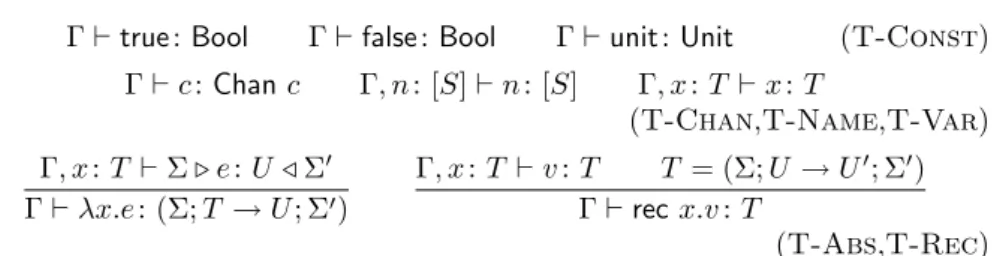
The type system is presented in figures 5 to 9. Typing judgements for con- stants are of the form Γ ` v: T, where Γ is a map from names and variables to types. Value judgements do not mention channel environments, for values, having no behaviour, do not change channels. Judgements for expressions are of the form Γ`Σ. e: T /Σ0, where Σ is a channel environment (a map from channels into sorts, as in figure 4). The difference between Σ and Σ0reflects the effect of an expression on the types of channels, for example
x:Chanc`c: ?Int.End.receivex:Int/ c:End.
Finally, typing judgements for configurations are of the form ∆ ` Σ. C where ∆ is a map from names to datatypes of the form [S].
Typing Values (figure 5). T-Chansays that a channel named c has type Chan c. The actual type (or state) of channel c is to be found in a channel environment Σ, in the rules for expressions. In T-Abs, the initial and final channel environments of the function body are recorded in the function type.
Typing Expressions (figures 6, 7). There are two rules for receiveand two rules forsend, for these constructors are overloaded: they allow transmission of data as well as channels. InT-ReceiveD, the prefix ?D., of the type for channel c, is consumed, provided that we are receiving on a value aliased to channel c
Γ`v:Chanc
Γ`Σ, c: ?D.S .receivev:D /Σ, c:S (T-ReceiveD) Γ`v: Chanc dfresh
Γ`Σ, c: ?S0.S .receivev:Chan d /Σ, d:S0, c: S (T-ReceiveS) Γ`v: D Γ`v0:Chanc
Γ`Σ, c: !D.S .sendv onv0:Unit/Σ, c:S (T-SendD) Γ`v:Chand Γ`v0:Chan c
Γ`Σ, c: !S0.S, d:S0.sendv onv0:Unit/Σ, c:S (T-SendS) Γ`v:Chanc j∈I
Γ`Σ, c:⊕hli:Siii∈I.selectlj onv:Unit/Σ, c:Sj (T-Select) Γ`v:Chanc Γ`Σ, c:Sj. ej:T /Σ0 ∀j∈I
Γ`Σ, c: &hli:Siii∈I .case vof {li⇒ei}i∈I:T /Σ0 (T-Case) Γ`v:Chanc
Γ`Σ, c:End.closev:Unit/Σ (T-Close) Γ`v: [S] c fresh
Γ`Σ.requestv: Chanc /Σ, c:S
Γ`v: [S] cfresh Γ`Σ.acceptv:Chanc /Σ, c:S
(T-Request,T-Accept) Figure 6: Typing rules for expressions I: Channel operations
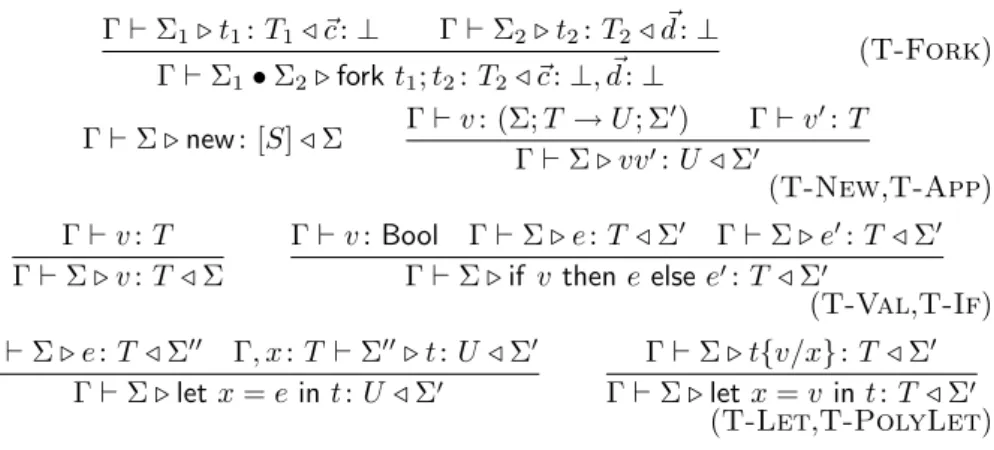
(of typeChanc). InT-ReceiveS, we receive a channel, that we decided to call d; the type of the expression is Chan d, and we add a new entry to the final channel environment, where we record the type ford. The particular form of the final channel environment allows the continuation to hold both ends of the channel. The rulesT-SendD andT-SendS, for sending values and channels, are similar. InT-Select, the type forcin the final channel environment is that of branch li in the type for c in the source channel environment. In T-Case, all branches must produce the same final channel environment. This enables us to know the environment for any code following thecase, independently of which branch is chosen at runtime. The same applies to the two branches of the conditional inT-If. RuleT-Closerequires that the channel must be ready to be closed (of typeEnd). We remove the closed channel from the environment.
Rules T-Request and T-Accept both introduce a new channelc in the channel environment, ofdual polarities [6, 10, 11, 20, 21]. The dual of a session type S, denoted S, is defined for all session types except ⊥, and is obtained by interchanging output ! and input ?, and by interchanging branching & and selection ⊕, and leaving S otherwise unchanged. The inductive definition of duality is in Figure 8.
InT-App, the initial and final channel environments in the type of the func- tion are released into the typing for the application. T-Valsays that constants do not affect the state of channels. Expression new has any type of the form
Γ`Σ1. t1: T1/ ~c:⊥ Γ`Σ2. t2:T2/ ~d:⊥
Γ`Σ1•Σ2.forkt1;t2:T2/ ~c:⊥, ~d:⊥ (T-Fork) Γ`Σ.new: [S]/Σ Γ`v: (Σ;T →U; Σ0) Γ`v0:T
Γ`Σ. vv0:U /Σ0
(T-New,T-App) Γ`v:T
Γ`Σ. v:T /Σ
Γ`v:Bool Γ`Σ. e:T /Σ0 Γ`Σ. e0:T /Σ0 Γ`Σ.if v theneelsee0:T /Σ0
(T-Val,T-If) Γ`Σ. e:T /Σ00 Γ, x:T `Σ00. t:U /Σ0
Γ`Σ.letx=ein t:U /Σ0
Γ`Σ. t{v/x}:T /Σ0 Γ`Σ.letx=v int:T /Σ0
(T-Let,T-PolyLet) Figure 7: Typing rules for expressions II: Other rules
End=End ?D.S=!D.S ?S0.S =!S0.S !D.S=?D.S !S0.S =?S0.S
&hli:Siii∈I =⊕hli:Siii∈I ⊕hli:Siii∈I = &hli:Siii∈I
Figure 8: Duality on session types
[S], denoting a name that, when shared by two threads, is able to produce (via accept/request) new channels of type S.
Rule T-Forkcomposes the initial channel environments of two configura- tions, by checking that the types of the channels occurring in both environments are dual. As for the final environment, the rule requires, via the~c: ⊥andd:~ ⊥ in the antecedent, that each thread involved either consumes their channels (that is sends or closes), or uses them in dual mode.
Thecomposition of two channel environments, Σ1•Σ2, is defined only when Σ1(c) = Σ2(c), for all c ∈ dom Σ1∩dom Σ2. In this case dom(Σ1•Σ2) = dom Σ1∪dom Σ2, and (Σ1•Σ2)(c) is⊥whenc∈dom Σ1∩dom Σ2, and is Σi(c) whenc∈dom Σi\dom Σ3−i, fori= 1,2.
Rule T-PolyLet types the various forms of polymorphism identified in section 2, by separately typing different copies of the polymorphic value [16, Chapter 22].
Typing Configurations (figure 9). Rule T-Thread requires that threads either consume their channels or use them in dual mode, similarly toT-Fork. The ∆ in the antecedent of ruleT-Threadensures that threads are closed for variables, for the domain of ∆ does not include variables. RuleT-Paris similar toT-Fork. T-NewNdiscards information on the bound name. There are two rules for channel creation. Rule T-NewB says that a newly created channel must be used with dual modes by exactly two threads, since the type⊥usually
∆`Σ. t: / ~c: ⊥
∆`Σ.hti
∆`Σ1. C1 ∆`Σ2. C2
∆`Σ1•Σ2. C1|C2
∆, n: [ ]`Σ. C
∆`Σ.(νn)C (T-Thread,T-Par,T-NewN)
∆`Σ, c:⊥. C cnot in ∆,Σ
∆`Σ.(νc)C
∆`Σ. C cnot in ∆,Σ
∆`Σ.(νc)C
(T-NewB,T-NewC) Figure 9: Typing rules for configurations
arises from the• operator in rules T-Par or T-Fork. Rule T-NewC allows to garbage collect unused channels.
The formulation of Subject Reduction is standard; the proof is in appendix A, page 18.
Theorem 1 (Subject Reduction).If∆`Σ.CandC→C0, then∆`Σ.C0.
6 Type Safety
In our language of functional communicating threads different sorts of problems may occur at runtime, ranging from the traditional error of testing, in a con- ditional expression, a value that is nottrue or false; through applying close to a value that is not a channel; to the most relevant to our work: having one thread trying to send on a given channel, and another trying toselect on the same channel, or having three or more threads trying to synchronize on the same channel.
In order to define what we mean by a faulty configuration, we start by calling a c-thread any thread ready to perform an operation on channel c, that is a thread of the formhletx=receivecin ti, and similarly forsend,case,select, and close. Ac-redex is the parallel composition of two threads ready to communicate on channel c, that is hletx=sendv onc int1i | hlety=receivecin t2i, and similarly for case/select, close/close. A configuration C is faulty when C ≡ (ν~a)(C1|C2) andC1 is
1. the threadhletx=einti, whereeis i)ifvthen else withv6=true,false, or is ii)v withv6=λy.e0 andv6=recy.e0; or is
2. the threadhletx=accept/requestvin ti, wherev is not a name; or is 3. the threadhletx=ein ti, wheree is i)receive/close v, or ii)send onv,
or iii)casev of , or iv)select onv, withv not a channel; or is
4. the parallel composition of twoc-threads that do not form ac-redex; or is 5. the parallel composition of three or morec-threads.
The main property of this section says that typable configurations are not faulty; the proof is in appendix B, page 29.
Theorem 2 (Type Safety). Typable configurations are not faulty.
7 Related Work
Cyclone [9] is a C-like type-safe polymorphic imperative language. It features region-based memory management, and more recently threads and locks [8], via a sophisticated type system. The multithreaded version requires “a lock name for every pointer and lock type, and an effect for every function”. Our locks are channels; but more than mutual exclusion, channels also allow a precise de- scription of the protocol “between” acquiring and releasing the lock. In Cyclone a thread acquires a lock for a resource, uses the resource in whichever way it needs, and then releases the lock. Using our language a thread acquires the lock via arequest operation, and then follows the protocol for the resource, before closing the channel obtained withrequest.
In the Vault system [3] annotations are added to C programs, in order to describe protocols that a compiler can statically enforce. Similarly to our ap- proach, individual runtime objects are tracked by associating keys (channels, in our terminology) with resources, and function types describe the effect of the function on the keys. Although incorporating a form of selection (⊕), the type system describes protocols in less detail than we can achieve with session types. “Adoption and Focus” [4], by the same authors, is a type system able to track changes in the state of objects; the system handles aliasing, and includes a form of polymorphism in functions. In contrast, our system checks the types of individual messages, as well as tracking the state of the channel. Our sys- tem is more specialized, but the specialization allows more type checking in the situation that we handle.
Igarashi and Kobayashi have developed a generic framework in which a range of π-calculus type systems can be defined [13]. Although able to express se- quencing of input and output types similarly to session types, it cannot express branching types.
A somewhat related line of research addresses resource access. Walker, Crary, and Morrisett [22] present a language to describe region-based mem- ory management together with a provably safe type system. Igarashi and Kobayashi [12] present a general framework comprising a language with primi- tives for creating and accessing resources, and a type inference algorithm that checks whether programs access resources in a disciplined manner. Although types for resources in this latter work are similar in spirit to session types, we work in a much simpler setting.
Type and effect systems can be used to prove properties of protocols. Gordon and Jeffrey [7] use one such system to prove progress properties of communi- cation protocols written in π-calculus. Rajamani et al.’s Behave [2, 17] uses CCS to describe properties of π-calculus programs, verified via a combination
of type and model checking. Since our system is purely type checking (not model checking) we expect verification to be more efficient and easier to implement.
8 Future Work
We outline some of the issues involved in extending our language to include a wider range of standard features.
Recursive Session Types. We have introduced recursive session types in a previous work [5]. We feel its incorporation in the present setting would not present major difficulties, although care must be taken in the definition of duality [21].
Principal Typings. For practical type inference, for separate compilation and modularity, one needs a notion of principal typings for the language. Par- ticularly challenging is the share/not-share kind of polymorphism identified in section 2.
Type Inference. We are working on a constraint-based type inference algo- rithm for (the monomorphic fragment of) the language.
ML-style references and assignment. This would introduce further issues of aliasing. We do not yet know whether our present infrastructure for type- checking in the presence of aliasing would be sufficient for this extension.
Acknowledgements. This work was partially supported by the EU IST proac- tive initiative FET-Global Computing (projects Mikado, IST–2001–32222, and Profundis, IST–2001–33100), Funda¸c˜ao para a Ciˆencia e a Tecnologia (via CLC, CITI, and the project MIMO, POSI/CHS/39789/2001), and a Treaty of Wind- sor grant from the British Council in Portugal and the Portuguese Council of University Rectors.
References
[1] H. Barendregt. The Lambda Calculus: Its Syntax and Semantics. North- Holland, Amsterdam, 1984.
[2] S. Chaki, S. K. Rajamani, and J. Rehof. Types as models: model checking message-passing programs. In POPL, pages 45–57. ACM Press, 2002.
[3] R. DeLine and M. F¨ahndrich. Enforcing high-level protocols in low-level software. In PLDI, pages 59–69. ACM Press, 2001.
[4] J. S. Foster, T. Terauchi, and A. Aiken. Flow-Sensitive Type Qualifiers. In PLDI, pages 1–12, Berlin, Germany, June 2002.
[5] S. Gay, V. T. Vasconcelos, and A. Ravara. Session types for inter-process communication. TR 2003–133, Department of Computing, University of Glasgow, March 2003.
[6] S. J. Gay and M. J. Hole. Types and subtypes for client-server interactions.
volume 1576 of LNCS, pages 74–90. Springer-Verlag, 1999.
[7] A. Gordon and A. Jeffrey. Typing correspondence assertions for communi- cation protocols. Theoretical Computer Science, 300:379–409, 2003.
[8] D. Grossman. Type-safe multithreading in cyclone. InACM Workshop on Types in Language Design and Implementation. ACM Press, 2003.
[9] D. Grossman, G. Morrisett, T. Jim, M. Hicks, Y. Wang, and J. Cheney.
Region-based memory management in cyclone. In PLDI, pages 282–293.
ACM Press, 2002.
[10] K. Honda. Types for dyadic interaction. InCONCUR’93, volume 715 of LNCS, pages 509–523. Springer-Verlag, 1993.
[11] K. Honda, V. Vasconcelos, and M. Kubo. Language primitives and type discipline for structured communication-based programming. volume 1381 ofLNCS, pages 122–138. Springer-Verlag, 1998.
[12] A. Igarashi and N. Kobayashi. Resource usage analysis. In POPL, pages 331–342. ACM Press, 2002.
[13] A. Igarashi and N. Kobayashi. A generic type system for the pi-calculus.
Theoretical Computer Science, 311(1–3):121–163, 2003.
[14] A. Jeffrey and J. Rathke. A fully abstract may testing semantics for con- current objects. In Proc. Lics2002, 17th Annual Symposium on Logic in Computer Science, Copenhagen, pages 101–112. IEEE Computer Society Press, 2002.
[15] R. Milner, J. Parrow, and D. Walker. A calculus of mobile processes, I and II. Information and Computation, 100(1):1–77, September 1992.
[16] B. Pierce. Types and Programming Languages. The MIT Press, 2002.
[17] S. K. Rajamani and J. Rehof. A behavioral module system for the pi- calculus. volume 2126 ofLNCS, pages 375–394. Springer-Verlag, 2001.
[18] J. Reppy. CML: a higher order concurrent language. InPLDI, pages 293–
305. ACM Press, 1991.
[19] D. Sangiorgi and D. Walker.Theπ-calculus: a Theory of Mobile Processes.
Cambridge University Press, 2001.
[20] K. Takeuchi, K. Honda, and M. Kubo. An interaction-based language and its typing system. volume 817 ofLNCS. Springer-Verlag, 1994.
[21] A. Vallecillo, V. T. Vasconcelos, and A. Ravara. Typing the behavior of objects and components using session types. InFOCLASA 2002, volume 68 ofElectronic Notes in Theoretical Computer Science. Elsevier, August 2002.
[22] D. Walker, K. Crary, and G. Morrisett. Typed memory management via static capabilities. TOPLAS, 22(4):701–771, 2000.
A Proof of Theorem 1, Subject Reduction
We start with a few auxiliary results; the proof of Subject Reduction is on page 23. To simplify the proofs, we make use of the variable convention [1], allowing, for example, to assume that, in sequent ∆`Σ.(νc)C, channelcdoes not occur in either ∆ or Σ. Relatedly, when we say thatcdoes not occur inC, we mean that it does not occur free inC and, by the variable convention, that it does not occur bound either.
The following easy results allow to grow and shrink the variable environment of an expression. Weakening is used in Subject Reduction (rule R-Let) and narrowing in the Substitution Lemma 12.5
Lemma 3 (Variable Weakening). Suppose that xdoes not occur ine, v.
1. If Γ`Σ. e:U /Σ0, thenΓ, x: T`Σ. e:U /Σ0. 2. If Γ`v:U, thenΓ, x:T `v:U.
Proof. The proofs, by mutual induction, are straightforward.
Lemma 4 (Variable Narrowing). Suppose thatxdoes not occur ine, v.
1. If Γ, x:T `Σ. e:U /Σ0, thenΓ`Σ. e:U /Σ0. 2. If Γ, x:T `v:U, thenΓ`v:U.
Proof. The proofs, by mutual induction, are straightforward.
The following two unchallenging results allow to grow and shrink, this time, the name environment of a configuration. They are used in the proofs of Subject Congruence (ruleS-ScopeN) and Subject Reduction (ruleR-New).
Lemma 5 (Name Weakening). Suppose thatn does not occur inC, e, v.
1. If ∆`Σ. C, then∆, n: [S]`Σ. C.
2. If Γ`Σ. e:T /Σ0, thenΓ, n: [S]`Σ. e:T /Σ0. 3. If Γ`v:T, thenΓ, n: [S]`v:T.
Proof. The proof for configurations is a straightforward induction on the deriva- tion of the judgement, using the result for expressions when the last rule in the derivation tree isT-Thread. The proofs for expressions and for values are by mutual induction.
Lemma 6 (Name Narrowing). Suppose thatnis not in C, e, v.
1. If ∆, n: [S]`Σ. C, then∆`Σ. C.
5In the formulation of the lemma, we have omitted the hypothesis thatx is not in the domain of Γ (for otherwise Γ, x:T would not be defined in the conclusion). We henceforth follow this convention for all sorts of environments.
2. If Γ`Σ, n: [S]. e:T /Σ0, thenΓ`Σ. e:T /Σ0. 3. If Γ, n: [S]`v:T, thenΓ`v:T.
Proof. The proof for configurations is a straightforward induction on the deriva- tion of the judgement, using the result for expressions when the last rule in the derivation tree isT-Thread. The proofs for expressions and for values are by mutual induction.
The following two results allow to grow and shrink the channel environment of a configuration. Weakening is needed in Subject Reduction (ruleR-Close);
Narrowing in Subject Congruence (channel extrusion using ruleT-NewB).
Lemma 7 (Channel Weakening). Suppose that c does not occur in any of
∆,Γ,Σ,Σ0, C, e, v.
1. If ∆`Σ. C, then∆`Σ, c: ⊥. C.
2. If Γ`Σ. e:T /Σ0, thenΓ`Σ, c: ⊥. e:T /Σ0, c: ⊥.
3. If Γ`v: (Σ;T →U; Σ0), thenΓ`v: (Σ, c: ⊥;T →U; Σ0, c: ⊥).
Proof. The proof for configurations is a straightforward induction on the deriva- tion of the jugdement, using the result for expressions when the last rule in the derivation tree isT-Thread. The proofs for expressions and for values are by mutual induction.
Lemma 8 (Channel Narrowing). Suppose that c does not occur in any of
∆,Γ,Σ,Σ0, C, e, v.
1. If ∆`Σ, c:S . C, thenS =⊥and∆`Σ. C.
2. If Γ`Σ, c:S . e:T /Σ0, thenΣ0= Σ00, c:S andΓ`Σ. e:T /Σ00. 3. If Γ`v: (Σ, c: S;T →U; Σ0, c:S), then Γ`v: (Σ;T →U; Σ0).
Proof. The proofs are by induction on the possible derivation trees for the judge- ment.
1. Configurations. The only cases worth mentioning are when the last rule isT-ParorT-Thread; the four remaining cases follow directly by induction.
T-Par. By hypothesis we have a tree of the form:
∆`Σ∗1. C1 ∆`Σ∗2. C2
T-Par
∆`(Σ1•Σ2), c: ⊥. C1|C2
We analyse the possibilities for splitting the environment (Σ1•Σ2), c: ⊥.
There are three cases.
1. Σ∗1= Σ1, c:S and Σ∗2= Σ2
2. Σ∗1= Σ1 and Σ∗2= Σ2, c:S
3. S=⊥, Σ∗1= Σ1, c: S1and Σ∗2= Σ2, c:S1
Each case follows easily by induction.
T-Thread. By hypothesis we have a tree of the form:
∆`Σ, c:S . t:T / ~d:⊥
∆`Σ, c:S .hti
and use the clause for expressions in this lemma, to conclude thatd~:⊥= Σ0, c:S (thereforeS=⊥) and that ∆`Σ. t:T /Σ0. The result follows by induction.
2. Expressions. The cases for all the rules in figure 6 (exceptT-Case), as well asT-NewandT-Valin figure 7 are direct, for the antecedents (if any) do not mention channel environments. The case for ruleT-Appuses the clause for functional values in this lemma. All other cases, exceptT-Forkfollow directly by induction.
T-Fork. By hypothesis we have a proof tree of the form:
∆`Σ∗1. t1:T1/ ~c:⊥ ∆`Σ∗2. t2:T2/ ~d:⊥
T-Fork
∆`(Σ1•Σ2), c:S .forkt1;t2:T2/ ~c:⊥, ~d:⊥
We analyse the possibilities for splitting the environment (Σ1•Σ2), c: S.
There are three cases.
1. Σ∗1= Σ1, c:S and Σ∗2= Σ2. 2. Σ∗1= Σ1 and Σ∗2= Σ2, c:S.
3. S=⊥, Σ∗1= Σ1, c: S1and Σ∗2= Σ2, c:S1.
The first two cases follow directly by induction. In the third case, the induction hypothesis implies thatS1=⊥andS1=⊥, meaning that Σ∗1•Σ∗2is not defined.
So the third case cannot arise.
3. Values. Rules T-Const, T-Chan, andT-Name do not apply, for the types in the axioms are not of the required form. RuleT-Var does not apply, for c is not in Γ, by hypothesis. Rule T-Rec follows by induction, and rule T-Absuses the clause for expressions in this lemma.
The following result accounts for the monoidal structure of configurations;
it is used in the proof of Subject Congruence.
Lemma 9 (Channel environment monoid). Consider the commutative monoid axioms expressed in terms of (Σ,•,∅), each in the form LHS =RHS . For each axiom, LHS is defined if and only if RHS is defined, and then they are equal.
Proof. Directly from the definition of channel environment composition, on page 12.
Congruent configurations share the same typings. This result is used in the proof of Subject Reduction, ruleR-Conf.
Lemma 10 (Subject Congruence). If ∆ ` Σ. C and C ≡ C0, then ∆ ` Σ. C0.
Proof. The proof proceeds by induction on the derivation of C ≡ C0. The inductive cases (the congruence rules) are straightforward. We now consider the base cases.
When the last rule applied is the commutative monoid rule, we use Lemma 9.
For the scope extrusion rulesS-ScopeNandS-ScopeCwe must consider each rule in both directions; forS-ScopeC we must consider two cases, depending on whether the typing derivation usesT-NewBorT-NewC.
S-ScopeN. When reading the rule left-to-right we use name weakening (lemma 5). In the other direction we use name narrowing (lemma 6). In both cases, we use the hypothesis (in the congruence rule) thatnis not inC2.
S-ScopeC, left-to-right, T-NewB. By hypothesis, we have
∆`Σ1, c:⊥. C1 c not in ∆,Σ1
T-NewB
∆`Σ1.(νc)C1 ∆`Σ2. C2
T-Par
∆`Σ1•Σ2.(νc)C1|C2
From the assumptions in the above tree, we build the following derivation, where we crucially use the variable convention to ensure thatcis not in Σ2.
∆`Σ1, c:⊥. C1 ∆`Σ2. C2
T-Par
∆`Σ1•Σ2, c:⊥. C1|C2 c not in ∆,Σ1,Σ2
T-NewB
∆`Σ1•Σ2.(νc)(C1|C2)
S-ScopeC, left-to-right, T-NewC. Similar to the previous case, again using the variable convention.
S-ScopeC, right-to-left, T-NewB. By hypothesis, we have a proof tree of the form:
∆`Σ∗1. C1 ∆`Σ∗2. C2
T-Par
∆`(Σ1•Σ2), c:⊥. C1|C2 cnot in ∆,Σ1,Σ2
T-NewB
∆`(Σ1•Σ2).(νc)(C1|C2)
We analyse the possibilities for splitting environment (Σ1•Σ2), c:⊥. There are three cases.
1. Σ∗1= Σ1, c:⊥and Σ∗2= Σ2. 2. Σ∗1= Σ1 and Σ∗2= Σ2, c:⊥.
3. Σ∗1= Σ1, c:S and Σ∗2= Σ2, c:S.
In case 1 we build the following derivation.
∆`Σ1, c:⊥. C1 c not in ∆,Σ1
T-NewB
∆`Σ1.(νc)C1 ∆`Σ2. C2
T-Par
∆`Σ1•Σ2.(νc)C1|C2
In case 2 we build the following derivation.
∆`Σ1. C1 c6∈∆,Σ1
T-NewC
∆`Σ1.(νc)C1
∆`Σ2, c:⊥. C2 c6∈∆,Σ2, C2
Lemma 8
∆`Σ2. C2
T-Par
∆`Σ1•Σ2.(νc)C1|C2
In case 3 the typing derivation gives us the additional hypothesis that (Σ1, c:S)•(Σ2, c: S) is defined. As we have ∆` Σ2, c: S . C2 and we know thatc is not inC2, Lemma 8 applies and this judgement is ∆`Σ2, c: ⊥. C2, contradicting the assumption that (Σ1, c: S)•(Σ2, c:S) is defined. Therefore this case cannot arise.
S-ScopeC, right-to-left, T-NewC. Similar to case 1 of the previous argument.
The following result allow to replace a given channel for a another one, throughout a derivation tree. We use it in Subject Reduction, ruleR-Init, to unify the two fresh channels in the hypothesis.
Lemma 11 (Channel replacement). Suppose that neitherdnorc occurs in any ofΓ,Σ,Σ0, T, e, v.
1. If Γ`Σ. e:T /Σ0, thenΓ{d/c} `Σ{d/c}. e:T{d/c}/Σ0{d/c}.
2. If Γ`v:T, thenΓ{d/c} `v:T{d/c}.
Proof. The proof of the two results, by mutual induction, is straightforward.
The following lemma accounts for all cases in Subject Reduction where sub- stitution is needed, namely, in rulesR-App,R-Rec, andR-Beta.
Lemma 12 (Substitution). Suppose thatΓ`v: T.
1. If Γ, x:T `Σ. e:U /Σ0 thenΓ`Σ. e{v/x}: U /Σ0. 2. If Γ, x:T `u: U thenΓ`u{v/x}:U.
Proof. The proof of the two results is by mutual induction on the derivation of the judgement.
1. Expressions. The result follows easily using the result for values and induction.
2. Values. The cases of rules T-Const, T-Chan, and T-Name follow easily, observing thatxdoes not occur inu, and applying lemma 4. The case of ruleT-Varfollows trivially, asu=x. The case of rule T-Absuses the result for expressions, and that of ruleT-Recfollows by induction.
We are finally in a position to prove Subject Reduction.
Proof of theorem 1, page 13. The proof proceeds by induction on the derivation ofC→C0. We analyse each reduction rule in figure 3, page 9, in turn.
R-Init. By hypothesis, we have
hletx=requestnin t1i | hlety=acceptnin t2i →
(νc)(hletx=c int1i | hlety=cint2i).
and ∆ ` Σ.hletx=requestnint1i | hlety=acceptnint2i. The only proof tree for this sequent is of the form
(1) (2)
T-Par
∆`Σ1•Σ2.hletx=requestnin t1i | hlety=acceptnin t2i where (1) is the tree
∆`n: [S] d1 fresh
∆`Σ1.requestn:Chand1/Σ1, d1:S ∆, x:Chand1`Σ1, d1:S . t1:T / ~c:⊥
∆`Σ1.letx=requestnin t1: T / ~c:⊥
T-Thread
∆`Σ1.hletx=requestnint1i and (2) is the tree
∆`n: [S] d2 fresh
∆`Σ2.acceptn:Chand2/Σ2, d2:S ∆, y:Chand2`Σ2, d2:S . t2:U / ~d:⊥
∆`Σ2.lety=acceptnint2:U / ~d: ⊥
T-Thread
∆`Σ2.hlety=acceptnin t2i
From the assumptions in the above tree we may build the following tree
(1*) (2*)
T-Par
∆`Σ1•Σ2, c:⊥.hletx=cin t1i | hlety=c int2i
T-NewB
∆`Σ1•Σ2.(νc)(hletx=c int1i | hlety=cint2i) where (1*) is the tree
T-Chan
∆`c:Chanc
∆, x:Chand1`Σ1, d1: S . t1: T / ~c:⊥
Lemma 11
∆, x:Chanc`Σ1, c:S . t1: T / ~c:⊥ T-Let
∆`Σ1, c:S .letx=c int1:T / ~c:⊥
T-Thread
∆`Σ1, c:S .hletx=c int1i
and (2*) is the tree
T-Chan
∆`c:Chanc
∆, y: Chand2`Σ2, d2:S . t2:U / ~d: ⊥
Lemma 11
∆, y: Chanc`Σ2, c:S . t2:U / ~d: ⊥ T-Let
∆`Σ2, c:S .lety=cint2:U / ~d:⊥
T-Thread
∆`Σ2, c:S .hlety=cin t2i
Notice that we are in the conditions of lemma 11, sinced1 and d2 are fresh in the assumptions of tree (1) and (2). By the same reason ∆{c/di} = ∆, and similarly for Σ2 and forU.
R-Com. By hypothesis, we have
hletx=receive cint1i | hlety=sendvon cint2i →
hletx=v int1i | hlety=unit int2i There are two possible derivations to consider, depending on the kind of valuev carried by channelc. Let us consider the case where v is a channel (the other case is similar—and simpler).
(1) (2)
T-Par
∆`Σ.hletx=receivec int1i | hlety=sendv onc int2i where Σ is (Σ1•Σ2), c:⊥, d:S0, and (1) is the tree
T-Chan
∆`c:Chanc dfresh
∆`Σ1, c: ?S0.S .receivec:Chand /Σ01 ∆, x: Chand`Σ01. t1:T / ~c:⊥, c:⊥
∆`Σ1, c: ?S0.S .letx=receivec int1:T / ~c:⊥, c: ⊥
T-Thread
∆`Σ1, c: ?S0.S .hletx=receivec int1i where Σ01is Σ1, c:S, d:S0. (2) is the tree
∆`v:Chand ∆`c:Chanc
∆`Σ2, c: !S0.S, d:S0.sendv onc:Unit/Σ02 ∆, y:Unit`Σ02. t2:U / ~d:⊥
∆`Σ2, c: !S0.S, d:S0.lety=sendvon cint2:U / ~d:⊥
T-Thread
∆`Σ2, c: !S0.S, d:S0.hlety=sendv onc int2i where Σ02is Σ2, c:S.
From the assumptions in the above tree, one may build
(1*) (2*)
T-Par
∆`(Σ1•Σ2), c:⊥, d:S0.hletx=v int1i | hlety=unit int2i
where (1*) is the tree
∆`v:Chand ∆, x:Chand`Σ1, c:S, d:S0. t1:T / ~c:⊥, c:⊥ T-Let
∆`Σ1, c:S, d:S0.letx=vin t1:T / ~c:⊥, c:⊥
T-Thread
∆`Σ1, c:S, d: S0.hletx=v int1i and (2*) is the tree
T-Unit
∆`unit: Unit ∆, y:Unit`Σ2, c:S . t2:U / ~d: ⊥ T-Let
∆`Σ2, c:S .lety=unit int2:U / ~d:⊥
T-Thread
∆`Σ2, c: S .hlety=unit int2i
Notice that the type environment (Σ1, c:S, d:S0)•(Σ2, c:S) in the conclusion of ruleT-Parabove is defined, since (Σ1, c: ?S0.S)•(Σ2, c: !S0.S, d:S0) is defined (in the tree for the hypothesis) anddis fresh (in tree (1)).
R-Close. By hypothesis, we have
hletx=closec int1i | hlety=closecin t2i →
hletx=unit int1i | hlety=unit int2i and
(1) (2)
T-Par
∆`(Σ1•Σ2), c:⊥.hletx=closec int1i | hlety=closec int2i where (1) is the tree
· · · ∆, x:Unit`Σ1. t1:T / ~c: ⊥1
T-Let
∆`Σ1, c:End.letx=closec int1:T / ~c: ⊥1
T-Thread
∆`Σ1, c:End.hletx=closec int1i and (2) is the tree below.
· · · ∆, y: Unit`Σ2. t2: U / ~c: ⊥2
T-Let
∆`Σ2, c:End.lety=closecint2:U / ~c: ⊥2
T-Thread
∆`Σ2, c:End.hlety=closecin t2i From the assumptions in the above tree, one may build
(1*) (2*)
T-Par
∆`Σ1•Σ2.hletx=unit int1i | hlety=unit int2i
Lemma 7
∆`(Σ1•Σ2), c:⊥.hletx=unit int1i | hlety=unit int2i
where (1*) is the tree
∆`unit: Unit
T-Val
∆`Σ1.unit: Unit/Σ1 ∆, x:Unit`Σ1. t1:T / ~c: ⊥1
T-Let
∆`Σ1.letx=unit int1:T / ~c: ⊥1
T-Thread
∆`Σ1.hletx=unit int1i and (2*) is a similar tree.
R-New. By hypothesis, we have
hletx=new inti →(νn)hletx=nin ti and
∆`new: [S]
T-Val
∆`Σ.new: [S]/Σ ∆, x: [S]`Σ. t: T / ~c: ⊥ T-Let
∆`Σ.letx=new int:T / ~c: ⊥
T-Thread
∆`Σ.hletx=new inti
From the hypothesis in the above tree, we build a tree to complete the proof.
∆, n: [S]`n: [S]
∆, x: [S]`Σ. t:T / ~c: ⊥
Lemma 5
∆, n: [S], x: [S]`Σ. t:T / ~c: ⊥ T-Let
∆, n: [S]`Σ.letx=nint:T / ~c: ⊥
T-Thread
∆, n: [S]`Σ.hletx=ninti
T-NewN
∆`Σ.(νn)hletx=nin ti R-Fork. By hypothesis, we have
hforkt1;t2i → ht1i | ht2i and
∆`Σ1. t: / ~c:⊥ ∆`Σ2. t0: / ~d: ⊥
T-Fork
∆`Σ1•Σ2.forkt;t0: / ~c:⊥, ~d:⊥
T-Thread
∆`Σ1•Σ2.hforkt;t0i
From the hypotheses in the above tree, we build a tree to complete the proof.
∆`Σ1. t: / ~c:⊥
T-Thread
∆`Σ1.hti
∆`Σ2. t0: / ~d:⊥
T-Thread
∆`Σ2.ht0i T-Par
∆`Σ1•Σ2.hti | ht0i
R-App. By hypothesis, we have
hletx= (λy.e)vin ti → hletx=e{v/y}inti and
∆, y:T `Σ. e:U /Σ0
T-Abs
∆`λy.e: (Σ;T →U; Σ0) ∆`v:T
T-App
∆`Σ.(λy.e)v:U /Σ0 ∆, x:U `Σ0. t:T / ~c:⊥
∆`Σ.letx= (λy.e)v int: T / ~c:⊥
T-Thread
∆`Σ.hletx= (λy.e)vin ti
Then, one may build the following derivation to complete the proof.
∆`v:T ∆, y: T `Σ. e: U /Σ0
Lemma 12
∆`Σ. e{v/y}:U /Σ0 ∆, x:U `Σ0. t:T / ~c:⊥ T-Let
∆`Σ.letx=e{v/y} int:T / ~c: ⊥
T-Thread
∆`Σ.hletx=e{v/y}inti R-Rec. By hypothesis, we have
hletx= (recy.v)uin ti → hletx= (v{recy.v/y})uin ti and
∆, y: (Σ;T →U; Σ0)`v: (Σ;T →U; Σ0)
T-Rec
∆`recy.v: (Σ;T →U; Σ0) ∆`u:T
T-App
∆`Σ.(rec y.v)u:U /Σ0 (1)
T-Let
∆`Σ.letx= (recy.v)uin t:T / ~c:⊥
T-Thread
∆`Σ.hletx= (rec y.v)uinti where (1) is ∆, x:U `Σ0. t:T / ~c:⊥.
Then, one may build the following derivation to complete the proof.
∆, y: (Σ;T →U; Σ0)`v: (Σ;T →U; Σ0)
T-Rec
∆`recy.v: (Σ;T →U; Σ0)
Lemma 12
∆`v{recy.v/y}: (Σ;T →U; Σ0) ∆`u:T
T-App
∆`Σ.(v{rec y.v/y})u:U /Σ0 (1) T-Let
∆`Σ.letx= (v{recy.v/y})uint:T / ~c:⊥
T-Thread
∆`Σ.hletx= (v{rec y.v/y})uinti R-Beta. By hypothesis, we have
hletx=v inti → ht{v/x}i.
There are two possible derivations forhletx=v inti; we analyse each in turn.
When the derivation uses ruleT-Let, the result follows by lemma 12.
∆`v: U
T-Val
∆`Σ. v: U /Σ ∆, x:U `Σ. t:T / ~c:⊥ T-Let
∆`Σ.letx=v int: / ~c:⊥
T-Thread
∆`Σ.hletx=vin ti
When the derivation uses ruleT-PolyLet, the result is immediate.
∆`Σ. t{v/x}: T / ~c:⊥
T-PolyLet
∆`Σ.hletx=v inti:T / ~c:⊥
T-Thread
∆`Σ.hletx=v inti R-Let. By hypothesis, we have
hletx= (lety=eint0)in ti → hlety=ein(letx=t0 int)i and
∆`Σ. e:T /Σ1 ∆, y:T `Σ1. t0:T1/Σ01
∆`Σ.lety=eint0:T1/Σ01 ∆, x:T1`Σ01. t:U / ~c:⊥
∆`Σ.letx= (lety=eint0)in t:U / ~c:⊥
T-Thread
∆`Σ.hletx= (lety=eint0)inti Then, one may build the following derivation to complete the proof.
∆`Σ. e:T /Σ1 (1)
T-Let
∆`Σ.lety=ein (letx=t0 int) :U / ~c:⊥
T-Thread
∆`Σ.hlety=ein(letx=t0 int)i where (1) is the tree
∆, y:T `Σ1. t0:T1/Σ01
∆, x:T1`Σ01. t:U / ~c:⊥
Lemma 3
∆, y: T, x: T1`Σ01. t:U / ~c: ⊥ T-Let
∆, y:T `Σ1.letx=t0 int:U / ~c: ⊥ R-IfT/R-IfF. Follows the pattern in all the above cases.
R-Branch. Follows the pattern in all the above cases.
R-Conf. The three cases follow directly by induction. For the rule that uses structural congruence, we use lemma 10.
B Proof of Theorem 2, Type Safety
We start with a couple of easy results.
Lemma 13. Suppose that∆`Σ. C.
1. If C is ac-thread, thenc is in the domain ofΣ.
2. If C is ac-redex, then Σis of the from Σ0, c: ⊥.
Proof. 1. A smple analysis of the conclusions of the last rule applied in the derivation of the sequent for c-threads, namely T-SendD, T-SendS, T-ReceiveD,T-ReceiveS,T-Case,T-Select, and T-Close.
2. A simple analysis of the possible derivation trees for the thre possible c-redex cases.
Proof of theorem 2, page 14. By contradiction, assuming faulty configurations typable and performing a case analysis on the possible forms of the faulty con- figurations.
Assume ∆ ` Σ.(ν~a)(C1|C2). Without loss of generality, assume that
~a=~n~c ~d, where d~are the channels that do not occur in ∆,Σ. Build the only possible proof tree for the above sequent, first using rule T-NewN as many times as there are names in~n, then proceeding similarly with rulesT-NewB and T-NewC, a finally with rule T-Par, to obtain two subtrees ending with the sequents (i= 1,2):
∆, ~n:[S]~ `Σi. Ci (1)
where Σ, ~c: ~⊥ = Σ1•Σ2. We now analyse each of the five possible cases of faulty configurations defined in section 6, where we let ∆0= ∆, ~n:[S].~
1. The three cases are similar. We analyse the conditional expression. The only derivation tree for sequent (1) above is of the form below.
∆0 `v: Bool · · · ·
∆0`Σ1.if v thene1 elsee2: / ~f:⊥T-If · · ·
T-Let
∆0 `Σ1.letx=if v thene1 elsee2 int: / ~f:⊥
T-Thread
∆0 `Σ1.hletx=if vthen e1 elsee2 inti
Analysing the rules for values (figure 5, page 10), one realises that v can only betrueorfalse, for theT-Vardoes not apply since variables are not in the domain of ∆0, and the type in the conclusion of the remaining rules (T-Abs, T-Rec,T-Chan,T-Name,Unit) is not Bool.
2. As above, analyse the lower part of the only proof tree for, say,
∆0`Σ1.hletx=acceptv inti to obtain a tree for
∆0 `v: [S].