Occupational therapy practitioners (OTPs) work with individuals with autism spectrum disorder (ASD) of all ages to support their participation in meaningful occupations throughout their lives (Crabtree & Demchick, 2018). Patricia Henton, OTD, OTR/L, ICA, is an Assistant Professor in the Doctor of Occupational Therapy program at Huntington University.
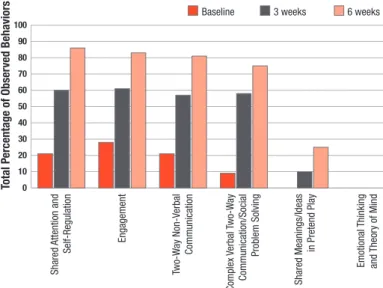
Evidence Supports Yoga as Preparatory Activity for Children's Mental Health
What is the evidence for the effectiveness of activity and occupation-based interventions within the scope of occupational therapy practice to improve mental health, positive behavior and social participation for children and youth aged 5-21 years. In addition, activity- and occupation-based interventions promote general mental health, positive behavior and increased social participation (Bazyk.
AOTA Critically Appraised Topic Series: Children & Youth 5 – 21 Years
In Level I studies, the positive results of sports activities on the development of social skills and social participation were clear. The sports activities included in the interventions varied, as did the duration of the interventions. Success in the K–12 setting (Crevecoeur et al., 2014) supported the adoption of UDL in the Higher Education Opportunity Act of 2008.
Education
One evidence-based strategy to assist learners and occupational therapy educators in the academic setting is Universal Design for Learning (UDL; Center for Applied Special Technology [CAST], 2018). Developed in the mid-1990s by clinicians working with children with learning disabilities in the K-12 setting, and in response to the poor learning outcomes of children participating in public education in the United States, researchers have found that school failure is often associated with the environment. - mental and curriculum design rather than to the learners themselves (Meyer et al., 2014). This may be particularly important for higher education leadership as focusing on admission, retention and graduation rates of all students is essential for institutional viability (Tobin & Behling, 2018).
Universal Design for Learning in OT/OTA Academic Programs
This law promotes access and opportunity for diverse students across a spectrum of abilities based on socioeconomic and life experiences, English language proficiency, and psychosocial, physical, or learning disabilities. Using the UDL framework, occupational therapy program courses can be designed with diverse learners in mind, so all students will benefit from the scaffolding, flexibility and adaptation of the environment for optimal learning.
Working With Our Students
Associate/Assistant Professor - Occupational Therapy #604160
Through these multiple modes of action and expression, students advance the use of executive functioning and clinical reasoning necessary for use with the complex clients they will encounter in the profession. The following examples of the application of UDL principles in the design and delivery of occupational therapy education were developed for the online environment with transfer provided during traditional laboratory and simulated clinical experiences. An essential component to the application of UDL guidelines during the course design was to ensure that the process documents reflect UDL principles and are encouraged to be embedded in the structure of the course, along with the course content items and activities themselves.
About the Academic Education SIS
The first part of the framework – multiple ways of engagement – is the why of learning. The second part of the framework – multiple means of representation – is the thing about learning. The Concepts in Action section is specially designed to add context and meaning to the content presented in the unit.
Support Best Practice With Choosing Wisely ® Clinical Application Handouts
The Concept in Action area provided students with another method to reinforce the information in the unit through alternative exploration opportunities. Each assignment included a space to describe the assignment itself in broad terms in relation to the unit's goals and content, which helped highlight the importance of the goals and objectives. This enhanced the ability of the instructor and students to translate their knowledge of occupational therapy education to the clients they will serve in future practice.
Health & Wellness
Improving Outcomes in Chronic Conditions: Occupational Therapy’s
More than 300 Annual Conference presenters have expressed their interest in sharing their Conference presentations virtually and AOTA is excited to offer this opportunity
The occupational profile recommends that the occupational therapy plan should address food preferences, the client's understanding of the effects of diet on their condition, and their willingness to consider alternative diets. During the occupational therapy care plan, OTPs should establish the client's existing routines and habits in relation to their energy needs and abilities. Some of those characteristics include the client's chronic illnesses and their ability to cope;
Evidence Connection Article Applies Home Modification Research to Practice
Karen Vance, BSOT, is a senior management consultant at BKD Health Care Group in Springfield, Missouri. Clarice is the Advocacy and Policy Coordinator for AOTA's Special Interest Section on Home and Community Health. Medicare and Medicaid programs; CY 2020 Home Health Prospective Payment System Rate Update; Home Health Value Based Procurement Mod-.
About the Home & Community Health SIS
Rates of TBI are even higher among veterans, who are overrepresented as 9% of the homeless population (Barnes et al., 2015; US Interagency Council on the Homeless, 2018). Cognitive impairment is a hallmark symptom of TBI that is also frequently present in the general homeless population (CDC, 2019; Stubbs et al., 2020). Attention is commonly affected, with implications for concentration, time management, and working memory (Andersen et al., 2014).
Mental Health
These deficits may affect the ability to complete ADLs and especially complex IADLs such as health management (Gillen, 2009). In adults who are homeless, these symptoms can make it particularly difficult to access services and can affect the ability to return to living or working independently. TBI may be associated with mental disorders, personality changes, substance use disorders, suicidality, migraines, epilepsy, increased contact with the criminal justice system, increased emergency room visits, and unmet health needs despite increased access to physicians (Stubbs et al., 2020 ; Topolovec-Vranic et al., 2017).
Head Injury and Homelessness: An Opportunity for Occupational Therapy
TBI can also be considered a risk factor for homelessness, as 51% to 92% of homeless individuals who report having a TBI were injured before becoming homeless.
AOTA CE
Self-report measures continue to be supported as the most effective screening method (Dams-O'Connor et al., 2014). The Ohio State University Traumatic Brain Injury Identification Method (OSU TBI-ID) has demonstrated high interrater reliability and predictive validity (Corrigan & Bogner, 2007) and is recommended by the National Council on Homeless Health Care (NHCHC; Lemsky et al., 2018). . Homeless people often have limited access to health services and/or ability to adhere to a treatment plan (Lemsky et al., 2018).
About the Mental Health SIS
In 2018, however, NHCHC released “Adapting Your Practice: Recommendations for the Care of Patients Who Are Homeless or Unstably Housed and Living with the Effects of Traumatic Brain Injury” (Lemsky et al., 2018). The high burden of traumatic brain injury and comorbidity among homeless adults with mental illness. Adapting your practice: Recommendations for the care of patients who are homeless or unstably housed and living with the consequences of traumatic brain injury.
Evidence Supports Cognitive-Behavioral Interventions for Caregivers
Weight loss programs that meet the specific needs of people with severe mental illness are needed, and occupational therapists have the expertise to develop such programs. The purpose of this review is to assist occupational therapists in making evidence-based decisions about the use of weight-loss interventions for clients with severe mental illness. Occupational therapists also have skills training expertise, which is especially helpful in the areas of shopping and meal planning for weight loss.
AOTA Critically Appraised Topic Series: Mental Health
Nineteen level I studies looking at weight loss as an outcome were reviewed; 17 studies were randomized controlled trials. In addition, occupational therapists should approach the weight loss process with their clients realistically, recognizing that there is variation in the amount of weight loss that will occur between individual clients. The interventions included in this review are within occupational therapy practice and occupational therapists are well suited to develop and manage weight loss programs using knowledge related to active learning principles and the adoption of healthy routines and habits.
Productive Aging
At the end of the fourth session, Mary and three other group members shared their plans to meet for coffee outside of the program. Participants' attitudes towards AT at the start of the program may influence the approach used to familiarize them with the devices. The social experiences integral to the program's success were identified as a strength of the program by participant evaluations of the program.

About the Productive Aging SIS
OT-led community-based programs create opportunities to bring out the special value of occupational therapy in supporting healthy aging and aging in place (Popova & Wescott, 2019). Mary tried various ergonomic garden tools and tools to help manage yard work, and she reported that she would purchase some of the tools through a local home improvement store. Occupational therapy students helped her download a free fall tracking app to ease her worries about falling while gardening.
Evidence Supports Cognitive-Behavioral Interventions for Sleep
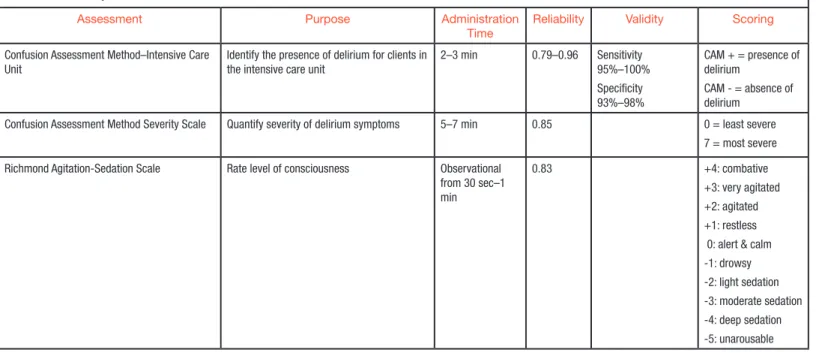
Anne Lansing, OTD, MOL, OTR/L, is an Assistant Professor in the Department of Occupational Therapy at St. The CAM-ICU determines the presence or absence of delirium and is the gold standard for delirium screening (van Eijk et al., 2011 ). The CAM-ICU identifies delirium as present when the client experiences an acute change or fluctuation in mental status, inattention, and a) an altered level of consciousness, and/or b) disorganized thinking (Sessler et al., 2002). While the CAM-ICU remains the most researched and widely used assessment of delirium, it cannot be used to quantify the severity of delirium, which is related to length of stay, mortality, and duration of delirium.
Rehabilitation, Disability, & Participation
The use of valid and reliable measures to assess delirium in patients is critical for early detection and intervention.
The Role of Occupational Therapy in Delirium Detection and Management
The ICU diary has been shown to help fill memory gaps, recreate biographical accounts of factual events, and validate client emotions (Blair et al., 2017). Music listening activates areas of the brain involved with memory, sustained attention and emotions (Khan et al., 2017). Preferred music listening, especially to slow-tempo music, is “an excellent way to deliver client-centered care and promote a healing environment by increasing activity in the area of the brain related to memory” (Khan et al., 2017, p. 2) ).
About the Rehabilitation & Disability SIS
The spectrum of psychocognitive morbidity in the critically ill: a review of the literature and a call for improvement. Delirium reduction through music (DDM) in critically ill, mechanically ventilated intensive care unit patients: study protocol for a pilot randomized controlled trial. Routine use of a confounding assessment method for the intensive care unit: a multicenter study.
Evidence Connection Article on Traumatic Brain Injury Helps to Inform Your Practice
Due to the hypoactive nature of the delirium John was experiencing, initial occupational therapy interventions focused on increasing stimulation, including sensory modulation (i.e., fitting hearing aids and glasses), progressive mobilization, and increasing family interactions with John through conversation, storytelling narrate. , and read a favorite book aloud. Due to the client-centered nature of occupational therapy and extensive theoretical training, OTPs are well positioned to provide meaningful contemporary and traditional interventions during the most vulnerable moments of a client's recovery. Improving the patient experience by implementing an ICU diary for those at risk of post-ICU syndrome.
Work & Industry
Occupational Therapy and Workplace Stress
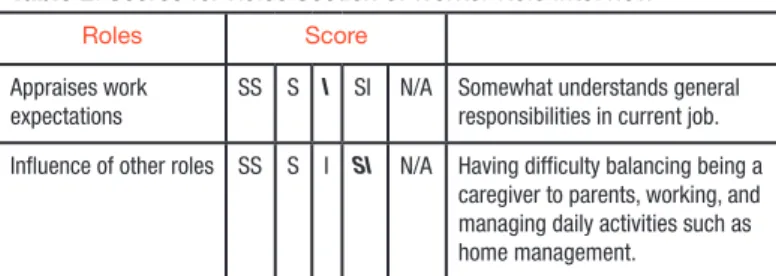
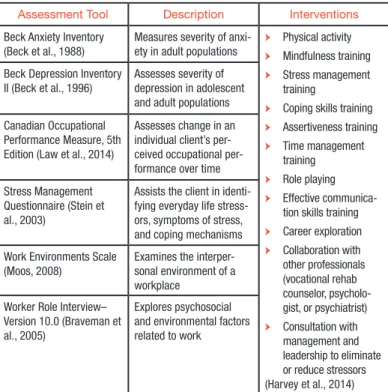
Occupational therapy interventions that have been successful in reducing work-related stress and symptoms of depression include physical activity programs, mindfulness-based programs, stress management interventions, and work environment modifications (Joyce et al., 2016; Khoury et al., 2015; Richardson, 2017; Stoewen, 2016). Other work-related stressors include poor work-life adjustment (balance between work and life) and poor work adjustment (how a worker feels about his job) (Marchand et al., 2015; Shepherd-Banigan et al., 2016). When a worker experiences a poor fit in their job, they believe their skills or abilities are overutilized or underutilized and may experience increased work-related stress and negative mental health outcomes (Marchand et al., 2015).
About the Work & Industry SIS
Using a client-centered, holistic approach rooted in evidence, we can address work-related stressors at different levels of an organization. Hemphill-Pearson (Ed.), Assessments in occupational therapy mental health: An integrative approach (2nd ed., pp. 293-308). The association between type and number of adverse working conditions and mental health in a time of economic crisis.
Evidence Supports Workplace-Design Modifications for Clients
Brandy Brown, OTD, OTR/L, is an assistant professor of occupational therapy at West Virginia University in Morgantown, West Virginia. Marissa Marchioni, OTD, OTR/L, CEAS, is an assistant professor of clinical occupational therapy at the University of Southern California, Chan Division of Occupational Science and Occupational Therapy in Los Angeles. Explore evidence on work and industry in the topics section of the American Journal of Occupational Therapy at.
Low Cost
Great Coverage Easy Application
LOW COST
GREAT COVERAGE
HIGH LIMITS
365/24/7 PORTABLE PROTECTION Covers you wherever you go!
RISK MANAGEMENT
SERVICE AND STABILITY YOU CAN TRUST Proliability has been providing coverage to health
Proliability® powered by Mercer is the best choice for occupational therapy practitioners!