Such results may prove a situation in which educational institutions do not perceive the importance of skills in the same way as companies. Such difficulties brought problems in the analysis of the availability of jobs, the review of the educational offer and the realization of surveys.
Index of Figures
196 Figure 11.6 - Assessment of the importance of competencies by Employees and other Engineers in Manufacturing Companies (Research & Development) and Students. 196 Figure 11.7 - Assessment of the importance of competencies by Employees of other Engineers in Manufacturing Companies (Engineering) and Students.
Index of Table
210 Figure 11.58 - Assessment of the relevance of operations competencies by manufacturing companies and Aeronautical Engineering courses taught by Educational Institutes. 210 Figure 11.59 - Evaluation of the relevance of engineering competencies by manufacturing companies and Aeronautical Engineering courses taught by Educational Institutes.
1 Introduction
- Background and Motivation
- Scope
- Demand Side
- Supply Side
- Rationale
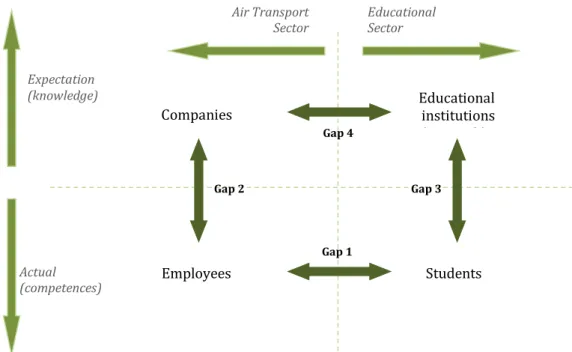
- Gap 3 Gap 4
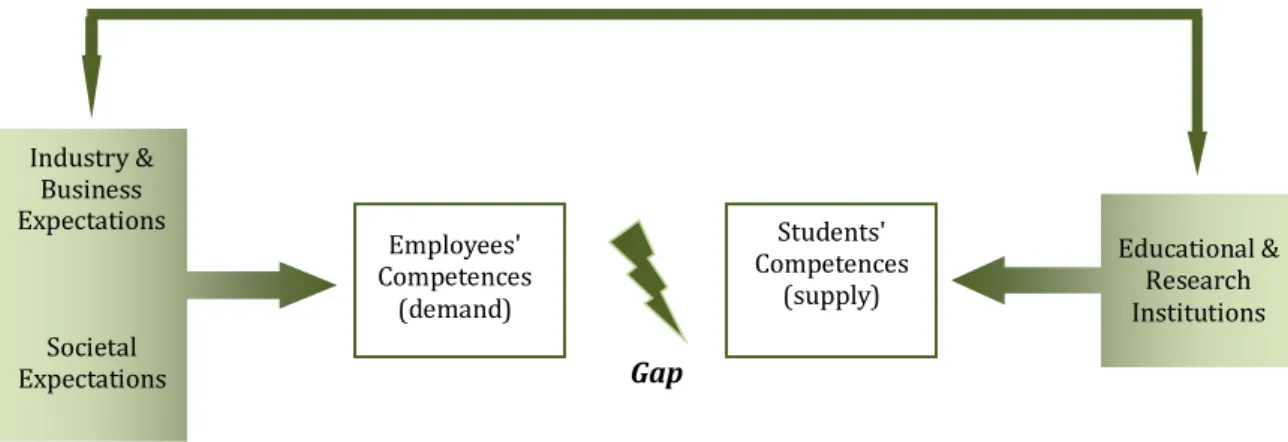
These sectors account for the vast majority of the basic demand and the derived demand for trained personnel. The assessment of the skills gap was made through the analysis and cross-comparison between the demand and supply side of each gap.
2 Aviation Sector in the European Union
Recent Market Developments
- Global trends influencing today’s market
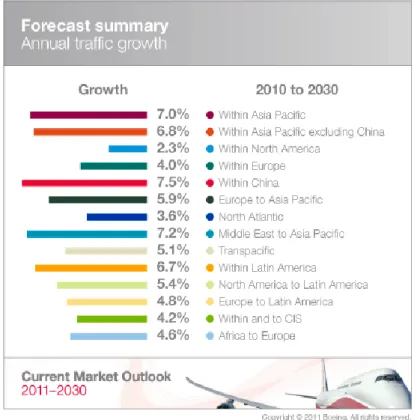
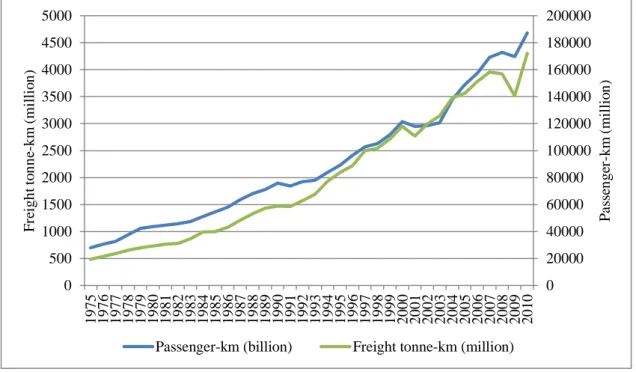
- The growth of the air transport sector
- Traffic flows
- Demand for innovations
Importantly, an increase in urban population has historically led to an increase in GDP per capita, a key driver for Aviation (Airbus, 2011, p.18). The growth of such cities means a greater need for secondary airports - to eventually reduce added pressure on existing airports - and aircraft (of the right size) to serve these new markets. Forty percent will replace older aircraft and 3,800 new twin-aisle aircraft will contribute to segment growth.
Labour Attractiveness
- Current Situation in Air Transport and Aeronautics Sectors
- Results of the Surveys and Interviews
The impact of each of the above-mentioned problems on the degree of attractiveness varies in nature and scope. The gradual loss of reputation of the air transport and aeronautics sector (problem 2) is another problem with the same degree of impact.
Q1: Age
Q4: Gender
Q2: Nationality
Discussion of Results
Secondly, our surveys targeted a very specific segment of the employees and students; therefore, we could never expect a large amount of recordings. They are also outside the network of contacts of the Aviation Associations or Alumni Associations (they are most likely not enrolled in other associations). Looking now at the students' survey, they reported an excessive difficulty of the course as a problem.
One of the factors of reluctance is related to the overly extensive theoretical content of the lessons with an apparently low connection to practice. In section 2.2.1, we listed the trend factors behind the gradual loss of students in aviation education programs.
3 Availability of Job in the Aviation Sectors in 2020
- Existing forecasts concerning the availability of jobs for pilots, maintenance personnel and controllers
- Data and Method
- Availability of jobs in the airport sector
- Availability of jobs in the airline sector
- Availability of jobs in the aeronautics sector (civil)
- Availability of jobs at ANSPs
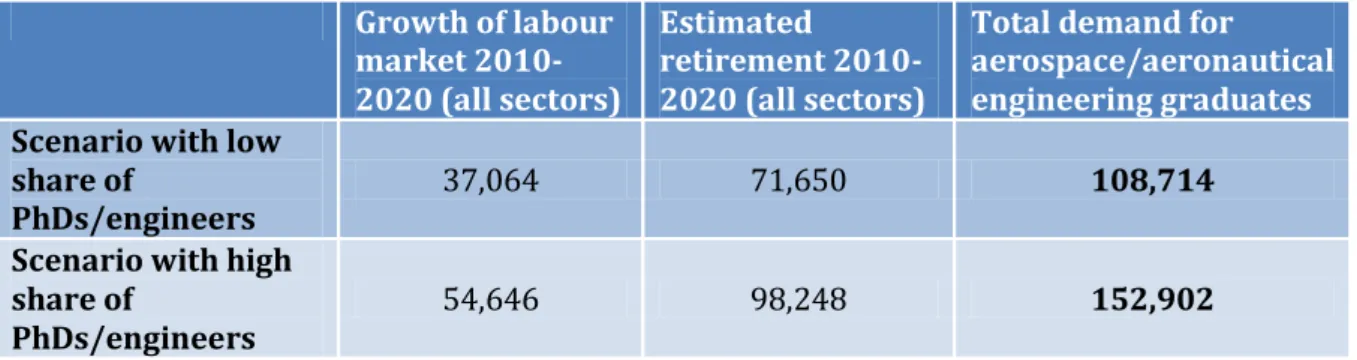
- Comparing the demand and supply side of aerospace/engineering graduates between 2010 and 2020
Data on employment in the European (military and civil) aeronautics sector are obtained from ASD for Europe17. To estimate future employment in the airline sector, FTK and traffic growth data were used. This may indicate the good quality of the data used by ASD for employment in the aeronautics sector.
Based on information from ASD, a share of 30-35% of engineers in the aviation sector can be assumed. To estimate future employment in the ANSP sector, data on the average daily movements were used.

4 Education and Curricula in Aviation
Review to the Educational Tools and Techniques
- Impact of international focus on students
- Implementation of the international focus in education
- The effect on air transport related education?
- Changes in Aviation-related training: some examples
The survey highlighted that the majority of respondents said they see the Internet as a source of information rather than entertainment. The educational objectives of the collaboration between an educational institution in the United States and an educational institution in the United Kingdom are. It must improve its safety record in the face of traffic growth, address the need for increased innovation, ensure the more sustainable and environmentally friendly future of air transport, take advantage of the latest technologies and processes to make aircraft safer, etc.
Air navigation service providers are seeking to improve their existing training to anticipate the significant technological and operational developments in virtually every aspect of the world's air traffic management (ATM) system. Combinations of academic, simulator and on-the-job training are created and customized to meet the specific needs of the provider.

Bachelor and Master Programmes (1 st and 2 nd Level of Bologna)
The concept has three key elements: a competency-based approach that is tailored to the student and led by the instructor; fully integrated use of state-of-the-art training and simulation media;. The review of academic study programs was initially intended to develop a comprehensive inventory/list of relevant programs that include the existing aviation education offer in the EU27. The primary targeted educational programs were the Aviation engineering programs at the 1st and 2nd Bologna levels.
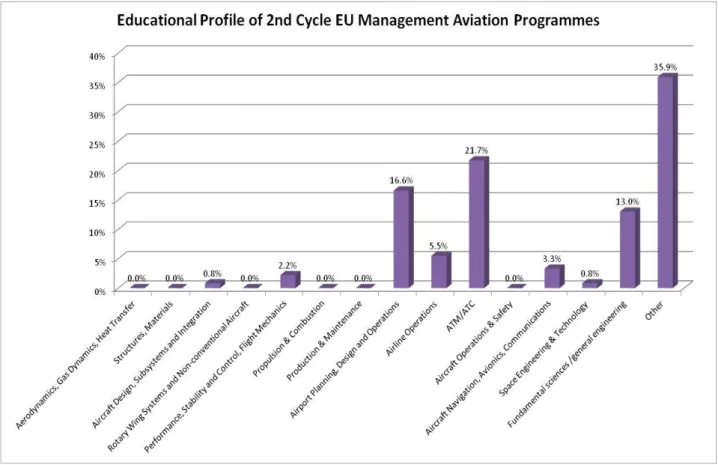
Furthermore, integrated Master's Engineering (MEng) programs were also considered, covering both the 1st and 2nd Bologna cycles at the same time. The list of (technical) programs was enriched with bachelor's and master's programs in aviation with management (e.g. air transport/aviation management, airport planning and management, aviation management) or other relevant orientation (e.g. aviation safety, aviation technologies, aircraft maintenance, flight operations).
- ATM/ATC
- Doctoral Programmes (3 rd Level of Bologna)
We observed that 62 percent of the analyzed doctoral programs have some learning modules. Regarding fees in euros, we note that in most cases dr. It is evident that finding a global pattern of doctoral education funding in the analyzed doctoral programs is complex.
It goes without saying that funding and the legal position of the PhD candidate are closely related. This practice is common in most programs under analysis, except in some cases.

5 Assessment of the Skills and Competence Gaps in Aviation Sector
Concepts and Definitions
- Knowledge
- Skill
- Competence
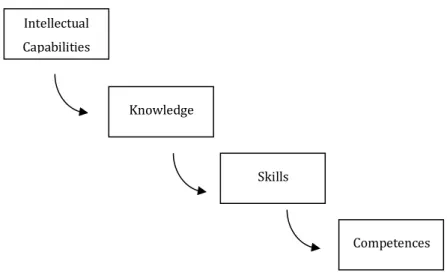
- Interaction between Knowledge, Skill and Competence
First, a skill is a goal-directed behavior that indicates that it is manifested in response to an external demand. Motor skills are related to a person's ability to perform some motor-related behavior, such as speed and accuracy of physical movements or dexterity. Problem solving ability is related to a person's ability to solve new (or unfamiliar) tasks.
The author defines competence as a (job) task that an individual can perform, and competence as an individual's ability (or characteristic) to perform a particular (job) task well. The definition of competence is functional in nature and relates to the characteristics (and functions) of a task or position; while competence has a behavioral character related to what an individual can achieve.
Methodological Framework
- Step 1 –Competences in Aviation industries
- Step 2 – Surveys to Companies, Employees, Educational and Research Institutions and Students
- Step 3 – Gap Assessment
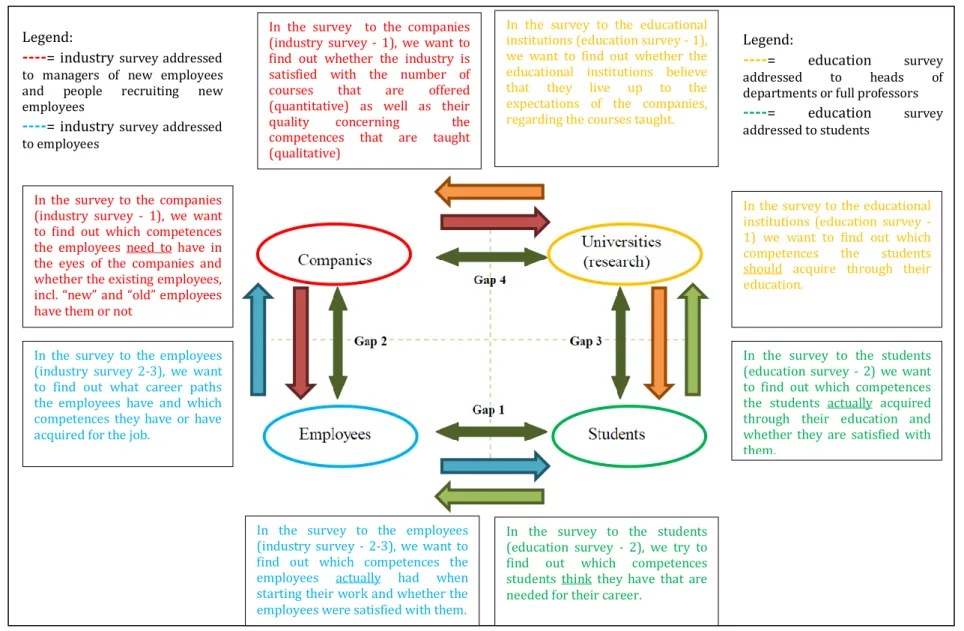
In the survey for companies (industry survey - 1), we want to find out what competencies employees should have in the eyes of companies and whether existing employees, incl. In the employee survey (industry survey - 2-3), we want to find out what competencies employees actually had when they started their jobs and whether employees were satisfied with them. In the survey for companies (industry survey - 1), we want to find out whether the industry is satisfied with the number of courses offered (quantitative) as well as their quality in relation to the competences provided (qualitative).
In a survey of educational institutions (educational survey - 1), we want to find out which competencies students should acquire through education. In the student survey (survey on education - 2), we want to find out which competencies the students have actually acquired through education and whether they are satisfied with them.

Companies
Universities
Formulation 1: in relation to any gaps in relation to the competences taught in Educational Institutions (ie 4.2). On the horizontal axis (X-axis), we display the results from the survey to students or companies on a scale of 1 to 4, with 1 indicating low relevance, 4 indicating high relevance, and 2.5 medium relevance. On the vertical axis (Y-axis), the results from the survey are shown to students or companies on a scale of 0% to 100%, with 0% indicating that none of the educational institutions surveyed teach a particular competency and 100% that shows that all educational institutions surveyed are teaching a certain competency.
On the other hand, a very specific competence (needed only in some special cases of projects) is likely to be taught only in specific schools. The assessment of the skills gaps is supported by the graphs in Annex III (Chapter 10).

No Gap Quadrant
The reason for the likely existence of a gap is due to a mismatch between the perspective of companies or students and the educational offer. The probable existence of a gap was considered when the deviation of evaluations between individual pairs or agents (companies, employees, educational institutions or students) was above half of one level (out of four on the Likert scale).
Gap Quadrant
Competences Gaps
The assessment of the skills gaps is supported by the graphs in Annex IV (Section 10). It is important to emphasize that the actual nature of the analyzes was strongly conditioned by the amount of responses. The situation is cause for concern, as the gaps are invariably28 due to an overestimation of the companies versus the employees.
Second, the results show a wide spread in the frequency of teaching competencies, although some patterns are recognizable. Regarding the assessment of the gap between the educational institution and the students, the results reveal gaps in most cases.
6 Conclusions
- Introduction
- Attractiveness and Repulsion Factors in EU Aviation Sector
- Availability of Jobs in the Aviation Sector in 2020
- Review of the Educational Offer in Aviation
- Skills and Competence Gaps
- Skill Gaps
- Competences Gaps
- European Observatory for Education and Employment in Civil Aviation
The results show that Skills were rated above 2.5 and often above 3.5 (on a scale of 1 to 4) in the vast majority of cases. The results also indicate a consistency and similarity of perspectives among groups of respondents as there is a visible alignment in the valuation of the Skills. This is precisely the root of the concern, as we may be facing a situation in which educational institutions do not see the relevance of the skill in the same way as companies.
The situation is cause for concern, as the gaps are invariably29 due to an overestimation of the companies versus the employees. All these factors prevent the development of robust statistics on the state and development of the EU aviation sector.
7 Bibliography
The Case of Bangkok Suvarnabhumi Airport, Paper presented at TRB Annual Meeting 2012, 11 p. 2005) "Applicant attraction to organizations and job choice: A meta-analytic review of correlates of recruitment outcomes", Journal of Applied Psychology, Vol. Eurocontrol (2013) Seven-year IFR Flight Movements and Service Units Forecast available online at http://www.eurocontrol.int/documents/seven-year-flights-forecast-2013- 2019. Database of Eurostat (2013), available online at http://epp.eurostat.ec.europa.eu/portal /page/portal/eurostat/home/. 2011), Using project-based learning (PBL) to enhance student learning in transportation engineering, paper presented at the 2012 TRB Annual Meeting, 27 p. commissioned by the BBC, news.bbc.co.uk/2/shared/bsp/hi/pdfs/08_03_10_BBC_internet_poll.pdf Hartle, F. 1995), How to re-engineer your performance management process, London, Kogan.
2011), To play or not to play: teaching transport planning with board games, paper presented at the TRB 2012 annual meeting, 21 pp. A contribution to the psychology of learning", Psychological Bulletin, Vol 1, p. 2011), Regional Catalytic Economic Impacts and Noise -Damage Costs of Aviation Growth, Paper presented at TRB 2012 Annual Meeting, 14p. 1995), Developing Corporate Competence: A High-Performance Agenda for Managing Organizations, London, Gower. 2000), "Aircraft design education in Europe", Editorial in Aircraft Design, 3, p. 2011), Exploring Cooperative Learning through Gaming Simulation in an integrated Land Use-Transportation Planning Course, paper presented at TRB 2012 Annual Meeting, 16 p. 2001) Vergleichende Leistungsmessung in Schulen eine umstritene Selbstverständlichkeit.
8 Annex I – Characterisation of Surveys
9 Annex II –Results of the Surveys about the relevancy of Skills and Competences
Skills
Competences
- Airline-related Competences
- Airport-related Competences
- ANSP-related Competences
- Manufacturer-related Competences
Other non-engineering UNIVERSITIES (Bologna level 1 and 2) Aeronautical/Aeronautical Mechanical Civil Other Engineering. Other Non-Technical STUDENTS (Bologna Level 1 and 2) Aeronautics/Aeronautics Mechanical Engineering Civil Engineering Other Engineering. Aeronautics/Aeronautics Mechanical Engineering Construction Other Engineering Other non-technical STUDENTS (Bologna level 1 and 2).
Other engineering Other non-technical STUDENTS (1st and 2nd level of Bologna) Aerospace/Aviation Mechanics Civil. Aerospace/Aviation Mechanical Civil Other Engineering Other non-technical Aerospace/Aviation Mechanical Civil Other Engineering Other non-technical.

10 Annex III – Skill Gaps Graphs
Employees and Students Skill Gap Assessment
- Employees and Aerospace/Aeronautical Engineering Students Skill Gap Assessment
- Employees and Mechanical Engineering Students Skill Gap Assessment
- Employees and Civil Engineering Students Skill Gap Assessment
- Employees and Other Engineering Students Skill Gap Assessment
- Employees and Other Non-Engineering Students Skill Gap Assessment
Companies and Employees Skill Gap Assessment
Educational Institutions and Students Skill Gap Assessment AEROSPACE & AERONAUTICS MECHANICAL
Companies and Educational Institutions Skill Gap Assessment .1 Airlines Companies and Educational Institutions Skill Gap Assessment
- Airport Companies and Educational Institutions Skill Gap Assessment
- ANSP Companies and Educational Institutions Skill Gap Assessment
- Manufacturer Companies and Educational Institutions Skill Gap Assessment
- Other Companies and Educational Institutions Skill Gap Assessment
11 Annex IV – Competence Gaps Graphs
Employees and Students (relevancy) Competences Gap Assessment
Companies and Employees Competences Gap Assessment
Educational Institutes and Students (relevancy) Competences Gap Assessment