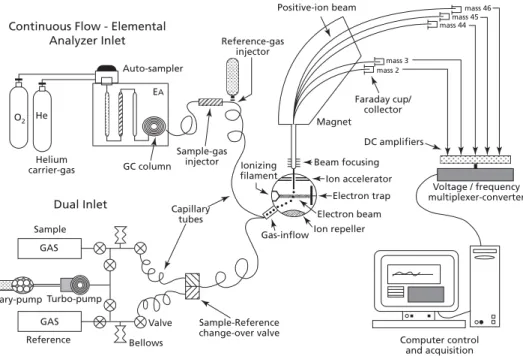
1989) Determination of the isotopic composition of ammonium nitrogen at the natural abundance level of estuarine waters. Schematic representation of the continuous flow (top) and dual inlet (bottom) interfaces to the ion source of an isotope ratio mass spectrometer (center). Broad peaks also ensure optimal recording in the specialized Faraday cups of the ion detector.
Maciel (2003) cautioned that a significant fraction of the carbon content of soil samples is missed by CP/MAS 13C-NMR methods, and that the treatment of organic matter to remove interfering paramagnetic substances (2% HF) may reveal the chemical nature of the sample. Finally, in evergreen leaves, small amounts of carbon continue to be added in the years after the leaves are first produced, which can similarly interfere with the interpretation of the isotopic signal (Hobbie et al. 2002). Shade experiments show that the refixed C is incorporated into biosynthetic pathways, lowering the δ13C of the tissues in which it occurs (Cernusak et al. 2001).
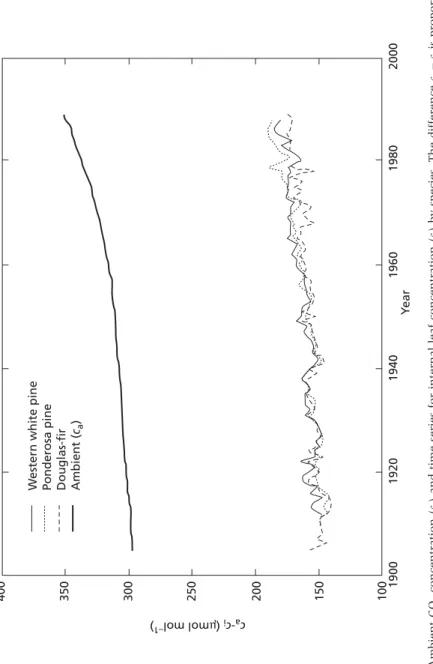
The transfer conductance, which describes the rest of the diffusion path to the chloroplast, has been related to the surface area of the chloroplast (Evans et al. 1994). In the simplified form of the equation presented above, the empirically derived b-value is about 27‰. Therefore, the isotopic ratio of xylem water can be used as a measure of the isotopic signature of the soil water being utilized.
1994) Carbon isotope discrimination and water use efficiency in native plants of the north-central Rockies.
N- and 13 C-abundance as indicators of forest nitrogen status
Greater soil N availability also appears to increase boletus root production and turnover (Aber et al. 1985; Nadelhoffer 2000). In some forests, N-rich leaf litter inputs appear to significantly increase humus accumulation (Berg et al. 2001). 15N abundance through time coincided with temporal changes in stream water nitrate concentrations (Pardo et al. 2002).
Soil types in the Oak Ridge Preserve are diverse due to the underlying complexity of the near-surface geology (Hatcher et al. 1992). More recent studies suggest that the applicability of the Rayleigh equation to vertical profiles of soil δ13C values may depend on soil texture (Wynn et al. 2005). This could lead to considerable errors given the wide variation in soil organic compounds (Ostle et al. 1999).
Ecosystem models of soil nitrogen and carbon dynamics recognize that there are several pools in soil with different residence times (Parton et al. 1987). However, direct measurements of soil δ15N and nitrogen gas loss only partially support this hypothesis (Aranibar et al. 2004). 20 percent of the carbon atoms are essential and must be derived from dietary protein (Howland et al. 2003).
Among grasses, C4 species abundance and biomass increase with growing season temperature and humidity (Epstein et al. 1997). Because of their efficient method of carbon fixation, C4 plants show little environmental variability in δ13C values (Ehleringer et al. 1997). The proteinaceous organic matrix of otoliths contains 1-3 percent cysteine and methionine (Weber et al. 2002).
25 percent of essential hydrogen is present in essential amino acids and must therefore come from food (Birchall et al. 2005). Material selection for the calcium isotope reference standard is still ongoing; CaF2 (NIST 915a) has been proposed (Hippler et al. 2003). Most fatty acids are rapidly lost from bone in subterranean and burial environments (Koch et al. 2001).
In an in-depth study, Franz-Odendaal et al. 2003) used δ18O values from tooth enamel to show that it had disappeared. Isotopic and other data have revealed the place of origin and lifetime movements of Alpine ice man (Müller et al. 2003).

Distance from base of crown (mm)
An example again involving terrestrial vertebrates comes from the work of Balasse et al. 2002), who measured the 87Sr/86Sr ratios and δ13C and δ18O values of the teeth of domestic sheep and cows on the south-west coast of South Africa. The nitrogen isotope biogeochemistry of sinking particles from the edge of the Eastern North Pacific Ocean.Deep. 1993) Experimental evidence for the relationship of the carbon isotope ratios of the whole diet and dietary proteins to those of bone collagen and carbonate.
Paleobiological implications of the isotopic signatures (13C,15N) of fossil mammalian collagen in Scladina Cave (Sclayn, Belgium). The paleoecology of the non-mammal cynodonts Diademodon and Cynognathus from the Karoo Basin of South Africa, using stable light isotope analysis. 1997). A paleoecological paradox: the habitat and feeding preferences of the extinct tethythere Desmostylus, inferred from stable isotope analysis. Paleobiology.
Stable carbon and nitrogen isotopic analyzes of the underclass at the colonial Cape of Good Hope in the eighteenth and nineteenth centuries. 2004). 2003) Expression of the dietary isotope signal in the compound-specific δ13C values of pig bone lipids and amino acids. The origin of the Juch'uypampa cave mummies: strontium isotope analysis of archaeological human remains from Bolivia.
1988) Variability in the preservation of the isotopic composition of collagen from fossil bone. 2004) Paleobiology and skeletochronology of Jurassic dinosaurs: implications for bone histology and oxygen isotope composition. The following are some examples of the use of different isotopic contrasts in nature to track animal movements. This includes potential enrichment due to water use efficiency mechanisms, but also, in the case of previously dense forest, removal of the canopy effect that tends to lower plant δ13C values (Schlesser & Jayasekera 1985; Brooks et al. 1997).
In more temperate areas, Figure 6.2 The distribution area of the loggerhead shrike (Lanius ludovicianus) in North America in relation to mean δD values for precipitation during the growing season. In addition, the most important region for butterfly production was determined to be the corn belt of the northeastern US (Hobson et al. 1999b). Recently, this base map was used to show that the increase in monarchs in Cuba during the fall was due to the dispersal of individuals originating from the northeastern US (Dockx et al. 2004).