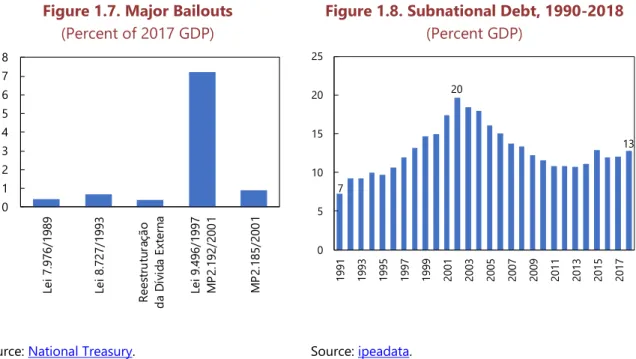
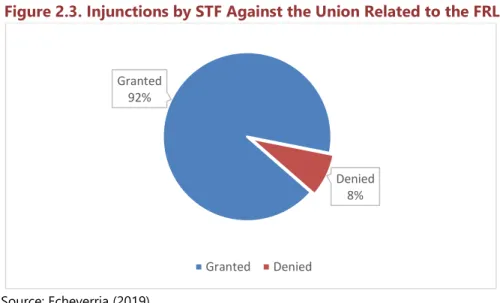
This was confirmed from 2014 with a large debt relief to all states and court rulings in favor of the sub-national governments. More financial support from the federal government is expected over the next few years at a time when the Union's fiscal position remains fragile.

Subnational Debt
The management of subnational debt has defined intergovernmental relations over the past few decades. After the introduction of the 1988 Constitution, the federal government
Current Framework
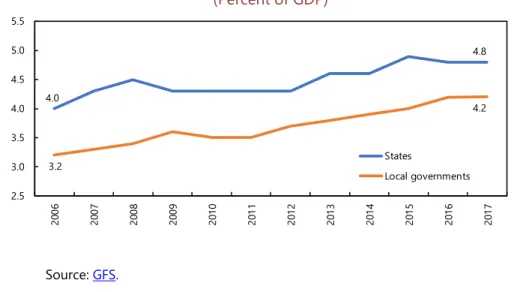
The framework that contributed to a gradual decline in subnational debt for some years after the passing of the FRL is starting to falter. In marked contrast with the decline in
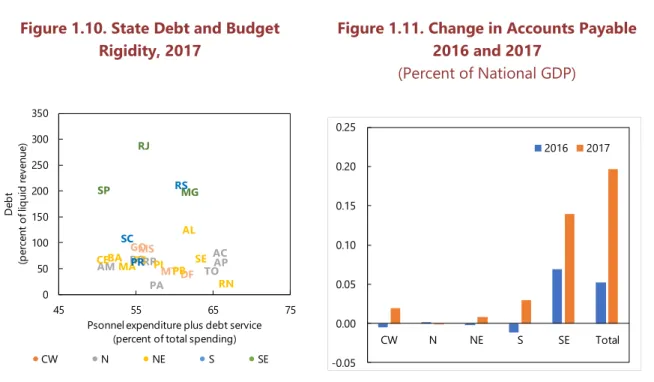
In 2017, between 51 and 67 percent of central government expenditure was allocated to salaries, pensions or debt servicing (figure 1.10). In many states, the financial imbalance has resulted in growing creditors (Restos a Pagar), which together grew by 0.3 percent of GDP between 2015 and 2017 (Figure 1.11).
Tax exemptions approved at the federal level—which are beyond the control of subnational governments—affect subnational government revenues by reducing constitutional transfers.16 But states provide tax exemptions on their own, including those related to the ICMS, a mixed origin/destination-based VAT that is the largest source of revenue for states. There are ongoing discussions to provide financial support to subnational governments in the short and medium term. Based on existing information, the PEF will allow the federal government to grant debt guarantees for states that would not otherwise qualify.
The decision to give oil revenues to local governments as an ex-post response to financial pressures can also create moral hazard. Furthermore, care must be taken with sharing highly volatile and non-renewable resources with subnational governments that may not be well equipped to manage them. It would be prudent to create a mechanism to smooth oil revenue transfers to subnational governments.

RETHINKING THE SUBNATIONAL BORROWING FRAMEWORK
- Addressing the weaknesses in the system requires a comprehensive reform of the existing framework. The approach proposed in this report represents a significant departure
- The proposed strategy requires advancing simultaneously on the different reform areas to ensure appropriate incentives and controls. That is, reducing the subnationals
Reduce Dependence on Federal Guarantees and Public Banks
- The Union has become the de facto almost exclusive creditor of the states and municipalities. Loans from or guaranteed by the Union represent 90 percent of the total debt of
- Federally owned banks also account for a large share of the loans not guaranteed by the Union. In the period 2009-2019 there were only two private financing transactions (from
- The concentration of risk in the Union has led to moral hazard due to the history of bailouts. This is further accentuated by provision of guarantees to states that have worse fiscal
- The decisions on the enforceability of the guarantees effectively subordinates debt service to expenditure on essential public services. Although similar concepts of
- Restraining the use of guarantees would also reduce the incentives for fiscal profligacy. There have been periods when federal guarantees have been very low, including in
The concentration of risk in the Union has led to moral hazard due to the history of bailouts. Court decisions have questioned the enforceability of the security obtained by the Union as security for its claims against states as well as for issuing guarantees for the state. This means that there is no distinction between state-level spending on public services, leaving the states' debt servicing to the Union as a subordinate payment to all other spending.
The role of the Union calls for a significant restriction of its use to exceptional cases. The Union's role as bearer of the credit risk of the States in its capacity as creditor and guarantor is inconsistent with its role as. Important examples are the decisions of the Supreme Court that require the Union to enforce guarantees because this would (i) contradict its action as a tax authority under the Brazilian constitutional system, (ii) contradict its action as a supervisory authority under the FRR regime, (iii) and violate the constitutional duty to contribute to the provision of public services.

Strengthen the CAPAG as a Risk Management Tool
- Subnational entities applying for credit guarantees from the National Treasury are subject to a system of internal credit ratings. Efforts to rate Brazilian subnational entities
- To be eligible to receive a Treasury guarantee, a subnational must have at least an overall B rating. A close look at the historical distribution of internal credit ratings shows a
- The new CAPAG could be strengthened by improving and updating thresholds based on cumulative experience. Some of its indicators, such as the net current revenues that
- The CAPAG may place too little weight on the level of indebtedness. The threshold for the overall level of debt appears too loose and seems to play a secondary role on the
- A prospective analysis of the subnational capacity to repay the Treasury under the baseline scenario would be useful. For example, an analysis as done by the IMF with the
- A more explicit debt sustainability analysis could enhance the evaluation of subnational credit risk. A rigorous debt sustainability analysis (DSA) could be developed to
- The improved CAPAG could be used as a more effective risk assessment tool when monitoring subnational finances. Recent regulation grants to the National Treasury the ability
The threshold for the overall debt level appears too loose and appears to play a secondary role to that for the overall debt level appears too loose and appears to play a secondary role in determining the overall subnational rating (Figure 2.6). A forward-looking analysis of the subnational capacity to repay the treasury under the baseline scenario would be useful. 27 For a recent example of a Capacity to Pay table, see e.g. the appendix "Assessment of risks for the fund and the fund's liquidity position" in IMF country report no.
The debt sustainability analysis takes into account various elements of the debt profile, including maturity, currency denomination, indexation (inflation links), term structure of interest rates, place of residence of the debt holders, among others. Most importantly, the exercise could include an assessment of the realism of the projected fiscal adjustment compared to historical periods. The analysis of risks, as suggested above, could also be included in the STN's annual sub-national finance reporting to complement the already high-quality information and analysis.

More Emphasis on Market-Induced Fiscal Discipline
- The legal and administrative controls, however, did not prevent overborrowing and led to distorsions in the pricing of risk and untransparent borrowing operations
- Further reliance on capital markets could help promote fiscal discipline among the entities. If states rely more on private funding (private banks and capital markets) without
- The framework could be monitored by the National Treasury to ensure borrowing is in line with the fiscal rules. Tighter supervision by the central government could be adopted
- Borrowing at a greater degree from private markets will require upgrading
The framework could be monitored by the National Treasury to ensure that borrowing complies with fiscal rules. Fiscal rules could accept tighter control from the central government. Tighter control by the central government could be accepted depending on the level and complexity of the debt business.34 However, in order for this capital market to deepen the legal framework applicable to subnational debt, it should be developed to allow for a more streamlined process.
Experience across the country shows that standards of transparency, depth of credit information, and degree of disclosure determine the size of subnational capital markets.35 Capital market transactions require scale and technical skills that may not be available to every state. Tools that would allow states to work together to gain scale could be used to address these issues, or technical support could be provided to states and large. Improving the quality of information provided to markets, including through privately issued sub-national credit ratings, CAPAG, early warning indicators and full-fledged debt sustainability analysis;

Enhancing the Fiscal Recovery Regime
- In 2017 Brazil launched the Fiscal Recovery Regime (FRR), a subnational insolvency framework for the most indebted states. The program was created in response to growing
- The main goal of the program is to stabilize debt at the end of the program. A state that adheres to the regime is granted a suspension of (i) the service on its debt with the federal
- The insolvency triggers under the FRR are inconsistent with debt limits under the FRL. The sections of the FRL that address indebtedness limits (together with the Senate
- Upfront debt relief affects incentives to adjust and allows free riding. The plan envisages immediate debt service relief once the state enters the fiscal adjustment program and,
- The planned adjustment should be credible and realistic—e.g., based on an examination of the proposed effort vis-à-vis the distribution of historical outcomes and
- The Brazilian insolvency framework does not sufficiently address debt overhang
- The law lacks a clear definition of what constitutes essential public services under the Brazilian insolvency framework. The need to maintain public services should be one of the
- The FRR is subject to legal uncertainty and undermined by ad-hoc bailouts outside of the insolvency regime. The FRR differs from past approaches in that it provides a permanent
- The design of sanctions for non-compliance with the adjustment plan could be improved. The two main penalties for a state that fails to comply with an adjustment plan are (i)
The speed and extent of fiscal adjustment could be optimized if debt relief were gradual and performed satisfactorily in accordance with the conditions required in the adjustment plan (see below). In addition, there are no specific requirements in the law regarding the objectives of the adaptation plan. The need to maintain public services should be one of Brazil's insolvency frameworks.
The need to preserve public services should be one of the main objectives of the subnational insolvency regime. The FRR is subject to legal uncertainty and is undermined by ad hoc resolution outside the insolvency regime. FRR differs from past approaches in that it provides a permanent insolvency arrangement.

Introducing a Debt Fund for States
A risk sharing mechanism between states may create better incentives for maintaining fiscal discipline. Creating a mechanism (fund) by which states have a direct
The FRR can be extended to apply to municipalities, at least the largest one, with the necessary adjustments. A possible approach would be to extend the FRR regime to large municipalities or introduce an insolvency or bankruptcy legal framework for municipalities as in other countries (see Annex 2). The limits under the FRL and the insolvency triggers under the FRR could be harmonised, although the current debt limits set by the Senate Resolution are too lax.
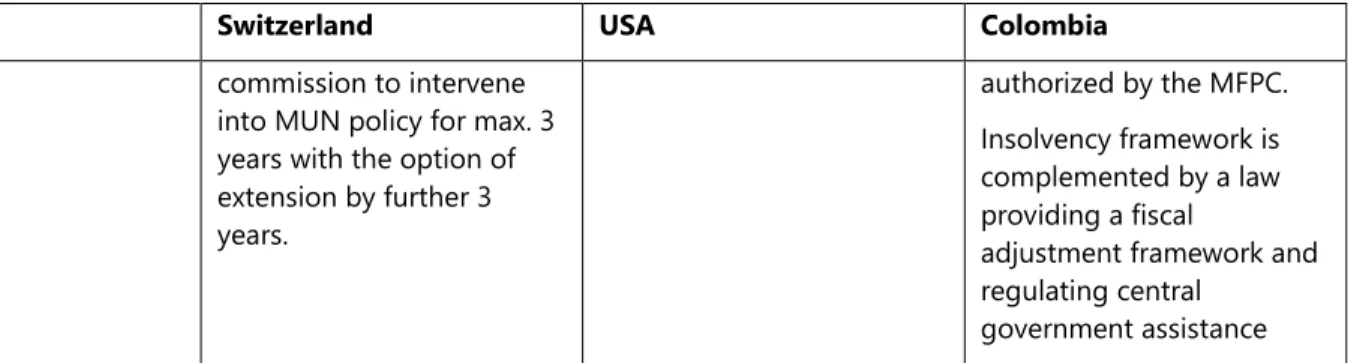
The FRR stipulates that its adaptation programs should have a 3-year term, which can be extended once. The FRR should provide more clarity on what happens if debt service with private creditors is unsustainable. This would help when designing the FRR program (and when applying sanctions to the FRL as discussed above).
A fund that acts as a lender of last resort, in case of financial distress, could better manage the risk of strategic default and promote effective fiscal adjustment programs
Examples are budget stabilization funds or rainy day funds in the United States, Canada, Mexico and Sweden, which are individually state-level funds. The existence of pooled resources that can be called upon in case of emergency signals that states are primarily responsible for servicing their debts and that only the fund's assets are available to provide support. The foundation's management structure, which could consist of a board where all states and possibly the Union are present, and a management committee with a technical focus.
This includes deciding how to allocate the fund's shares across states (eg all states can have similar shares or be based on existing rules for FPE). The role of the Fund and its coordination with the FRR framework, for example the provision of liquidity and funding under Article 11 FRR legislation. Further work is required to assess the optimal design choices in the context of the current circumstances in Brazil.
ENHANCE FISCAL RESPONSIBILITY AND TRANSPARENCY
Tasks to be performed by the fund: purchase of existing debt, provision of liquidity to countries in difficulty, provision of technical assistance in debt renegotiations and fiscal adjustment; Seed capital could include:41 a portion of existing debt that states owe to the federal government, revenue from other sources such as oil royalties. Cooperative approaches work better when there is no expected bailout and require, among other complementary reforms, the standardization of fiscal reporting.
Subnational Fiscal Rules
There needs to be greater effort to improve transparency and monitoring. A possibility could include the creation of an independent fiscal council that would provide a view
This authority could be given to the Independent Fiscal Institution (IFI), which already monitors the federal government's fiscal accounts. However, it would be important to further strengthen the independence of the IFI and provide more resources through the law. The design of the rules also contributed to some extent to the recent fiscal distress.
This means that in periods of economic boom, the rules allow large increases in spending and debt. On the other hand, it is very difficult that these unfair increases during the economic downturn, as would be required by the rule. There may be benefits to moving to a total spending rule if it is well calibrated.
There could be gains from moving to an expenditure rule for total spending if well calibrated. This could be particularly useful given the problems with creative accounting
Strengthen fiscal rules by
Transparency and Enforcement of Rules, Standards, and Audits
- The disclosing of subnational financial information has improved in Brazil in the past two decades. The introduction of the Fiscal Responsibility Law (FRL) led to an improvement
- However major weaknesses persist related to the quality of fiscal reporting
- Weaknesses in the public finance management (PFM) systems further exacerbate the challenges in fiscal management and production of quality reporting. Figure 3.3
- The creation of the FMC, as required by the FRL, has become even more a necessity
- The FMC could encourage the dialogue with SCUs towards convergence with international standards in compiling and reporting data. Although the International
- There is also a need to improve the publication of data by disclosing explanatory notes on differences in fiscal statistics published by various agencies. This exercise is been
- The need to enhance and strengthen the whole budget cycle management is even more relevant. The quality of the fiscal reports produced by the states and municipalities are not
- Enhance transparency by
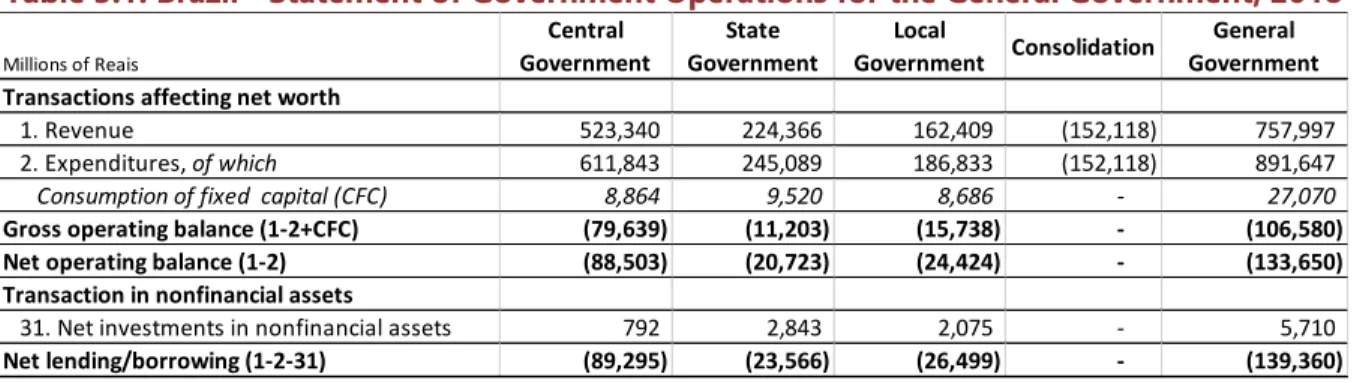
Comparison of staff spending between state definitions and the National Treasury definition for 2017. Any inconsistencies found by state auditors could be forwarded to the Treasury to improve data quality. Accelerate the implementation of the matrix of accounts and the platform to generate reports and improve analysis.
The creation of FMC, as required by the FRL, has become even more of a necessity. The quality of the financial reports that states and municipalities produce is no longer relevant. The quality of the fiscal reports produced by states and municipalities is affected not only by the different interpretations of laws and regulations, but also by weak PFM systems.
Portugal: Financial Support Fund for Municipalities
Eligigible Municipalities that did not Enter a Program
Municipalities that Adhered to a Program
Selected Insolvency Frameworks
Debt restructuring only applies to bondholders Statutory obligations, pensions, salaries, insurance contributions and other obligations that cannot be seized are exempt from restructuring. States can apply for financial support if consolidated debt over current income exceeds 2.25 and states must apply for financial support if the above ratio exceeds 3.