©2006Nature Publishing Group
The distillation and volatility of ionic liquids
Martyn J. Earle
1, Jose ´ M.S.S. Esperanc¸a
2, Manuela A. Gilea
1, Jose ´ N. Canongia Lopes
2, Luı´s P.N. Rebelo
2, Joseph W. Magee
3, Kenneth R. Seddon
1& Jason A. Widegren
3It is widely believed that a defining characteristic of ionic liquids (or low-temperature molten salts) is that they exert no measurable vapour pressure, and hence cannot be distilled1,2. Here we demon- strate that this is unfounded, and that many ionic liquids can be distilled at low pressure without decomposition. Ionic liquids represent matter solely composed of ions, and so are perceived as non-volatile substances. During the last decade, interest in the field of ionic liquids has burgeoned3, producing a wealth of intellectual and technological challenges and opportunities for the production of new chemical and extractive processes4–6, fuel cells and batteries7, and new composite materials8,9. Much of this potential is underpinned by their presumed involatility. This characteristic, however, can severely restrict the attainability of high purity levels for ionic liquids (when they contain poorly volatile components) in recycling schemes, as well as excluding their use in gas-phase processes. We anticipate that our demonstration that some selected families of commonly used aprotic ionic liquids can be distilled at 200–3008C and low pressure, with concomitant recovery of significant amounts of pure substance, will permit these currently excluded applications to be realized.
The belief that ionic liquids are not volatile can probably be traced back to a report on first-generation ionic liquids10by Øye and co- workers11, that the Franklin acidic [C2mim]Cl2AlCl3system (in which [C2mim]þis 1-ethyl-3-methylimidazolium) does not exhibit a measurable vapour pressure, even at raised temperatures, whereas the analogous NaCl-AlCl3 system exhibited a significant vapour pressure of Al2Cl6 (refs 11, 12). However, for [C2mim]Cl2AlCl3
systems with a greater than 2:1 excess of AlCl3, a detectable vapour
pressure of Al2Cl6was observed above 1918C. Again, this is not a vapour of ions, and is generated by dissociating the ionic liquid13. With the discovery of second-generation and third-generation ionic liquids, and the explosion of newly discovered systems, this lack of volatility seems to have been assumed rather than tested.
Of course, it is known that ionic liquids can be thermally decom- posed, leading to transalkylation (alkyl scrambling) in the conden- sate. For example, [C2mim]Cl thermally decomposes when heated to 1908C in vacuum: the volatile decomposition products (1-methyl- imidazole, 1-ethylimidazole, chloromethane, chloroethane, ethene and hydrogen chloride) can be recondensed to create a new ternary ionic liquid system: [C1mim]Cl2[C2mim]Cl2[C2eim]Cl, in which [C1mim]þ is 1,3-dimethylimidazolium and [C2eim]þ is 1,3-diethylimidazolium14. Similarly, ionic liquids with protonated cations, [BH]X (for example, [Hmim]Cl), will dissociate on heating to produce the molecular base, B, and the molecular acid, HX, which can be recondensed to regenerate [BH]X15,16. However, in neither scenario did the ionic liquid exert a vapour pressure—the vapour consisted of uncharged molecular components, not the ionic liquid itself.
We show here that a range of pure, aprotic, ionic liquids can be vaporized under vacuum at 200–3008C and then recondensed at lower temperatures. Some selected families of ionic liquids show no signs of degradation either in the distillate or the residue. We also demonstrate significant enrichment in distillations of mixtures of ionic liquids. Multiple-ion cluster transfer into the gas phase is most probably the underlying mechanism by which these compounds first evaporate, then maintain their stability in the low-density phase, and, finally, recondense as a pure ionic liquid at lower temperatures17.
Two types of apparatus were used for these experiments: a Kugelrohr apparatus (Fig. 1) and a sublimation apparatus (see Supplementary Information). Survey experiments were performed at 3008C and 0.1 to 5 mbar in the Kugelrohr apparatus (1 mbar¼100 Pa). These temperatures and pressures are below the predicted boiling points18of the ionic liquids, but it was possible to vaporize the ionic liquids and then condense them on colder parts of the Kugelrohr apparatus. Typically, times for the distillation were 4 to 6 h. A photograph of the apparatus is given in Fig. 1. In this apparatus, there is a possibility of splashing as a result of bubbles bursting in the ionic liquid, and to prevent this from affecting the
LETTERS
Figure 1|Labelled photograph of the Kugelrohr oven and distillation apparatus. The central glassware rapidly rotates.
Table 1|Distillation rates at 3008C and 0.1 mbar
Second-generation ionic liquid Distillation rate (g h21)
[C2mim][NTf2] 0.120
[C10mim][NTf2] 0.070
[C16mim][NTf2] 0.024
Results obtained in the Kugelrohr apparatus.
1The QUILL Centre, The Queen’s University of Belfast, Stranmillis Road, Belfast BT9 5AG, UK.2Instituto de Tecnologia Quı´mica e Biolo´gica, Universidade Nova de Lisboa, Av.
Repu´blica, Apartado 127, 2780-901 Oeiras, Portugal.3Physical and Chemical Properties Division, National Institute of Standards and Technology, 325 Broadway, Boulder, Colorado 80305, USA.
Vol 439|16 February 2006|doi:10.1038/nature04451
831
©2006Nature Publishing Group
results glass wool was placed between the oven flask and the collection flask.
To demonstrate the distillation of pure ionic liquids, 1.0 g samples of [C2mim][NTf2] and [C10mim][NTf2] (in which [C10mim]þ is 1-decyl-3-methylimidazolium, and [NTf2]2is bis{(trifluoromethyl)- sulphonyl}amide, also known as bistriflamide, [N(SO2CF3)2]2) were heated for five hours at 3008C and 0.1 mbar. This process was filmed and two time-lapse (speeded up 100 and 150 times) video files are available in the Supplementary Information to demonstrate the process in action. [C16mim][NTf2] (in which [C16mim]þ is 1-hexadecyl-3-methylimidazolium) was treated similarly. The con- densate was collected and analysed by 1H, 19F and 13C nuclear magnetic resonance (NMR) spectroscopy. These three ionic liquids are stable to prolonged heating at the distillation temperature and could be distilled, although the distillation rate varied according to the chemical structure (Table 1). The NMR spectra of these three compounds showed that no detectable decomposition had occurred during the distillations.
Distillations of a range of other ionic liquids were performed at 3008C in the Kugelrohr apparatus (Table 2). Generally, the bistri- flamide ionic liquids distilled without significant decompo- sition, and only salts containing the larger tetraalkylammonium ([NCw x y z]þ), tetraalkylphosphonium ([PCw x y z]þ), or cholinium ([Cx y zN(C2H4OH)]þ) cations showed signs of decomposition. For the triflate ([OTf]2) salts, only [C2dbu][OTf] (in which [Cndbu]þis 1-alkyl-1,8-diazabicyclo[5.4.0]undec-7-enium) distilled without sig- nificant decomposition. The vapour pressures for triflate salts seemed lower than for similar bistriflamide salts, as shown by their low distillation rates (,0.01 g h21). Examples of tosylate ([OTs]2, [Me-4-C6H4SO3]2) and hexafluorophosphate ([PF6]2) ionic liquids distilled very slowly, with little decomposition (the [PF6]2 salt must be free of acidic or basic impurities for a clean distillation).
Ionic liquids with other anions (for example, halides, sulphates, or carboxylates) decomposed on distillation. The principal mechanism of decomposition was by dealkylation or transalkylation of the cation14. This is aided by a nucleophilic anion. The triflate anion has low nucleophilicity, and hence forms relatively thermally stable ionic liquids. The bistriflamide anion has an extremely low nucleo- philicity, and hence forms very thermally stable ionic liquids; this also leads to a very low probability of transfer of a proton from the cation to the anion.
To probe the effects of temperature and pressure on the distilla- tion of ionic liquids, three experiments were performed with [C6mim][NTf2] in a small glass sublimation apparatus (Table 3).
No precautions for splashing were needed in this apparatus because it
is mechanically still and bubble formation was not observed at the temperatures and pressures of these experiments. For each experi- ment, [C6mim][NTf2] was heated from room temperature to 200 or 2508C, then held at the maximum temperature for 1–2 h. The temperature at which condensation was first observed on the cold finger condenser (or on the walls of the apparatus) was noted. At the end of the experiment, the relative rate of distillation was determined from the amount of [C6mim][NTf2] that had condensed on the cold finger. Additionally, the purities of the distillate and of the undistilled residue were checked by 1H and 19F NMR spectroscopy. The distillation at atmospheric pressure (in dry air) and 2508C failed in that the distillation was very slow, and much of what ‘distilled’
consisted of decomposition products. On the other hand, the distillation at 2008C and #0.001 mbar proceeded much faster, despite being 508C lower in temperature, and subsequent NMR analysis showed that the distillate was pure [C6mim][NTf2].
The pressure–temperature effects on the distillations are inti- mately related to the vapour pressure of the ionic liquids. A manu- script reporting the determination of the vapour pressure of [C12mim][NTf2] by a direct static method is under preparation, and a recent paper19 describing the use of an indirect (Knudsen) method for vapour pressure determination of [C4mim][NTf2] has also appeared.
Thus, reduced pressure allowed the distillation to occur more rapidly, at a lower temperature, and without observable decompo- sition. The unrecognized importance of low pressure to the success of such distillations may have contributed to the myth that ionic liquids cannot be distilled—for example, differential scanning calorimetry (DSC) and thermal gravimetric analysis (TGA) studies (which register the thermal decomposition of ionic liquids) have all been reported at atmospheric pressures.
Thus we have presented experimental data to demonstrate that several ionic liquids can be vaporized and recondensed without significant decomposition. We now consider the mechanism of mass transfer. Below, we rule out the three conceivable alternative mechanisms of mass transfer that could explain our results without involving the vaporization of the ionic liquids as ionic species.
We have eliminated the possibility of physical transfer (either by
‘spraying’, ‘splashing’ or ‘creeping’) by investigating the distillation of equimolar binary mixtures of ionic liquids (see Table 4). The observed difference in the compositions of the distillate and residue in such experiments cannot be explained by a physical transfer mechanism. For all of these distillations, the composition of the distillate is enriched in one component (or in two ions for the case in which all four ions in the mixture are different) compared to the residue, which is the hallmark of separative distillation.
It could also be proposed that the ionic liquids were not being transferred into the gas phase as ionic species, but were being volatilized as neutral molecular species by a proton transfer mecha- nism (for example, the BASIL process20 involves protonating 1-methylimidazole to an ionic liquid, [Hmim]Cl, which dissociates on heating). Examination of Table 2 reveals that ionic liquids derived from tetraalkylammonium cations,N,N-pyrrolidinium cations, and 1-alkyl-1,8-diazabicyclo[5.4.0]undec-7-enium cations can be dis- tilled without significant decomposition. For these cation types, there is no feasible mechanism to transfer a proton to the anion; in other words, the only possible mechanism for volatilization of these Table 2|Effects of distillation at 3008C in the Kugelrohr apparatus
Ionic liquid Conditions Fraction
of residue decomposed (%)
Fraction of distillate decomposed (%)
[C4mim][NTf2] 8 h, 6 mbar 2 2
[C4dmim][NTf2] 4 h, 6 mbar 1 1
[C8dbu][NTf2] 4 h, 6 mbar 3 3
[NC2 2 2 6][NTf2] 4 h, 6 mbar 1 50
[NC2 2 2 2][NTf2] 4 h, 6 mbar 1 2
[C4mpyrr][NTf2] 4 h, 6 mbar 1 1
[PC6 6 6 14][NTf2] 4 h, 6 mbar 1 65
[PC4 4 4 16][NTf2] 4 h, 6 mbar 1 60
[C6 1 1N(C2H4OH)][NTf2] 4 h, 6 mbar 15 85
[C2mim][OTf] 4 h, 7 mbar 4 12
[C6mim][OTf] 4 h, 6 mbar 1 50
[C2dbu][OTf] 4 h, 8 mbar 1 1
[C4mim][PF6] 4 h, 6 mbar 1 1
[C4mim][FAP] 18 h, 8 mbar 99 50
[P(s-C4)3C1][OTs] 4 h, 6 mbar 5 5
[C2mim][OSO3C2H5] 5 h, 7 mbar 99 99
[PC6 6 6 14][decanoate] 6 h, 7 mbar 98 95
[Cnmpyrr]þis 1-alkyl-1-methylpyrrolidinium; [FAP]2is trifluorotriperfluoroethylphosphate. A fraction of 1% represents the limit of our detection, and is thus an upper bound.
Table 3|Pressure effects on the distillation of [C6mim][NTf2]
p(mbar) tmax(8C) tat which
distillation was first observed (8C)
Distillation rate (mg h21)
Purity of the distillate (%)
830 250^5 250^5 ,1 ,50
0.07 200^5 170^5 3 .99
#0.001 200^5 155^5 15 .99 Results obtained in the sublimation apparatus.
LETTERS NATURE|Vol 439|16 February 2006
832
©2006Nature Publishing Group
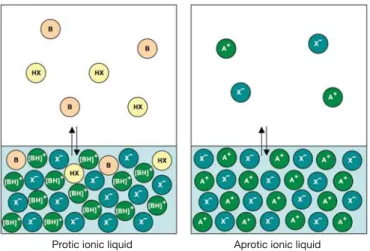
ionic liquids is as intact ions, either alone or aggregated. This is represented schematically in Fig. 2.
In the case of tetraalkylphosphonium-based ionic liquids, the majority decomposed before distillation could occur. However, in the case of tris(sec-butyl)methylphosphonium tosylate, distillation without significant decomposition was observed, and again there is no possible mechanism which can be envisaged involving proton transfer. Finally, the possibility of dissociative alkyl transfer was eliminated, as there was no evidence for alkyl scrambling in any experiment (such as when [C2mim]Cl is distilled)14.
In the cases of 1-alkyl-3-methylimidazolium salts, the majority distilled without decomposition. However, here a proton transfer mechanism must be considered, as the possibility of transferring the 2-H proton from the cation to the anion, creating a carbene and a free acid, is feasible. Nonetheless, a study of the decomposition of [C2mim][NTf2] by pyrolysis mass spectrometry found no evidence for the formation of HNTf2at 3008C (ref. 21). We further note that when we replace the 2-H proton on the cation with a 2-methyl group, the new ionic liquid [C4dmim][NTf2] (in which [C4dmim]þ is 1-butyl-2,3-dimethylimidazolium) is both volatile and less decom- posed than [C4mim][NTf2] (see Table 2). If a proton transfer mechanism were dominant, the 2-methylated ionic liquid would have had its volatility suppressed with a much greater level of decomposition. Indeed, examination of Table 4 reveals that in a mixture of tetraethylammonium bistriflamide and 1-ethyl-3- methylimidazolium triflate, a tetraethylammonium ionic liquid
vaporizes preferentially to an imidazolium ionic liquid, making a proton transfer mechanism appear highly improbable.
Thus, if we examine all the reported cases, we can completely discount direct physical transfer of liquids, and also eliminate the possibility of dissociative mechanisms (either alkyl or proton transfer) for all ionic liquids except those based around the 1-alkyl-3- methylimidazolium cation, and even in that case proton transfer must be considered to be highly unlikely. For these latter ionic liquids, we believe that there is no significant contribution from dissociation of the cation to form carbenes, but at this stage it cannot be entirely eliminated.
These distillations, accompanied by the recovery of substantial amounts of commonly employed ionic liquids, corroborate recent theoretical predictions18that some selected families of ionic liquids could boil at a temperature sufficiently low to avoid decomposition.
These observations lay to rest a paralysing and invalid assumption that has dominated and restricted the field of ionic liquids since its origins, and should open up new ways for exploiting their properties.
At the very least, a new method for purifying ionic liquids now exists, and we can imagine other applications (such as isolation of highly soluble products by high-temperature crystallization). However, near ambient temperature the vapour pressure of ionic liquids remains negligible, so we have, in effect, the best of both worlds.
Received 26 August; accepted 21 November 2005.
1. Seddon, K. R. Room-temperature ionic liquids—neoteric solvents for clean catalysis.Kinet. Catal.37,693–-697 (1996).
2. Seddon, K. R. inMolten Salt Forum: Proceedings of 5th International Conference on Molten Salt Chemistry and Technology(ed. Wendt, H.) 53–-62 (Trans Tech Publications, Zu¨rich, 1998).
3. ISI Essential Science IndicatorsSpecial Topics: Ionic Liquidskhttp://www.esi- topics.com/ionic-liquids/index.htmll(ISI, 2004).
4. Rogers, R. D. & Seddon, K. R. (eds)Ionic Liquids IIIB: Fundamentals, Progress, Challenges, and Opportunities—Transformations and Processes(American Chemical Society, Washington DC, 2005).
5. Rogers, R. D. & Seddon, K. R. (eds)Ionic Liquids IIIA: Fundamentals, Progress, Challenges, and Opportunities—Properties and Structure(American Chemical Society, Washington DC, 2005).
6. Atkins, M. P.et al. Ionic Liquids: A Map for Industrial Innovation: Q001 (January 2004)(QUILL, Belfast, 2004).
7. Ohno, H. (ed.)Electrochemical Aspects of Ionic Liquids(Wiley-Interscience, Hoboken, 2005).
8. Rogers, R. D. & Seddon, K. R. (eds)Ionic Liquids: Industrial Applications for Green Chemistry(American Chemical Society, Washington DC, 2002).
9. Rogers, R. D., Seddon, K. R. & Volkov, S. (eds)Green Industrial Applications of Ionic Liquids(Kluwer, Dordrecht, 2002).
10. Wasserscheid, P. & Welton, T. (eds)Ionic Liquids in Synthesis(Wiley-VCH, Weinheim, 2003).
11. Dymek, C. J. Jr, Hussey, C. L., Wilkes, J. S. & Øye, H. A. inJoint (Sixth) International Symposium on Molten Salts(eds Mamantov, G.et al.) 93–-104 (The Electrochemical Society, Pennington, New Jersey, 1987).
12. Øye, H. A. & Wahnsiedler, W. E. inThe Fourth International Symposium on Molten Salts(eds Blander, M., Newman, D. S., Saboungi, M. L., Mamantov, G. &
Johnson, K.) 58–-73 (The Electrochemical Society, Pennington, New Jersey, 1984).
13. Øye, H. A., Jagtoyen, M., Oksefjell, T. & Wilkes, J. S. Vapour pressure and thermodynamics of the system 1-methyl-3-ethylimidazolium chloride- aluminium chloride.Mater. Sci. Forum73–-75,183–-190 (1991).
Table 4|Distillation of approximately equimolar mixtures of ionic liquids
Ionic liquid A Ionic liquid B Composition ratios of
the residue (A:B)
Composition ratios of the distillate (A:B)
Fraction of distillate decomposed (%)
[C2mim][NTf2]†‡ [C16mim][NTf2] 24:76 76: 24 ,1
[C2mim][NTf2]§ [C6mim][NTf2] 5 1:49 59:41 ,1
[C4mpyrr][NTf2]‡ [NC2 2 2 2][NTf2] 47:53 53:47 ,1
[C4mim][NTf2]§ [C4mim][PF6] 52:48 98:2 ,1
[C2mim][OTf]‡ [NC2 2 2 2][NTf2] * * ,1
† A mass balance of greater than 99% was observed when 40% of the mixture had distilled. Fractional distillation led to a distillate which was 97:3 (A:B).
‡ This mixture was distilled in the Kugelrohr apparatus at 3008C and 0.05 mbar for 6–8 h.
§ This mixture was distilled in the sublimation apparatus at 190–2008C and#0.001 mbar for 1–3 h.
* The undistilled residue contained 56% [C2mim]þ, 44% [NC2 2 2 2]þ, 47% [OTf]2and 53% [NTf2]2; the distillate contained 30% [C2mim]þ, 70% [NC2 2 2 2]þ, 57% [OTf]2, and 43%
[NTf2]2.
Figure 2|Schematic representation of the differences between protic and aprotic ionic liquids, in both the liquid and the gaseous phases. For the protic ionic liquids, a dynamic equilibrium exists between the ionic and dissociated forms: [BH]þX2(l)XB(l)þHX(l)XB(g)þHX(g). Green circles represent cations, blue circles represent anions, other coloured circles represent neutral molecules;l, liquid phase;g, gaseous phase. For the gaseous phase over the aprotic ionic liquid, the representation is purely schematic and has no implication for the actual degree of aggregation.
NATURE|Vol 439|16 February 2006 LETTERS
833
©2006Nature Publishing Group 14. Jeapes, A. J.et al.Process for recycling ionic liquids. World PatentWO01/
15175 (2001).
15. Yoshizawa, M., Xu, W. & Angell, C. A. Ionic liquids by proton transfer: Vapor pressure, conductivity, and the relevance ofDpKafrom aqueous solutions.
J. Am. Chem. Soc.125,15411–-15419 (2003).
16. Kreher, U. P., Rosamilia, A. E., Raston, C. L., Scott, J. L. & Strauss, C. R.
Self-associated, “distillable” ionic media.Molecules9,387–-393 (2004).
17. Abdul-Sada, A. K., Elaiwi, A. E., Greenway, A. M. & Seddon, K. R. Evidence for the clustering of substituted imidazolium saltsviahydrogen bonding under the conditions of fast atom bombardment mass spectrometry.Eur. Mass Spectrom.
3,245–-247 (1997).
18. Rebelo, L. P. N., Canongia Lopes, J. N., Esperanc¸a, J. M. S. S. & Filipe, E. On the critical temperature, normal boiling point, and vapor pressure of ionic liquids.
J. Phys. Chem. B109,6040–-6043 (2005).
19. Paulechka, Y. U., Zaitsau, Dz. H., Kabo, G. J. & Strechan, A. A. Vapor pressure and thermal stability of ionic liquid 1-butyl-3-methylimidazolium
Bis(trifluoromethylsulfonyl)amide.Thermochim. Acta439,158–-160 (2005).
20. Maase, M.et al.Method for the separation of acids from chemical reaction mixtures by means of ionic fluids. World Patent WO 03/062171 (2003).
21. Baranyai, K. J., Deacon, G. B., MacFarlane, D. R., Pringle, J. M. & Scott, J. L.
Thermal degradation of ionic liquids at elevated temperatures.Aust. J. Chem.
57,145–-147 (2004).
Supplementary Informationis linked to the online version of the paper at www.nature.com/nature.
AcknowledgementsThis work was supported by a grant from FC&T, Portugal (to J.M.S.S.E. and L.P.N.R.). The Belfast team wishes to thank the industrial members of QUILL for support and Al Robertson (Cytec) for supplying the phosphonium ionic liquids. For J.W.M. and J.A.W. this work represents an official contribution of the National Institute of Standards and Technology and is not subject to copyright in the USA.
Author InformationReprints and permissions information is available at npg.nature.com/reprintsandpermissions. The authors declare no competing financial interests. Correspondence and requests for materials should be addressed to L.P.N.R. ([email protected]).
LETTERS NATURE|Vol 439|16 February 2006
834
Supplementary Methods
Distillation of [C
4mim][N(SO
2CF
3)
2].
A sample of [C
4mim][N(SO
2CF
3)
2] (2 g) was heated at 300 °C (6 mbar) for 1, 4, 8 and 13 h in a Kugelrohr apparatus and the condensate was analysed after these time intervals. These multiple analyses were deemed necessary in order to eliminate any uncertainty in the observations. The NMR spectra showed that the ionic liquid has distilled without significant decomposition. The distillation residue (undistilled ionic liquid) showed no sign of decomposition after heating for a total of 13 h at 300 °C.
Distillation of [C
2mim][ N(SO
2CF
3)
2].
A sample of [C
2mim][N(SO
2CF
3)
2] (1 g) was heated at 300 °C, 0.1 mbar for 5 h, and the condensate was analysed. In addition, the whole distillation was filmed and a time lapse video of the distillation is shown in Video 1. The
1H,
13C and
19F NMR spectra (Figure 1a, 1b and 1c) show that the ionic liquid had undergone no
decomposition. The undistilled [C
2mim][N(SO
2CF
3)
2] remained intact after 5 h at 300
°C (Figure 2a, 2b and 2c).
Distillation (with decomposition) of [C
6mim][CF
3SO
3].
A sample of [C
6mim][CF
3SO
3] (2 g) was heated at 300 °C (6 mbar) for 4 h and the condensate was analysed. The
1H NMR spectrum (Figure 3a) shows that the ionic liquid had undergone some decomposition. From this spectrum the ionic liquid appears to be 50 % [C
6mim][CF
3SO
3]. The remainder appears to be a mixture of compounds including 1-hexylimidazolium triflate, 1,3-dihexylimidazolium triflate and
1,3-dimethylimidazolium triflate. This lower stability is thought to be due in part to the
greater nucleophilicity of the triflate ion when compared to the bistriflamide ion. This
leads to alkyl group exchange. This phenomena is common with 1,3-dialkylimidazolium halides.
14The undistilled [C
6mim][OTf] remained intact after 4 h at 300 °C (Figure 3b).
Distillation of [C
10mim][ N(SO
2CF
3)
2].
A sample of [C
10mim][N(SO
2CF
3)
2] (1 g) was heated at 300 °C, 0.1 mbar for 5 h in a Kugelrohr apparatus and the condensate was analysed. In addition, the whole distillation was filmed and a time lapse video of the distillation is shown in Video 2.
The
1H,
13C and
19F NMR spectra (Figure 4a, 4b and 4c) show that the ionic liquid had undergone no decomposition. The undistilled [C
10mim][N(SO
2CF
3)
2] remained intact after 5 h at 300 °C (Figure 5a, 5b and 5c).
Distillation of [C
16mim][ N(SO
2CF
3)
2].
A sample of [C
16mim][N(SO
2CF
3)
2] (1 g) was heated at 300 °C, 0.1 mbar for 5 h in a Kugelrohr apparatus, and the condensate was analysed. The
1H,
13C and
19F NMR spectra (Figure 6a, 6b and 6c) show that the ionic liquid had undergone no
decomposition. The undistilled [C
16mim][N(SO
2CF
3)
2] remained intact after 5 h at 300
°C (Figure 7a, 7b and 7c).
Distillation of other ionic liquids.
Samples (2.5 g) of various other ionic liquids were heated at 300 °C, 5 mbar for 5
h in a Kugelrohr apparatus and the condensate was analysed. The
1H and
13C spectra
were analysed and the decomposition of the distilled ionic liquids and distillation
residue were estimated from the spectra. These data are shown in Table 2.
Distillation of [C
6mim][N(SO
2CF
3)
2] as a function of temperature and pressure in a sublimation apparatus.
The [C
6mim][N(SO
2CF
3)
2] used is from the same batch described in Widegren, J.
A., Saurer, E. M., Marsh, K. N. & Magee, J. W. J. Chem. Thermodynamics 37, 569-575, (2005). It is colourless to the eye, contains less than 10 ppm halide by ion-selective electrode, and contains less than 20 ppm water by coulometric Karl Fischer titration.
Additionally,
1H and
19F NMR spectra (Figure 8a and 8b) show the ionic liquid to be greater than 99.5 % pure (excluding the water impurity and other peaks known to originate from the NMR solvent). A small commercial glass sublimation apparatus was used for these distillation experiments. For each distillation, fresh
[C
6mim][N(SO
2CF
3)
2] (ca. 0.5 cm
3) was introduced into the apparatus. During a distillation, the cold finger condenser was maintained at 25 °C with a circulator.
Meanwhile, the thin layer of [C
6mim][N(SO
2CF
3)
2] in the bottom of the apparatus was heated from room temperature to the maximum temperature using a hotplate (this temperature ramp took about an hour). By using a thin layer of the
[C
6mim][N(SO
2CF
3)
2] and heating it slowly, we were able to de-gas the sample without bubble formation. It was necessary to avoid such bubbling to ensure that any
[C
6mim][N(SO
2CF
3)
2] on the upper part of the apparatus was transferred in the vapour phase (and not by splashing). The temperatures were determined by measuring the temperature of the hotplate surface with an infrared thermometer. For the experiment at atmospheric pressure, a tube filled with anhydrous CaSO
4was connected to the vacuum attachment on the sublimation apparatus. For the other experiments, the apparatus was connected to a vacuum line with a mechanical pump and a liquid nitrogen cold trap.
The pressures were determined with a thermocouple vacuum gauge located about
halfway between the sublimation apparatus and the cold trap. Consequently, the
reported pressures indicate the quality of the vacuum during the distillation, but do not
correspond to the absolute pressure inside the sublimation apparatus. The distillation
experiments are of a qualitative or semi-quantitative nature; hence, we do not report experimental uncertainties in most cases.
Distillation of a mixture of [C
2mim][N(SO
2CF
3)
2] + [C
6mim][N(SO
2CF
3)
2] in a sublimation apparatus.
This experiment was performed in the same manner as the distillation of [C
6mim][N(SO
2CF
3)
2] in the sublimation apparatus. For this experiment, 0.4676 g of [C
2mim][N(SO
2CF
3)
2] and 0.5137 g of [C
6mim][N(SO
2CF
3)
2] were introduced into a sublimation apparatus. The apparatus was connected to a vacuum line with a
mechanical pump and a liquid nitrogen cold trap. With a vacuum of ≤0.001 mbar, the apparatus was heated to 190 °C over 45 minutes, and then maintained at 190-200 °C for the next hour. At this point, about 20 mg of distillate had collected on the cold finger of the sublimation apparatus. The experiment was then stopped and
1H and
19F NMR spectra were obtained, which showed that the ionic liquids in both the distillate and the undistilled residue had undergone no observable decomposition. The
1H NMR spectra were used to determine that the ratio of cations in the distillate was 59 mol % [C
2mim]
+and 41 mol % [C
6mim]
+, and the ratio of cations in the undistilled residue was 51 mol % [C
2mim]
+and 49 mol % [C
6mim]
+. Hence, a modest separation was observed even for these quite similar cations.
Distillation of a mixture of [C
4mim][N(SO
2CF
3)
2] + [C
4mim][PF
6] in a sublimation apparatus.
This experiment was performed in the same manner as the distillation of [C
2mim][N(SO
2CF
3)
2] + [C
6mim][N(SO
2CF
3)
2]. For this experiment, 0.5056 g of [C
4mim][N(SO
2CF
3)
2] and 0.3074 g of [C
4mim][PF
6] were introduced into a sublimation apparatus. The apparatus was connected to a vacuum line with a
mechanical pump and a liquid nitrogen cold trap. With a vacuum of ≤0.001 mbar, the
apparatus was heated to 190 °C over 45 minutes, and then maintained at 190-200 °C for the next 2.75 h. At this point, about 12 mg of distillate had collected on the cold finger of the sublimation apparatus. The experiment was then stopped and
1H and
19F NMR spectra were obtained, which showed that the ionic liquids in both the distillate and the undistilled residue had undergone no observable decomposition. The
19F NMR spectra were used to determine that the ratio of anions in the distillate was 98 mol %
[N(SO
2CF
3)
2]
−and 2 mol % [PF
6]
−, and the ratio of anions in the undistilled residue was 52 mol % [N(SO
2CF
3)
2]
−and 48 mol % [PF
6]
−. Hence, a dramatic separation was observed for these two anions. See Figures 11 and 12 below for the
1H and
19F NMR spectra of the distillate and residue from this experiment.
NMR Spectra.
Solvent = methanol-d
4(gives peaks at 3.31 and 4.8 ppm in the proton spectra and a multiplet at 49.15 in the carbon spectra; n.b. the imidazolium 2-H protons undergo deuterium exchange in methanol-d
4) or ethanenitrile-d
3(gives a multiplet at 1.94 ppm in the proton spectra from the residual solvent impurity, CHD
2CN, and a peak at 0.0 ppm from the chemical shift reference TMS). Spectra run on a Bruker Avance DPX300, DRX 500 or Varian Inova 400 NMR spectrometer.
‡‡ Certain commercial materials and suppliers are identified in this paper in order to adequately specify the experimental procedure. Such identification does not imply recommendation or endorsement by either the U.S. Government or the National Institute of Standards and Technology, nor does it imply that the equipment or materials identified are necessarily the best available for the purpose.

![Table 3 | Pressure effects on the distillation of [C 6 mim][NTf 2 ]](https://thumb-eu.123doks.com/thumbv2/123dok_br/17602028.4189656/2.918.50.429.850.1115/table-pressure-effects-distillation-c-mim-ntf.webp)