Instituto de Letras
Regina Fatima Oliveira de Sá
Engaging with Africa: a study of Chimamanda Ngozi Adichie’s Americanah
Rio de Janeiro
2019
Engaging with Africa: a study of Chimamanda Ngozi Adichie’s Americanah
Dissertação apresentada, como requisito parcial para obtenção do título de Mestre, ao Programa de Pós-Graduação em Letras, da Universidade do Estado do Rio de Janeiro. Área de concentração: Estudos de Literatura.
Orientador: Prof. Dr. Davi Ferreira de Pinho
Rio de Janeiro 2019
Bibliotecária: Eliane de Almeida Prata. CRB7 4578/94
Autorizo, apenas para fins acadêmicos e científicos, a reprodução total ou parcial desta dissertação, desde que citada a fonte.
________________________________________ _________________
Assinatura Data
A235 Sá, Regina Fatima Oliveira de.
Engaging with Africa: a study of Chimamanda Ngozi Adichie’s Americanah / Regina Fatima Oliveira de Sá. - 2019.
103 f.: il.
Orientador: Davi Ferreira de Pinho.
Dissertação (mestrado) – Universidade do Estado do Rio de Janeiro, Instituto de Letras.
1. Adichie, Chimamanda Ngozi, 1977- - Crítica e interpretação – Teses. 2. Adichie, Chimamanda Ngozi, 1977-. Americanah – Teses. 3. Ironia na literatura – Teses. 4. Dialogismo (Análise literária) – Teses. 5. Literatura nigeriana (Inglês) – História e crítica – Teses. I. Pinho, Davi. II.
Universidade do Estado do Rio de Janeiro. Instituto de Letras. III. Título.
CDU 896(669)-95
Engaging with Africa: a Study of Chimamanda Ngozi Adichie’s Americanah
Dissertação apresentada, como requisito parcial para obtenção do título de Mestre, ao Programa de Pós-Graduação em Letras, da Universidade do Estado do Rio de Janeiro.
Área de concentração: Estudos de Literatura.
Aprovada em 19 de fevereiro 2019.
Banca Examinadora:
__________________________________________
Prof. Dr. Davi Ferreira de Pinho (Orientador) Instituto de Letras – UERJ
__________________________________________
Profª Dra. Maria Conceição Monteiro Instituto de Letras - UERJ
_________________________________________
Prof. Dr. Leonardo Bérenger Alves Carneiro Pontifícia Universidade Católica do Rio de Janeiro
Rio de Janeiro 2019
Ao professor e orientador Davi Pinho por toda compreensão, inspiração, paciência e revisões.
À professora Maria Conceição Monteiro por ser um exemplo.
Ao professor Leonardo Bérenger por seus comentários criteriosos.
Às professoras Adriana Jordão e Débora da Rosa pela generosidade de compor a banca de minha defesa.
Ao professor Júlio França cujos conselhos me apontaram na direção certa.
Às amigas Vania Freire, Inês França, Ana Paula Abreu e Rosemary Afonso por estarem ao meu lado. À Luciana Rocha pelo empréstimo de material e incentivo.
À minha equipe do Colégio Pedro II por assumirem minhas funções nos últimos meses.
Aos meus filhos, Ana Clara e João Antonio, pela compreensão e amor incondicional.
But the fact that I feel a foreigner in the worlds of the schizophrenic or the sexual cripple in no way diminishes their reality.
Frantz Fanon, Black Skin White Masks
SÁ, Regina Fatima Oliveira de. Engaging with Africa: a study of Chimamanda Ngozi Adichie’s Americanah. 2019. 103 f. Dissertação (Mestrado em Letras) - Instituto de Letras, Universidade do Estado do Rio de Janeiro, Rio de Janeiro, 2019.
This work aims to analyze Chimamanda Ngozi Adichie’s novel Americanah, one of the representatives of the third generation of Nigerian writers. The novel reaches prominence not only for presenting numerous themes and perspectives but also for combating stereotypes, or 'single stories', in Adichie’s words, as it amplifies the possibilities of stories about Africa and Diasporic Nigerians. This dissertation uses Mikhail Bakhtin’s concepts to demonstrate how intertextuality, dialogism, Otherness and multivocality can be observed in Adichie's text, especially in the space of irony. To explore irony as a stylistic and sociocultural aspect of the novel, this dissertation finds theoretical and methodological support in the works of Linda Hutcheon and Claire Colebrook. In this sense, this dissertation cuts through the Postcolonial Literature stamp in order to think of Adichie’s polyphonic novel as an invitation to a different form of engagement with Africa. Texts by Frantz Fanon, Edward W. Said, Homi Bhabha, Aimé Césaire, Abdul Jan Mohamed, Achille Mbembé, Ngũgĩ Wa Thiong'o, Jemie Chinweizu, Onwuchekwa Jemie, Ihechukwu Madubuike, Olatunji Ogunyemi and Chinua Achebe contribute to elaborate the themes addressed by Adichie in the novel.
Keywords: Adichie. Irony. Dialogism.
SÁ, Regina Fatima Oliveira de. Engaging with Africa: a study of Chimamanda Ngozi Adichie’s Americanah. 2019. 103 f. Dissertação (Mestrado em Letras) - Instituto de Letras, Universidade do Estado do Rio de Janeiro, Rio de Janeiro, 2019.
Este trabalho tem por objetivo analisar o romance Americanah de Chimamanda Ngozi Adichie, uma das representantes da terceira geração de escritoras nigerianas. O romance destaca-se por não só apresentar inúmeros temas e perspectivas mas por também combater os estereótipos, ou as ‘estórias únicas’, como formulou Adichie, pois amplia as possibilidades de estórias sobre a África e os nigerianos diaspóricos. Esta dissertação utiliza os conceitos de Mikhail Bakhtin para demonstrar como a intertextualidade, dialogismo, alteridade e polifonia podem ser observados no texto de Adichie, especialmente no espaço da ironia. Para explorar a ironia enquanto aspecto estilístico e sociopolítico, este trabalho encontra suporte teórico e metodológico nas obras de Linda Hutcheon e Claire Colebrook. Neste sentido, esta dissertação esgarça o selo de “literatura pós-colonial” para pensar o romance polifônico de Adichie como um convite para um outro modo de engajamento com a África. Textos de Frantz Fanon, Edward W. Said, Homi Bhabha, Aimé Césaire, Abdul Jan Mohamed, Achille Mbembé, Ngũgĩ Wa Thiong'o, Jemie Chinweizu, Onwuchekwa Jemie, Ihechukwu Madubuike, Olatunji Ogunyemi e Chinua Achebe contribuem para elaborar as temáticas abordadas por Adichie no romance.
Palavras-chave: Adichie. Ironia. Dialogismo.
Illustration 1 - Data about Diversity at Princeton amongst Students from the
Class of 2021 ………..………. 87
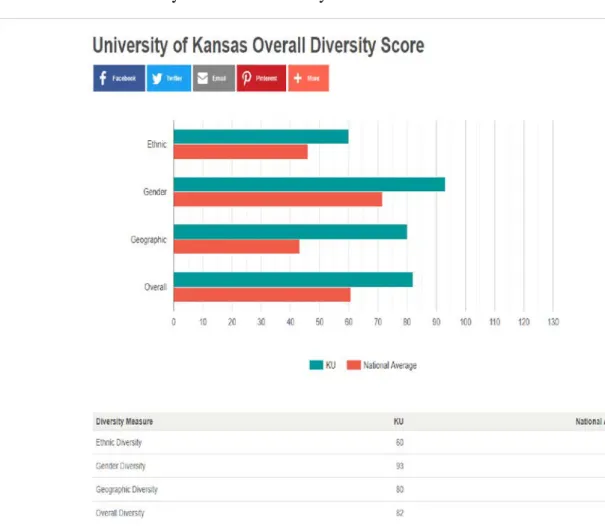
Illustration 2 - Undergraduate Ethnic Diversity Breakdown at the University of
Kansas .……….……… 87
Illustration 3 - Illustration 3: University of Kansas Diversity Data ………. 88 Illustration 4 - Racial Diversity at Historically Black Colleges and Universities
(HBCU) ……….………...……… 89
INTRODUCTION ... 9
1 CHIMAMANDA NGOZI ADICHIE’S SCENE IN CONTEMPORARY CULTURE: ENGAGING WITH AFRICA ………... 21
2 DIALOGISM AND OTHER BAKHTINIAN CONCEPTS AS KEYS TO READING AMERICANAH ……… 60
3 THE SCENE OF IRONY IN AMERICANAH ……… 78
CONCLUSION ... 96
REFERENCES ... 98
INTRODUCTION
Chimamanda Ngozi Adichie’s book Americanah was my first contact with Nigeria.
The contemporaneity of this novel was what impressed me the most. Adichie’s political engagement against racism and sexism was responsible for my strong identification. I had lived in the United States and experienced many of the same trials and tribulations of being a foreigner in America; I could see myself reflected in the story, even though I am not black. As I read, I found myself observing a reality, which at times was familiar to me, but also shockingly different. In my second reading of this novel, the fierce criticism being made of America, so strongly identified in my first reading, slowly sounded different. By that time, I had seen Adichie in many interviews and had noted her very firm, elegant stance. I had heard her laughter. This made me read the novel under a different light and, suddenly, I perceived Adichie’s fascinating irony and was captured by Adichie’s plural perspectives.
As one reads Adichie’s love story Americanah, one cannot ignore social criticism as a subtext. As Emily Raboteau posits, “Americanah is social satire masquerading as romantic comedy. There is mocking, but not without love”1. Social criticism makes us look at our society and question its values. Social criticism that comes in the form of fiction is even better, since it introduces different realities to the reader without generating defense mechanisms that occur when one faces other genres. To be lectured on, to be shown scientific reports, to hear the cry of manifestations in the streets, may not be as easy to confront. As Adichie herself said, “I think because I’m a novelist, I come from the point of view of storytelling and I’m keen with stories. I think storytelling is the most effective way to communicate.”2
How much about the author does the reader need to know to understand the novel Americanah? Is it possible for one to be innocent of its power when one buys the novel, because it has been recommended by a friend or due to the many prizes it has won, and not wish to engage with Africa during its reading? Or better, could it be read just as a love story?
Can a love story provoke deeper thought? Yes, the reader may have bought the book and not have been aware that Americanah is written by a woman, a feminist and a Nigerian. The reader may not have seen the TED talks that popularized Adichie as a feminist, though “The
1 Emily Raboteau, The Washington Post, June 10, 2013
2 https://qz.com/quartzy/1133732/chimamanda-ngozi-adichie-talks-about-feminism-and-raising-her-daughter- ina-gendered-world/
Danger of a Single Story” sits in the top 25 most viewed talks of all times.3 The reader may ignore Adichie’s past intellectual achievements and biography as a student of medicine and pharmacy in Nigeria, communication at Drexel, political science in Eastern Connecticut State University. Adichie has also obtained a Master’s Degree in creative writing at Johns Hopkins University, continued her studies at Princeton, received another MA in African Studies from Yale University and was granted a fellowship for advanced studies at Harvard University.4 Is any of this information relevant for the reader of Americanah? Does this information only contribute to the certainty that Adichie spent a good part of her life in the United States and has obviously experienced racism and sexism like those presented in the narrative of her book? Or are there other ways that the author’s biography affects the writing and helps fortify the novel’s effectiveness? Can one separate a literary work from the life of its creator?
On the other hand, if the reader is familiar with Adichie’s personal life, he/she may be curious to determine how much of the story is autobiographical and how this has affected what she writes and how she writes. The question could be: how much of this is true? For one, Adichie has avowed that, as a writer, it is essential that she tell her story truthfully. “And I think that’s a difficult thing to do, to be truly truthful, because it’s only natural to be concerned about offending people, or possible consequences”5 she added in an interview for Zadie Smith for the NYPL podcast.
In the same interview, Adichie begins to speak about the importance of being truthful in her writing. Clarity is an important issue for Adichie. She associates this with important feminist issues. “I think that what our society teaches young girls (…) is this idea that likability is an essential part of the space you occupy in the world.”6 Adichie compares woman’s habit of twisting oneself into shapes to make oneself likable to the same expectation one may have with her writing. To this Adichie adds: “If you start off thinking about being likable you’re not going to tell your story honestly. Because you’re going to be so concerned with not offending. And that’s going to ruin your story.” 7 Coherence is a strong characteristic of Adichie. Her writing is lucid and her fiction portrays reality. There is always the impression that the novel is telling the reader something that the world needs said. If there is
3 https://i-d.vice.com/en_uk/article/wjkbzz/the-powerful-words-of-chimamanda-ngozi-adichie
4 The Chimamanda Ngozi Adichie Website www.cerep.ulg.ac.be/adichie/cnabio.html
5 https://www.pressreader.com/
6 https://www.pressreader.com/
7 https://www.pressreader.com/
a moral judgment, it is lost amongst the great quantity of stories, with different perspectives, being presented. Adichie’s narrative is plural. It is never a single story.
Maybe because Adichie believes in plurality, she rejects tags placed on her writing.
Labels like “black” or “African” used to describe the type of book she writes are not value free. Adichie prefers to be identified as a realistic fiction writer.
In 2017, during an interview with writer and friend Dave Eggers, Adichie spoke of her new phase as a writer. After writing about Nigeria´s past with Purple Hibiscus set in the period of the military coup and Half a Yellow Sun during the Biafra War, Adichie decided to be contemporary and to write a love story about a diasporic couple. Adichie told Eggers that she was “no longer the dutiful daughter of literature”. 8 She claimed now she was “having fun, discarding the rules and increasingly blurring the boundaries between fiction and memoir.” 9 However, Adichie clarifies any doubt that may exist about these boundaries by saying: “of course you put yourself into your fiction, your fiction is you.”
The practical aspect of Adichie’s fiction is that it will help the reader reflect on innumerable contemporary themes, experience new realities by way of the characters of the novel and experiment with Otherness. The reader will be engaged with Others’ reality and this will enable the reader to see the world from new perspectives and consequently innovate in his/her approaches to personal situations.
In the 477 pages of Americanah, Adichie tells the story of a couple that parts ways to live abroad. Ifemelu goes to the United States and Obinze, her boyfriend, to England. As the reader follows the narrative of these two characters, Adichie presents the reality not only of being black in America, but also of being black in England and being African black.
Ironically, Ifemelu, the main character, had never experienced racism until she arrived in America. Being a Nigerian black in America is different from being an African-American black since this confronts American black representation. Ifemelu meets other Africans, from countries other than Nigeria, with their distinct cultures, backgrounds and life stories. Adichie presents the different identity crises experienced by various diasporic individuals, as they develop defense mechanisms to survive, but also the double voice that results from living inbetween places and never fully adapting or completely forgetting where one came from. At the end of the novel, Ifemelu has the experience of achieving the American Dream (having a job and an American boyfriend), but still decides to return home to Nigeria. Arriving in
8 www.theguardian.com/books/2018/apr/28/chimamanda-ngozi-adichie-feminism-racism-sexism-gender-metoo
9 www.theguardian.com/books/2018/apr/28/chimamanda-ngozi-adichie-feminism-racism-sexism-gender-metoo
Nigeria, she is confronted with the reality that she will never fit in, because now she is an
‘Americanah’, a slang word used for a Nigerian who has been changed by living abroad.
As I have stated, plurality and diversity are everywhere in the novel. For instance, people in Americanah are described as alluding to their skin color in various shades of blackness: “sable”, “gingerbread”, “caramel” or even “an undertone of blueberries”
(ADICHIE, 2014, p.341). Readers may not be accustomed to hearing these adjectives in relation to skin color, but that strikes a familiar ring at the same time. IBGE’s Suplemento da Pesquisa Mensal de Emprego de julho de 1998 listed 143 variations of skin color in Brazil.
This is due to the Brazilian population’s spontaneous answers to a survey question about their
‘race’, in which they had to identify with a term that they themselves came up with to answer an open-ended question about how the interviewee identified the color of his/her skin. In other words, many of the people being interviewed did not see themselves as “blacks” or “whites”, therefore, they came up with a term that they felt described themselves better. Some of the most well-known terms were: jambo, marrom-canela, meia-branca, meio-termo, mel, moreno-café-com-leite, clarinha, castanho, marrom bombom and cor do pecado (SILVEIRA, 2006, p.87). Many of them allude to sumptuous food categories in the same way that gingerbread, caramel and blueberries are used in the novel.
As we elaborate on this example, we begin to think about the many times that our culture appears to be very similar to distant lands. As I read Americanah, many questions of this sort came to mind. How similar are we to Americans and Africans? Immediately a paradoxical thought comes to mind: what do I really know about Africa? Or even: Am I perceiving Africa with the same eyes of the conquerors of the past, and the tourists of the present, namely an exotic Africa? Also, if we do linger on the thoughts about similarities and differences, we may find ourselves thinking: do I truly have the right to identify myself with the characters of the novel just because I have been a foreigner in America and have gone through some of the same diasporic situations described in the narrative? Can a white person (as myself) and a black one (as Adichie and her characters) be part of the same ‘Othering’ of a model that makes Europe and North America the epicenters of the world and casts Africans, Latins and all other minorities towards their margins? This questioning leads to still other types of questions: where exactly does the West end and the ‘rest of us’ begin? On the other hand, one can also start thinking about the status of migrants with questions like: if you have bridged the gap, left the frontiers, headed to the center, mingled with the natives there, will you ever really feel like one of them? Can you ever become unAfrican? The reader can also find himself/herself thinking about Adichie and her relation to what she writes by asking: in
Americanah, does the reader have the impression that the author, Adichie, has moved on and left behind her Nigerian background?
Questions abound. The reader could easily find himself/herself thinking: if I do not identify with the characters, or with the author’s subtext, does that determine that the reality, exposed in the novel, is inaccurate or stereotyped? Then, one starts thinking about how important is reader response. Is it possible to push aside the stories being told as being part of fiction, and thus not reflect reality? As if one were to say, “It’s just a story.” On the other hand, if I do identify with the novel, does it make the values, contained in its pages, a declaration of truth? In other words, is it possible for Adichie to create a story along the novel’s almost 500 pages without any of her values, personal stories, and experiences of reality seeping through? Next the reader may ask himself/herself: If Adichie’s world transcends the novel, can this be beneficial?
Dan Izevbaye, professor at Bowen University, Iwo, Nigeria, states that a “writer need not be always as direct as this artist in bearing witness to his experience. But authorial presence, even if it is mediated through narrative surrogates, is essential to the moral conception of the experience that is being narrated” (IZEVBAYE, 1990, p.28). Aware of this one could ask next: does Adichie perceive her writing as having a moral obligation and thus assume responsibility for her “Africanness”? Do readers expect this mediation? Should a work of art, as Americanah, have this practical function? Can the result of reading a novel augment the moral conception of the African experience for foreign readers?
Actually, Adichie includes this discussion in her novel. Ifemelu has various boyfriends in the novel. Blaine, for example, is an Afro-American college professor. The narrator describes him as being a man that only “cooked organic vegetables”, a man of “careful disciplines” that “ran every morning and flossed every night” (ADICHIE, 2014, p.310-311).
In chapter 34, Blaine gives Ifemelu this advice about her writing: “Remember people are not reading you as entertainment, they’re reading you as cultural commentary. That’s a real responsibility. There are kids writing college essays about your blog”10. Does making the reader reflect upon the reason for reading any work of literature, and more specifically this novel, in some way subvert the theme, genre and objective of Americanah? Can this reflection change the way the novel is read? Can this type of reflection, which creates subversion, help question certain labels and borders of African literature? Is Adichie inscribing the role of the author in the creation of an imagined community, Africa, in which all people can contribute to
10p.312
its formation by perpetuating certain images and vernaculars, as proclaimed by Benedict Anderson? 11 Is this playful game of writing about the writer, in one’s own writing, a way of subverting? Can this practice be seen as a form of criticizing and undermining the usual way things are seen or done? Or is this just a simple humorous approach in narrative without any greater objective?
A few pages later, there is a discussion between Ifemelu and Blaine about divorce in America and Ifemelu shares that she does not understand the “unbending, unambiguous honesties that Americans required in relationships” (ADICHIE, 2014, p.320). Blaine asks her why she feels this way and she answers “It’s different for me and I think it’s because I’m from the Third World (…) To be a child of the Third World is to be aware of the many different constituencies you have and how honesty and truth must always depend on context” 12. Though the narrator states that Ifemelu felt very clever to have thought of this explanation, which is humorous, Blaine shook his head and said: “That is so lazy, to use the Third World like that”13. Labels, as third world, are introduced in the novel in an ordinary discussion between a couple. Adichie introduces an academic discussion in a romantic exchange between Ifemelu and Blaine. An odd place, maybe, for such a subject to come up that results in catching the reader off guard and provoking a reflection where one could not expect. In one short romantic passage there is not only exchange, intimacy, representation, defiance, but also a sophisticated discussion about the third-world that reminds us of other important discussions related to postcolonial literature, African literature and many other definitions attributed to forms of classification regarding different theories and different groups. Can all these perspectives be attributed to Adichie’s talent in elaborating the passage?
In order to delve into the reasons for multiple interpretations of the same passage of a novel, we can recall the French linguist, sociologist, writer, and philosopher, Roland Barthes.
He was one of the first to call attention to the network created in literature that expands the possibilities of combination and selection of signs creating many more possibilities of interpretation. Though he posits the death of the author, thus removing from the author the major responsibility with the message of the text, he does recognize the multiplicity present in discourse. His claim that the text can be “read without its father’s guarantee” maybe due to the fact that cultural codes will guarantee this in historical contexts. His affirmation that “the
11 ANDERSON, Benedict, “Imagined Communities: Reflections on the Origin and Spread of Nationalism”
London: Verso, 1983.
12 Ibid
13 Ibid
restoration of the intertext paradoxically abolishes inheritance” is epoch-making (BARTHES, 1989, p.61). In this sense, Barthes indicates that the author is seen as “a guest”. Though authors can inscribe themselves as characters, or appear in the subtext, they are “a figure in the carpet” perceived but not in a “privileged way”. Rather, Barthes stipulates the author is perceived in the ludic dimension of the text (BARTHES, 1989, p.61). It is not that Barthes does not consider the influence of the author’s ideas, it is more that he interprets all texts as intertexts due to the many influences they present. In other words, no text is created in a void.
Even though texts speak to one another, for they are not created in a vacuum, their interpretation depends on the discursive community one belongs to. The community in turn determines what information one has access to, and thus there are as many interpretations as there are communities. Back to our last example in Americanah, one of the possibilities of interpretation of the passage is: Blaine being a college professor believes his opinion on such matters is more qualified, since Ifemelu is only a blogger. Ifemelu uses the “third-worldism”
in her argument to justify her position. The narrator states that Ifemelu felt clever, as if this were a sophisticated position for her to defend. Blaine calls her position lazy. These two qualifiers have opposing values. This passage reminded me of the discussion of these labels in the academic world of literature: third world, postcolonial, global, etc.
Aijaz Ahmad, an Indian professor at the UC Irvine School of Humanities, and Arif Dirlik, Turkish historian who taught at Duke University for 30 years, are critical of such labels. Dirlik, sarcastically claims that “Postcolonial theory happened when third world intellectuals arrived in first-world academe” (Dirlik, p.294 apud NAYAR, 2010, p.30), which seems to be in synchrony with Adichie’s recent polemic answer when asked about Postcolonial theory. “Postcolonial theory? I don't know what it means. I think it is something that professors made up because they needed to get jobs.” 14
Clarification is necessary here since Dirlik and Adichie’s comments need to be read taking into consideration the complexity of the issue. Though many discussions related to colonized countries and their literature have come about in recent years and seem to call for an umbrella term to be used to indicate similar realities, theories and theorists, the term postcolonial is questioned not only by its critics but also by theorists who consider themselves postcolonial. The discussions englobe questions like: What national literatures or authors can be included? Does this term indicate that only native writers in the colonized country are qualified to be called postcolonial? Does the term only denote works written after
14 www.aljazeera.com/indepth/opinion/chimamanda-adichie-burden-representation-180204094739657.ht
independence or also those written during colonization? Is the term accurate since it implies that colonialism is over (others have adopted the term neo-imperialism to indicate a different period/type of “colonization”)? Does this term crystalize a perspective that serves to marginalize the views of native people and thus does more harm than good? Thus, Dirlik and Adichie’s stance, on the issue, not only reflect the many questioning that the term evokes, but also does not necessarily discredit the need to acknowledge the importance of the studies in this field.
The dinner party scene in Americanah may help us have another glimpse at this introductory discussion. Nathan, one of the dinner guests, is a “literature professor, neurotic and blinky behind his glasses, who Blaine once said was the only person at Yale that he trusted completely” (ADICHIE, 2014, p.323). He wants to know if Ifemelu is making money with her blog and Ifemelu answers that most of the money is going back home to her “hungry relatives”. Nathan replies: “It must be good to have that. (…) To know where you’re from.
Ancestors going way back, that kind of thing” 15. The reader, as Adichie, is left confused.
Could this be another stereotypical vision of Africans that believe all Africans live in large tribal communities? Ifemelu looks at Nathan and feels uncomfortable. “She was not sure what his eyes held” 16. As a reader I perceived that there were enormous differences among the visitors sitting at that table. Differences that could make Nathan envious of Ifemelu’s supposedly large family, or the realization that he did not know his ancestors and felt cut off.
Nathan may have no idea who his ancestors were due to peculiarities related to different forms of immigration in the US. However, on the other hand, it could just be that odd remark that people make when they have no idea how to interact with someone, especially when one is very different from oneself. Nathan’s impulse to theorize, in any case, is here presented as an inaccurate assumption of Ifemelu’s experience.
Another character, Shan, Blaine’s sister, is the type that fills a room. The narrator observes that Shan flirted with everyone, hugged too closely and her compliments were so extravagant that they seemed insincere (ADICHIE, 2014, p.333). During the same dinner party, she tells the group about the book she is writing, “this book is a memoir, right? It’s about tons of stuff growing up in this all-white town, being the only black kid in my prep school, my mom’s passing, all that stuff”17. Next, she confides that her editor read the manuscript and said, “we have to make sure the book transcends race, so that it’s not just
15 Ibid. p.327
16 Ibid. p.328
17 Ibid, p. 334
about race”18. Shan concludes that “race is a brew best served mild, tempered with other liquids, otherwise white folk can’t swallow it” 19. This passage presents still another reflection about writing. Almost like a Matryoshka Russian doll that surprises you with more and more issues, one inside the other, the novel reveals unexpected complexity. The reader begins to wonder what type of writer Shan is. Growing up in all-white town and being always amongst whites, her life story is very different from Ifemelu’s. Thus, Ifemelu must be a completely different black writer.
In the next passage, Shan is discussing the ideology of writing, especially fiction, and states, “if a character is not familiar, then that character becomes unbelievable. (…) You can’t even read American fiction to get a sense of how actual life is lived these days” ((ADICHIE, 2014, p.336). She concludes: “You read American fiction to learn about dysfunctional white folk doing things that are weird to normal white folks”20. What is being said in between the lines here? The reader senses that such an uncommon remark must be referring to some inside story or recent event.
Another way to interpret this is by considering what Stuart Hall called “positively marked” as passages that signify because they point to a relation to what is absent, unmarked, unspoken and unsayable: “meaning is relational within an ideological system of presences and absences” (HALL, 1985, apud, HUCKIN, 2002, p.348). Thomas Huckin, linguist and professor at the University of Utah, adopts the definition of textual silences, based on Gricean and Leechian principles, which is characterized by “the omission of some piece of information that is pertinent to the topic at hand” (HUCKIN, 2002, p.348). Huckin defines presuppositional silence as “those that serve communicative efficiency by not stating what the speaker/writer apparently assumes to be common knowledge.” 21 This does not mean that silence is “innocent or non-manipulative.”22Alternatively, maybe the “dysfunctional white folk” passage would be better defined as an example of discreet silence, which is the type used to “avoid stating sensitive information.”23 If the author does not state it in the open, the reader cannot feel offended by such information. One could interpret that Adichie was being
18 Ibid
19 Ibid
20 Ibid
21 Ibid
22 Ibid,p.350
23 Ibid, p.348
discreet or subtle, since, as Huckin would conclude, “tactfulness is called for in cases in which knowledge shared by writer and reader is potentially embarrassing to the reader.” 24
If one is familiar with the “Black Lives Matter” movement, one knows that it was created with the mission to “build local power” and “intervene in violence inflicted on Black communities”25. Moreover, the reader may be aware that there is a common belief that crime is committed more by blacks and minorities than by whites. This is an erroneous belief, a stereotype. The “dysfunctional white folk” may allude to those white boys or men in school shootings, shootings in malls and, recently, the firing in synagogues in New York. Only whites commit mass violence. Dr. Stanton Peele confirms that mass violence is a “privileged white” phenomenon. Peele mentions Newsweek article that wondered if “white men commit mass shootings out of a sense of entitlement.”26 Therefore, can Adichie, subtly, be bringing up the ‘dysfuncional white folk” subject up as a way of questioning our conceptions related to violence and its stereotypes? Could Adichie also be stating that when violence is committed by a white person, the term dysfunctional excuses the act? This goes to show that Adichie, as a writer, presenting a narrative that takes place at a dinner party is able to posit several reflections including one that contrasts real fiction and fictional reality in the same space.
In the novel, the group is still sitting around the table when Shan decides to discuss Ifemelu’s role as a legitimate representative of a certain reality. She says:
You know why Ifemelu can write that blog, by the way?(…)Because she's African.
She's writing from the outside. She doesn't really feel all the stuff she's writing about. It's all quaint and curious to her. So she can write it and get all these accolades and get invited to give talks. If she were African-American,
she'd just be labelled angry and shunned (ADICHIE, 2014, p.326).
Hence, in this passage we are made aware that there are many disputes amongst black characters. It is not because one in black in America that one will embrace as equal all other blacks. There is a complexity of black representation and identification in Americanah that helps construct the many stories of Africans and blacks.
The journalist Alex Clark of The Guardian thinks about Adichie’s intentions as a writer in her third novel as he questions “how many layers of history and culture it takes to construct a national, or racial, or personal identity, and how contingent that identity is on its immediate surroundings”.27 Thus, in Clark’s perspective Adichie contributes with the
24 Ibid
25 https://blacklivesmatter.com/about/
26 https://www.psychologytoday.com/us/blog/addiction-in-society/201710/how-are-african-americans-doing- iviolence-and-segregation
27 https://www.theguardian.com/books/2013/apr/11/americanah-chimamanda-ngozi-adichie-review
construction of Nigerian identity. However, though the novel is a very Nigerian sort of love story, it can also be found at bookstores in Rio de Janeiro in the American Literature section, as I did, which shows how writers like Adichie have fluid market identities that are in synchrony with her refutation of any form of label.
As already stated in this dissertation, Adichie rejects tags based on race like “black”
and “African” associated to her work because she believes that they are not “value-free’ and come with “baggage”.28 As she explains the risk of labels, she gives examples:
a black writer who wrote about Africa would be placed on the ‘ethnic’ shelf in many bookstores in the US and UK, ‘ethnic’ in this sense subtly suggests not being quite on a par with ‘mainstream’ writing. A white writer, such as the Polish Ryszard Kapuscinski would not be on that ‘ethnic’ shelf. He would be considered ‘mainstream’
although he would be writing on the same subject as the black writer. The point is that it would be preferable if categorizations were based on the writing rather than on the writer.29
For certain, one of Adichie’s talents is her ability to fuse reality and fiction into highly personal stories about multiple perceptions of race and ethnicity fading boundaries.
To that end, this dissertation initially stems from the many quaint interrogations that have come to mind and have evolved to broader and denser investigations which came about mainly due to the multivocal quality of Adichie’s writing, as I have shown in this introductory analysis of some of the many characters in Americanah. Instead of applying postcolonial theory to the novel, which would have meant some sort of domestication of Adichie’s different voices in Americanah into a cohesive framework, I have chosen instead to argue that it is precisely her sense of irony towards the very issues she raises that makes this a remarkable work of contemporary fiction. Therefore, Engaging with Africa: a Study of Chimamanda Ngozi Adichie’s Americanah is a peregrination into an unknown fictional territory of various possibilities with the intention of finding a path to coming closer to understanding Others and their world. In a certain way, it is also a form of stretching outwards in search of reaching inwards to come to a better comprehension of contemporary issues.
In the first chapter of this dissertation, I wish to contextualize Adichie’s scene in contemporary culture by analyzing reviews written on Americanah, Adichie’s essays, TED talks, and interviews. This will show how the novel has come to occupy the center stage of a worldwide awakening to new perceptions of Africa and of the Other. The novel’s themes of racism, agency, media coverage, home and other diasporic concerns and behaviors (in relation to other Africans and non-Africans) will be elaborated. Adichie’s use of irony to demonstrate
28 http://www.cerep.ulg.ac.be/adichie/cnainterview.html
29 http://www.cerep.ulg.ac.be/adichie/cnainterview.html
multivocality will be introduced. Examples of stereotypes found in the novel and related to Africa will be analyzed and compared to epoch-making texts written by Frantz Fanon, Edward W. Said, Homi Bhabha, Aimé Césaire, Abdul Jan Mohamed, Achille Mbembé, Ngũgĩ Wa Thiong'o, Jemie Chinweizu, Onwuchekwa Jemie, Ihechukwu Madubuike, Olatunji Ogunyemi and Chinua Achebe. All the while, the nature of this dissertation as a “Study” will be revealed in its collection of basic data about Africa – from geographical to linguistic information. This is important in order to reveal how rudimentary our knowledge of Africa as a continent is, even when we study theories that supposedly specialize in its cultural manifestations. Didacticism here serves as social and academic commentary.
In the second chapter, I will explore the Bakhtinian concepts that inform his definition of dialogism as that which reflects, produces and informs our exchanges with Others. By scrutinizing Bakhtin’s thoughts on Outsideness, we will be able to realize that all consciousness comes from the outside world in the form of Other words and perceptions. In this sense, this entire dissertation is framed by Bakhtin’s lessons and how they are recognizable in Americanah. A critique of binarism and stereotypes will also be touched upon due to its impact on Americanah as a novel.
In chapter three, I intend to explore the scene of irony, starting with an incident involving Adichie during a ceremony in France that will lead us to think about what makes something ironic or not. A short historical review will be made of the term irony (from Platonic to Romantic irony) to better understand the complexity behind the term and how it occurs as part of the communication process introducing intent, discursive communities and challenging shared common ground and conventions. At the end of the chapter, various examples from Americanah will be explored and irony will be presented as a form of subverting our common beliefs about ourselves and Others.
By the end of this dissertation, I hope that I will have shed light on contemporary social issues that help us better comprehend the questions raised by Adichie in her novel and that relate so closely with our quests for identities, however frail they may be.
1 CHIMAMANDA NGOZI ADICHIE’S SCENE IN CONTEMPORARY CULTURE:
ENGAGING WITH AFRICA
Most of the reviews state that Americanah is honest, brave, empathetic, moving and warm. Dave Eggers defines Adichie’s work as an example of “searing social acuity.”30 Elizabeth Day begins her review of Americanah for The Guardian saying that “there are some novels that tell a great story and others that make you change the way you look at the world.
[…] Americanah is a book that manages to do both.”31 Adichie speaks about the reality of Africa, the Western world’s perception of this continent, but also about the North American and English societies.
The great reception of the novel, in the U.S., came as a surprise to Adichie. In an interview with Candice Carty-William, for i-D magazine, Adichie admitted: “I really did think that it probably wouldn’t do very well, because Americanah isn’t very interested in being subtle about race”. And she continues: “I’ve been amused by how many non-black people have said it was an education. They’re like ‘Really? So that’s what happens?’ And I’m like
‘Yes!’’32
In an interview given to Stephen Moss, Adichie affirms that “Africa is seen as the place where the Westerner goes to sort out his morality issues. We see it in films and in lots of books about Africa, and it’s very troubling to me.”33 Adichie adds that Madonna adopting an African child is viewed as if she were saving Africa. In Adichie’s opinion, we need to do more than go to Africa and adopt a child or show pictures of children with flies in their eyes.
She claims this simplifies Africa. Adichie claims that we need to engage with Africa more.
In 2006, in The Washington Post, Adichie refers to Madonna’s adoption one more time. “And so I was wearing my ‘African’ lenses as I watched Madonna on television, cautiously, earnestly explaining the media circus around her adoption.”34 Adichie explains that she did not think it was her place to wonder what Madonna’s motivations for adopting David Banda were. During the television coverage, Adichie watched David’s biological father express how grateful he felt for Madonna giving David a “better life.” Adichie claims that at that moment she noticed the “stark power differential” and felt very sad to see how Africa
30 www.theguardian.com/books/2013/apr/15/americanah-chimamanda-ngozi-adichie-review
31 www.theguardian.com/books/2013/apr/15/americanah-chimamanda-ngozi-adichie-review
32 https://i-d.vice.com/en_uk/article/wjkbzz/the-powerful-words-of-chimamanda-ngozi-adichie
33 Stephen Moss, www.theguardian.com/books/2007/jun/08/orangeprizeforfiction2007.orangeprizeforfiction
34 http://www.washingtonpost.com/wp-dyn/content/article/2006/11/12/AR2006111200943.html?noredirect=on
seemed terribly dispensable. Adichie explains that what really matters to her is not Madonna’s motivation or “her supposed flouting of Malawian adoption laws.”35 Rather, Adichie is bothered with the notion that Madonna thinks she has helped Africa by adopting David Banda. This creates the illusion that to help Africa is to adopt Africa’s children.
In other words, the problem here is the removal of agency from the people of a whole continent. If Africa is understood as “the poor and needy,” Africans will be stripped of any humanity, dignity and transformed into objects where pity is deposited. A distorted image created in the minds of those sitting in a comfortable living room, watching the lives of others on television, thousands of kilometers away. Lives simplified as their reality is removed from any context, romanticized, so that the viewer, in the far away land, will think they can fully understand what they are seeing. Small chunks of information, given to the audience in bite sizes, fills the viewer with comforting feelings simple enough to keep them seated dumbfounded in awe until the next commercial break. In the next commercial break, a product will be presented for consumption in the expectation of ridding the viewer of the strange uneasiness created in the news.
Adichie admits that she believes that if she were not African, watching the coverage of Africa in the media, she would probably think that Africa was “a place of magnificent wild animals in which black Africans exist as tour guides, or as a place desperately poor people who kill or are killed by one another for little or no reason.”36 To speak of racism, one could choose a moralistic- accusational tone of authority as if preaching to an audience. This is common, though not subtle, but never used by Adichie. In the passage above, for instance, Adichie slants her text by putting herself, a black woman, in the position of villain as she claims that she would also have a racist perception of Africa if she were not African, as if the media had produced a scene that demanded this inevitable response. By doing so, she concomitantly forgives and blames the Western world. She urges for change by producing laughter.
The same approach is used by Adichie in her Ted Talk, “The Danger of a Single Story” when Adichie tells a personal story of her trip to Mexico. She says, “I, too, am as guilty in the question of the single story… I realized that I had been so immersed in the media coverage of Mexicans, that they had become one thing in my mind: the abject immigrant”
[08:20]. Karen Hua, in her B.A. thesis Beyond the Single Story: A Feminist Critical Discourse Analysis of Chimamanda Ngozi Adichie, uses Thomas Huckin’s linguistic theory and
35 http://www.washingtonpost.com/wp-dyn/content/article/2006/11/12/AR2006111200943.html
36 http://www.washingtonpost.com/wp-dyn/content/article/2006/11/12/AR2006111200943.html
interprets Adichie’s choices. “Using the active voice and first person ‘I,’ Adichie takes full responsibility for her own actions. Instead of pinning Western society or Caucasians as the culprit, she pinpoints instances of ignorance on her own” (HUA, 2016, p.9). For Hua the fact that Adichie “acknowledges her own flaws allows her to be perceived as the prevailing voice of reason.”37 Though I find this analysis interesting, I interpret this as a form of creating empathy with the reader and demonstrating that one can put oneself in the other’s shoes to try to understand the world we live in, but still making a point.
Though Adichie seems to understand the foreigner’s gaze, in Americanah she presents similar situations. Once more, we see Adichie inscribing a reality only to subvert it the next moment. When Ifemelu starts working as a babysitter, she begins to have much contact with Kimberly, the mother of the children. Kimberly is unintentionally patronizing, but caring.
She has the habit of calling every black person “beautiful” all of the time. When Ifemelu notices this, she tells Kimberly just to say “black”. As she explains to Kimberly, not every black person is beautiful. Ifemelu, as a Nigerian, does not have a problem with saying that someone is black. In America, because of cultural reasons, white people are more careful in using the word black to describe someone. One day Kimberly’s sister comes to the house and shows Ifemelu a magazine.
“Look at this, Ifemelu,” she said. “It isn’t Nigeria, but it’s close. I know celebrities can be flighty but she seems to be doing good work.”
Ifemelu and Kimberly looked at the page together: a thin white woman, smiling at the camera, holding a dark-skinned African baby in her arms, and all around her, little dark-skinned African children were spread out like a rug. Kimberly made a sound, ahmmm, as though she was unsure how to feel.
“She’s stunning too,” Laura said.
“Yes, she is,” Ifemelu said. “And she’s just as skinny as the kids, only that her skinniness is by choice and theirs is not by choice.” A pop of loud laughter burst out from Laura. “You are funny! I love how sassy you are!”(ADICHIE, 2014, p.162)
Similarly to Madonna’s story of adoption, the celebrity, in the novel, has the same intention, to show how charitable she is. Kimberly’s sister, Laura, acknowledges the good deed. What is ironic is that Laura senses that something if off, because she calls the celebrity
“flighty”, but at the same time says she is stunning in the picture. The reader imagines that, aesthetically, this is a well-composed photograph and that the woman must be of an extraordinary beauty. This makes the whole situation more ironic. A beautiful, slim, celebrity surrounded by the very poor and starving. The narrator pushes the irony further explaining that the children were spread out like a rug, an object and not human beings. At the end of this passage, Laura finds Ifemelu’s remark funny and calls her sassy. To be “sassy” is to use
37Ibid, p.9
sarcasm in a funny way, but it can also mean rude and showing no respect, ill bred. Adichie is able to bring together sophistication, beauty, poorness and racism into the same picture. One that we have seen only too many times.
In the following paragraph, Kimberly tells Ifemelu that she is sorry for how her sister expressed herself and tells Ifemelu that she thinks “It’s the kind of word that’s used for certain people and not for others”(ADICHIE, 2014, p.162). Later on in the chapter, Kimberly gives a party and introduces Ifemelu to the guests as her babysitter and friend. Immediately one of the male guests says, “You’re so beautiful,” smiling, his teeth jarringly white. “African women are gorgeous, especially Ethiopians.”38 The reader is led to believe that in this awkward conversation the man was trying to be friendly and thought he was paying Ifemelu a compliment. In reality, he was tactless. The overly enthusiastic manner of speaking only emphasized the stereotypical approach to African women. The irony is made clearer as he adds “Especially Ethiopians.” In the passage the foreigner is portrayed stereotypically as he groups together 54 distinct nationalities that make up the African continent. The act of trying to complement a Nigerian by mentioning Ethiopian women’s beauty illustrates this.
In the U.S., there is a great concern in being politically correct. In Americanah there is another passage that illustrates this. Ginika, Ifemelu’s high school friend who has been living in the U.S. for a longer time, introduces Ifemelu to the American culture. The two girls are at a shopping mall and they speak to a clerk trying to identify the salesperson that had helped them earlier. It had been a black salesperson. When they leave the store, Ifemelu asked Ginika why the clerk had not asked them, “Was it the black girl or the white girl?” 39which would have made the identification easier. Ifemelu tells Ginika that she was waiting for the clerk to ask her if the salesperson had two eyes or two legs because he had made all sorts of questions always avoiding identifying the salesperson’s race. Ginika laughs and informs Ifemelu that
“Because this is America. You’re supposed to pretend that you don’t notice certain things.”40. In the U.S., to identify someone as black may be considered racist.
Back to Kimberly’s dinner party, the conversation revolved around Ifemelu and Africa. Each guest has a wonderful experience to share about Africa. A couple spoke about their safari in Tanzania. “We had a wonderful tour guide and we’re now paying for his first daughter’s education.” 41Two other women bragged about their donations to a wonderful
38 Ibid, p.169
39 Ibid, p.127
40 Ibid
41 Ibid. p.169.
charity in Malawi that builds wells, a wonderful orphanage in Botswana, a wonderful microfinance cooperative in Kenya. The narrator marks the actions with the word
“wonderful” as if none of these places could be anything but “wonderful” in the romantic image created by these tourists while in Africa. If this behavior has been naturalized amongst the readers to the point that the absurdity of the stories were not noticed, the narrator quickly adds Ifemelu’s reaction: “she gazed at them” (ADICHIE, 2014, p.169). Ifemelu did not smile, or nod, or agree, or even comment. She only looked at them for a long period. The narrator continues speaking of the situation in relation to Ifemelu, “There was a certain luxury to charity that she could not identify with and did not have. To take ‘charity’ for granted, to revel in this charity towards people whom one did not know—perhaps it came from having had yesterday and having today and expecting to have tomorrow.” 42
Adichie having lived in the U.S. for 15 years, intermittently, has the ability of seeing Nigeria from a distance. Possibly, from this double consciousness, she is able to have a clearer perspective of the issues concerning Nigeria, the United States and England. Being thus, Adichie naturally writes using this double-sidedness and engages with both. In between the lines, the reader notices the ambiguities of the society exposed in Americanah. The reader starts to notice a subtext and perceives that there is the need for some reflection. The contrast created in the juxtapositioning of the various characters, stresses the different points of view.
Though this plurality is enriching, it can also generate some conflict. At times, the Other in the novel shows us that we are limited and that there is a lot we do not know. This is eased by Adichie’s humored style. Humor arises once the reader reconciles the incongruity between what the text says and what is implied or goes unsaid, as we will see this in the next chapters.
In Adichie’s article for The Washington Post, she places herself in this position of foreigner. “If I were not African, I wonder whether it would be clear to me that Africa is a place where the people do not need limp gifts of fish but sturdy fishing rods and fair access to the pond.”43 She continues reflecting on Africa and wonders if the world knows that “corrupt African countries are also full of fiercely honest people and that violent conflicts are about resource control in an environment of (sometimes artificial) scarcity.” 44
To Elizabeth Day from The Guardian, Adichie elaborates,
42 Ibid
43 www.washingtonpost.com/wp-dyn/content/article/2006/11/12/AR2006111200943.html
44 www.washingtonpost.com/wp-dyn/content/article/2006/11/12/AR2006111200943.html
We have a long history of Africa being seen in ways that are not very complimentary, and in America […] being seen as an African writer comes with baggage that we don’t necessarily care for. Americans think African writers will write about the exotic, about wildlife, poverty, maybe Aids. They come to Africa and African books with certain expectations. I was told by a professor at Johns Hopkins University that he didn’t believe my first book [Purple Hibiscus, published in 2003] because it was too familiar to him. In other words, I was writing about middle-class Africans who had cars and who weren’t starving to death, and therefore to him it wasn’t authentically African.45
In an interview given to Stephen Moss in 2007, Adichie comments on media coverage of Africa. She gives an example of a common interview format: the CNN crew would line up Congolese people as a backdrop and interview a Belgian, identified as a Congo expert, up front as part of the coverage of some activity happening in the Congo. Adichie finds this kind of media coverage “exhausting”. She sums up her thoughts by asking, “Wouldn’t it be wonderful if I could become the voice explaining America or England to the world [?]” And concludes, “It would never happen.” 46
Ironically, in 2013, with the first publication of Americanah, this is exactly what happens. An African shows America to the world. The New York Times commented on the feat as “Americanah examines blackness in America, Nigeria and Britain,” with the “accuracy of Adichie’s observations […] It never feels false.” 47 The British online newspaper Independent claims that Americanah is “Ostensibly a novel that shows us America from the outside, it also reveals something of Nigeria from the inside.”48 49
Before going further, it is necessary to clarify why I have chosen to use the term Africa, so often, instead of Nigeria. It seems that it would be more correct to speak of Mali,
Cameroon, Rwanda, Togo, Egypt, Kenya, Sudan, Ghana, Madagascar, Mali, Senegal, and Zambia educating people as to the many countries that constitute Africa. After all, this is a common criticism; people tend to group together the 54 independent states, with all their diversity, as if there were no distinctions.
In Adichie’s TED talk “The Danger of a Single Story”, Adichie speaks of her personal experience and how she began to see herself also as an African, not only a Nigerian.
As a new student at Drexel University, she had her first experience of encountering the underrepresentation of her own people. Adichie’s roommate was surprised that Adichie did not listen to tribal music and that her English was fluent [04:01]. Adichie states: “My
45 ww.theguardian.com/books/2013/apr/15/americanah-chimamanda-ngozi-adichie-review
46 www.theguardian.com/books/2007/jun/08/orangeprizeforfiction2007.orangeprizeforfiction
47 www.nytimes.com/2013/06/09/books/review/americanah-by-chimamanda-ngozi-adichie.html
48 https://www.independent.co.uk/arts-entertainment/books/reviews/americanah-by-chimamanda-ngozi-adichie-
49html
roommate had a single story of Africa: a single story of catastrophe. In this single story, there was no possibility of Africans being similar to her in any way [04:37].”50 If one can only feel pity for the Other, there is no possibility of empathy.
In 1952 Frantz Fanon had already shared a similar story in his book Black Skin White Masks. Fanon was born in Martinique and thus spoke French as well as Antillean Creole.
Still white Europeans were frequently surprised and did not expect this black man to speak French fluently. As Fanon himself stated, “What I am asserting is that the European has a fixed concept of the Negro, and there is nothing more exasperating than to be asked: “How long have you been in France? You speak French so well” (FANON, 1986, p.23).
Adichie during the same TED talk posits, “I must say that before I went to the U.S., I didn't consciously identify as African. But in the U.S., whenever Africa came up, people turned to me. Never mind that I knew nothing about places like Namibia [05:09].”31 She does confide that she learned to embrace this new identity and she now thinks of herself as African.
Adichie shares another anecdotal moment: “I still get quite irritable when Africa is referred to as a country, the most recent example being (…) in which there was an announcement on the Virgin American Airlines flight about the charity work in ‘India, Africa and other countries.’"51
A passage in Americanah’s opening chapter illustrates this. Ifemelu, who lives in Princeton, has gone to Trenton, a nearby town, to have her hair braided at Mariama African Hair Braiding salon for her return to Nigeria. At this salon, there are only African employees.
She fans herself with a magazine, and says, “It’s so hot.” The narrator states that at least, these women would not say to her “You’re hot? But you’re from Africa!” (ADICHE, 2014, p.15, my emphasis). How can this passage be interpreted? Why would the Senegalese and Mali employees of the salon not question why Ifemelu was feeling so much heat? Are these employees, also being African, more empathic? Could this passage be alluding to the stereotype response that many non-Africans receive from foreigners? Is it a rule that someone coming from a country close to the equator should never feel hot living in the U.S.? Could the logic behind the foreigner’s reaction be something like, “But you are used to the heat. You come from Brazil, Nigeria, etc,” as if coming from one of these countries disables someone from feeling heat in a country like the U.S. ?
50 https://www.ted.com/search?q=The+danger+of+a+single+story
51 https://www.ted.com/search?q=The+danger+of+a+single+story
Most probably, the Nigerian (or Brazilian) reader will identify with this passage and understand its context, even if he/she has not experienced it in real life. Even if the reader has not heard this said to him/her, because one has not lived abroad or traveled to a cold country, one has enough cultural information to be able to jump the gap between what is said and what is not, but only insinuated in the narrator’s words. If the reader is an American, maybe he/she will have a harder time understanding what is being said between the lines and thus the passage may not mean anything to him/her. Does Adichie, using the term “Africa” instead of the name of the country, make a difference in how the passage will be read? Would the stereotype be as clear if she had said “But you´re from Mali!” When a writer chooses to exaggerate a stereotype, the reader has a bigger chance of making irony clear. There is never any guarantee that the passage will be interpreted ironically or even that the intention of the writer was this. Still, judging from my response to the passage, there is the possibility of the reader thinking, “What is the writer insinuating here?” On the other hand, the reader may think, “There is something a little odd here. Should I be reading this in a different way?” Or still, “If I were to adopt another point of view, to try to read this as an African, would this help me understand this passage? ”
Further clarification is needed here, what I mean by ironic is not the traditional definition of irony as antiphrasis: saying the opposite of what one means. This definition of irony perceives irony as purely a rhetorical device. This is the definition we first learn at school. A common example would be a situation where one is staring out the window, at the rain, and says “What a lovely day!” Instead, I will adopt Linda Hutcheon’s definition of irony.
She states irony is a “semantically complex process of relating, differentiating, and combining said and unsaid meanings - and doing so with an evaluative edge” (HUTCHEON, 1995, p.89).
In other words, irony is very complex and calls attention to how the reader relies on knowledge shared by a certain group of people, discursive community, to interpret discourse.
Therefore, there is a vital relationship between the ironist, interpreter and the context for irony to happen. If the reader does not share a common context, the text will be read without an understanding of what is being insinuated in the subtext. Thus, if one perceives irony, one has made a reading, which includes an evaluation, a judgement, of the passage. Hutcheon claims that this evaluation always has an “edge”. This implies a social and political interpretation of the text and “happens in the tricky, unpredictable space between expression an understanding.”52 This response provokes, also, an emotional response.
52 Ibid, p.i
Though my main point is not to explain the differences between the various types of irony or to try to synthesize the different types, I will explore these aspects more in the third chapter. For now, I wish to analyze various passages of Adichie’s novel, since this is a way to interpret the many responses to Americanah and relate it to contemporary culture and Africa.
All texts can be interpreted in a variety of ways, but a text that is written on the edge of irony will increase the chances of multiple readings. A Nigerian will have one interpretation, a Nigerian living in the United States, another, a Brazilian still another and an American a fourth interpretation because these readers belong to different discursive communities, for example. The different life experiences and knowledges many times are influenced, purely, by geography, but there is an edge bordering all of these geographical differences.
In Americanah, again at the Mariama African Hair Braiding salon, Aisha, the hairbraider, is now “watching Ifemelu in the mirror, as though deciding whether to believe her or not” (ADICHIE, 2014, p.15). Ifemelu had said something that did not match Aisha’s information about Yoruba and Igbo, two Nigerian ethnic groups. Aisha was not Igbo, and she was quoting her sister who was also not Igbo. The sister had said something about getting married to Yoruba and Igbo men. Ifemelu, being Igbo, had a different opinion. Thus, Aisha watched Ifemelu attentively trying to decide whom to believe. Trying to prove that Aisha’s sister could be misinformed, Ifemelu askes Aisha where her sister was living:
“Where is she?”
“In Africa.”
“Where? In Senegal?”
“Benin.”
“Why do you say Africa instead of just saying the country you mean?” Ifemelu asked.
Aisha clucked. “You don’t know America. You say Senegal and American people, they say, Where is that? My friend from Burkina Faso, they ask her, your country in Latin America?” Aisha resumed twisting, a sly smile on her face, and then asked, as if Ifemelu could not possibly understand how things were done here, “How long you in America?” (ADICHIE, 2014, p.15)
In this passage, we are presented with a situation so common, among migrants, that it is almost an anecdote. Many foreigners would not know where Nigeria, Mali, Senegal are located, much less the countries Sierra Leone, Guinea-Bissau, Lesotho, Mauritius, Eswatini and Seychelles. The irony of it is that the conversation is occurring between two Africans that surely know their countries. In other words, the notion that it may be necessary to speak to a foreigner this way, saying “Africa” instead of the name of the country, is common knowledge amongst Africans, but that two Africans would speak this way, is ironic.