This enables the investigation of various aspects of the Standard Model - the theory that describes the elementary particles - and beyond. The main aspects of the Standard Model and the Effective Field Theory formulation for the aQGCs description in a W W production are presented in chapter 1.
Standard Model of particle physics
Electroweak Theory
The mass terms mW and mZ in equation (2) represent the masses of the gauge bosons W and Z respectively. With this new field, it is possible to understand the last line of equation (2), σ is the Higgs field and mH is the mass of the Higgs boson.
Beyond Standard Model
Effective Field Theory and Anomalous Gauge Couplings
The values of αC/Λ2 and α0/Λ2 parameterize the process of the diagram in Figure 1 (b) in the scenario of the sixth dimension of effective field theory (EFT). The cross-section can be tuned using a shape factor that ensures suppression of the aQGCs effect at high center-of-mass energies.
Experimental exclusion limits
For the analysis presented in this thesis, simulated samples without shape factor and with shape factor using Λcutof f = 500 GeV were considered to compare with the results of previous measurements at the LHC (CMS COLLABORATION, 2016a) and (ATLAS COLLABORATION, 2016) . If a formalism with the Higgs standard model is considered, the obtained limits for CMS and ATLAS collaborations change as given in Table 2 .
Proton-proton collision and Central Exclusive Production
Subtitle: A γ-exchange CEP process with two protons and a central object X in the final state.
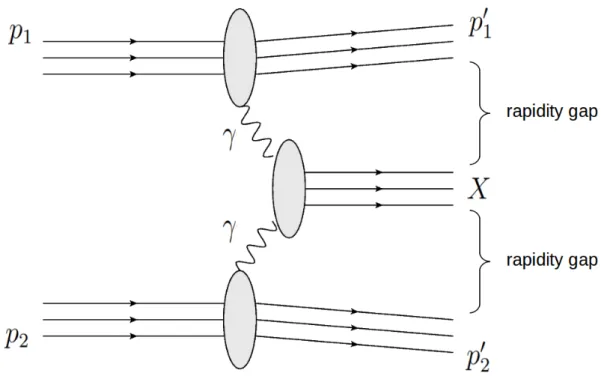
Subtitle: A γ-exchange CEP process with two protons in the final state and a W pair decaying in a semilepton channel. This chapter will present a brief introduction about CMS and PPS, and a detailed description is available in (CMS COLLABORATION, 2008) and (ALBROW et al., 2014) respectively.

The Large Hadron Collider
LHC experiments
LHCf: LHC-forward (LHCF COLLABORATION, 2008) is located in the forward region on both sides of the ATLAS detector. TOTEM: Measurement of the total elastic and diffractive cross section (TOTEM COLLABORATION, 2008) is located in the forward region on both sides of the CMS detector.
Compact Muon Solenoid
Subdetectors
- Tracking System
- ECAL
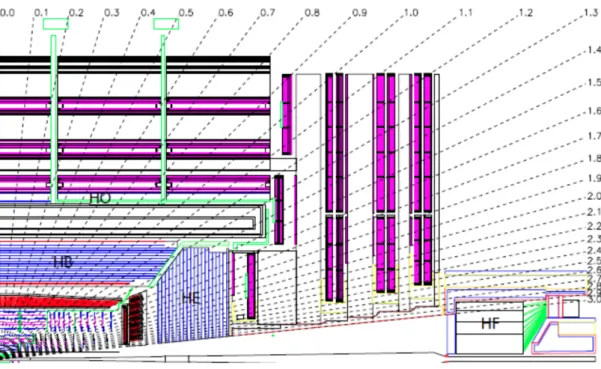
- HCAL
- Muon Chambers
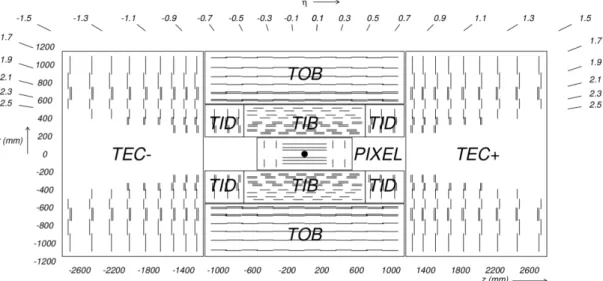
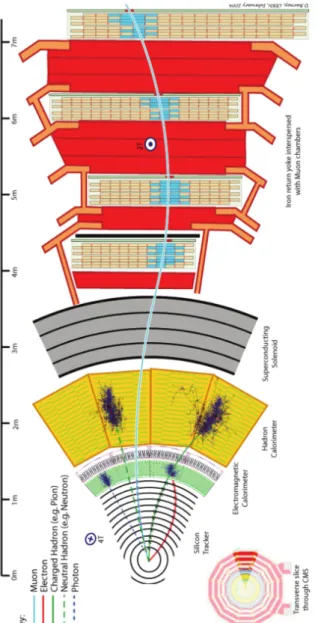
In figure 10 there is a representation of a slice of the CMS detector, in the inner part there is the Tracking System which is able to characterize all charged particles (muons, electrons and charged hadrons). It is composed of 10 layers and 12 disks divided into four parts: 6 layers in The Outer Barrel (TOB), 4 layers in The Inner Barrel (TIB), 3 Tracker Inner Disks (TID) inside the TOB and 9 Tracker Endcaps (TEC) ) outside the TOB. In figure 10, a schematic cross-section of the CMS Tracking System with z and η acceptance is presented.
It consists of four discs on each side with three rings in the innermost disc and two rings in the other 3. RPCs: Located on the end cap (four discs each) and in the barrel regions (six wheels) to supplement the muon measurements.
Trigger System
- Level-1 Trigger
- High Level Trigger
The L1 consists of a series of decisions based on the calorimeters and the muon system, made by a hardware programmable system. The L1 system consists of three subsystems: the L1 muon trigger, the L1 calorimeter trigger, and the L1 global trigger. The events accepted by the L1 are reconstructed by software in a more sophisticated process, using all detector subsystems.
For each positive signature, the event receives an HLT tag that is used in the analysis tier to identify the event. For example, an HLT that labels events with at least one jet with transverse momentum of 400 GeV may have a prescale of 10, that is, in 10 events with this condition, only one will receive the HLT label.
Physics event reconstruction
- Particle Flow
- Muon reconstruction
- Jet reconstruction
- Missing Transverse Energy
A combination of all subdetectors is used to determine four particle pulses. The longitudinal distance (along the z-axis) of the tracking path to the primary peak must be less than 5 mm. It is obtained from the estimation of the energy contribution of events unrelated to hard scattering in the event and electronic noise.
It is estimated using simulation and data to correct for imperfections in the detector modeling as a function of η. It is calculated using simulation and data to correct for imperfections in the detector modeling as a function of pT.

Precision Proton Spectrometer
Alignment procedure
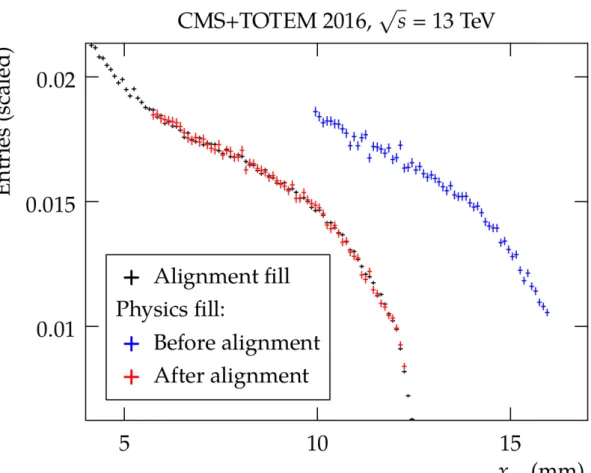
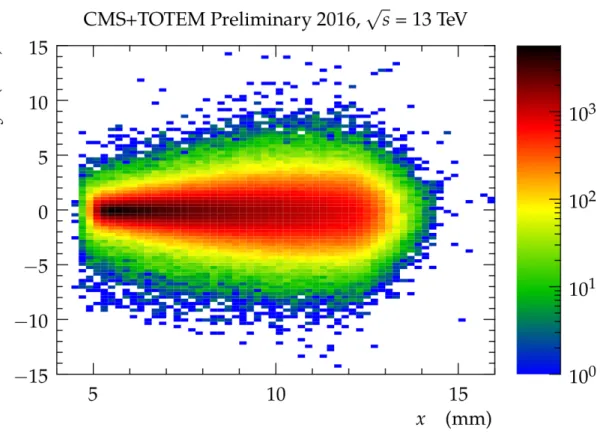
The fractional momentum loss of the proton is correlated with its impact position in the PPS sensors with respect to the beam center. During these runs, the sensors were inserted at approximately 5σ from the beam, where a σ is the standard deviation of the beam's transverse dimension at the RP position. When the rate in the beam loss monitors has a rapid increase, it means that the RP has had contact with the edge of the beam and it has the same position as the collimator.
The magnets in the beam line cause an elliptical shape of the hit distribution centered around the beam position. The kinematics of the scattered protons have a similar distribution in the two types of fills, then the alignment is done by matching these distributions with the same in the alignment fill.
Proton reconstruction
- Track reconstruction in the Roman Pots
- LHC beam optics
- ξ determination
Once the beam optics and the track reconstruction made are determined, the protonξ can be associated with the hit position in the RP. The trajectory of the protons in the RP can be considered a straight line since there is no significant magnetic field there. In the analysis chapter, the strategy to avoid the radiation damage impact will be described.
There is also, to a lesser extent, reconstruction inefficiency due to the production of showers in the interaction between the protons and the detector material. In this parameterization, the elements in the beam line are treated as optical lenses.
Work for the CMS Collaboration
Alignment studies
Subtitle: Thexcoordinate distribution of track impact points in runs 299593 (left) and 299649 (right) compared to the reference run. The correlation between the average number of pileup and the inefficiency of the proton track reconstruction in the strip sensors was investigated. In Figure 24 there is the correlation between the average number of pileup and the multi-tracking inefficiency for different beam conditions.
As expected, it is possible to see a linear relationship between the average number of pileups and the multi-tracking inefficiency. Subtitle: The relationship between the pileup average number and the multi-tracking efficiency for different beam conditions.

Timing detector stability
Shifts on detector operation
The shifter is also the representative person for the subdetector in the run coordination to summarize the subdetector's operation and make any requests. In the next subsection, the MC generators used for the background processes of the analysis presented in this thesis will be briefly discussed. Once the events are generated, the next step is to simulate the interaction between the particles passing through matter and the electronic response of the detector.
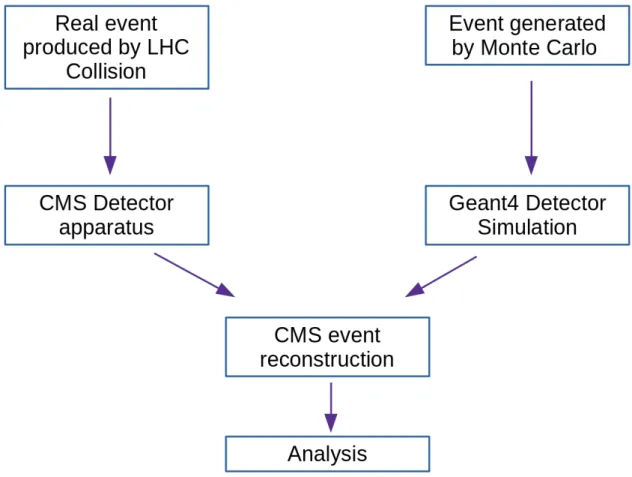
After the simulation, the MC events have the same structure as when the data is collected, after which the reconstruction step is the same for both, where the building of the physical objects is carried out as discussed in the previous chapter. Figure 26 shows a diagram of the steps in the procedure for generating MC events and processing data for analysis.
Event generators
To accomplish this, a set of simulated events is used, which should be able to reproduce the data as realistically as possible. Subheading: Description to have MC events and data from generation (for MC events) or collision (for data) in the reconstruction structure. Parton scattering in pp interaction, strong subprocess, parton shower, hadronization and finally decay.
This combinatorial generator can produce events according to the first-order approximation to the parton shower. It is an extension of the DPEMC generator (BOONEKAMP; KúCS, 2005) and is built within the framework of the Herwig generator (CORCELLA et al., 2001).
The Detector simulation
The PPS simulation
The signal and background processes
The Signal
The Background
The single peak can be produced in 3 different ways: in the t-channel in the distribution qb → qt mediated by a virtualW, it is generated by Powheg; in the tW channel from a gluon-bottom quark distribution (bg → W t) which is also generated using Powheg;. In the following, the contribution of all these processes is considered as a single high process. The analysis was divided into two phases: in the comprehensive phase, the selection of central objects considering the scenario of anomalous mergers was carried out using the analysis strategy from (CMS COLLABORATION, 2016b) as a reference.
The exclusive stage was performed to ensure the CEP topology of the process, this was done using mainly the detection manifold in the central detector and the proton information in the PPS RPs. For the proton treatment, the analysis procedures developed in the first PPS and joint CMS-TOTEM publication (CMS COLLABORATION et al., 2018), the internal note (CMS COLLABORATION., 2019), and the study (CMS AND TOTEM COLLABORATION, 2018) are consequence.
Inclusive Selection
- Trigger
- Jets
- Muons
- Missing Transverse Energy (MET)
- Baseline Event Selection
- Pileup reweighting
- Data and MC Comparison
The trigger efficiency turn-on curve was measured by the Muon POG8, the minimum value of the muonpT on the plateau was found to be 53 GeV. Because the beam energy resolution in the data is poorer than in MC, beam energy smearing was applied for the MC samples. For the hadronic W reconstruction, the AK8 jet was used because it contains the complete product of the W decay.
The four-momentum of the leptonic W is defined as the vector sum of the muon and neutrino four-momentum. Once both W bosons have been reconstructed, it is possible to define a cut on the invariant mass of the diboson final state, mW W.

Central Exclusive Production
Track Multiplicity
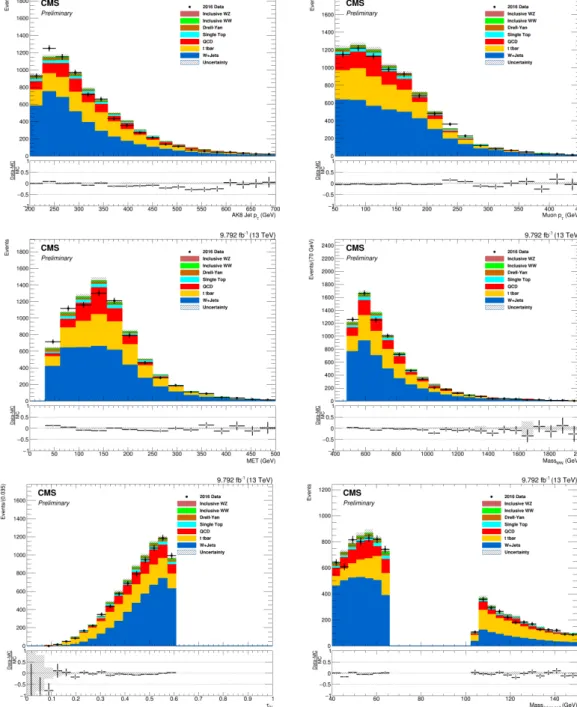
Subtitle: Comparison between data and MC of jet pT (top left), muonpT (top right), missing transverse energy (left center), W W central mass (right center), the jetτ21 (bottom left) and the pruned mass of the jet (bottom right ). The MC background events have been reweighted, taking into account the additional track distribution to correctly describe the data. The data and MC comparison are shown in Figure 35 next to four signal samples.
It can be seen that the signal events are concentrated in the region of low abundance of additional traces. Caption: Comparison between data and background MC after multi-shot reweighting, four signal samples included.
The fractional momentum loss of the scattered protons
Subtitle: Comparison between the multi-tracking efficiency (in red) and the multiplicity of primary vertices (in blue). The study found that a series of cuts to ξ reduced inefficiency due to radiation damage to less than 10% (CMS COLLABORATION., 2019). The inefficiency due to the multi-tracking in the RPs for the 2017 data was briefly discussed in section 2.4.3.
Subtitle: Comparison between data and MC forMX in the inclusive W W region, including four signal samples. The signal correction for proton multi-tracking inefficiency and the selection to reduce the impact of radiation damage were considered.
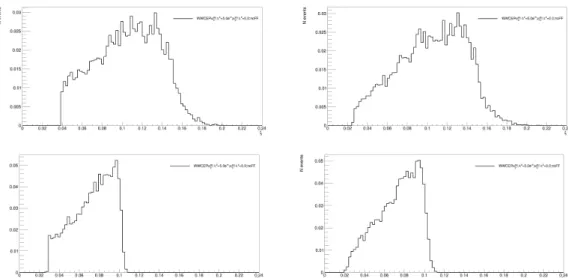
Final Selection
Subtitle: Distribution of the leptonicW pT in the inclusiveW W region with additional tracks≤4 and MMW W. The expected number of events for signal and background is shown in Table 11, where the expected number after each final selection is shown, the numbers in each column is for cumulative cuts.
Results
Subtitle: Hadronic pT distribution in the inclusive W W region with additional tracks≤4 and MMW W. Furthermore for this type of analysis, the electron as a lepton in the semileptonic channel can be considered. Another improvement for the 2017 and 2018 data analysis is the presence of new technologies introduced in the PPS apparatus.
Observation of a new particle in the search for the standard model Higgs boson with the ATLAS detector at the LHC. Single-top Wt channel production combined with parton showers using the POWHEG method.The European Physical Journal C, [s.