
MIT President Rafael Reif convened the MIT Task Force on the Work of the Future in the spring of 2018. Perhaps, in the words of The Economist, "the zeitgeist has lost touch with data."
A Firm Foundation
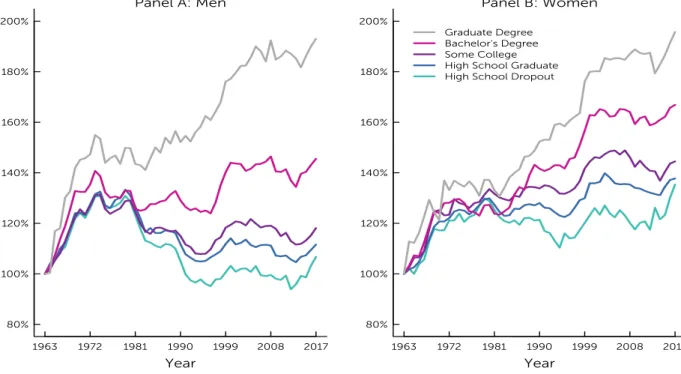
A solid foundation: In the post-war decades between 1940 and 1980, rapid technological advances and well-functioning institutions in the United States led to rising productivity and rapid, relatively evenly distributed wage increases for the vast majority of workers. Cause for concern: This virtuous dynamic has broken down in the decades from 1980 to the present.
The Case for Concern
Why, for the vast majority of workers, the last four decades of economic history have failed to live up to the promise of the previous four decades. From the end of World War II to 1973, the income of the typical worker grew with productivity, both of which nearly doubled over three years.
The Case Against Fatalism
Among children born in 1980, four decades later, this proportion was only five in ten. It shows that the United States now has one of the lowest rates of intergenerational mobility among wealthy democracies.

Investing in Job Quality Not Job Quantity
As labor force growth slowed, the educational attainment of entering cohorts of workers rose rapidly.36 In the decade between 2007 and 2017, for example, the share of U.S. In the 19th century, machine tools displaced skilled craftsmen, mechanized farming displaced masses of agricultural workers, and typewriter workers displaced.

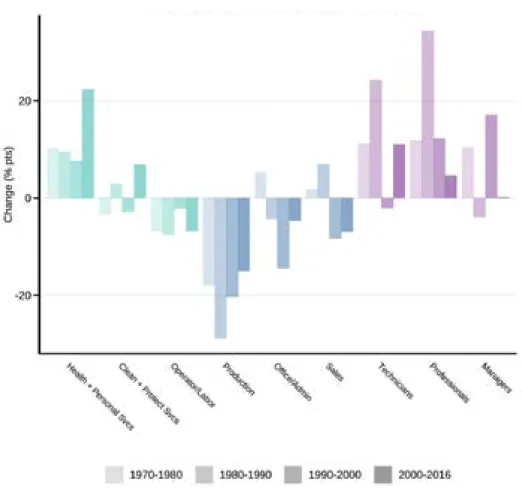
Employment Polarization
In earlier eras, mechanization and automation eliminated much unwanted work while creating substantially new and more desirable work, while at the same time increasing productivity and raising standards of living.50 Does the current age of digital technologies possess the same virtues – or is it different this time? And herein lies a little-acknowledged economic reality: Not all innovations that increase productivity displace workers, and not all innovations that displace workers substantially increase productivity. Not all innovations that increase productivity displace workers, and not all innovations that displace workers substantially increase productivity.
Economists Daron Acemoglu and Pascual Restrepo label these latter cases as "so-so" technologies.66 They disrupt employment and displace workers without generating much productivity gain. Automated phone agents and self-checkout kiosks probably increase productivity to some degree, or companies would presumably stick with human employees. But the relationship between labor relocation and productivity growth is demonstrably less favorable for these mediocre technologies than for labor-additional innovations such as electric lighting.67.
The "as is" nature of some digital innovations may help explain the paradox of slow productivity growth accompanied by significant labor displacement.68 Of course, not all digital innovations are so, and some have tremendous productivity benefits, such as the CAD software and medical diagnostic tools mentioned above.
Different But Not Altogether Better
How advances in artificial intelligence, machine learning (ML), robotics, and autonomous vehicles are currently being used and reported, and what the implications are for the future of work. How much replacement, how much addition and how much creation of new tasks do we expect.
The Robots Are Coming, But Slowly
While collaborative robots are a small fraction of the total robotics industry, they do represent the vanguard of a new wave of "augmented intelligence," in which AI and related technologies help human workers to make them more productive—enhancing the complementary nature of new forms of automation. We envision factories of the future that have achieved the safe, harmonious coordination of large numbers of humans and robots, and innovation is indeed already taking place in this area. Using robots effectively will require redesigning how work is performed to take advantage of the strengths of the new technologies while circumventing their current limitations.
For example, the well-known Amazon/Kiva robotic system used to fulfill orders in Amazon's warehouses is effective precisely because engineers have redesigned the warehouse to separate tasks that can be performed by a robot and tasks that require human touch into separate stages of the workflow. However, one large e-commerce supplier told us that they could never fully automate their supply chain because the spike in consumer demand during the Christmas season is so great that the company can't afford to have robots sit idle for the rest of the year. Therefore, their return on investment for adopting new robotics must include any required reconfiguration of existing equipment, as well as the cost of the robots, which represent a high scale.
Lights out” factories, without human input, have long been a utopian/dystopian vision of the future.
Artificial Intelligence and Machine Learning: Deep Strengths,
ML differs from previous waves of automation in that it applies to both high- and low-skilled jobs and holds the promise of learning as it works. As an example, ML interpretation of X-ray images, although an important part of a radiologist's work, affects only one of dozens of tasks performed by a professional radiologist. ML differs from previous waves of automation in that it applies to both high-skill and low-skill jobs and holds the promise of learning as it works.
To take advantage of the strengths and limitations of ML, organizations will need to redesign workflows and rethink the division of tasks between workers and machines, similar to what happened when Amazon deployed robotics in its warehouses. The industries that use ML are slowly learning that the data used to train ML systems must be as unbiased and confidential as the systems themselves—crucial challenges in an age of hacking and cyberwarfare. Additionally, ML systems tend to be "black boxes" that provide no insight into how they make their decisions.
AI is being applied to a variety of tasks in white-collar work and is predicted to have greater displacement effects on higher-skilled professional and technical workers than previous waves of automation.79 However, proven measures of these effects are still evolving.
Autonomous Vehicles: A Leading Use Case
Autonomous mobility—a form of automation and artificial intelligence that is receiving the lion's share of public attention, private investment, and engineering development—is a leading use case for artificial intelligence and robotic systems in general. Productive uses of the technology are still evolving, along with key supporting technologies. We begin by articulating the need for proactive policies and investments before offering some preliminary thoughts on specific opportunities in education and training and other policy areas.
Much of the rest of this section focuses on how the United States can once again be a leader in education, training, and continuous learning to better equip its workforce for the digitized economy of the future. Joint public and private action is essential to shaping the work of the future towards greater economic security for workers, higher productivity for businesses and broader opportunities for all. Change is overdue, not only for education and training institutions, but also in the areas of tax policy, labor representation and public investment.”
Change is required, not only for education and training institutions, but also in the areas of fiscal policy, worker representation and public investment.
The Skills of the Future: Attaining Excellence in Education, Training,
Another promising investment avenue involves connecting community colleges with employers to design skills programs that are directly responsive to market demands.92 Ongoing engagement between community colleges and private sector employers is critical to ensuring the long-term success of the community college system; here too, best-practice models are emerging in several states.93. Because of their scale, their ability to adapt offerings to local market needs, and their ongoing engagement with non-baccalaureate adults at all career stages, community colleges could play an even more central role in providing skills and training to American work-based learning programs in the form of co-ops and apprenticeships, proven valuable for German and in-class programs that are often valuable for education and training models. and work-based learning, both for vocational and four-year degrees, which are becoming increasingly integrated.95 Workers benefit from apprenticeships by receiving a competency-based education that prepares them for well-paid jobs, while employers benefit from recruiting and retaining a skilled workforce.96 However, the current focus on this approach has not yet encouraged the expansion of the application, but the expansion of the app has not yet been supported by the expansion of the country. the availability of programs; in addition, more work is needed at the state and national level to facilitate the administration of apprenticeships.
They describe the advantages of access and scope of the Georgia Tech master's degree and the opportunities that online programs can create. Realizing the full potential of a major new technology almost always means restructuring the way work (in this case, learning) is done to take advantage of the strengths and work around the limitations of the new tool. To promote such evaluation and to build our knowledge base about what types of programs and strategies might be most effective in providing skills and increasing career opportunities, particularly for non-college-educated workers, MIT's Abdul Latif Jameel Poverty Action Lab (J-PAL) North America is conducting a multi-year, multi-million-dollar research effort to work with the Task Force.
Our final report will contain early results from some of the experiments conducted by the J-PAL Work of the Future Initiative, as well as qualitative work on non-degree faith programs.107.
Shaping the Work of the Future Towards Innovation,
8 Raj Chetty et al., "The Fading American Dream: Trends in Absolute Income Mobility since 1940," Science 356, no. Solow, "Tegniese verandering en die saamgevoegde produksiefunksie," The Review of Economics and Statistics 39, no. 27 Sien Facundo Alvaredo et al., "The Top 1 Percent in International and Historical Perspective," Journal of Economic Perspectives 27, no.
The Geography of Intergenerational Mobility in the United States,” The Quarterly Journal of Economics 129, no. US Census Bureau, “Nation's Older Population Still Growing, Census Bureau Reports,” United States Census Bureau, accessed August 17, 2019, https://www. Chandler, Alfred D., The Visible Hand: The Managerial Revolution in American Business (Harvard University Press, 1977) and Daron Acemoglu and Pascual Restrepo, "Automation and the New Tasks: How Technology Displaces and Restores Work," Journal of Economic Perspectives 33, no.
Jeffrey Lin, "Technological Adaptation, Cities, and the New Work," Review of Economics and Statistics 93, no. Erik Brynjolfsson, Daniel Rock, and Chad Syverson, “The Productivity J-Curve: How Intangibles Complement General Purpose Technologies,” Working Paper (National Bureau of Economic Research, October 2018), https://doi.org/10.3386/w25148. Von Weitershausen, "Training for the 'Work of the Future': The Role of Work-Based Higher Education Programs in Germany and the United States," MIT Work of the Future working paper (forthcoming).
