Allerdings sind günstigere Produkte oft teurer in der Anschaffung und es gibt keinen wirtschaftlichen Grund für eine solche erhöhte Nachfrage. Neben der „klassischen“ Reflexion im Zusammenhang mit der Steigerung der Energieeffizienz sind auch andere Reflexionseffekte möglich.
Illustratives Beispiel
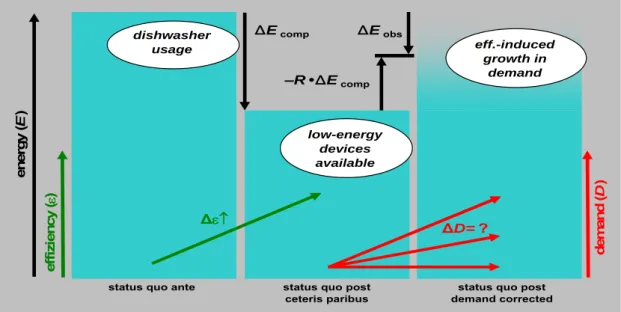
Wie in Kapitel 1 erwähnt, sind neben dem „klassischen“ Rebound im Zusammenhang mit der Steigerung der Energieeffizienz auch andere Rückkopplungseffekte möglich. Die Einführung einer Technologie oder Dienstleistung mit höherer Energieeffizienz, Δε>0, führt bei gleichem Bedarf zu einem Systemzustand mit um ΔEcomp reduziertem Energieverbrauch (Status quo post, ceteris paribus vorausgesetzt).
Drei Arten von Reboundeffekten: Direkt, indirekt, Makroebene
Drei Gründe der Entstehung: Ökonomisch, soziopsychologisch, regulatorisch
Zusätzlicher Einsatz von Stromsparlampen wegen ihrer geringen Betriebskosten;
Reduktion Investitionsaufwand beim Hausbau im Tausch gegen höhere Energiekosten im Betrieb, wenn effizientere Heizungen oder Kühlsysteme verfügbar werden
Kauf eines SUV mit Hybridantrieb, wenn der Kauf eines SUV mit konventionellem Antrieb nicht in Frage gekommen wäre
In Minergie-Häusern kann eine grössere Heizleistung eingebaut werden, wenn dazu eine Wärmepumpe verwendet wird, weil deren Elektrizitätsbedarf mit einem Faktor 2 (statt wärmetechnisch
Die Verbilligung von Elektrofahrrädern führt nicht nur zu einer Reduktion der Motorrad-/Mofa- Kilometer, sondern (weil mit der staatlichen Förderung die Wahrnehmung einhergeht, das Geförderte sei
- Drei Ausprägungen zusätzlicher Nachfrage: Häufiger, intensiver, mehr
- Fragestellung
- Entstehung von Reboundeffekten: Kausale Gründe für Rebound
- Das Konzept mentaler Umweltbudgets
- Vorstudie zu mentalen Gründen für Reboundeffekt
- Schlussfolgerungen für das Befragungsdesign
- Ausmass von Reboundeffekten: Empirische Untersuchungen
- Abgrenzung von einkommens- und effizienzinduzierter Mehrnachfrage
- Mögliche mentale Reboundeffekte bei biologischen Lebensmitteln
Ein entsprechender Formalismus, analog zu den Definitionen in Kapitel 2, für Rückkopplungseffekte ist in Anhang 3 zu finden. Wie in diesem Bericht dargestellt, muss unterschieden werden zwischen jenem Mehrbedarf, der durch eine erhöhte Ressourceneffizienz im Allgemeinen (oder einer erhöhten Energie) verursacht wird Effizienz (insbesondere Effizienz) wird vorangetrieben und zusätzliche Gesamtnachfrage bzw

Handeln Biokonsumenten konsequent?
- Mögliche mentale Reboundeffekte bei Hybridfahrzeugen: Fahren Hybridkäufer mehr, öfter oder grösser?
- Mögliche Reboundeffekte bei der Verkehrsmittelwahl: Fliegt mehr, wer kein Auto hat?
- Zusammenhänge zwischen Umweltbewusstsein, Umweltverhalten und Carbon Footprint
- Eindämmung von Reboundeffekten: Diskussion und Schlussfolgerung
- Zusammenfassung
- Reboundeffekte sind nicht vermeidbar, aber eindämmbar
- Wie Energiepolitik Reboundeffekte eindämmen kann
- Ausblick und künftiger Forschungsbedarf
Befragt wurden Käufer der ersten drei in der Schweiz erhältlichen Hybridautos (Toyota Prius, Honda Civic IMA, Lexus RX400h) und Kontrollgruppen (Toyota Corolla/Avensis, Honda Civic 5d, Lexus RX300). Um es in der Sprache dieses Berichts zu sagen: Der Spätmarkt reagiert wohl empfindlicher auf mentale Rebound-Effekte als der Frühmarkt.
Literatur
The Rebound Effect - an assessment of the evidence of economy-wide energy savings from improved energy efficiency: UKERC (United Kingdom Energy Research Centre). Environmental rebound effects of high-velocity technologies: a case study of climate change rebound effects of a future subsurface mist system.
Beilagen
Rebound Research Report 1
Rebound Research Report 2
Rebound Research Report 3
Rebound Research Report 4
Rebound Research Report 5
IED-NSSI
EMDM1521
Identification, quantification, and containment of energy-efficiency induced rebound effects
A research agenda
Rebound Research Report 1 Zurich, 30 Oct 2008
9 1.4 Illustrative example ..10 1.5 Recommendations from UK ERC..11 1.6 Cornerstones for research on rebound effects in IED-NSSI.
Abstract
Keywords
1 Introduction
- Introduction
- Definition
- Notation
- Illustrative example
- Recommendations from UK ERC
- Cornerstones for research on rebound effects at IED-NSSI
Below we illustrate the rebound effects caused by energy efficiency with the example of dishwashers (Figure 2). The aim of our research is to formulate conclusions and guidelines for energy policy with regard to containment of rebound effects.
2 Identification, quantification, and containment of rebound effects in energy policy
Three causal mechanisms for rebound effects, with specific examples and conclusions
This will then inevitably lead to demand increases which should be identified as regulatory recovery effects. Applies to resource rebound effects in general, especially to energy recovery (increased demand due to increased energy efficiency) and time rebound (increased demand due to increased time efficiency).
Resulting rationale for research
Differentiation of the observable total return effect according to different types of demand growth, both in the Saunders (2000) and Sorrel (2007) categorizations, and according to different causal mechanisms.
3 Integration of Rebound Effects into Life-Cycle Assessment
- Using LCA for assessment of new technologies
- Past and future of LCA
- On attributional vs. consequentional LCA
- Resulting rationale for research
An attributive LCA aims to describe the environmental characteristics of a life cycle and its subsystems. In order to accurately model the effects of an increased demand for a product in the life cycle studied, it is necessary to take into account effects on the market of this product.
4 Rebound effects associated with hybrid vehicles
Previous work
Resulting rationale for research
5 References
An Econometric Model Integrating Storage into Estimating Residential Electricity Demand, JAI Press, Greenwich CT. 2005 Is cumulative fossil energy demand a useful indicator of environmental performance of products?, submitted to Journal Environmental Science and Technology.
EMDM1381
Environmental impact of
Swiss household consumption, and estimated income rebound effects
Rebound Research Report 2 Zurich, 14 Nov 2008
Girod
Environmental impact of households
Households' environmental impact includes the impact caused by consumption when considering the entire life cycle of products. In order to answer and assess these questions, a model of household environmental impact is needed.
Study approach
Therefore, the assessment of the environmental impact of households can be based on the assessment of the environmental impact of individual products consumed. Therefore two questions regarding the impact of households are of particular interest: What is the potential of changing household consumption to reduce greenhouse gas emissions.
2 Method
- Deriving functional units
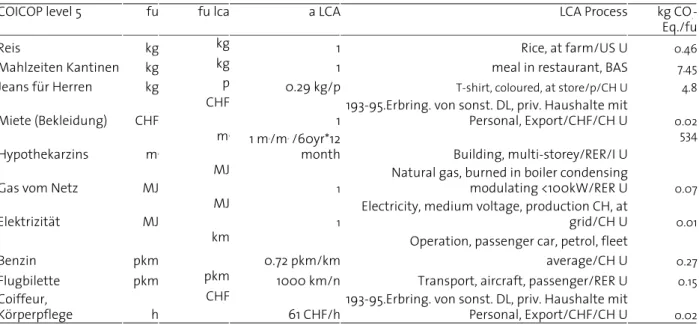
- Connecting functional units to LCA processes
- Collapse to main consumption categories
- Formal description
- Estimating income rebound
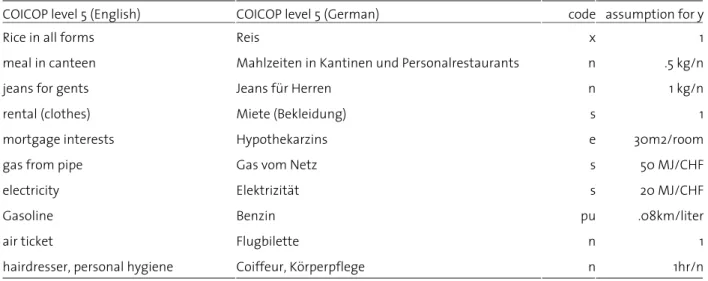
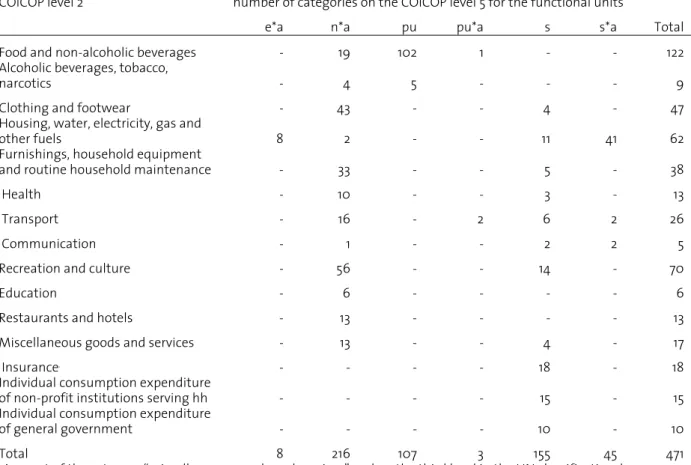
The cross table shows the number of consumption categories at the 5th COICOP level for the different functional units, compared to the consumption categories at the 2nd COICOP level. It seems that for some COICOP level consumption categories we have different functional units.
3 Results
Consumption and impact of Swiss average household consumption
Since there are no pure bottom-up estimates for GHG emissions, we have to compare our results with studies using top-down or mixed approaches (both top-down and bottom-up elements). According to a study by Ecospeed SA (2008), which is a more refined version of the model published by Durenberger et al. 2001), the shares of greenhouse gas emissions for different categories are very similar.
Carbon emissions of marginal consumption
Comparison of methods to allocate greenhouse gas emissions to consumption for increasing greenhouse gas emissions with increasing household expenditures. Comparison of household types taking into account the increasing greenhouse gas emissions of households with increasing spending (spending).

4 Discussion and Conclusion
Deriving functional units
Bottom-up estimates
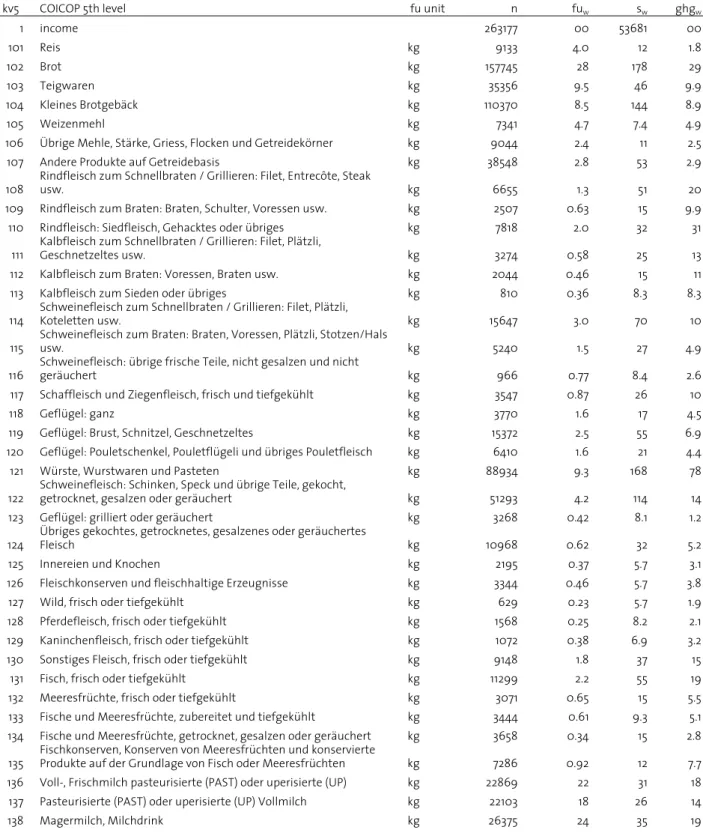
While for food the LCA processes are quite specifically related to consumption categories, in other categories – for example goods and services – a weaker relationship was applied. Only new consumption categories from the survey need to be included and updates in the LCA database need to be taken into account.
Rebound estimates
5 Outlook
Improvements on the model side
Include time: Time consumption along with the purchase and use of energy services can be included in the model. Impact of quality and labeled product: As our results showed, wealthier households pay higher prices.
Improvements on the data side
These higher prices are mostly paid for higher quality, so the impact of quality would be of interest: If the price of an expensive bottle of wine is twice the price of a cheap bottle, the impact is also twice bigger. A description of the living impact per square meter for average buildings, MINERGIE- and MINERGIE-P buildings would be very useful.
Appendices
435 Sonstige Nebenkosten, keine weiteren Angaben. kv5 kvd5 fu_unit-Code geht von kvdlca lca_unit a_lca ghg_fu kvp1 kvecos fu_0 aus. eigener Hauptwohnsitz) Export/CHF/CH U.
EMDM1522
Mental rebound
Rebound Research Report 3 Zurich, 31 Mar 2009
BG, PdH
Non-monetary causes for rebound effects
Income upturn (“economic recovery”, “upturn induced by a rational price signal”): the increased demand for the energy service that has become more energy efficient is only due to economic reasoning. The increased demand is due to lower socio-psychological costs of ownership or use for energy service with better energy efficiency.
Empirical evidence for mental rebound: Indications from current surveys and further evaluations
We define mental rebound as the increase in energy consumption or GHG (greenhouse gas emissions) after increased efficiency due to mental causes. In the literature, the term "mental rebound" is not used, and there is no extensive research focus on this problem. 2006) postulates that efficiency improvements can lead to changed preferences for mental reasons, which can for example be a compensation for lower happiness due to changes in consumption.
2 Formal description
Household consumption: An optimization problem
Rebound effect
Mental rebound
- Mental environmental Budget
Mental accounting is usually used for financial accounting, but also describes the effect of consumers having different "accounts". This mental account influences how changes in the subjective environmental impact, ∆, are "spent" on other activities.
3 Indications from existing surveys
Income and expenditure survey: Organic food and total GHG emissions
- Method
- Results
- Discussion and Conclusion
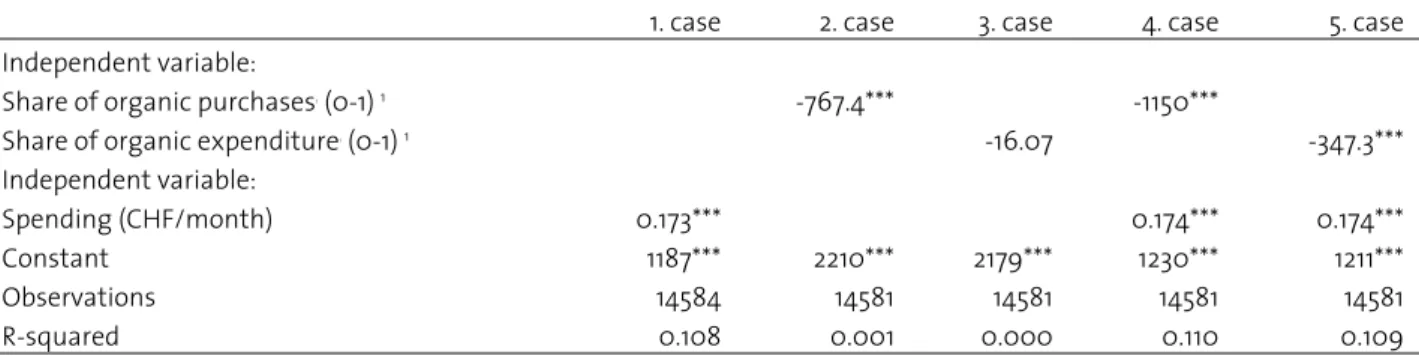
It reveals that the share of organic purchases and spending decreases with increasing total greenhouse gas emissions. The differences in the proportion of organic purchases are significant (p<0.01) between the 1st and 2nd and 2nd and 3rd quintiles.
Traffic survey: Car availability and flights
- Method
- Results
- Discussion and Conclusion
Number of flights for trips of different household income groups, with and without a car. The higher number of flights for trips for households without a car compared to households of the same income group with at least one available car can be explained by a rebound effect.
Environmental survey: Flights, car, efficient building and environmental awareness
However, the sample size of car-free households for different income groups is quite small. In addition, the higher number of flights for households without a car could also be explained by (i) income recovery, as lower expenditure on the use of a car allows more spending on holidays, or (ii) logistical reasons, as households without a car may find it more difficult to choose to travel by car for holidays , so leave plane or train as the mode of travel.
4 Rebound due to efficient buildings?
No monetary basis for Rebound effects
Indications for (mental) rebound
- Parameters of the survey
- Larger Flat
- More flights
- Spending of financial saving and wage increase
The comparability for the number of flights is limited as we collected flights per household and the Swiss traffic survey collects flights per target person (BFS & ARE, 2007). The targeted persons of the Swiss traffic survey show significantly lower number of flights compared to residents of MINERGIE buildings (see table 7).

Lessons learned for future surveys
- Quantitative aspects
- Qualitative aspects
- Questionnaire for future survey on rebound from MINERGIE Buildings
Subjective environmental impact: If mental accounting exists, it is not the real environmental impact that counts, but the subjective environmental impact. In addition to an absolute reduction question (By what percent does the MINERGIE building reduce your GHG emissions?), questions should be asked that compare the environmental contribution to other actions. For example: How high is the environmental impact of the following compared to the reduced impact of a MINERGIE building? i) one flight to New York per year, ii) recycling waste, iii) not owning a car, iv) using a smaller car, v) using a hybrid car, vi) halving your living space, etc.
5 General findings for future research and recommendation for policy
Indications for mental rebound concept from existing surveys
Indication for mental rebound from case study (efficient buildings)
If this finding holds true, an indirect rebound could reduce the efficiency gain of MINERGIE buildings at the macro level. Mental rebound: If the larger area and higher number of flights for residents of MINERGIE buildings is verified, the causal relationship of these differences needs to be further investigated.
Robust recommendation for policy
Larger housing: Our pre-test showed that residents of MINERGIE buildings use 75 m2 of living space compared to 50 m2 for the Swiss average of the same income level. Indications that residents of MINERGIE buildings use more living space compared to residents of regular buildings (even if income is controlled) should be further investigated, as, if confirmed, this would be a strong argument for an effect direct return, leading to a decrease in the overall increase in the efficiency of MINERGIE buildings.
6 Literature
Questionnaire of Pretest
EMDM1601
Empfehlungen
Rebound Research Report 4 Zurich, 27 Apr 2009
MSch
Einführung
- Ausgangslage
- Fragestellung
- Methode
Abschließend werden die Ergebnisse diskutiert und mit den zusammengefassten Forschungsergebnissen des UKERC-Reviews (Kapitel 4) verglichen, sodass abschließende Schlussfolgerungen gezogen werden können (Kapitel). Als zusätzliche Hauptquelle wurde der „Aktionsplan Energieeffizienz“ der Bundesregierung herangezogen ( (BFE) 2007b; 2008d) zur Identifizierung aktueller politischer Massnahmen im Bereich Energieeffizienz.
Der Reboundeffekt
- Definitionen
- Einflussfaktoren
Dies wird von Kirchner et al. unterstützt. 2003), die betont, dass die Energiekosten im Industriesektor grundsätzlich von untergeordneter Bedeutung sind und daher einem geringeren Optimierungsdruck ausgesetzt sind als im Handels- und Dienstleistungsbereich. Dies lässt sich dadurch erklären, dass bei einem Durchbruch in der Entwicklung die daraus resultierenden Effizienzgewinne zu einem günstigeren und damit flächendeckenden Einsatz der Technologie führen.

Analyse ausgewählter Politikinstrumente
- Auswahl zu untersuchender Politikmassnahmen
- LSVA und 40-Tonnen-Gewichtslimite
- Road Pricing
- CO 2 -Abgabe
Art. 2 der Bundesverfassung (BV) sah vor, „die mit dem Strassenverkehr verbundenen Kosten zu decken“ (Schweizerische Eidgenossenschaft 1999), also nicht nur externe Kosten, sondern auch für den normalen Bau und Unterhalt von Strassen, oder dagegen zu dieser Definition. für allgemeine Staatsausgaben (VCS Bern 2001). Im Idealfall würden die Effizienzgewinne aus der gesteigerten Produktivität aufgrund der erhöhten Gewichtsgrenze aus dem Schwerlastkraftwagen entfernt werden und somit keinen Rückprall verursachen.


![Table 6: Derivation of functional unit from the income and spending survey (main consumption categories) consumption categories on disaggregated level [n]](https://thumb-eu.123doks.com/thumbv2/pubpdfco/327881.42327/69.892.108.807.232.879/derivation-functional-spending-consumption-categories-consumption-categories-disaggregated.webp)