Influencing natural resource management and forestry practices in the United States of America and Canada. Cubbage, Frederick W.; Siegel, William C.: The Impact of Federal Environmental Law on Forest Resource Management in the United States.
PUBLIC LAND OWNERSHIP IN THE UNITED STATES
LEGAL FRAMEWORK FOR MANAGING THE PUBLIC FORESTS
The Property Clause of the Constitution gives Congress exclusive authority to determine the management of federal lands.3 In turn, Congress has enacted laws that delegate specific management powers to various federal departments and agencies depending on the functions and the land involved. Congress thus, under its constitutional authority, prescribes laws governing the management of the nation's forests.
THE DISPOSAL OF PUBLIC LANDS AND THE ESTABLISHMENT OF PARKS AND FORESTS - ACTIONS AND REACTIONS
The National Forests were established in 1891 when Congress passed the first law setting aside federal lands as forest reserves. Virtually all of the newly established National Forests were in the western states, but there was growing recognition of the need for forest management in the eastern states.
SUBSTANTIVE AND PROCEDURAL LAWS GOVERNING FOREST MANAGEMENT IN THE UNITED STATES
Enactment in 1960 of the Multiple Use-Sustained Yield Act marked a turning point in forest management policy for the United States. Since 1964, approximately 42 million hectares (17 million acres) comprising approximately 22 percent of the National Forests have been legally set aside for special management primarily for recreation and resource conservation.
INTERPLAY BETWEEN LAWS AND PUBLIC POLICY
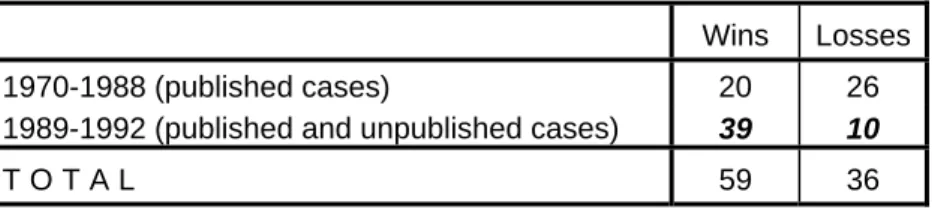
That disputes between various interest groups and the Forest Service are regularly decided in the courts is understandable in light of the ever-increasing number of laws regulating forest management. Lawsuits filed by environmental organizations have challenged the harvesting of timber in old-growth forests in the Pacific Northwest as a violation of various laws governing the management of the National Forests.
LEGAL IMPACTS ON FOREST MANAGEMENT IN THE FUTURE
The real issue in the dispute is not only the continued existence of the Uharica, but the preservation of the entire ecosystem of old-growth forests. Most importantly, however, the Forest Service has generally succeeded in gaining public support for balancing competing development and environmental interests by fully involving the public in forest planning processes.
THE PUBLIC DOMAIN AND THE CREATION OF NATIONAL FORESTS
Most federal land grants were made in the 19th century, but it wasn't until 1976 that a federal law was passed to officially end the policy of public domain disposal. Although public domain disposal programs were well-intentioned, some were poorly conceived and executed.
EVOLVING MANAGEMENT PHILOSOPHY FOR THE NATIONAL FORESTS
- A Focus on Settlement and Economic Development
- A Focus on Sustained Yield and Community Stability
- A Focus on The Environment
- The Situation Today
The Federal Government funded development projects in the National Forests to provide jobs for men who were out of work due to the Great Depression. The National Forest Management Act specifies procedures for forest management planning and achieving the policies of the 1960 Multiple Use-Sustainable Yield Act.
TIMBERLAND OWNERSHIP AND FOREST PRACTICES IN THE U.S
Ownership Pattern
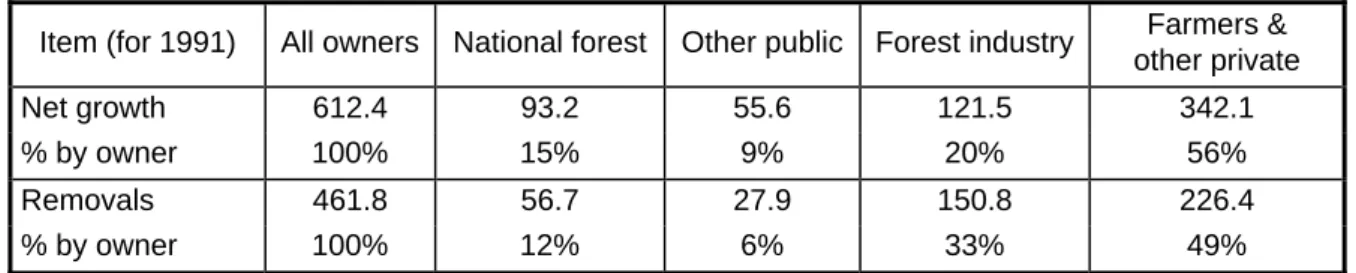
Although forest industry owners account for only 14 percent of the nation's timberland, they contribute about one-third of the nation's timber harvest each year (Table 2). Withdrawal exceeds growth only for the forest industry owner class, suggesting that forest industry harvests are likely to fluctuate somewhat in the future in an approach to a long-term balance between harvest and growth.
Management Practices and Controls
With current timber growth at 73 percent of potential, forest industry owners have the highest apparent timber production efficiency. There are several reasons for the lower timber production efficiency of farmers and other non-industrial private owners.

CONSIDERATIONS ON MANAGEMENT EFFICIENCY
- The Standard Used To Determine Relative Efficiency
- Differences in Site Capability
- The Meaning of Current Growth
- Normative Implications Regarding Forest Ownership
THE EVOLUTION OF FOREST MANAGEMENT POLICY ON CROWN LAND IN THE PROVINCE OF ONTARIO, CANADA. Over the past 167 years, farmers, foresters and politicians have played a role in the evolution of forest management policy and legislation.
THE FORESTS AND THE FOREST SECTOR IN ONTARIO
Lawrence Forest Region, which stretches inland from the edges of the Great Lakes and the St. The implementation of the Forest Management Act (1947) led to a significant increase in the number of foresters on staff over the next 15 years and the establishment of several tree nurseries.
FOREST PRODUCTION POLICY (1972) AND FOREST MANAGEMENT AGREEMENTS A number of concerns resurfaced again around 1966 regarding the future demand for timber,
The report was widely reviewed by government and industry and its recommendations were instrumental in the development of Forest Management Agreements (FMAs). The costs of forest management activities are shared between the government and forest companies.
VALUES, POLICIES AND LAW
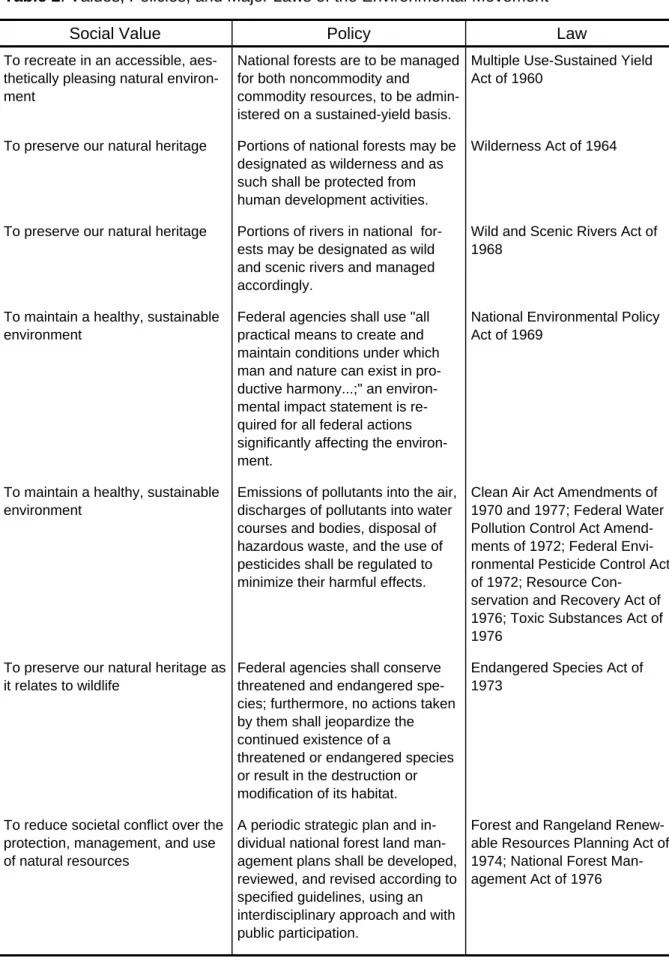
The noncommodity values of national forests, especially as sites for outdoor recreation, began to rise in relative importance. These differences are based on the relative acceptance of human consumptive use of natural resources and the tolerance of human disturbance of the biosphere.
VALUE DIFFERENCES RELATED TO NATURAL RESOURCES 1 Identifiable Current Values
- Environmental Quality
- Ecological Values
- Recreation Values
- Amenity Values
- Spiritual Values
Although one of the values associated with recreational use of public lands is associated with. In the context of rural areas, amenity resources have been identified as those features of the environment that provide beauty and pleasure (Shafer and Siehl 1991).
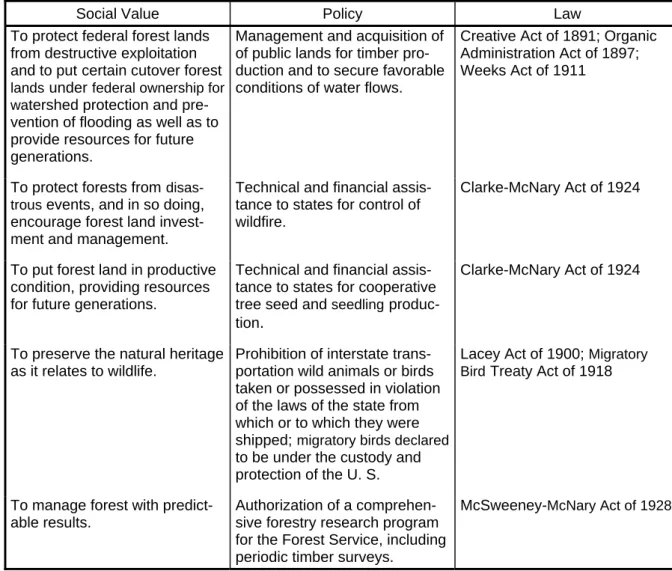
CHANGES IN PRACTICES RESULTING FROM THE PROGRESSIVE CONSERVATION MOVEMENT
- Use of Resource Professionals
- Establishment of Forestry and Range Research
- Wildlife Conservation
- Protection of Forests from Wildfire
- Cooperative Federal and State Programs
- Rehabilitation of Cutover Forest Land and Marginal Farm Land as National Forest Land
Tree planting increased dramatically in the late 1950s and 1960s as part of the Soil Bank program. The national forests of the East are mainly composed of land that no one wanted.
CHANGES IN PRACTICES RESULTING FROM THE ENVIRONMENTAL MOVEMENT Several changes in Forest Service practices occurred as a result of statutory policies enacted
- Multiple-Use Management
- Reservations for Specific Uses
- Management and Use in Productive Harmony with Nature
- Regulation of Pollution
- Protection of Threatened and Endangered Species
- Comprehensive Land Management Planning with Public Participation
Two years later, the National Forest Management Act (NFMA) was passed, which provides standards and guidelines for the planning and management of national forests. CHANGES IN FOREST CONDITION AND REGULATIONS AS A RESULT OF PROGRESSIVE CONSERVATION MOVEMENT PRACTICES.
CHANGES IN FOREST AND RANGE CONDITION AS A RESULT OF PRACTICES OF THE PROGRESSIVE CONSERVATION MOVEMENT
Forest Condition
NFMA was adopted in response to the ruling by the Fourth Circuit Court of Appeals, which upheld a lower court decision, that timber sales in the Monongahela National Forest violated provisions of the Organic Management Act of 1897. They are process-oriented, rather than outcome-oriented, with the intention of establishing a framework according to which the Forest Service and various public interests can reach agreement on the management of the national forests.
Range Condition
All national assessments (of rangeland conditions) suffer from the lack of up-to-date, comprehensive and statistically representative data obtained in the field. If so, future evaluations of rangeland management and use can be made.
CHANGES IN FOREST AND RANGE CONDITION AS A RESULT OF PRACTICES OF THE ENVIRONMENTAL MOVEMENT
- Multiple Use and Sustained Yield
- Wilderness and Other Restricted-Use Designations
- National Environmental Policy Act
- Water and Air Pollution
- Protection of Threatened and Endangered Species
- Renewable Resources Planning and National Forest Management
- Public Involvement
Criticism of the Forest Service's timber sales program increased and the agency was slow to respond. Unfortunately, this is not the prevailing situation, which is to the detriment of the condition of the national forests.

CHANGES IN CONDITION OF PRIVATE FOREST LAND AS A RESULT OF PRACTICES OF THE ENVIRONMENTAL MOVEMENT
CHANGES IN THE CONDITION OF PRIVATE FOREST LAND AS A RESULT OF THE PRACTICES OF THE ENVIRONMENTAL MOVEMENT. The corporate deals and leveraged buyouts of the 1980s are still causing negative consequences on private forest lands.
CONCLUSION: FOREST SERVICE ACCOMPLISHMENTS
It is interesting that the Forestry Institute could not adapt in time to the values of the environmental movement. The text of the inter-institutional memorial can be found in: Institute for Forestry in the Seventies.
GENERAL ASPECTS OF PUBLIC INVOLVEMENT
At one end of the spectrum, we can inform or educate so that the public understands why forests are being managed in a certain way. The Forest Service hopes that the public will cooperate with the proposed activity because of increased understanding.
HISTORY OF PUBLIC INVOLVEMENT
At the other end of the spectrum, the goal may involve more complicated interactive processes with the public about proposals and alternatives that influence final decisions. Use the press first, last and all the time if you want to reach the public.
LEGAL MANDATE FOR PUBLIC PARTICIPATION
- The Multiple-Use Sustained-Yield Act of 1960
- The National Environmental Policy Act of 1969
- The National Forest Management Act of 1976
- Federal Land Policy and Management Act (FLPMA) of 1976
It treats the public primarily as a recipient of information rather than as a participant in decision-making. With the passage of the NFMA in 1976, Congress asserted the public's right to participate and play a key role in Forest Service planning and decision-making.
FOREST SERVICE EFFORTS IN PUBLIC PARTICIPATION
Still, the Forest Service has had several successes in involving the public in national forest planning and management. 34;open decision-making' (or decision-making) and 'shared management', the agency and the public are both contributors to decision-making.
PUBLIC INVOLVEMENT OF THE FUTURE
In a community of interest, on the other hand, a leader causes work to be done by stimulating members of the community to engage each other and ultimately resolve the issues that concern them. The paper provides an overview of the Export Trading Company Act (ETCA), and the performance of the wood products industry under the Act.
BACKGROUND
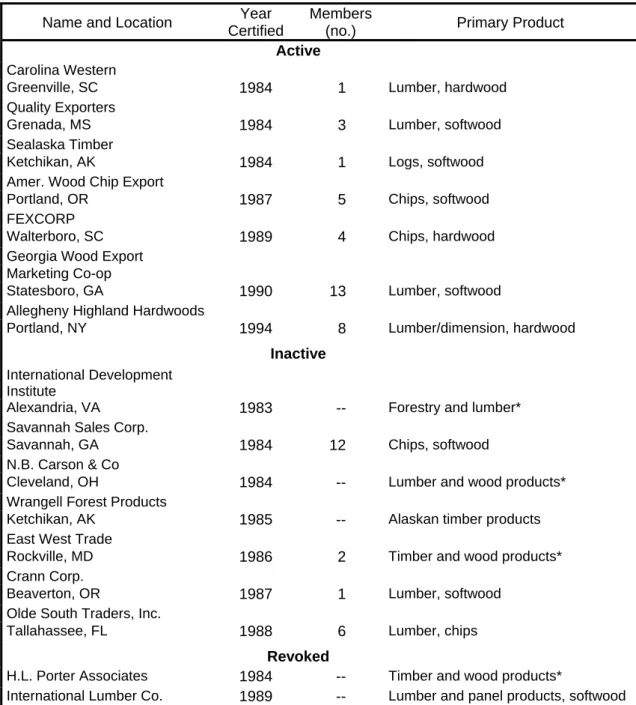
First, the background and general provisions of the law are discussed, followed by an examination of wood products companies that use the Title III certification process authorized under the law.
THE EXPORT TRADING COMPANY ACT OF 1982
Eventually, both versions became part of the Act, but the Webb Act was not repealed. However, the wood products industry has been one of the more active users of the Webb-Pomerene Act.
CERTIFICATION OF WOOD PRODUCT EXPORTERS 1 Certification Criteria
Firms Certified
Similarly, it also amends the Federal Trade Commission Act to disapply unfair methods of competition involving trade with foreign countries unless such conduct has a direct and substantial effect on domestic trade. Export sales by certificate holders were estimated at $125 million, or 1.9 percent of total U.S. value.
Conduct certified
CONCLUSION
INTRODUCTION
MAJOR FEDERAL ENVIRONMENTAL LAWS
- Wilderness, Trails, and Scenic Rivers
- The National Environmental Policy Act
- Air Pollution Control
- Federal Pesticide and Herbicide Control
- Water Pollution Control
- Section 402 - Industrial Point Sources
- Sections 208 and 319 - Nonpoint Source Pollution
- Section 404 - Wetland Point Sources
- Endangered Species Protection
- Spotted Owl
- Red-Cockaded Woodpecker
- Forest Resource Planning
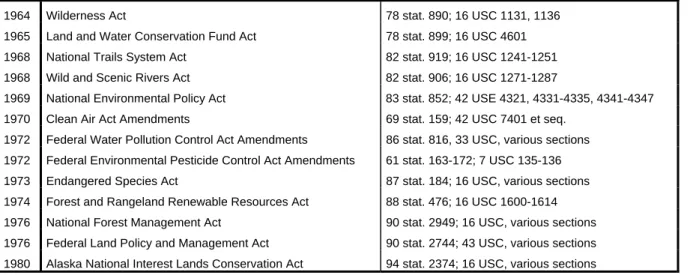
In addition, many of the federal environmental laws passed in the 1970s—such as the Endangered Species Act and the Federal Water Pollution Control Act—amendments—were reauthorized and strengthened in the 1980s. The most important provisions of the Act require (a) public participation in the planning process, (b) promulgation of regulations to govern the preparation and review of the management plans, (c) resource management guidelines.
CONCLUSIONS
State water quality laws and programs to control nonpoint pollution of southern woodlands. The Interaction of State and Federal Water Quality Legislation in the United States - Implications for Forest Practices.
THE EFFECTS OF SOIL LOSS
EARLY FEDERAL PROGRAMS
NEW FEDERAL PROGRAMS
- Sodbuster Program
- Swampbusting Program
- Conservation Compliance
- The Conservation Reserve Program
- Wetlands Reserve Program
- Environmental Easement Program
The other two are part of the new Agricultural Resource Conservation Program authorized by the 1990 statute. A particular field can only be considered highly erodible if two-thirds or more of the soil in the field meets the erodibility requirement.
CONCLUSIONS
In summary, tree planting under the 1985 and 1990 Farm Bills made a substantial contribution to the nation's timber growth stock—especially in the southern United States. As a result of these plantings, the total number of trees planted in the United States as a whole in each of the years from 1986 to 1990 was more than had ever been planted in any previous year.
SPECIES EXTINCTIONS AND POLICY RESPONSE 1 The Problem of Species Extinctions
The Policy Response of the Federal Government
In response to earlier concerns, the United States federal government has attempted since 1966 to provide comprehensive legislative protection for species threatened with extinction.4 Current state policy is set forth in the Endangered Species Act (ESA) of 1973, as amended [16 U.S.C. Premise (2): Assuming that these conflicts that have arisen would be relatively easy to resolve, it is only necessary to highlight the controversy surrounding the spotted owl and its impact on forestry-related activities in Washington's old-growth forests. Oregon and Northern California to verify that this is not always the case.
KEY PROTECTIONS FOR DOMESTIC SPECIES 1 General Aspects
Listing Process
The decision to list a species must be made on the basis of the best "scientific and commercial" data available. One method is for the species to be listed on the initiative of the responsible management authority.
Critical Habitat
The factors to be taken into account include the following: (1) the present or threatened destruction, modification or reduction of the habitat or range of a species; (2) the overuse of a species for commercial, recreational, scientific, or educational purposes; (3) disease or predation affecting a species; (4) the adequacy of existing regulatory mechanisms for the protection of a species; and (5) other natural or man-made forces that affect the survival of a species (4). Section (4) of the ESA provides that critical habitat should normally be designated at the same time the decision is made to list a species.
Recovery Plans
Although it may seem unlikely that the designation of critical habitat could pose a threat, experience has shown that this is a distinct possibility. The danger, which is especially great for plants, is that identification of critical habitats will locate the endangered or threatened species to both collectors and vandals (21).9.
RESPONSIBILITIES OF FEDERAL AGENCIES, SECTION (7)
Jeopardy Clause
During this contact, the action agency asks the management agency whether the listed or candidate species is likely to be affected. If reasonable and prudent alternatives cannot be found, the action agency may proceed in one of three ways.
Conservation Clause
Finally, it may request that the "Endangered Species Committee" be convened to assess the justification for exempting the project from the provisions of the ESA (3,16). The plaintiffs argued that the ministry was only obliged to prevent endangering the bare survival of the species.
Prohibition of Taking a Listed Species, Section (9)
The Supreme Court agreed to hear the case, and in 1978 it upheld the decision of the Court of Appeal. In this case, a federal district court in Nevada upheld the authority of the Secretary of the Interior to regulate the use of reclamation project waters for the benefit of two species of endangered fish—i.e. Cui-ui and Lahontan cutthroat trout.
POLICY OPTIONS NOW BEING DEBATED
Topping the list was the northern spotted owl, which benefited from $9.7 million in spending. Proponents of the law urge: (1) streamlining the listing process, (2) improving procedures for designating critical habitat, (3) speeding up the mechanisms for formulating recovery plans, (4) improving funding, (5) strengthening enforcement, and (6) the principles of "triage" are used to decide which species should be protected (5,15,17).
FORESTRY IMPACTS ON WATER QUALITY
In many parts of the country today, non-point sources in particular remain a major contributor to water pollution. So Congress passed the Water Quality Act of 1987, a law that sets new directions for protecting the nation's water.
FEDERAL LEGISLATIVE AND JUDICIAL HISTORY
Section 208
Most states in the eastern half of the country have therefore directly addressed nonpoint pollution from forestry through voluntary programs that use proposed best management practices (BMPs) for forestry operations. However, some states in the eastern and many states in the western United States have also passed regulatory legislation to control non-point source pollution in forestry.
Section 319
Section 208 of the FWPCA Amendments of 1972 mandated that individual states develop and implement water quality management plans, subject to EPA approval. The Forest Service is responsible for ensuring that runoff from road construction and timber harvesting on national forests meets California state water quality standards.3 The Forest Service had argued that only using state-approved MPCs met all obligations under the FWPCA.
Section 404
The Supreme Court upheld the right of the California Coastal Commission to require that a mining company on federal lands under the rock mining laws meet state mining permit requirements for nonpoint water pollution control.4 The court wrote that the requirement of simply for a state permit was not evidence of a duplication of federal permit requirements: "If reasonable state environmental regulation is not preempted, then the use of a permit requirement to impose state regulations does not create a conflict with federal law where none existed ago. In November 1986, the Crops of Engineers issued its final regulations on section 404 excavation and billing permits and other regulatory programs it administers.9 These regulations continue to exempt normal silvicultural activities from permit requirements.
STATE LAWS AND OTHER IMPLEMENTING MECHANISMS
In this regard, the Corps' Section 404 authority may overlap with the provisions of Section 208 as administered by EPA. For example, cut roads and skid trails that meet BMP guidelines established under Section 208 state planning may be exempt if they meet certain additional Section 404 criteria.
A LOOK AT SPECIFIC STATES
The South
The main authority for issuing PKMs belongs to the State Forestry Office. Mississippi also relies on the voluntary use of state-developed forest BMPs.
The West
CONCLUSION
Section 404 of the 1972 Amendments to the Federal Water Pollution Control Act (FWPCA) was the first explicit statutory basis for a federal role in wetland protection. Most of the direct Federal law regulating forestry activities in wetlands is contained in Section 404 of the 1972 Amendments to the Federal Water Pollution Control Act, as amended, and subsequent administrative regulations.
EARLY FEDERAL CONTROL OF WATERS OF THE UNITED STATES
ENVIRONMENTAL FACTORS EMERGE
The developers filed a lawsuit against the Corps, basing their case on the Corps' right to deny a permit on grounds other than navigational restrictions. The Court also cited the National Environmental Policy Act in support of the Corps' action.
FEDERAL WATER POLLUTION CONTROL ACT AMENDMENTS OF 1972
In 1969, the Corps granted a second permit for Roberts Bay over the objections of the FWS. These conflicting recommendations were sent to the Corps office in Washington for consideration by the chief engineer, General William Gribble.
THE 1980S: NEW DIRECTIONS
New Manual Proposed: Due to public opposition to the federal manual, President George Bush proposed a new wetlands policy on August 9, 1991. For vegetation, the second test of the federal manual was retained for the proposed revisions using frequency analysis of plant species.
OTHER FEDERAL REGULATION
The 1985 and 1990 amendments to the federal farm bill may also affect forestry operations in wetland areas. The Farm Bill also requires all farmers to have farm management plans in place by 1995 in order to continue receiving federal subsidies and cost-sharing payments authorized by the Farm Bill.
CONCLUSION
A REVIEW OF FEDERAL AND STATE LAWS AFFECTING THE USE OF PRESCRIBED FIRE FOR FORESTRY OPERATIONS IN THE SOUTHERN UNITED STATES. Hauenstein and Siegel (1980) provide an excellent overview of state-level restrictions on prescribed burning in the South.
FEDERAL GOVERNMENT RESPONSIBILITIES
National Air Quality Standards
Currently, air quality standards are in effect for six pollutants, commonly referred to as criterion pollutants (Regens/Rycroft 1988). The State Implementation Plans (SIPs) must contain provisions for the implementation, maintenance and enforcement of the primary and secondary air quality standards.
Prevention of Significant Deterioration
STATE RESPONSIBILITIES
Pre-1980 Restrictions
Post-1980 Restrictions
Before 1980, individuals were required to notify the Department of Health and Environmental Control and the Forestry Commission before burning. Both the Department of Health and Environment and the Division of Forestry are authorized to issue prescribed fire permits.
DISCUSSION
However, at the time of the study, South Carolina was the only state where such guidelines were mandatory. Most of the other states went to great lengths to publicize their voluntary guidelines during the 1980s.
MANAGEMENT OF PUBLIC TIMBER ASSETS
Public institutions are not regulated by competition and are therefore not driven to efficient production in the way that private firms are. The national forests in the United States provide one example of state management of resources in a market economy.
TIMBER HARVEST SCHEDULING AND MULTIPLE USE PLANNING
The USFS has a 30-year history of structuring forest management problems with computer models, and the principle computer model used in multiple-use planning over the past fifteen years has been a linear programming model that allocates forest land to different types of uses while scheduling timber. management activities.2 Linear programming has particular strength for forest planning because: (1) as an optimization model, it focuses only on relevant production alternatives (i.e., technically and economically inefficient alternatives are eliminated), (2) linear programming directly confronts resource trade-offs with a multi-objective objective function, and ( 3) derived shadow prices provide insight into the costs of various constraints on the planning model. Shadow prices are particularly important in multi-use planning, where many resources cannot be priced and therefore do not form part of a value-based objective function.
PLANNING INFORMATION
However, few of these have observed prices (only wood and fodder in the previous list), while few others have values that can be assigned based on observed decisions (e.g. recreational values).4 Most cannot be readily determined. . Defining Management Options: The final area of information needed for forest planning analysis is the set of feasible options that can be applied to forested land.
STRATEGIC PLANNING ANALYSIS 7
Taken together, management emphases and activity schedules determine the range of options that can be applied to each forest area. Manufacturing alternatives are developed in accordance with the requirements of the National Environmental Policy Act of 1969.
SELLING TIMBER ON THE NATIONAL FORESTS
A key link between the strategic plan and timber sale planning is in the selection of the group of specialists who will design the timber sale. For example, if management's emphasis calls for limiting increases in water flow in streams to ten percent or less, a watershed hydrologist would be engaged to estimate the effects of the timber sales on water flow.
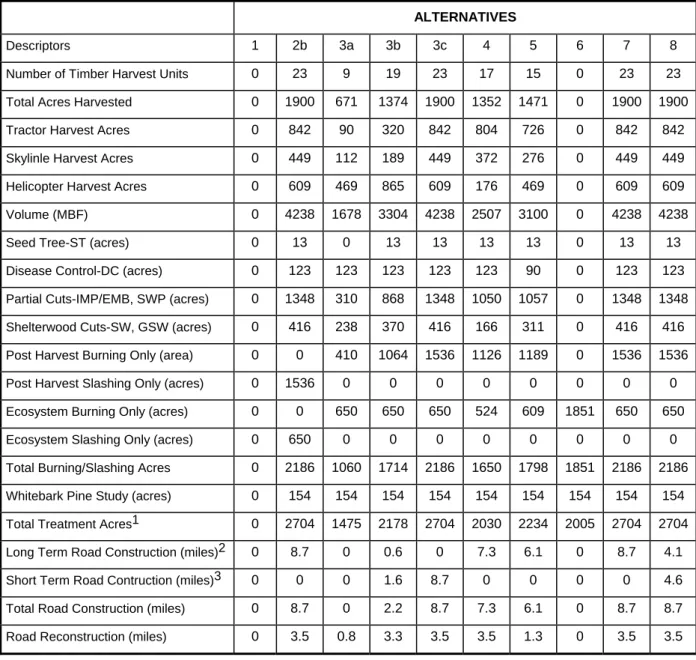
A CASE STUDY: THE NORTHSIDE ANALYSIS AREA
All of these decisions have significant implications for the costs and benefits of timber sales. A present value analysis is therefore required to assess the long-term financial consequences of the timber sale.
TIMBER SALE APPRAISALS AND AUCTIONS
This is especially critical in areas where the number of bidders is small, limiting competition for timber sales. Here, the minimum bid ensures that the federal government receives reasonable compensation for the resource.
APPRAISAL METHODS
Without good market information at some point in the production process and reliable cost estimates (which can be expensive to determine), a residual value estimate will not provide useful estimates of stumpage value. These management costs are not included in the determination of stumpage value using the residual value method.
TIMBER AUCTIONS
In a sealed bid auction, each buyer will submit a bid to the government for the public timber. That is, as long as there are two or more bidders (who do not collude), then the price will rise throughout the auction until it reaches the point where it is priced equal to its marginal benefit to the buyer (i.e. the competitive price is obtained ) ).
MONITORING