The views expressed in the Global Migration Research Paper Series are those of the author and do not represent the views of the Graduate Institute of International and Development Studies. In the presence of consumption patterns that may be considered salient, what role do perceptions of relative deprivation (if any) play among households as a driver of emigration. I use the relative deprivation variable defined by Stark and Taylor and the Yitzhaki index in the empirical analysis.
Context; Kerala and International Migration
Conspicuous Consumption
The tendency to enhance status and imitate consumption patterns for upward social mobility is a result of susceptibility to interpersonal influence, which has been defined as a construct that binds an individual to a desire to please significant others. This susceptibility exists among consumers in new and less developed contexts where extended family structures exist (Childers and Rao 1992). If an individual or household from such a context comes to possess significant purchasing power, consumption of goods that confer status and enable upward social mobility are low-hanging fruits after basic needs have been met.
Relative Deprivation and Migration
This leads to attempts to bridge structural differences through consumption, which can also be seen at the macroeconomic level, where demonstration effects drive less developed nations to imitate the consumption patterns of advanced ones (Ger and Belk 1996).
Keeping up with the Joneses in Kerala
Bhandari (2004) found a significant effect of relative deprivation on the propensity to migrate using the size of land holdings as a proxy. Aspirational states that have experienced a democratization of access to resources and the emergence of middle-income groups are prone to poverty traps. This discrepancy or discrepancy is central to the theory of relative deprivation, as the influence of visible others is persistent on the aspirational psyche.
Data Source
Considering the positive relationship between aspirations and education levels that Kerala has, the latter being a social indicator that Kerala leads among Indian states, feelings of dissatisfaction are exacerbated by perceptions of relative deprivation due to conspicuous consumption in exposure, neighborhood, cities and among the various social groups that necessarily characterize the Indian psyche. The democratization of access to resources through industrialization and technological advancement has empowered aspiring middle-income groups and rewarded them with increased financial mobility across India (Mai and Tambyah 2011). However, Malayali youth, as the qualitative analysis shows, tend to value the economic mobility offered by immigration.
Quantifying Relative Deprivation
To this extent, each family i belonging to a social group r is identified with the economic well-being of the whole group, in this case religion. The welfare of the group is represented (representative) by the annual consumption of kr households and compared to the average consumption levels of all the wealthiest social groups within the same social reference category as in Czaika (2012). The modified Yitzhaki index uses the log of income instead of nominal income to capture relative deprivation as an increasing function of yj and a decreasing function of yi, and concave with respect to yj, such that an expenditure transfer of consumption by a rich person to a poorer person who both have more income than person i will increase the relative deprivation of person i (Eibner and Evans 2005; Lee, 2012).
Constructing the 2011-2016 panel
Thus, the propensity to migrate of an individual is a function of general aspirations, which are motivated by the deprivation felt individually as a unit, collectively across different reference groups, as a result of a combination of the two and fundamentally, as a function of absolute deprivation. The second approach is based on a more popular literature and uses the Yitzhaki index as a measure of relative deprivation. In addition to the cross-sectional analysis, I use the same Yitzhaki index as explanatory variable(s) on the 2011-2016 panel.
Identification strategy
For the first approximation, which is based solely on the cross section of the 2016 KMS, I calculate 2 measures of IRD (IRD state, IRD religion), 1 measure of GRD (GRD religion) and 1 measure of MRD (MRD religion and state) . I also include a dummy for the type of fuel used at home and the quality of the home. For the good house dummy, there is a scale of 1-5 included in the survey instrument to be completed by the field researcher.
For the household items that are generally luxury goods and are the centerpiece of what is conspicuous consumption, I generate asset indices using the eigenvalues of principal component analysis. For approach two, which is based on the cross-section of KMS 2016 and on the panel, I generated 4 measurements of the Yitzhaki index for the former and 5 measurements for the latter. For the panel dataset, I generated Yitzhaki indices for individual consumer spending quartiles, while also distributing the data based on consumer spending quartiles over total households as a robustness check.
For the cross-sectional analysis, I used the same dependent variable as in the previous approach, with different specifications. In this I have included household size, consumer spending, a nationwide household administrative classification dummy and a Rashtriya Swasthya Bima Yojana (RSBY) insurance dummy, which provides free social security schemes and health insurance to eligible families (India, 2012). For the panel dataset, the dependent variable is a binary variable equal to one if a household in the 2011 survey with no emigrants had at least one emigrant during the 2016 survey.
As a robustness check, the data were trimmed into the consumption expenditure quartiles in specifications 6–9, while the Yitzhakis generated for the entire state were retained to run the model.
IRD, GRD and, MRD
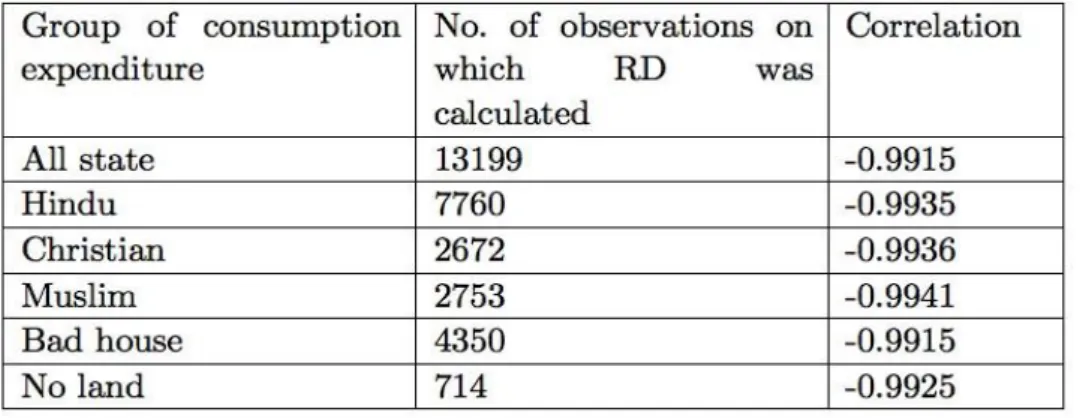
Yitzhaki and modified Yitzhaki (see Table 4)
For the reference group of all households in Kerala, the Yitzhaki index had a negative sign. When the Yitzhaki index was calculated separately for each consumption quarter, there were no significant effects in any of the models for the explanatory variable, except for a reducing effect of migration for households in the top 25 countries. When the original Yitzhaki index was calculated across the country divided into consumption level quartiles, a positive and significant effect was observed for the 25-50% consumption quartile.
It is also possible to evict a member with several brothers and sisters, because there are other members who take care of the household. Conditional logistic regression yields a negative sign for the Yitzhaki index across the country (see Table 7). It could not be performed on consumption quartiles or religious groups because reducing the size of observations and limiting the variance in the dependent variable prevents the logistic function from reaching convergence.
The panel structure was useful insofar as it provided the dependent variable required for Tables 6 and 7. However, there is insufficient time variation in Yitzhaki for the panel to be truly appropriate. In the last decade there have been stories going around a country where you end up getting rich if you somehow.
Data Source
Design
Finally, this method of identification of subjects also guaranteed informed consent, adhering to the Graduate Institute Research Ethics Guidelines where the same was obtained orally to avoid counterproductive results arising from the loss of trust associated with signed documents for unique interactions such as these interviews . In contrast to 'focused interviews' with a pre-defined problem statement, the method used was of 'elite interviews' as in Dexter (2006) where I was willing, and often eager, to let the interviewer teach me what the problem, the question, the situation. This relaxed the interviewees from the preconceived notions formed around their first interaction with a stranger like myself and the stimulus that is my own positionality as interviewer and researcher; the ways in which my values and subjectivity are part of the construction of knowledge.
To avoid potential biases inherent in elite interviews, Lilleker (2003) cautions interviewers of elites to tiptoe carefully around the question of inclusion, respectfully ask how much time the interviewee can spare, listen attentively, and use flattering phrases when the interview brought back to the question at hand. In the appendix, I attach instead a spreadsheet with socio-demographic and religious characteristics, with y/n questions answered by all 15 respondents (see table D). Each interview follows a certain sequence of thematic questions, although the paradigm that ensured better answers, as mentioned earlier, was allowed as long as the following themes were covered.
According to your estimate, what percentage of people in the age group of 21-29 years from Kerala want to migrate. It allows for progression that is specific but with the ability to answer questions in detail and 10. I begin each interview by telling the interviewee that I am interested in what motivates their desire to relocate.
Only in questions 9 and 10 do I partially give up and reveal the main ideas in the research, both through the questions and through my final admission at the end of the interview.
Mixed Analysis of the Predeparture Module, the Interviews and Popular Culture 22
In the film Akkare Ninnoru Maran (A Groom from Elsewhere, 1985), the male lead fakes a job in the Gulf and arranges for a fake Arab to come to Kerala to impress his uncle in order to win his daughter's hand, which the father had decided would only marry a Gulf karan (an emigrant). 34;Chinese ethnic identification and conspicuous consumption: Are there moderators or mediators of the effect of acculturation dimensions?." Journal of International Consumer Marketing 17, no. 34;The influence of familial and peer-based reference groups on consumer decisions." Journal of consumer research 19, no.
34; A Study of the Role of Materialism and Interpersonal Influence in Inducing Conspicuous Consumption among Kerala Expatriates." Rajagiri Management Journal 10, No. 34; Income and Well-Being: An Empirical Analysis of the Income Comparison Effect." Journal of Public Economics 89, no. 34; Car proliferation in Indian cities: Don't copy the West.” Policy Brief: The Energy and Resources Institute (TERI) (2014).
34; 'Mind the gap!'Integrating approaches to internal and international migration." Journal of Ethnic and Migration Studies 36, no. 34; Fiction of development: Literary representation as a source of authoritative knowledge." Journal of Development Studies 44, no. 34; Absence of Selection Bias in a Snowball Sampling Case-Control Study of Drug Abuse." International Journal of Epidemiology 25, no.
34; Antecedents and Consequences of Status Consumption among Vietnamese Urban Consumers." Organizations and Markets in Developing Economies 2, No. 34; Contemporary Theories of International Migration." Worlds in Motion Understanding International Migration at the End of the Millennium. 34; Asian Migration in the Arab World: Migration from Kerala (India).” Trivandrum: Center for Development Studies (1986).