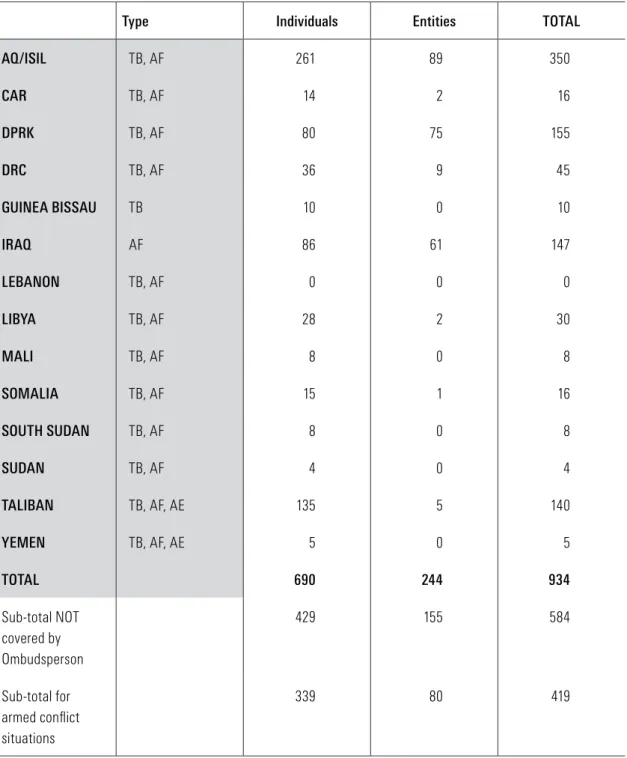
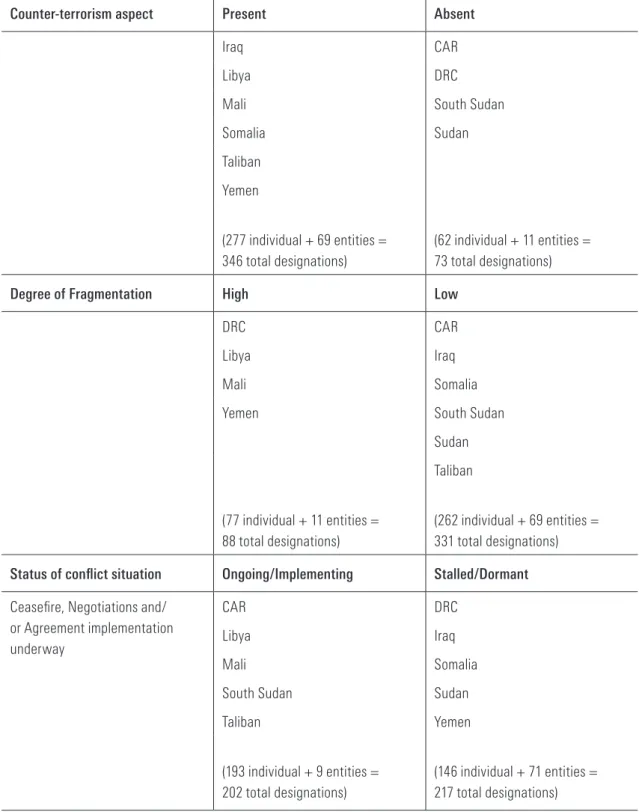
Of the 934 individuals and entities currently designated by the Security Council for sanctions, the majority (584) do not have access to the Office of the Ombudsman. The Democratic Republic of the Congo (DRC) is recommended as a suitable first example for the development of a new review mechanism that could be extended to other, similar situations of armed conflict without the presence of groups involved in acts of global terrorism. rorism (such as Central African Republic, South Sudan and Sudan). Two-thirds of the current UN sanctions regimes involve armed conflicts and represent the largest number of individual designations.
Of the regimes not covered by the Office of the Ombudsperson, two have only one type of individual sanction (Guinea-Bissau with only one travel ban and Iraq with only one asset freeze), while two regimes have three types of individual restrictions authorized (Taliban and Yemen have travel bans, asset freezes and individual arms embargoes). All other sanctions regimes have authorized individual travel bans and asset freezes (CAR, DPRK, DRC, Lebanon, Libya, Mali, Somalia, South Sudan and Sudan). A total of 429 individuals are subject to individual sanctions in sanctions regimes that are not covered by the mandate of the Office of the Ombudsperson.
See Table 1 for details of the total number of listings by the UN Security Council. There is considerable variation between the contexts of armed conflict sanctions regimes beyond their geographic locations.
Counter-terrorism and armed conflict sanctions regimes
The political context is (armed) conflict or civil strife/unrest, and sanctions are usually used as a political lever for political reconciliation/resolution of the conflict. Situations of armed conflict usually involve several phases, from negotiating a ceasefire to reaching a negotiated settlement, maintaining compliance with the agreement, peace-building activities and finally political reconciliation. The targets are usually politico-military actors determined to limit their activity or persuade them to participate in and/or implement a negotiated agreement with a broader interest in political reconciliation or conflict resolution.
Listings in an armed conflict regime are generally based on recommendations by panels/groups of experts, information from (UN) field offices and experts, special envoys, SRSGs, members of the sanctions committees, NGOs operating in the regions, as well as other public or public sources. The procedure should be adapted to facilitate the interaction of the assessor(s) with relevant information providers, including national authorities, in-country witnesses, panels/groups of experts, ICC investigators, UN peacekeeping bodies, relevant agencies at the UN Secretariat , member states, non-governmental organizations and journalists.
Core functions of a review mechanism and overview of two options
It is therefore important that the review mechanism that will be proposed for the sanctions regime in the DRC provides proper procedural protection comparable to that currently offered by the Office of the Ombudsperson. Unlike the Office of the Ombudsman, this is expected to entail a close working relationship with the relevant panel/group of experts, the country's political offices and the UN Secretariat in New York. While it is desirable to extend the Ombudsman's mandate to the other Sanctions Committees, it has proved difficult to extend the Ombudsman's mandate to the other Sanctions Committees.
The independent reviewer could be located in the Ombudsman's office to avoid institutional fragmentation and increase cost-effectiveness and efficiency. The purpose of the review is not to dispute the correctness of the construction decision. The political discretion of the UN Security Council and its subsidiary bodies, the sanctions committees, is respected.
Instead, an independent evaluator or group of independent evaluators will ensure the accuracy of the information on the basis of which the individual/legal entity was originally listed. Given that the objectives of the Office of the Ombudsman and the proposed independent evaluator or group of evaluators are fundamentally the same – to ensure a fair process for certain individuals and entities – there are many similarities between the two. Ideally, the profile of an independent evaluator would be someone with judicial and field experience.
The process of an independent assessor or group of independent assessors would differ in that the work would involve close coordination with the relevant panels/groups of experts, including access to their confidential material. While the anti-terrorism context of the ombudsman is closer to a review of criminal law, the proposed independent reviewer or group of independent reviewers would deal with a more fluid conflict context, engaging in dialogue, with the aim not to exclude, but potentially to include and coordinate with mandate holders. The set-up of an independent evaluator or panel of independent evaluators could be more flexible, as most committees/groups of experts work from home and are spread around the world.
While there are necessarily many similarities between the Office of the Ombudsman and the proposed Independent Reviewer or Panel of Independent Reviewers, the overview below summarizes the main differences between the two.
Independent Reviewer or Panel of Independent Reviewers for the DRC sanctions regime
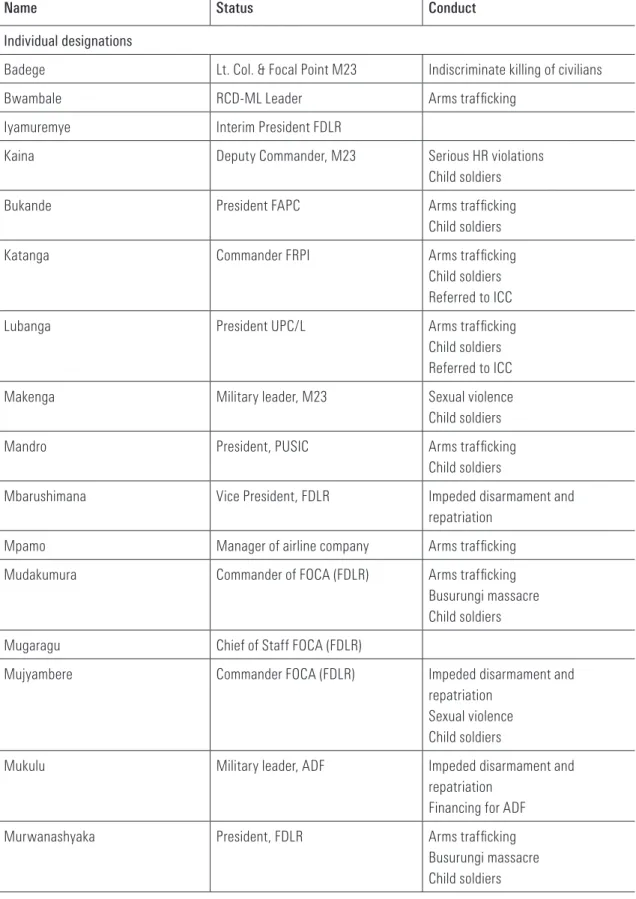
As indicated in Table 3, the distinction between status versus behavior does not clearly apply to the overwhelming number of individual designations in the DRC case. While there are two status-based designations, the other 34 individual designations cite specific conduct in the case presentations—most commonly violations of the arms embargo, obstruction of disarmament and repatriation, and use of child soldiers. Almost all the designated individuals are affiliated with non-state armed groups (M23, FDLR, FAPC, FRPI, UPC/L, PUSIC, FNI, NDC, RCD-G and ADF).
So many different groups are involved because of the fragmentation of some groups and the change of others over the fifteen-year course of the conflict since the UN began imposing targeted sanctions. Two sanctioned individuals have been associated with the Federal Army of the DRC (FARDC). Members of the Secretariat met two of them (and their lawyers) during a trip with the chairman of the Sanctions Committee of 1533 in the Great Lakes region in 2015.25 They argued that they had taken corrective action after they unconsciously noticed that they had ignored the sanctions. did not comply.
The UN Sanctions Committee website has lengthy descriptions of the behaviors for which the three groups are listed. Given the amount of information pertaining specifically to conduct in the DRC conflict, there seems to be a lot for an independent reviewer or panel of independent reviewers to review in takedown cases. 26 We note that the composition of the expert group has changed since the time of this report and that neither the original nor later members of the group have been approached for their assessment of the current situation.
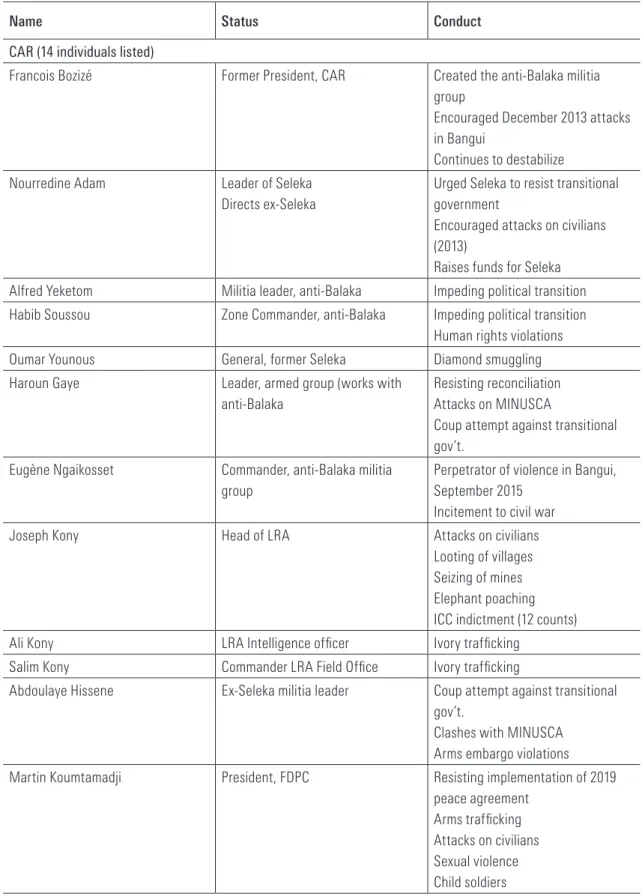
Although the proposed review mechanism relates specifically to the DRC, the functions of the same mechanism could perhaps be extended to three other relatively similar cases of armed conflict that also do not have a strong counter-terrorism dimension: the Central African Republic, South Sudan and Sudan. In all of the individual designations in the three additional cases, the designations are based on both status and conduct. Labels based on conduct in Sudan are more varied and unique to each of the four listed individuals: violations of the arms embargo, attacks on civilians, ceasefire violations and abductions of AU personnel.
As in the case of the DRC, the amount of information publicly available on the individuals and entities designated in the other three armed conflict cases, without a counter-terrorism dimension, appears to provide a significant amount of information to a review mechanism. investigation in cases of delisting requests.
Draft annex for a future UN Security Council Resolution
After the completion of the information gathering period, the independent reviewer will facilitate a two-month engagement period, which must include a dialogue with the petitioner. The independent evaluator may reduce this time period if he deems that less time is needed. Summarize and, if applicable, provide the sources of any information available to the independent reviewer that is relevant to the deletion request.
The draft report must respect confidential elements of the Member States' communication with the independent reviewer. Describe the independent reviewer's activities with respect to this delisting request, including dialogue with the petitioner; and. Based on an analysis of all the information available to the independent reviewer and the independent reviewer's recommendation, the main arguments regarding the delisting request shall be presented to the Committee.
The recommendation should state the independent reviewer's views regarding the listing at the time of the review of the delisting request. After the committee has completed its consideration of the comprehensive report, the independent reviewer may notify all relevant states of the recommendation. The committee reviews the summary within 30 days of the decision to retain or terminate the listing and conveys its views on the summary to the independent reviewer.
The summary must accurately describe the main reasons for the recommendation of the independent reviewer, as reflected in the analysis of the independent reviewer. In its communication with the petitioner, the independent reviewer will specify that the summary of the analysis does not reflect the views of the committee or any of its members. In cases where the record is retained, the summary of analysis must cover all arguments for delisting by the petitioner to which the independent reviewer responded.
In case of removal from the list, the summary contains the main points of the independent reviewer's analysis. Transmits from the Committee all information about the decision to the independent reviewer pursuant to paragraph 18 of this Annex. Submit semi-annual reports summarizing the activities of, and any challenges faced by the independent reviewer, to the Security Council.