The data presented in this work are the results of the research activity of Mgr. I also want to thank Honza Mach, who taught me most of the methods in the lab that I know now and who never said no when I asked him for advice. One of these mechanisms is the ability to adjust mitochondrial metabolism to maintain whole cell viability.
Second, we elucidated the mode of action of the mitochondrially targeted anticancer drug MitoTam in the bloodstream form of Trypanosoma brucei.
Mitochondrion: the powerhouse of the cell
Electron transport chain
- Complex I and the alternative NADH dehydrogenase
- Complex II
- Complex III
- Complex IV and alternative oxidase
- F o F 1 ATPase (complex V)
The main source of ROS in the cell is electron leakage in the ETC, and the other is NADPH oxidase (Zhao et al., 2019). AOX is a small (~36 kDa) monotopic protein localized to the matrix side of the inner mitochondrial membrane, which belongs to a subfamily of di-iron proteins, including e.g. fatty acid desaturases, rubrerythrin and monooxygenases (Moore et al., 2013). ATP synthase couples the conversion of ADP and Pi to ATP with the electrochemical potential generated by the difference in proton concert across the IMM (Capaldi et al., 1994).
It is an antibiotic oligopeptide found in Streptomyces that binds to a 25 kDa polypeptide in the Fo part of the rotary motor system, preventing the pumping of protons into the mitochondrial matrix (Lee and O'Brien, 2010; Shchepina et al., 2002).
Other functions of mitochondria in the energy metabolism of the cell
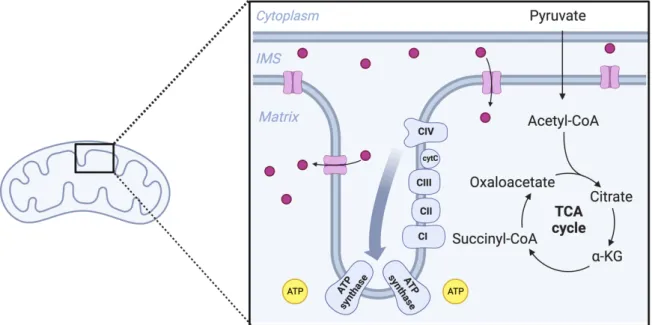
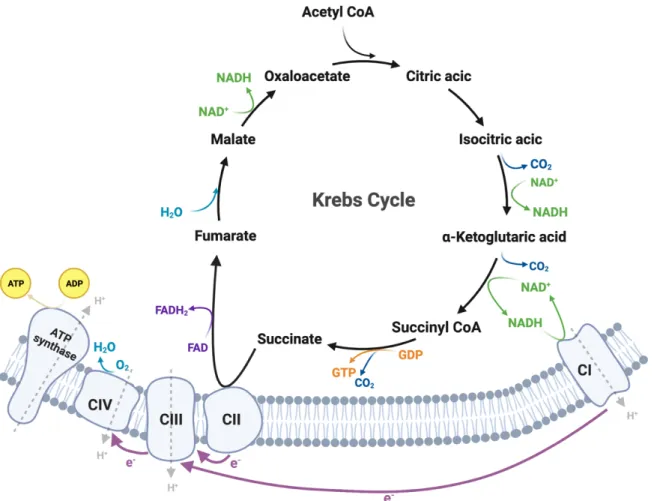
Schematic of the arrangement of the plant ETC with cofactors and prosthetic groups, according to (Vanlerberghe, 2013). NADH is oxidized by complex I, and this process is coupled to proton translocation from the mitochondrial matrix to the intermembrane space. This is followed by seven enzymatic reactions that result in the conversion of citrate back to oxaloacetate, which continues the cycle, and two molecules of carbon dioxide. For example, mitochondrial calcium uptake or release is a sensor mechanism for regulating OXPHOS, and key regulators of the Krebs cycle, such as pyruvate dehydrogenase, isocitrate dehydrogenase, and 2-oxoglutarate, are activated by certain levels of calcium in the mitochondrial matrix (Ivannikov and Macleod, et al., 2004).
Schematic of the Krebs cycle localized in the mitochondrial matrix, which produces the reducing equivalents of NADH, GTP, and FADH2, which are required in the ETC for ATP synthesis and generation of the mitochondrial membrane potential.
Mitochondria-targeted drugs as a therapeutic strategy
Indeed, tumor cells lacking mitochondrial DNA have been shown to exhibit lower tumorigenesis potential and slower overall tumor growth (Cavalli LR, 1997; Magda et al., 2008; Morais et al., 1994). Due to mΔψ, the lipophilic cations accumulate in the mitochondrial matrix against a concentration gradient (Smith et al. The accumulation of singly charged cations is governed by the Nernst equation, which states that for every 61.5 mV, there is a tenfold accumulation at 37 °C, after which the concentration of these only 1000 million higher than in the extracellular environment (Ross et al., 2008a; Zielonka et al., 2 017).
TPP+-based compounds have also been extensively studied in vivo (Rodriguez-Cuenca et al., 2010a; Smith et al., 2003) and it was shown that in only 5 min after intravenous administration, the compound can be completely absorbed by mitochondria into tissues (Ross et al., 2003).
The importance of iron and copper in mitochondrial processes
Iron
- The role of iron in mitochondria
One of the oldest cofactors is Fe-S clusters, which are essential for the function of more than 100 proteins involved in many cellular processes, including DNA replication, translation and respiration (Johnson et al., 2005). Interestingly, the alternative NDH2, which replaces or bypasses the function of complex I in several plant or fungal organisms, lacks Fe-S clusters (Friedrich et al., 1995; Yagi, 1991). The last and rather unusual type, commonly known as a "Rieske type" [2Fe-2S] cluster is found in the Q cycle of complex III, where one of two iron atoms is coordinated by two histidines and two cysteine residues (Iwata et al., 1996).
An alternative and more complex pathway, found in bacteria or plastid-containing eukaryotes, consists of two intermediate steps before ALA formation involving glutamyl-tRNA synthetase, glutamyl-tRNA reductase, and glutamate-1-semialdehyde 2,1-aminomutase with the L-glutamate amino acid as a substrate (Brzezowski et al., 2015; Panek and O'Brian, 2002).
Copper
- The role of copper in mitochondria
- Copper acquisition and its homeostasis
Cu, Zn SOD is predominantly localized in the cytosol, but 5-10% is found in the mitochondria together with the Mn SOD enzyme, where it plays a key role in controlling ROS levels in the mitochondrial intermembrane space (Fukai and Ushio-Fukai, 2011; Zelko et al., 2002). Homologs of these proteins have been identified in the organisms studied in our laboratory, non-pathogenic Naegleria gruberi and pathogenic Naegleria fowleri (Ženíšková et al., 2022). Finally, the ATX1 chaperone is described to transport copper to the copper transport protein CCC2, a highly conserved P-type ATPase localized in the Golgi apparatus.
Due to the potential toxicity of copper in the intracellular space, free copper is virtually absent in the cell.
Nutritional immunity: the battle for nutrient metals at the host-pathogen interface
Another strategy is the acquisition of heme using specific heme receptors or hemophores, proteins that complex extracellular heme and are functionally similar to siderophores (Cescau et al., 2007; . Fabian et al., 2009). The release of iron from the tetrapyrrole ring inside the cell occurs due to the activity of heme oxygenase (Kim et al., 2006; Sutak et al., 2008). First, the entire protein is first transported to the lysosome, where it is digested, and the released iron is then transported to the cytosol (Kariuki et al., 2019).
The first step of this mechanism involves ferric reductases at the plasma membrane, which can reduce a wide variety of Fe 3+ sources (Askwith et al., 1994; Lesuisse and Labbe, 1994).
Naegleria spp
Naegleria metabolism
Although the amoeba is thought to be completely aerobic, features common to anaerobic organisms have been identified in its genome leading to a possible ability to alternate between aerobic and anaerobic metabolism (Fritz-Laylin et al., 2010; Opperdoes et al., 2011). All four proteins were predicted to have N-terminal mitochondrial targeting signals, however, data presented by Tsaousis et al. However, other protists such as Entamoeba histolytica, Giardia intestinalis and Trichomonas vaginalis, also possess cytosol-localized hydrogenase (Lloyd et al., 2002; Nixon et al., 2003; Smutná et al., 2022).
Naegleria also has parts of a branched ETC, such as AOX and NDH2 (Fritz-Laylin et al., which explains the fact that respiration (oxygen consumption) is not completely inhibited by the addition of KCN (Cantoni et al., 2022; Weik and John, 1979).

Trypanosoma brucei
Life cycle
Trypanosome mitochondria and their metabolic reprogramming
While the host's immune system begins to produce antibodies against one variant of VSG, trypanosomes switch VSG expression to a different form and create a new layer of VSG (Mugnier et al., 2016). Because the ETC complexes that normally translocate protons and contribute to the formation of the proton gradient are not present in this form, the mΔψ necessary for protein translocation and substrate transport is generated by ATP hydrolysis (Schnaufer et al., 2005). To study the effect of mitochondrially targeted Tamoxifen (MitoTam) on the mitochondria of the bloodstream form of Trypanosoma brucei.
Mitochondria are often called the powerhouse of the cell because they are the main site of key energy metabolism processes in aerobic eukaryotic organisms.
Metabolic adaptation of Naegleria fowleri mitochondria to low iron and copper
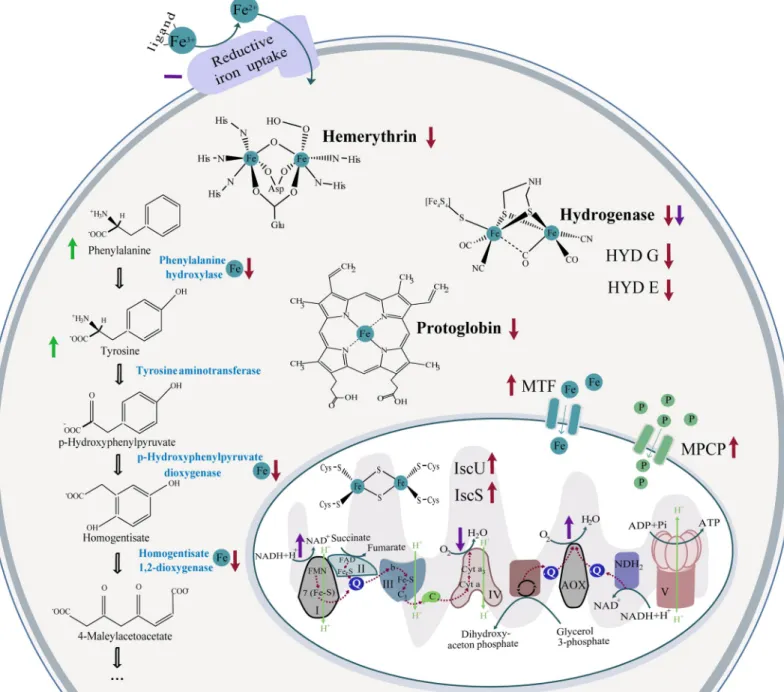
Any disruption of mitochondrial processes or mitochondrial integrity by various stress factors can cause programmed cell death. Not surprisingly, mitochondria are one of the most studied organelles, and the development of mitochondria-targeted drugs is a major goal for scientists and pharmaceutical companies. In the iron-focused project, we observed an interesting trend of down-regulation of non-essential iron-containing proteins localized in the cytosol, but at the same time proteins involved in mitochondrial Fe-S cluster assembly processes were up-regulated, probably to maintain ETC.
Our measurements show a strong reduction of hydrogenase activity under low iron conditions in its pathogenic relative, suggesting that it does not play a major role in its metabolism. On the other hand, complex I, which is the main electron input to the ETC, was upregulated. In addition, we showed that AOX activity is also significantly affected by low iron availability, balancing the reduced activity of the more iron-demanding complex IV during iron deficiency.
A similar trend was also observed in our previous work on the non-pathogenic relative Naegleria gruberi (Mach et al., 2018). This project is built on the knowledge gained during my Masters studies when I studied the effect of low copper conditions on the metabolism of the non-pathogenic amoeba N. The comparative proteomic analysis showed changes at the protein level in cells pre-incubated with copper excess and two copper chelators: the extracellular copper chelator the lipophilic (lipoproiensdi) and i.
However, the expression of another component of the branched respiratory chain of this pathogen reflects this limiting condition. Proteomic analysis revealed massive upregulation of rotenone-insensitive NDH2 in the neocuproine-induced low-copper condition.
Elucidation of the effect of MitoTam on Trypanosoma brucei mitochondria
Oxidative phosphorylation is required to enhance motility and development of the sleeping sickness parasite Trypanosoma brucei in the Tsetse Fly Vector. Revisiting the central metabolism of bloodstream forms of Trypanosoma brucei: Production of acetate in the mitochondrion is essential for parasite viability. These findings revealed a possible exploitable weakness in the amoeba's survival strategy in the host.
Considering the involvement of the reduction step necessary for the acquisition of N.fowleriiron, the activity of a ferric reductase was assessed in cells preincubated under iron-rich and iron-deficient conditions. The increase in the expression of mitoferrin was below our established threshold, but the results from the comparative analysis of. While hydrogenase was significantly downregulated, complex I was significantly upregulated as a result of iron deficiency conditions.
The compounds inhibited the growth of the cultures to different extents compared to the growth under iron-rich conditions (Table 2 and S2(A) Fig). Label-free proteomic analysis of the samples was assessed using the method described in Mach et al.2018[34], using liquid chromatography coupled with mass spectrometry. The proteins were determined from whole cell extracts of N.fowleri which had previously been grown for 72 hours under iron-deficient conditions (25μM BPS) or iron-rich conditions (25μM Fe-NTA) and further incubated with 55Fe(II) (ferrous ascorbate) and 55Fe(III) (ferric citrate-inferrin-afrin-, 55Fe(II)-ascorbate- and 55Fe(III) (Berri- citrate-inferrin-afrin.cultivated under iron-rich and iron-deficient conditions.The uptake of transferrin-bound iron was assessed by PLOS INFERIOR TROPICAL DISEASES Iron Metabolism in Naegleria fowleri.
The graphs show the cytostatic effect of selected concentrations of the iron chelators compared to the effect of iron-rich culture conditions. One of the selected Ctrs from each amoeba (NgCTR1, NAEGRDRAFT_61759 and NfCTR1, NF0078940) restored copper transporter function in the yeast mutant and showed typical localization to the yeast plasma membrane (Figure 1A and Figure 1B). Our proteomic analysis indicated a rearrangement of the mitochondrial electron transport chain in both amoebae under copper starvation.
To assess statistical confidence, Student's t test was used (* indicates apvalue≤0.05). (B) Enzyme activity of NfNDH2 increases under low copper conditions.