Social Stratification and Its Perception in Austria and Central-East Europe from 1960 to 2015:
Historical Legacies, Socialist Pasts and Recent Developments
MAx HALLER and MARkuS HADLER*
University of Graz
Abstract: This article compares Austria with three of its former state-socialist neighbouring countries: the Czech Republic, Slovakia, and Hungary. The au- thors are guided by the assumption that it is necessary to analyse changes in both the structure and the perception of inequality and that the two are interconnected. They assume that some general differences exist as a result of the legacy of state socialism in the three post-communist countries, but also that significant differences exist between those three countries themselves that stem from their different paths of development in the 19th and early 20th cen- turies. In the first part of this article, differences in the societal-political aims of a Western country such as Austria and those of state-socialist countries are discussed. The authors argue that the state-socialist countries were able to contain income inequality but were less successful at limiting other aspects of inequality. Austria, on the other hand, was able to avoid the severe income in- equalities of the capitalist system by introducing democratic-corporatist insti- tutions and a strong welfare state. In the second part of the article the authors investigate the subjective perception of inequality based on the ISSP inequality surveys. The majority of the population in all four countries think that income differences are too large, but there are significant differences in how people perceive and evaluate the stratification structure: in Austria, individuals rank themselves significantly higher than do people in the other three countries and see their society as dominated by the middle classes. The opposite is true in Hungary, where most people think that they live in a society characterised by a small elite, and they see the mass of the people at the bottom.
keywords: social stratification, inequality, Austria, state socialism, perception of inequality
Sociologický časopis/Czech Sociological Review, 2019, Vol . 55, No . 6: 697–733 https://doi .org/10 .13060/00380288 .2020 .55 .6 .490
* Direct all correspondence to: Max Haller, Institute of Sociology, University of Graz, e-mail: [email protected]; Markus Hadler, Department of Sociology, University of Graz, e-mail: [email protected].
Introduction
Differences between the four neighbouring countries of Austria, the Czech Re- public, Hungary, and the Slovak Republic in terms of stratification and inequality are frequently explained by the experience of state socialism in the latter. This view is not surprising considering the post-war developments in the Central- East European Countries (CEEC). Since 1945 Austria has been through a dynamic and continuous process of development that vaulted it from a position below the West European average to one of the five richest countries in the European Un- ion; during this period, its eastern1 neighbouring countries were lagging behind or even falling back significantly [Therborn 1995]. The transition to a capitalist economic and democratic system in the three latter countries in the early 1990s and their accession to the EU in 2004 ushered these countries also onto a path of strong economic growth. Many observers thus assumed that the differences be- tween the four countries would soon diminish. Yet, it is evident that such a view is too simplistic because it ignores many historical developments and legacies, as we will show in this article.
Our overarching sociological perspective is that both objective social struc- tures and subjective perceptions of inequality need to be analysed. It has to be appreciated that recently many economists [e.g. Milanovic 2005; Stiglitz 2013;
Piketty 2014] have analysed the structural trends in inequality and pointed to the disruptive effects of increasing inequality. However, objective structures of ine- quality can be perceived and evaluated by a population quite differently, depend- ing on the dynamics of economic growth, the societal and political ideologies prevailing in a society, and the position of a person in the social structure. These factors constitute the dominant view or consciousness about the class structure [Ossowski 1963]. In line with this basic assumption, we first offer an overview of the historical and current political, social, and economic developments in these four countries and subsequently an analysis of the subjective perceptions of in- equality and social structures.
The discussion of objective structures and subjective perceptions is guided by three general hypotheses: First, we assume that a main difference between the four countries will derive from the socialist past of three of them. The embedding of Austria in the Western political-economic system, with its higher level of com- petitiveness and innovation, its strong collective representations of capital and labour, and its democratic, consensually oriented political institutions, has led to more dynamic and consistent socio-economic transformations and more sustain- able improvements in the life conditions of the population. In the former state- socialist countries, the full mobilisation of human resources, including women, led to rapid industrialisation. But, central planning and an increasing shortage of
1 ‘Eastern Europe’ refers to the former socialist regimes. In a geographical sense, Prague is further west than Vienna.
consumer goods may have led to stress and a reduced quality of life for many so- cial groups. The collectivisation of agriculture, the abolishment of private proper- ty, and the focus on heavy industry resulted in faster growth of the working class in Czechoslovakia and Hungary than in Austria, where the petty bourgeoisie and employees in services were the segments of the population that were increasing in size. Because of the strong position of working-class organisations in Austria (unions and the Social Democratic Party), the increase in inequality has remained rather low. The resulting differences between Austria and its three neighbouring countries in Central-Eastern Europe have not been equalised in the two and a half decades since their transition from a socialist to a capitalist system given the tenacity of social structures and processes.
Second, we consider differences and similarities among the former state- socialist countries, which are often seen as a more or less homogeneous group.
The internal differences and the differences to Austria derive from the countries’
specific historical heritages and developments. A comparison of these three coun- tries showed that specific national factors, alongside the differences between the two political systems, were significant in explaining differences in patterns of so- cial mobility [Haller, Kolosi and Robert 1990]. Hungary has a stronger heritage of inequality than the Czech Republic; therefore, we assume that objective levels of inequality (there) were higher until the mid-20th century, and four decades of the communist regime were unable to level these differences. For this reason, we ex- pect that Hungary is still more unequal than the Czech Republic. Slovakia, which was a part of Hungary for centuries, might be in this regard figure somewhere between the Czech Republic and Hungary. Further, while all three countries be- came members of the EU in 2000, the Czech Republic was the least enthusiastic, and, like Hungary, it is still not a member of the Euro group. The Slovak Republic and Hungary were much more open to international connections, and this was especially true in Slovakia, where investments from Western firms contributed massively to its economic growth. In sum, we hypothesise that these develop- ments shaped the influence of state socialism after 1989 and resulted in differ- ences both in the social structures and perceptions across our four countries.
Third, we propose that these specific historical backgrounds also shape cur- rent subjective views on inequality. Comparing the standard of living in Central- East European countries to that in neighbouring Western European countries (Austria and Germany in particular) is highly informative for understanding subjective perceptions of the social structure and for evaluating social inequal- ity. These comparisons are fostered by the intense processes of labour mobility between these countries and Austria in recent times [Haller and Verwiebe 2016].
We expect, therefore, that the subjective images of class structure and social in- equalitywill differ more between the four countries than the objective levels of inequality do; people in the former state-socialist countries will probably have a more critical view of the social structure and inequality.
In the next section, we discuss some of the main differences in the goals and strategies of state-socialist societies concerning social equality compared to Aus- tria’s system of a ‘social partnership’. This part is followed by a discussion of the socio-economic development and social-structural changes in the four countries since World War II. In the fourth section, we present findings on changes in the perceptions of inequality based on ISSP-surveys on inequality carried out in 1987, 1992, 1999, and 2009. The conclusion ties together our findings and discussions on objective structures and subjective perceptions.
Two roads: state socialism vs corporatist ‘social partnership’
State socialism in East Europe is highly relevant from a sociological and a politi- cal perspective, as it can be considered to have represented a big experiment in redistribution and ‘destratification’ [Lenski 1978; Szelenyi 1998; Večerník 2009:
122]. The central aims and political measures of state socialism (following the So- viet model) can be summarised in five points: (1) the nationalisation of industrial enterprises and the creation of regular five-year-plans to regulate the allocation of funds and resources and establish goals for industrial production and services;
(2) a focus on the development of heavy industry at the expense of consumer goods and services; (3) an effort to utilise all the labour resources in society, in particular the full inclusion of women in gainful work; (4) the expansion of the education system; (5) the extensive provision of social services, particularly for families with children, and the provision of cheap housing. All these aims were justified by the overall goal to generate basic equality among all citizens.
Western social scientists who analysed the changes in state-socialist coun- tries were impressed by their success in achieving rapid industrialisation and deep-reaching social-structural changes [Lane 1971; Parkin 1972; Connor 1979].
But the emergence of a new divide between the Nomenclature elites and the rest of the population was viewed with scepticism—including by political writers in- side the system [e.g. Djilas 1959; Voslensky 1984]. Very few observers, however, foresaw the breakdown of the whole system within a generation. Western ana- lysts seem to have been misled to some degree by descriptions of the system pro- vided by the state-socialist elites themselves [von Beyme 1994: 17], although few would have agreed with the rosy picture of the future of state socialism put forth by Hegedüs [1977]. After 1989/1990, influential Western analysts argued that the main factors responsible for the collapse of communism were the deficiencies associated with central planning. Liberal economists and international institu- tions (IMF, World Bank), therefore, urged a radical and fast transition to capitalist principles in order to avoid counterproductive effects and counter the stubborn resistance of the old elites. It was expected that with the introduction of a market economy post-communist countries would quickly catch up with neighbouring countries such as Austria to the West.
State socialism and equality
It is widely assumed that social equality was the central aim of socialist societies.
A multivariate analysis of the determinants of income inequality in 139 countries has shown that the experience of state socialism did in fact reduce the level of in- equality significantly [Haller and Eder 2015: 106–111; see also Večerník 2009: 73ff].
However, the relevance of equality as a political goal declined over time [Haller and Mach 1984; Nee 1989; Szelenyi 1998; Ivanova 2007]. Also, socialist politics had to reconcile the values of equality and achievement. Therefore, the idea of equality in opportunities and the goal of increasing the educational level of the children of ‘workers’ was a central political focus [Connor 1979]. Correspond- ingly, the expansion of the education system was considered to be very impor- tant, and this included establishing an extended secondary education system in order to enable the ascended members of the cadres to make up for the gaps in their higher education. However, research has shown, particularly in Hungary, that the significant increase in educational opportunities for children from farm and working-class backgrounds was primarily the result of structural changes (the extension of the school system) and was less due to policy measures (like quota systems) [Szelenyi 1998; for the GDR see Geissler 1983; Solga 1995]. The aim of establishing equality was certainly realised with respect to inequalities in officially recognised and published working incomes. The range from the low- est to the highest income was much smaller than in Western countries [Večerník 2009: 83]. Moderate income differences also existed in relation to education and between blue- and white-collar workers. However, by the 1960s and 1970s, critical voices were already being raised by economists and sociologists (Ota Sik, Pavel Machonin) concerning the negative effects that levelling down (Gleichmacherei) has on achievement motivation, economic innovation, and growth [see Connor 1979]. Internal critics [Djilas 1959] and Western social scientists [von Beyme 1975;
Konrad and Szelenyi 1979] pointed to the fact that the main aim of state-socialist systems was the preservation of power and stability in the political sphere and industrialisation and modernisation in the economic sphere. To achieve this aim, all of society’s resources—including the labour power of women—had to be mo- bilised.
The socialist equalisation process was also less successful in terms of overall life chances: non-workers and in particular cadres of all sorts enjoyed many ad- ditional privileges which made their situation much better than that of rank-and- file workers. People in the lower classes, women, and families were left exhausted by long working hours, long waiting times to get scarce goods and services, and constricted living conditions (small apartments).
Consensual politics and the ‘social partnership’ in Austria
‘Capitalist’ Austria was also able to keep economic inequality at a rather moder- ate level. This was due to the implementation of consensual democratic policies and a strong welfare state—like in the other two German-speaking countries Ger- many and Switzerland [Haller, Eder and Müller 2015]. Throughout the four post- war decades the bourgeois Christian-Democratic People’s Party (Österreichische Volkspartei) and the Social Democratic Party were the decisive political forces.
This was connected to the existence of strong collective organisations of workers (unions and chamber of workers) embedded in an effective social partnership (Sozialpartnerschaft) with the representatives of business and capital (chamber of commerce and federation of Austrian industries). This arrangement has been called ‘corporatist tripartism’; it prevailed in similar forms also in other Con- tinental European countries and in Scandinavia [Lehmbruch 1982]. In Austria, this economic-political system ensured low levels of industrial conflict, steady economic growth, and a continuous rise in income paralleling the increase in productivity [Pelinka 1981; Prisching 1996]. Also, all governments (culminating in the period 1970–1983 when social-democratic chancellor Kreisky won the ab- solute majority of votes in the elections of 1971, 1975, and 1979) promoted the substantial expansion of the education system and the welfare state. These devel- opments contributed to an improvement of human capital and an increase of up- ward social mobility [Haller 1982; Altzinger et al. 2013; Leitner and Wroblewski 2019]. In comparative terms, educational and mobility opportunities in Austria were clearly above the OECD average [OECD 2010]. Austria was also able to pre- vent a significant increase in income inequalities, which in many Western coun- tries had begun to occur since the onset of neoliberalism in the mid-1980s. In the 1980s, German newspapers were already expressing admiration for the Austri- ans’ economic success, which had even surpassed the German Wirtschaftswunder.
Austrian national identity and pride increased strongly as a consequence [Haller 1996].
However, it would be too simplistic to ascribe this success mainly to a far- sighted policy or to the particular abilities and industriousness of the Austrians.
An economic historian has rightly remarked that policy decisions in Austria were often reactions to socio-economic changes rather than their causes [Mathis 2007].
A good example is the privatisation of state industry in Upper Austria and Styria (then called VOEST), which went nearly bankrupt in the late 1980s as a result of ineffective management and political interventions (for instance, to prevent worker lay-offs). After privatisation, this industrial conglomerate became a high- ly competitive and successful enterprise (Voest Alpine). The success of Austria was also supported by a number of lucky circumstances, such as its central loca- tion between the thriving South German and North Italian regions; its possession of a diversified landscape and a rich array of historical monuments ensuring both summer and winter tourism; and its inheritance of prosperous towns and cities from the late Middle Ages.2
Social-structural developments: 1960–2015
The above description of state socialism must be supplemented in two ways:
First, we need to depart from considering East-European state-socialist countries as a single block, without acknowledging the differences between them [see also von Beyme 1975: 18; Haller 1990]. Second, we need to overcome the neglect of the historical differences and similarities that existed during the modernisation process that were connected with the effects of the Habsburg Monarchy.3 We will thus outline the deep-reaching social-structural differences that existed between Austria, the Bohemian lands (today the Czech Republic), and Hungary under the Austro-Hungarian Monarchy and, subsequently, present some basic data on socio-economic development and income inequality since 1960.
A differing social-structural and political heritage
At the onset of the industrial modernisation in the 19th and early 20th centuries, the four countries were part of the Habsburg monarchy. The American histo- rian David F. Good [1984] has disproved the formerly widespread thesis that the Habsburg Empire was not able to catch up with the industrialisation and mod- ernisation happening in West Europe in this period. However, there existed sig- nificant differences between the more developed western and the less developed eastern parts of the monarchy. Lower Austria and the Czech lands (Bohemia)4 were comparable to the most prosperous regions in Western Europe, while Hun- gary lagged behind. Inequality was much greater in Hungary (which at this time included present-day Slovakia) than in the Austrian-Czech lands. In fact, Hun- gary has been characterised as ‘the quintessential home of a landed aristocracy’
before World War I [Eddie 1989: 249; Kopsidis 2006]. It was characterised by a high level of inequality in agriculture, where the landlord nobility owned the largest swathes of arable land, while the peasant masses were poor farmers with small plots or were landless labourers. This structure emerged in the course of the 19th century, while Hungary became the ‘breadbasket’ of Austria-Hungary, fostered by the political protection of estate owners and their large farms. Indus-
2 Even more than 250 year ago, Austria was described in the encyclopaedia as an affluent country where people live much better than in its East European neighbour countries [Zedler’s Lexikon, edited in 1741.]
3 The economist Leon Podkaminer (Vienna Institute for International Economic Studies), for example, does not differentiate between the Central European (e.g., Poland, the Czech Republic, and Slovakia, Hungary) and East European countries (the countries of the for- mer USSR). He refers only to CEE countries in this otherwise very informative study on this geographical area.
4 Lower Austria is the province surrounding Vienna; the present-day Czech lands were formerly called Bohemia; this was the name of an independent kingdom in the mediaeval and early modern age.
trialisation only made headway in the food-processing (mainly milling) sector and was financed in large part by an influx of capital from Austria. Thus, a du- alism emerged in the agricultural market between the extensive production of the large estates and unproductive small agriculture. The abolition of serfdom in Hungary in 1848 was not designed to support industrial development but rather to provide cheap labour for the big estates [Kopsidis 2006]. Members of the no- bility (many of whom were pauperised) were contemptuous of manual work, while the rural surplus population could not find jobs in industry and sank into poverty. These social-structural differences were closely tied to differences in the education systems. While Austria and Bohemia both had a well-developed sys- tem of education in place by the late 19th century, in Hungary no free education was provided even at the elementary level [Connor 1979: 29ff.; Kaser and Radice 1985: 119, 160; Szelenyi 1998: 6ff.].
Significant changes with long-lasting effects took place when the Habsburg Empire disintegrated at the end of World War I. In the 1920s, the old and deep- running ties between Austria, the new Republic of Czechoslovakia, and Hungary were curtailed, and this caused economic hardships in all three countries and contributed to the deep economic crises of the 1920s and early 1930s. In Hungary the conservative government attempted to address the urgent need for land re- form after World War I, but with moderate results: 400 000 families were given plots, but they were so small that the families could barely live off them. At the same time, a great deal of land was given to former members of the national army, who were supporters of the authoritarian Horthy regime. Around 1930, 54% of Hungarians were still working in agriculture (most of them in rather poor conditions), compared to 30% in Czechoslovakia and 27% in Austria [Möller 1974:
210]. Significant improvements were, however, achieved in the Hungarian educa- tion and health systems in the interwar period [Connor 1979: 245].
The idea of societal equality was much more entrenched in the Czech lands than it was in Hungary. Its origins there can be traced back to the Hussite revo- lution in the 15th century, which had both national and social aims; one conse- quence of this was a strong focus on education. Another factor can be seen in the fact that Bohemia and Moravia fell under Habsburg rule and consequently the high-ranking aristocracy in these lands was made up of Austrians. Domination by non-Czechs may have led to Czechs placing a high value on equality as (a form of) in-group cohesion among the dominated. After World War II, the commu- nists’ take-over of political power had a relatively strong base in Czechoslovakia (the Communist Party received 38% in 1946).
Far-reaching land reforms and redistributions were undertaken in commu- nist East-Central Europe after World War II. In Czechoslovakia, the lands of nearly 3 million expelled Germans were confiscated by the state, which give land reform a distinctively national flavour [Kaser and Radice 1985: 585]. In Hungary, the tradi- tional landholding gentry was practically abolished. Land was first redistributed to farmers who supported this reform. But later the collectivisation of agricul-
ture and the creation of large, but not very productive kolkhozes took place in both countries, which often involved harsh intimidation and violence [Djilas 1959]. In addition, investments in agriculture were neglected in favour of industry, result- ing in shortages of agricultural products and a massive exodus of the population from rural areas. Later, in the 1960s, reforms in Hungary reduced central planning and public debt and partially introduced market prices; in the aftermath of these reforms agricultural production rose significantly [Kopsidis 2006].
From 1946 on, Czechoslovakia and Hungary were incorporated into the Soviet-dominated economic area. The common trade and economic area, COM- ECON, was established by the Soviet Union out of political and military consid- erations in order to control their new satellite states in the communist bloc and to profit from their industrial capacities [Haller 2011].5 This new foreign economic relationship made CEE countries (in particular Czechoslovakia) focus strongly on heavy industry and machinery (including arms production). It also had the effect of curtailing technological progress as the countries were cut off from com- petition with industrial and technological developments in the West. From 1989 onwards there again occurred a radical reorientation of the relations of the post- communist CEE countries to the West and the European Union [Nee 1989]. As a consequence there was a strong influx of Western capital and the take-over of large segments of the economy of all CEE countries [Haller 2008: 140–151]. This also led to a strong dependence on foreign domestic investment from Western countries [Podkaminer 2013: 30; Haller 2008: 140–149]. However, in terms of the recruitment of business leaders and company management, the transition did not involve a total break with the past: many members of the former nomenklatura cadres were able to maintain their position, because they possessed relevant so- cial capital (they belonged to the right power networks and had access to insider information) and often used somewhat aggressive, semi-legal or illegal meth- ods to build up large businesses. Their previous positions and contacts and their knowledge of specific organisations were more decisive factors for their success in the privatisation process than human capital [Mejstrik 1997]. Some researchers speak about a ‘revolution of deputies’, wherein there was a systematic exchange of positions between former company directors and their assistants, with the lat- ter taking over the reins of management [Večerník and Matějů 1999: 84–85]. The problem for the transition process from state socialism to a market society and democracy was that an economic and political transformation both had to be achieved at the same time [Offe 1994; Baravalle 2009]. Yet, a positive significant change was that returns to education increased significantly [Matějů and Lim 1995; Lengyel 2007].
5 The first uprisings in East Europe—in East Berlin in 1951, and in Budapest in 1956—
were to a large degree directed against this forced integration into a new, less developed economic area.
Table 1. Three indicators of socio-economic development, 1960–2015 Population (in Mio)Changes 196019902000201020151960–19901990–2015 Austria7.07.68.08.38.6108113 Czech Rep.9.610.310.2 10.410.5107102 Slovakia4.05.35.35.35.4132102 Hungary9.910.710.210.09.810891 (1973)Gross Domestic Product per capita (USD, PPP)1973–19901990–2015 Austria11 235 19 49129 37542 04750 552173259 Czech Rep.7 0418 89516 98827 69434 749180273 Slovakia7 76211 35524 98730 460126338 Hungary5 5968 25211 87621 58626 701110323 1960Life expectancy at birth (in years)1960–19901990–2015 Austria68.575.578.180.681.8+ 7.0+ 6.0 Czech Rep.70.371.375.077.479.5+ 1.0+ 8.2 Slovakia69.871.373.175.177.2+ 0.4+ 5.9 Hungary68.069.371.274.276.0+ 1.3+ 6.7 Source: WKO (Wirtschaftskammer Österreich); GDP 1973: https://en.wikipedia.org/wiki/Economy_of_communist_Czechoslovakia.
Trends in socio-economic development and social inequality
We now present some basic empirical data and consider economic and social development in Central Europe since World War II, distinguishing the state-so- cialist period (ca. 1950–1990) and the period from 1990 to 2015.6 Table 1 provides an overview of the changes in three basic socio-economic indicators in the four countries compared: GDP per capita, size of population, and life expectancy. Sub- sequently, Figure 1 shows the development of income inequality over time, meas- ured by the GINI index.
The basic economic indicator of Gross Domestic Product (GDP) per capita shows a significant increase in all periods and in all four countries. In the state- socialist period, 1960–1990, it increased quite strongly in Austria and Czecho- slovakia and somewhat less in Hungary. Between 1990 and 2015, the increase was even much stronger: GDP per capita increased by more than two-and-a-half times in Austria and the Czech Republic and by more than threefold in Slovakia and Hungary. Thus, the distance between Austria and its neighbouring countries decreased significantly, although the differences were still considerable.
A good indicator of the general living conditions in a country is life expec- tancy at birth. In this regard we can see a large difference between the periods before and after the transition in 1989/1990 in the former socialist countries. Be- tween 1960 and 1990, life expectancy increased significantly in Austria: from 68.5 to 75.5 years—an addition of seven years. Compared to this substantial improve- ment, in all three state-socialist societies the increase was rather modest: only between 1 and 1.5 years. Since the transition in 1990, however, life expectancy has also been increasing in the three post-socialist countries.
How can we explain this surprising fact? There can be only two reasons for the factually modest improvement in this regard: either, the quality of social benefits and services was not as good as in Austria, or other processes may have thwarted their success.7 General support for the first conjecture is provided by Jiří Večerník, who writes that the communist state bestowed irregular ‘gifts’ on citi- zens, couching them in paternalistic rhetoric: ‘But in fact social protection was the lowest priority in state spending, well below spending on the army and police, industry and agriculture, and the party and state bureaucracy.’ [Večerník 2009:
145]. To make up for the low pensions paid by the state, the state kindly allowed
6 Our data focus on the period from 1960 onwards due to limitations in data availability.
Further, as a reviewer pointed out, it is important to keep in mind that policies differed significantly in the first years after World War II, when half of Austria was occupied by Russia and Stalin was in power.
7 Altogether, social expenditures in Austria were about 30% of GDP, in its three neigh- bouring countries 18–19; absolute in expenses per head were about 12 000 euro in Austria, 3000 in the Czech Republic, 2600 in Slovakia and 2100 in Hungary. See WKO (Wirtschaftskammer Österreich), Sozialausgaben (http://wko.at/statistik/eu/europa- sozialausgaben.pdf) (retrieved 23 November 2018).
pensioners to couple pension benefits and wages; however, the number of days spent in employment were unlimited only for manual workers, while they were limited to 120 working days per year for non-manual workers. As a consequence, however, time-stress increased [Haller and Mach 1984]. In this respect an inter- national comparison showed that time spent on work and household chores was higher in Czechoslovakia than in France and much higher than in the USA, and free time was correspondingly shorter [Lupri 1983: 27]. A more recent analysis of the experience of leisure time using data from the ISSP 2007 also revealed that people in all post-communist East European societies typically felt higher levels of stress in their leisure time [Haller, Hadler and Kaup 2013]. Austria was in the group of countries with the lowest level of leisure-time stress: only 14% of the re- spondents share this experience often. In the Czech Republic, 30% of respondents had this experience, and in Hungary 44%.
Table 1 presents another indicator of the situation of people in the four countries compared here and that is population development. We can say that an increase in the population in general is indicative of positive development perspectives of a country, either because young people are optimistic about their life prospects and ready to establish a family or because the country is attracting immigrants from other countries [Haller and Ressler 2005]. The data show that in the three decades before 1990 the population increased slightly in three countries (AT, CZ, and HU) and was to some extent stronger in Slovakia. Since the transi- tion, trends have changed significantly: while Austria experienced a continuous population increase, the Czech and Slovak populations stagnated and the Hun- garian population even decreased (in absolute terms, by nearly half a million people). One reason for these differences was migration: Austria had experienced considerable immigration over many periods since 1960, but the state-socialist countries—except the Czech Republic—experienced emigration. The number of foreign-born people in Austria in 2015 was 17%, while in the three other countries it was only 3% to 5%;8 a total of 21% of Austrians have a migrant background.
Today these four countries, in fact, constitute a new migration space [Haller and Verwiebe 2016], one that is, however, somewhat asymmetrical. It comprises a con- siderable amount of circular mobility and commuting in the shared border re- gions of western Slovakia and Hungary and the Vienna metropolitan area in east- ern Austria. The main reason for this migration is certainly the significant pay gap between Austria and its Central European neighbours.9 It has also been shown for all post-communist East European countries, that the proportion of people work- ing in West Europe is directly correlated with these relative pay gaps: the bigger the gap, the more people there are working in West Europe [Bahna 2016]. While
8 United Nations Population Division, Republic of Economic Affairs (available at https://
de.wikipedia.org/wiki/Einwandereranteile_nach_Ländern (retrieved 23 November 2018).
9 Between Austria and Hungary, it is 3:1 among the highest, and 4:1 among the lowest income groups [Eurostat data 2016].
the immigration of mostly well-educated working-age people provided an eco- nomic stimulus for Austria, emigration in some respects had a negative impact on the economies of post-communist East Europe, leading to a shortage of skilled workers [Atoyan et al. 2016].10
As for changes in economic inequality, Figure 1 shows the levels and changes in economic inequality during the era of state socialism (1960–1990) and since then. The data on income inequality in state-socialist countries in general have to be viewed with caution; they are probably an underestimation of the degree of inequality in those societies given that poverty, for instance, was a taboo subject [Večerník 2009: 160; Lengyel and Rsotovány 2011: 126ff.].
There are three noteworthy findings alongside the most conspicuous fact that income differences and changes in income are rather modest. First, in Austria we can observe a continuous but only slight increase in recent decades. This is far below of what is observed in other Western countries. Second, in all three post- socialist countries inequality is increasing in the first decade after the transition (1990–2000) but remains rather stable afterwards. Finally, Hungary experienced a change that was different from the former Czechoslovakia in that inequality
10 This is less true for the Czech Republic and Slovakia, but is most serious for more eastern countries like Romania and Bulgaria.
Figure 1. Income inequality over time
Source: Solt [2016]; first data point: Austria: 1983, CSFR 1965, and Hungary 1962.
Source: Solt 2016; first data point: Austria: 1983, CSFR 1965, and Hungary 1962 15
17 19 21 23 25 27 29 31
1965 1983 1989 2000 2010 2015
GINI of disposable household income post tax
Austria Czech Rep. Slovakia Hungary
seems to have increased somewhat during the period of state socialism. Today, the absolute size of the reported Gini coefficients is very similar and is between 25 and 28 in all four countries. According to recent data from the Luxembourg In- come Study, Austria and Hungary went from being among the ‘most equal coun- tries’ (with a Gini below 25) in the early 1980s to being in the group of ‘somewhat equal countries’ (Gini 25–30) in the late 2000s; the Czech Republic and Slovakia remained in the ‘most equal group’ during this time [Nolan et al. 2014; Toth 2014, 2016]. This relative stability of income inequality in all three post-communist CEE- countries contrasts sharply with the massive changes in Russia and China during and after the transition. There, inequality was also rather low under state social- ism but ballooned after the down-break of the system in the Soviet Union and the introduction of strong market mechanisms in China [Haller and Eder 2015: 195].11
Summarising the findings of this section, we might conclude that they pre- sent a puzzle. After forty years of state socialism in the three East-Central Euro- pean societies, which in fact retarded their development, the transition to market societies and parliamentary democracies has brought them onto a dynamic path of growth. This is true not only in economic terms, but also in terms of the qual- ity of life. But why are so many people leaving their countries for work in the West (though this is not so much the case for the Czech Republic)? Differences in income alone cannot explain it. With the exception of Slovakia, unemployment rates are rather low in these countries and moderate also among young people.12 We think that some of the social structural trends and perceptions of inequality provide further insight into these questions.
The development of social and class structures since 1990
Concluding this section, we provide a brief overview of structural changes since the transition in the early 1990s focusing on changes in the levels of education, labour force participation, and occupational class structure. For this purpose, we use findings from the ISSP surveys on inequality carried out between 1987 and 2009 and data from the OECD and the ILO.
The ISSP data on education clearly reflect old structural differences be- tween the three (and today four) countries, which were outlined in the previous section. In the early 1990s, one-third of Austrians and Hungarians had only basic education [see also the Ministry of Education 2008: 44]; the corresponding figures were between 15% and 20% for the Czech Republic and Slovakia. Corroborating OECD data (available only from the mid-2000s onwards) also show that the rate of
11 A figure with changes in the Gini coefficients 1950/60–2009, including Russia and Chi- na, can be found in Haller [2015: 195].
12 In 2016, the unemployment rate was 4% in the Czech Republic, 5% in Hungary, and 9.7% in Slovakia; in Austria it was also low with 6% (WKO). Unemployment among young people in 2016: AT 11%, CZ 10%, SK 22%, HU 13% (Eurostat).
25–64 year olds with less than an upper secondary level of education is much lower in Slovakia and the Czech Republic than in Austria and Hungary. Further- more, in Austria many young people (especially young men) enter an appren- ticeship in an enterprise after finishing elementary school and while attending a vocational school at the same time, which is why a large number of Austrians having a lower secondary level of educational attainment (over 40%). As for the changes that have occurred since 1990, in all three former state-socialist socie- ties the main increase in education was observed at the upper-secondary level;
a significant increase in the share of university graduates was observed also, but only in Austria and Slovakia. In the Czech Republic, the percentage of university graduates was already quite high in 1992 (about 10%).
The OECD data on labour-market participation show a significant decrease in Slovakia and Hungary during the early 1990s (from around 75% and 65% to less than 70% and below 60% in Slovakia respectively). Later on, it increased again significantly in Slovakia and from 2010 onwards it rose slightly in all four countries. By 2017, the difference between the four countries had become rela- tively small (around 67% in Hungary, 70% in Slovakia, and 75% in Austria and the Czech Republic).
As for the development of the occupational class structure, both ISSP and ILO data show some commonalities, but also some differences in structures and changes. Austria has the highest proportion of workers in professional and semi- professional positions at about one-third of the workforce; it is followed in this by the Czech Republic and Slovakia, while Hungary has the smallest share of such workers (less than one-fourth). The percentage of workers, particularly in semi- skilled and unskilled jobs, is significantly higher in all post-communist countries (around one-fourth and one-third of the workforce, compared to one-eighth in Austria), despite the fact that their proportion was declining. In these countries, nearly half of all employed people belong to the manual working class (including skilled workers); in Austria it is only one-third. A uniform trend in all four coun- tries was the expansion of routine non-manual jobs; in Austria today such jobs are held by about one-third of the workforce, and in the three neighbouring countries the figure is about one-fourth. These persistent differences may be a consequence of differing levels of development; but they also seem to be related to the specific state-socialist pattern of industrialisation and development. Strong investment from Western (particularly German) industrial firms in manufacturing plants in these post-communist countries may have contributed to the perpetuation of past structures.
Interim conclusions
We can summarise the findings in this section with three conclusions. First, all three of Austria’s East-European neighbouring countries have been rather successful in their transition from a state-socialist to a market society [see also UNDP 2015].
The success of the transition becomes evident when we compare Hungary, the Czech Republic, and Slovakia to South-East European countries such as Romania or Bulgaria or, even more, East-European countries such as Ukraine or Belarus.
Two factors may have been responsible for this success: One was the positive in- stitutional legacy, in the form of education systems, public administration, and so forth, that these countries inherited from the Austro-Hungarian Empire. Fenger [2007] found that the welfare-state regimes of the Central European countries were developed in a direction that brought them closer to the central European (German) model. The other possible factor is the relatively ‘soft’ transition from socialism to a market society. What form the transition should take was a hot sci- entific and political issue in the early 1990s: on one side there was a group (mostly liberal US economists) who favoured a ‘big bang’ approach through the radical and sharp destruction of the socialist command system in favour of a market sys- tem, and on the other hand there was a group calling for a ‘soft’ transition [von Beyme 1994: 207ff.; Ivanova 2007]. The transition process in Czechoslovakia and Hungary leaned more towards the second type [Laki 2007; Večerník 2009: 14].
Slovakia, in contrast, became the leader in liberal reforms after 2000 (like in the Czech Republic, Slovakia also introduced a flat tax [Stolarik 2016: 238]). Whereas it is difficult to estimate the effects of different modes of transition [Podkamin- er 2013], the World Bank [2005] has pointed out that some of the countries that adopted a soft or slow transition process have fared better than those that under- went the fast one. Slovakia has probably experienced the most difficult transition, but it has recovered quite well, if we disregard its high rate of unemployment.
These developments lead to our second conclusion: the differences between Austria and its three former state-socialist neighbours are still quite significant.
Three basic indicators can be mentioned in this regard: the persistent differences in levels of income; the fundamental differences in patterns of migration (im- migration towards Austria, emigration from the other); and the corresponding changes in the population development—the steady increase in Austria contrasts sharply with the net loss observed in Hungary.
The third general conclusion is that significant differences also persist with- in the three post-communist countries. In terms of income level and life expectan- cy, there exists a rank order among the three countries, with the Czech Republic on top and Hungary at the bottom—a ranking that could already be observed in the time of the Austrian Monarchy.
The perception of social stratification and inequality: 1987–2009
The issue of social inequality and stratification is not only a matter of objective facts and trends, but also one of political rhetoric and subjective perceptions. Sim- ilar objective levels of inequality may be perceived and evaluated in quite varied ways by different individuals and social groups, depending on their position in
the social structure and their personal biographies and future prospects and on the issues and images which prevail in public life and politics [Ossowski 1963;
Runciman 1967; Parkin 1972; Letwin 1983; Haller, Mach and Zwicky 1995; Riedl and Haller 2014].
We know that there are situations and countries in which high levels of inequality coexist with little critique from the population. While in the relatively equal countries of Austria and the Czech Republic nearly half of the population agrees strongly with the statement ‘income differences are too large’, in the Unit- ed States, where the Gini coefficient is around 40, only around 30% agree [Haller and Eder 2015: 169].
Dissatisfaction with inequality, however, arises only if people feel that dis- tribution processes and structures are obscure and influenced by clientelism and corruption, if specific groups feel treated and remunerated unfairly, or if strong theories and ideologies emerge which induce people to look critically at such facts [Moore 1979]. The revolutions in the former state-socialist societies, includ- ing the Soviet Union, broke out not only because they were lagging behind West European societies, but also because Margaret Thatcher—an influential West Eu- ropean political leader—gave strong support in public to the liberalist credo about the superiority of market economies over state socialism [Lane 2011]. People in socialist Central European countries faced neighbouring countries with signifi- cantly higher standards of living, the freedom to travel, and other opportunities.
The sharp divide between Western and Eastern Europe diminished with the fall of the Iron Curtain. But the integration of CEE countries into the European Union may have strengthened their inclination to compare their situation with that of people in the old EU member states [Heidenreich 2006; Delhey and Kohler 2016].
In this section, we thus investigate the perception of societal stratification and inequality in our four countries since 1989/1990. The data these analyses are based on come from the four surveys on social inequality carried out in the con- text of the International Social Survey Programme (ISSP) in 1987, 1992, 1999, and 2009. Every year the ISSP fields a specific module in each country as part of a rep- resentative population survey; all the surveys are carried out again several years later. In this way, the ISSP offers two powerful research strategies to study societal change: it combines a cross-time and cross-national perspective [Haller, Jowell and Smith 2009].13 Fortunately, Austria and Hungary have been members of the ISSP since its beginnings in 1984/1985. The Czech Republic and Slovakia are also early members of the ISSP and carried out the ISSP modules on inequality.
13 For detailed information on the ISSP, see www.issp.org and Haller, Jowell and Smith [2009] (in particular Smith [2009]). The ISSP data are retrieved by GESIS in Cologne (Ger- many) and available to the scientific community worldwide; see https://www.gesis.org/
issp/home/.
Subjective perceptions of social stratification and inequality: theoretical considerations
There are three frequently used approaches that we can identify in the literature on the perception of social structure and social and economic inequalities: the reflection thesis, the deprivation thesis, and the dominant ideology thesis.
The reflection thesis [see Mau 1997; Hadler 2005; Eder et al. 2018] posits that the objective level of inequality determines its subjective perception and evalua- tion. Thus, people in unequal societies should be more critical of inequality than those in more equal societies. Perceptions thus should be more critical in Hun- gary (and possibly Slovakia) than in Austria and the Czech Republic, although the Gini coefficients do not vary much between these countries.
The class position or social deprivation thesis asserts that people who are socio-economically well off and belong to the middle and higher social classes are less critical of the existing patterns of inequality than are people in the lower social classes. This was demonstrated to be a fact in Runciman’s [1967] pioneering research on Great Britain and has since been confirmed by many other studies [see, e.g., Verwiebe and Wegener 2000; Hadler 2005; Lengyel 2007; Sauer et al.
2016; Eder 2017].
The dominant societal ideology thesis posits that within any given society a certain worldview or societal ideology is dominant [Abercrombie and Turner 1978]. This ‘social consciousness’ [Ossowski 1963] arises as the result of a con- tinuous competition between different ideologies [Mannheim 1951]. It has been shown that the content and influences of these ideologies vary significantly be- tween societies [Haller et al. 1995]. The United States is a paradigmatic society where the liberal ideology of equal opportunities prevails, while the Scandinavi- an countries might represent the opposite position, that of a society where there is support for substantive equality of conditions and considerable redistribution [Willi 1966; Münch 2001; Svallfors 2003]. In this regard, we expect that the herit- age of state socialism will result in a stronger perception of the importance of equality in the three East European neighbouring countries than in Austria [see also Gijsberts 2002].
The perception and evaluation of income and income inequality
Figure 2 shows how the perception and evaluation of income inequality has changed in the four countries since the late 1980s. First, we can see that a large proportion of the respondents consider income inequalities to be too high. Add- ing the responses ‘agree strongly’ and ‘agree’ shows that between 85% and 95%
of the respondents think so in all countries. Yet, when we consider only those who ‘agree strongly’, we find, in 2009, that significant differences between the countries exist: 77% in Hungary, 63% in Slovakia, 51% in the Czech Republic, and less than half (46%) of respondents in Austria agree strongly. In all the former
Figure 2. Attitudes towards income inequality
Source: ISSP 1987, 1992, 1999, and 2009. Mean value comparisons based on (a) country differences and (b) country-time groups are all significant. Eta between .115 and .253.
20%
30%
40%
50%
60%
70%
80%
1987 1992 1999 2009
Income differences are too large (% agree strongly)
AT CZ HU SK
0%
10%
20%
30%
40%
50%
60%
70%
80%
1987 1992 1999
Large income differences are necessary (% agree)
AT CZ HU SK
state-socialist countries there has also been a marked increase in the proportion of people who consider inequality to be being too high; the proportion who agree fully increased the most in Hungary (from 41% to 77%). These trends parallel the trends in objective levels of inequality as shown in Figure 1.
An inverse change took place on the question about whether ‘large differ- ences in income are necessary’, which captures a liberal, achievement-oriented evaluation of inequality. In 1987, about one-fourth of Austrians and Hungarians agreed with this statement. By 1999, this proportion dropped to around one- tenth. Interestingly, the Czechs are more inclined to support the view that large income differences are necessary. Almost half a century ago Walter Korpi [1978:
323] formulated the thesis that ‘it is improbable that workers can be “bought off”
with an increased standard of living to accept the subordination inherent in the institution of labor’. Today, anti-capitalist revolutionary ideas seem outdated, but high levels of inequality are not be tolerated even in times of economic prosper- ity. In the past decade, the acceptance of increasing and high inequality has been shrinking in most countries around the world [Dorling 2018].
There are also two facts worth noting on the question of how individual re- spondents evaluate their own income (Figure 3). First, many more people consider their personal income as being too low, and nearly nobody feels it is too high; this Figure 3. Perceived income justness
Source: ISSP 2009. The question read: ‘Would you say you earn … than you deserve?
The response categories were: much less, less, adequate, more, and much more. Differ- ences are significant, association measures: phi = .283** and eta = .229** when consider- ing all five categories.
60 50 40 30 20 10
0 much less less adequate more/much more
Austria 9 33 52 1
Czech Republic 25 32 33 3
Slovakia 23 42 24 2
Hungary 25 46 22 1
60 50 40 30 20 10 0
is a general empirical finding as pointed out in Runciman’s [1967] study. Second, however, there are some significant differences between the countries: In Aus- tria, about half of the respondents think they get an adequate income; but in the three neighbouring former state-socialist countries, this is true of only one-fourth (SK, HU) and one-third (CZ) of the respondents. Interestingly, these evaluations changed little over time, so it is sufficient to present only the data for the last ISSP survey. There are two factors that may explain this significant difference between Austria and its neighbouring countries: One is the fact that wages and salaries are indeed significantly higher in Austria than in the three post-communist countries and people will be aware of this in all four countries. Another explanation could be that the process of wage determination is considered to occur in a fairer and more transparent and way in Austria than in the post-communist countries. Some clues towards an understanding of this difference can be found when we look at the different views on the societal structure in the following section.
The perception of social stratification and self-assessed social position
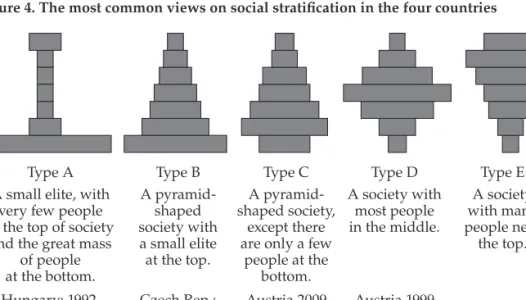
The ISSP surveys on social inequality also include pictures of different stratifica- tion patterns or models of a society. These range from a picture of a very unequal society, where most people are at the bottom and a few are on top, to a society in which most people are in the upper classes and status groupings (see Figure 4).
Figure 4. The most common views on social stratification in the four countries
Type A A small elite, with
very few people at the top of society
and the great mass of people at the bottom.
Type B A pyramid-
shaped society with a small elite at the top.
Type C A pyramid- shaped society,
except there are only a few
people at the bottom.
Type D A society with
most people in the middle.
Type E A society with many people near
the top.
Hungary: 1992, 1999, 2009 Slovakia: 1999, 2009
Czech Rep.:
1992, 1999, 2009 Slovakia: 1992
Austria 2009 Austria 1999
Source: ISSP 1987, 1992, 1999, and 2009.
Note: Detailed answers and percentages are provided in Table A1.
the text on the countries is only part of the word document
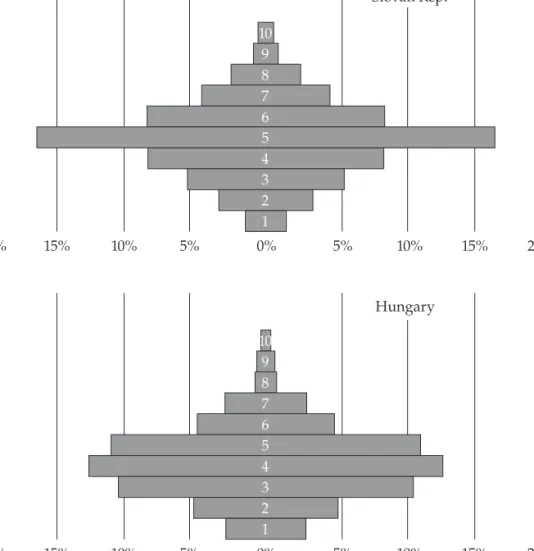
Figure 5. Type of society reconstructed from a subjective ranking on a 10-point scale (2009)–first part
Source: ISSP 2009.
20% 15% 10% 5% 0% 5% 10% 15% 20%
10 9 8 7 6 5 4 3 2 1
Austria
20% 15% 10% 5% 0% 5% 10% 15% 20%
10 9 8 7 6 5 4 3 2 1
Czech Rep.
Figure 5. Type of society reconstructed from a subjective ranking on a 10-point scale (2009)–second part
20% 15% 10% 5% 0% 5% 10% 15% 20%
Slovak Rep.
10 9 8 7 6 5 4 3 2 1
20% 15% 10% 5% 0% 5% 10% 15% 20%
10
9 8 7 6 5 4 3 2 1
Hungary
Source: ISSP 2009.
Respondents are asked which one of these patterns reflects the current stratifica- tion in their countries and which stratification pattern they prefer.
On the question of the current stratification in one’s country, the dominant view in Austria is that it is a middle-class society (Type C and D); respondents in the Czech Republic see their country as a pyramid (Type B); and in Hungary and twice in Slovakia respondents identified their country as the elite-mass model (Type A14). In the latter two countries, this critical view people take of the so- cial structure is probably also influenced by political developments since 1990.
In both countries authoritarian leaders came to power: in the Slovak Republic Vladimír Mečiar (1990–1998), in Hungary Victor Orbán (1998–2002 and again since 2010). Orbán’s regime is regarded with great scepticism by many analysts in Hungary [Lengyel and Rostovany 2011; Szikra 2014; Magyar 2016] and by the European Union.15
Table A1 (Appendix) provides more detailed information on respondents’
views and preferences regarding the country’s social structure. These detailed numbers show that in the three post-socialist societies there is a general, weak tendency to more commonly see the social structure of one’s country as polar- ised between the elites and the masses, while it is less common to regard it as a middle-class society. In Austria, on the other hand, there was a shift in the percep- tion of the social structure from a middle-class to an attenuated pyramid model (D to C). As for the preferred structure, respondents in all four countries favour a society that is dominated by the middle class (D), or even one whose structure is dominated by the upper-middle and upper classes (E). The desired structure corresponds well to the widespread opinion, expressed already by the Greek phi- losopher Aristotle (384–322 BC), that among the three classes of a society—the rich, the poor, and those in the middle—the last one is the most moderate; there- fore, the best society is one with a strong middle class. Another noteworthy trend can also be seen in the three former state-socialist countries: a high proportion of people preferred Model E in 1992, but by 2009 that percentage had dropped significantly in favour of the middle-class and the pyramidal society. This trend can be interpreted as a return to a more realistic view of the social structure in the new, non-socialist context. There exists a significant difference, however, between the Czech Republic and Slovakia versus Hungary: in the former, the preference for a middle class is somewhat weaker than that for a pyramidal society, which may indicate a stronger commitment to the achievement principle.
These views of the social structure parallel the objective changes in the four countries in the last decades. Table 1 showed that the income levels increased massively in all of them. However, the relative income differences between the
14 This view is even more widespread in the post-Soviet communist countries in East Europe [see Riedl and Haller 2014].
15 On 11 September 2018, the European Parliament voted to initiate Article 7 disciplinary procedures against Hungary for undermining democratic rules.
countries did not change significantly; GNP per capita in Austria was 60% higher than in Czechoslovakia and about twice the level in Hungary. Overall, incomes in Austria today are between two-and-a-half and three times higher than in the Czech Republic and four to five times higher than in Hungary.16 This difference is reflected in the subjective self-ranking of individuals in the stratification struc- ture, which we address now.
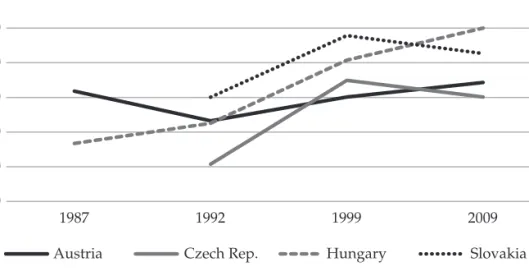
The ISSP asked respondents to rank themselves on a social status scale go- ing from 1 (lowest) to 10 (highest social position). In Figure 5, this scale is trans- posed to a vertical axis in order to match the graphics displayed on the cards during the interviews and shown in the previous figure. In Austria, the largest proportion of people class themselves in the middle category; this proportion increased considerably between 2003 and 2016 [Hadler and Klebel 2019]. In the Czech Republic and Slovakia and in Hungary particularly, many more people class themselves into a lower category. Yet, in terms of mean values the average classification/self-ranking has improved in all countries between 1992 and 2009:
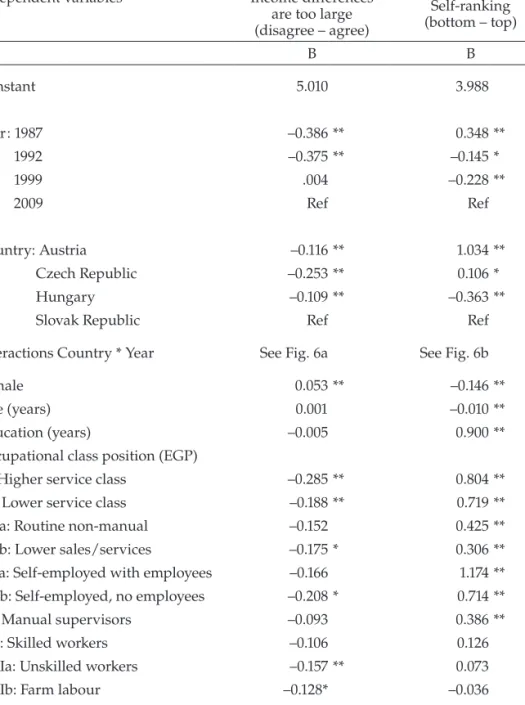
in Austria from 5.77 to 6.01, in the Czech Republic from 4.78 to 4.87, in Slovakia from 4.56 to 4.86, and in Hungary from 3.92 to 4.04 (see also the regression results in Table 5).
In sum, we observe an overall improvement but also persistent differences.
Here the ongoing European integration may have played an important role.
European integration fostered labour mobility and financial transfers between the EU member states and thus contributed to the ‘Europeanisation of inequal- ity’ [Heidenreich 2006]. This is of particular importance as individuals compare themselves also to those in other countries: if the living conditions in one’s own country are estimated to be better than in other countries, satisfaction increases [Delhey and Kohler 2006]. In the four CEE countries, which were united within a single empire for centuries, such comparisons were relevant long before Europe- an integration started in the late 1950s. Rising incomes and improving living con- ditions thus can explain the overall increase, and comparisons with neighbouring countries can explain the persistent differences. The subjective self-ranking in the stratification system is thus related to the differences in incomes and living standards in the four countries.
16 See the data on mean income in 78 countries of the world at https://www.laenderdaten.
info/durchschnittseinkommen.php. According to a report in the Austrian business maga- zine Trend, a skilled worker in Austria earns three times as much as in the Czech Republic, and 5.85 times as much as in Hungary (see https://www.trend.at/branchen/karrieren/
riesige-lohnunterschiede-oesterreich-tschechien-ungarn-6213889; retrieved 14 October 2018).