Faculty of Philosophy and Arts, University of West Bohemia, Pilsen / Faculty of Economics, University of Economics, Prague, Czech Republic). Faculty of Philosophy and Arts, University of West Bohemia, Pilsen / Faculty of Arts, Charles University, Prague, Czech Republic).
Clémence-Auguste Royer and the Rise of Aryan Ideology 1
Asi Gray wrote that Clémence-Auguste Royer is one of the smartest and strangest women in Europe. In the winter, Clémence-Auguste Royer was invited to lecture in Belgium and the Netherlands for her translation of The Origin of Species.
Civic Gentry in Sáros County in the 19 th Century. The History of Hazslinyszky Family, Part I
Tamás Hazslinszky moved to Késmárk (Kežmarok) at the beginning of the 19th century, where he established himself as a saddler. Most of the towns in the area remained quite small and maintained their early modern social structure into the 19th century.
The Hungarian-Italian Support of the Croatian Separatism between 1928 and 1934
The reason for the accusations against Hungary was the existence of the Jankapuszta camp, where Croatian refugees lived. In my essay, I present Hungarian-Italian cooperation in support of Croatian separatism between 1929 and 1934.
The Mediating Activity of János Esterházy between the Governments of Slovakia and Hungary in 1939–1942
On 22 July 1941, Esterházy spoke for the Hungarian minority in the Slovak parliament in the debate on the establishment of the propaganda office. The Slovak press took a softer tone and wrote about the improvement of the Slovak minority in Hungary. Tuka insisted on the principle of reciprocity in the cases of the Slovak minority in Hungary. 27.
Esterházy, after studying the cases blamed by the Slovaks, confirmed the harshness of the Hungarian authorities towards the Slovak minority around Kosice. For all this, Esterházy has become an example in the eyes of Hungarians in Slovakia. The Slovaks wanted to be eminent in the eyes of the Germans, and they did their best to eliminate.
Then the Ministry of the Interior declared the Jews to be enemies of the Slovak nation. The bill on the "Constitutional Law on the Expulsion of Jews" had four articles. It should be noted that the anti-Jewish laws and the deportations were the work of the Slovak government and authorities.
The System of the Nazi Occupation Policy in the Soviet Territory as the Factor of Economic Gains?
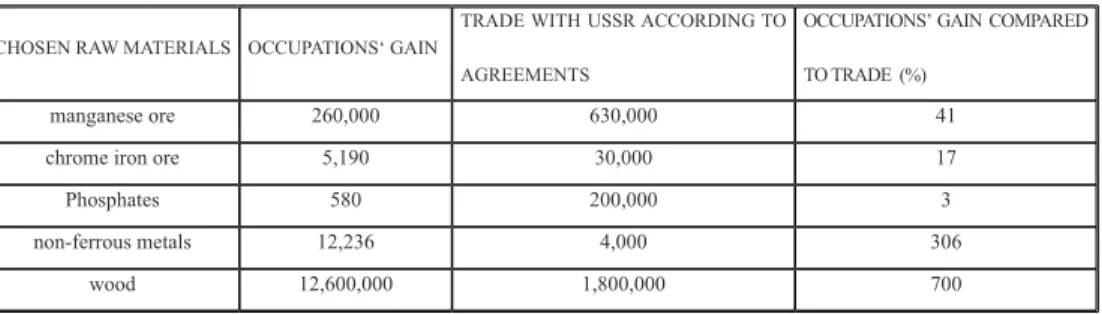
The System of Nazi Occupation Policy in the Soviet Territory as a Factor of Economic Profit. According to English statistics from 1942, they controlled 40% of pre-war Soviet agricultural production, worked only 60% of the land in Ukraine at a time, and almost 50% of crops were regularly frozen to death.4 The average food standards per local worker did not include vegetables , eggs or dairy products.5 The only food guaranteed was the reimbursement of bread. The labor force was mainly employed in the agricultural sector (harvest, water supply and food division), construction industry (construction of infrastructure), military and series production.6 The forced laborers were registered as foreigners and were therefore not entitled to vacation. ; they were subject to a strict hygiene regime and were paid an hourly wage in accordance with their gender and age.
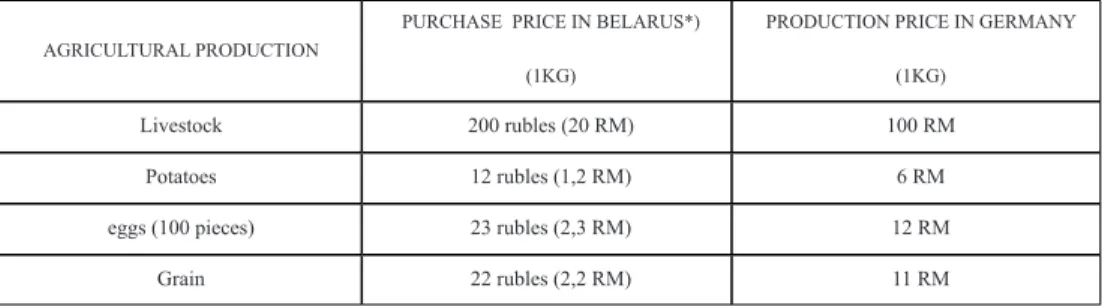
The purchase prices that the German army paid in Belarus compared to the production prices in the Reich PURCHASE PRICE IN BELARUS*) (1 kg). An investment of 172 million Reichsmarks17 was made from the German state budget for the purchase of fertilizers and simple machines. The problem can also be seen in the fact that the money market was not developed in the Soviet territory, which limited the process of privatization.
In 1943, a family of four in Kiev spent about 500 Karbovanec on the black market every day. Even in the important supplies of food products, France and the General Government compensated for an ineffective concept of agricultural policy practiced in the territory of the Soviet Union.38. The turnover and the resulting defeat of the Reich army indirectly prove that the annexation of economically valuable territories did not solve the supply situation of the German economy substantially.
The Tragedy of Prime Minister Imre Nagy and the Radio Free Europe – 1956–1958 1
As a result, the collection of documents on the activities of Imre Nagy's government began from October and November 1956. Colonel Sándor Rajnai arrested members of Imre Nagy's group on various dates from March 27 in Snagov. On April 5, János Kádár asked Stoica, Prime Minister of the Romanian People's Republic, in a letter to withdraw the "right to asylum" from Imre Nagy and his colleagues.
Imre Nagy and his colleagues were taken under the cover of total secrecy first to Tököl from Bucharest on April 14 and then to the Gyorskocsi Street building of the Examination Board of the Political Department of the National Police. The next day, Géza Szénási, chief prosecutor brought a complaint against Imre Nagy and his colleagues.19 The trial was started on February 5 by the Special Committee of the People's Court of Supreme Court in Fő Street, and it was not covered at all in the Hungarian Press of then. After the execution of the former Prime Minister, a report was published by the Hungarian News Agency (MTI) in Népszabadság on June 17, 1958.
The main indictments against Imre Nagy and his colleagues were as follows: participation in an anti-state organization in 1955, preparation and launch of the Revolution of 1956, an attempted coup against the Hungarian People's Republic with the aim of overthrowing it. During the judicial process - according to the announcement - it was proven that Imre Nagy and his colleagues conspired with the imperialist forces of the bourgeoisie based on their revisionist, bourgeois nationalist ideas to subvert popular democracy. The military intervention of the Soviet troops that began on November 4, the so-called Imre Nagy group was given the possibility of asylum in the Yugoslav Embassy.
Romania and the “Western” World: a Brief Overview of Romanian Foreign Policy, 1990–2012
The USA and Romania’s Hard Road for Integration
A CRS report55 notes that US-Romanian relations were "problematic" in the early 1990s,56 but sometimes became cordial in the middle of the last decade of the 20th century. Financial aid was steady and the US also supported Romania's bid for the rotating chairmanship of the Organization for European Cooperation. 55 In the following, we will use as a source mainly two reports of the Congressional Research Service to establish the general characteristics of the US attitude towards Romania.
We do this because the text of the Reports is designed to be simple and accessible and contains information that is designed to be confidential. ZURCHER, Post-Soviet Wars: Insurgency, Ethnic Conflict, and the Nation in the Caucasus, New York 2009; S. In the overview of what was presented, we can ask ourselves the question: if the separation – at least at the level of concepts and ideas – is inevitable, which way will Romania take.
This paper is about the evolution of Romanian foreign policy after the fall of the Ceausescu regime in 1989, up to 2012. Our analysis approaches the otherwise complex issue in the mirror of two distinct phenomena: first, Romania's quest for the - the so-called Euro-Atlantic integration, which means the accession of NATO and the European Union, secondly, the Romanian approach to the debate between Atlantic and integrated European approaches. The conclusions of the study also describe a predicted possible sketch of the Romanian orientation.
State Influence on Social Policy, Partnership and Responsible Business Development in the EU Countries
TNCs are quite active in the field of social partnership of a new type in the EU, which improve the work of their companies. KHOMA, The social process in the countries of the 5th wave of integration in the context of the development of the welfare state and compliance with EU social standards (on the example of Estonia, Lithuania, Latvia), in: Derzhava i Pravo, Is. On the other hand, there are international networks that are formed outside the traditional system of nation states.
Many Western experts appreciate that the social partners adapt their organizations to the requirements of the new economy.8. Among the trends that appear today, there is a tendency for the role of the state in the system of social partnerships and its influence on the development of the latter to increase. The welfare state's main task is to ensure stability in state development and social protection of citizens under the new conditions.
The functioning of the welfare state is based on social justice, social responsibility and social partnership. The Danish Ministry of Social Affairs has created a special index for evaluating the level of corporate social responsibility. Thus, the Paris Chamber of Commerce gave a completely negative assessment of the policy of informing and counseling workers within the framework of the social dialogue initiated by the European Commission.
Individual, Community, Identity
Although much more homogeneous than in the era of "regional unification", it is one of the most complex ethno-political systems in Europe. The issue of minorities (large social groups in a non-dominant situation) was highlighted again by the transitions of the post-socialist region during the end of the last century. Under the new legislation, the minority communities of the now-dissolved (2006) Serbian confederation could elect their own national minority councils as early as June 6, 2010.
However, it is still unknown whether this is simply the external communication of the main actors representing the state (president, head of state). The last action on the issue was the "big march" organized by the National Minority Council of the Szekelys, on October 27, 2013. The second chapter therefore consists of the evaluation of "big" historical events that preceded the Second World War (the Munich Agreement and the occupation of Czechoslovakia).
Another part of the study, the fourth chapter, is made up of the memories of co-witnesses. In one of the chapters we study the military elite, and in the other the political elites. It should also be emphasized that the time span of the monograph goes beyond the war period, the author discusses some "places of memory" in a wider time frame.